Quick Answer: Dr. Muscle is an AI workout app that auto-generates progressive overload plans based on your logged performance each session. $49/mo. Best for gym-goers who want smart hypertrophy and strength programming without hiring a coach. Works best for intermediate lifters; less suited to complete beginners.
Quick comparison at a glance: full breakdown for each option below.
Dr. Muscle vs the alternatives
Last updated: April 22, 2026.
| Dr. Muscle | Fitbod | JuggernautAI | Hire a PT | |
|---|---|---|---|---|
| Monthly cost | $49 | $15.99 | $34.99 | $200-500+ |
| Best for | Hypertrophy / DUP | General fitness / recovery-aware | Competitive powerlifting | Anything. fully bespoke |
| Exercise consistency | Same exercises, full cycle | Rotates based on fatigue | Squat/bench/deadlift focused | Fully customized |
| Methodology | DUP (science-backed) | Muscle fatigue algorithm | RPE / MRV periodization | Coach-dependent |
| Periodization | Yes (DUP) | No | Yes (block + peak) | Yes |
| Beginner-friendly | No | Yes | No | Yes |
| Cancellation reliability | Poor (documented issues) | Good | Good | n/a |
| Free plan | No | 3 free workouts | 2-week trial | n/a |
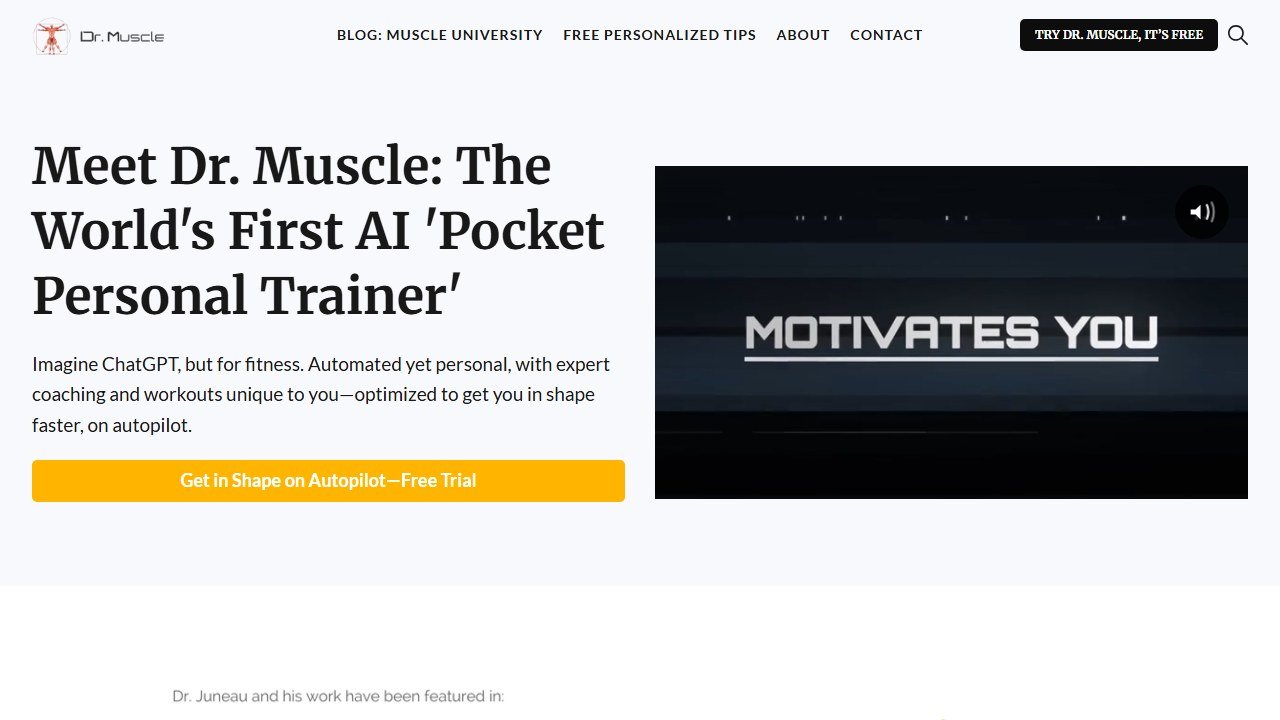
Website: Dr. Muscle
Related: See also: Best AI workout apps 2026 | JuggernautAI review | Fitbod review
What Dr. Muscle actually is
Dr. Muscle was built on a simple premise: most workout apps are not scientific enough to drive real hypertrophy. The algorithms rotate exercises too often, don’t respect progressive overload principles, and treat session-to-session adaptation as something that can be solved by muscle fatigue scores.
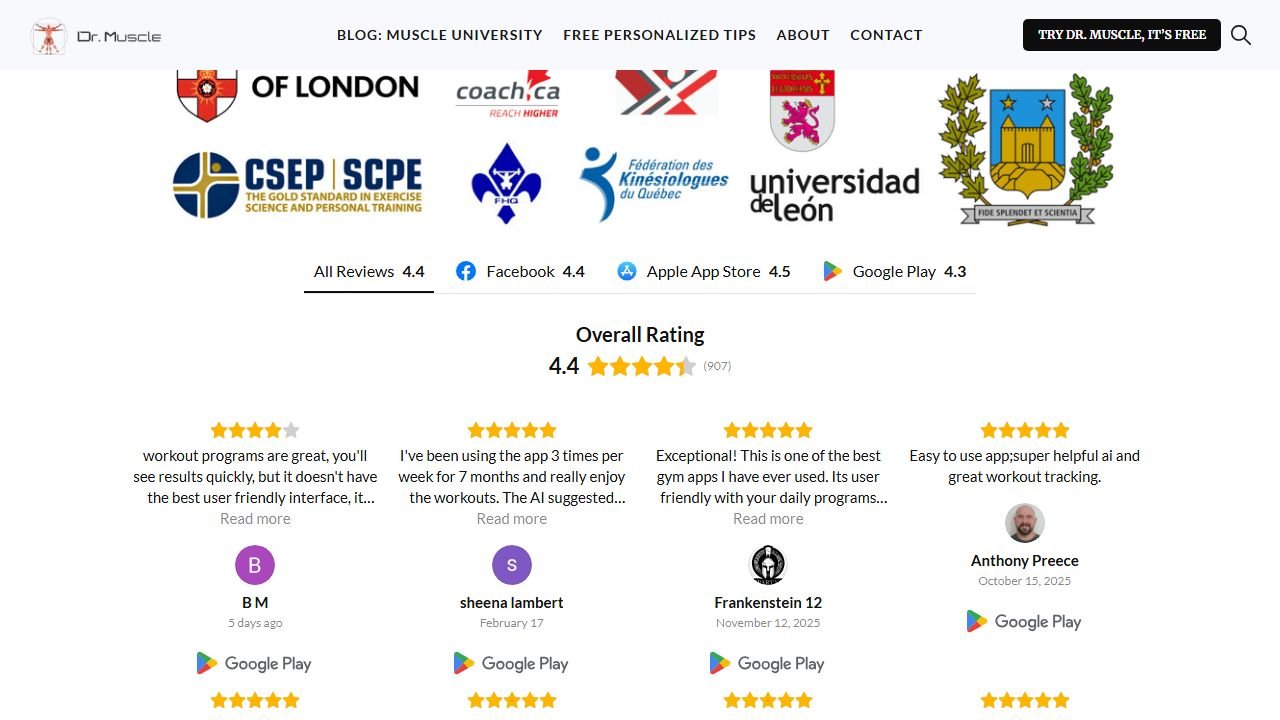
The app uses DUP. Daily Undulating Periodization. which varies training intensity and volume day-to-day within the same weekly cycle, while keeping the same core exercises long enough to actually track progress on them. If you’re trying to get your bench press stronger, you need weeks of bench press data. Dr. Muscle gives you that. Fitbod will have you bench pressing on Monday, doing a Hammer Strength press on Wednesday, and an incline dumbbell on Friday.
The developer. Dr. Carl Juneau, who has a PhD in exercise science. spent 10+ years building and refining the algorithm. That background matters. This is not a lifestyle app dressed up with science language. The methodology is legitimate.
Pricing
- Monthly: $49/mo
- Annual: not prominently listed. monthly is the default offering
At $49/mo, Dr. Muscle is the most expensive consumer workout app in the category. For comparison:
- Fitbod: $15.99/mo
- JuggernautAI: $34.99/mo
- Hevy (basic): free
The justification for $49/mo is that it replaces programming from a real coach. For serious lifters who would otherwise pay $75-150/hr for a session with a coach, that argument has some merit. For recreational lifters who just want a gym plan, it does not.
There is no free plan. No free tier, no trial structure that doesn’t require payment. If you want to test it before committing, you’ll need to sign up and then cancel. which brings us to the most important section of this review.
The cancellation issue you need to know about before signing up
This is not a small problem. It has been documented repeatedly on Trustpilot, Reddit, and App Store reviews.
Multiple users report:
- Being charged for a full additional year after attempting to cancel
- Cancel requests being acknowledged but billing continuing
- Refund requests being denied with generic responses
- The cancellation process requiring email confirmation that doesn’t always come through
The developer has responded to some of these complaints, and customer service is reportedly responsive (some users cite sub-hour response times). But the pattern of billing complaints is consistent enough that it needs to be treated as a real risk, not an edge case.
Before you sign up: Check if you subscribing through the app (Apple/Google handles billing) or through the Dr. Muscle website directly. App-store subscriptions are much easier to cancel. you cancel through your Apple or Google account settings, not through Dr. Muscle. Direct billing subscriptions require cancellation through Dr. Muscle, and that’s where the complaints cluster.
If you subscribe directly: set a calendar reminder to cancel before your renewal date. Screenshot your cancellation confirmation. Don’t rely on email alone.
This is not meant to scare you off the app. it’s meant to give you the context to use it safely.
What Dr. Muscle does well
The progressive overload tracking is genuinely better than Fitbod. If you train bench press on Monday and Wednesday, the app logs your performance on both sessions, adjusts your prescription for the next week, and keeps building. Fitbod swaps exercises based on recovery state, which helps muscle balance but kills systematic strength tracking on specific movements. For hypertrophy, Dr. Muscle’s approach is more rigorous.
DUP delivers variety within structure. A typical week might have low-rep high-intensity work on Monday, moderate rep work Wednesday, and higher rep pump work Friday. You’re not doing the same thing three times, but you’re also not starting over with random exercises. This is how real intermediate and advanced programs work.
Customer service is genuinely fast. The developer himself is reportedly responsive. Multiple reviewers cite same-day or sub-hour responses to questions. For a solo developer product at $49/mo, that’s a real differentiator.
The algorithm improves with data. The more you log, the more accurate the prescriptions get. After 8-12 weeks, the recommendations feel genuinely calibrated to your personal recovery capacity and strength levels.
What frustrates users
The interface is rough. Multiple reviewers describe it as “ugly,” “dated,” and “looks like a 2015 app.” Dr. Juneau has acknowledged this. his position is that serious lifters prioritize function over aesthetics, and the UI reflects that. That’s a coherent position, but if app UX matters to you, it will feel jarring compared to Fitbod or JuggernautAI.
$49/mo is hard to justify against the alternatives. Fitbod at $15.99/mo handles general fitness programming well. JuggernautAI at $34.99/mo handles powerlifting better than Dr. Muscle. Dr. Muscle sits in a specific niche. hypertrophy-focused lifters who aren’t competitive powerlifters. and that niche needs to be worth the premium.
Not easy-to-use. The DUP methodology assumes you know how to do the movements being prescribed. There’s no form coaching, no guided intro phase, no “start here” structure for someone who has never lifted. Fitbod handles beginners significantly better.
No Apple Health or wearable integration. Like JuggernautAI, there’s no way for the app to account for sleep quality, stress load, or other activity from wearables. Your RPE logging has to compensate for all of that.
Who should use Dr. Muscle
It’s the right call if:
- You’ve been training consistently for 1+ years and have plateaued on generic programming
- Your goal is hypertrophy. adding muscle mass rather than competing in powerlifting
- You train 3-5 days per week and log every session without skipping
- You want an app that keeps you on the same exercises long enough to actually track progress
- You are comfortable with a dated interface and don’t need a polished UX
It’s the wrong call if:
- You’re a beginner. you don’t need DUP periodization yet
- You train for powerlifting. JuggernautAI’s methodology is more appropriate
- You train inconsistently. the progressive overload model requires consistent data to work
- You’re on a budget. $49/mo is hard to justify against Fitbod at $15.99/mo for general training
- You’re concerned about subscription management. read the Trustpilot reviews before committing
Final verdict
Dr. Muscle is the most scientifically rigorous AI workout app for hypertrophy on the market. The DUP methodology is legitimate, the progressive overload tracking is better than any competitor in its price range, and the developer’s credentials are real.
The $49/mo price tag is the barrier. It’s only justified if you’re training consistently for hypertrophy and have hit the ceiling of what general-purpose apps can do for you. If you’re there, it works. If you’re not, Fitbod at $15.99/mo handles your needs at a third of the price.
The cancellation situation is a real concern and should be managed proactively. Subscribe through the App Store if possible. Know your renewal date. Keep records.
What Dr Muscle does differently in 2026
Dr Muscle is an AI personal training app focused on adaptive strength programming. The 2026 product handles three core jobs: generating personalized workouts that progress automatically based on logged performance, adjusting volume and intensity when the user logs fatigue or missed sessions, and providing exercise substitutions based on available equipment. The differentiator versus Fitbod and Caliber: Dr Muscle has stronger autoregulation features built around real strength science, with RPE-based load adjustments and deload weeks programmed automatically.
The strongest use case: intermediate lifters who already know the basics and want smart progression without programming their own routines. The less strong use case: total beginners, who would benefit from simpler onboarding before Dr Muscle’s autoregulation features become useful.
Dr Muscle pricing and the lifter framework
Dr Muscle prices around $10 to $15 a month or $80 to $100 annually in 2026. The free tier covers limited workouts for evaluation. Most lifters who commit to using it long-term pay for the annual plan. The math: at $80 a year, even one extra month of consistent training that you would not have completed yourself pays for the subscription many times over in long-term strength gains.
The decision framework. Pick Dr Muscle if you are an intermediate lifter who wants science-backed autoregulated programming without writing your own programs. Pick Fitbod if you value adaptive workout selection over autoregulation. Pick Caliber if you want a real coach plus AI. Pick 5/3/1 in Strong app if you want to follow a structured program rather than letting AI generate workouts.
Final 2026 verdict
Dr Muscle is the right pick for intermediate lifters in 2026 who want autoregulated strength programming without the overhead of writing their own programs. The product is mature, the price is reasonable, and the strength science is solid. The case against: it lacks the social and motivational features of Hevy or Strong, and beginners may find the autoregulation overwhelming.
Per client pricing, and the crossover most coaches miss
Almost every platform here charges on active clients, and the marginal rate matters more than the headline. Here is the same roster priced across the vendors that publish, using their own rates read 4 September 2026.
| Active clients | PT Distinction | Everfit, monthly | Everfit, annual | FitBudd |
|---|---|---|---|---|
| 5 | $31.90, Basic +2 | $19 | $16 | $27 |
| 20 | $59.90, Pro | $49 | $41 | $79 |
| 50 | $89.90, Master | $95 | $79 | $139 |
| 100 | $169.90, Master +50 | $140 | $117 | $239 |
Upgrade before you hit the allowance, not after
On PT Distinction, 25 clients on Basic would cost $151.90 against $59.90 on Pro, because the marginal rate on the entry tier is $6.00 a client against $2.40. The included allowance is not the point at which you should move; the point is wherever the marginal rates cross, and that is usually far earlier. Work it out once and set a calendar reminder at that client count.
Annual billing is a real discount here, unusually
Everfit at 100 clients is $140 a month billed monthly and $117 billed annually, a saving of $276 a year. TrueCoach publishes one month free on Starter and two months free on Standard and Pro. FitBudd gives two months free on yearly billing. In a category where client numbers fluctuate seasonally, the question is whether you are confident enough of your floor to commit, and most established coaches are.
Count active clients, not total clients
The meter is people currently assigned programming, not everyone who has ever trained with you. Coaches routinely over-buy because they price on their contact list. Before choosing a tier for dr muscle or anything else, count the clients who received a programme in the last thirty days. That is your number, and it is usually smaller than expected.
What software should cost as a share of coaching revenue
The useful test is not whether a platform is cheap but whether it is a sane fraction of what it helps you earn, and that arithmetic is straightforward in this business.
Work it out per client, per month
At 20 clients on Everfit billed annually you are paying $41 a month, which is about $2.05 per client. If your average client pays $150 a month, software is roughly 1.4% of revenue. At the same roster on FitBudd’s $79 tier it is $3.95 a client, or 2.6%. Both are defensible. What is not defensible is paying a per client rate that approaches a meaningful share of what each client pays you, and that happens most often on the entry tiers where marginal rates are highest.
The branded app question is a business decision, not a software one
My PT Hub publishes a custom branded app at $95 one-time and a white label app at $145 a month. FitBudd’s own-app tier is $149 for 20 clients with a $100 setup fee. A branded app is worth it if you are selling to your own audience at scale and the app is part of the product you charge for. It is not worth it if you have 15 clients who already message you on WhatsApp, however good it looks.
Price the tier you will be on in six months
Coaching rosters grow in steps rather than smoothly, usually after a launch or a referral run. Buying for today’s client count and re-evaluating quarterly is fine; buying an enterprise tier for a roster you hope to have is how coaches end up paying for capacity they never use. The published ladders in this category make it easy to model both, so model both.
What the platform does not fix
Software does not sell coaching. If your constraint is that you have twelve clients and want thirty, no feature on any of these pages changes that, and the money is better spent on whatever actually brings people in. Buy a platform when delivery is the bottleneck, not when demand is.
Related personal trainer & fitness AI guides
Other tools and comparisons we have reviewed in this category:
- best AI workout apps. where Dr. Muscle ranks for hypertrophy
- JuggernautAI review. powerlifting-focused alternative
- Fitbod review. general-fitness alternative
References & further reading
For deeper context on programming, periodization, and training science behind the tools we evaluate:
- NSCA: peer-reviewed strength and conditioning research. evidence-backed programming principles from the National Strength and Conditioning Association
- ACSM physical activity guidelines. official exercise prescription standards from the American College of Sports Medicine
- PubMed sports science database. searchable archive of peer-reviewed studies on resistance training, hypertrophy, and recovery

Written by
FazFaz is the founder of AIToolsBakery. Some tools here are tested hands on. Others are assessed from vendor documentation and pricing verified on the live page, and every review says which one it is. Sponsors can buy a position in a guide. They cannot buy the score, the criticism, or silence about a better option.
How we test and how we make money →