Quick Answer: Fitbod is an AI workout app that generates personalised strength training sessions based on muscle recovery data and your training history. $12.99/mo. Best for gym-goers who want smart progressive programming without a personal trainer. Not a coaching platform. it is a consumer workout app.
Quick comparison at a glance: full breakdown for each option below.
Fitbod vs the alternatives
Last updated: April 22, 2026.
Website: Fitbod
Related: See also: Best AI workout apps 2026 | Fitbod vs JuggernautAI | JuggernautAI review
What Fitbod actually is
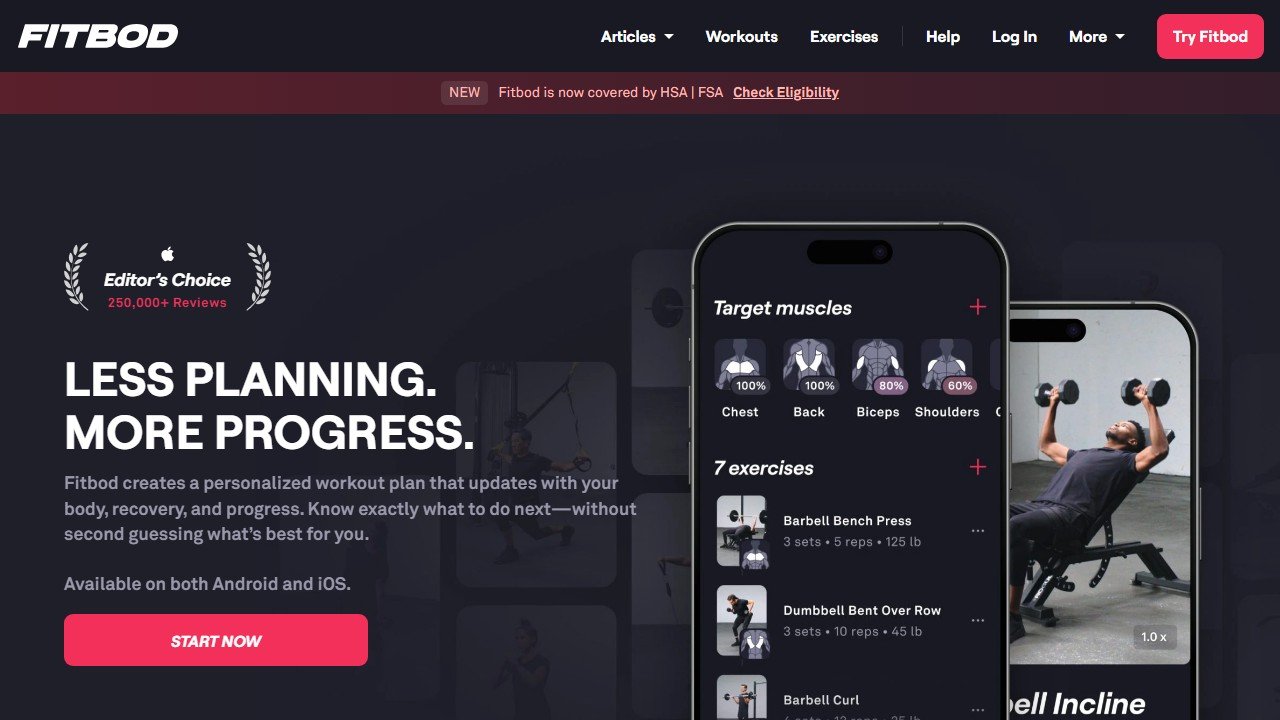
Fitbod’s core algorithm does one thing: it estimates how recovered each muscle group is based on your recent training history, then selects exercises that balance training stimulus against recovery state. If your chest is still recovering from Monday’s press work, Wednesday’s workout won’t heavily target chest. If your legs are fresh, leg work gets prioritized.
| Fitbod | Dr. Muscle | JuggernautAI | Working with a coach | |
|---|---|---|---|---|
| Monthly cost | $15.99 | $49 | $34.99 | $200-500+ |
| Best for | General fitness / recreation | Hypertrophy / DUP | Competitive powerlifting | Anyone with specific goals |
| Exercise consistency | Rotates for recovery | Same exercises per cycle | Squat/bench/deadlift focused | Coach-determined |
| Progressive overload | Recovery-managed rotation | DUP (daily undulating) | RPE/MRV block | Full control |
| Equipment flexibility | Excellent | Moderate | Limited (barbell focus) | Coach-dependent |
| Beginner-friendly | Yes | No | No | Yes |
| Android support | Yes | Yes (via web) | Yes | n/a |
| Cancellation reliability | Easy (App Store) | Poor (documented issues) | Good | n/a |
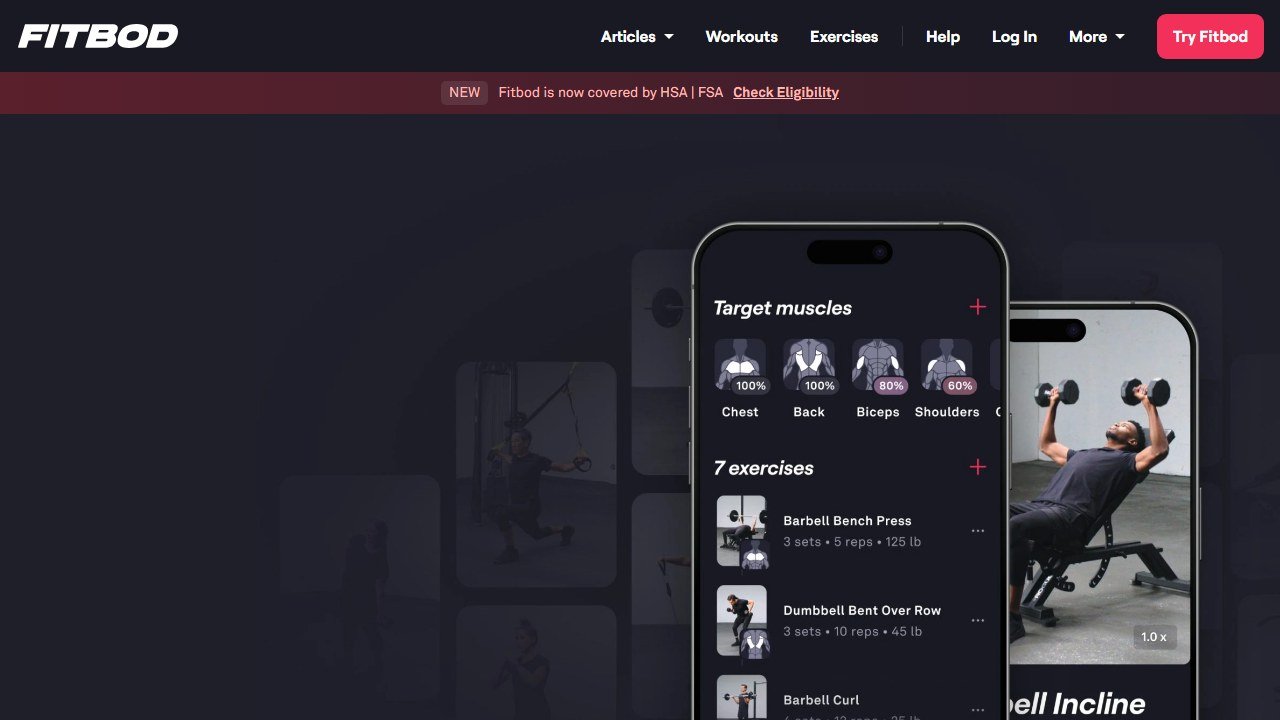
This makes it excellent for people who want to show up to the gym, open the app, and get a sensible session without thinking about programming. It works across equipment configurations. barbell, dumbbell, machines, bodyweight, cable. and adapts to whatever you have access to. At a hotel gym with only dumbbells? Fitbod gives you a dumbbell session. Back at your home gym with a full rack? The session adapts accordingly.
What it doesn’t do: systematically progress you on specific movements over a training cycle. Fitbod rotates exercises to manage recovery state. If you want to get your deadlift stronger over the next 12 weeks, you need a program that keeps you deadlifting consistently with progressive loads. Fitbod might give you a conventional deadlift one week, Romanian deadlift the next, and trap bar deadlift the week after. Muscle fatigue might be managed well, but movement-specific strength development isn’t the goal.
Pricing
Fitbod doesn’t have a public pricing page. pricing is through the App Store and Google Play.
- Monthly: $15.99/mo
- Annual: $79.99/yr (works out to $6.67/mo)
- Lifetime: $159.99 one-time (available periodically)
The annual plan at $79.99/yr is the obvious choice for anyone who plans to use the app for more than 6 months. The lifetime plan, when available, represents exceptional value for anyone who will use Fitbod long-term.
No free plan, but there is a free trial (typically 25 free workouts before subscription is required).
At $15.99/mo or $79.99/yr, Fitbod is the most affordable of the structured AI workout apps. Dr. Muscle is $49/mo, JuggernautAI is $34.99/mo. If price is a factor, Fitbod wins.
What Fitbod does well
The muscle recovery tracking is the most sophisticated in the category. Fitbod maintains a model of each muscle’s fatigue state based on how you’ve trained it recently, weighted by how heavy the sets were and how many sets you did. This isn’t just “did you train chest Monday”. it’s an estimated percentage of recovery for each muscle group. The practical result is workouts that feel appropriately hard without consistently overloading or underloading specific areas.
Equipment flexibility is the best in the category. You can set your available equipment per session rather than per account, which means gym days and home days and hotel days all get appropriate programming. No other app in the category handles this as smoothly.
The interface is the best of the consumer workout apps. Clean, fast, well-designed. Logging a set takes two taps. The post-workout summary is informative. Exercise demo videos are higher quality than most competitors. If app UX matters to your consistency with an app, Fitbod is at the top of the consumer category.
15M+ downloads and 250,000+ reviews at 4.8 stars. This is not a small app with a vocal minority of fans. The scale of positive feedback validates that the core algorithm delivers what it promises for the large majority of users.
HSA/FSA eligible. As of 2025-2026, Fitbod is covered by many HSA and FSA plans, which means some users can pay for it with pre-tax dollars. This is unusual for a fitness app and meaningfully changes the real cost for eligible users.
The progressive overload problem
This deserves its own section because it’s the most important limitation and most reviews don’t explain it clearly enough.
Fitbod is built on a recovery management philosophy: rest muscle groups that need recovery, train muscle groups that are ready. This is genuinely useful for avoiding overtraining and generating workout variety. It is not the same as progressive overload programming.
Progressive overload. adding load or volume to a specific movement over time. requires consistent repetition of that movement. You can’t add 2.5kg to your squat each week if you squat once every 10 days. You can’t track your bench press progress meaningfully if the app substitutes it with machine press, incline press, and push-ups in alternating sessions.
For recreational gym-goers who just want to stay active and reasonably fit, this doesn’t matter much. The recovery-based rotation keeps training fresh and prevents overuse.
For anyone with specific strength goals. “I want my deadlift at 200kg by December”. Fitbod is not the right tool. JuggernautAI, Dr. Muscle, or a structured linear program with a coach will serve that goal better.
Can coaches use Fitbod for clients?
The short answer: no, and it’s not designed for it.
Fitbod is a consumer app. There’s no coach dashboard, no client management, no ability to build custom programs and assign them to multiple clients. You can use Fitbod yourself, but you can’t use it to run a coaching practice.
Coaches who try to work around this by having clients use Fitbod independently run into a structural problem: if Fitbod is adapting the client’s workouts based on their individual recovery state, the coach has limited visibility into what the client is actually doing on any given day and no ability to override the programming.
The B2B coach software category. TrueCoach, Everfit, PT Distinction. exists because coaching clients requires building programs and delivering them to specific people. Fitbod is a personal tool. The two use cases are separate.
Who should use Fitbod
It’s the right call if:
- You go to the gym 3-4 times per week for general fitness and don’t want to think about programming
- You train in multiple environments (gym, home, hotel) and need equipment-flexible sessions
- You’re a beginner who wants a structured starting point without hiring a coach
- You want the most polished consumer workout app UX at the lowest price in the category
It’s the wrong call if:
- You want to systematically get stronger on specific lifts. the exercise rotation prevents this
- You’re a competitive powerlifter or strength athlete. use JuggernautAI or a structured program
- You want to use it as part of a coaching practice. it doesn’t have coach or client management features
- You’re focused primarily on hypertrophy through progressive overload. Dr. Muscle’s DUP approach is better suited
Final verdict
Fitbod is the best AI workout app for recreational lifters who want to show up to the gym and get a sensible session without planning anything. The recovery algorithm works, the equipment flexibility is unmatched, and at $79.99/yr it’s the most affordable structured AI workout option available.
The progressive overload limitation is the ceiling. If you have specific strength goals, Fitbod will eventually frustrate you because it’s not designed to serve them. Know your goal before choosing your tool.
Related personal trainer & fitness AI guides
Other tools and comparisons we have reviewed in this category:
- best AI workout apps. where Fitbod ranks for general fitness
- Fitbod vs JuggernautAI. who each app is actually for
- Dr. Muscle review. hypertrophy-focused alternative
References & further reading
For deeper context on programming, periodization, and training science behind the tools we evaluate:
- NSCA: peer-reviewed strength and conditioning research. evidence-backed programming principles from the National Strength and Conditioning Association
- ACSM physical activity guidelines. official exercise prescription standards from the American College of Sports Medicine
- PubMed sports science database. searchable archive of peer-reviewed studies on resistance training, hypertrophy, and recovery
What AI form checking can and cannot actually see
Pose estimation from a phone camera is genuinely useful and routinely oversold. Knowing where the line sits protects you from both the hype and the injury risk.
It works well on large, planar, well-lit movement
A squat filmed from the side in good light, with the whole body in frame and reasonably fitted clothing, is close to the ideal case. Knee position, hip depth, bar path and tempo are all measurable from that, and feedback on them is real. If your use case looks like that, these tools do what they claim.
It degrades sharply outside those conditions
Accuracy falls away with loose clothing, poor lighting, an angled or moving camera, occlusion where one limb hides another, and any movement that happens largely in the depth axis away from the lens. Rotational movement, anything on the floor, and lifts where the critical detail is spinal position rather than joint angle are all much harder. A tool that is confident in those conditions is not more capable, it is less honest.
It cannot see the things that most often cause injury
A camera does not know your training history, whether that shoulder has been irritable for three weeks, how heavy the bar is relative to your capacity, or that you slept four hours. Most training injuries come from load management rather than from a visibly wrong joint angle in a single rep. Treat form feedback as one input among several rather than as a safety system.
The honest way to use it
Film the same lift from the same angle every few weeks and compare. Consistency of setup matters more than the sophistication of the model, and a fixed camera position turns these tools from a novelty into a genuine progress record. Use the feedback to prompt questions rather than to make decisions, and take anything about pain or persistent discomfort to a physiotherapist rather than to an app.
How to tell whether the tool was worth it
Fitness software is easy to evaluate honestly because the numbers are countable and small. The reason most coaches cannot say whether a platform helped is that nobody wrote down where they started.
Pick the metric the tool is supposed to move
For a coaching platform it is clients per coach and hours spent on programming and admin per client per week. For a consumer app it is sessions completed per week and adherence over eight weeks. For form checking it is whether you are still filming in month three. Each of those is countable and each needs a figure from before.
Record the time cost this month, before anything changes
Ask yourself or your coaches to log how long programming, check-ins and admin take across one normal week. It takes minutes and it is the only way the time saving is ever provable. Most of the honest value in this category is hours rather than revenue, and hours are measurable in advance and unprovable afterwards.
Give it two client cycles
Retention and adherence move slowly and seasonally. A four week read tells you about novelty rather than value. Judge a coaching platform over at least two full client cycles, and say so at the outset so an unremarkable first month is understood as expected.
Name the result that would end it
Write down before you subscribe what twelve months would have to look like for you not to renew. It converts renewal from a default into a decision, which matters more in a category where the monthly figure is small enough to stop noticing.
Where a fitness app should stop and a professional should start
This category sits close to health advice without being health care, and the distinction matters for the reader rather than for the vendor.
Nutrition tools estimate, they do not measure
Calorie and macro figures from photo recognition or database lookup carry meaningful error, both in portion estimation and in the underlying food data. That is fine for tracking a trend over weeks, which is what most people need. It is not fine as a basis for aggressive restriction, and anyone with a history of disordered eating should be pointed away from precise daily tracking rather than towards a better tracker.
Wearable recovery scores are directional, not diagnostic
Sleep staging, readiness and recovery metrics from consumer wearables are useful for spotting your own patterns over time and unreliable as absolute measurements on any given night. Use them to notice a fortnight of poor sleep. Do not use them to decide whether a symptom needs attention, and be wary of any app that encourages that reading.
Anything involving pain, pregnancy, injury or a medical condition needs a human
Postpartum training, rehabilitation, cardiac conditions, hypermobility, pregnancy and any current injury all need individual clinical assessment. An app can support a programme a professional has designed, and it cannot design one safely from a questionnaire. The good tools in these areas say so plainly on their own marketing; treat the ones that do not as a warning.
What a coach should check before recommending anything
Whether the app claims to diagnose or treat, what it does with health data, and whether it has any mechanism for escalating a red flag. If a client tells the app about chest pain during exercise, what happens? Most consumer tools have no answer to that, which is exactly why the coach relationship is the safety layer rather than the software.
Tools mentioned in this guide

Written by
FazFaz is the founder of AIToolsBakery. Some tools here are tested hands on. Others are assessed from vendor documentation and pricing verified on the live page, and every review says which one it is. Sponsors can buy a position in a guide. They cannot buy the score, the criticism, or silence about a better option.
How we test and how we make money →