Sales reps forget 84% of training content within 90 days. Traditional classroom roleplay is expensive, inconsistent, and hard to scale past a dozen people. AI roleplay tools fix all three problems by letting employees practice conversations with AI personas that respond in real time, give instant feedback, and never get tired of running the same scenario again.
Related deep dive: See our full comparison of AI coaching roleplay for corporate training with pricing for 7 leading platforms (Mindtickle, Second Nature, Yoodli, Rehearsal, Outdoo AI, Edflex, Rocky.ai).
Second Nature wins overall for enterprise sales orgs in 2026. Yoodli is the affordable pick with the strongest compliance stack (SOC 2, FedRAMP, HIPAA) at the lowest price point. Mindtickle takes full sales-readiness. Hyperbound and Kendo AI lead for sales teams specifically. Full 15-tool breakdown below.
Last reviewed May 2026. AI coaching roleplay is a fast-moving 2026 category. New entrants like Hyperbound have raised the bar on persona realism. Pricing transparency varies wildly. Our deep comparison of 7 leading platforms is at AI coaching roleplay for corporate training.
Last updated: April 22, 2026.
Related: See also: Best AI tools for corporate training | Yoodli AI review
Why AI Roleplay Is Replacing Traditional Sales Training
Traditional sales roleplay has a logistics problem. You need a manager or peer partner, a quiet room, scheduled time, and someone willing to give honest feedback without making it awkward. Most companies manage this once a quarter. Some never do it at all.
AI roleplay removes every one of those barriers. A rep can practice a cold call at 10pm on a Tuesday, run the same objection-handling scenario 15 times in a row, and get scored feedback after each attempt. No scheduling. No social pressure. No ceiling on repetitions.
The data backs this up. Research from the Sales Management Association found that companies using AI-powered practice tools saw a 28% improvement in quota attainment compared to traditional training alone. Gartner projects that 60% of B2B sales organizations will shift from experience-based selling to data-driven selling by 2026, with AI roleplay as a key enabler. A 2024 Training Industry report found that 76% of L&D leaders plan to increase investment in AI simulation tools over the next two years.
The ROI is measurable. Oracle NetSuite reported 32% more sales opportunities and a 21% revenue increase after deploying Second Nature’s AI roleplay platform. SAP Academy saw 7x more practice time per rep when switching from scheduled roleplay to on-demand AI sessions.
Faz says: The real shift is not about technology. It is about reps actually practicing. When roleplay requires booking a meeting with a manager, nobody does it. When roleplay is available 24/7 on a laptop, reps practice voluntarily. That behavioral change is where the ROI comes from.
Beyond sales, AI roleplay is expanding into customer service, leadership development, compliance training, and healthcare communication. Contact centers use it to simulate angry customer calls. Managers use it to practice difficult feedback conversations. Compliance teams use it to rehearse scenarios involving harassment, ethics violations, and regulatory interactions. The use cases keep growing because the core value proposition is simple: safe, repeatable, scalable practice.
How We Evaluated These Tools
Saru says: Every tool was assessed and scored using the same five criteria, weighted for what matters most in corporate training environments:
| Criteria | What We Looked At |
|---|---|
| Realism | Avatar quality, conversation flow, response accuracy, ability to handle unexpected inputs |
| Feedback quality | Scoring depth, actionable coaching tips, manager dashboards, progress tracking |
| Language support | Number of supported languages for global teams |
| Pricing | Cost per user, free tier availability, enterprise vs self-serve options |
| Compliance | SOC 2, GDPR, HIPAA, FedRAMP, ISO certifications |
We signed up for every free tier and demo available, ran the same sales objection-handling scenario across each platform, and evaluated the feedback quality and conversation realism.
The 15 Best AI Roleplay Tools for Sales and Corporate Training in 2026
1. Second Nature. Best for Enterprise Sales Teams
| Best for | Enterprise sales organizations with global teams |
|---|---|
| Free plan | No |
| Pricing | Enterprise only (contact sales) |
| Languages | 24+ |
| Compliance | SOC 2, GDPR |
| G2 Rating | 4.6/5 (298 reviews) |
What It Does
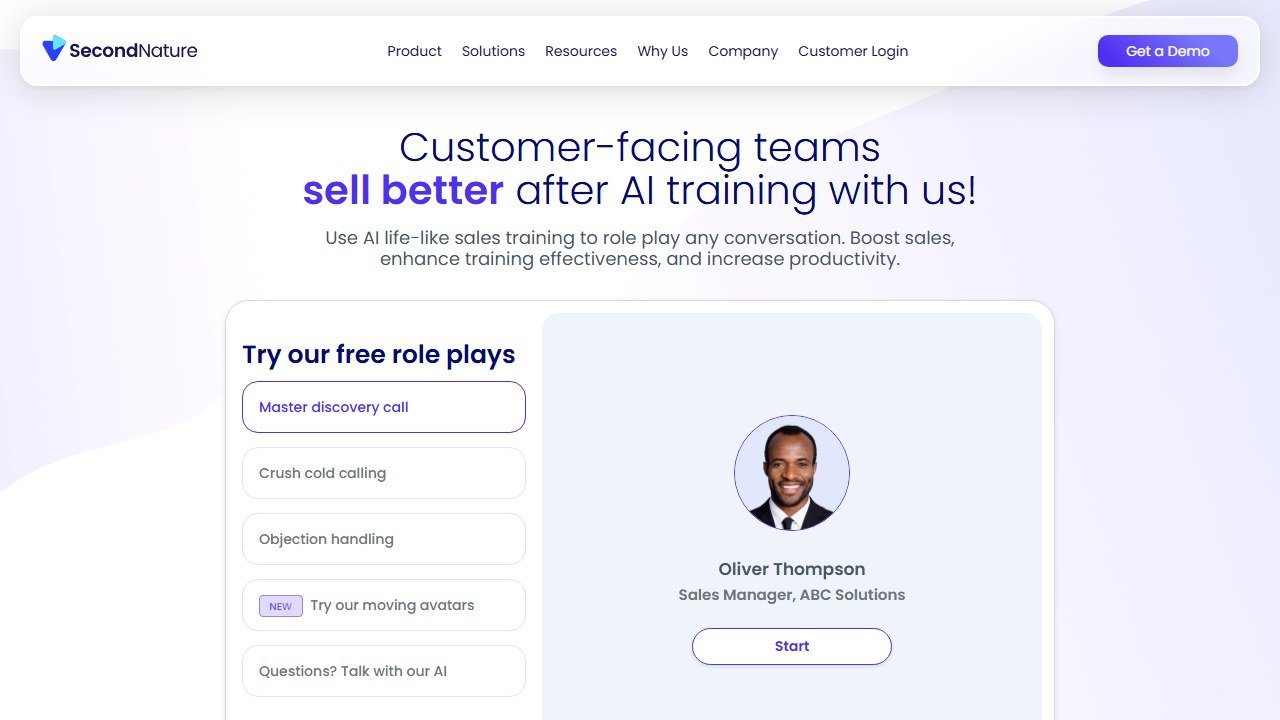
Second Nature is the most established AI sales roleplay platform on the market. Reps practice conversations with dynamic 3D AI avatars that respond naturally to what you say, push back on weak pitches, and throw curveball objections. Every session gets scored automatically with detailed feedback on content accuracy, delivery, and objection handling.
The platform supports 24+ languages, making it the strongest option for global sales teams that need consistent training across regions. Managers get dashboards showing team-wide readiness scores, individual progress, and areas where reps struggle most.
Second Nature holds the #1 spot in G2’s AI Role Play Training category with 298 reviews and a 4.6/5 rating. The platform integrates with Salesforce via AppExchange, connecting practice performance to actual pipeline data.
Who Uses It
Adobe, SAP, Oracle NetSuite, Zoom, and Check Point all run their sales enablement programs through Second Nature. Oracle NetSuite’s case study is the standout: 32% more sales opportunities and a 21% increase in revenue after deploying AI roleplay across their sales org. SAP Academy saw 7x more practice time per rep.
What Could Be Better
G2 reviews consistently mention that scoring feels inconsistent between runs. The same content sometimes gets a different score depending on the session. Second Nature is also enterprise-only with no self-serve pricing, which means smaller teams cannot trial it without a sales conversation.
Pros
- Dynamic 3D avatars with natural conversation flow
- 24+ languages for global deployments
- Salesforce AppExchange integration connects training to pipeline
- Strongest enterprise case study data (Oracle NetSuite, SAP)
- #1 ranked in G2’s AI Role Play Training category
Cons
- Enterprise-only pricing with no self-serve tier
- Scoring inconsistency between runs (reported in G2 reviews)
- No free trial available without contacting sales
Faz says: Second Nature is the obvious pick for enterprise sales teams that need a proven, global-ready platform. The Oracle NetSuite results are hard to argue with. But if you are a team of 10 reps, you will not get past the sales process.
For a detailed side-by-side with a more affordable alternative, see our Yoodli vs Second Nature comparison.
2. Yoodli. Best for Affordable Communication Coaching
| Best for | Teams that need communication coaching at an accessible price |
|---|---|
| Free plan | Yes (5 lifetime roleplays) |
| Pricing | Pro ~$8-11/mo; Advanced ~$20-28/mo; Enterprise custom |
| Languages | English only |
| Compliance | SOC 2 Type 2, FedRAMP, HIPAA, ISO 27001, GDPR, PCI, CSA STAR |
| G2 Rating | 4.7/5 |
What It Does
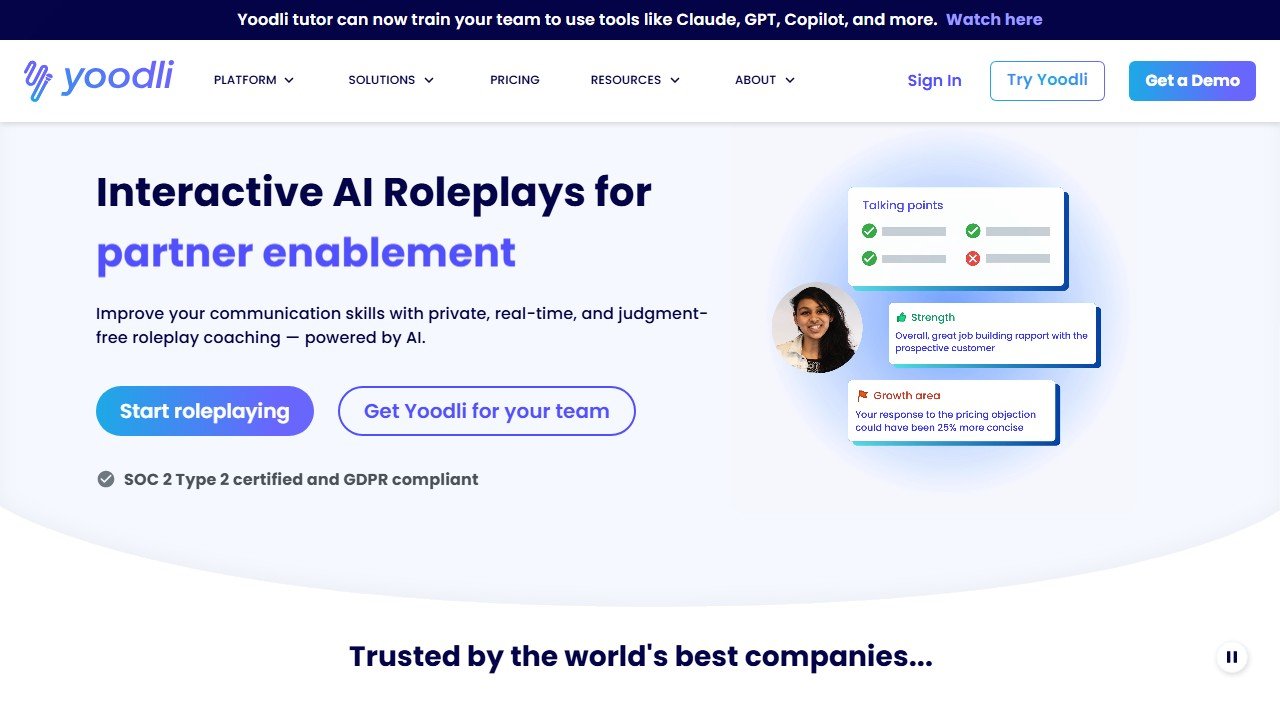
Yoodli started as an AI speaking coach and expanded into full roleplay simulations for sales, interviews, presentations, and difficult workplace conversations. What sets it apart is the dual functionality: you get on-demand AI roleplay practice plus real-time meeting coaching that runs as a private overlay during live Zoom, Teams, and Google Meet calls.
The roleplay side lets you practice against customizable AI personas. The meeting coaching side gives you private nudges during actual calls, flagging filler words, pacing issues, and moments where you are losing the conversation. No other tool on this list does both.
Yoodli’s compliance stack is unusually strong for its price point. SOC 2 Type 2, FedRAMP, and HIPAA certifications put it on par with enterprise platforms costing 10x more. Google, Snowflake, Databricks, and Sandler Sales are among its enterprise customers.
What Could Be Better
English only is a dealbreaker for global teams. The free tier is extremely limited at 5 lifetime roleplays total. Scoring the content of a pitch against your own rubric is on the Team and Enterprise plans, not Pro. (Correction, 13 October 2026: an earlier version of this guide said Yoodli does not evaluate content at all; its roleplay page now says it “scores every rep against your rubric”.)
Pros
- Affordable entry point with free tier and Pro from ~$8/mo
- Real-time meeting coaching during live calls (unique feature)
- FedRAMP + HIPAA compliance rare at this price
- 900% year-over-year revenue growth signals strong momentum
- SCORM 1.2 export for LMS integration
Cons
- English only, no multilingual support
- Free tier limited to 5 lifetime uses
- Scoring content against your own rubric needs the Team or Enterprise plan
- Slight AI latency during roleplay sessions
Read our full Yoodli review for a deeper look.
3. Mindtickle. Best Full Sales Readiness Platform
| Best for | Sales orgs that want roleplay inside a complete enablement platform |
|---|---|
| Free plan | No |
| Pricing | Enterprise ~$15-50/user/mo |
| Languages | Multi-language support |
| Compliance | SOC 2, GDPR |
| G2 Rating | 4.7/5 (2,223 reviews) |
What It Does
Mindtickle is not a standalone roleplay tool. It is a full sales readiness platform that includes AI roleplay as one component alongside content management, conversation intelligence, coaching workflows, and analytics. Think of it as the operating system for your entire sales enablement function, with roleplay built in rather than bolted on.
The AI roleplay module lets reps practice pitch scenarios and get scored on content accuracy, delivery, and adherence to your company’s messaging framework. But the real power is in how roleplay data connects to everything else. Managers can see how a rep’s roleplay performance correlates with their actual call performance (via conversation intelligence), their content consumption, and their certification status. That 360-degree view is something standalone roleplay tools cannot offer.
With 2,223 G2 reviews and a 4.7/5 rating, Mindtickle has more market validation than any other tool on this list. Companies like Johnson & Johnson, Splunk, and Infosys use it to train and certify thousands of reps.
What Could Be Better
Mindtickle’s breadth is also its complexity. If all you need is roleplay, you are buying a full platform you may not use. Pricing starts around $15/user/month and can reach $50/user/month depending on modules, which makes it expensive for teams that only want the practice simulation piece. Implementation timelines are longer than standalone tools because there is more to configure.
Pros
- Roleplay performance connected to real call data via conversation intelligence
- 2,223 G2 reviews provide strong market validation
- Complete sales readiness platform (content, coaching, analytics, certification)
- Manager dashboards with 360-degree rep performance views
- Custom scenario builder aligned to your messaging framework
Cons
- Overkill if you only need roleplay
- $15-50/user/mo pricing adds up for large teams
- Implementation takes weeks, not days
- No free tier or self-serve signup
Saru says: Mindtickle’s G2 review count (2,223) is 7.5x higher than Second Nature’s (298). For buyers who weight market validation heavily, that gap matters. But review volume reflects the platform’s breadth across sales enablement, not just its roleplay quality.
4. Exec. Best for Teams That Want to Score Against Their Own Rubric
| Best for | Teams that want to score against a rubric they write themselves |
|---|---|
| Free plan | Yes, but a look rather than a workspace: 5 roleplay sessions a year, 2 custom scenarios |
| Entry price | $120 a month for five full seats |
| Extra full seat | $240 a year |
| Credits included | 1,000 per full seat per month |
| Languages | 9, with localised character voice and coach feedback |
| Compliance | SOC 2 Type 2 certified, TLS 1.2+ encryption |
| G2 Rating | 4.8/5 (42 reviews) |
What It Does
Exec is a voice roleplay platform where a rep talks to an AI character and is then marked against a rubric the buyer writes, rather than a generic scoring model the vendor ships. We spent a day inside it for our full Exec review, and the roleplay engine is the most convincing we have used. The character holds its role when challenged, because it is a language model kept on rails by a trigger table an administrator can edit rather than an open chatbot that drifts the moment a rep pushes back.
Call scoring points that same rubric at real recorded calls, pulled from Gong, Fireflies, Fathom, Clari Copilot, Sybill, Zoom or Teams. So the standard a rep rehearses against is the standard their live calls are marked against. That loop is rare at this price, and it is the reason a training team would pick Exec over a cheaper practice tool. Scenarios take up to four characters, so panel conversations work rather than only one-to-one calls.
What Could Be Better
There is no CRM integration today and no Slack integration, and Exec’s own estimates are roughly two months and early 2027. Custom scenarios are capped at 50, generous for one team and tight for a rollout across several functions. It is SOC 2 Type 2 certified, but publishes no ISO 27001 or HIPAA attestation, so check it against your own security checklist rather than assuming parity with the enterprise names above. Its G2 presence is also thin at 42 reviews next to Mindtickle’s 2,223, and two of its five product pillars were still in beta when we looked.
Pros
- Publishes a real price, which most of this list will not
- Scoring rubric is written by the buyer, not shipped by the vendor
- Voice roleplay that stays in character when a rep pushes back
- Call scoring applies the same rubric to real recorded calls
- LTI 1.3 for LMS, plus SSO through Okta, Azure AD and Google Workspace
- SOC 2 Type 2 certified, and Exec states it does not use customer data to train its models
Cons
- No CRM integration today, and no Slack until early 2027 on Exec’s own estimate
- Only 42 G2 reviews, thin beside the enterprise platforms above it
- Custom scenarios capped at 50
- Two of five product pillars still in beta
- Free tier is a look rather than a usable trial at five sessions a year
5. Rehearsal by ELB Learning. Best for Blended AI + Human Coaching
| Best for | Organizations that want AI feedback combined with human mentor coaching |
|---|---|
| Free plan | No |
| Pricing | Enterprise only (contact sales) |
| Languages | English (primary) |
| Compliance | Not publicly specified |
| G2 Rating | Listed (low review volume) |
What It Does
Rehearsal takes a hybrid approach that no other tool on this list matches. Reps record video practice sessions where they pitch, handle objections, or work through scenarios. The AI provides instant feedback on delivery and content. Then a human mentor (manager, coach, or senior rep) reviews the same recording and adds their own feedback.
This blend solves a real problem with pure AI roleplay: AI is good at measuring pacing, filler words, and keyword usage, but it struggles with nuance. Did the rep handle that objection with the right tone? Was the analogy they used actually persuasive? A human mentor catches things AI misses. The combination of instant AI feedback plus thoughtful human coaching creates a feedback loop that neither approach achieves alone.
Rehearsal launched its AI Roleplay feature in February 2026, adding real-time AI avatar interactions to its existing video practice platform. The asynchronous model means reps can record practice at any time, and mentors can review on their own schedule, eliminating the scheduling problems of live roleplay.
Who Uses It
CVS/Aetna, Pfizer, 3M, Capital One, Cardinal Health, and AbbVie. The Paychex case study reported that 79% of participants rated Virtual Coaching as “Very Good” to “Excellent.”
What Could Be Better
Rehearsal has low market visibility compared to Second Nature or Mindtickle. G2 review volume is minimal. Enterprise-only pricing with no self-serve tier makes it hard to evaluate without a sales call. Compliance certifications are not publicly listed, which could be a blocker for regulated industries.
Pros
- Unique hybrid model combining AI + human mentor feedback
- Async video practice eliminates scheduling problems
- Strong customer list (Pfizer, 3M, CVS/Aetna, Capital One)
- Native iOS/Android apps for mobile practice
- LMS/LTI integration for existing learning ecosystems
Cons
- Enterprise-only with no free tier or self-serve pricing
- Low G2 review volume limits independent validation
- Compliance certifications not publicly documented
- Primary focus on English-language scenarios
6. SymTrain. Best for Contact Center Training
| Best for | Contact center teams training new and existing agents |
|---|---|
| Free plan | No |
| Pricing | Custom (contact sales) |
| Languages | Multi-language support |
| Compliance | SOC 2 |
| G2 Rating | Listed |
What It Does
SymTrain is purpose-built for contact centers, not sales teams. The platform creates AI simulations that mimic real customer interactions across phone, chat, and screen-based workflows. Agents practice handling calls while simultaneously navigating CRM screens, ticketing systems, and knowledge bases, just like they would on a live call.
This is the key differentiator. Most AI roleplay tools simulate conversations only. SymTrain simulates the entire agent workflow: talking to the customer while clicking through screens, entering data, and following processes. For contact centers where handle time, first-call resolution, and process adherence are the metrics that matter, this full-workflow simulation approach is significantly more realistic than conversation-only tools.
The platform reduces new agent ramp time by letting them practice dozens of call scenarios before going live. According to SymTrain’s published data, clients have seen up to 40% reduction in training time and 20% improvement in quality scores within the first 90 days of deployment.
What Could Be Better
SymTrain is heavily focused on contact centers, which means sales teams, leadership development, and compliance training are not its strength. Custom pricing with no published rates makes it hard to budget without a sales conversation. The G2 presence is minimal compared to broader platforms like Mindtickle.
Pros
- Simulates full agent workflow (voice + screen navigation), not just conversation
- Purpose-built for contact center KPIs (handle time, FCR, quality scores)
- Reduces new agent ramp time by up to 40% (published client data)
- Multi-channel simulation (phone, chat, screen)
- SOC 2 compliant
Cons
- Contact center focus limits usefulness for sales or leadership training
- Custom pricing with no published rates
- Limited G2 review presence
- Not suitable for teams outside customer service functions
Faz says: If you run a contact center, SymTrain is the only tool on this list that simulates what your agents actually do: talk to a customer while navigating three screens at once. Every other tool just handles the conversation piece. For call centers, that missing half matters more than the half everyone else covers.
7. Virti. Best for Immersive VR Scenario Training
| Best for | Organizations investing in immersive, scenario-based training |
|---|---|
| Free plan | No |
| Pricing | Starter $99/mo (25 learners); Enterprise custom |
| Languages | Multi-language |
| Compliance | GDPR, ISO 27001 |
| G2 Rating | Listed |
What It Does
Virti combines AI roleplay with virtual reality to create immersive training scenarios that go beyond screen-based conversations. Learners can practice in 360-degree VR environments, adding a layer of spatial presence and emotional engagement that flat-screen roleplay tools cannot replicate. The platform also works on desktop and mobile for teams that do not have VR headsets.
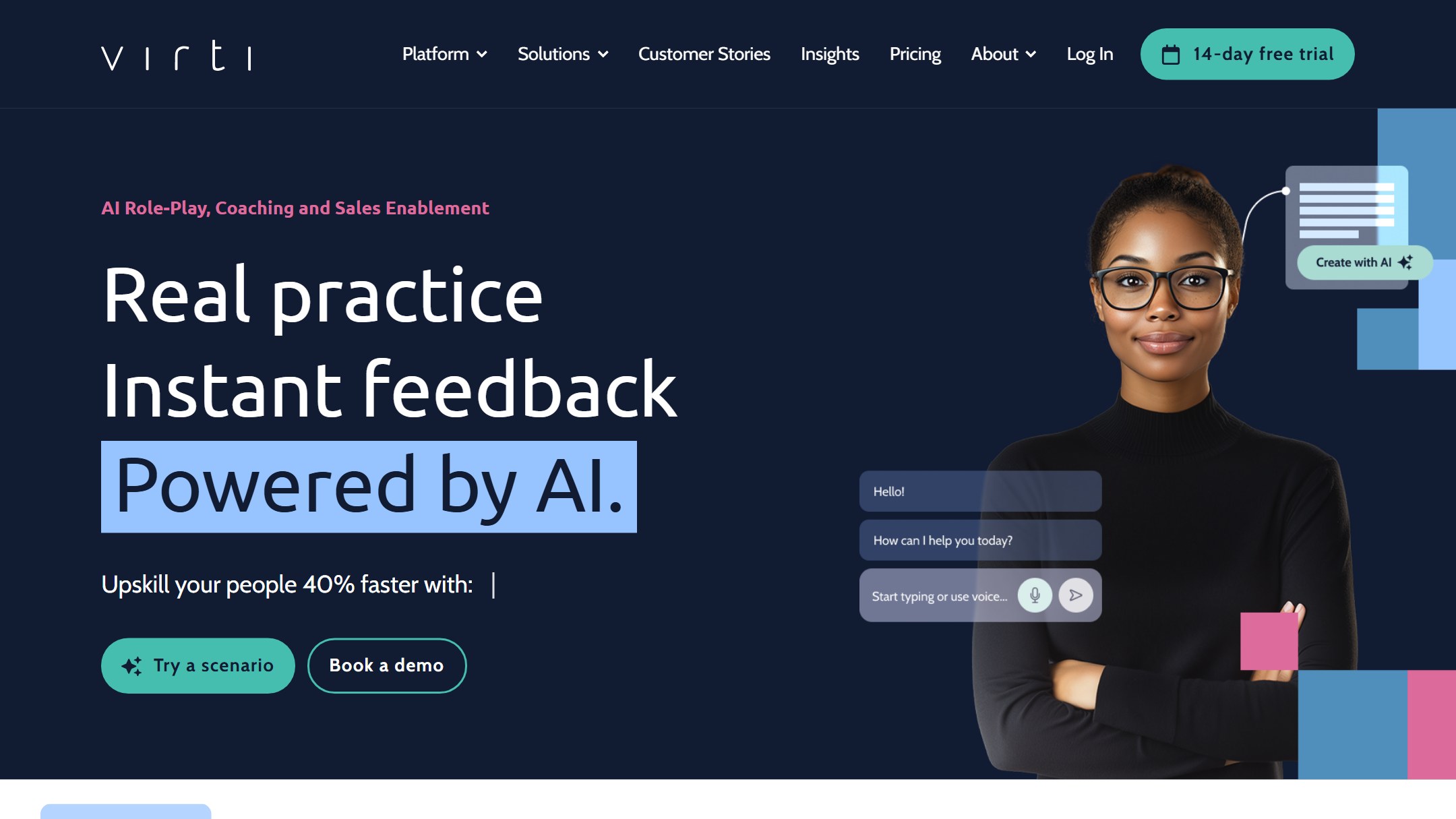
The AI component powers conversational roleplay within these environments. You can practice a difficult patient conversation in a virtual hospital room, handle a customer complaint at a virtual front desk, or navigate a compliance scenario in a virtual office. The AI adapts based on your responses, and the system tracks biometric signals (if using VR) to measure stress levels and emotional engagement.
Virti’s published research shows 230% improvement in learning retention when combining VR with AI practice compared to traditional classroom methods. The platform has been used in healthcare, aviation, and corporate environments. The NHS, Stanford Health Care, and Vodafone are among its users.
What Could Be Better
VR requires hardware investment (headsets, space, IT support) that many L&D teams are not ready for. The $99/month starter plan covers only 25 learners, which means costs scale quickly for larger teams. The non-VR desktop experience, while functional, loses the immersive advantage that justifies choosing Virti over cheaper alternatives.
Pros
- VR immersion drives 230% higher learning retention (published research)
- Works across VR, desktop, and mobile
- AI adapts scenarios in real time based on learner responses
- Strong healthcare and enterprise customer base (NHS, Stanford, Vodafone)
- Biometric tracking adds emotional engagement data
Cons
- VR hardware adds significant cost and logistics overhead
- $99/mo starter plan limited to 25 learners
- Non-VR mode loses the core differentiator
- Smaller market presence than conversation-only competitors
8. Zenarate. Best for Multi-Channel Agent Simulation
| Best for | Customer service teams needing phone, chat, and screen simulation |
|---|---|
| Free plan | No |
| Pricing | Enterprise subscription (contact sales) |
| Languages | Multi-language |
| Compliance | SOC 2 |
| G2 Rating | Listed |
What It Does
Zenarate calls itself an AI “flight simulator” for customer-facing agents, and the analogy is apt. Just as pilots log hours in simulators before flying real planes, Zenarate lets agents practice across every channel they will work in: phone calls, chat messages, email responses, and screen-based workflows. The AI simulates realistic customer interactions and scores agents on accuracy, empathy, process adherence, and resolution quality.
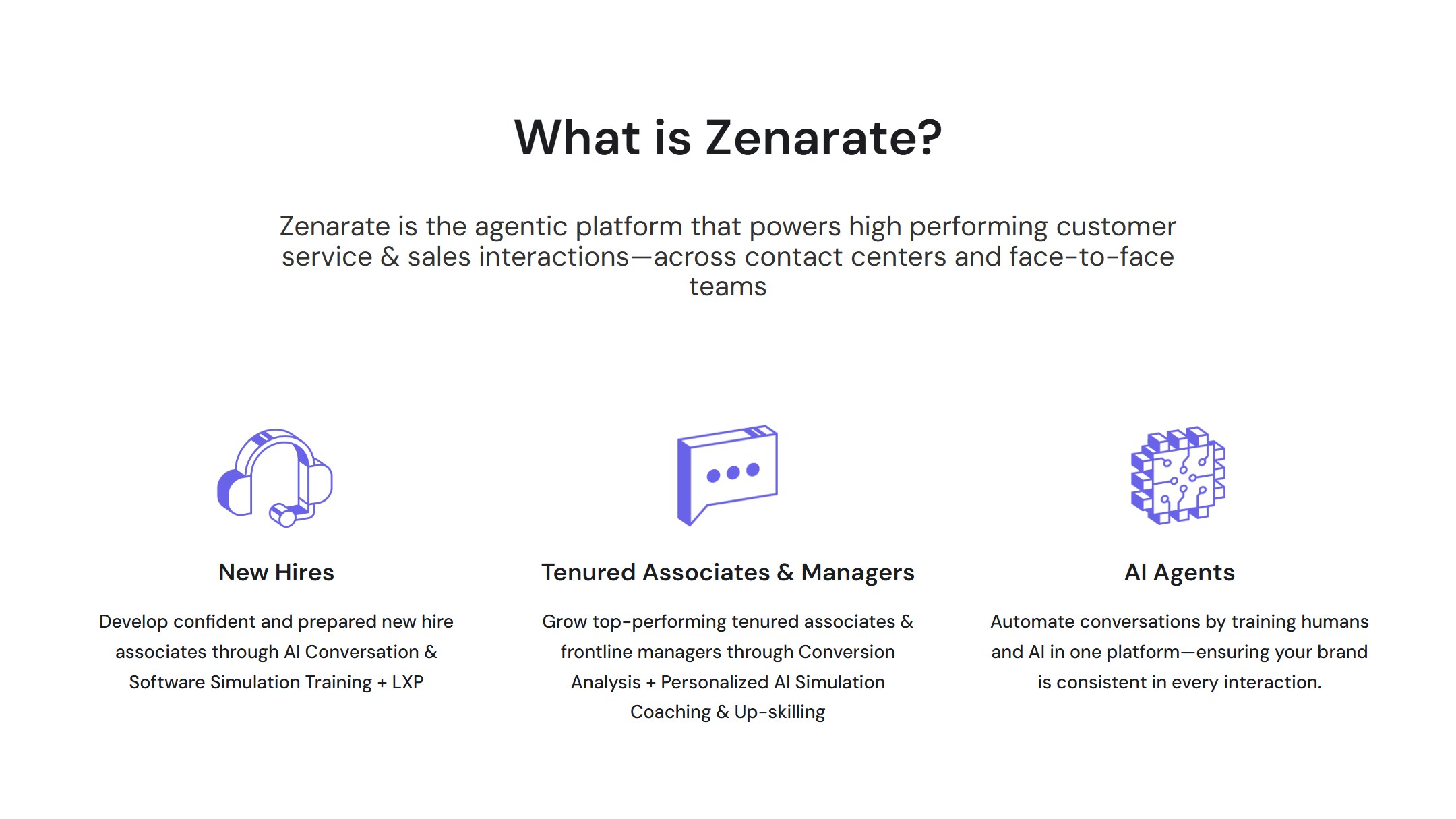
The platform separates itself from other contact center tools through channel breadth. SymTrain focuses on phone + screen. Zenarate covers phone, chat, email, and screen, giving agents practice across every interaction type they will encounter. For organizations where agents handle multiple channels, this cross-channel simulation is a significant advantage.
Zenarate secured $15 million in funding and reported 234% client growth in 2025, signaling strong market traction. The company focuses exclusively on simulation training for customer-facing roles, with use cases spanning insurance, healthcare, financial services, telecommunications, and retail.
What Could Be Better
Enterprise-only pricing with no published rates or self-serve tier limits accessibility. The G2 presence is light, making independent validation difficult. The platform is heavily focused on customer service roles, so sales enablement and leadership training are outside its core competency.
Pros
- Multi-channel simulation (phone, chat, email, screen) in one platform
- AI “flight simulator” model builds competence before live interactions
- 234% client growth and $15M funding show strong momentum
- Industry-specific scenarios for insurance, healthcare, financial services
- SOC 2 compliant
Cons
- Enterprise-only with no published pricing
- Limited G2 review presence
- Customer service focus, not suitable for sales or leadership
- Requires implementation and configuration time
9. Skillsoft CAISY. Best for Leadership and Compliance Practice
| Best for | Leadership development, compliance, and soft skills training |
|---|---|
| Free plan | No |
| Pricing | Individual $20/mo; Team $55/user/mo |
| Languages | Multi-language |
| Compliance | SOC 2, GDPR, ISO 27001 |
| G2 Rating | Listed (Skillsoft platform: 4.1/5, 553 reviews) |
What It Does
CAISY (Conversation AI Simulator by Skillsoft) is a conversational AI practice tool designed specifically for leadership, compliance, and interpersonal skills. Unlike the sales-focused tools that dominate this list, CAISY targets the conversations most managers dread: giving constructive feedback, handling harassment reports, navigating conflict resolution, and coaching underperformers.
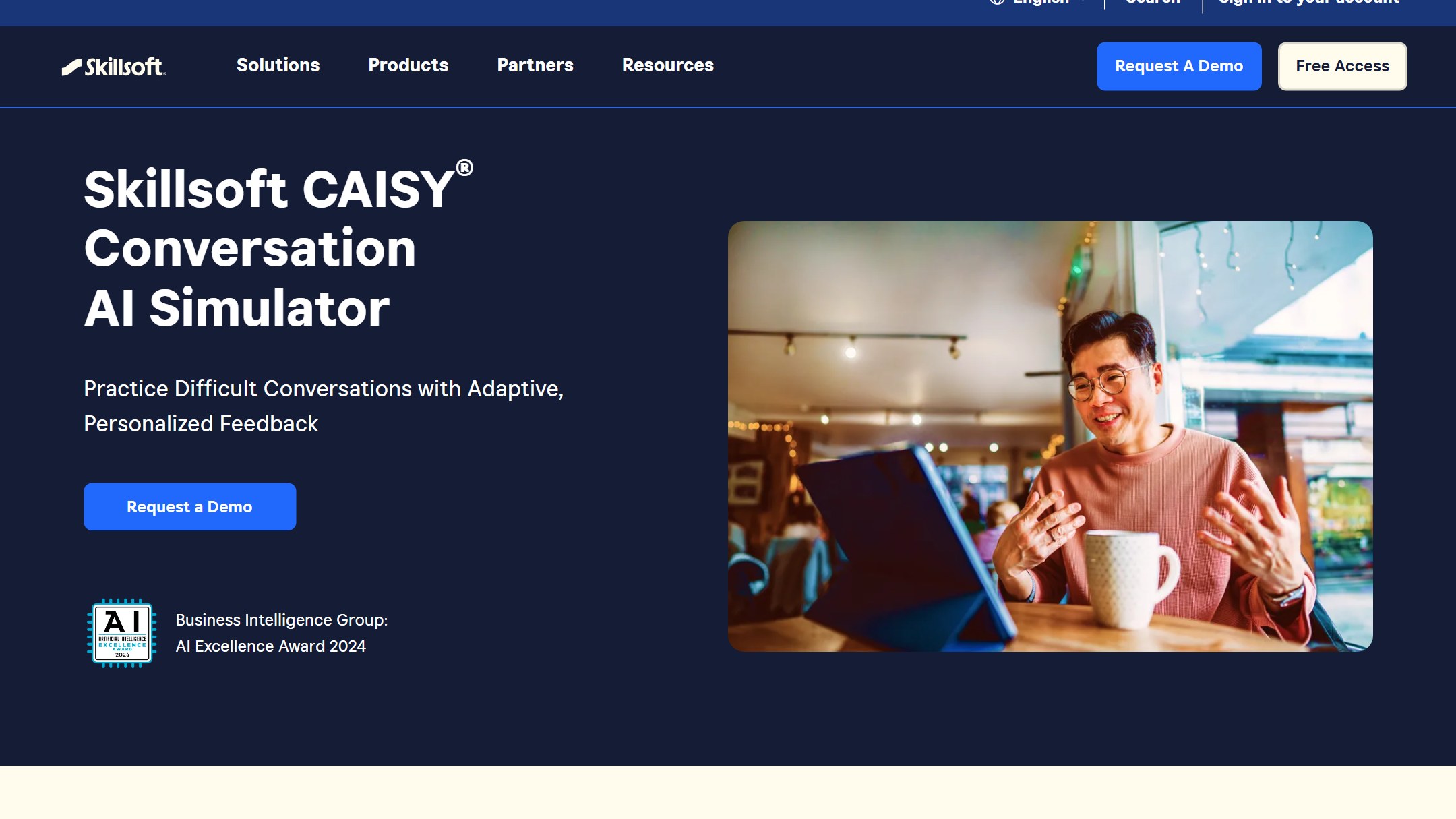
The simulator presents realistic workplace scenarios and lets you practice the conversation in a judgment-free environment. The AI responds based on how you communicate, escalating or de-escalating the simulated employee based on your approach. Post-session analytics break down what you said, how you said it, and where you could have handled the conversation differently.
Skillsoft reports over 1 million CAISY launches and 341% growth in usage since its introduction. The tool is backed by Skillsoft’s decades of corporate training content, which means the scenarios are grounded in real-world workplace situations, not generic roleplay prompts.
What Could Be Better
CAISY exists within Skillsoft’s broader platform ecosystem, which means you are potentially buying more than you need if roleplay is your only use case. The $55/user/month team pricing is steep compared to tools like Yoodli. Individual plan at $20/month is reasonable, but team deployment adds up quickly at scale.
Pros
- Purpose-built for leadership, compliance, and soft skills (unique focus)
- 1M+ launches and 341% growth demonstrate market adoption
- Grounded in Skillsoft’s extensive corporate training content library
- Individual plan at $20/mo is accessible for self-directed learners
- Strong compliance stack (SOC 2, GDPR, ISO 27001)
Cons
- $55/user/mo team pricing is expensive at scale
- Tied to Skillsoft’s broader ecosystem
- Not designed for sales-specific roleplay
- Scenario library depth depends on Skillsoft’s content coverage for your industry
Faz says: Every other tool on this list focuses on sales or customer service conversations. CAISY is the only one built for the conversations managers actually lose sleep over: telling someone their performance is not cutting it, handling a harassment report correctly, or coaching someone through a conflict. If your training gap is leadership, not sales, start here.
10. Paradiso AI. Best Budget LMS with Roleplay
| Best for | Budget-conscious teams that need an LMS with built-in roleplay |
|---|---|
| Free plan | Yes (limited) |
| Pricing | From ~$5.50/user/mo |
| Languages | 50+ |
| Compliance | GDPR |
| G2 Rating | Listed |
What It Does
Paradiso AI is an AI-first learning management system that includes roleplay as one feature within a broader LMS platform. For organizations that need course management, compliance tracking, certifications, and roleplay practice all in one tool, Paradiso bundles everything at the lowest per-user price on this list.
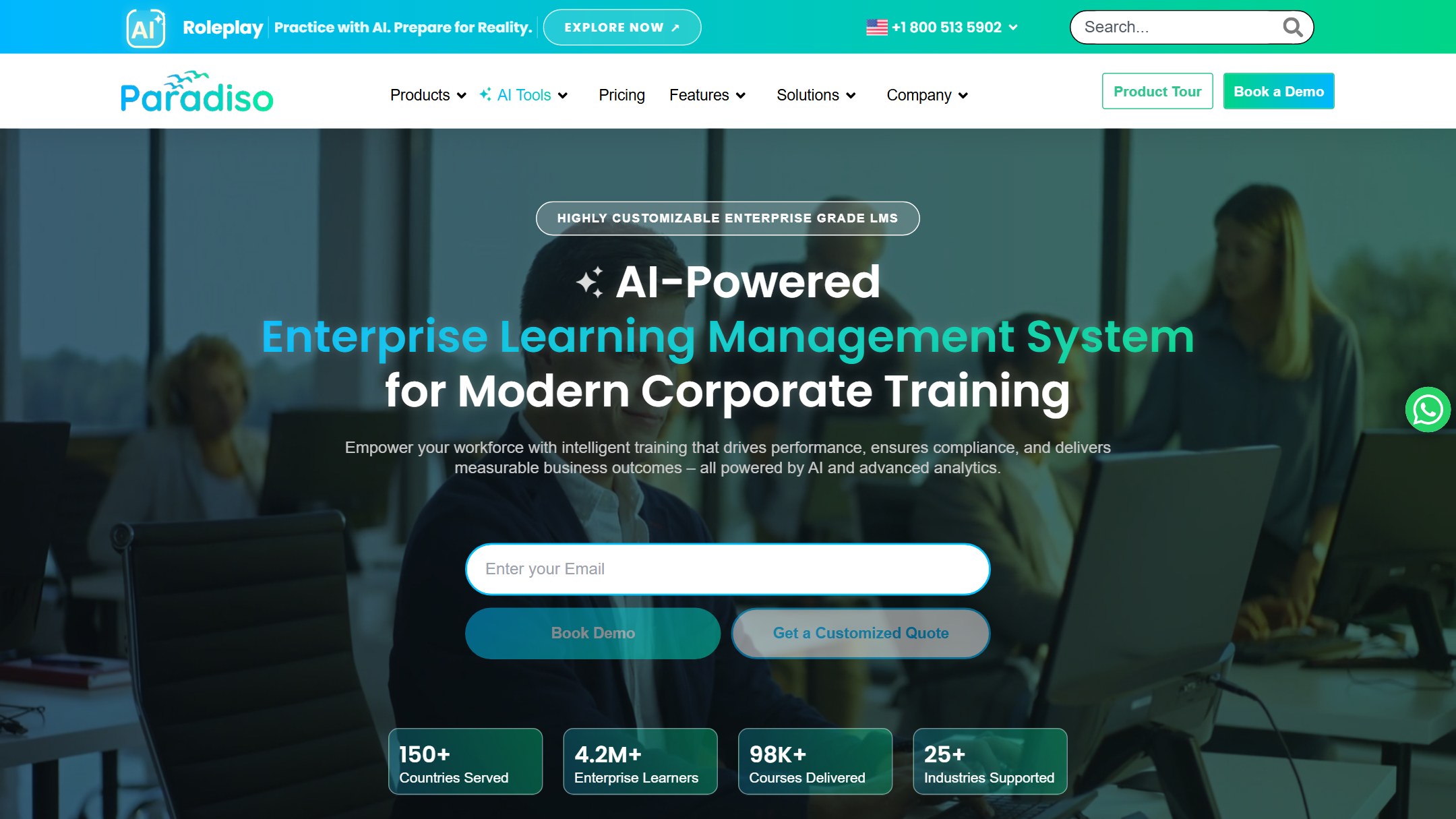
The AI roleplay feature lets you create custom conversation scenarios for sales, customer service, compliance, and onboarding. With support for 50+ languages, it handles multilingual training better than most standalone roleplay tools at any price point. The platform also includes AI-generated course content, quizzes, and learning paths.
Starting at approximately $5.50 per user per month with a free tier available, Paradiso undercuts every other option on this list by a wide margin. For SMBs and mid-market companies that cannot justify $15-50/user/month for an enterprise platform, this price point makes roleplay training financially viable.
What Could Be Better
You get what you pay for. The roleplay feature is one module within a budget LMS, not a dedicated simulation platform. Conversation realism and feedback depth do not match purpose-built tools like Second Nature or Hyperbound. The G2 presence is minimal, and the free tier is limited enough that you will likely need a paid plan for any real team usage.
Pros
- Lowest per-user pricing on this list (~$5.50/user/mo)
- Free tier available for small teams
- 50+ languages for global deployments
- Full LMS platform (courses, compliance, certifications) included
- AI course generation beyond just roleplay
Cons
- Roleplay quality below purpose-built competitors
- Limited G2 review presence
- Free tier heavily restricted
- LMS-first, roleplay-second approach means less simulation depth
11. Outdoo AI. Best for AI Roleplay Coaching for Customer-Facing Teams
| Best for | Customer-facing teams (sales + support) practicing realistic conversations |
|---|---|
| Free plan | Trial available, contact sales for terms |
| Pricing | Custom, see outdoo.ai for current pricing |
| Languages | English (primary) |
| Compliance | SOC 2, GDPR, ISO 27001:2022, HIPAA, CCPA |
| G2 Rating | Listed on G2 (146 reviews) |
What It Does
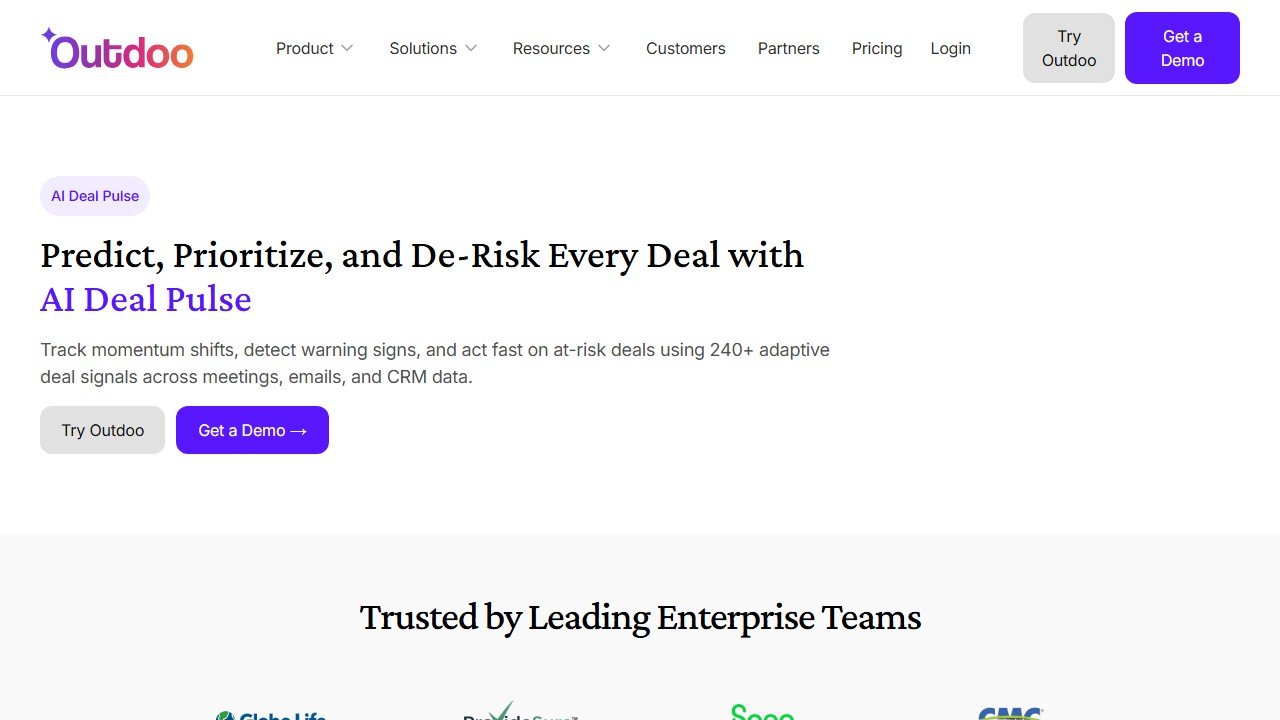
Outdoo AI is an AI roleplay coaching platform built specifically for customer-facing teams. The pitch is that reps practice realistic sales and support conversations with AI counterparts, get feedback after each session, and improve readiness before facing live customers. The focus is firmly on the customer-conversation side of L&D rather than broad sales enablement.
Where Outdoo positions itself in the category: between the enterprise lift of Mindtickle (which bundles content, certification, coaching, and analytics in one heavy platform) and the sales-specific narrowness of Hyperbound (which is excellent at sales roleplay but only sales roleplay). Outdoo’s framing is “AI roleplay coaching” with explicit support for both sales and customer support contexts.
The product is a newer entrant in the AI roleplay space compared to the established names higher on this list. That cuts both ways: less third-party validation and outcome data exists for Outdoo than for Second Nature or Mindtickle, but it also means the team is shipping fast and pricing is likely more flexible than the established enterprise platforms.
What Could Be Better
The main gap remaining is pricing transparency. Public pricing is not posted, so buyers still need a sales conversation to self-qualify or budget. On the validation side, Outdoo has addressed several gaps since our initial write-up: the platform is now listed on G2 with 146 reviews, holds SOC 2, GDPR, ISO 27001:2022, HIPAA, and CCPA certifications, and has public case studies on their website. That puts it ahead of most newer entrants on the compliance and trust-signal front.
Pros
- Built specifically for customer-facing teams (sales + support)
- Positioned to be lighter than enterprise platforms like Mindtickle
- AI feedback after each practice session
- Customizable scenarios for company-specific contexts
- Newer entrant, likely more flexible on pricing + onboarding than established players
- Enterprise security certifications: SOC 2, GDPR, ISO 27001:2022, HIPAA, CCPA
- Public case studies available on outdoo.ai
- Listed on G2 with 146 reviews
Cons
- Public pricing not posted; requires a sales conversation to get numbers
- Still building review volume on G2 (146 reviews) compared to established players like Second Nature or Mindtickle
- We have not done a 14-day hands-on test at the time of writing, so the entry above reflects what we can verify from publicly available information
Saru says: Faz, Outdoo has closed the main trust-signal gaps faster than most newer entrants do. G2 listing with real reviews, a full enterprise compliance stack (SOC 2, GDPR, ISO 27001:2022, HIPAA, CCPA), and public case studies. That combination would have taken most platforms 18+ months to assemble. The remaining gap is pricing transparency, which is a deliberate sales-motion choice rather than a maturity problem. Worth monitoring whether the G2 review volume builds out over the next couple of quarters.
The next four are built mainly for sales teams. They come from our former guide to AI sales roleplay tools, which this guide now replaces.
12. Hyperbound. Best for SDR Teams and Fast ICP Iteration
| Category | Details |
|---|---|
| Best for | SDR/BDR teams, high-volume cold call practice |
| Free trial | Yes: 9 pre-built bots, unlimited call time, no credit card |
| Starting price | Free tier available; enterprise from ~$15,000/year |
| Integrations | Salesforce, HubSpot, Gong, Outreach (enterprise plan) |
| Feedback type | Talk ratio, objection tracking, AI scorecards, real call scoring |
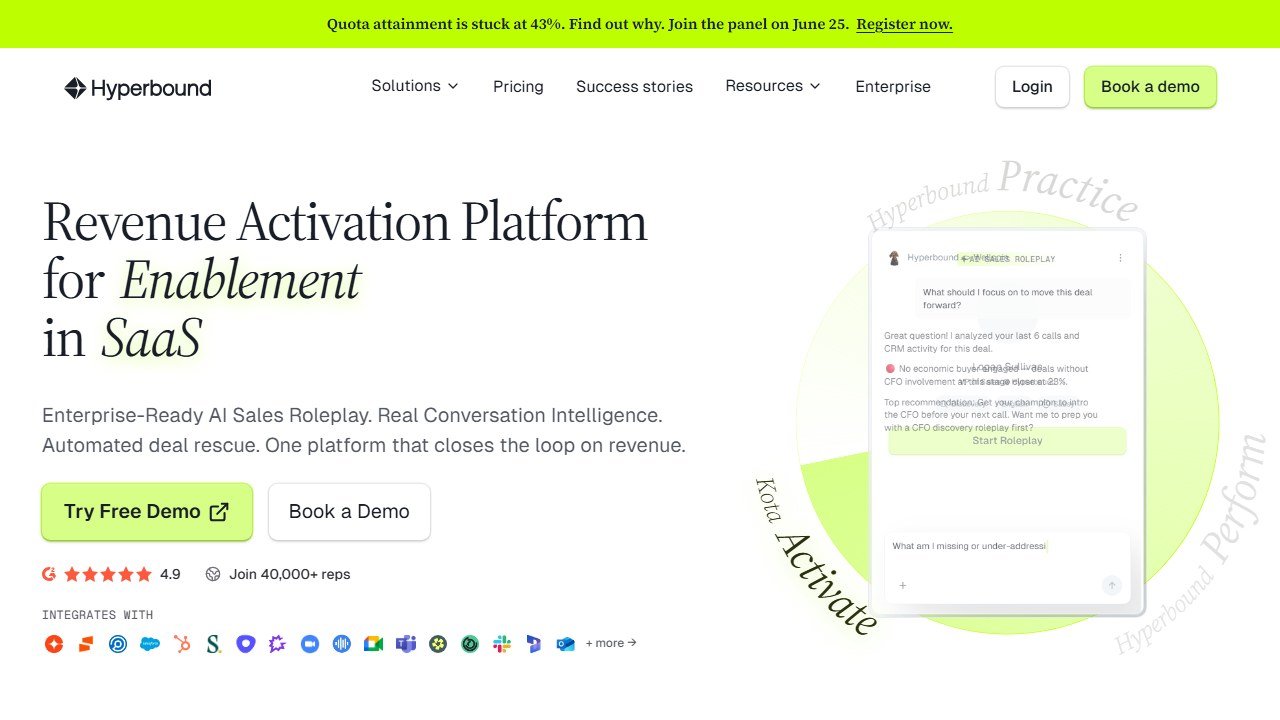
Hyperbound was built specifically for the outbound sales motion, and it shows. The platform’s core promise is that you can build a custom AI buyer bot that matches your exact ICP (industry, persona, company size, objection style) in under 10 minutes, then have your whole SDR team practice against it before the next campaign goes live. The free tier is genuinely useful: nine pre-built roleplay bots with unlimited call time, full transcriptions, and AI coaching feedback, all without a credit card. That makes it the easiest tool in this list to trial with a skeptical sales leader.
Pros:
- Best free tier of any tool in this category, with real practice value with no commitment
- Custom ICP bots ready in under 10 minutes
- Scorecards map to any sales methodology you already use
- Real call scoring ties practice rubrics to live performance
Cons:
- No self-serve paid tier between free and enterprise (~$15K/year)
- Integrations and custom bots locked to enterprise plan
- Focused on outbound/SDR workflows, with less depth for complex AE scenarios
13. Kendo AI. Best for Small Teams With Transparent Pricing
| Category | Details |
|---|---|
| Best for | Small sales teams, startups, individual reps |
| Free trial | Yes (free tier available) |
| Starting price | $55/month per seat (Pro plan, 180 roleplay minutes) |
| Integrations | CRM integrations on higher tiers; 5+ languages |
| Feedback type | Real-time call scoring, talk time analysis, AI feedback |
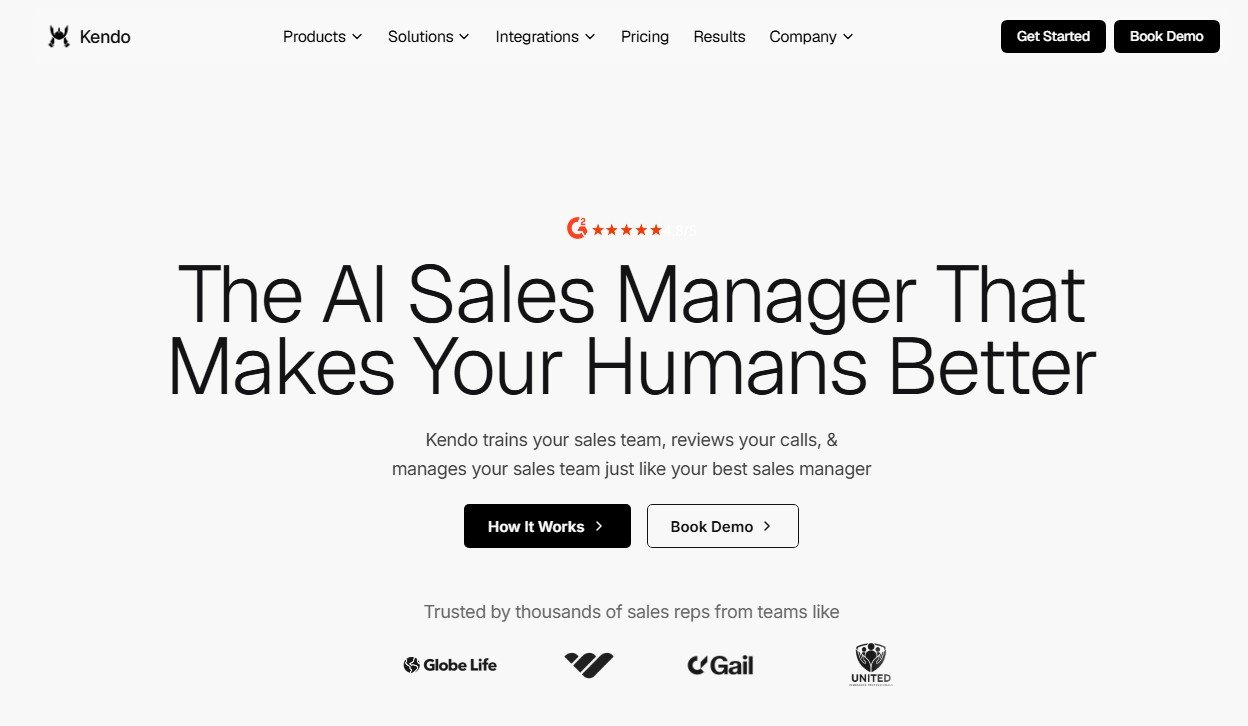
Kendo AI stands out in a category where most vendors hide pricing behind a demo request. The Pro plan is $55 per seat per month with 180 roleplay minutes included and pay-as-you-go overages at $0.33 per minute. The platform covers the full sales practice spectrum: cold calls, discovery, objection handling, product demos, rapport building, and closing. A Custom Prospect Builder lets you define the exact buyer persona (job title, industry, company size, personality type, voice style) rather than selecting from a generic library.
Pros:
- Fully published per-seat pricing, which only a few tools here offer
- Custom prospect builder with voice and personality options
- Covers B2B and B2C scenarios in one platform
- Pay-as-you-go overages keep costs predictable
Cons:
- Less depth for large enterprise team management and learning paths
- Minute-based usage model can create friction for high-volume teams
- Ecosystem integrations thinner than enterprise competitors
14. Allego. Best for Video-Based Coaching Alongside AI Roleplay
| Category | Details |
|---|---|
| Best for | Enterprise teams needing video coaching plus AI roleplay |
| Free trial | Demo only |
| Starting price | Custom enterprise pricing |
| Integrations | Salesforce, Microsoft Teams, Zoom, SharePoint |
| Feedback type | AI-scored roleplay, video exercise review, conversation intelligence |
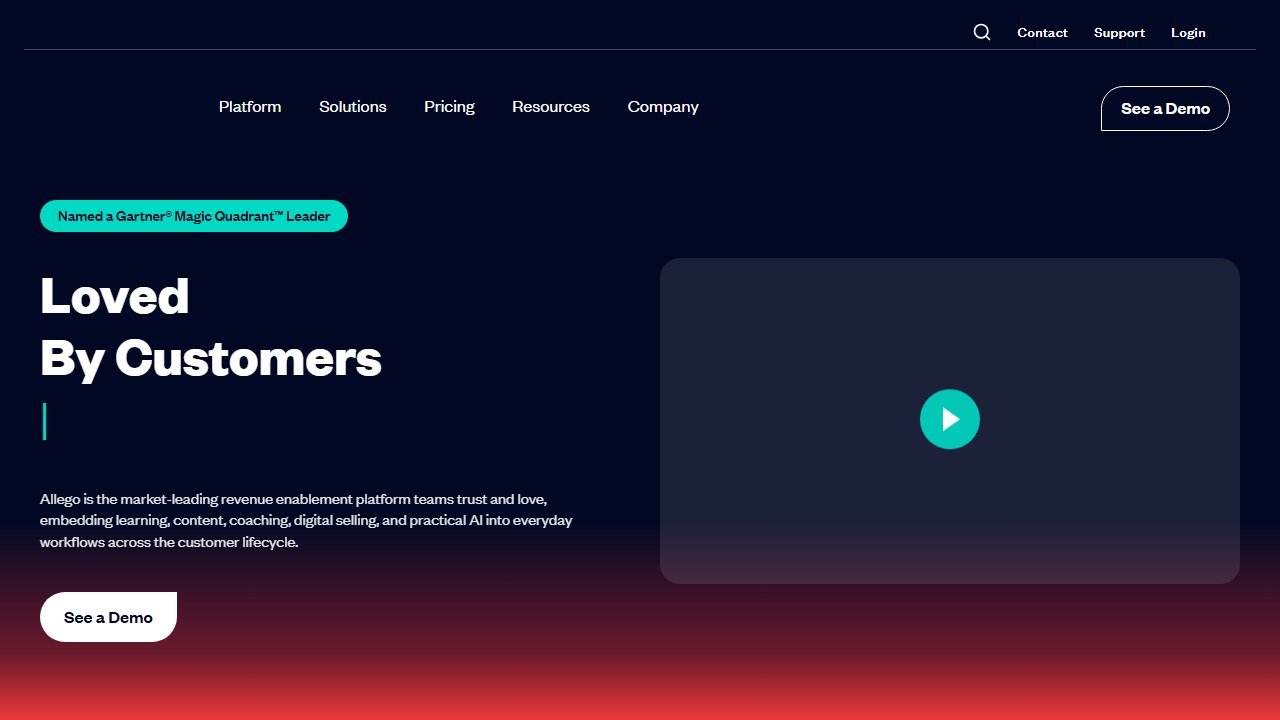
Allego has been a Gartner Magic Quadrant Leader in revenue enablement for several years. Its platform covers LMS/LXP, coaching, reinforcement, conversation intelligence, content management, digital sales rooms, and video selling. The AI roleplay feature, delivered through its Live Dialog Simulator, was added in mid-2025, bringing real two-way conversational practice into the platform. Teams that already run video-based pitch certification programs get a single platform that handles both formats with consistent rubrics across both modalities.
Pros:
- Gartner MQ Leader with deep enterprise credibility
- Combines video coaching and AI roleplay in a single platform
- Strong Microsoft ecosystem integrations (Teams, SharePoint)
- Seven tools in one for teams looking to consolidate
Cons:
- Live Dialog Simulator is newer, less mature than dedicated roleplay tools
- Custom enterprise pricing with no self-serve access
- Heavy platform requires significant implementation and change management
15. SmartWinnr. Best for Regulated Industries
| Category | Details |
|---|---|
| Best for | Pharma, medtech, financial services, global regulated teams |
| Free trial | Demo only |
| Starting price | Custom pricing (contact for quote) |
| Integrations | CRM platforms, LMS, compliance systems |
| Feedback type | Explainable AI scores, compliance flagging, audit-ready transcripts |
SmartWinnr is a practice-first platform for regulated industries. The AI roleplay experience lets reps practice with AI avatars that listen, ask follow-up questions, raise objections, and even respond to screen shares. After each session, reps receive an explainable score, a full transcript, and flags for missed mandatory statements, the compliance detail that pharma and financial services teams need for audit trails. Real-time suggestion nudges during the roleplay prompt reps toward better responses as the conversation unfolds, which is particularly useful during onboarding when reps are learning required compliance language.
Pros:
- Compliance-grade audit trails and transcript archiving built in
- Real-time in-session coaching nudges during roleplay
- Screen share-aware AI buyer for virtual selling practice
- Designed for global regulated teams with multi-language support
Cons:
- Compliance-heavy feature set is unnecessary complexity for non-regulated teams
- No self-serve pricing or free tier
- Narrower community and third-party integration ecosystem than larger competitors
Newer tools worth a look
Two newer roleplay tools have launched or grown since this guide was ranked. We have not used either, and neither is in the ranking above. The details come from each vendor’s own pages, read on 13 October 2026, and from questions the vendors answered for us, which we label as such.
TrackPoint: roleplays built from your own material
TrackPoint says “your team runs AI roleplays built from your material”, and that “every roleplay is scored on five criteria by default”, with Enterprise teams adding their own. You can try it with no account. Team is “From $350” per team per month, booked through a demo rather than a self-serve checkout, and Enterprise is custom, with single sign-on and API access listed only on that plan. TrackPoint told us Enterprise starts from $15,000 a year, with seats and customisation negotiated. We found no LMS or CRM integrations listed on its site.
MockProspect: roleplay by phone, for small teams
MockProspect does “AI sales roleplay by phone”: a rep calls a number from their own mobile, and the AI “objects, interrupts, and can hang up”. Plans run from $29 a month for 40 minutes to $449 a month for 1,000 minutes, all with unlimited reps, month to month with no contract and no overage charges. Its founder told us each call produces a transcript and a scorecard graded against the company’s own standards, with ready-made standards for fifteen industries, and that it launched in September 2026 and has no paying customers yet. There is no free trial; a public demo line is the way to try it, and there are no CRM or LMS integrations today.
Master Comparison Table
| Tool | Pricing | Free Tier | Roleplay Type | Languages | Compliance | G2 Rating | Best For |
|---|---|---|---|---|---|---|---|
| Second Nature | Enterprise only | No | Sales conversations with 3D avatars | 24+ | SOC 2, GDPR | 4.6/5 (298) | Enterprise sales teams |
| Yoodli | ~$8-28/mo | Yes (5 uses) | Communication coaching + roleplay | English only | SOC 2, FedRAMP, HIPAA, ISO 27001 | 4.7/5 | Affordable coaching |
| Mindtickle | ~$15-50/user/mo | No | Sales readiness + roleplay | Multi-language | SOC 2, GDPR | 4.7/5 (2,223) | Full sales enablement |
| Exec | $120/mo for 5 seats | Yes (5 sessions/yr) | Voice roleplay + call scoring | 9 | SOC 2 Type 2 | 4.8/5 (42) | Teams writing their own rubric |
| Rehearsal | Enterprise only | No | Video practice + AI + mentor | English (primary) | Not listed | Listed (low) | Blended AI + human coaching |
| SymTrain | Custom | No | Contact center voice + screen | Multi-language | SOC 2 | Listed | Call center training |
| Virti | From $99/mo | No | AI + VR immersive scenarios | Multi-language | GDPR, ISO 27001 | Listed | VR scenario training |
| Zenarate | Enterprise only | No | Multi-channel agent simulation | Multi-language | SOC 2 | Listed | Agent phone/chat/email sim |
| Skillsoft CAISY | $20-55/user/mo | No | Leadership + compliance conversations | Multi-language | SOC 2, GDPR, ISO 27001 | Listed | Leadership + compliance |
| Paradiso AI | From ~$5.50/user/mo | Yes (limited) | LMS with built-in roleplay | 50+ | GDPR | Listed | Budget LMS + roleplay |
| Outdoo AI | Custom (contact sales) | Trial available | Customer-facing AI roleplay (sales + support) | English (primary) | SOC 2, GDPR, ISO 27001:2022, HIPAA, CCPA | Listed on G2 (146 reviews) | Sales + support teams |
| Hyperbound | ~$15K/yr enterprise | Yes (9 bots, unlimited calls) | ICP bot builder in under 10 minutes | 25+ | Not stated | Not stated | SDR/BDR teams, cold call volume |
| Kendo AI | $55/seat/month | Yes | Fully published per-seat pricing | 5+ | Not stated | Not stated | Small teams and startups |
| Allego | Custom | No | Video exercise and AI roleplay in one platform | Multiple | Not stated | Not stated | Video coaching + AI roleplay combined |
| SmartWinnr | Custom | No | Compliance-grade audit trails + real-time nudges | Multiple | Not stated | Not stated | Pharma, medtech, financial services |
Verdict
For enterprise sales teams with global operations, Second Nature is the proven choice. Its 24+ languages, Salesforce integration, and strong case study data (Oracle NetSuite, SAP) make it the safest bet for large deployments.
For teams that need strong compliance at an affordable price, Yoodli is the standout. FedRAMP and HIPAA certification at ~$8/month is unmatched.
For organizations that want roleplay inside a full sales enablement platform, Mindtickle provides the broadest feature set with the deepest market validation (2,223 G2 reviews).
For teams that want to write their own scoring rubric rather than accept a vendor default, Exec is the pick, and it publishes a price, $120 a month for five seats, while most of this list will not quote you one.
For contact centers, choose between SymTrain (phone + screen workflow simulation) and Zenarate (multi-channel including chat and email).
For leadership and compliance training, Skillsoft CAISY is the only dedicated option on this list.
For budget-conscious teams, Paradiso AI (~$5.50/user/mo) provides the lowest barrier to entry on this list.
Faz says: Pick the tool that matches your actual use case, not the one with the most features. A contact center has zero use for VR immersive scenarios. A leadership development team does not need 2M hours of B2B call data. Match the tool to the problem, and you will see results. Try to buy one platform to cover everything, and you will get mediocre practice across the board.
For the complete guide to AI in corporate training, including video creation, course authoring, and instructional design tools, see our full best AI tools for corporate training roundup.
More corporate training AI guides
For broader corporate-training AI coverage, see our cluster guides:
- best AI corporate training tools. cross-functional CT pillar covering content, video, roleplay and assessment
- best AI onboarding tools. employee onboarding AI roundup
- best AI instructional design tools. L&D toolset for course authoring
- how to build an AI training program. implementation playbook for L&D leads
AI coaching tools outside of corporate L&D
Conversational AI roleplay is also showing up in personal-training software (form correction, accountability check-ins, AI lead follow-up for gyms). For the fitness-coaching counterpart of this category:
- best AI tools for personal trainers. the fitness-coaching equivalent of this guide
- best free personal trainer software. free-tier PT platforms for solo coaches
- FirstRep review. AI lead follow-up specifically for gyms
How to Build an AI Roleplay Training Program From Scratch
Most AI roleplay rollouts fail not because the technology is bad but because the program design is thin. Here is a practical build sequence that gives you the best chance of a successful deployment.
Step 1: Define your scenario library before you touch the software. Pull your top three to five performance gaps from CRM data, manager observation notes, or call recordings. Discovery calls where reps talk too much, objection handling on pricing, and escalation conversations are common starting points. Each gap becomes one core scenario. Start with five or fewer, because programs that launch with 30 scenarios confuse learners and bury your analytics.
Step 2: Record expert performers, not trainers. The most effective AI systems are calibrated to what your top 10% of reps actually say, not what a script says they should say. Have two or three high performers record full practice runs of each scenario. Capture their phrasing, pacing, and the way they handle an unexpected pushback. This becomes the benchmark against which the AI scores everyone else.
Step 3: Build your scoring rubrics explicitly. Every platform lets you define what “good” looks like. Most buyers skip this and accept generic rubrics. Instead, specify the exact phrases, behaviors, and structures that matter for your context. For a discovery call, that might be “asked at least two open-ended questions before pitching” and “confirmed decision-making process.” Vague rubrics produce vague scores that managers ignore.
Step 4: Pilot with a single cohort of 10 to 15 reps. Pick one team, one scenario set, and a fixed four-week window. Measure two things only: completion rate and pre-to-post score improvement. Do not attempt to prove business impact yet. You are validating that the tool works for your content and your people.
Step 5: Establish a baseline before training starts. Have reps complete one unscored practice run on day one. That baseline recording becomes your control data. Without it, you cannot demonstrate improvement to leadership and you cannot identify whether the platform’s scoring is calibrated correctly.
Step 6: Scale only what is working. After the pilot, review which scenarios produced the highest completion and score improvement. Expand those. Retire or redesign scenarios where completion dropped below 60%, because low completion almost always signals that the AI persona felt unrealistic or the scenario felt irrelevant to the rep’s day-to-day work.
How to Roll Out AI Roleplay in a Sales Team
Start with one scenario, not twenty. The teams that see the fastest adoption launch with a single high-stakes scenario, usually the first cold call opener or the most common objection the team faces. Reps complete it, get feedback, and repeat.
Tie practice to real pipeline moments. If a rep has three discovery calls next week, assign a discovery roleplay the day before. Contextual timing dramatically improves both completion rates and skill transfer compared to rolling out a general training module.
Calibrate the AI difficulty upward over time. Most platforms let you adjust how aggressive or challenging the AI buyer persona is. Start at a moderate difficulty level for the first two weeks, then increase the pushback as rep confidence grows. Starting too hard kills early motivation; staying too easy produces no transfer to real calls.
If your team also needs structured scenario libraries and LMS integration for formal onboarding programs, see our roundup of the best AI roleplay tools for corporate training.
For broader coaching and performance enablement beyond sales, see our roundup of the leading AI coaching tools for corporate training.
Which Roleplay Scenarios Get the Best Results
Not all training conversations are equally suited to AI simulation. Knowing where AI roleplay excels and where it falls short will save you months of poor adoption and wasted license spend.
Scenarios where AI roleplay consistently delivers strong results:
- Objection handling on price, competition, and timing. These are high-frequency, structurally predictable conversations. A rep will hear “your price is too high” thousands of times in their career. AI roleplay is ideal for drilling the response patterns until they become automatic. Research from Second Nature’s customer base shows reps practicing objection handling at least three times per week improve manager assessment scores by 30 to 40% within 90 days.
- Discovery and qualification calls. Open-ended questioning, active listening cues, and avoiding the “pitch too early” failure mode are all measurable behaviors that AI scoring handles well. These are also low-stakes enough that reps tolerate making mistakes in front of an AI without ego damage.
- Difficult customer service conversations. Scenarios like refund denials, missed delivery escalations, and churn-risk conversations have enough structure that an AI can play a credibly frustrated customer. The variance in real customer emotion is high, but the rep’s response framework stays consistent, which is what you are training.
- Manager feedback delivery. Performance conversations, PIP introductions, and recognition conversations are high-stakes and infrequently practiced. Most managers do them badly because they never rehearse. AI roleplay is one of the few scalable ways to give manager-level reps repetition on these scenarios before a real conversation happens.
- Compliance and HR scenarios. Harassment reporting conversations, termination procedures, and whistleblower discussions require precise language and a consistent process. AI can check whether the manager covered required disclosures and avoided specific language without a human observer in the room.
Scenarios where AI roleplay underperforms or fails outright:
- Physical demonstration and hands-on product training. AI conversation practice has no mechanism to assess whether a field rep correctly assembled a device or conducted a physical safety inspection.
- Complex multi-party negotiations. When the real conversation involves a CFO, a legal counsel, and a procurement lead simultaneously, a single AI persona does not replicate that dynamic. The cognitive and political complexity of group negotiations is beyond what current platforms simulate.
- Highly emotional crisis conversations. Suicide risk, acute mental health episodes, or bereavement calls in a healthcare or support context require human judgment and empathy calibration that AI scoring models have not yet cracked. Deploying AI roleplay for these scenarios risks giving reps false confidence in their ability to handle them.
Deep-dive reviews of every roleplay tool in this guide
For honest, in-depth reviews of the individual tools mentioned:
- Yoodli review, the AI communication coach with roleplay built in
- Second Nature review, the enterprise roleplay platform
- Rocky.ai review, the personal development coaching AI
- Synthesia review, the AI video creation platform used for training content
- Colossyan review, the AI video alternative to Synthesia
How to Measure ROI on AI Roleplay Training
The ROI conversation stalls for most L&D teams because they track the wrong metrics or measure too late. Here are four metrics that work and how to build a credible measurement framework around them.
Metric 1: Time-to-competency. Define competency as the point at which a new hire achieves a passing manager assessment score consistently across three scenarios. Measure how many weeks that takes for cohorts trained with AI roleplay versus your historical baseline. A realistic 90-day target for AI-trained cohorts is a 20 to 30% reduction in time-to-competency compared to cohort averages from the prior year.
Metric 2: Practice-to-close rate correlation. Pull CRM data for reps who completed at least 10 AI roleplay sessions in their first 60 days on the job. Compare their 90-day close rate to reps who completed fewer than five sessions. This correlation is not causation, but it is a credible leading indicator you can present to a CFO. If the correlation is weak, your scenario library may not be aligned to the actual sales motion.
Metric 3: Manager assessment scores. Have frontline managers complete a structured assessment of each rep’s call quality at 30, 60, and 90 days using a standardized rubric. Track whether AI roleplay scores predict manager scores. If they diverge significantly, your AI rubric needs recalibration. If they track together, you have a scalable proxy for manager observation that costs nothing per assessment.
Metric 4: Rep ramp time to quota. The hardest metric to attribute but the most meaningful to revenue leadership. Measure the average number of weeks for a new rep to hit 70% of quota. Track this separately for cohorts that completed your AI roleplay program versus those who did not. Even a two-week reduction in ramp time for a team of 20 reps translates to significant recovered revenue.
Cost comparison to anchor your business case:
- A manager spending one hour per week coaching a single rep on call skills costs approximately $75 to $150 per session in loaded salary time, assuming a $150,000 to $200,000 OTE manager. That is $300 to $600 per month per rep for live 1:1 coaching.
- A dedicated practice partner program adds coordination overhead and inconsistent feedback quality.
- AI roleplay platforms typically cost $30 to $80 per user per month at enterprise scale, with unlimited practice sessions included. The cost-per-repetition drops to near zero after the first scenario build.
The ROI case is not “AI replaces coaching.” It is “AI handles high-volume repetition practice so managers spend their coaching hours on judgment calls and deal strategy instead of basic skill drilling.”
LMS Integration and Tech Stack Compatibility
Integration claims from AI roleplay vendors are often misleading. A vendor saying they “integrate with Salesforce” might mean they have a Zapier workflow that pushes a completion record into a custom object, or it might mean a native bidirectional sync that maps rep scores to opportunity records. You need to know which before you sign.
What to verify before procurement:
- SCORM vs xAPI. SCORM 1.2 records pass/fail and completion. xAPI (Tin Can) records granular interaction data, namely which specific questions a rep struggled with, how many attempts they took, how long they paused before answering. For AI roleplay, xAPI is the only standard that captures enough data to be useful. If a vendor only offers SCORM, you are flying partially blind on practice analytics.
- SSO configuration. Confirm whether SSO uses SAML 2.0 or OIDC and whether your IT team needs to maintain a custom connector or if the vendor handles provisioning via your identity provider (Okta, Azure AD, Google Workspace). Platforms that require manual user provisioning become an admin burden at scale.
- CRM data sync. If your primary use case is sales enablement, ask whether the platform can push practice completion data into Salesforce or HubSpot contact or opportunity records. This allows revenue ops to correlate training activity with pipeline outcomes without manual data joins.
- Video conferencing integration. Some platforms allow reps to practice directly inside Zoom or Microsoft Teams rather than switching to a separate application. For remote teams, this reduces friction significantly and improves completion rates.
Be cautious when a vendor shows a logo wall of integrations on their website but cannot produce a technical integration guide on request. Ask specifically: “Is this a native integration maintained by your engineering team or a third-party connector?” and “What is the data latency between a rep completing a session and that data appearing in our LMS?” If they cannot answer these questions in the demo, escalate to their solutions engineering team before proceeding.
Buying Checklist for Enterprise Buyers
Use this checklist before issuing an RFP or entering final contract negotiations. Every item on this list has burned a buyer who skipped it.
- Scenario authoring time. How long does it take a non-technical L&D administrator to build one complete scenario from scratch? Acceptable benchmark: under two hours for a standard sales or service conversation.
- Language support. If your workforce is multilingual, confirm which languages receive full AI scoring support versus which are available for recording only. Many platforms advertise 20+ languages but provide scoring rubrics only in English.
- Custom persona creation. Can you upload a custom AI persona that matches your buyer archetype, including name, industry background, and specific objection patterns? Generic personas reduce scenario realism.
- Scoring rubric customization. Can administrators edit or build scoring rubrics without vendor support? Platforms that require a professional services ticket to change a rubric will create a bottleneck as your scenario library evolves.
- Admin reporting dashboard. Confirm the dashboard shows cohort-level completion, average scores by scenario, and individual rep trend lines. Ask to see a live demo of the reporting interface, not a screenshot.
- Mobile support. If any portion of your workforce is field-based, confirm whether the platform runs on iOS and Android without a degraded experience.
- SOC 2 Type II certification. Required for most enterprise procurement. Also confirm GDPR compliance if you operate in the EU and ask whether rep conversation recordings are used to train the vendor’s AI models, a data privacy issue most buyers overlook.
- Contract flexibility. Is the contract annual with no mid-term seat adjustment, or can you scale seats up and down quarterly? For a growing sales team, rigid seat caps create either waste or access gaps.
- Professional services availability. Does the vendor offer paid implementation support, scenario design services, or a customer success manager for accounts under $50,000 ARR? Smaller enterprise deployments often get deprioritized without this in writing.
- Reference customers in your industry. Ask for two or three references from companies with a similar use case, team size, and industry vertical. Generic references from large logos in unrelated sectors are not useful for evaluating fit.
- Pilot structure. What does the vendor’s standard pilot look like? A credible vendor offers a time-boxed pilot (30 to 60 days), a defined success metric, and a named implementation contact. Vendors who resist a structured pilot are a flag.
- Data export and ownership. Confirm in writing that you own all rep conversation recordings and practice data and that you can export it in a standard format (CSV, JSON) at contract termination without a data retrieval fee.
- AI model transparency. Which underlying language model powers the AI persona? Is the vendor using a proprietary model, a fine-tuned open-source model, or a commercial API (OpenAI, Anthropic, Google)? This matters for your security and compliance team’s model risk review.
- User seat pricing model. Is pricing per active user per month, per named seat, or per session? For a team with variable training cadence, active-user pricing is almost always cheaper than named-seat pricing.
- Support SLA. What is the guaranteed response time for a P1 issue (platform down during a live training session)? Enterprise contracts should include a four-hour or better response SLA in writing, not just a general support page reference.
The Honest Limitations of AI Roleplay
AI roleplay platforms are genuinely useful. They are also genuinely limited, and the vendors will not volunteer these limitations in a sales process.
AI cannot read non-verbal cues. In a real sales or coaching conversation, 40 to 60% of the signal is non-verbal: the prospect who checks their phone, the employee who crosses their arms, the customer whose voice goes flat. AI roleplay trains the verbal layer only. Reps who train exclusively in text or audio-only AI environments may become less attuned to visual and physical cues because they are never rewarded for noticing them.
AI cannot simulate a truly irrational interlocutor. Real buyers and real employees are sometimes irrational, emotionally volatile, or operating from hidden agendas that have nothing to do with the stated objection. AI personas are probabilistic. They respond from a distribution of plausible responses. A buyer who is angry because their last vendor burned them personally, or an employee who is lying about a situation, requires human judgment to navigate. AI will not adequately prepare a rep for that conversation.
AI cannot adapt to deeply novel objections outside its training data. If a prospect raises an objection your scenario library has never encountered, such as a new regulatory change, a competitive move that happened last week, a highly specific technical concern, the AI persona will either default to a generic response or stall. Reps practicing against AI get very good at the known objections. They may actually become less practiced at improvising when the conversation goes somewhere genuinely unexpected.
The AI confidence trap. Reps who consistently score well in AI practice sometimes become overconfident going into live conversations, then freeze or fall back on scripted responses when the human on the other end does not follow the expected pattern. The AI environment is inherently more forgiving and more predictable than a real conversation.
Structure your program so AI practice is the foundation, not the ceiling. Use AI roleplay for high-volume repetition on known scenarios, then layer in live coaching, peer role-play, and call shadowing to expose reps to human variability. A practical cadence: three AI sessions per week for the first 30 days of onboarding, then two AI sessions plus one live manager debrief per week through the 90-day mark. Reps who hit the AI scoring benchmarks should graduate to harder live scenarios, not more AI practice.
For other corporate-training needs, see our guides to the best AI soft-skills training tools and AI customer-service training tools.
Related AI tool guides
Related guides:
- AI Tools Updates 2026. Every Major Release This Year.
More AI tool guides worth reading: AI Leadership Development Tools.
More AI tool guides worth reading: Second Nature Pricing, How to Roll Out AI Sales Coaching in 30 Days and Mindtickle vs Yoodli.
Tools mentioned in this guide
- Second Nature
- Yoodli
- Mindtickle
- Exec
- Rehearsal by ELB Learning
- SymTrain
- Virti
- Zenarate
- Skillsoft CAISY
- Paradiso AI
- Outdoo AI
Roleplay is one piece of a bigger stack. For the full category, see the best AI sales training software, which also covers coaching and conversation intelligence, and our Mindtickle review. If you are specifically weighing alternatives to Yoodli, those guides cover the strongest options.
How we reached this verdict: this guide is research-based. We compare each tool against its published documentation, pricing pages and terms, and we do not claim hands-on testing we have not done.

Written by
FazFaz is the founder of AIToolsBakery. Some tools here are tested hands on. Others are assessed from vendor documentation and pricing verified on the live page, and every review says which one it is. Sponsors can buy a position in a guide. They cannot buy the score, the criticism, or silence about a better option.
How we test and how we make money →