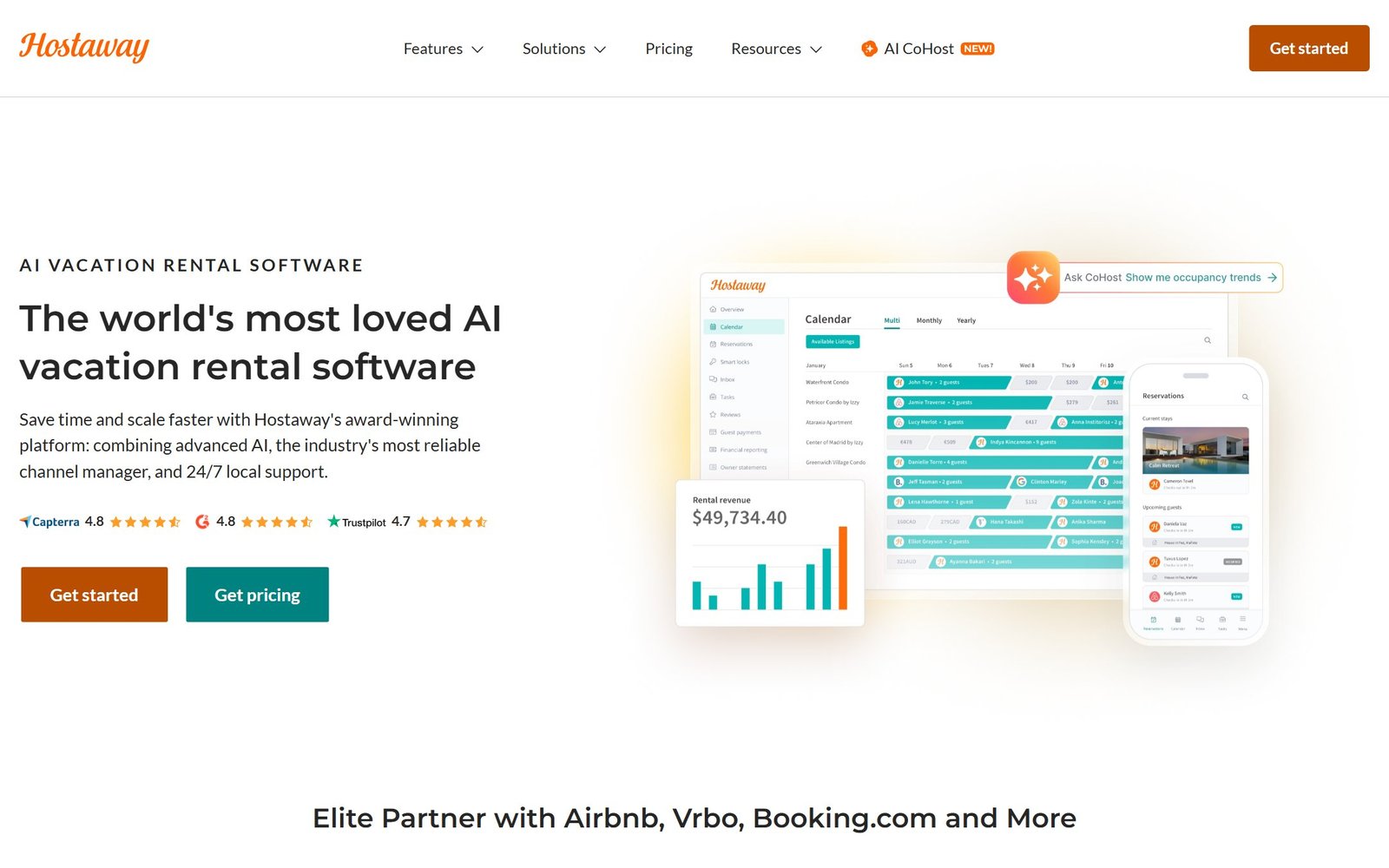
There is a specific moment in researching this review that is worth describing, because it is the review.
We loaded Hostaway’s pricing page on July 27, 2026 and extracted the complete text of it, the way we do for every vendor in this batch, so that every figure we print can be traced back to a saved file. The extraction ran fine. The page loaded fine. And the list of currency figures it produced was empty.
Not sparse. Empty. Zero dollar amounts, zero percentages, zero per-listing rates, zero ranges. One call to action: “Get a free quote.”
Hostaway raised $365 million in December 2024 in a round led by General Atlantic, at a $925 million post-money valuation. It is one of the two or three most significant companies in short-term-rental software. And a prospective customer cannot learn from Hostaway what Hostaway costs.
That fact shapes everything below, including the score, and it should shape how you read every other Hostaway review you find, because all of them are working from the same absence.
What is actually known, and what is only reported
This review runs on two labels and the distinction is not decoration. OFFICIAL means we read it on Hostaway’s own site on July 27, 2026. REPORTED means somebody else published it, we name who, and neither we nor you can confirm it before entering a sales process.
| Item | Figure | Status |
|---|---|---|
| Any published price | None. Zero currency figures on the pricing page | OFFICIAL, hostaway.com/pricing, Jul 27 2026 |
| Pricing page call to action | “Get a free quote” | OFFICIAL, same page |
| Funding round | $365M led by General Atlantic, with PSG | OFFICIAL, General Atlantic release, Dec 17 2024 |
| Valuation | $925M post-money | OFFICIAL, announced Dec 17 2024 |
| Total funding | ~$543M across seven rounds | REPORTED, funding databases |
| Founded | 2016, Finland | OFFICIAL, company materials |
| Subscription | ~$25 to $50 per listing per month | REPORTED, aggregators and reviewers |
| Direct booking engine fee | 1.8% guest service fee | REPORTED, widely repeated, not on Hostaway’s page |
| Onboarding | ~$300 to $1,000 | REPORTED, reviewers |
| Dynamic pricing | Paid add-on, price unknown | REPORTED |
| SMS and WhatsApp messaging | Paid add-on, price unknown | REPORTED |
Look at the status column. Two rows are things Hostaway told us about its money, and both are about money it raised rather than money you pay.
Why quote-only is not automatically a scandal
It would be easy, and lazy, to treat an unpriced pricing page as proof of bad faith. It is not, and the fair version of the argument deserves stating before the criticism.
Hostaway sells to operators running anywhere from a handful of units to several thousand, across dozens of countries and currencies, with different channel requirements, different add-on needs and different migration complexity. A single headline number would be wrong for almost everyone who read it, and vendors who publish one often end up burying the real cost in footnotes anyway. Configured pricing is a legitimate model, it is normal in business software at this scale, and Guesty and AppFolio do versions of the same thing.
There is also a competitive argument. Publishing per-listing rates hands your pricing to every rival’s sales team, and in a market with this much venture money moving through it, that is a real consideration.
So the criticism is not that quote-only pricing exists. It is narrower and it holds anyway.
First, Hostaway publishes nothing at all, not even a floor. Guesty publishes $16 for its smallest tier and quotes above it. Hospitable publishes the entire grid. Even a “from $X per listing” would let a two-property host self-select out without a sales call. Nothing is a choice.
Second, the absence gets filled by other people. Every comparison page ranking for Hostaway’s price is repeating a number Hostaway did not give them. The $25 to $50 range, the 1.8 percent, the onboarding fees: those figures circulate as facts because the vacuum demands filling. A vendor that publishes nothing does not stop being priced publicly. It just stops controlling the number, and the buyer loses the ability to tell a real figure from a stale one.
That second point is the whole thesis of this batch, and Hostaway is its clearest case.
The product, on the evidence available
Set the pricing aside, because the platform is genuinely well regarded and the score reflects that.
Hostaway is a full property management system for professional operators. Channel management across the major OTAs is its core and it is the part reviewers praise most consistently. Around it sits a unified inbox, an automation engine, a direct booking engine, owner statements and reporting, and a large integration marketplace connecting the tools you already run, including the dynamic pricing specialists covered in our best dynamic pricing tools guide.
The recurring positive across the review corpus is automation depth. Message triggers, task generation, cleaner assignment and owner reporting are described as more configurable than the mid-market alternatives, which is what an operator with staff is actually buying. The recurring caveat is that this configurability comes with setup weight, which is presumably why onboarding is a paid, human-assisted process rather than a self-serve wizard.
On AI specifically, the honest characterisation is that Hostaway’s marketing runs ahead of what is documented. The AI features resolve largely to suggested guest replies, which is a real and useful capability and the same one Hospitable caps at ten per week on its free tier. What Hostaway does not do, and what both Hospitable and iGMS do, is publish a tier-by-tier grid of which AI features you get. In the absence of that, “AI-powered” tells you nothing you can act on.
The complaint pattern worth knowing before the call
Every platform of this size accumulates unhappy reviews and it would be unfair to weight them heavily. But three patterns recur specifically around commercial terms rather than product quality, and in a quote-only purchase those are the ones that should shape your questions. All are attributed reports from public review platforms, not findings of ours.
Quote inconsistency. One account describes two account representatives quoting 100 USD and 100 EUR on the same deal. Whatever happened there, the lesson generalises: in an unpublished-price product, get the number in writing from one named person.
Billing after downgrade. A reviewer describes requesting a reduction from a large listing count down to five in April, holding written proof of the request, and continuing to be billed for the full count for two further months. Ask specifically how mid-term listing reductions are processed and when they take effect.
Dynamic pricing sync failures. Several reports describe incorrect rates appearing on Airbnb while the paid dynamic pricing add-on was active. If you intend to buy rate-setting through Hostaway rather than plugging in PriceLabs or Beyond, ask about sync reliability and what the remedy is when it fails.
None of these are disqualifying. All three are cheaper to ask about than to discover.
What the $365 million was for
The funding round is not trivia. It is the best available evidence about where this product is going, and it is one of the few things about Hostaway’s commercial position that is on the record.
The round closed at $365 million led by General Atlantic with participation from PSG, announced December 17, 2024, at a $925 million post-money valuation. Hostaway had raised roughly $543 million in total across seven rounds by that point. Both General Atlantic and PSG were described as becoming significant minority shareholders, so this was a growth investment rather than a change of control.
The stated uses were product innovation, European expansion with France, Italy and Spain named specifically, and artificial intelligence.
Two things follow for a buyer.
The European expansion is a reason to look closely if you operate there. Channel coverage and local payment handling in France, Italy and Spain are exactly the sort of thing that gets built when a company raises money and names those markets. If you are running listings in those countries, Hostaway’s roadmap is pointed at you in a way its competitors’ are not.
The AI investment has not yet produced a published feature grid. Money named for AI in December 2024 should be visible in the product by mid-2026, and to some extent it is. What it has not produced is any account of which AI capability sits on which tier, because there are no published tiers to hang it from. A competitor at a fraction of the valuation lists eight AI features against four plans with the caps written next to each one. That comparison is not about engineering budget. It is about a decision to tell customers what they get.
There is also a structural consideration worth naming plainly. A company that has taken $543 million has investors who expect a return on it, and pricing power is one of the ways that return arrives. That is not an accusation, it is how growth equity works, and it is a reason to ask about renewal escalators in a contract you cannot benchmark against a published rate.
Where Hostaway actually sits against the alternatives
| Hostaway | Guesty | Hospitable | Lodgify | |
|---|---|---|---|---|
| Published entry price | None | $16/mo (1 to 3 listings) | $0, then $29 | $18/mo list |
| Published price above entry | None | None | $59 and $99 | $33, $53, $77 |
| Published add-on prices | None | None | Yes | No |
| Published AI feature ladder | No | No | Yes, with caps | No |
| Real free tier | No | No | Yes | No |
| Best fit by size | 10+ listings with staff | Dozens to hundreds | 1 to ~20 | 1 to ~15, direct-booking led |
Read across the bottom row and the segmentation is clearer than the marketing makes it. Hostaway and Guesty are not really competing with Hospitable and Lodgify; they are competing with each other, for operators who have staff and owners to report to. The comparison sites that put all four in one table on price are comparing products bought by different people for different reasons, which is part of why their price figures are so unreliable.
Where Hostaway wins that head-to-head is channel breadth and automation depth. Where it loses is that Guesty at least publishes a floor.
Six questions to ask before you sign
Because the entire commercial relationship is established in a conversation rather than on a page, the quality of your questions is the only leverage you have. Based on what Hostaway does not publish and what reviewers report, these are the ones that matter.
1. What is the per-listing rate at my exact listing count, in my currency, in writing? The currency point is not pedantic given the reported USD and EUR mix-up.
2. What is the onboarding fee and what does it include? Reported at $300 to $1,000, unconfirmed. If the answer is zero, get that in the thread.
3. What does the rate renew at in year two? Growth-equity-backed software companies raise prices. Ask now.
4. Which add-ons am I being quoted for, and which are extra? Dynamic pricing and SMS or WhatsApp messaging are both reported as paid add-ons. Confirm whether your quote includes them.
5. Is there a fee on direct bookings through the booking engine? Reported at 1.8 percent. If you intend to build a direct channel, this is the number that scales with your success, and it is worth more attention than the subscription.
6. How are mid-term listing reductions processed, and when do they take effect? This goes directly to the reported billing-after-downgrade complaints. A clear written answer costs the salesperson nothing and protects you completely.
Six questions, all of which a competitor answers on a public web page before you speak to anyone.
Who Hostaway is genuinely for
Ten listings or more, with staff. This is the consensus sweet spot and it matches the product’s shape. The automation depth and owner reporting only pay for themselves when there are people and owners to coordinate.
Operators who need channel breadth. If you distribute beyond Airbnb, Vrbo and Booking.com, Hostaway’s connection list is a genuine advantage over Lodgify, whose API connections stop at those three. Our Lodgify review covers where that ceiling bites.
Buyers with negotiating patience. The process assumes a sales conversation. If you find that intolerable, this is not your platform regardless of product quality.
Not for you if you have fewer than about five listings, if you want to know the price before you talk to anyone, or if your requirement is essentially guest messaging, in which case you are buying a great deal of platform to solve one problem that cheaper published-price tools solve well.
Payment and screening fees, which usually exceed the subscription
The subscription is the number everyone compares. The fee schedule is the number that decides your actual cost, and in this category it is published in enough detail to be worth reading properly.
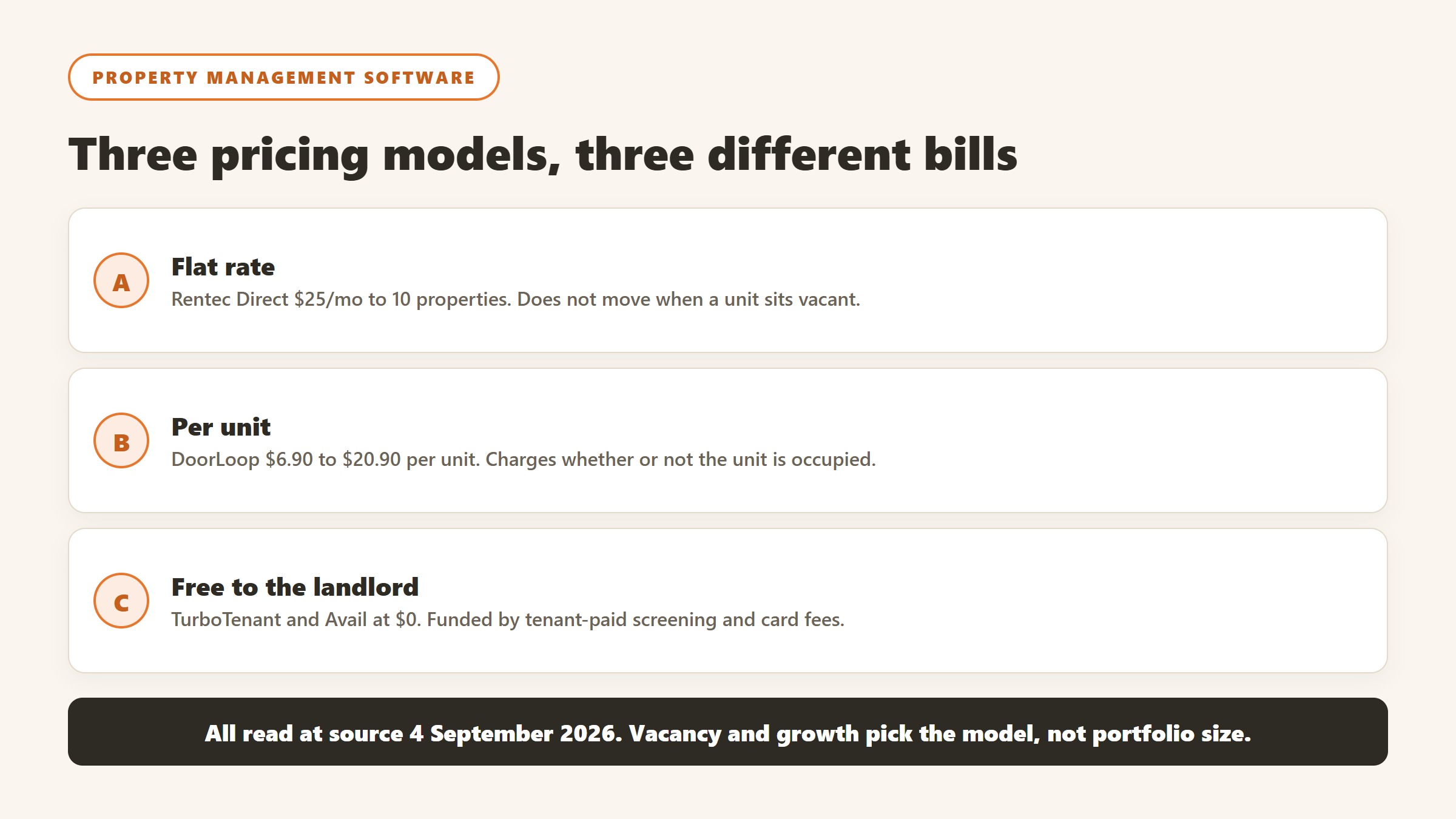
ACH and card are priced very differently, and the gap is the whole point
Buildium publishes incoming EFT at $2.35 per transaction on Essential, falling to $1.35 on Growth, with the first twelve months free and then $0.60 on Premium, alongside credit cards at 2.99% on every tier. On a $1,800 rent, that 2.99% is about $54 against roughly $1 to $2 for a bank transfer. Whichever platform you pick, the largest single saving available to you is usually getting residents onto ACH rather than cards, and that is a policy decision rather than a software one.
Who pays the card fee is a decision you should make deliberately
Most platforms let you absorb the card fee or pass it to the resident. Passing it is common and legal in most jurisdictions, though not all, and it changes on-time payment behaviour in ways worth watching. TenantCloud publishes ACH at $1.95, $1.75 and $1.50 paid by the tenant across its tiers. Decide the policy, check it against your state rules, and put it in the lease rather than discovering it at the first dispute.
Screening is priced per application and it adds up
Buildium publishes tenant screening at $17 per screening, $35 applicant-paid, and enhanced screening at $20 on Growth and Premium. TurboTenant publishes screening fees of $45 and $55 paid by the applicant on completion. On a portfolio with real turnover this is a recurring line rather than an occasional one, and it is worth modelling against your actual annual application volume rather than your unit count.
The small line items that appear in year one
E-signatures are charged per document by several vendors: Buildium publishes $5 per document on Essential, $1 on Growth and unlimited on Premium, and DoorLoop publishes $3 and $1 with its top tier free. Bank account setup appears too, at $99 per business bank account on Buildium with some accounts included at higher tiers. Inspections can carry a setup fee and a monthly charge. None of these is large alone and together they routinely add a four figure sum.
Ask for the fee schedule before the demo
Every vendor above publishes this detail, which means you can build a real model before any sales conversation. Take your annual rent roll, your expected applications, your card versus ACH split and your document volume, and price two platforms properly. That exercise takes an hour and it regularly reverses the ranking that the subscription prices suggested.
The verdict: 3.9 out of 5
Hostaway is a strong platform with a real engineering investment behind it, aimed at a market that genuinely does buy this way, and the operators who use it at scale mostly rate it highly.
The score is held below four for one reason, stated plainly: you cannot evaluate it before you buy it. Not the subscription, not the booking engine fee, not the onboarding, not a single add-on. In a batch where a direct competitor publishes its complete price grid down to the per-extra-property fee, and where a second competitor at least publishes an entry price, publishing nothing is a choice with consequences for the buyer, and a review that does not weigh it is not reviewing the actual purchase.
If Hostaway publishes pricing, this score goes up, and we will say so on this page.
Score 3.9 out of 5. This rating is editorial. It reflects our judgement from Hostaway’s published materials, the public review corpus and the documented funding record, read on July 27, 2026. We have not run a live trial of the platform and we do not claim to have. Where a figure is not Hostaway’s, we have said whose it is.
For the wider category, see our best AI tools for Airbnb hosts. For the other platform that will not publish above its smallest tier, our Guesty pricing decode. And for the one that publishes everything, our Hospitable review.

Written by
FazFaz is the founder of AIToolsBakery. Some tools here are tested hands on. Others are assessed from vendor documentation and pricing verified on the live page, and every review says which one it is. Sponsors can buy a position in a guide. They cannot buy the score, the criticism, or silence about a better option.
How we test and how we make money →Frequently Asked Questions