Bizzabo is not quote-only, and almost everyone says it is
The most repeated claim about Bizzabo pricing is that there isn’t any. Directory listings, comparison pages and roundups routinely file it under “contact sales”.
The verdict on whether the product justifies the number is a separate question, and it lives in our Bizzabo review.
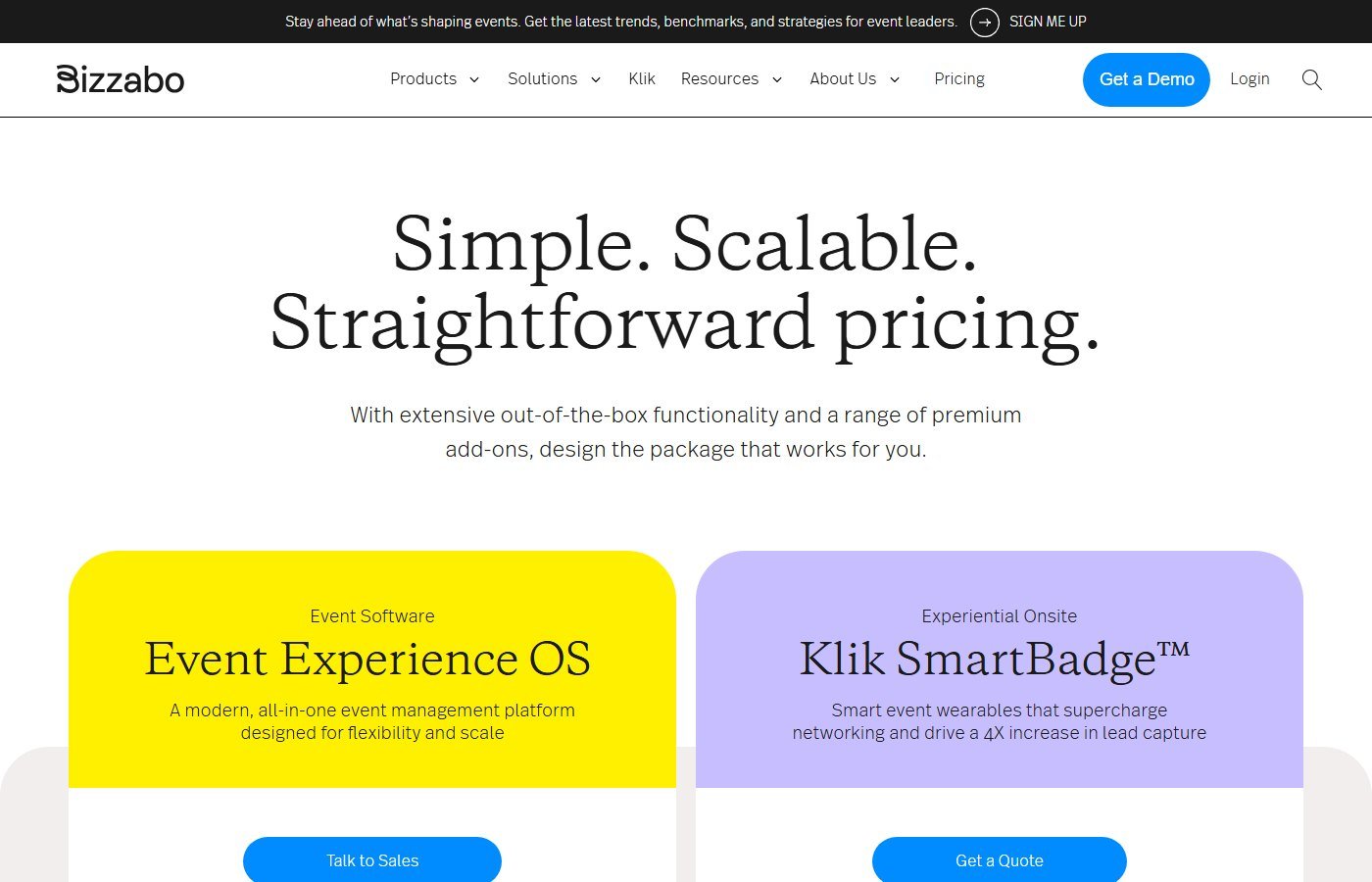
Loaded on 19 August 2026, Bizzabo’s pricing page publishes this:
| Product | Price | Terms |
|---|---|---|
| Event Experience OS | $499 per user per month | Billed annually, three user minimum |
| Event Experience OS | Starting at $17,999 per year | Billed annually, three user minimum |
| Klik SmartBadge | Quote only | Single and multi-event pricing available |
Both figures are on the same page, presented together.
This is worth correcting loudly, because the “quote-only” reputation has a practical cost. Buyers screening vendors on whether pricing is public are excluding Bizzabo on a false premise, and comparison tables that mark it as unpriced are misinforming exactly the people trying to shortlist.
The two numbers do not quite multiply
$499 per user, three users, twelve months, is $17,964. The stated floor is $17,999. A gap of $35.
We are not going to pretend to know why. It is most likely a rounded marketing figure rather than a line item, but we have not confirmed that and we are not going to assert it. What matters for your budget is that both numbers are published and they agree to within a rounding error: the entry point for Bizzabo’s core platform is about eighteen thousand dollars a year.
What $499 per user actually buys
From the same page, the Event Experience OS tier includes unlimited events and unlimited registrations, contact management, ticketing and registration, email campaigns, an event website builder, advanced registration flows, the mobile app, reporting and analytics, curated onboarding, tiered customer support and 24/7/365 support.
Two things are worth pulling out, because they change how the price behaves for different buyers.
Unlimited events at a per-user price is a different shape
Cvent, Whova and OneCause all price against event count, attendee count or funds raised in some form. Bizzabo prices against how many of your staff use it.
That inverts the usual maths. If you run many events with a small core team, the cost per event falls every time you add an event, and it falls fast. A three-seat team running four events a year is paying roughly $4,500 per event in platform cost. The same team running twenty events is paying roughly $900 per event. Nothing about the contract changes.
If you run one large event with a big cross-functional team touching the platform, it works the other way. Twelve people needing logins for a single annual conference is roughly $71,856 a year for one event.
So the question that determines whether Bizzabo is expensive is not how big your events are. It is the ratio of events to seats.
The three user minimum is the real floor
Not the $499. A two-person events team still pays for three seats, so the practical entry price is $17,964 regardless of how small you are.
This is the detail that makes Bizzabo unsuitable for small organisations even though its per-seat rate looks approachable. There is no route in below about eighteen thousand dollars.
The Klik hardware is the quote-only part
Klik SmartBadge, the wearable networking and lead-capture hardware, carries no public price. The page says single and multi-event pricing is available and directs you to a quote.
This is almost certainly the bit that created the “Bizzabo is quote-only” reputation. It is accurate about Klik and wrong about the platform, and somewhere along the line the two got merged.
Budget for it separately and treat it as genuinely unknown. Event hardware is usually priced per unit or per event, and it is the line item most likely to move a total well beyond the $17,999 floor. Bizzabo markets Klik on a claimed 4x increase in lead capture, which tells you it is positioned as a value-add with pricing to match rather than as a commodity accessory.
What to ask for in a quote
Confirm the user count you actually need, since seats are the entire pricing axis. Then ask who counts as a user: full administrators only, or anyone with a login, including someone who only pulls reports. The answer can double your bill.
Ask what happens mid-contract if you add seats, and at what rate. Adding a seat in month seven of an annual agreement should be pro-rated, and you want that in writing.
Ask whether seats are named or floating. If a seat is tied to a named individual, seasonal staff and contractors each need their own. If seats float, a small team can share access across a wider group.
Get Klik quoted per event and per unit, and ask about badge reuse across events. Reusable hardware amortised over a programme is a very different cost from single-use per event.
Ask which premium add-ons are excluded. The page references optional capabilities without pricing any of them, which is where the published-pricing transparency stops.
Ask about the annual uplift at renewal. Annual billing is mandatory here, so renewal terms are the whole negotiation. A capped uplift is worth more than a first-year discount.
Ask whether unlimited really is unlimited. Unlimited events and registrations is a strong claim. Check for fair-use language in the contract, particularly around registration volume.
Bizzabo against the category
Six platforms captured 19 August 2026.
| Platform | Publishes a price? | Entry |
|---|---|---|
| Little Green Light | Complete public table | $45/month up to 2,500 constituents |
| Donorbox | Yes, in depth | $0 Standard, $150/month Pro |
| Bizzabo | Yes | $499/user/month, from $17,999/year |
| Cvent Event Design | Yes, with a buy button | Free, $49, $150, $320 a month |
| OneCause | Partial, behind accordions, two pages disagree | $200 or $500 |
| Whova | No | none published |
| Cvent platform | No | none published |
The comparison that actually helps
Against Cvent specifically, the useful contrast is not the number, it is the shape. Vendr puts mid-market Cvent buyers at $30,000 to $150,000 a year, largely because Cvent’s per-event modules scale with what you run. Bizzabo’s published floor is roughly $18,000 and scales with seats.
For a buyer running a high volume of events with a lean team, that structural difference matters more than any discount either vendor offers. For a buyer running one flagship event with a large internal stakeholder group, it points the other way.
The seats-to-events model, worked out
Because seats are the only variable, you can model Bizzabo exactly, which is rare in this category. Platform cost only, at list price, no negotiated discount.
| Seats | Annual platform cost | Cost per event at 4 events | at 12 events | at 30 events |
|---|---|---|---|---|
| 3 (minimum) | $17,964 | $4,491 | $1,497 | $599 |
| 5 | $29,940 | $7,485 | $2,495 | $998 |
| 8 | $47,904 | $11,976 | $3,992 | $1,597 |
| 12 | $71,856 | $17,964 | $5,988 | $2,395 |
Read down a column and you see the seat problem. Read across a row and you see the volume benefit.
The useful comparison is against Vendr’s reported range for Cvent, $30,000 to $150,000 a year for mid-market buyers running 20 to 50 events. A three-seat Bizzabo team running 30 events sits at roughly $18,000 for the platform, well below that range. An eight-seat team running four events sits at roughly $48,000, comfortably inside it while getting far less event volume for the money.
Two practical conclusions. Keep the seat count honest, because every seat is $5,988 a year. And if your event count is low, Bizzabo’s pricing model is working against you and a per-event competitor deserves a look.
Add Klik hardware separately if you need it. It is unpriced and it is the line most likely to move these totals.
Why a published price changes the negotiation
There is a second-order benefit to Bizzabo publishing that is worth naming, because it affects what you can actually achieve in a procurement process.
When a vendor publishes a floor, you know what the discount is measured against. A quoted $24,000 against a published $17,999 floor is a conversation about what the extra $6,000 buys. The same $24,000 from a vendor with no public price is unanchored, and you have no way of knowing whether it is generous or twice what the last buyer paid.
It also means you can be turned down cheaply. If $18,000 is out of reach, you know that in five minutes rather than after three calls and a demo. That is a real courtesy to small buyers even though it reads as a rejection.
The limit of that transparency is worth stating too: the add-ons are not priced, and Klik is not priced. So the published floor tells you where the platform starts, not where your contract lands.
Who Bizzabo’s pricing suits
It suits teams running a continuous programme of events with a small number of platform users, where unlimited events and registrations turn a fixed seat cost into a steadily falling cost per event. Marketing teams running field events, roadshows and webinars at volume are the clearest fit.
It does not suit an organisation running one annual conference, where roughly $18,000 buys a single event’s worth of value and a per-event competitor will almost certainly come in lower. It also does not suit a large team where many people need direct access, because seat count drives the bill up quickly and there is no viewer-only tier published.
And it does not suit anyone whose budget cannot absorb $18,000, full stop. The three-seat minimum means there is no smaller version of this product.
Method and limits
Bizzabo’s pricing page was loaded on 19 August 2026 and every collapsed control was expanded before reading. The capture ran from an Indian IP; Bizzabo served its US site in USD with no locale redirect.
The cost-per-event and multi-seat calculations above are our own arithmetic on Bizzabo’s published rates. They are sizing guides, not quotes, and they assume no negotiated discount, which for an enterprise contract at this level is an unlikely assumption.
We have not used Bizzabo. This is document research, and the headline figures are quoted from the vendor’s own published page on the date stated.
For the comparison buyers actually make, see Cvent vs Bizzabo, plus Cvent pricing and Whova pricing.

Written by
FazFaz is the founder of AIToolsBakery. Some tools here are tested hands on. Others are assessed from vendor documentation and pricing verified on the live page, and every review says which one it is. Sponsors can buy a position in a guide. They cannot buy the score, the criticism, or silence about a better option.
How we test and how we make money →