What Cvent’s pricing page actually contains
We loaded Cvent’s official pricing page on 19 August 2026, reaching it through the link in Cvent’s own homepage navigation rather than by guessing a URL. The page returned 9,023 characters of content under the title “Cvent Pricing | Request a Quote”.
The verdict on whether the product justifies the number is a separate question, and it lives in our Cvent review.
It contains no prices. Not a starting figure, not a range, not a per-user rate. The headline reads “Pricing designed for how you work” and the call to action is “Get a quote”.
That is worth stating plainly because a large number of pages ranking for this query imply otherwise, and because the two claims “we could not find a price” and “there is no price published” are very different. The first describes the person searching. The second describes the vendor. This is the second.
Why this matters more than it used to. When a vendor publishes nothing, the answer engines still have to answer the question. They assemble a figure from whoever did publish one. For Cvent, that is mostly competitors, resellers and procurement platforms, each with their own reason for the number to look the way it does. The absence of an official figure does not create silence. It creates a vacuum that gets filled by people selling something.
The verifiable figures, and where each comes from
None of these are Cvent’s own published prices, because Cvent has none for the platform. Each is attributed so you can weigh it yourself.
| Source | What it says | What kind of source |
|---|---|---|
| Stanford University IT | Level A, 12 months, single licence, $1,866 per user. Level B, 8 months, $1,480 per user. Level C, 4 months, lower again. | A customer publishing its own negotiated rate card |
| Vendr | $30,000 to $150,000 a year for mid-market buyers running 20 to 50 events annually | Procurement marketplace with contract data |
| Software Finder | Typically starts at $10,000 a month. OnArrival 360 $3,000 to $25,000+ per event. Attendee Hub 360 $5,000 to $30,000+ per event. | Software directory |
| RegFox | Cvent PayGo at $3.95 + 1.95% per registrant, with no cap | A direct competitor |
The Stanford number is the one nobody cites
Stanford University’s IT department publishes a rates page for the Cvent licences it resells internally to departments. It lists $1,866 per user for a twelve-month single licence, $1,480 for eight months, and a lower four-month tier.
This is unusual and useful. It is a real institution publishing what it actually pays, under the kind of disclosure norms a public-facing university operates by, rather than a vendor estimating what a rival charges. It is also the only figure in that table that is a per-user licence rate rather than a modelled annual contract, which makes it the only one you can sanity-check your own quote against on a like-for-like basis.
Three caveats before you use it as a benchmark.
It reflects an education agreement. Higher education pricing in enterprise software is routinely well below commercial rates, and sometimes structured completely differently.
It reflects Stanford’s volume, not yours. A university buying licences centrally and distributing them across departments is negotiating as a large single account.
The shorter tiers cost more per month, not less. $1,866 over twelve months is $155.50 a month. $1,480 over eight months is $185 a month. If your events are seasonal and you assumed a part-year licence would save proportionally, it does not.
Treat it as a floor-shaped data point. It tells you the per-seat licence exists as a construct and roughly what order of magnitude it sits at. It is not a price you can walk in and buy.
How the fee stack works
Cvent is not one product. The figures above disagree partly because buyers are quoting different combinations of it. Broadly there are three layers, and knowing which one a quoted number refers to is most of the battle.
Platform licence. The core event management software, sold per user, annually, with a commitment. Stanford’s per-user rate sits here. This is the layer that behaves most like traditional enterprise software: you are buying seats for the people who build and run events, not capacity for the events themselves.
Per-event modules. OnArrival for on-site check-in, Attendee Hub for the attendee app, and similar. These are quoted per event or per event programme, which is where Software Finder’s $3,000 to $30,000+ per event ranges come from. This is the layer that scales with what you actually run, and the layer most likely to surprise you in year two if your event count grows.
Pay-as-you-go registration. A per-registrant route for organisations that do not want an annual licence. RegFox, a competitor, reports this at $3.95 + 1.95% per registrant with no cap. Cvent does not publish it. The uncapped part is the detail worth checking: on a 2,000-person event at a $300 ticket, an uncapped 1.95% plus $3.95 per head works out near $19,600, which is a different proposition from the same fee on a 200-person event.
A mid-market buyer paying $30,000 to $150,000 a year is usually combining the first two. Which is why “how much is Cvent” has no single answer, and why a quote that looks cheap can be a platform licence with the modules stripped out.
Working out roughly where you would land
Cvent will not give you a number without a conversation, but you can arrive at that conversation with a defensible estimate. Take the two published anchors and work between them.
Start from seats, not events. If Stanford’s $1,866 per user is directionally right for a negotiated rate, then a five-person events team is looking at something in the region of $9,000 to $10,000 a year for platform licences alone before any commercial uplift. Assume a commercial rate is higher.
Add modules per event. Using Software Finder’s ranges, a single significant event with on-site check-in and an attendee app carries $8,000 to $55,000 of module cost depending on scale. Most organisations do not buy the top of that range.
Sanity-check the total against Vendr. If your working number lands far outside $30,000 to $150,000 and you are a mid-market buyer running twenty-plus events, one of your assumptions is wrong.
This will not give you a quote. It will tell you whether Cvent is plausibly in your budget before you spend three weeks in a sales process finding out it is not, which is the actual question most people searching this term are asking.
What to ask for in a quote
Since there is no list price, the quote is the price, and what you ask for determines what you pay. Ask for all of these in writing.
The per-user rate and the user minimum, separately. A low per-user rate with a high minimum is not a low price. Ask explicitly who counts as a user: full administrators only, or anyone who needs a login to pull a report.
Which modules are in the base and which are quoted separately. Check-in and the attendee app are the two that most often arrive as separate line items after the headline number has been agreed. Get the full module list priced, including the ones you do not think you need, so you know what adding them later costs.
The commitment length and the renewal uplift. Annual commitments are standard here. The number that matters is not year one, it is what year two costs, and whether the uplift is capped.
Whether registration fees apply on top of the licence, and whether there is a cap. If the per-registrant route is uncapped, as RegFox reports, then a successful event costs you more in a way that is not obvious at signature.
What happens if you exceed your forecast event count. Event counts are a common overage trigger and the overage rate is rarely as favourable as the contracted rate.
Whether unused licences can be reallocated. If you buy seats for a seasonal team, ask whether a seat can move between people mid-term or whether it is tied to a named user.
Who Cvent’s pricing suits
It suits organisations running a large, continuous programme of events where the software cost is small next to the event budget, where procurement can absorb an annual commitment and a negotiation cycle, and where the breadth of the platform genuinely gets used. If you are running forty events a year and your alternative is four separate tools stitched together, the consolidation argument is real and the price starts to look reasonable per event.
It does not suit anyone running one or two events a year, where the annual licence is amortised across almost nothing. It does not suit anyone who needs to know the cost before speaking to a salesperson, which includes most small nonprofits, most first-time organisers and anyone whose budget approval process requires a published figure before a meeting can be booked. For those buyers the absence of a public number is itself the answer, and it is not a hostile one: Cvent is not trying to sell to them.
There is a middle case worth naming. Organisations running six to twelve substantial events a year are the ones for whom this genuinely needs modelling, because that is where the per-event cost of a platform licence crosses over against buying point solutions per event.
Cvent against the rest of the category
Across six major event and fundraising platforms captured on the same day, only one publishes a complete price you can act on without contacting sales.
| Platform | Publishes a price? | Entry figure |
|---|---|---|
| Little Green Light | Complete public table | $45/month up to 2,500 constituents |
| Donorbox | Yes, in depth | $0/month Standard, $150/month Pro |
| Bizzabo | Yes | $499/user/month, 3 user minimum, from $17,999/year |
| OneCause | Partial, behind FAQ accordions | $200, though a second OneCause page says $500 |
| Whova | No | none published |
| Cvent platform | No | none published |
Cvent and Whova are the two that publish nothing at all for their core product.
Cvent does publish prices. Just not for the thing you came here about.
This is the part that undercuts the bespoke-deal explanation, and it comes from Cvent’s own site.
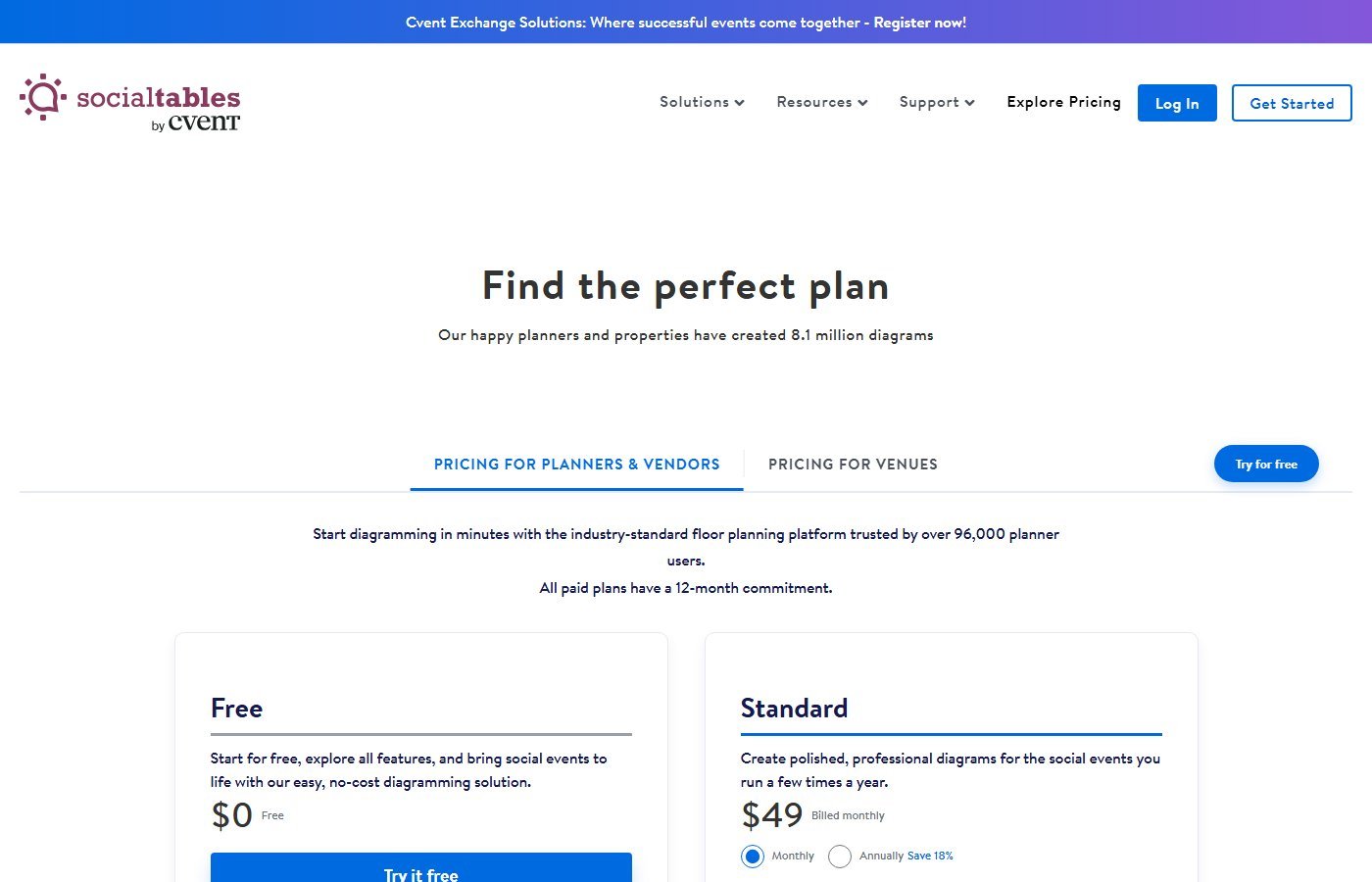
Cvent Event Design, the diagramming and floor-plan product, has a full public pricing page with tiers, an annual discount, a free plan and a Buy It button. Captured 19 August 2026 and re-verified 22 August 2026, unchanged:
| Plan | Price | What you get |
|---|---|---|
| Free | $0 | 1 user, 3 events, 2 diagrams per event, 150 attendees per list |
| Standard | $49/month, save 18% annually | 1 user, 15 events, 3 diagrams per event, core diagramming |
| Pro | $150/month, save 17% annually | 1 user, 50 events, advanced diagramming |
| Premium | $320/month, save 9% annually | 1 user, unlimited events, diagrams and attendees |
| Enterprise | Tailored plan, quote only | Multi-user, multi-client portfolios |
So the same company, on the same domain, publishes a self-serve price list with a checkout for one product and a quote form with no numbers for the other.
That tells you the silence on platform pricing is a commercial choice about how enterprise deals are sold, not a technical impossibility. Which is fine, and worth knowing before you book the call.
One more thing, and it is stranger than the pricing itself
That pricing page is not on cvent.com.
It lives at socialtables.com/pricing, because Social Tables is the product Cvent acquired and Event Design is what it became. On 22 August 2026 we checked the obvious paths on Cvent’s own domain: cvent.com/en/event-diagramming returns a 403, and cvent.com/en/event-diagramming/pricing returns a 404.
So a buyer sitting on Cvent’s website, looking for the price of a Cvent product, will not find it. They have to already know that Social Tables is Cvent, then go to a different domain.
Which means the comparison is not quite “Cvent publishes pricing for one product and not the other”. It is closer to “Cvent publishes pricing for one product, on a domain that does not carry the Cvent name, and nothing at all on the site that does”. Whatever the internal reason, the effect on a buyer is the same as not publishing.
It also has a practical consequence. If what you actually need is event diagramming and seating, you can buy it today for $49 a month without speaking to anyone. A meaningful number of people searching for Cvent pricing want the floor-plan tool rather than the event platform, and the tiering is generous: fifteen events a year on Standard, fifty on Pro. Note the single-user limit on every self-serve tier, which is the constraint that pushes teams to Enterprise.
Method and limits
Cvent’s pricing page was loaded on 19 August 2026, reached from the link in Cvent’s own homepage navigation. An earlier guessed URL returned 404 and was discarded rather than reported as a missing page, because a guessed URL that fails tells you nothing about the vendor. Every accordion and collapsed control on the page was expanded before the text was read, since collapsed content is invisible to a plain read and we have found real prices hiding behind accordions elsewhere in this same batch.
The capture ran from an Indian IP address. Cvent served the en/US site with no locale redirect and no currency selector, but any vendor can serve regional pricing, so treat these as US-facing figures.
We have not used Cvent, and nothing here is a hands-on assessment. Third-party figures are attributed to their source and were not independently audited. Where a source is a direct competitor, we have said so, because it is relevant to how much weight the figure deserves.
Also in this batch: Bizzabo pricing, which does publish a floor, and Whova pricing, which publishes nothing at all. For the head to head, see Cvent vs Bizzabo.

Written by
FazFaz is the founder of AIToolsBakery. Some tools here are tested hands on. Others are assessed from vendor documentation and pricing verified on the live page, and every review says which one it is. Sponsors can buy a position in a guide. They cannot buy the score, the criticism, or silence about a better option.
How we test and how we make money →