
Quick Answer: Fitbod ($12.99/mo) targets general gym-goers who want smart personalised workouts. JuggernautAI ($35/mo) targets serious strength and Olympic lifting athletes who want periodised auto-regulation. They barely compete. pick Fitbod for general fitness, JuggernautAI if you compete in strength sports.
Head-to-head comparison
| Fitbod | JuggernautAI | |
|---|---|---|
| Monthly price | $15.99 | $34.99 |
| Annual price | $79.99/yr | $349.99/yr |
| Best for | General fitness, recovery variety | Competitive/serious powerlifting |
| Training focus | Full body, all movement patterns | Squat, bench, deadlift only |
| Exercise approach | Rotates based on recovery | Same exercises, periodized blocks |
| Progressive overload | Recovery-managed rotation | RPE/MRV block periodization |
| Competition peaking | No | Yes (set competition date) |
| Beginner-friendly | Yes | No (requires RPE knowledge) |
| Equipment flexibility | Excellent | Limited (barbell primary) |
| Community/coaching | No | Weekly Q&A with coaches |
| Android support | Yes | Yes |
| Free trial | ~25 free workouts | 2 weeks |
Last updated: April 22, 2026.
Related: See also: Full Fitbod review | Full JuggernautAI review | Best AI workout apps 2026
The honest framing
Most “Fitbod vs JuggernautAI” articles do a feature comparison and then declare a winner. That framing is misleading because these apps are not trying to do the same thing.
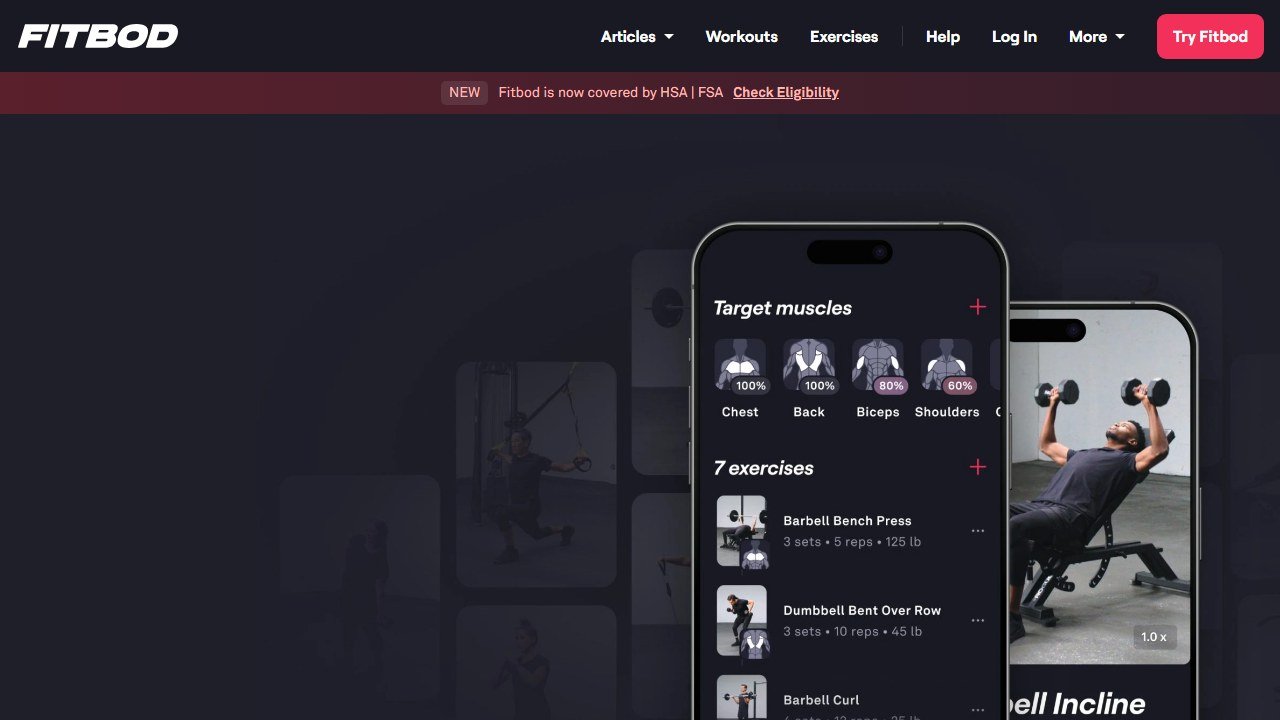
Fitbod is a recovery management tool with a workout delivery layer. It tracks how fatigued each muscle group is and generates sessions that balance training stimulus against recovery state. If your goal is to stay active, look better, and not think about programming. Fitbod.
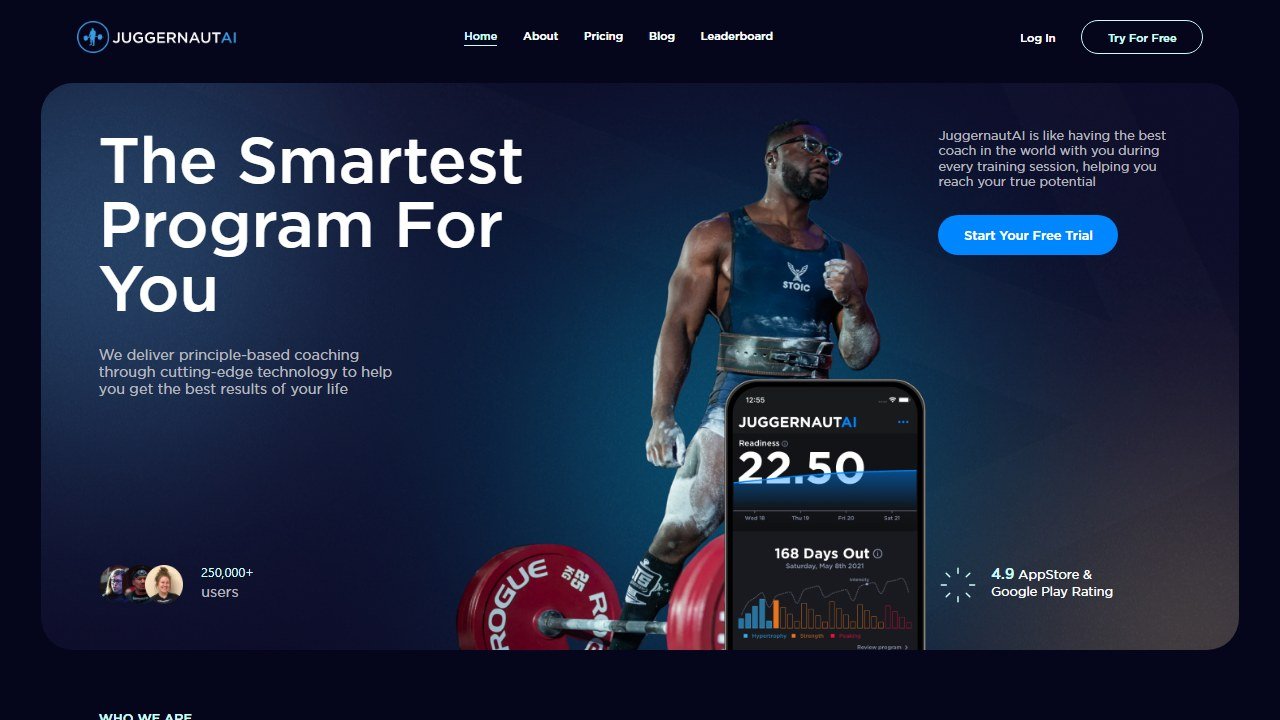
JuggernautAI is a periodized powerlifting coaching methodology delivered through software. It uses RPE (Rate of Perceived Exertion), MRV (Maximum Recoverable Volume), and block periodization to structure training across multiple weeks and peak you for a competition. If your goal is to squat, bench, and deadlift as heavy as possible on a specific date. JuggernautAI.
You shouldn’t be comparing these unless you’re in a specific edge case. We’ll cover that edge case later.
Fitbod: who it’s actually for
Fitbod works for people who answer yes to most of these:
- I go to the gym 3-4 times per week but don’t follow a specific program
- My goal is general fitness, looking better, and staying healthy
- I train in different gyms or environments with different equipment
- I don’t have specific strength goals on specific lifts
- I’d rather open an app and follow what it says than think about programming
Fitbod’s algorithm tracks muscle recovery across your recent training history and generates the next session based on what’s ready to train. This prevents overtraining certain muscle groups and keeps variety in training. both of which support general fitness goals.
Where Fitbod falls short: Progressive overload on specific movements. If you want to get your bench press from 80kg to 100kg, Fitbod is the wrong tool. Its exercise rotation means you won’t consistently bench press often enough or in a structured enough way to drive that specific adaptation.
Price: $15.99/mo or $79.99/yr.
JuggernautAI: who it’s actually for
JuggernautAI works for people who answer yes to most of these:
- I compete in powerlifting, or I train specifically to maximize squat, bench, and deadlift
- I train 4-6 days per week with defined strength goals
- I understand RPE. I can accurately gauge a set as “RPE 7” versus “RPE 9”
- I want periodized training that peaks me for a specific competition date
- I’m willing to log every set honestly for the feedback system to work
Chad Wesley Smith’s Juggernaut Method uses MRV to calculate how much volume you can absorb before recovery breaks down, then structures training blocks to build into and then peak from that ceiling. This is how elite powerlifters train. Most AI workout apps ignore this framework entirely.
Where JuggernautAI falls short: It’s exclusively focused on squat, bench, and deadlift. If you want upper body aesthetics work, running, or general conditioning alongside powerlifting, JuggernautAI does the powerlifting part well and doesn’t offer the rest. It’s also not for beginners. the RPE system requires enough training experience to accurately gauge perceived exertion.
Price: $34.99/mo or $349.99/yr.
The one scenario where this is a genuine choice
There is exactly one type of person for whom Fitbod vs JuggernautAI is an actual decision: the recreational lifter who also competes occasionally in powerlifting.
This person trains 3-4 days per week, cares about squat/bench/deadlift but also trains for general fitness, and competes in local meets 1-2 times per year without being a serious competitor.
For that person, neither app is perfect. JuggernautAI is designed for people who treat powerlifting as their primary sport. the volume and structure may feel excessive for a recreational competitor. Fitbod doesn’t do competition peaking or RPE-based programming at all.
The honest answer for the recreational competitor: JuggernautAI if you genuinely prioritize the big three and competition performance, even occasionally. Dr. Muscle if your primary goal is muscle building with some powerlifting. Fitbod if powerlifting is genuinely a secondary interest and general fitness is primary.
Price and value comparison
Fitbod at $79.99/yr ($6.67/mo): Strong value for recreational lifters. For general fitness programming that adapts to your recovery and equipment, this is the best-priced option in the category.
JuggernautAI at $349.99/yr ($29.17/mo): Strong value specifically for serious powerlifters. The annual plan includes a 30-minute consultation with Chad Wesley Smith (listed at $150+ standalone) and weekly Q&A access with Juggernaut coaches. For competitive lifters, this is significantly cheaper than hiring a human powerlifting coach ($150-300/mo for remote coaching).
For anyone who is not a competitive or serious powerlifter, JuggernautAI’s $349.99/yr price is hard to justify. That’s $270 more per year than Fitbod’s annual plan.
The verdict
If you’re a recreational lifter: Fitbod. Better value, more flexibility, lower cognitive load.
If you’re a competitive or serious powerlifter: JuggernautAI. Better methodology, competition peaking, access to Chad Wesley Smith’s programming system.
If you’re somewhere in between: JuggernautAI if the big three are your primary training focus, even if you don’t compete often. Dr. Muscle if muscle building is primary and strength is secondary.
This is not a comparison where one product wins. It’s a comparison where the right product depends entirely on your goals. Know your goals first.
Related personal trainer & fitness AI guides
Other tools and comparisons we have reviewed in this category:
- best AI workout apps. category overview by use case
- Fitbod review (full). standalone deep-dive
- JuggernautAI review (full). standalone deep-dive
References & further reading
For deeper context on programming, periodization, and training science behind the tools we evaluate:
- NSCA: peer-reviewed strength and conditioning research. evidence-backed programming principles from the National Strength and Conditioning Association
- ACSM physical activity guidelines. official exercise prescription standards from the American College of Sports Medicine
- PubMed sports science database. searchable archive of peer-reviewed studies on resistance training, hypertrophy, and recovery
When to choose Fitbod over Juggernautai
Picking between Fitbod and Juggernautai comes down to four factors: team size, budget, integration needs, and how much customization you want. Use the framework below to map your situation to the right tool.
Pick Fitbod if:
- You’re an individual operator or a small team and you want the fastest setup path.
- Your budget favors a lower entry tier or a strong free plan over premium features you may never use.
- Your existing stack is light, and you prefer a tool that works well out of the box.
- You value simplicity over feature breadth.
Pick Juggernautai if:
- You’re a growing or mid-sized team and you need room to scale without switching platforms.
- You’re willing to pay more upfront for advanced features, integrations, or higher usage limits.
- You already have a mature stack and you need a tool that plugs into it cleanly.
- You’d rather have power and configurability than the simplest possible setup.
What we’d switch for
The most common reasons we see teams move between tools in this category: (1) pricing changes that push the cheaper option out of reach, (2) a missing integration that becomes a daily friction, (3) hitting a usage cap on the lower tier, (4) a feature ship from the alternative that closes a gap users had been working around.
If you can avoid those four switching triggers with your initial pick, you’ve made the right call. If any of them are likely in your first 12 months, plan for them now and pick accordingly.
Bottom line
Fitbod is the more accessible starting point. Juggernautai is built for the stage after you’ve outgrown a simpler tool. Most teams should start with the tool that matches today’s needs and move when (and if) they hit a real wall, not based on what they think they might need in two years.
Key Takeaway
Fitbod is the better pick for gym-goers who want smart workout suggestions without a steep learning curve. JuggernautAI suits intermediate to advanced lifters who follow structured periodization. If progressive overload and sport-specific programming matter to you, JuggernautAI is worth the higher price point.
The final pick by lifter profile
Recreational lifters who want adaptive programming without writing their own routines: pick Fitbod. The price is reasonable, the AI is mature, and the program scales to general fitness goals well. Competitive lifters (powerlifting, strongman, weightlifting) preparing for meets: pick JuggernautAI. The credentials, periodization depth, and meet-day attempt selection earn the premium price. Intermediate lifters who train recreationally but care about long-term strength: either works; Fitbod is cheaper, JuggernautAI is more rigorous.
The math: Fitbod at $13 a month is around $156 a year. JuggernautAI at $35 a month is around $420 a year. The price gap is meaningful for casual users but trivial for serious competitive lifters whose meet results depend on programming quality.
What software should cost as a share of coaching revenue
The useful test is not whether a platform is cheap but whether it is a sane fraction of what it helps you earn, and that arithmetic is straightforward in this business.
Work it out per client, per month
At 20 clients on Everfit billed annually you are paying $41 a month, which is about $2.05 per client. If your average client pays $150 a month, software is roughly 1.4% of revenue. At the same roster on FitBudd’s $79 tier it is $3.95 a client, or 2.6%. Both are defensible. What is not defensible is paying a per client rate that approaches a meaningful share of what each client pays you, and that happens most often on the entry tiers where marginal rates are highest.
The branded app question is a business decision, not a software one
My PT Hub publishes a custom branded app at $95 one-time and a white label app at $145 a month. FitBudd’s own-app tier is $149 for 20 clients with a $100 setup fee. A branded app is worth it if you are selling to your own audience at scale and the app is part of the product you charge for. It is not worth it if you have 15 clients who already message you on WhatsApp, however good it looks.
Price the tier you will be on in six months
Coaching rosters grow in steps rather than smoothly, usually after a launch or a referral run. Buying for today’s client count and re-evaluating quarterly is fine; buying an enterprise tier for a roster you hope to have is how coaches end up paying for capacity they never use. The published ladders in this category make it easy to model both, so model both.
What the platform does not fix
Software does not sell coaching. If your constraint is that you have twelve clients and want thirty, no feature on any of these pages changes that, and the money is better spent on whatever actually brings people in. Buy a platform when delivery is the bottleneck, not when demand is.
Client retention, and the small number of things that actually move it
Coaching businesses live and die on retention rather than acquisition, and this is where software genuinely helps, though not in the way the feature lists suggest.
The check-in is the product
Clients renew because they feel seen, and the single highest leverage feature in any of these platforms is whatever makes a consistent, personal check-in easy to deliver at scale. Everything else is secondary. When evaluating, time how long it takes you to review a week of one client’s data and send something meaningful back, then multiply by your roster. That number is your real capacity.
Automation helps until it is noticed
Automated messaging is the standard feature here and it works right up to the moment a client realises the encouraging note arrives every Monday regardless of what they did. Use automation for logistics, reminders and structure. Keep anything that reads as personal actually personal, because the cost of being caught is the relationship rather than the message.
Watch the first six weeks
Most coaching churn happens early, before habit forms and before results arrive. If your platform gives you an activity view, the one report worth opening weekly is the list of clients who have not logged anything in seven days, filtered to those in their first six weeks. Acting on that list is worth more than any feature comparison.
Measure retention before you change anything
Take your current three month and twelve month retention rates from your own records before switching platforms, because you cannot reconstruct them afterwards and every vendor conversation will otherwise be about features. If retention does not move within two full client cycles, the platform was not the constraint.
How to tell whether the tool was worth it
Fitness software is easy to evaluate honestly because the numbers are countable and small. The reason most coaches cannot say whether a platform helped is that nobody wrote down where they started.
Pick the metric the tool is supposed to move
For a coaching platform it is clients per coach and hours spent on programming and admin per client per week. For a consumer app it is sessions completed per week and adherence over eight weeks. For form checking it is whether you are still filming in month three. Each of those is countable and each needs a figure from before.
Record the time cost this month, before anything changes
Ask yourself or your coaches to log how long programming, check-ins and admin take across one normal week. It takes minutes and it is the only way the time saving is ever provable. Most of the honest value in this category is hours rather than revenue, and hours are measurable in advance and unprovable afterwards.
Give it two client cycles
Retention and adherence move slowly and seasonally. A four week read tells you about novelty rather than value. Judge a coaching platform over at least two full client cycles, and say so at the outset so an unremarkable first month is understood as expected.
Name the result that would end it
Write down before you subscribe what twelve months would have to look like for you not to renew. It converts renewal from a default into a decision, which matters more in a category where the monthly figure is small enough to stop noticing.
Tools mentioned in this guide

Written by
FazFaz is the founder of AIToolsBakery. Some tools here are tested hands on. Others are assessed from vendor documentation and pricing verified on the live page, and every review says which one it is. Sponsors can buy a position in a guide. They cannot buy the score, the criticism, or silence about a better option.
How we test and how we make money →