Search for annotation tools and you mostly find "data labeling" roundups: thirty platforms ranked by how fast they can label a million images for training. That is a real job, but it is not the job here. Evaluating a model is a different task with different requirements, and most listicles quietly conflate the two.
The tools at a glance
The table below is a starting filter, not a verdict. "Pairwise + IAA" means the platform exposes both a side-by-side comparison interface and inter-annotator agreement reporting in some form. A partial mark means one is present, weak, or available only through configuration or export rather than as a first-class feature. Treat it as a prompt to verify, not a score.
| Tool | Open-source or commercial | Best evaluation use case | Pairwise + IAA support |
|---|---|---|---|
| Label Studio | Open source (HumanSignal commercial tier available) | LLM output grading, agent-trace review, RLHF | Yes: pairwise templates, agreement reporting |
| SuperAnnotate | Commercial | Managed end-to-end curation, annotation, evaluation | Yes: built into the platform |
| Labelbox | Commercial | Enterprise all-rounder with model error analysis | Yes: model-diagnostics and agreement tooling |
| Encord | Commercial | Multimodal data, regulated and audit-heavy domains | Yes: evaluation and error analysis |
| CVAT | Open source | Computer-vision QA across images, video, 3D | Partial: strong consensus, IAA less central |
| Kili Technology | Commercial | NLP grading, ranking, RLHF preference work | Yes: ranking and consensus workflows |
| Scale AI | Commercial (managed service) | Large-scale RLHF and model evaluation, outsourced | Yes, via managed workflows, not self-serve UI |
| Snorkel | Commercial | Programmatic eval-set construction (adjacent) | No: not a human-judgment grading tool |
| Appen | Commercial (managed service) | Outsourced human evaluation workforce | Via managed service, not a self-serve product |
This guide stays scoped to evaluation: tools that support grading model outputs, running pairwise preference comparisons, measuring annotator agreement, and building eval sets. AIToolsBakery has no platform in this space, so what follows is organized the way an ML engineer actually decides: by evaluation use case, mapped to the primitives each tool genuinely supports.
The 30-second answer: Label Studio is the most flexible open-source option and covers LLM evals and agent traces; SuperAnnotate and Labelbox are the strongest commercial all-rounders; Encord suits multimodal and regulated domains; CVAT is the open-source standard for computer-vision QA; Kili leans NLP and RLHF. Choose by your evaluation use case, not labeling throughput.
What evaluation needs that bulk labeling does not
Before the tools, the criteria. A platform built for training-data labeling optimizes for throughput. A platform usable for evaluation needs a different set of primitives, and these are what to check for:
- A pairwise comparison interface, showing two model outputs side by side for an annotator to pick the better one. This is the core of preference evaluation and RLHF.
- Inter-annotator agreement (IAA) metrics, because an eval where annotators silently disagree is not measuring the model, it is measuring noise.
- Multi-annotator consensus workflows, routing the same item to several annotators and resolving disagreement deliberately.
- Eval-set creation and management, building, versioning, and reusing a held-out evaluation set, not just labeling a stream.
- API and pipeline hooks, so evaluation runs as a step in your ML pipeline, not as a manual detour.
A tool can be excellent at labeling and weak at several of these. Rate any platform against this list before its marketing.
It also helps to know that "inter-annotator agreement" is not one number. The right metric depends on the task. For categorical grading with two annotators, Cohen's kappa is standard; for more than two annotators, Fleiss' kappa or Krippendorff's alpha generalize it. For pairwise preference, simple percent agreement plus a chance-corrected statistic is usually enough. Some platforms report a single agreement figure without saying which it is, which is not useful for a technical audience. If IAA matters to your decision, check what the tool actually computes, and be ready to recompute it yourself from raw annotations when the built-in number is opaque.
One more distinction worth holding onto. Some of these primitives are about capturing judgment: the pairwise UI, the rubric forms, the trace viewer. Others are about trusting it: IAA metrics, consensus routing, adjudication queues. A platform that nails the first set and ignores the second will give you a fast eval that nobody should believe. When you scope a tool, score the two halves separately. Capture without trust is just opinion collection.
It is also worth being honest about how fast this category moves. Several vendors below have repositioned in the last 18 months, some adding evaluation features to a labeling product, some narrowing their focus, one being substantially restructured after a large strategic investment. Where a tool's current positioning is genuinely in flux, this guide flags it rather than pretending the picture is settled. Verify anything load-bearing on the vendor's own documentation before you commit budget.
Use case one: LLM output grading and agent-trace review
Evaluating a language model means grading generated text against a rubric, and increasingly reviewing multi-step agent traces rather than single responses.
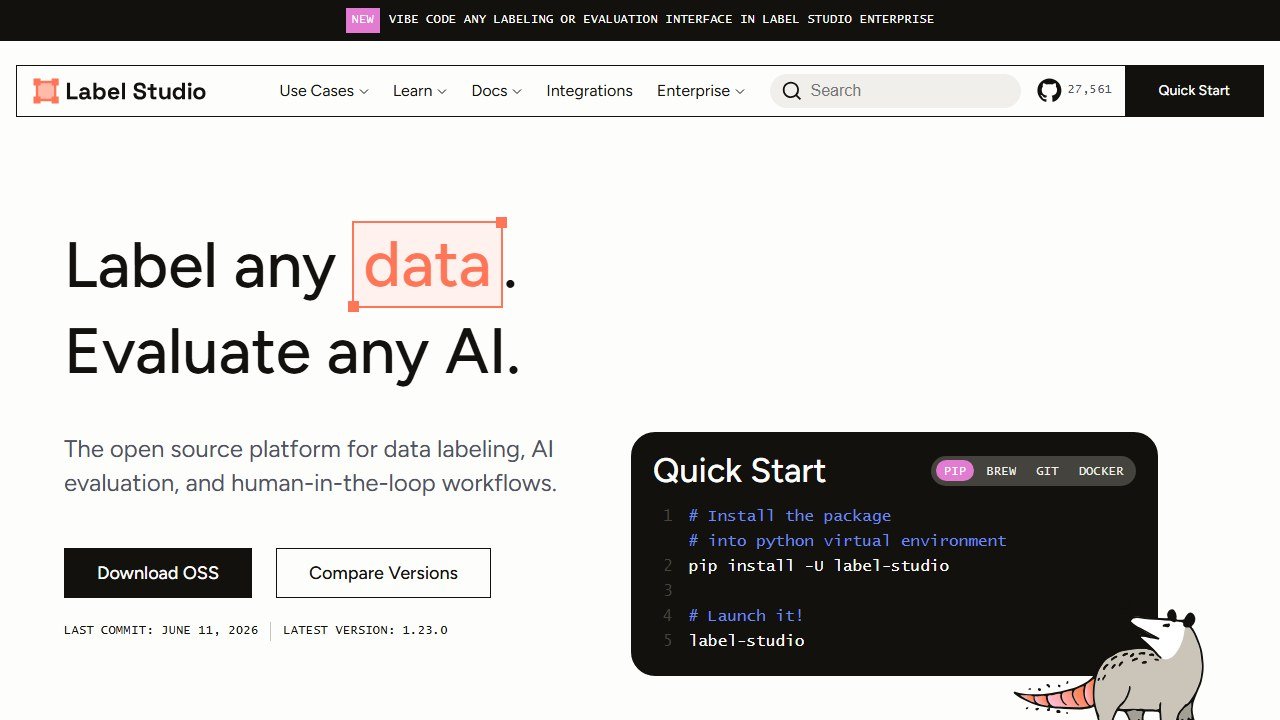
Label Studio is the most flexible option here and is open source, maintained by HumanSignal, which also offers a hosted commercial tier. It handles multimodal data and ships explicit LLM evaluation templates: setups where you provide data and a prompt, the model response is generated into the interface, and annotators grade it against a rubric. More recent work has pushed it firmly into agent evaluation, including importing execution traces from frameworks like LangChain and LangGraph so reviewers can inspect individual reasoning steps, tool calls, and recovery behavior rather than only the final answer. It also covers RAG evaluation and response moderation. For a team that wants control, self-hosting, and no per-seat licence cost, it is a strong default. The tradeoff is that you own the setup and the infrastructure.
SuperAnnotate takes an expert-in-the-loop approach, unifying dataset curation, annotation, and evaluation in one commercial platform. It suits teams that want managed quality and a single vendor relationship rather than self-hosted flexibility. Its evaluation features sit alongside its labeling features, so the same project can move from building an eval set to grading outputs without exporting between tools.
Kili Technology is NLP-focused and built around ranking and preference workflows, which makes it a natural fit for text-output grading specifically. If your evaluation is dominated by language tasks rather than vision, Kili's interfaces are designed for exactly that shape of work.
The decision inside this use case is mostly about how much you want to operate yourself. Label Studio gives the most configurability and the most responsibility. SuperAnnotate and Kili hand you a managed surface and a narrower set of choices, which is the right trade for teams without spare ML-platform engineering time.
Use case two: pairwise preference and RLHF
If your evaluation is reinforcement learning from human feedback, annotators choosing between model outputs to build a preference dataset, the pairwise interface and consensus handling are everything. A weak pairwise UI introduces position bias and rushed clicks; weak consensus handling means you ship disagreement as if it were signal.

Kili is built around these ranking workflows and is a sensible first look for text-preference work. Label Studio supports RLHF-style tasks through dedicated templates, including pairwise comparison and preference collection, and remains the open-source option if you want to own the pipeline.
Scale AI is widely used for large-scale labeling and RLHF and operates as a managed service rather than a tool you self-host. Its Generative AI Data Engine bundles RLHF data collection, human data generation, and model evaluation. If you are evaluating at scale and willing to outsource the human workforce, it belongs on the shortlist. Two caveats for a technical buyer. First, Scale was substantially restructured following a large strategic investment from Meta in 2024 and 2025, and some customers moved away over data-exclusivity concerns; its product lineup and naming have shifted as a result. Second, it is a service engagement, not a self-serve UI you can trial in an afternoon. Confirm the current scope of its evaluation-specific offerings directly with the vendor before assuming a roundup, including this one, is current.
Snorkel belongs in the conversation with a clear caveat: its strength is programmatic data development, creating and curating datasets at scale with labeling functions. That is closer to building an eval set than to running the human-judgment evaluation itself. It is genuinely useful adjacent to evaluation, especially for assembling and weakly labeling candidate eval data, but it is not a pairwise-grading tool and should not be slotted in as one.
For RLHF specifically, decide first whether you are running the workforce or buying it. If in-house, Label Studio or Kili give you the pairwise primitives directly. If outsourced at volume, Scale AI is the established managed option, with the positioning caveats above.
Use case three: computer-vision QA and evaluation
For evaluating vision models, reviewing detections, segmentations, classifications, and edge cases, the requirements shift again. The unit of judgment is a spatial annotation, not a block of text, and the QA pass is often about catching where the model is confidently wrong.
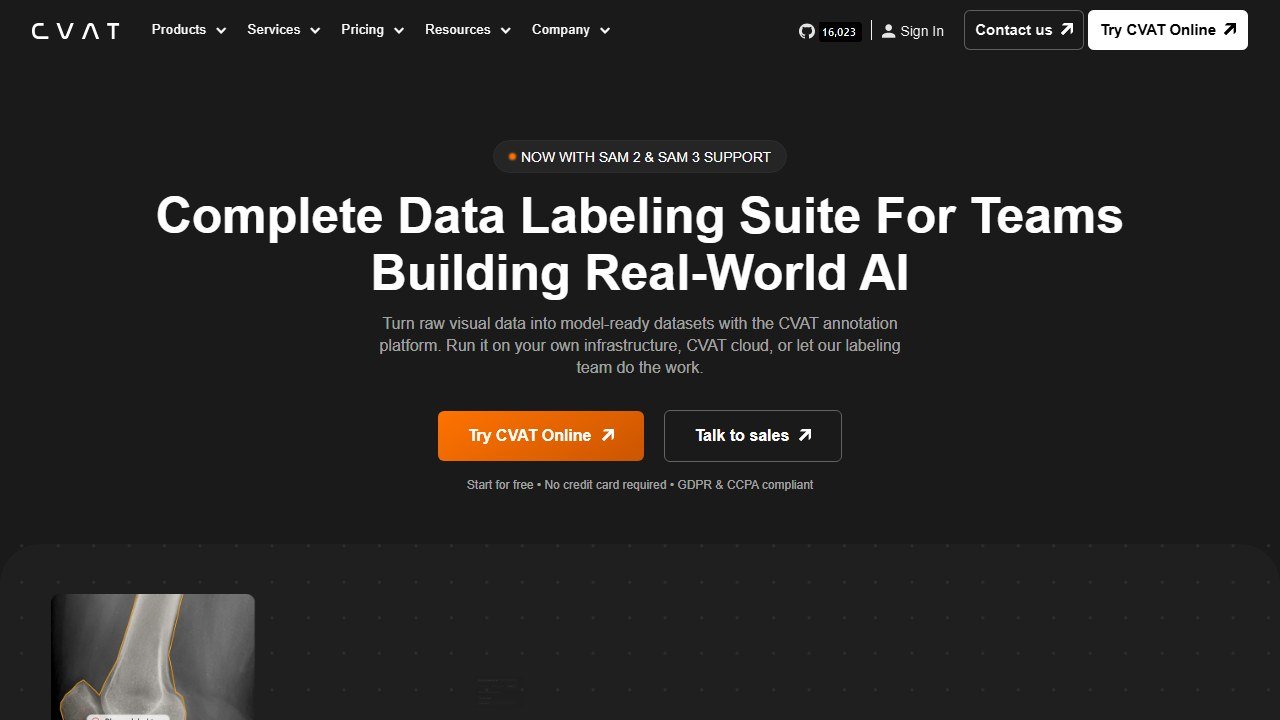
CVAT is the open-source standard for computer-vision annotation across images, video, and 3D, and it is widely used for the QA pass on model outputs. Its consensus and review workflows are mature, which makes multi-reviewer QA practical. Formal IAA reporting is less central than it is in text-grading tools, so if agreement metrics are critical to your process, plan to compute them from exports rather than expecting a polished dashboard.
Encord is a full-stack commercial data platform with model evaluation and error-analysis features. It is the strongest pick for multimodal data and for regulated domains like healthcare, where audit trails, access control, and compliance documentation matter as much as the annotation interface itself. If your evaluation has to survive an audit, Encord's positioning is built for that.
Labelbox is an enterprise platform with model-evaluation and error-analysis tooling built in. Its model-diagnostics features help surface where a vision model fails and cluster those failures, which is useful for turning a raw eval into an actionable error analysis. It is a solid commercial all-rounder for teams that want one platform spanning data labeling and evaluation.
Between the three, the split is straightforward. CVAT if you want open source and own the process. Encord if compliance and multimodal breadth lead. Labelbox if you want enterprise tooling with error analysis as a first-class feature.
A note on the established services
Appen is a long-standing vendor offering data sourcing, labeling, and model-evaluation services. It is relevant if you are outsourcing the human workforce rather than running annotation in-house, and its scale is in the crowd, not in a self-serve product. Treat it as a workforce decision, not a tooling decision.

More broadly, several platforms in this space market evaluation features that are genuinely in flux. Vendors reshuffle product lines, rename offerings, and reposition labeling tools as "evaluation platforms" faster than any roundup can track. If a platform's evaluation product is central to your decision, verify its current capabilities and naming on the vendor's own documentation rather than trusting a comparison article, including this one. This category moves fast, and a confident-sounding listicle is not a substitute for the vendor's current docs.
Common pitfalls when standing up an evaluation workflow
A few failure modes show up repeatedly, independent of which tool you pick.
Treating a labeling tool's defaults as an eval design. Most platforms ship with single-annotator, single-pass settings because that is what bulk labeling wants. An evaluation needs multiple annotators per item and a deliberate adjudication step. If you accept the defaults, you get a fast eval with no measurable reliability.
No held-out, versioned eval set. If your evaluation data drifts every run, you cannot compare model versions over time. Pick a tool that lets you freeze and version an eval set, and actually use that feature. A moving target is not a benchmark.
Skipping a rubric. Annotators asked to pick "the better answer" with no rubric will each invent their own definition, and your IAA will be low for reasons that have nothing to do with the model. Write the rubric, test it on a small batch, and revise it before scaling.
Confusing eval-set construction with evaluation. Tools like Snorkel help you build the dataset. That is upstream of evaluation, not evaluation itself. Keep the two phases, and the two tool choices, distinct.
Not budgeting for the human cost. Whether you run annotators in-house or outsource to a service like Scale AI or Appen, reliable evaluation is labor. The tool is the cheap part. Plan for the people.
Letting the tool become the source of truth. Annotation platforms are good at collecting and storing judgments, but the evaluation result, the scores, the model comparison, the decision, should live in your own analysis layer. Treat the tool as the data-capture surface and export raw annotations into a notebook or pipeline you control. That keeps your evaluation reproducible if you switch tools later, and it stops a vendor's dashboard from quietly defining what "better" means for your model.
Skipping a calibration round. Before a full eval, run a small shared batch where every annotator grades the same items and the team reviews disagreements together. This surfaces rubric ambiguity early, when it is cheap to fix, instead of after you have paid for a thousand inconsistent judgments. Most platforms support this through consensus or review settings; the discipline of actually doing it is the part teams skip.
How to choose
Work backward from the use case:
- Grading LLM outputs or agent traces: Label Studio (flexible, open source) or SuperAnnotate (managed).
- Pairwise / RLHF preference: Kili, Label Studio, or Scale AI at scale.
- Computer-vision QA: CVAT (open source) or Encord / Labelbox (commercial, multimodal).
- Regulated or audit-heavy domains: Encord.
- Outsourced human workforce: Appen or Scale AI.
- Building the eval set itself: Snorkel, then grade in one of the tools above.
Then confirm the platform supports the five evaluation primitives (pairwise UI, IAA metrics, consensus workflows, eval-set management, pipeline hooks) that your specific evaluation actually needs. A practical test before you commit: run a small pilot eval, with multiple annotators on the same items, and check whether the tool makes disagreement visible and resolvable. If it does not, no amount of throughput will save the result. Throughput is a labeling metric. For evaluation, judgment infrastructure is the thing to buy.
For a closer look, see our LangSmith review.

Written by
FazFaz is the founder of AIToolsBakery. Some tools here are tested hands on. Others are assessed from vendor documentation and pricing verified on the live page, and every review says which one it is. Sponsors can buy a position in a guide. They cannot buy the score, the criticism, or silence about a better option.
How we test and how we make money →