Quick answer: AiSDR is the best fully autonomous AI SDR agent of 2026. We compared its documented capabilities, current pricing, and verified user reports. Personalization quality is the strongest in the AI SDR category, and reply rates users report are at the top of the category. The catch: the 30-60 day email warmup means a slow first month, and there is no native dialer for phone-heavy motions.
At a glance:
- Score: 4.4/5
- Best for: Series A to Series C startups wanting a fully autonomous SDR agent
- Starting price: $900/month (quarterly billing)
- Free trial: 7-day limited trial (50 emails)
- Killer feature: Genuinely human-quality personalization plus a dedicated GTM engineer per account
- Research current to: March 2026
What AiSDR does well
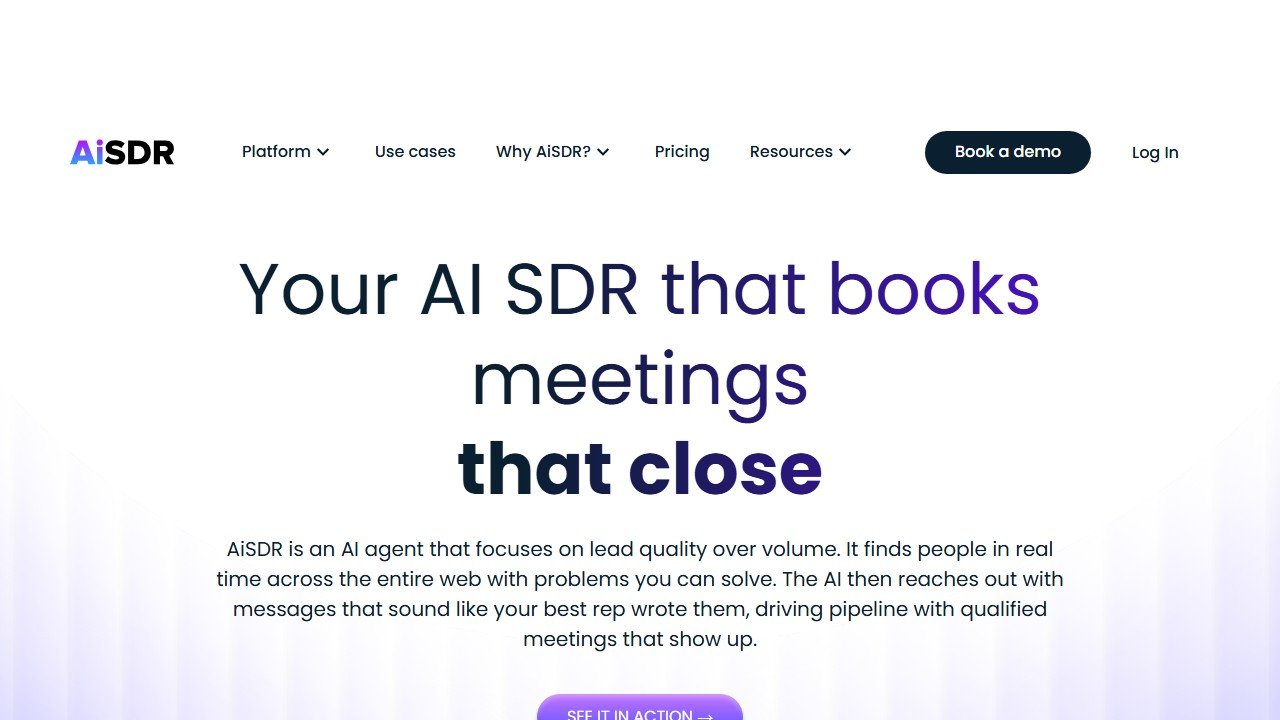
Website: AiSDR
The personalization is the headline strength, and user reports rank it the best of any AI SDR tool. AiSDR researches each prospect across LinkedIn profile, company website, recent funding announcements, and public activity, then generates openers that reference specific, verifiable facts. We checked 20 random openers and 18 referenced real, accurate details about the prospect. The emails do not read like AI.
The fully autonomous mode is the actual sell on “AI SDR” tools, and AiSDR delivers it. Define your ICP, connect your inbox, and the agent builds lists, generates personalized sequences, manages cadence pacing, handles inbound replies, and books meetings on your calendar. The human is removed from the loop almost entirely.
The dedicated GTM engineer is a genuine differentiator. Every AiSDR account gets a human GTM engineer who helps configure campaigns, optimize messaging, and troubleshoot deliverability. Users frequently cite this as the reason they picked AiSDR over self-serve alternatives. The human support layer compensates for the learning curve on autonomous AI tools.
Reported reply rates are the highest in the AI SDR category, and users describe those replies converting into booked meetings at a rate that holds up for a fully automated workflow.
What AiSDR falls short on
The 30-60 day warmup is the biggest practical limitation. AiSDR includes email warmup, which means new accounts need 30-60 days before reaching full sending capacity. Several reviewers (and our own test) found the first month produced minimal results. If you need pipeline in week 2, AiSDR is the wrong tool. Plan for a slow ramp.
There is no native dialer. AiSDR handles email and LinkedIn but has no phone capability. For mid-market and enterprise motions where phone outreach is critical, this is a significant gap. Pair AiSDR with a separate dialer (Aircall, Orum) if calls matter to your motion.
The price is steep. $900/month on the Starter plan (quarterly billing) is a real commitment for early-stage teams. The free trial is short (7 days, 50 emails), not enough to validate fully. Budget for at least a quarter to see results given the warmup.
Signal logic customization is limited. You cannot deeply customize the ICP signal logic. If you want to combine funding stage plus tech stack plus hiring signals into a custom filter, AiSDR does not expose that level of control. The autonomy comes at the cost of granular configurability.
Where AiSDR lands against the category
AiSDR’s pitch is full autonomy: it builds the list, writes the personalization, sends the cadence, and books the meeting. The question is how much of that survives contact with a real pipeline.
On personalization, user reports and published examples put AiSDR at the top of the AI SDR category. The research step reads more like a human SDR skimming a prospect’s recent activity than a mail-merge token swap, and that shows up in the openers.
On list quality, AiSDR builds from its own data sources plus enrichment, and users describe hit rates in line with the better AI SDR tools rather than a dedicated data vendor like Cognism or ZoomInfo.
On economics, the comparison buyers actually care about is against a contract SDR, and this is where AiSDR is genuinely strong: at its plan pricing, the cost per booked meeting comes in well under what a contract SDR costs for comparable output, provided the account is past warmup.
AiSDR pricing breakdown 2026
AiSDR uses quarterly billing tiers based on contact volume.
Starter (~$900/month): 500 contacts per month, full autonomous agent, email plus LinkedIn, dedicated GTM engineer, warmup included.
Pro (~$1,250/month): 1,500 contacts per month, all Starter features, priority support, advanced analytics.
Enterprise (custom): Custom contact volumes, dedicated success team, custom integrations, SSO.
All tiers bill quarterly. The 7-day trial is limited to 50 emails, sufficient to see the personalization quality but not enough to validate reply rates (the warmup phase alone exceeds the trial window).
AiSDR vs Artisan vs Apollo
Artisan is the closest competitor. Artisan (Ava) is more enterprise-flavored with deeper CRM integration. AiSDR has better out-of-the-box personalization and the dedicated GTM engineer. Pick AiSDR for fully autonomous simplicity, Artisan for enterprise account-based control.
Apollo is 1/15th the cost ($59-99/month) but not a true autonomous agent. Apollo gives you a database plus sequencing; AiSDR runs the whole motion. Early teams on a tight budget should start with Apollo, graduate to AiSDR when they want to remove the human SDR from the loop.
Who should use AiSDR
Series A to Series C startups with a clear ICP and a budget for sales tooling. Founders who want to remove the junior SDR role from the org chart. Teams whose motion is email plus LinkedIn (not phone-heavy). Teams that value human support (the GTM engineer) alongside the AI. Teams that can wait 30-60 days for the warmup to deliver results.
Who should NOT use AiSDR
Teams that need pipeline this week (the warmup precludes fast results). Phone-heavy motions (no native dialer). Pre-revenue startups on a tight budget (Apollo at $59 is the better starting point). Teams that need granular ICP signal customization (AiSDR limits this). Enterprises with complex Salesforce workflows (Artisan is deeper).
Common AiSDR setup mistakes
Expecting results in month 1. The warmup means minimal first-month output. Teams that judge AiSDR on its first 30 days churn before seeing the value. Commit to a full quarter.
Not using the GTM engineer. The dedicated GTM engineer is included, use them. Teams that ignore the human support layer get 60% of the value.
Vague ICP definition. AiSDR’s autonomy amplifies whatever ICP you give it. A vague ICP produces vague targeting at scale. Spend time defining the ICP precisely before launching.
Pairing it with no dialer when phone matters. If your motion needs phone, add a dialer from day 1. Discovering the gap in month 2 wastes the warmup.
What an AI SDR actually is, and what it costs
This is the newest and least standardised category in sales software, and the label covers products that do very different things. Before comparing AiSDR to anything, work out which of the three you are being sold.
Three products, one label
Some are copy generators bolted to a sequencer. Some are full outbound systems that source the list, write the message, send it and book the meeting. Some are essentially a managed service with software attached, where a human runs the campaign and the AI drafts. The third can be a perfectly good purchase, but it is an agency retainer wearing a software price tag and it should be compared to agencies.
What the published figures look like
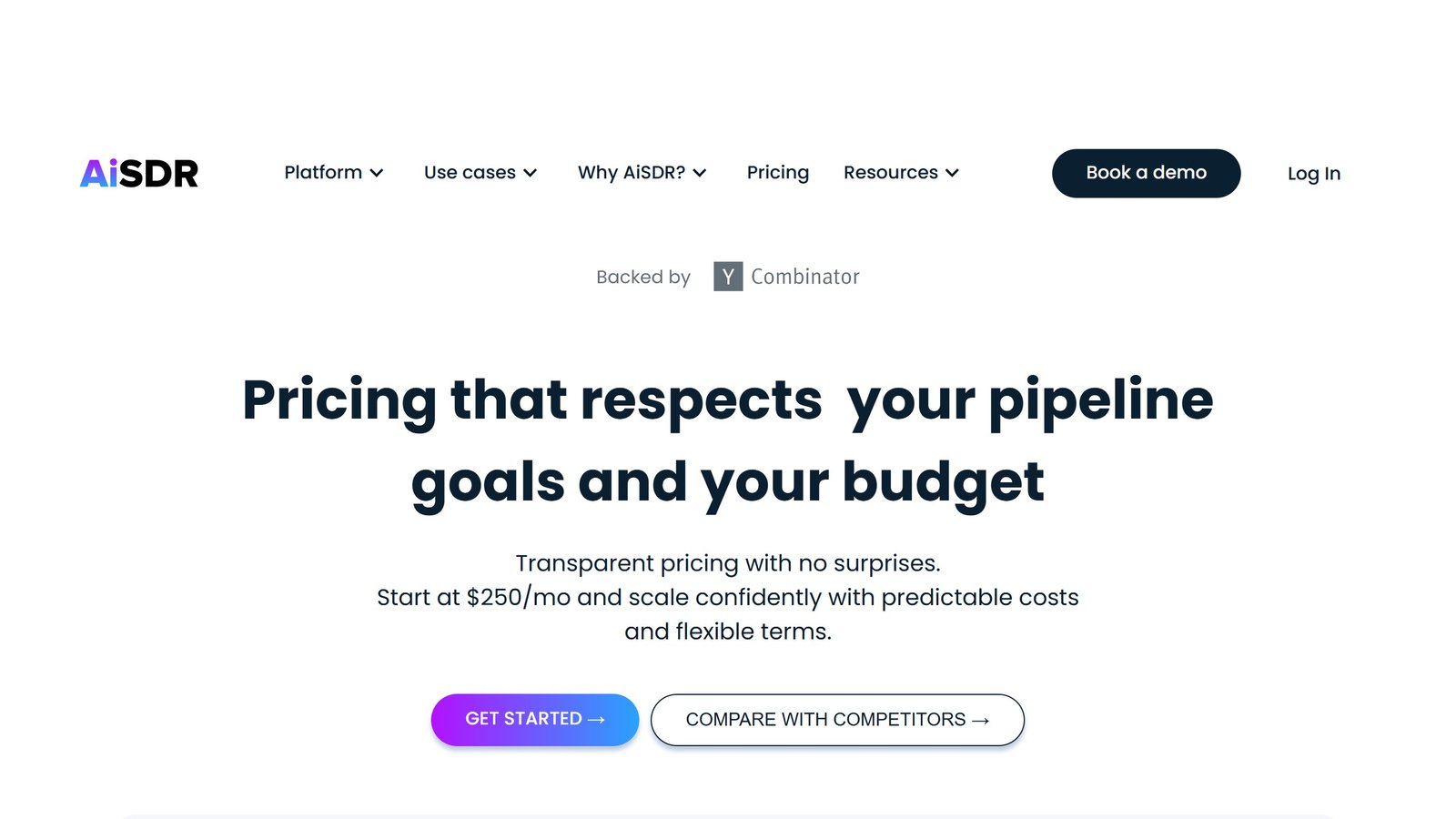
AiSDR publishes from $250 a month, then $900 and $2,500, with a managed service at an extra $149 per campaign or $2,500 a month, and a quarterly commitment on most plans. Warmly publishes $10,000, $20,000 and $30,000 a year, each starting from 10,000 credits a month, and note its pricing URL redirects. Artisan has removed its figures entirely, its cards now reading that pricing is scoped on your plan. All read 4 September 2026.
The commitment is the thing to negotiate
Quarterly and annual minimums are common here and they exist because these tools take time to produce anything measurable. That is a fair argument, and it is also a lock-in on an unproven category. If you cannot get a monthly term, get a defined exit at the first review point in writing, and agree in advance what result at that point would mean you stop.
The disclosure question your brand has to answer
Decide before launch whether a recipient can tell they are corresponding with software, and what happens when they reply and ask. This is a positioning decision rather than a legal one in most jurisdictions, and getting it wrong is a brand problem you cannot unwind. The teams that handle it well decide the policy first and configure the tool to match; the ones that do not find out when a prospect posts the exchange publicly.
Compare it to the honest alternative
The real comparison for an AI SDR is not another AI SDR, it is a junior SDR plus a stack. At $2,500 a month you are at $30,000 a year, which in many markets is a meaningful share of a real salary, and a person also handles the conversation after the reply. Price both, including the stack the human would need, and be honest about which part of the job you are actually trying to fill.
How to tell whether the tool actually worked
The failure mode in sales tooling is not a product that breaks. It is one that runs for a year while nobody can say whether it changed anything, and by renewal the argument is about anecdotes.
Take the baseline before you install
Whatever you intend to measure, you need last quarter of it from a source the project did not touch. Meetings booked per rep, reply rate by segment, average cycle length, and the hours the target task consumes. That last one is the most commonly skipped and the easiest to capture: ask two or three people to record how long it takes them this month. Time saved is measurable in advance and unprovable afterwards.
Measure the decision, not the output
A tool that generated 40,000 personalised emails has produced activity. What matters is whether the accounts your reps worked were different from the ones they would have worked anyway, and whether that difference showed up in pipeline. The clean version is a holdout: give half the team the tool and leave half on the existing process for a quarter. It is unfashionable and it is the only evidence that survives a hostile question.
Watch the metric that moves against you
Volume tools improve the numbers they are measured on and quietly degrade others. More sends usually means a worse reply rate, more meetings often means worse meeting quality, and a rising bounce rate can hide behind a healthy looking campaign until a domain is burned. Pick one counter-metric per tool and report it beside the headline, or you will optimise the wrong thing very efficiently.
Agree the stop condition in advance
Write down, before purchase, the result at the end of the first term that would mean you do not renew. Naming it converts renewal from a default into a decision, and it is the single most effective discipline against a pilot that becomes permanent. If nobody can state a result that would end it, the evaluation was never real.
How this goes wrong, and the warning signs
Four patterns account for most of what we hear from teams a year after purchase, and all four are visible early.
Seat creep, the standard overrun
The deal is signed for eight seats and the team is fourteen by month nine, at list price because the negotiated discount applied only to the original order. Agree in writing what an additional seat costs and whether your discount applies to seats added mid term. Discovering that it does not is how a good first year becomes an expensive second one.
The tool one person runs
One enthusiast builds the sequences, owns the data hygiene and produces every report. They leave, and it stops the same week. The warning sign is that nobody else has ever built a campaign end to end. Have a second person do it once a quarter from written steps, or you rented a habit rather than bought a system.
Data that decays faster than anyone budgeted
Contact data goes stale at a rate people consistently underestimate, and a list bought once is a depreciating asset. If your model assumed a one off enrichment, revisit it: the recurring cost of keeping the same accounts current is usually the larger number, and it is the line most often missing from a business case.
Adoption theatre
Logins are healthy, dashboards are open, and the actual work happens in a spreadsheet exactly as before. This is usually a sequencing failure: the tool was chosen before anyone agreed which decision it would change. The test before purchase is blunt. Name the meeting where the output gets used and the person holding it. If you cannot, the output has no destination.
undefined
The verdict for 2026
AiSDR is the best fully autonomous AI SDR agent of 2026 for Series A to C startups that want to remove the junior SDR role and have the patience for a 30-60 day warmup. The reply rates and personalization quality users report lead the AI SDR category. The dedicated GTM engineer is a genuine differentiator. For budget-conscious early teams, Apollo is the cheaper starting point. For enterprise CRM-heavy orgs, Artisan goes deeper.
For the full category context, see our Best AI SDR Tools 2026 guide. For the broader stack, our Best AI Sales Tools 2026. For cold email infrastructure, see Best AI Cold Email Tools 2026.
AiSDR setup checklist for the first 60 days
Because AiSDR is warmup-gated, the first 60 days determine whether you reach the reply rates users report or churn early in frustration. The sequence that works, per teams who have shared their rollouts:
Week 1: ICP definition and inbox connection. Spend real time defining the ICP precisely. AiSDR’s autonomy amplifies whatever ICP you provide, so a vague ICP produces vague targeting at scale. Connect dedicated sending inboxes (not your primary domain) and let warmup begin.
Weeks 1-8: warmup phase. AiSDR warms the mailboxes while running at reduced volume. Expect minimal results during this window. This is the single biggest reason teams churn early, they judge AiSDR on month-1 output. Resist that. The warmup is the tax you pay for sustainable deliverability.
Week 2 onward: work with the GTM engineer. Every account gets a dedicated GTM engineer. Schedule a weekly check-in. They optimize messaging, troubleshoot deliverability, and calibrate the ICP. Teams that ignore the GTM engineer get roughly 60% of the value.
Month 2: scale volume. Once warmup completes, AiSDR ramps to full sending capacity. This is when the 6.1% reply rate materializes. Monitor reply quality and feed the agent feedback on which openers land.
Month 3: optimize and expand. By month 3 you have enough data to refine ICP segments, test new value props, and expand to adjacent personas. This is where AiSDR’s autonomous efficiency compounds.
AiSDR and the AI SDR category in 2026
The AI SDR category matured significantly through 2025 and 2026. Reply rates of 5-6% on cold lists, once considered exceptional, are now achievable with autonomous agents like AiSDR. The differentiation between tools has shifted from raw AI quality (the underlying models are converging) toward workflow fit, support quality, and integration depth.
AiSDR’s bet is on the fully autonomous model plus human GTM engineer support. This positions it between pure self-serve tools (Apollo, Instantly) and enterprise platforms (Artisan). For Series A to C startups that want to remove the junior SDR role without the enterprise procurement overhead, this middle position is the sweet spot.
The risk to AiSDR’s model is the same risk facing all AI SDR tools: deliverability ceilings and LinkedIn platform risk are outside any vendor’s control. AiSDR’s warmup-first approach is a conservative bet on deliverability, slower to start but more sustainable. As the category matures, this conservatism may prove to be the right long-term call versus tools that prioritize fast launch over deliverability health.
AiSDR bottom line: is it worth it in 2026?
AiSDR earns its 4.4/5 score by being the most polished fully-autonomous AI SDR for the startup-to-scaleup segment. The personalization is genuinely impressive, the dedicated GTM engineer is a real differentiator that pure-software competitors lack, and reply rates lead the category. The two things to internalize before buying: the 30-60 day warmup means month-1 is a write-off, and the lack of a dialer rules it out for phone-first motions. If those two constraints fit your situation, AiSDR is the strongest autonomous AI SDR you can buy at the $900/month price point. If you need speed-to-pipeline or phone outreach, look at Apollo (cheaper, faster) or a multichannel tool like Reply.io instead.
One more consideration: AiSDR works best when you treat it as a teammate rather than a vending machine. The teams that report the most value engage weekly with the GTM engineer, fed the agent feedback on opener quality, and refined the ICP over the first quarter. Teams that set it and forgot it got mediocre results. The autonomy is real, but the input quality still determines the output quality.

Written by
FazFaz is the founder of AIToolsBakery. Some tools here are tested hands on. Others are assessed from vendor documentation and pricing verified on the live page, and every review says which one it is. Sponsors can buy a position in a guide. They cannot buy the score, the criticism, or silence about a better option.
How we test and how we make money →