The AI sales tools market in 2026 looks nothing like 2024. The category exploded from a handful of established names (Outreach, Salesloft, ZoomInfo) into a sprawl of over 200 tools, all promising AI-powered outbound, conversation intelligence, or signal-based selling. Most of them are noise. About fifteen do real work.
we have reviewed 21 sales tools this quarter across cold email, lead enrichment, conversation intelligence, sales engagement, sales coaching, and roleplay training. This guide ranks the ones that deliver in real-world conditions: a 4-person SDR team running 200 emails a day, a solo founder doing 30 personalized touches, an agency enriching 50 leads weekly, an enterprise team trying to coach 12 reps without burning out the manager.
Below is the honest map of which tool wins which job in 2026, who they are built for, what they cost, and where they break.
A note on price, because it is the question this roundup does not answer. These tools do not price on the same unit, so they cannot honestly share a price column. Salesforce and HubSpot charge per seat, Apollo and Clay per credit, Smartlead and Instantly by email volume, and Outreach, Salesloft, Cognism and ZoomInfo publish nothing at all. We read all eleven pricing pages on the same day in AI sales tool pricing compared.
The 10 best AI sales tools of 2026 at a glance
| Tool | Best for | Starting price | Score |
|---|---|---|---|
| Clay | Personalized list building at scale | $167/mo | 4.4/5 |
| Apollo.io | All-in-one for early teams | $59/mo | 4.3/5 |
| Gong | Revenue intelligence + coaching | Custom (~$1,200/seat/yr) | 4.5/5 |
| Lavender | Cold email coaching for reps | $29/mo | 4.4/5 |
| Smartlead | High-volume cold email infrastructure | $39/mo | 4.3/5 |
| Outreach | Enterprise sales engagement | Custom | 4.2/5 |
| Salesloft | Cadence-driven mid-market teams | Custom | 4.2/5 |
| Chorus | Conversation intelligence (ZoomInfo stack) | Custom | 4.1/5 |
| Instantly | Solo founders + agencies cold emailing | $47/mo | 4.2/5 |
| Fathom | Free meeting notetaker | Free | 4.4/5 |
What the quote-only tools on this list actually cost
Four of the ten publish no price at all, which makes them impossible to budget from their own websites. The best public evidence comes from Vendr, which brokers software contracts and publishes aggregates from its own transaction data. Every figure below was read on 1 September 2026 and comes from Vendr rather than from the vendors.
| Tool | Median annual contract | Contracts in sample | Observed range | Average buyer saving |
|---|---|---|---|---|
| Outreach | $45,600 | 914 | $8,560 to $213,832 | 12% |
| Cognism | $36,000 | 108 | $18,350 to $93,886 | 26% |
| ZoomInfo | $33,500 | 1,571 | $7,200 to $156,000 | 22% |
| Salesloft | $30,740 | 704 | $5,160 to $145,903 | 18% |
Two things are worth taking from that table. The spread inside each row is wider than the gap between the rows, so a per-seat figure quoted anywhere is close to meaningless unless you also know the seat count and the term. And every one of these vendors discounts as a matter of routine, between 12% and 26% on average, which means the first number you are shown is an opening position rather than a rate.
Which of these actually help with ABM and the buying committee
Account-based selling asks a different question of a tool than cold outbound does. It is not “who can I email”, it is “who else is on this account, and where does this deal actually get decided”. Most of the ten are not built for that, and the marketing rarely makes the distinction clear. For the platforms actually built for account-based work, and what each one publishes, see our guide to AI ABM tools. Here, so here is what each vendor states on its own pages.
Outreach is the only one of the ten that ships named buying-committee tooling. Its site describes it plainly: “Build and align stronger buying committees. Identify and engage all stakeholders with AI-powered account insights.” The features behind that are Account Planning and Relationship Maps, which appear in the Amplify Plus feature list rather than the entry packaging. If mapping a committee is the job, that is the tier to price.
Clay is the strongest account-research layer, not a mapping layer. It lists ABM as a supported use case, and what it genuinely does for account work is waterfall enrichment across more than 100 data providers, which is how you build the full contact set on a named account rather than the two people you already knew about. It will not draw you a relationship map. It will tell you who exists.
Gong is where multi-threading gets measured. Conversation intelligence records who is actually turning up on calls, which is the only honest signal of whether a deal is single-threaded. It does not build the account plan, but it tells you when the plan is failing.
Apollo, Salesloft, Lavender, Smartlead, Instantly, Chorus and Fathom do not market account or stakeholder mapping on their own product pages, checked 1 September 2026. That is not the same as saying the capability is absent from every plan, and if a vendor tells you otherwise on a call, ask which tier it sits on and get it in writing.
The practical stack for account-based work, then, is narrower than the top ten suggests: Clay to find the committee, Outreach to plan and sequence against it, Gong to check whether you are genuinely multi-threaded. Everything else on this list is built for volume, and volume is the opposite problem.
1. Clay: personalized list building at scale
Best for: SDR teams, agencies, and founders who want to send genuinely personalized outbound at volume without hiring a researcher.
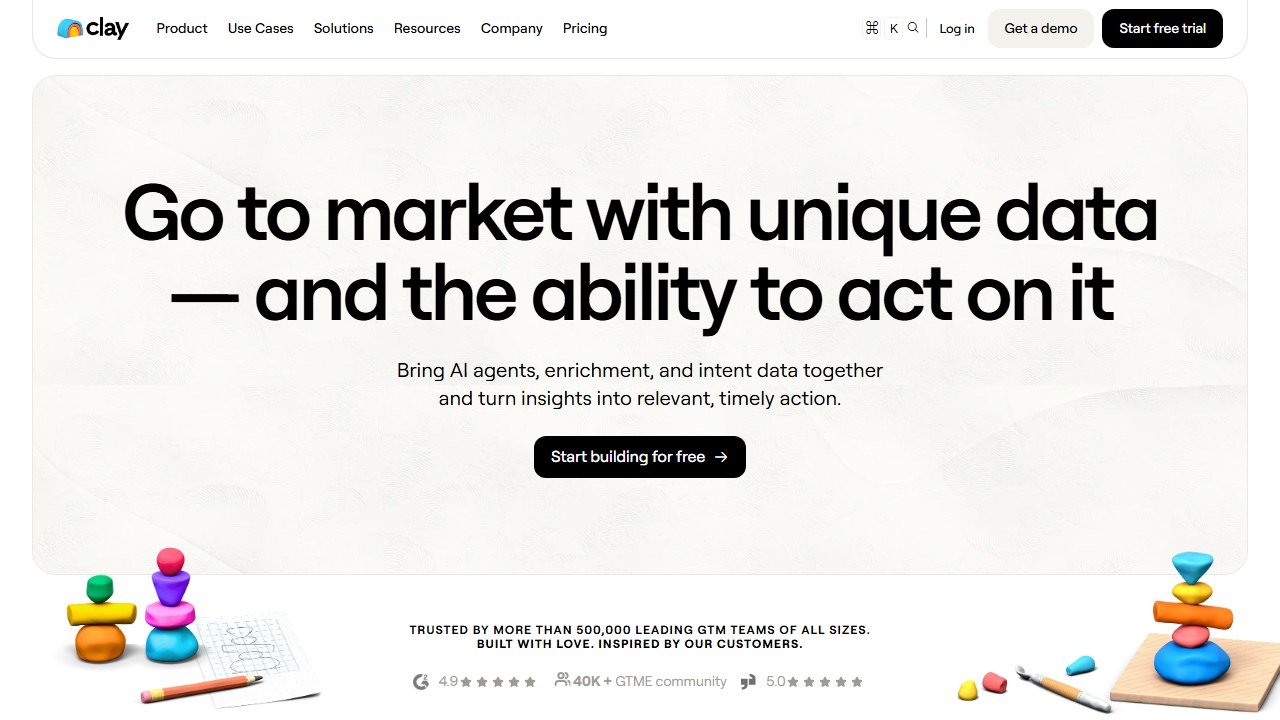
Clay is a programmable spreadsheet that connects to over 100 data providers (Apollo, Clearbit, Hunter, Phantombuster, LinkedIn Sales Navigator, OpenAI, Anthropic), runs them in waterfall logic, and lets you push enriched lists straight to your email tool or CRM. Our full Clay review works through three common workflows and what each costs in credits: an SDR list of 200 accounts, agency weekly enrichment of 50 leads, and a solo founder’s daily competitive intel scrape.
What makes Clay different from Apollo: Apollo gives you a database. Clay gives you a workflow that combines twenty databases plus AI per row. The result is dramatically better hit rates and the ability to generate personalized openers at scale.
The catch: pricing is credit-based and credits burn fast when you stack providers and AI calls. Launch is $167 a month and Growth is $446, and each is two meters added together, actions plus data credits. On Launch roughly two thirds of the bill is the data meter.
Skip Clay if you only need basic contact data for under 100 accounts a month. Apollo at $49 a seat billed annually covers that for less.
2. Apollo.io: all-in-one for early teams
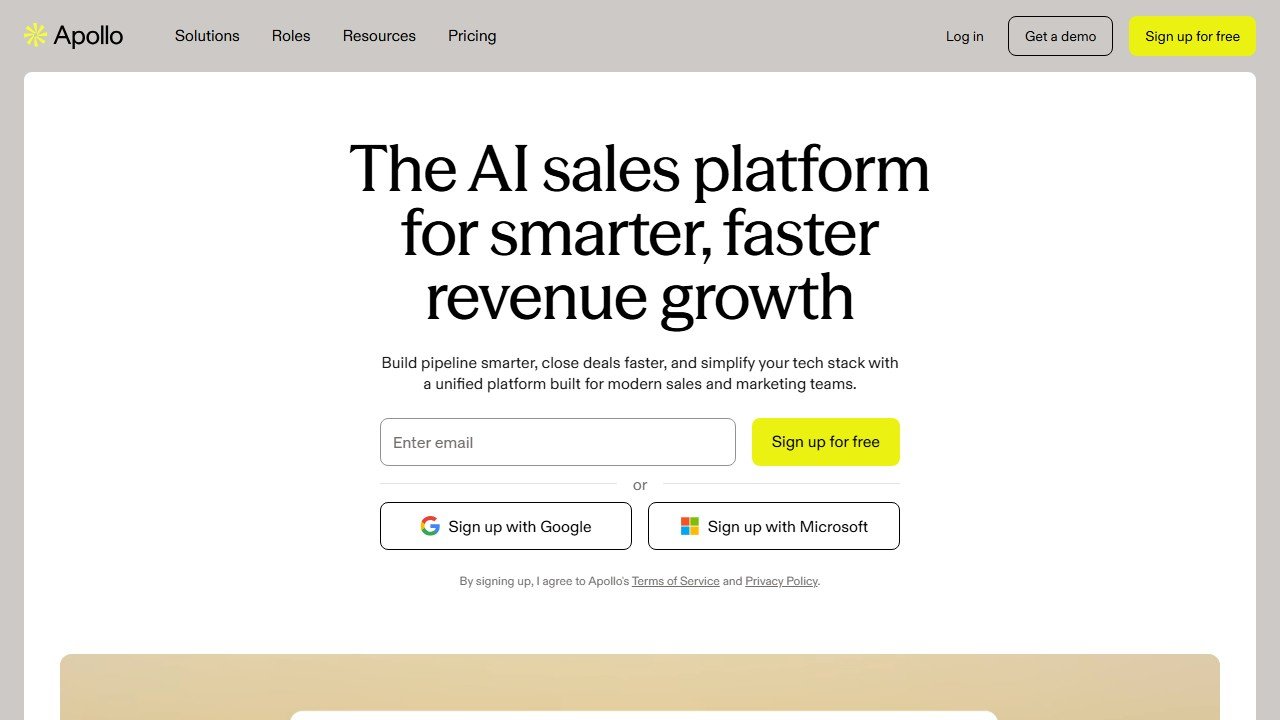
Best for: Founders and small sales teams who need contact data, sequencing, and basic dialer in one tool under $100 a month.
Apollo is the most-used sales tool in our reader surveys because it covers 80% of the SDR stack at a fraction of the cost. The B2B database hits 275 million contacts, the sequencing tool handles email + LinkedIn + calls in unified cadences, and the data quality has improved meaningfully since their 2024 rebuild.
Where Apollo falls short: its data quality on senior executives in non-tech industries lags ZoomInfo and Cognism. For broad SDR list building it is fine. For named-account ABM targeting C-suite at Fortune 1000s, supplement with another source.
Apollo Free is genuinely usable for solo prospecting (10,000 emails per month, 5 mobile credits per month). The Basic plan at $59 unlocks unlimited sequences and is the most common starting point for funded startups.
3. Gong: revenue intelligence + coaching
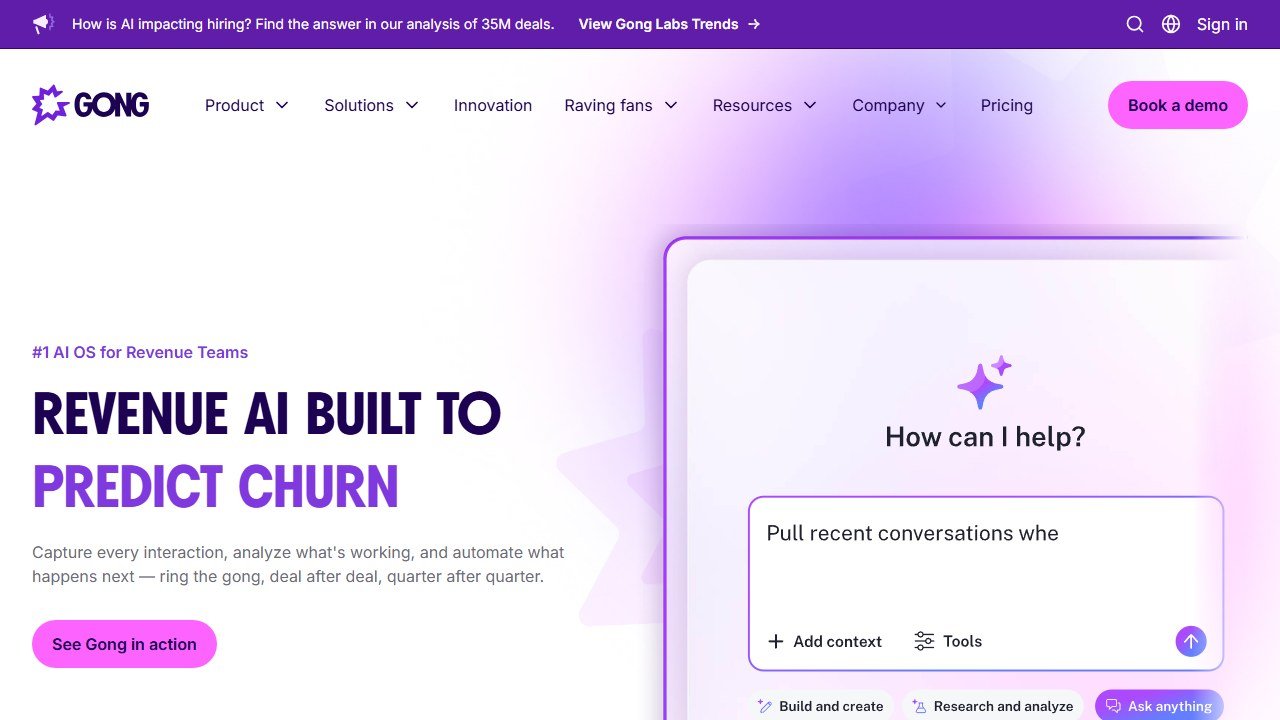
Best for: Sales orgs over 15 reps where managers spend more than 4 hours a week on call reviews and pipeline health.
Gong remains the category-defining revenue intelligence platform. It records every call and meeting, transcribes it, surfaces deal risks, and gives managers a coachable feed of every rep’s conversations. The AI in 2026 has improved sharply on objection detection, competitor mentions, and next-step accountability.
The honest reality on Gong: it is expensive (roughly $1,200 per rep per year, sometimes more), and it only pays back if your managers actually use it. Teams that buy Gong and treat it as a recording tool waste it. Teams that build coaching workflows around the AI scorecards see real win-rate lift.
For under-15-rep teams, the Gong price is hard to justify. Fathom (free) or Avoma (mid-market) cover the recording and basic analysis well enough.
4. Lavender: cold email coaching for reps
Best for: SDR teams and solo founders who write a lot of cold emails and want to improve reply rates without hiring a coach.
Lavender is a Chrome extension and Gmail integration that scores every email you draft in real time and suggests rewrites based on a model trained on millions of cold outbound sequences. Length, tone, personalization, readability, spam triggers, all flagged live as you type.
This is the single tool we recommend most to new SDRs. The feedback loop is immediate and the recommendations are actually correct most of the time. The value shows up in the habit rather than in a headline number, and we do not publish a reply-rate lift for it.
The Starter plan at $29 a month is fully featured for individual reps. Teams plans add manager dashboards and shared playbooks at $49 per seat per month. Skip Lavender if you already have a strong writing background and have run cold outbound for years; the improvements get marginal at that point.
5. Smartlead: high-volume cold email infrastructure
Best for: Agencies and outbound teams sending 5,000+ emails per day across multiple domains and mailboxes.
Smartlead is purpose-built for cold email at industrial scale. Unlimited mailboxes (most competitors charge per mailbox), built-in warmup, master inbox to consolidate all replies, AI-powered subsequence branching, and integrations with Clay, Apollo, and Instantly.
This is the tool of choice for cold email agencies in 2026. The infrastructure is rock-solid, the deliverability tooling is best in class, and the unified inbox saves agencies from drowning in 12 different mailbox tabs.
Pricing starts at $39 a month for the Basic plan (2,000 active leads, unlimited mailboxes). Pro at $94 unlocks API access and webhooks. For most cold email agencies, the math against Instantly is close; we slightly prefer Smartlead for the cleaner master inbox and the unlimited-mailbox pricing model.
6. Outreach: enterprise sales engagement
Best for: Sales orgs over 50 reps with established RevOps, complex sequence governance, and Salesforce as the source of truth.
Outreach is the long-time category leader in sales engagement and remains the dominant choice for enterprise SaaS. The sequence engine handles edge cases that smaller tools cannot, the Salesforce sync is the deepest in the category, and the new AI Smart Account Plan feature has actual use in named-account selling.
The downside: Outreach is expensive, complex to roll out, and you do not need 80% of the features unless you are running a 50+ rep team. For under-25-rep orgs, Salesloft or Apollo cover the same ground more simply.
7. Salesloft: cadence-driven mid-market teams
Best for: Mid-market sales teams (25-100 reps) who want a cleaner UX than Outreach without giving up enterprise features.
Salesloft has consistently shipped a more thoughtful product experience than Outreach for the past two years. The cadence builder is the cleanest in the category, the rep workflow respects the rep’s time, and the AI Insights pane gives managers visible signal on rep activity without surveillance.
Salesloft is the right pick if you find Outreach overwhelming but Apollo too limited. The Drift acquisition in 2024 added conversational AI to the stack, which is now a real differentiator for inbound + outbound coordination.
8. Chorus: conversation intelligence (ZoomInfo stack)
Best for: Teams already running ZoomInfo who want call recording and coaching without buying a second vendor.
Chorus, owned by ZoomInfo, is the value-tier alternative to Gong in 2026. The recording and transcription quality is on par with Gong. The AI analysis is one tier behind. The pricing inside a ZoomInfo bundle can be 40-50% cheaper than a standalone Gong contract.
For ZoomInfo-stack teams, Chorus is the sensible default. For greenfield buyers, Gong is still the better product if budget allows.
9. Instantly: solo founders + agencies cold emailing
Best for: Solo founders, lean teams, and lifestyle businesses doing cold outbound at moderate volume (under 5,000/day).
Instantly is the friendly cousin of Smartlead. The UI is more polished, the onboarding is faster, and the pricing at $37 a month for Growth is one of the best deals in the category. Warmup pool is large (over 200,000 inboxes), deliverability tooling is solid, and the lead-finder add-on is genuinely useful.
Pick Instantly over Smartlead if you value UX over raw power and are sending under 5,000 emails per day. Pick Smartlead if you are running an agency or have outgrown Instantly’s infrastructure limits.
10. Fathom: free meeting notetaker
Best for: Sales teams who want call recording and AI summaries without buying Gong-level infrastructure.
Fathom is genuinely free, unlimited, and the AI summaries are noticeably better than Otter or Fireflies. CRM integration with HubSpot and Salesforce, action item extraction, follow-up email drafts, all in the free tier. The paid Team plan ($19 per seat per month) adds shared transcripts and team coaching features.
This is the most-recommended tool in our reader surveys among solo founders and small teams. The math is straightforward: if you do not need Gong’s deal intelligence layer, you do not need to pay Gong’s bill.
Building a dedicated SDR motion? See our standalone guide on the best AI SDR tools of 2026 across AiSDR, Artisan and the rest.
For Gong specifically, see our full Gong review and pricing breakdown.
For a direct head-to-head, see our Clay vs Apollo comparison and pricing breakdown.
For Salesloft specifically, see our Salesloft review and pricing breakdown.
For Outreach specifically, see our Outreach review and the Outreach pricing breakdown. One thing to know before you compare quotes: Outreach moved to outreach.ai and repackaged in 2026. The plans are now Essentials, Core, Amplify Plus and Enterprise, so any coverage still naming Engage tiers is describing a line-up the vendor no longer sells.
How to pick the right sales tool stack for your team
The mistake we see most often: teams buy six tools because each one looks essential on its landing page. The honest answer for most teams under 25 reps is that you need three.
For the 1-5 person team: Apollo ($49) + Smartlead ($39) or Instantly ($47) + Fathom (free). Total: around $90 a month per seat. Covers list building, cold email, and meeting capture. No overlap, no waste.
For the 5-25 person team: Apollo ($49 to $119 a seat) or Clay ($167 to $446) + Smartlead ($39 to $174) + Lavender ($49/seat) + Fathom or Avoma. Add a coaching layer here because rep ramp time becomes the bottleneck.
For the 25-100 person team: Outreach or Salesloft + Gong + Clay + a dialer like Aircall or Orum. Budget for $300-500 per seat per month in tool spend. The ROI is in rep productivity and manager leverage, not list size.
For the 100+ person enterprise team: Outreach + Gong + ZoomInfo + Highspot or MindTickle. The category leaders win at this size because integrations, governance, and admin features matter more than UX.
What we excluded from the 2026 list
A few tools we did not include in the top 10 but considered seriously:
ZoomInfo: Still the data quality leader for enterprise B2B, but the cost rules it out for most teams under 25 reps. ZoomInfo publishes no list price. Vendr, which brokers software contracts, reports a median ZoomInfo deal of $33,500 a year across 1,571 purchases, with the observed range running from $7,200 to $156,000. The standalone product is increasingly eclipsed by Clay plus Apollo combinations for less money.
Cognism: The European data champion, GDPR-compliant, increasingly competitive with ZoomInfo on US data. Worth a look if you have European outbound needs.
Reply.io: Solid all-in-one for under-15 rep teams but Apollo covers the same ground better in 2026.
Lemlist: Strong personalization features (especially video and image personalization) but pricing has crept above Smartlead and Instantly without a clear advantage.
Highspot and MindTickle: Excellent sales enablement platforms for enterprise teams but overkill for under-50-rep orgs.
Where the figures on this page come from
Every price here was read from the vendor’s own pricing page on 4 September 2026, not from an aggregator. That distinction matters in this category, because several vendors changed or withdrew their published figures during the past year and a great deal of what circulates describes packaging that no longer exists.
The pages we read
Apollo publishes $49, $79 and $119 per seat per month on annual billing, plus the credit allowance. Lusha publishes $0, $37.45, $52.45 and $299.95 a month billed yearly, tied to a credit volume selector. lemlist publishes $55 and $87 per user per month annually. Reply.io publishes $29 and $69 per month per account. AiSDR publishes from $250 a month. Warmly publishes $10,000 to $30,000 a year. Lavender publishes free to $89 a seat.
The ones that publish nothing
ZoomInfo renders a long pricing page with no figure on it. Cognism and Gong publish packaging and models but no numbers. Outreach publishes packaging only, and note the domain moved from outreach.io. Salesloft’s pricing URL now redirects to a page titled “Talk to Sales”, so it has no pricing page at all. Artisan removed its figures during 2026.
What we do not do
We do not carry a figure we cannot source to the vendor. Where a number circulates and cannot be traced, we say so and withdraw it rather than repeating it with a hedge, and we have withdrawn our own published figures on that basis more than once. Every price here carries the date we read it, because in this market a claim without a date is not checkable.
How this goes wrong, and the warning signs
Four patterns account for most of what we hear from teams a year after purchase, and all four are visible early.
Seat creep, the standard overrun
The deal is signed for eight seats and the team is fourteen by month nine, at list price because the negotiated discount applied only to the original order. Agree in writing what an additional seat costs and whether your discount applies to seats added mid term. Discovering that it does not is how a good first year becomes an expensive second one.
The tool one person runs
One enthusiast builds the sequences, owns the data hygiene and produces every report. They leave, and it stops the same week. The warning sign is that nobody else has ever built a campaign end to end. Have a second person do it once a quarter from written steps, or you rented a habit rather than bought a system.
Data that decays faster than anyone budgeted
Contact data goes stale at a rate people consistently underestimate, and a list bought once is a depreciating asset. If your model assumed a one off enrichment, revisit it: the recurring cost of keeping the same accounts current is usually the larger number, and it is the line most often missing from a business case.
Adoption theatre
Logins are healthy, dashboards are open, and the actual work happens in a spreadsheet exactly as before. This is usually a sequencing failure: the tool was chosen before anyone agreed which decision it would change. The test before purchase is blunt. Name the meeting where the output gets used and the person holding it. If you cannot, the output has no destination.
undefined
The bottom line
The best AI sales tool of 2026 depends entirely on which bottleneck is hurting you most. If your problem is list quality, buy Clay. If your problem is rep email skill, buy Lavender. If your problem is manager bandwidth, buy Gong. If your problem is all of the above and you have a budget under $200 a month, buy Apollo and start there.
The teams winning at outbound in 2026 are not the ones with the largest tool stacks. They are the ones who picked three tools that solve their actual bottlenecks and used them consistently for six months. Pick fewer tools, run them harder, and revisit the stack every quarter.
Going deeper on specific categories? See the best AI dialer software, the best conversation intelligence software, and our Warmly review for visitor de-anonymization.
More AI tool guides worth reading: Seamless.AI Review, Salesloft Review 2026 and Best Conversation Intelligence Software in 2026.

Written by
FazFaz is the founder of AIToolsBakery. Some tools here are tested hands on. Others are assessed from vendor documentation and pricing verified on the live page, and every review says which one it is. Sponsors can buy a position in a guide. They cannot buy the score, the criticism, or silence about a better option.
How we test and how we make money →