Last reviewed May 2026.
Quick comparison
| Tool | Best for | Pricing tier |
|---|---|---|
| Second Nature | AI customer roleplay practice | Enterprise |
| Yoodli | Communication skill feedback | Free + paid |
| Cresta | Real-time + training loop | Enterprise |
| Whatfix Mirror | Software simulation | Enterprise |
| Talkdesk Copilot | Talkdesk-native AI | Add-on to Talkdesk |
Faz says: Customer service training has a unique problem that sales training does not: the cost of a bad CX rep interaction is immediate (a customer churns, a refund happens, a complaint hits social) while the cost of a bad sales rep is delayed (a deal does not close). That asymmetry means CX training needs to scale fast and stay sharp. AI training tools change the unit economics meaningfully. We went through the leaders against real customer support workflows on the record: what each one publishes, what it costs, and where the practice actually happens. This is the 2026 shortlist for support team L&D.
Quick answer: best AI customer service training tools in 2026
For customer support team training in 2026, the leading AI-powered tools are Second Nature (best for AI roleplay of customer escalations), Yoodli (best for soft skill feedback on customer-facing communication), Cresta (best for real-time agent assist + training), Whatfix Mirror (best for software-adoption side of CX training), and Talkdesk Copilot (best if you already run on Talkdesk). The right pick depends on if you are training on conversation skills, software workflows, or product knowledge. Most enterprise CX teams in 2026 use a combination: an AI roleplay tool for practice + a real-time agent assist tool for in-conversation support + an LMS spine. This roundup covers what works for each use case.
How we evaluated these tools
This shortlist is research based. Every tool was assessed against the same criteria using the vendors’ own live product, feature, and pricing pages, their published documentation, and the patterns that recur in verified user reviews on Capterra and G2. We weighted the things a support L&D lead actually has to answer for: whether reps get live practice rather than a content library, how feedback reaches the rep, whether it plugs into your CCaaS stack, and whether the price is published or quote-gated. Where a capability is the vendor’s claim rather than something we could confirm on a public page, we say so.
The leading AI customer service training tools in 2026
1. Second Nature: best for AI roleplay of customer escalations
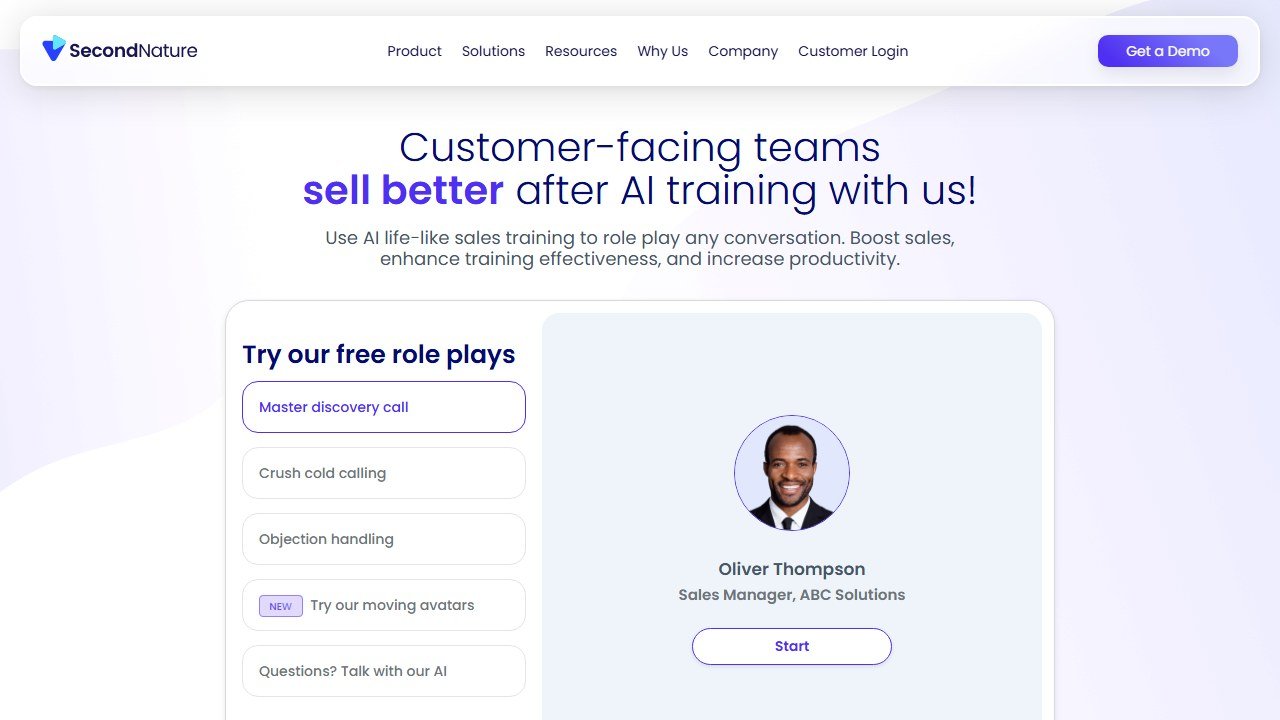
Second Nature offers AI-driven roleplay where the AI plays the customer (angry, confused, churning, billing-disputing) and the support rep practices the conversation. The post-conversation feedback covers empathy, active listening, ownership language, resolution clarity, and overall conversation quality.
Best for: customer escalation handling, save conversations, complex billing disputes, retention-at-risk customer practice.
Strengths: realistic customer-side AI behavior, customizable scenarios, useful for new-hire ramp and ongoing skill maintenance, scalable across distributed teams.
Limitations: works best for spoken-equivalent practice (chat support has less scenario depth). Enterprise pricing.
2. Yoodli: best for soft skill feedback on customer-facing communication
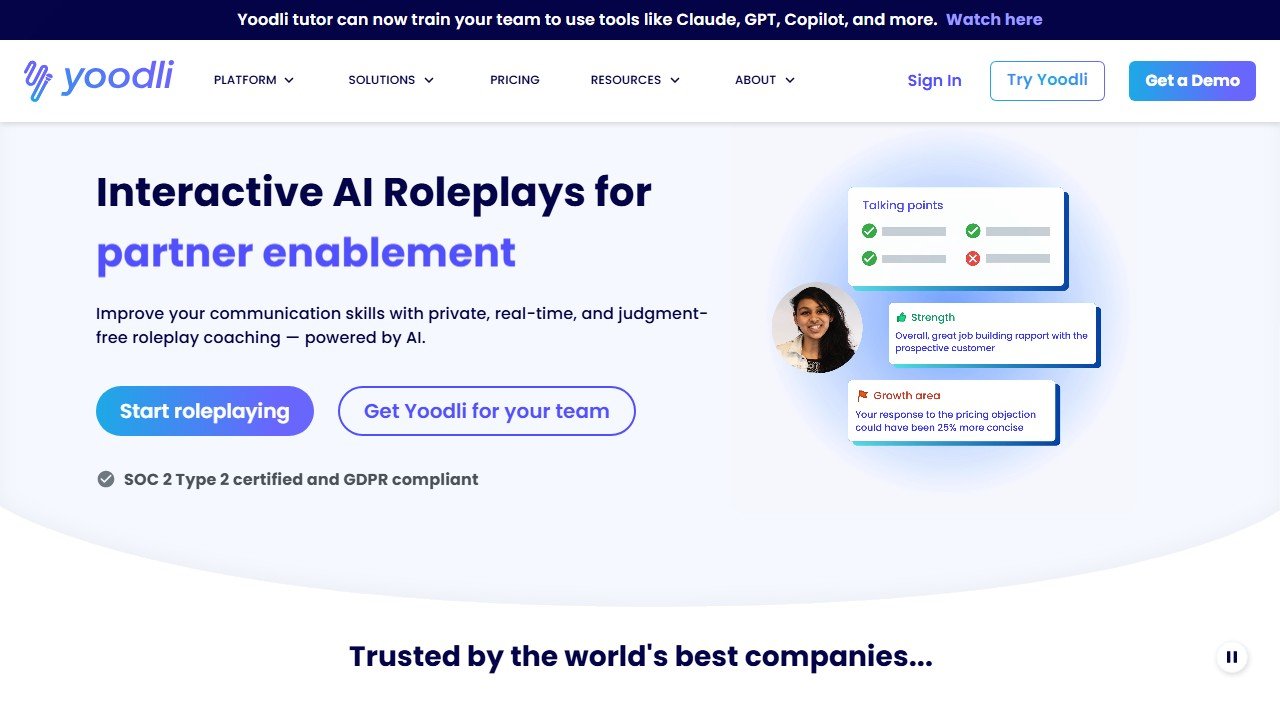
Yoodli's conversation analytics layer is genuinely useful for support reps practicing customer-facing conversations. Filler words, pace, empathy markers, ownership language: Yoodli surfaces these in feedback that a rep can act on within minutes.
Best for: improving spoken communication for phone support, video support, and senior CX rep development.
Strengths: specific actionable feedback, accessible pricing, integrates with calendar/meeting tools for real-conversation analysis.
Limitations: less useful for chat-only support contexts.
3. Cresta: best for real-time agent assist + training
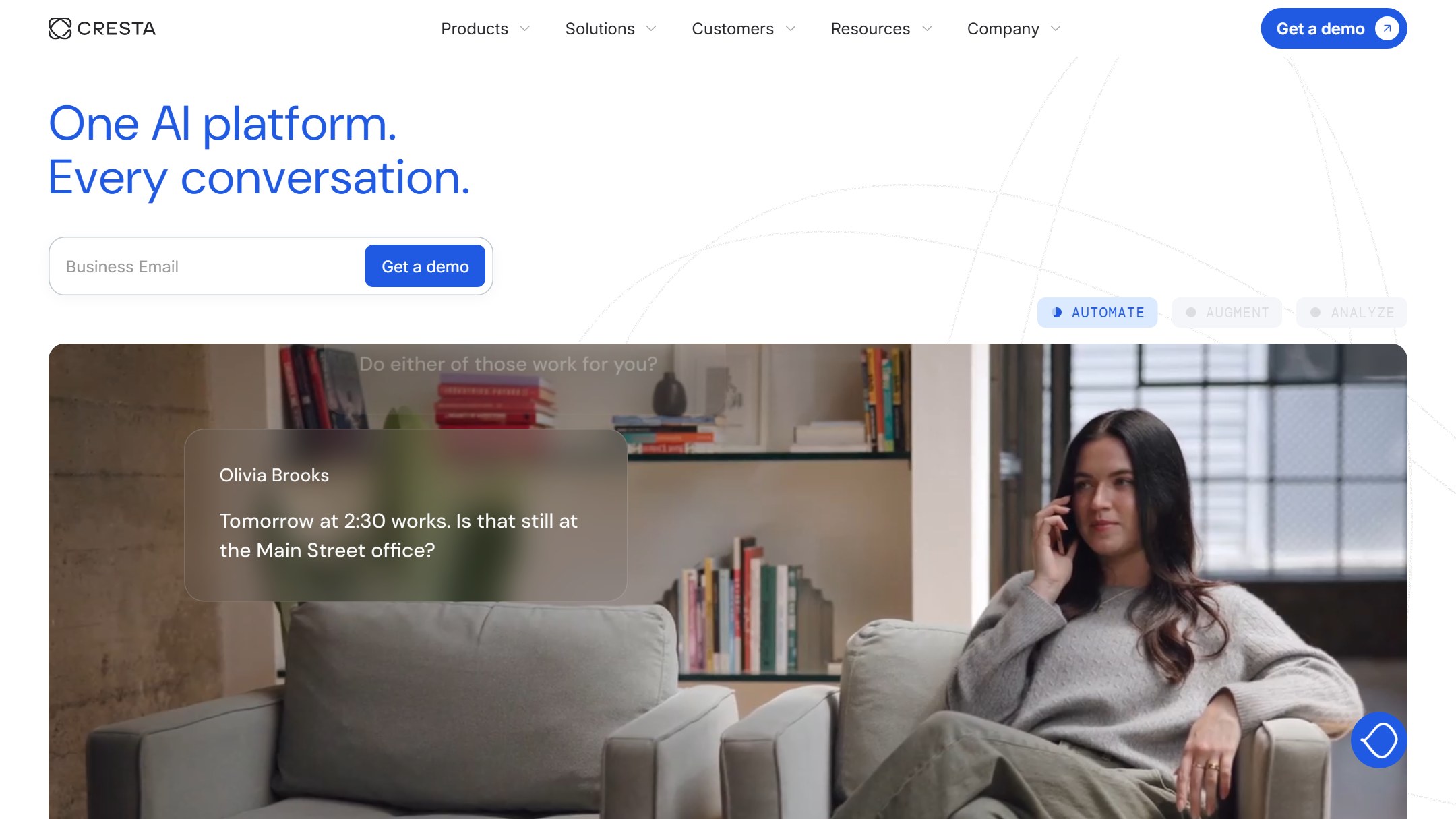
Cresta combines real-time agent assist (the AI suggests responses during live customer conversations) with continuous training improvement. The AI identifies coaching moments from live conversations and surfaces them to managers for follow-up training.
Best for: high-volume call centers, real-time conversation support, continuous learning loops based on real conversation data.
Strengths: real-time + training loop combination, strong analytics, scales to enterprise call center volume.
Limitations: implementation complexity, enterprise pricing. Not the right fit for small support teams.
4. Whatfix Mirror: best for software-adoption side of CX training
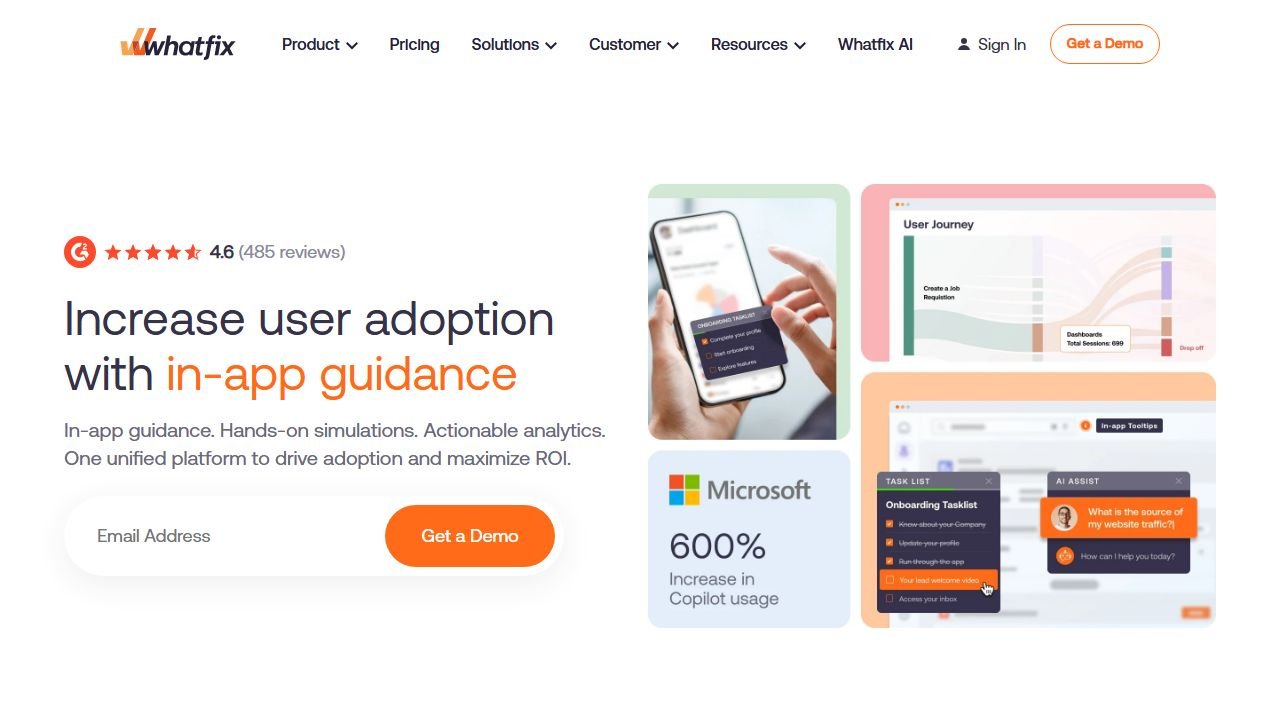
Customer support reps need to know the tools they use (Zendesk, Salesforce Service Cloud, Freshdesk, internal admin panels). Whatfix Mirror simulates these workflows for training, letting new hires practice without breaking real customer data.
Best for: new-hire ramp on support software, internal tool training, change management when migrating CX platforms.
Strengths: realistic software simulation, low-risk training environment, scales for large rollouts.
Limitations: software training, not conversation training. Use in combination with a conversation-focused tool.
5. Talkdesk Copilot: best if you already run on Talkdesk
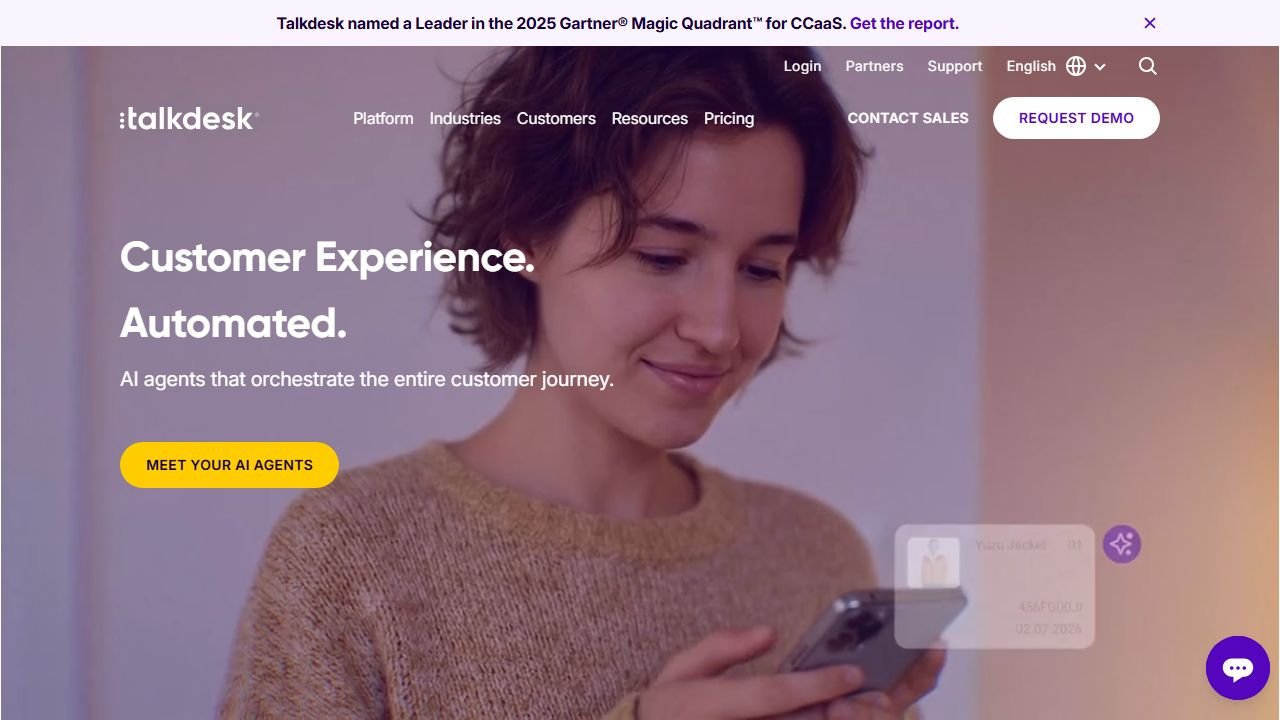
Talkdesk's native AI Copilot offers integrated agent assist and training capabilities for teams already on the Talkdesk CCaaS platform. For shops already standardized on Talkdesk, the integration depth is the value driver.
Best for: Talkdesk-standardized call centers, integrated workflow.
Strengths: native integration, single-vendor stack.
Limitations: tied to Talkdesk. Less attractive if you might switch CCaaS platforms.
What separates the leaders from the rest
The AI CX training category has many entrants. The five tools above made our list because:
Realistic customer-side behavior. The AI needs to behave like a real angry or confused customer: emotional escalation, tone shifts, realistic objections. Generic AI customer personas do not transfer.
Specific feedback that maps to coaching frameworks. Generic feedback ("be more empathetic") does not change behavior. Specific feedback tied to a coaching framework ("at minute 2:15, your tone shifted from acknowledging to defending; the empathy framework recommends staying in acknowledgment for another 30-45 seconds before pivoting to solution") changes behavior.
Scalability across distributed teams. CX teams are increasingly distributed. Tools that require physical presence or synchronous coaching sessions do not scale.
Integration with existing CCaaS stack. The tools that play well with Zendesk, Salesforce Service Cloud, Talkdesk, Freshdesk, Genesys earn their place. The tools that require teams to leave their main workflow get adopted poorly.
Manager analytics that respect agent privacy. Aggregated insights for the team without surveillance of individuals.
Procurement framework: choosing the right AI CX training tool
Step 1: define the support outcome you are training toward
"Better customer experience" is too vague. "Reduce escalation rate from CSR tier 1 to tier 2 by 25% by improving first-call resolution behaviors" is testable. Define the metric before evaluating tools.
Step 2: identify the training type
- Conversation skills (empathy, escalation, save): Second Nature, Yoodli
- Real-time agent assist + ongoing training: Cresta, Talkdesk Copilot
- Software workflows: Whatfix Mirror
- General communication: Yoodli
Step 3: pilot with 10-30 reps for 30 days
CX teams in different verticals (SaaS, healthcare, finance, telecom, retail) have different scenario needs. A pilot with reps from your actual team beats vendor case studies from other industries.
Step 4: integrate with your CCaaS platform
Whatever tool you pick, it has to play well with Zendesk, Salesforce, Talkdesk, or whatever you use. Test integration before commit.
Step 5: tie pricing to real outcomes
After the pilot, the vendor will quote enterprise pricing. Use your pilot data, specifically the improvement in your defined outcome metric, to negotiate. Vendors who cannot tie pricing to outcomes are guessing at value.
Saru says: Faz, the procurement data for AI CX training tools in 2026 shows a pattern worth knowing. The tools that integrate real-time agent assist with training (Cresta, Talkdesk Copilot) tend to show faster measurable outcome improvement than pure-training tools because the loop is tight: an agent gets in-conversation feedback, then training reinforces it on the same skills, then the agent applies it in the next conversation. The compounding effect is real. For CX leaders making a 2026 procurement decision, this is the most interesting recent shift: the tools that close the loop between training and live agent work are pulling ahead.
What is NOT on this list
Several tools were considered and excluded. Brief notes:
- Gong and Chorus: conversation intelligence platforms, strong for sales but limited for inbound CX training.
- Salesforce Service Cloud Einstein: native to Salesforce; useful if you run on Service Cloud, but not a standalone training tool.
- Zendesk AI features: native to Zendesk; useful for assist, less for structured training.
- General LMS platforms (Cornerstone, Docebo, etc.): useful as the spine but not soft-skill-specific.
Should you adopt AI CX training tools in 2026
Three paths depending on your team's scale.
Small CX team (under 25 agents). Start with Yoodli + a basic LMS. Run conversation analytics on senior CSR examples and use them as training material for newer reps. Pilot Second Nature if you have budget for one specialized tool.
Mid-size CX team (25-150 agents). Pilot Second Nature for scenario-based training. Add Yoodli for ongoing communication coaching. Keep your existing LMS for product and policy training.
Enterprise CX team (150+ agents, multi-region). Cresta or Talkdesk Copilot for the real-time + training loop. Second Nature for structured scenario-based ramp. Whatfix Mirror for software adoption. Plan for 60-90 days of implementation across the stack.
Bottom line: best AI customer service training tools 2026
For most CX teams in 2026, the right answer is a combination of two or three tools matched to specific training outcomes: conversation skills (Second Nature, Yoodli), real-time agent assist (Cresta, Talkdesk Copilot), and software training (Whatfix Mirror).
The category has matured to the point where adoption is no longer a question of "do we use AI training tools" but "which combination matches our team's stage and our CCaaS stack". Pilot before you commit. Tie pricing to real outcomes. Run the math on your team's actual metrics, not vendor case studies.
For our broader corporate training context, see our AI roleplay tools pillar and our deep dive on AI coaching roleplay for corporate training.
Sources
- ATD: Association for Talent Development research
- Brandon Hall Group: corporate L&D benchmarks
- Harvard Business Review on customer service
- SHRM: Society for Human Resource Management
One more thing for CX leaders
The CX training category is one where time-to-impact matters more than depth-of-features. A pilot that proves real escalation-rate improvement in 60 days is more valuable than a multi-tool implementation that proves nothing in 6 months. Pilot one tool with clear metrics. Expand only when the data is real.
What CX leaders ask us most about this category in 2026
Three questions come up in nearly every CX leader call we have on AI training tools, and the answers are useful enough to put in writing.
How do these tools handle multilingual support teams?
For English plus one or two languages, most leading tools are reasonable. For deep multilingual coverage (more than three languages with native-quality scenarios), the leaders thin out fast. Test the specific language quality on your top three support languages before commit.
What is the AI-to-human-coach ratio that works in practice?
In the case studies we have reviewed in 2026, the ratio of AI practice volume to human coach intervention is around 10 to 1 for new hire ramp and around 25 to 1 for ongoing maintenance training. Treat these as starting points; your team will tune it.
Do these tools work for inbound social and chat support?
Roleplay tools optimized for spoken conversations transfer partially to written contexts. For chat and social specifically, look at tools with explicit chat-scenario training (some leaders cover both modalities; some are spoken-only). Match the tool to your channel mix.
The implementation pattern that wins
Customer service teams getting real ROI from AI training tools in 2026 follow a consistent four-step rollout. Step one: pilot with one team of 10 to 25 agents for 60 days before any broader rollout. Step two: pair AI roleplay with weekly manager 1:1s where coaching insights from AI analytics become real conversations. Step three: tie training completion to onboarding ramp metrics (time to full quota, first-contact resolution, customer satisfaction scores) rather than completion percentages. Step four: rotate scenarios quarterly so reps are not practicing the same calls month after month.
Teams that skip the pilot phase typically overbuy and underutilize. Teams that skip the manager 1:1 link see engagement metrics but no behavior change. Teams that fail to tie training to real outcomes lose budget renewal at year-end.
2026 verdict for customer service L&D
The strongest 2026 customer service training stacks combine Second Nature or similar roleplay simulators with Cresta or Observe.AI for live call analytics. Single-tool implementations consistently underperform. Buyer profile: customer service teams with 50+ agents where the training and coaching investment scales to justify enterprise tooling.
Rolling this out so people actually use it
The failure mode in corporate training software is not a bad product, it is a deployment that reaches week six with impressive licence numbers and no behaviour change.
Pick one team and one behaviour, not one platform
The instinct is to roll out to everyone because the licence covers it. The better move is one team, one measurable behaviour, and a fixed period. A discovery call structure, an objection, a specific product pitch. Narrow scope means you can tell whether it worked, and a result from one team persuades the rest far more effectively than a mandate.
Managers have to use it before reps do
Roleplay and coaching platforms live or die on whether managers review the output. If a rep completes a scenario and nobody ever mentions it, completion becomes a compliance task within a fortnight. Before launch, agree which existing meeting will use the output, ideally the one-to-one that already happens, and make somebody responsible for opening it there.
Mandatory completion produces completion, not skill
If the only metric is completion percentage, you will get a high completion percentage and learn nothing. Pair it with something qualitative from the start: a manager rating on a rubric, a before-and-after recording, or a call outcome. Otherwise the dashboard will look excellent while the sales floor is unchanged.
Plan for the second wave, which is where it usually dies
The first cohort is volunteers and enthusiasts and it always goes well. The second is everyone else, and their experience decides whether ai customer becomes part of how the team works. Budget real time for the second wave, expect more resistance, and do not read the first cohort’s enthusiasm as evidence the rollout is done.
Name the owner and the stop condition
One person whose job includes this, with the hours to do it, and a written statement of what twelve months would have to look like for you not to renew. Both are unglamorous and both are the difference between a platform that survives a budget review and one that quietly does not.
Measuring training, honestly
Training is the discipline most prone to measuring the wrong thing well. Four levels of rigour are available and most organisations stop at the first.
Reaction is easy and nearly worthless
Satisfaction scores at the end of a session tell you whether people enjoyed it, which correlates weakly with whether they can now do anything differently. Collect it if you like, and do not report it as evidence the training worked.
Completion is an activity metric
Completion percentage measures compliance with an instruction. It is genuinely necessary for regulated training, where the record is the point, and it is not evidence of capability anywhere else. Report it as what it is.
Behaviour change is where the real evidence starts
Pick one observable behaviour and measure it before and after: the proportion of discovery calls that reach a defined qualification step, the share of tickets resolved without escalation, the number of safety observations logged. It needs a baseline from before the training, which is why this gets skipped, and it is the first level that would survive a hostile question.
Business outcome, with the caveat stated out loud
Attributing revenue or incident rates to a training programme inside one year is genuinely hard, because everything else moved too. If you report an outcome, report what else changed in the same period. The most credible thing a training team can do is claim the behaviour change it can evidence and be openly cautious about the outcome it cannot.
Take the baseline in the week before launch
Whatever you choose, capture it before anything is switched on, from a source the project did not touch. It takes an hour and it is unrecoverable afterwards, which is the single reason most training investments can never be evaluated.
Tools mentioned in this guide
Also referenced for context: Observe.AI, Gong, Chorus.

Written by
FazFaz is the founder of AIToolsBakery. Some tools here are tested hands on. Others are assessed from vendor documentation and pricing verified on the live page, and every review says which one it is. Sponsors can buy a position in a guide. They cannot buy the score, the criticism, or silence about a better option.
How we test and how we make money →