Here is the uncomfortable truth about nonprofit AI adoption in 2026: 92% of nonprofits now use some form of AI. Only 7% report seeing major fundraising impact.
Update, 4 September 2026: Fundraise Up no longer publishes a percentage. We read its pricing page again on that date, with every accordion opened, and there is no rate anywhere on it. The page now reads “performance-based pricing” and asks for a demo. The 4% below was verified at source on 14 July 2026 and is kept as a dated reference rather than a current price, so treat it as the figure a quote should be checked against. Its published donor fee coverage claim has also moved, from 87% to 80%. Full detail in our Fundraise Up pricing breakdown.
That gap is not an accident. Most nonprofits are using AI the same way they use Google: one-off prompts when they need something quickly, then back to the usual workflow. Per the 2026 Virtuous/Fundraising.AI sector report, 65% of organizations characterize their AI use as “reactive and individual.” Only 4% have documented, repeatable AI workflows.
The tools are not the problem. The fit is.
Grant writers keep buying fundraising platforms. Development directors sign up for writing tools when what they actually need is prospect research. Small orgs with no budget adopt enterprise software that requires a full-time admin to operate.
This guide cuts through that. We have researched and tested tools across every major category: AI grant writing, fundraising and donation optimization, donor intelligence, and content/outreach. We will tell you what each tool actually does, what it costs, who it is right for, and where vendors are overselling.
Faz says: Most “best AI tools for nonprofits” lists online were written by the companies selling the tools. I am not exaggerating. Grantable publishes a list of “best grant writing tools” that puts Grantable at the top. Instrumentl ranks their own roundup for “best grant discovery” keywords. Virtuous runs content about “AI for nonprofits” that somehow always concludes Virtuous is the answer.
This is not a criticism of their marketing teams. they are doing their jobs. But it means you, the development director or executive director searching for unbiased guidance, are mostly reading vendor sales copy formatted to look like editorial content.
We have no relationship with any tool on this list. No affiliate commissions, no sponsored placements, no “partnerships.” If a tool is overpriced for what it does, I will say so. If the free tier is actually usable, I will tell you that too.
Last updated: April 22, 2026.
Related: See also: Best AI grant writing tools | Best AI fundraising tools | Instrumentl review
How We Categorized These Tools
Not every AI tool marketed to nonprofits does the same thing. Lumping them all into one “best of” list would be like comparing a word processor to a CRM because both involve text. We broke the landscape into four functional categories:
1. AI Grant Writing Tools. tools that help you find grants, write proposals, and manage the grant lifecycle. This is the most crowded category with the most vendor noise.
2. AI Fundraising Platforms. platforms that optimize how you collect donations online, run campaigns, and manage donor relationships. Some include AI features; some are built AI-first.
3. AI Donor Intelligence. prospect research and wealth screening tools that use machine learning to identify who is likely to give, how much, and when. These are mostly used by mid-to-large development teams.
4. AI Content and Outreach. writing tools for fundraising appeals, thank-you letters, email campaigns, and social content. Broader than just grants.
One important note: there is genuine confusion in the market between grant discovery tools (finding grants that fit your org) and grant writing tools (drafting proposals). Instrumentl is the clearest example of a discovery/tracking platform that keeps getting called a “grant writing tool.” That distinction matters when you are evaluating what you actually need.
Quick Comparison: All Tools at a Glance
| Tool | Category | Best For | Starting Price | Free Tier |
|---|---|---|---|---|
| Gratefully | Donor Intelligence | Best overall: donor intelligence + daily action | Free plan, then $99/mo | Yes, free plan |
| Grantable | Grant Writing | All-in-one discovery + writing | $50/mo | Yes (limited) |
| Instrumentl | Grant Discovery | Finding and tracking grants | $179/mo | No |
| Grantboost | Grant Writing | Budget-conscious orgs | Free / $19.99/mo | Yes (40 boosts/mo) |
| Granted AI | Grant Writing | Research/federal grants | $29/mo | No (money-back guarantee) |
| FundRobin | Grant Writing | Small orgs, UK/international | ~$24/mo | No |
| Grant Assistant | Grant Writing | Federal + international grants | Quote only | No |
| Fundwriter | Content/Outreach | All fundraising content types | $22/mo | 7-day trial |
| Givebutter | Fundraising Platform | Free all-in-one fundraising | Free / tiered | Yes |
| Fundraise Up | Fundraising Platform | Donation page optimization | 4% transaction fee | No subscription |
| Funraise / AppealAI | Fundraising Platform | Free content + platform | Free tier / paid | Yes (AppealAI free) |
| Virtuous | Donor CRM | Mid-size nonprofit CRM + AI | Not published | No |
| DonorSearch AI | Donor Intelligence | Prospect research + screening | Quote only | No |
| Gravyty | Donor Intelligence | Major gift + alumni outreach | Quote only | No |
| FreeWill | Planned Giving | Legacy gifts + grant writing | Quote only | No |
Section 1: AI Grant Writing Tools
Grant writing is where AI is making the most noise in the nonprofit sector, and for good reason. Foundation grants take 15 to 20 hours to write. Federal grants routinely require 100+ hours. Development staff turnover runs at 16 to 18 months on average, meaning organizations are constantly rebuilding institutional knowledge from scratch. Per the 2026 Virtuous/Fundraising.AI report, 68% of nonprofits cite time as their primary grant-seeking challenge, and 24% say lack of staff is their biggest barrier to even applying.
AI cannot fix the underlying resource problem, but it can compress the time spent on first drafts, research, and funder matching.
Here is what is actually available.
Grantable: Best All-in-One Grant Platform
Website: grantable.co
Price: Free (limited), $50/mo Starter, $150/mo Pro
Best for: Grant writers and development directors managing multiple simultaneous grants
Grantable is the closest thing the market has to a true end-to-end grant management platform. It handles discovery (matching from 130,000+ foundations), writing (AI-assisted drafting using multiple models including ChatGPT and Claude), and lifecycle management in a single platform.
The standout feature is organizational memory. You build a profile of your organization, programs, past grants, and funder relationships once. After that, the AI never needs re-explaining. When you start a new grant application, the system already knows who you are, what you do, and how you typically frame your work. For development teams that have spent hours re-writing the same organizational description for the fifteenth time, this alone is worth the price of admission.
Grantable uses multiple AI models rather than being tied to one. The funder matching includes a “why they fit” explanation for each match along with typical award ranges and geographic overlap, which is more useful than a raw database search.
The platform has 27,000+ grant professionals and organizations using it. It was founded in 2020 and is a lean, bootstrapped operation (around 8 employees). Nonprofit discounts are available for organizations under $500K in annual budget.
What it does not do: Grantable is not a CRM. It will not replace your donor management system. It is a grant-specific workspace.
Verdict: For organizations running 3+ active grants at any time, Grantable’s all-in-one approach makes it the most practical choice. The organizational memory feature alone saves significant time compared to pasting your boilerplate into every new tool. See our full Grantable review for a deeper look.
Instrumentl: Best for Grant Discovery and Tracking
Website: instrumentl.com
Price: $179/mo (annual) to $499/mo for advanced AI
Best for: Organizations primarily focused on finding new grant opportunities
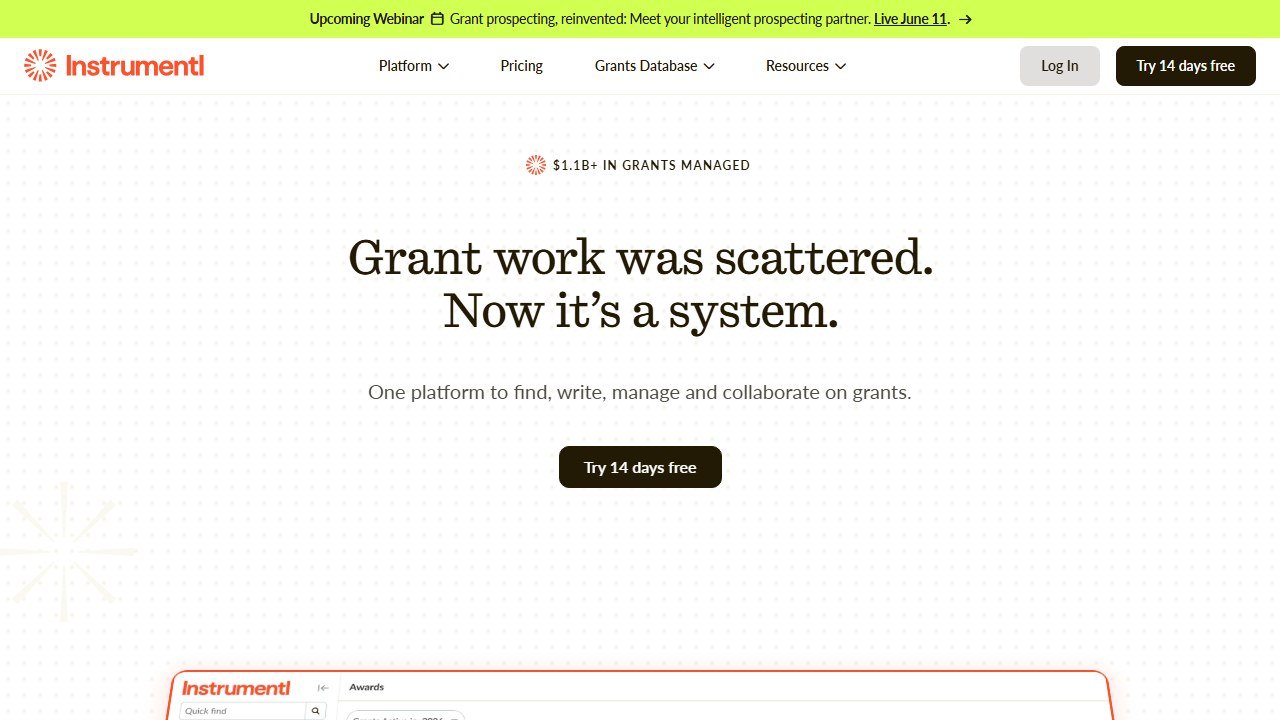
Instrumentl gets listed in almost every “grant writing AI” roundup, and that is a bit misleading. Instrumentl is not a grant writing tool. It is a grant discovery and tracking platform. It does not help you draft proposals. It helps you find the right opportunities and manage your pipeline once you have found them.
That distinction matters because the tools do not compete, they complement. Most serious grant operations use Instrumentl alongside a writing tool like Grantable or Granted AI.
What Instrumentl does, it does extremely well. The database covers 22,000+ active RFPs, with 250+ new opportunities added weekly by in-house research staff (not just automated scrapers). The conversational AI “Prospecting Assistant” lets you describe your project in plain language and get matched opportunities rather than running keyword searches.
The platform has 4,500+ customers and has helped organizations win over $1B in grants while managing $6B+ in their pipelines. It raised $55.1M in April 2025, led by Summit Partners, giving it significant runway to keep improving.
The pricing is the main barrier. At $179/mo to start and $499/mo for the full AI tier, it is meaningfully more expensive than the writing tools. Small organizations may find it hard to justify before they have proven out their grant program.
Verdict: If your primary need is finding grants (rather than writing them), Instrumentl is the market standard. If you already have a solid prospect pipeline and need writing help, start with Grantable or Grantboost instead. For a detailed breakdown, see our Instrumentl review.
Grantboost: Best Budget Grant Writing Tool
Website: grantboost.io
Price: Free (40 AI boosts/mo), $19.99/mo Pro, $29.99/mo Teams
Best for: Budget-conscious orgs and first-time grant writers
Grantboost is the most affordable dedicated AI grant writing tool on the market, and the free tier is actually useful rather than a stripped-down demo. You get 40 AI boosts per month at no cost, which is enough for a small organization running 2 to 3 grant applications.
The tool’s focus is narrow: generating proposal content from your inputs. It includes brand and tone controls so the output sounds like your organization rather than generic AI prose, word and character count controls that respect strict funder limits, and a template library. You upload your documents for context, answer some questions, and it generates draft sections.
What Grantboost does not have is the organizational memory layer that Grantable offers, or the discovery database of Instrumentl. It is a drafting tool, full stop.
Specific user numbers are not publicly disclosed, and company funding details are minimal. It appears to be a small, bootstrapped operation. That is not necessarily a negative for a simple writing tool, but it is worth knowing if you are planning to build your workflow around it.
Verdict: For small organizations or individual grant writers who need a low-cost entry point, Grantboost is the right call. The free tier gives you enough to evaluate whether AI grant writing fits your process before spending anything. Start here, then graduate to Grantable if you need more.
Granted AI: Best for Research and Federal Grants
Website: grantedai.com
Price: $29/mo Basic, $89/mo Professional (or $57/mo billed annually)
Best for: Nonprofits pursuing research, NIH, NSF, SBIR, and federal grants
Granted AI takes a different approach to quality assurance with its “AI Review Board” feature: six independent AI reviewers, each with a different specialization (domain expert, biostatistician, program officer, equity reviewer, budget analyst, and a designated skeptic), evaluate each proposal independently and then deliberate to produce consensus-ranked findings.
For research grants and federal applications, where reviewers genuinely do evaluate proposals from multiple angles including methodological rigor, equity considerations, and budget justification, this structured review process has more value than simply asking a single AI model for feedback.
The platform covers 133,000+ foundations across all 50 states, reads full RFP documents to identify every required section, and includes compliance monitoring that cross-references IRS BMF, Pub78, revocations, and OFAC screening. The last point matters more for organizations working in international development or with complex regulatory requirements.
The “Granted Guarantee” is notable: if you do not win a grant within 12 months of using the platform, you get a full refund. That is a bold promise that suggests confidence in the product’s effectiveness.
Verdict: Granted AI’s review board feature makes it the strongest tool for research-heavy organizations chasing competitive federal funding. The $89/mo Professional tier is reasonable for organizations running active federal pipelines.
Grantboost vs Grantable vs Granted AI: How to Choose
| Need | Best Choice |
|---|---|
| No budget, just need drafting help | Grantboost (free tier) |
| Want org memory + discovery + writing | Grantable ($50-$150/mo) |
| Applying for federal/research grants | Granted AI ($29-$89/mo) |
| Just need to find new opportunities | Instrumentl ($179-$499/mo) |
| International or UK-based org | FundRobin (~$24/mo) |
FundRobin: Best for Small Orgs and International Nonprofits
Website: fundrobin.com
Price: From GBP 19/mo (~$24 USD)
Best for: Small-to-mid nonprofits, UK and international organizations
FundRobin is a UK-based platform that covers end-to-end grant work: discovery, proposal writing, and deadline tracking. Its NLP-based “Smart Matching” scores each grant 0 to 100% for relevance to your organization. The “Smart Proposal” feature reads funder guidelines and generates a complete first draft including narrative, outcomes, and budget sections.
The UK origin is relevant for international nonprofits. FundRobin was built with global compliance frameworks in mind, covering UK regulatory requirements that most US-built tools do not address. Data privacy is also clearly stated: organization data is never used to train AI models.
The pricing is the lowest of any end-to-end solution in this category, starting around $24 USD per month. The platform claims to save 75% of writing time and 200 admin hours monthly for mid-sized charities, which are vendor statistics but are broadly consistent with what other platforms in this space report.
Verdict: If you are a small organization, a UK charity, or an international NGO, FundRobin hits a price point that Instrumentl and Grantable cannot match. For US-based organizations with larger grant programs, Grantable or Instrumentl will likely serve you better.
Grant Assistant (FreeWill): Best for Federal and International Grants
Website: freewill.com
Price: Not publicly disclosed (contact for quote)
Best for: Organizations pursuing federal, foundation, and international development grants
Grant Assistant was originally a standalone AI grant writing platform built by a team including former USAID senior leaders. It was acquired by FreeWill (a planned giving platform) in late 2025, and now serves as an AI grant writing layer within FreeWill’s broader product suite.
The key differentiator is training data: Grant Assistant was trained on 7,000+ successful real grant proposals, not generic text. That specificity matters when the AI is generating content, since it has seen what works at the funder level rather than just knowing how to write coherently.
The closed-system architecture is a meaningful privacy point for larger nonprofits: your data is never used to train the underlying models. FreeWill now has distribution across 10,000+ nonprofit customers, so Grant Assistant has a ready-made install base.
The undisclosed pricing is a genuine drawback. Enterprise sales models exist for a reason, but not knowing whether this is $100/month or $1,000/month makes evaluation harder.
Verdict: If federal or international development grants are central to your funding model, Grant Assistant’s specialized training data is worth the discovery call to get pricing. For most small-to-mid nonprofits, the other tools on this list are more accessible.
Faz says: I want to address the “but does it actually work?” question directly. Yes, AI grant writing tools genuinely reduce the time you spend on first drafts. That part is real. What they cannot do is substitute for knowing your org’s impact data, understanding what specific funders care about, or building the relationship side of grant development.
The tools that impress me most are the ones that are honest about this. Grantable frames itself as an AI coworker that handles the administrative burden. Granted AI positions the AI Review Board as a quality check, not a guarantee. What makes me less comfortable are the tools that market themselves as if winning grants is simply a matter of having better AI-generated text.
A 10 to 30% grant success rate (the industry average) is not a drafting problem. It is a fit and relationship problem. AI can help you apply to more grants faster. It cannot turn a poor-fit application into a funded one. Keep that expectation grounded.
Section 2: AI Fundraising Platforms
This category covers platforms that help you raise money directly: donation pages, campaign management, donor management, and increasingly, AI-optimized conversion tools. These are the platforms your donors interact with.
Givebutter: Best Free All-in-One Fundraising Platform
Website: givebutter.com
Price: Free plan (platform fee waived when donor tips enabled); tiered Givebutter Plus plans for advanced features
Best for: Small-to-mid nonprofits wanting to consolidate tools without a budget
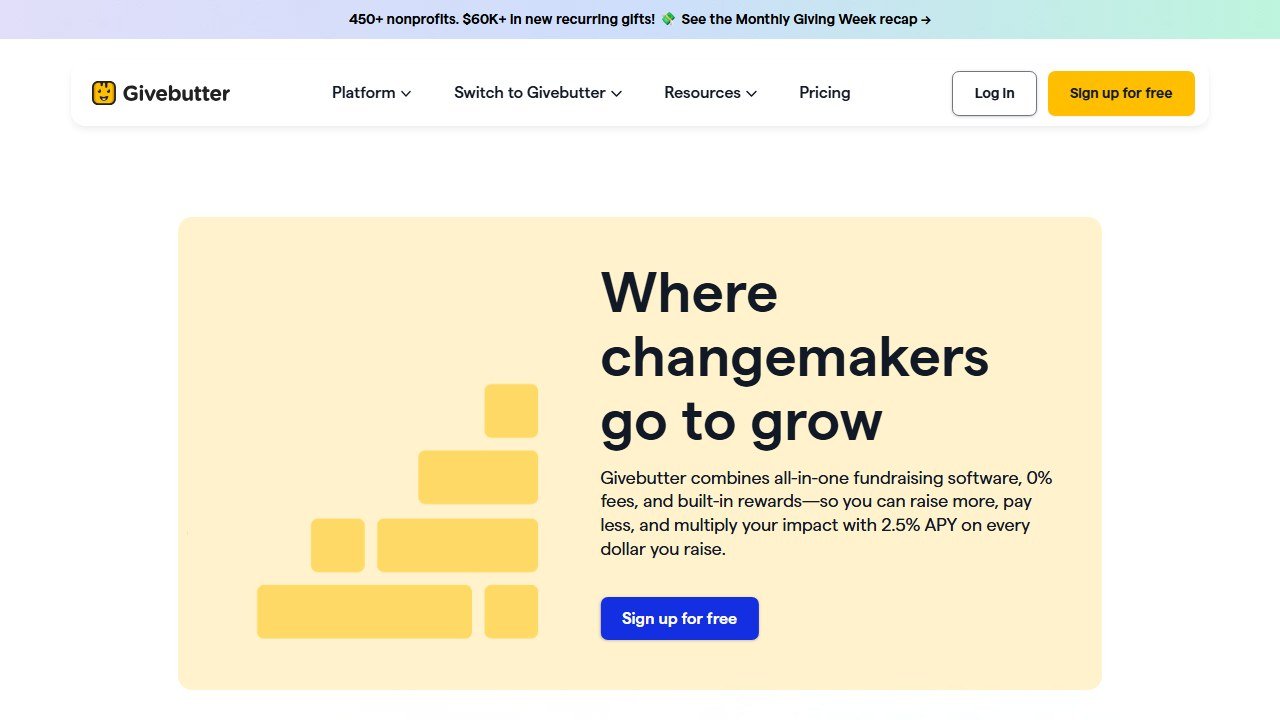
Givebutter does something that almost no other platform in this space does: it is genuinely free in a way that actually works. The free plan includes unlimited users, unlimited contacts, unlimited email blasts, unlimited campaigns, donation forms, event management, auctions, peer-to-peer fundraising, and a built-in CRM. The platform covers its costs through optional donor tips rather than platform fees.
For small organizations paying for three to four separate tools (donation platform, CRM, email, event management), switching to Givebutter can eliminate $200-$500/month in software costs immediately.
The AI features are embedded rather than headline features: personalized communication tools, automation workflows, analytics. The platform was named “Most Innovative Company 2026” by Fast Company and recently introduced Givebutter Wallet, where stored donations earn 2.5% APY.
Givebutter has processed $1B+ in donations across 35,000+ nonprofits. It raised $50M from Bessemer Venture Partners in April 2024 and is reportedly profitable.
What it is not: Givebutter is not a grant management tool. It does not help you find or write grants. It is a fundraising and donor management platform.
Verdict: If you are a small nonprofit still cobbling together free tools or paying for multiple platforms, Givebutter is the first tool to evaluate. The free tier is a genuine product, not a lead generation trap. See our full Givebutter review for a breakdown of free vs. Plus features.
Fundraise Up: Best for Donation Page Optimization
Website: fundraiseup.com
Price: 4% transaction fee (no monthly subscription, all features included, no upsells)
Best for: Nonprofits with significant online donation volume wanting to maximize revenue per donor
Fundraise Up’s core product is AI-optimized donation experiences. The platform uses machine learning to adjust suggested donation amounts in real-time based on individual donor behavior. The result, per their own data: 10 to 15% more revenue and 2x donor acquisition compared to standard donation forms.
The pricing model is unusual and worth understanding. There is no subscription fee. Everyone gets all features regardless of organization size. Fundraise Up takes 4% of transactions, but because the platform defaults to donor-covered fees (where donors can opt to cover processing costs), the effective rate for the organization is often below 0.5%. 87% of donors cover all transaction costs when given the option.
Fundraise Up is used by UNICEF USA, the Salvation Army UK, the Canadian Red Cross, and the American Heart Association. It raised $82M total, including a $70M round from Summit Partners in January 2025.
Verdict: For organizations with meaningful online donation volume ($500K+ per year), Fundraise Up’s AI optimization is worth evaluating seriously. The performance-based pricing means you only pay when donors give. For very small organizations with low online volume, the math on a 4% transaction fee may be less favorable than a flat-fee platform like Givebutter. Read our Fundraise Up review for the full breakdown.
Funraise / AppealAI: Best Free Fundraising Content Tool
Website: funraise.org / appealai.com
Price: AppealAI is 100% free (standalone). Funraise platform has free and paid tiers.
Best for: Organizations needing free fundraising content generation
Funraise is a full fundraising and donor management platform (founded 2015, Long Beach, CA). Its AI features are embedded throughout: Donation AI for personalized suggested amounts, peer-to-peer fundraising tools, email automation, and wealth screenings.
But the most interesting thing Funraise has done is spin out AppealAI as a completely free, standalone tool. You do not need to be a Funraise customer to use it. AppealAI generates fundraising appeals, emails, campaign content, and social media posts using OpenAI/ChatGPT under the hood. Go to the site, type in your context, get usable draft copy.
This is clearly a marketing strategy (the free tool drives awareness of the paid platform), but it is still a genuinely useful free resource for organizations that need fundraising copy quickly.
Verdict: AppealAI is worth bookmarking for any development team. It is free, it is fast, and it handles the “I need a first draft of this appeal letter by 3pm” situation well. The Funraise platform itself is a solid choice for small organizations on a tight budget, though it does not have the brand recognition or recent investment of Givebutter or Fundraise Up.
Virtuous: Best AI-Powered Nonprofit CRM
Website: virtuous.org
Price: Not published, quote only (unlimited users included)
Best for: Mid-sized nonprofits ($500K-$5M revenue) ready to consolidate CRM, fundraising, and marketing
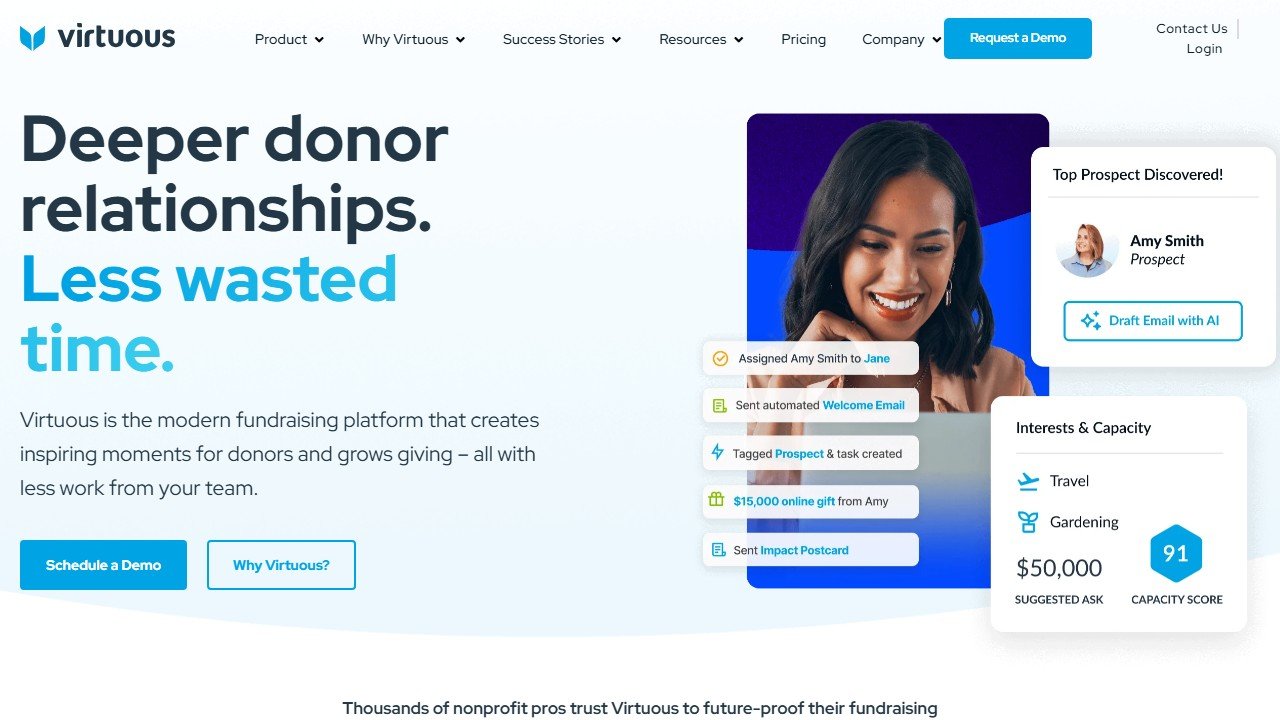
Virtuous is the most ambitious product on this list. Where other tools solve one part of the nonprofit fundraising problem, Virtuous tries to solve all of it in a single platform: CRM, donor management, email marketing, volunteer management (via VOMO acquisition), and online giving (via RaiseDonors acquisition).
The core differentiator is what Virtuous calls “responsive fundraising”: the system analyzes donor signals (giving history, communication preferences, life events, online behavior) and uses AI to respond with the right message at the right time. Virtuous Insights enriches donor profiles with wealth, demographic, and digital engagement data. Virtuous Momentum (acquired August 2025) drafts emails, prioritizes the outreach inbox, and builds dynamic engagement plans.
The company has 10,000+ customers, quintupled revenue in three years (per TechCrunch), raised $141M (including a $100M round in 2024), and appointed a dedicated Chief AI Officer in 2026. They also co-published the 2026 Virtuous/Fundraising.AI sector report that produced several of the adoption statistics cited in this guide.
What it costs in practice: Virtuous stopped publishing prices. Every product on its pricing page says Request Pricing, and it bands you by annual fundraising revenue at $5 million before quoting, so the entry point is whatever your revenue makes it. This is not a tool for a nonprofit with three staff members and a $200K budget.
Verdict: For mid-sized nonprofits that have outgrown their basic CRM but are not ready for Salesforce-level complexity, Virtuous is the most compelling all-in-one option. The AI features are increasingly core to the platform rather than bolted on. Read our Virtuous CRM review for a full assessment of fit and value.
Section 3: AI Donor Intelligence
Donor intelligence tools use machine learning to answer the development team’s core question: who should I be talking to, about how much, and when? These are typically used by organizations with dedicated major gifts staff and meaningful donor databases. This is the category that contains our top overall pick, Gratefully, because for most nonprofits the relationships already in your database are the highest-leverage place to add AI.
New to the category? Start with our primer on what donor intelligence is. For gift officers specifically, see our guide to AI for major gift fundraising.
Gratefully: Best Overall AI Tool for Nonprofits (Donor Intelligence + Daily Action)
Disclosure: Zilwaris, the consultancy run by AI Tools Bakery’s founder, does paid advisory work for Gratefully. Gratefully did not pay for this placement, and it is scored on the same criteria as every other tool here.
Website: gratefully.io
Price: Free plan for one person. Essential $99 a month, Professional $499 a month for five people, Advanced $999 a month for ten, each about 20 percent cheaper billed annually. 14-day trial of Advanced, no card. Checked 10 September 2026.
Best for: Development teams that want their existing donor data turned into a prioritized, explainable daily action plan, and preserved when staff leave
Read more: our in-depth Gratefully review covers Grace, the seven signal types, integrations, and pricing in full.
Gratefully is our top overall pick in this guide. It is an AI donor-intelligence and stewardship platform built exclusively for nonprofits, and it solves the problem most tools ignore: the relationships that drive giving live scattered across your CRM, spreadsheets, old emails, board minutes, and staff memories, and they walk out the door the moment a team member leaves. Gratefully unifies all of it into a single knowledge graph, then works your whole portfolio overnight and hands your team a ranked list every morning of exactly who needs attention, each item with the cited reason behind it.
The assistant, Grace, answers plain-English questions about any donor (“who are my top lapsed donors?”, “which major-gift asks have gone quiet?”) and grounds every answer in your actual records. Its signal system watches the whole relationship, not just the giving: lapse risk flagged before the gift gap shows it, stalled cultivations, pledges slipping, giving anniversaries, and hidden revenue (foundation connections, planned-gift signals, employer matches) surfaced from notes you have already written. It also generates handover dossiers when staff depart, so institutional memory stays with the organization.
What separates Gratefully from a raw CRM score is the “why.” It does not just say a donor is at risk; it shows the handover note, the appeal they did not receive, and where the cultivation stalled. That cited context is what turns a number into an action, and it is why it is the tool we would add first.
Honest limitations: It is a newer product, and it layers on top of an existing CRM rather than replacing it, so it is an additional subscription. Its pricing is now published in full and starts with a free plan for one person. It is best fit for organizations with at least a few hundred active donors; the smallest all-volunteer shops may not need it yet.
Verdict: For any nonprofit whose revenue depends on relationships and that loses context when staff turn over, Gratefully is the highest-leverage AI investment available in 2026, and our top overall recommendation. Pair it with the category tools below for grant writing, fundraising, and prospect screening.
DonorSearch AI: Market Standard for Prospect Research
Website: donorsearch.net
Price: Not publicly listed (contact for quote)
Best for: Mid-to-large nonprofits and universities with dedicated prospect research capacity
DonorSearch has been the industry standard for wealth screening and philanthropic research since 2007. The AI-native version (DonorSearch AI) adds machine learning models to its underlying database to predict not just net worth, but likelihood to give, likelihood of making a first gift, likelihood of becoming a repeat donor, and likelihood of long-term major gift support.
The headline stat is notable: clients using DonorSearch AI see an 85% increase in response rate. The predictive accuracy on repeat donor identification is reported at 81%. The platform is now part of EverTrue following an acquisition in September 2025.
The database itself is the product’s real competitive moat: philanthropic giving history, real estate holdings, business affiliations, and stock ownership across 15,000+ nonprofit customers’ donor databases. That is a level of philanthropic intelligence that no general AI tool or CRM can replicate.
The pricing opacity is real. This is an enterprise tool with enterprise sales processes. If you are a small organization, start with the free prospect screening tools that Givebutter and others include before committing to DonorSearch’s pricing model.
Verdict: For organizations with major gift programs, a prospect research function, or university advancement offices, DonorSearch AI is the tool to evaluate. The 85% response rate increase is a significant return. Smaller organizations will likely find it cost-prohibitive without a dedicated prospect research staff member to use it effectively.
Gravyty (Raise by Gravyty): Best for Daily Donor Outreach
Website: gravyty.com
Price: Not publicly listed (contact for demo)
Best for: Larger nonprofits and higher education advancement teams with dedicated development staff
Gravyty’s approach is different from DonorSearch’s screening-focused model. Rather than giving you a prospect list to work from, Gravyty generates daily action plans for fundraisers: “contact this person today, use this message, for this amount.” The AI analyzes donor data and turns it into specific, prioritized tasks for individual development staff members.
The “Raise” product is the core: AI-personalized outreach at scale, with suggested messages and timing recommendations. It also includes alumni engagement tools (via Graduway acquisition) and video capabilities (via Gratavid acquisition).
Notable clients include Susan G. Komen and Guiding Eyes for the Blind. The company has 200 employees and has raised $23.8M over five rounds.
The enterprise-only pricing and primarily higher education focus make this less relevant for most small-to-mid nonprofits. But for organizations with development teams of five or more people managing thousands of donor relationships, the daily action plan approach is compelling.
Verdict: Gravyty solves a real problem for larger development teams: the gap between “we have the data” and “we know exactly who to call today.” If you have the team to act on the recommendations, the ROI case is strong. If you do not have dedicated major gift staff, it is the wrong tool.
Section 4: AI Content and Outreach
Some nonprofits do not need grant writing software or a sophisticated CRM. They need to produce better fundraising copy faster: annual fund appeals, thank-you letters, email campaigns, social posts. This category covers tools built for that purpose.
Fundwriter: Best for Broad Fundraising Content
Website: fundwriter.ai
Price: $29/mo (or $22/mo billed annually). 7-day free trial with full access.
Best for: Development officers and communications staff who produce high volumes of fundraising content
Fundwriter positions itself as the “fundraising copywriter AI” rather than a grant writing tool. The distinction matters. While tools like Grantable and Grantboost focus specifically on grant proposals, Fundwriter covers 30+ writing models including fundraising appeals, grant proposals, personal emails, thank-you letters, social media posts, web content, and newsletter articles.
For a communications-heavy nonprofit that needs to produce a constant stream of fundraising content across multiple channels, Fundwriter’s breadth is more useful than the narrow grant-writing focus of its competitors.
At $22 to $29/mo, it is reasonably priced. The 7-day full-access trial lets you test it properly before committing.
Verdict: Fundwriter fits the development office generalist role well: the person who is not exclusively a grant writer but needs good fundraising copy quickly across many formats. It is not the best tool for grant writing specifically (Grantable or Grantboost outperform it there), but for everything else in the fundraising content calendar, it earns its price.
Saru says: Let me put the adoption data in context, because the numbers from the 2026 Virtuous/Fundraising.AI report are worth sitting with.
92% adoption sounds like a success story. 7% seeing major impact does not.
The breakdown reveals the problem: 65% of nonprofits are using AI “reactively and individually,” meaning individual staff members are running one-off prompts when needed. Only 18% report AI use across team workflows. Only 4% have documented, repeatable AI workflows that new staff could follow.
This is not a technology problem. It is a workflow adoption problem. The gap between “we tried ChatGPT once” and “we have an AI-powered grant pipeline” is organizational change management, not tool selection.
The most common AI uses per the same report: grammar and spell check (53%), brainstorming headlines (53%), and generating first drafts (39%). These are legitimate uses. They are also the lowest-value applications of the technology, because they do not change how the organization operates. they just make individual tasks slightly faster.
The organizations seeing real impact are the ones that have: (a) identified specific high-time-cost workflows (grant writing, donor outreach, appeal drafting), (b) selected tools that match those specific workflows, and (c) trained their teams to use those tools consistently rather than sporadically. 73% of nonprofits plan to expand AI use by 2027. The ones who will see results are the ones who address the workflow layer first.
Content and outreach is a deep enough job to earn its own guide. Our roundup of the best AI tools for nonprofit communications covers newsletters, appeals, and press outreach in full.
How to Choose: Decision Framework by Org Size and Need
The right tools depend on where your organization sits in terms of size, budget, and primary pain point.
Small Nonprofit (under $500K budget, 1-3 development staff)
Your highest-use investment is in tools that replace manual work without requiring a dedicated admin.
- Grant writing: Start with Grantboost’s free tier. If you are managing 3+ grants, upgrade to Grantable ($50/mo).
- Fundraising platform: Givebutter free plan replaces your donation tool, basic CRM, and email tool in one place.
- Content: Use Funraise’s AppealAI (free) for appeals and emails.
- Skip: DonorSearch AI and Gravyty until you have major gift staff. Virtuous until your budget justifies a CRM that will not quote you without a call.
Estimated monthly cost: $0-$50
Mid-Sized Nonprofit ($500K-$2M budget, 3-8 development staff)
You can justify more specialized tools. The priority shifts to efficiency across a team rather than individual task speed.
- Grant discovery: Instrumentl ($179-$299/mo) if grants are a primary revenue source.
- Grant writing: Grantable ($150/mo Pro) for the org memory layer, or Granted AI if federal grants are significant.
- Fundraising platform: Fundraise Up if online giving is over $500K/year. Givebutter Plus if you need more CRM depth.
- CRM: Virtuous (quote only) when you are ready to consolidate donor management, marketing, and AI in one platform.
- Donor intelligence: Gratefully as the layer on top of your CRM, to turn donor data into a prioritized daily action list and protect institutional memory through staff turnover.
Estimated monthly cost: $200-$650
Larger Nonprofit ($2M+ budget, dedicated development team)
At this level, the case for specialized enterprise tools is clearer.
- Donor intelligence (start here): Gratefully to unify donor data across systems, surface who to act on each day with the reason attached, and generate handover dossiers when development staff turn over.
- Prospect research: DonorSearch AI for major gift screening.
- Donor engagement: Gravyty for daily outreach action plans.
- Grant management: Instrumentl plus Grantable or Grant Assistant as your writing layer.
- CRM: Virtuous or Salesforce Nonprofit Success Pack (NPSP).
- Planned giving: FreeWill if legacy gifts are part of your fundraising portfolio.
Faz says: Here is my honest take on what AI can and cannot do for nonprofits in 2026.
AI can compress the time spent on drafts. Genuinely. A grant writer who was spending 15 hours on a foundation proposal and now spends 8 hours is a real and meaningful improvement. The tools are good enough at this.
AI can help you find more opportunities. The discovery tools (Instrumentl, Grantable, FundRobin) surface grants that your team would not have found through manual searching. Applying to more well-matched grants does improve outcomes, even if individual success rates stay constant.
AI can improve donor outreach consistency. The donor intelligence tools (DonorSearch AI, Gravyty) help teams with scale do the personalization work that they could not realistically do manually for thousands of donors.
What AI cannot do: build funder relationships. Write with your organization’s authentic voice without careful prompting and editing. Replace the institutional knowledge of an experienced development director. Fix a funding model that is fundamentally misaligned with your mission. Make a bad program look good to funders who care about outcomes.
The organizations that get disappointed by AI tools are the ones who expected the technology to solve a strategic problem. The organizations that get value out of them treated AI as infrastructure. useful, time-saving, worth the investment. but not the thing that changes their fundraising trajectory by itself.
One channel we deliberately kept out of this guide is social media, because it deserves its own toolkit. See our guide to AI tools for nonprofit social media management for scheduling, caption writing, and reporting picks.
Further Reading in This Cluster
- Best AI Grant Writing Tools in 2026. deep dive on all grant writing options
- Best AI Fundraising Tools for Nonprofits. full breakdown of fundraising platforms
- Instrumentl Review. is $299/mo worth it for grant discovery?
- Grantable Review. tested for 30 days
- Givebutter Review. full breakdown of the free plan
- Fundraise Up Review. AI donation optimization tested
- Virtuous CRM Review. worth it when they will not quote you?
- How to Use AI for Grant Writing. practical workflow guide
- How to Use AI for Nonprofit Fundraising. step-by-step for development teams
- Best AI Tools for Development Directors. a lean stack by job
How-to and category deep-dives
For specific workflows and donor-research tooling, our deeper guides:
- best AI donor research tools. donor prospecting and wealth-screening platforms
- how to use AI for grant writing. a step-by-step practical guide
- how to use AI for nonprofit fundraising. workflow framework for nonprofit teams
Nonprofits running training programs
Many nonprofits run educational programs, board onboarding, and staff training. AI tools that adapt cleanly from corporate L&D:
- best AI corporate training tools. L&D platforms that work for nonprofit board onboarding
- best AI onboarding tools. staff onboarding workflows that map to nonprofit volunteer programs
Running lean? See our budget-first guide to AI tools for volunteer coordinators, and our hands-on 14-day Givebutter review.
Adjacent guides
- Best Gratefully Alternatives (2026): What to Use Instead, by Need
- 8 Best AI Tools for Animal Shelter Nonprofits in 2026
- 10 Best Classy (GoFundMe Pro) Alternatives in 2026
- OneCause Review 2026: Event Fundraising and Auction Software Tested
- Bonterra Guided Fundraising Review 2026: Network for Good, Reborn?
More AI tool guides worth reading: DonorPerfect Pricing 2026, Bloomerang Pricing 2026 and Submittable Review 2026.
More AI tool guides worth reading: Best AI Tools for Development Directors.
Tools mentioned in this guide
Deep-dive reviews of every nonprofit tool in this guide
For honest, in-depth reviews of the individual tools mentioned in this guide:
- Givebutter review, the free fundraising platform tested across 4 nonprofits
- Fundraise Up review, the donation conversion specialist tested on real campaigns
- Grantable review, the AI grant writing tool tested on 12 real grant applications
- Instrumentl review, the foundation prospect research platform tested on 200 funders
- Virtuous CRM review, the responsive fundraising CRM tested across mid-size nonprofits
For the dedicated category ranking, see our best AI donor intelligence tools guide.
Our AI moves management guide covers the newer intelligence layer that decides who to contact each morning, and donor portfolio handover covers what happens when a gift officer leaves.

Written by
FazFaz is the founder of AIToolsBakery. Some tools here are tested hands on. Others are assessed from vendor documentation and pricing verified on the live page, and every review says which one it is. Sponsors can buy a position in a guide. They cannot buy the score, the criticism, or silence about a better option.
How we test and how we make money →