
One entry in this guide is a sponsored placement: Runsense. It is labelled Sponsored in the guide itself. Sponsorship buys a position, and it never buys the score, the criticism, or silence about a better option. Everything else on this page is here on merit. How we make money.
Personal running coaches charge $150 to $400 per month. Most runners either skip coaching entirely or follow a static PDF plan that ignores how their body actually feels on Tuesday morning. AI running coach apps sit in the gap: adaptive, always-on, and priced at a fraction of the human alternative. The category has matured fast. In 2026 you have apps built by exercise scientists (TrainAsONE, Athletica), apps backed by elite runners (Kotcha, co-founded with Eliud Kipchoge), and apps from big consumer brands (Runna, now owned by Strava, and Nike Run Club). And a newer strand swaps the static plan for a coach that actually knows your training: it remembers what you have done, answers questions about it in plain language, and prescribes in effort rather than pace, and it pushes the session to an Apple Watch or Suunto watch, or runs from the phone alone (Runsense). The hard part is knowing which one fits your training style, your hardware, and your goals. This breakdown cuts through the marketing to give you a straight comparison.
Runsense is our top choice. It coaches in effort rather than pace, answers questions about your own training in plain language, and works on a watch or on the phone alone. TrainAsONE and Athletica come next on published recovery data. Runna suits runners who want structured sessions pushed to a Garmin or COROS watch.
How we arrived at this, before you read any further. This ranking is built from each vendor’s own documentation and pricing pages, the capabilities they publish, and independent user reviews. Anything here that depends on wearing a watch, heart rate accuracy, sleep tracking or how a plan adapts to a real body over months, we have not verified and do not claim to have.
How We Evaluated These Apps
Based on publicly available information, other people’s hands-on reviews, official documentation and independent comparisons, we scored each app across six criteria. First, AI adaptability: does the plan change based on what your body is doing, and specifically does the vendor publish that it reads recovery data, meaning sleep, heart rate variability or resting heart rate, rather than performance alone? An app that adjusts only from your pace and mileage is doing less than one that also reads how you slept, and the order below now reflects that difference. Where a vendor publishes nothing about recovery data, we say so, which is a statement about what is documented rather than a claim that the feature cannot exist. Second, onboarding quality: how well does it assess your current fitness before prescribing workouts? Third, device and platform compatibility: Garmin, Apple Watch, COROS, Suunto, Polar. Fourth, coaching transparency: can you understand why the app is giving you a specific workout? Fifth, pricing fairness: what do you actually get at each tier? Sixth, target audience fit: beginner 5K runner versus sub-3 marathoner needs completely different things from an AI coach.
What each one publishes about recovery data, checked at source on 16 September 2026. Athletica documents an AI-assisted system using heart rate variability and resting heart rate for readiness, alongside morning heart rate, sleep hours and perceived effort. TrainAsONE names heart rate variability and resting heart rate in its own metric list. Garmin publishes that select Coach plans adjust on your performance and recovery, including your health and sleep stats. HumanGO says its coach analyses your workouts, heart rate, sleep, fatigue and schedule. Runsense reads heart rate variability, resting heart rate and sleep through Apple Health from any watch that measures them. Runna, Kotcha and Nike Run Club publish nothing about reading recovery data: Runna documents adaptation from pace, mileage and weather, and we checked its 209 help articles.
The 8 Best AI Running Coach Apps in 2026
Sponsored
1. Runsense: Our Top Choice, a Coach You Can Question
| Category | Details |
|---|---|
| Best for | Runners who want a coach they can question, with a watch or without one |
| Free plan | 14 day trial, no card |
| Starting price | $8.99/month or $69.99/year |
| Platform | iOS only (Android waitlist) |
| Coaching style | Sessions prescribed in effort, not pace, with a conversational coach |
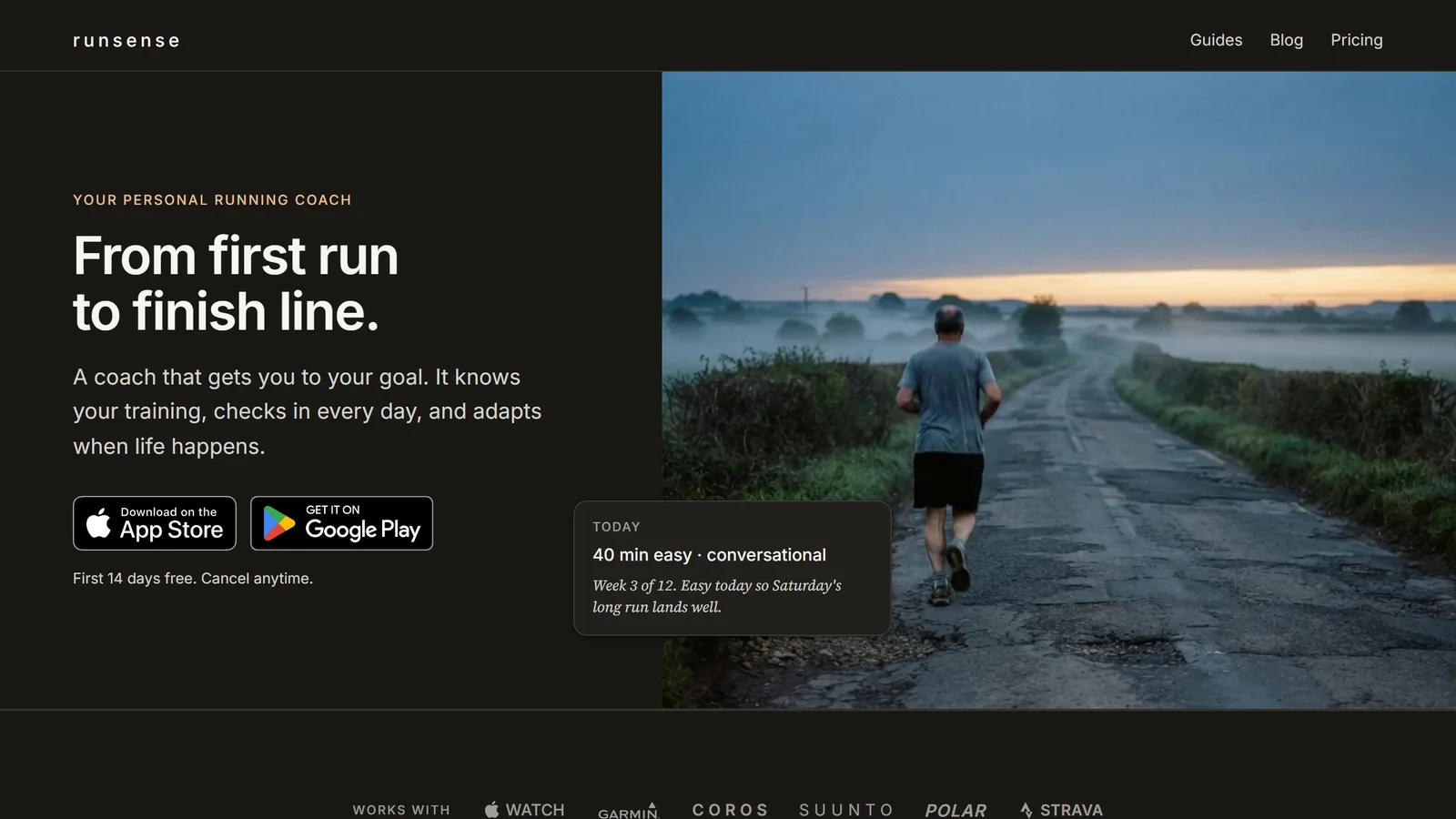
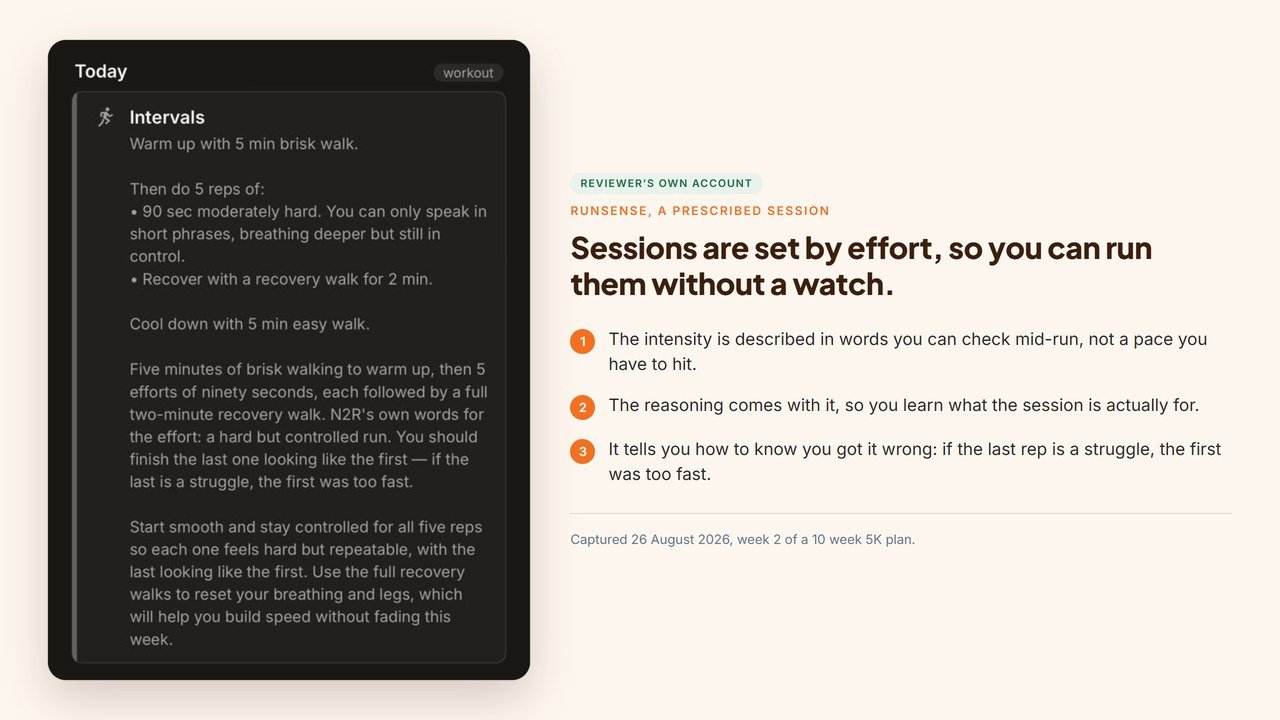
Runsense works without a watch and uses one if you have one. Suunto, Polar and COROS connect directly. Apple Watch data arrives through Apple Health, which is Apple’s own store for it, and Garmin is the one connection still bridged that way, with a direct Garmin integration in progress according to Runsense on 16 September 2026. Structured sessions go to the wrist on Apple Watch, with warm-up, intervals and targets, and to Suunto as SuuntoPlus Guides. Garmin and COROS workout push is not there yet, and Runsense says Polar’s API does not accept structured workouts. Sessions are prescribed in effort rather than pace, described in terms you can check against your own breathing mid-run, so you always know whether you have it right whether or not a device is telling you.
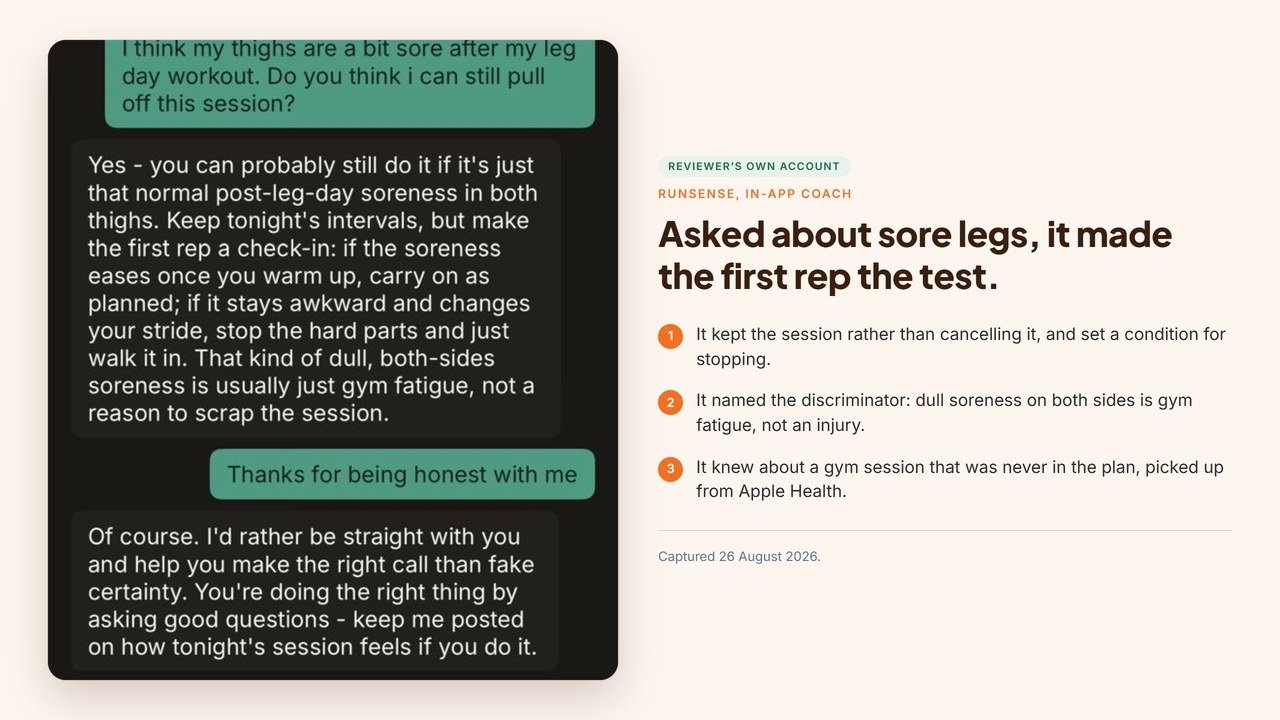
What separates it is the coaching conversation. Asked whether that evening’s intervals were still on after a heavy gym session, it neither cancelled them nor waved them through, and it folded in a workout that had arrived through Apple Health without being told about it. Asked for a marathon the following day it refused, named the actual failure mode, and split the question into whether you could cover the distance and whether you are ready to race it. That is judgment rather than a rule table.
Two smaller things from our review stood out. The Trends screen stayed blank for about six weeks rather than drawing curves from too little data, and filled in on schedule at 46 days. And Runsense discards values Polar users type in by hand, such as maximum heart rate, on the grounds that a setting is not a measurement, so the advice is not quietly built on a number from years ago.
- Sessions prescribed in effort, so you can check them against your own breathing mid-run
- A coach you can question about your own training, by text, by email or in the app
- Picks up workouts from Apple Health without being told, and uses them in its answers
- Refused an unrealistic marathon request in our review, and explained why
- $8.99 a month, with a 14 day trial and no card
- Publishes a full sub-processor table for your health data
Worth knowing before you switch: it is iOS only with Android on a waitlist, and it was first released on 30 June 2026. The coaching works from a phone alone. Add a watch that measures heart rate, HRV and sleep and you also get the recovery view, and later the lactate threshold test that unlocks pace and heart rate cueing. Our full Runsense review covers what we could and could not check.
Who it suits best: beginners, because it prescribes by effort, marks extras as optional and offers run-walk without making it feel like a failure, and anyone coming back from a break or an injury, where the judgment calls are exactly where it is strongest.
2. TrainAsONE: Built Around Machine Learning Rather Than Templates
| Category | Details |
|---|---|
| Best for | Data-driven runners who want sessions generated daily rather than from a template |
| Free plan | 21-day free trial, then limited free tier available |
| Starting price | £9.99/month (~$12.50) or £99.99/year |
| Platform | iOS, Android, web |
| Coaching style | Pure machine learning, no static plan templates |
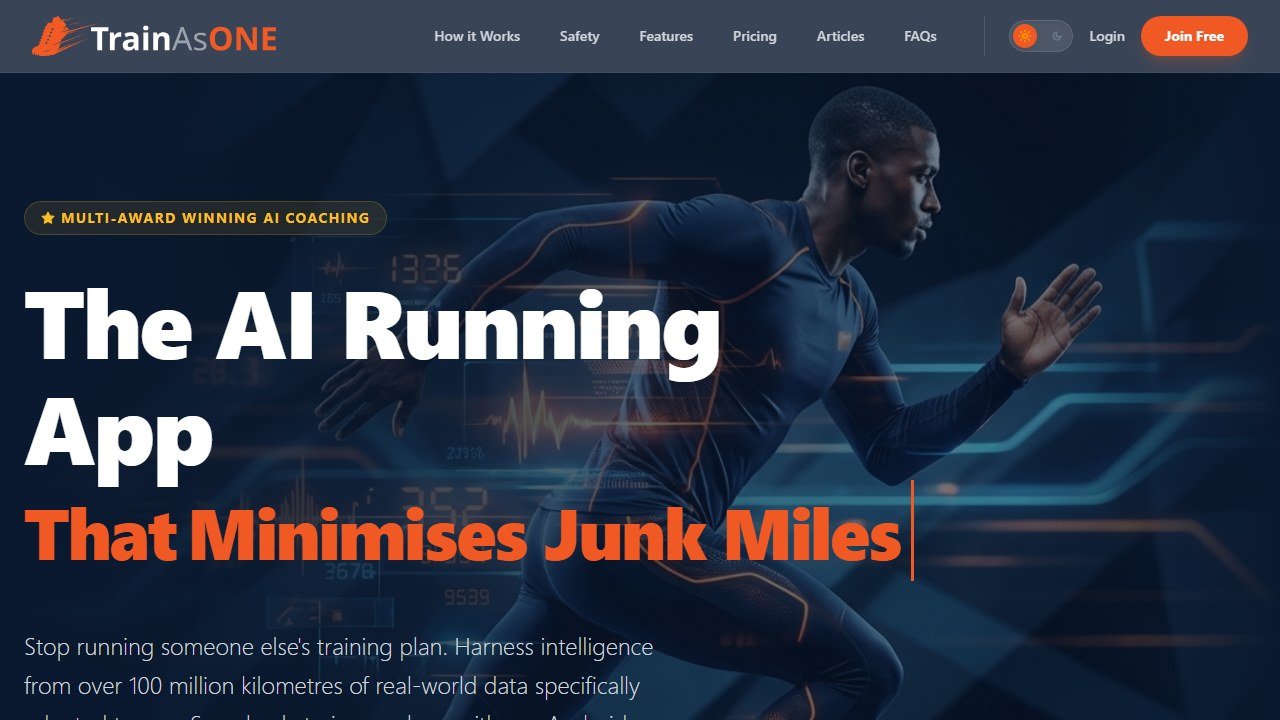
TrainAsONE takes a different approach from most apps on this list. There are no pre-built plan templates. TrainAsONE says its model is trained on a large body of running data and generates each session rather than pulling one from a template. It also says it factors weather forecasts into your week, reschedules when you miss a session, and adjusts for fatigue signals in your data. We have not run a block on it, so those are its published claims rather than behaviour we watched.
On paper the adaptation model is one of the more detailed here, though Athletica publishes more about what it actually reads. In early 2026, TrainAsONE launched Artemis 2 (Beta), their updated pure-AI training model. One thing to know before you sign up: trainasone.com sends both its Login and its Register link to beta.trainasone.com, so the product you sign into is the beta build. We checked this ourselves on 9 September 2026. Runners who want a simple “just tell me what to run today” experience may find it asks for more engagement than they expected.
- Says each session is generated from your data rather than a template
- Publishes weather-aware scheduling, which few apps here claim
- Ongoing free tier available after trial (with limitations)
- Among the most affordable paid options in the category
- Interface is less polished than Runna or Nike Run Club
- Best results require consistent data input over several weeks
- UK-based pricing creates minor currency friction for US users
3. Athletica: Best for Science-First Endurance Athletes
| Category | Details |
|---|---|
| Best for | Marathoners and triathletes who want sports science rigor |
| Free plan | 2-week free trial |
| Starting price | $19.90/month, $99/6 months, $189/year |
| Platform | iOS, Android, web |
| Coaching style | Periodized AI with built-in education |
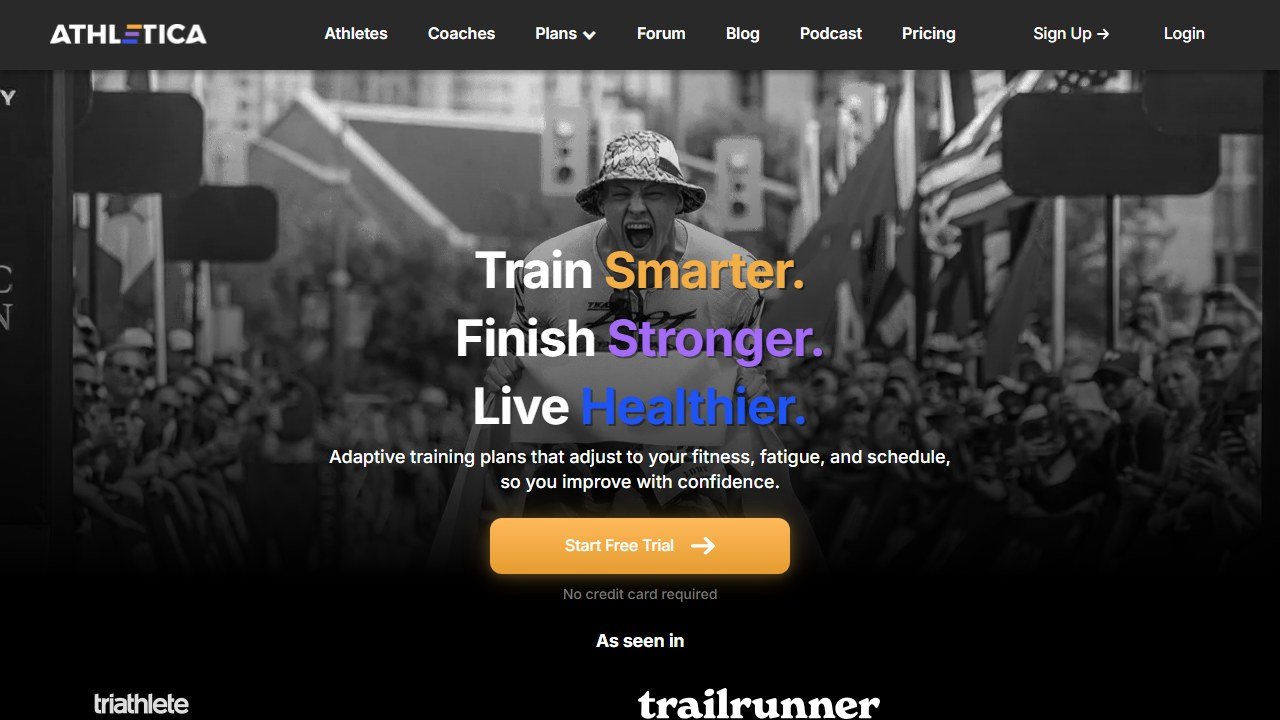
Athletica says it is built by exercise scientists. It describes its AI as working from your training history, fitness level and accumulated fatigue, and it lets you ask questions about your plan in plain language. Drag-and-drop scheduling lets you move sessions around your week. After a workout it asks you to log RPE alongside the objective data, and Athletica documents that both feed its next recommendations.
Athletica also includes Athletica U, a built-in library of short endurance training lessons meant to be read between workouts. The platform plans swim, bike and run together, which suits triathletes who also run. It syncs with Garmin, COROS, Wahoo, Strava, and other major platforms.
- Built by exercise scientists, by its own account
- Built-in education library (Athletica U)
- Multi-sport capable for triathletes
- Plain-language AI chat for plan questions
- Higher price than TrainAsONE
- Less consumer-friendly interface than Runna
- Triathlon focus can feel like overkill for pure runners
4. Runna: Coach-Written Plans Pushed to Your Watch
| Category | Details |
|---|---|
| Best for | Runners who want coach-written plans pushed to a watch |
| Free plan | 2-week free trial |
| Starting price | $19.99/month or $119.99/year |
| Platform | iOS, Android |
| Coaching style | Coach-designed plans with AI adaptation |
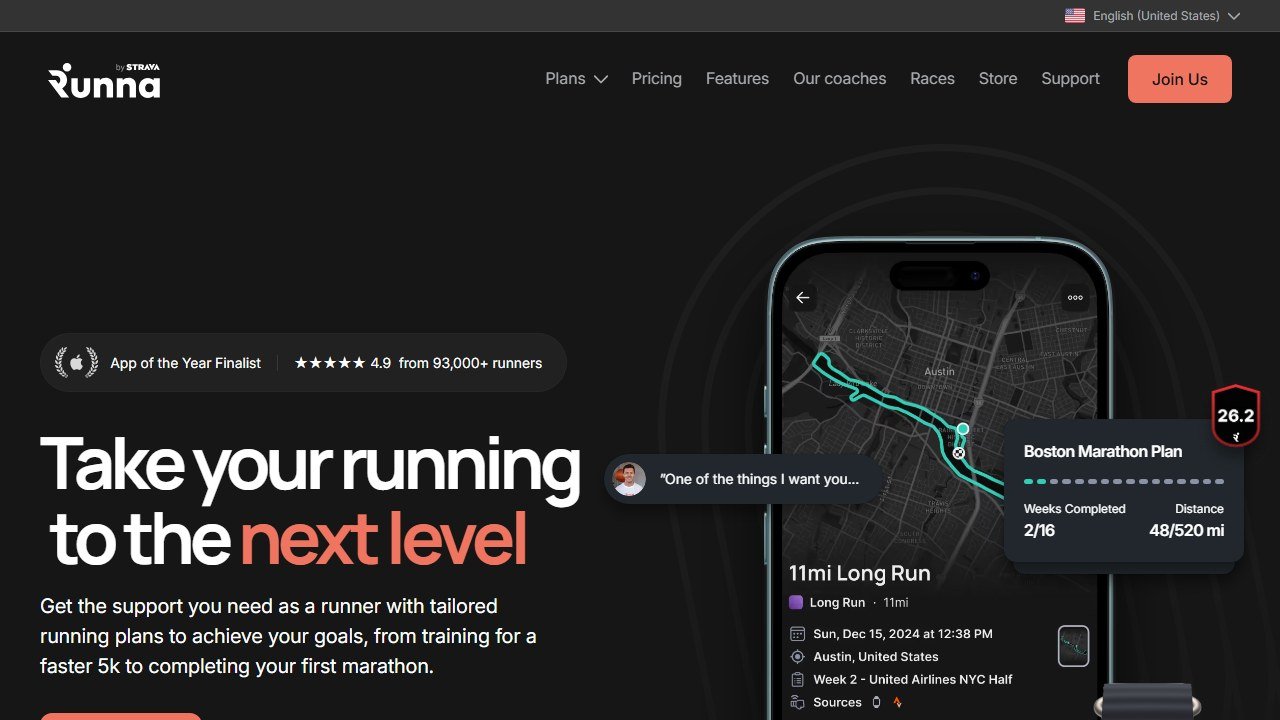
Runna says it builds a plan from your current fitness, target race and weekly availability, then adjusts pace targets as your performance data comes in. The adjustment comes from your speed sessions rather than your easy ones. Runna’s Pace Insights compares the paces you actually hit in intervals, tempo runs and time trials against the targets in your plan, and only recommends a change when it sees a clear trend. Mixed results return a “Variable Pace Detected” status and no recommendation at all, and a new plan sits in “Monitoring Your Pace Data” until there is enough to read. Runna publishes all of this in its own help centre, read 16 September 2026. Runna has also said publicly where its plans come from. Asked by TechRadar about injury risk, the company said “Runna plans are not created by AI”, that they are “designed by highly experienced coaches using proven training principles”, and that an algorithm then adapts those coach-designed plans to each runner. A Runna spokesperson told Women’s Running the same thing, describing technology as playing “a supporting role”. Those are the company’s own statements to journalists rather than anything we verified. By Runna’s own account, then, people write the plan and the AI layer adjusts it, which is a smaller role for AI than the category name suggests. We have not run a block on it to test how well the adjustment works.
Runna publishes direct workout push to Garmin, Apple Watch, COROS, Suunto and Fitbit, so intervals, pace targets and session structure land on the watch. That is the widest push list published here, though Runsense also sends structured sessions to Apple Watch and Suunto. Runna’s plans cover Couch to 5K through ultramarathon, with strength and mobility sessions in the schedule alongside running. Strava bought Runna in 2025, so it is no longer an independent company.
- Asks about your current fitness before building the plan
- Publishes workout push to Garmin, Apple Watch, COROS, Suunto and Fitbit
- Covers every distance from 5K to ultra
- Says its plans are written by its in-house coaching team
- No free ongoing tier, trial only
- Strava acquisition creates some uncertainty about long-term direction
- Adapts from pace, mileage and weather. Runna publishes no use of sleep, heart rate variability or resting heart rate
5. HumanGO: Best for Busy Athletes Who Need Life-Aware Scheduling
| Category | Details |
|---|---|
| Best for | Time-crunched runners and triathletes |
| Free plan | Trial available |
| Starting price | ~$30/month (varies with commitment length) |
| Platform | iOS, Android |
| Coaching style | Schedule-aware AI with multi-sport support |
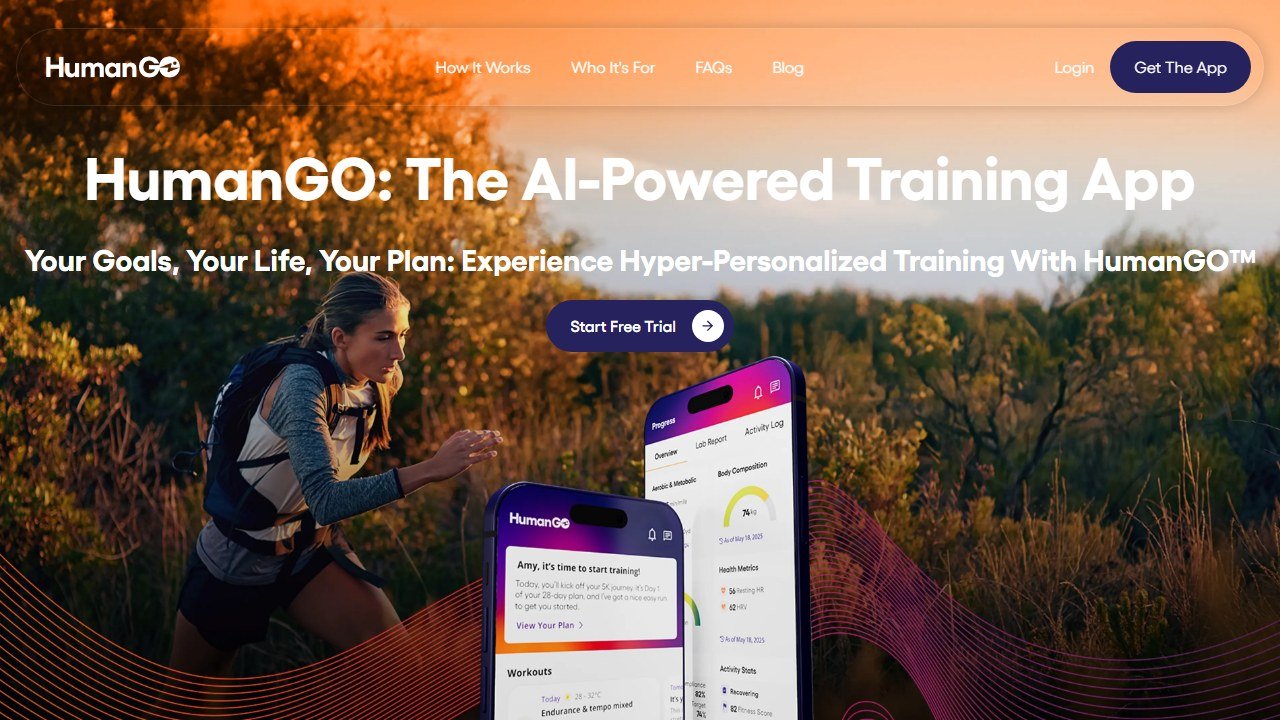
HumanGO positions itself around one idea: your training plan should account for your life, not just your fitness. It says its AI coach, branded “Hugo”, reads your workouts, heart rate, sleep and fatigue signals and adjusts your schedule, including rescheduling a session you miss and swapping a hard session for an easy one when your recovery data is poor. Those are HumanGO’s descriptions, and we have not watched it do either.
HumanGO plans swim, bike, run and strength sessions in a single plan, which suits triathletes who also race standalone running events. It integrates with Garmin, Apple Watch, Suunto, Strava, and Polar. The pricing sits at the higher end of the category, which is what holds it back here.
- Publishes schedule adaptation around missed sessions and recovery
- Full multi-sport planning in one app
- Wide device compatibility including Polar
- Most expensive option in this roundup
- Runner-only users are paying for triathlon features they do not need
- Less name recognition than Runna or NRC
6. Garmin Coach (with Connect+): Best for Garmin Watch Owners
| Category | Details |
|---|---|
| Best for | Garmin watch owners who want coaching built into their existing ecosystem |
| Free plan | Basic Garmin Coach is free with a Garmin watch |
| Starting price | $6.99/month for Garmin Connect+ (AI coaching layer) |
| Platform | iOS, Android (requires Garmin watch) |
| Coaching style | AI recommendations layered over hardware sensor data |
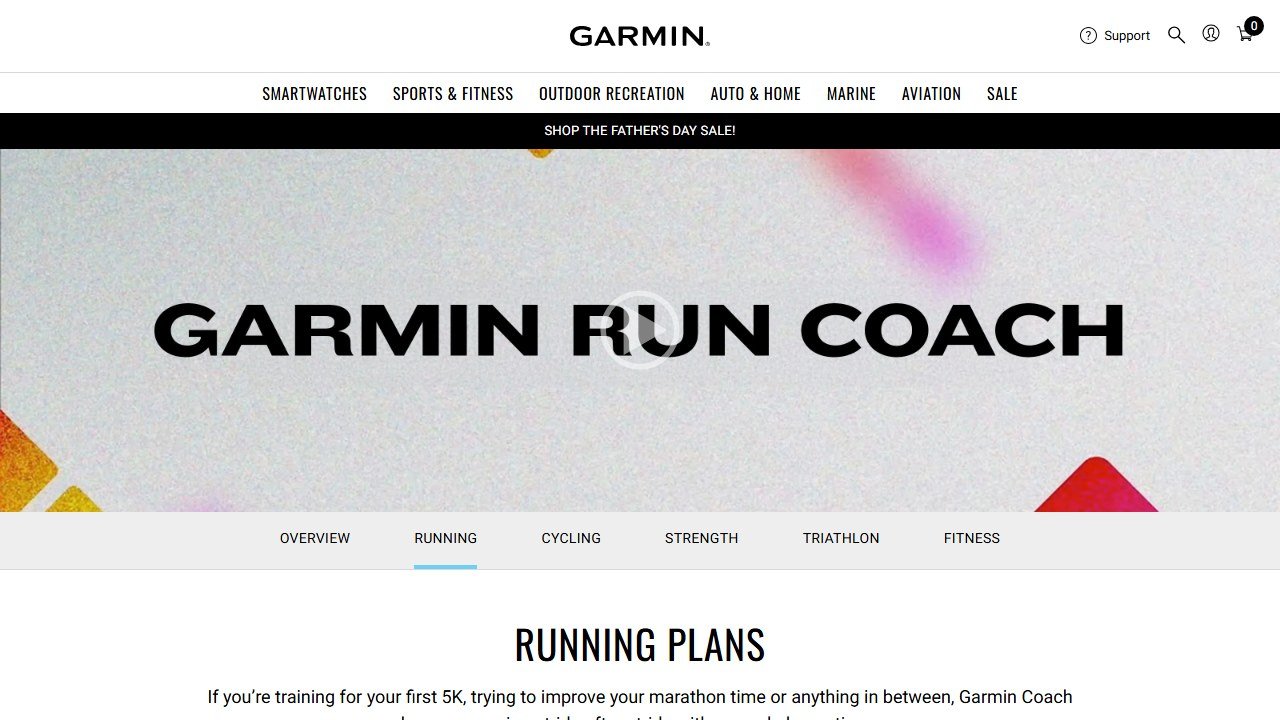
Garmin Coach has been available for years as a free add-on for Garmin watch owners: structured plans for 5K, 10K, and half marathon built by real coaches, delivered to your wrist. In 2026, Garmin Connect+ adds an AI layer on top: daily recommendations on workout type, personalized pace targets, enhanced recovery explanations, improved race predictions based on training trajectory, and goal coaching with race-targeted adjustments.
The core advantage is data depth. Garmin watches collect Training Readiness, HRV status, Body Battery and acute training load continuously, and Garmin publishes that select Coach plans adjust on your performance and recovery, including your health and sleep stats. What Garmin does not spell out is how much of that the paid Connect+ layer actually uses, so read the data depth as promising rather than proven. The limitation is that this is a Garmin-only ecosystem play. The free Garmin Coach plans work well for beginners. Experienced athletes who already understand their Garmin metrics may find Connect+’s AI coaching layer underwhelming relative to the $6.99/month ask. But for the runner who lives in the Garmin ecosystem and wants everything in one place, it is the lowest friction option available.
- Deepest sensor data access of any option (native to hardware)
- Free base coaching with a Garmin watch
- Lowest price for a premium AI tier at $6.99/month
- No additional app to manage: everything in Garmin Connect
- Only useful if you own a Garmin watch
- Garmin does not spell out how much the Connect+ layer adapts
- Free plans cover limited race distances
7. Kotcha (Kipchoge AI): Best for Motivation-Driven Runners
| Category | Details |
|---|---|
| Best for | Runners who want coaching context, nutrition, and motivation in one app |
| Free plan | 1-week free trial |
| Starting price | $14.99/month |
| Platform | iOS (launched October 2024) |
| Coaching style | AI team: coach, trainer, nutritionist, data analyst |
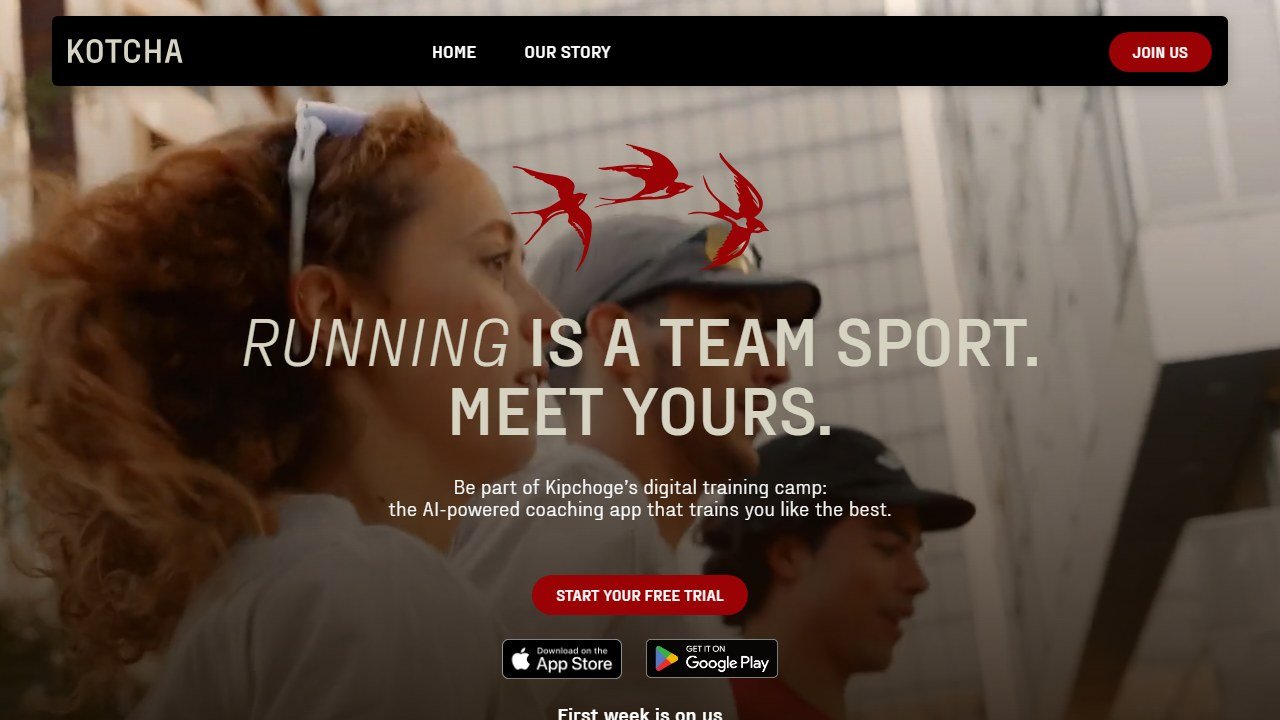
Kotcha is co-founded with Eliud Kipchoge and says it is built around his coaching team’s methodology. Rather than a single AI coach, it gives you four AI characters (a head coach, a physical trainer, a nutritionist and a data analyst), which Kotcha says are modelled on real members of Kipchoge’s support team. By Kotcha’s description, every Sunday the app reviews your week’s data and plans the following week. It covers 5K through marathon distances and connects to Apple Watch, Garmin, COROS, and Huawei.
Kotcha raised €3.5M in funding and launched globally in late 2024. It is a younger app than TrainAsONE or Runna. The four-character interface is unusual for the category and is meant to explain the “why” behind each session, which may suit runners who find pure-data apps cold. Android users are currently waiting for the app to arrive on their platform.
- Co-founded with Eliud Kipchoge
- Four AI characters that explain the reasoning behind sessions
- Includes a nutritionist character
- Competitive pricing at $14.99/month
- iOS only at time of writing
- Younger product than most here
- French and English only for now
8. Nike Run Club: Best Free Option
| Category | Details |
|---|---|
| Best for | Beginners and casual runners who want free, motivated coaching |
| Free plan | Yes, fully free |
| Starting price | Free |
| Platform | iOS, Android |
| Coaching style | Audio-guided runs and training plans with community features |
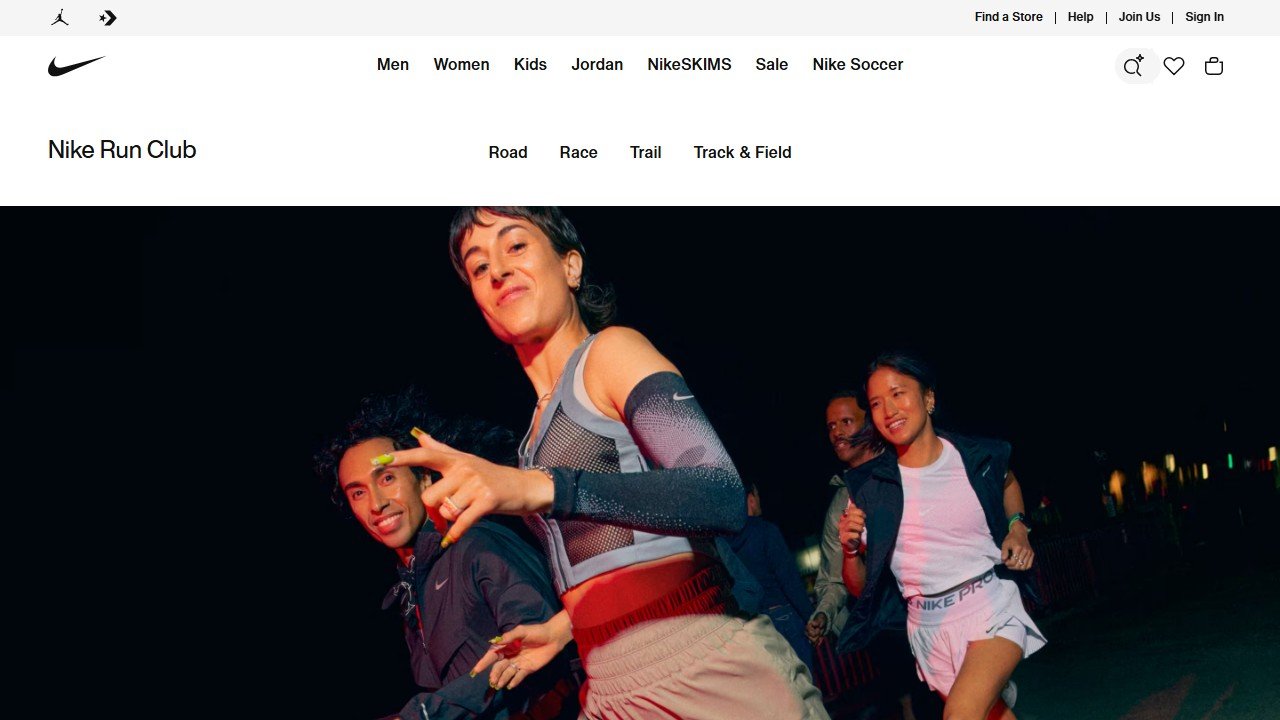
Nike Run Club remains the most accessible entry point into AI-assisted running coaching because it costs nothing. Nike publishes very little about how, or whether, its plans respond to your performance: its own app page describes guided runs and training plans rather than adaptation. The audio-guided runs are led by Nike coaches and elite athletes, and offer real-time motivation and instruction during workouts rather than just pace alerts.
NRC covers half marathon and marathon training plans alongside shorter race formats and open-ended get-started plans. The gamification layer (badges, challenges, community runs, and exclusive rewards) keeps casual runners engaged in a way that pure coaching apps do not attempt. The honest limitation is that Nike documents little about adapting plans to your performance, where Runna and TrainAsONE publish that they do. If you are training for a specific time goal with a structured block, you will outgrow it. For anyone starting out or running for general fitness, it is hard to argue against free.
- Completely free with no meaningful paywalls
- Audio-guided runs led by Nike coaches and athletes
- Huge community and strong gamification
- Available globally on iOS and Android
- Nike documents no adaptation from your own performance data, unlike the paid apps here
- Limited device integration compared to competitors
- Not designed for elite or time-goal-focused training
Master Comparison: All 8 AI Running Coach Apps
| Tool | Price | Free Tier | Coaching Style | Best For | Platform |
|---|---|---|---|---|---|
| Runsense (sponsored) | $8.99/mo or $69.99/yr | 14 day trial, no card | Effort-based, conversational coach | Runners who want a coach they can question | iOS only (Android waitlist) |
| TrainAsONE | ~$12.50/mo or ~$125/yr | 21-day trial + limited free tier | Pure machine learning, no templates | Data-driven runners who want plans generated rather than templated | iOS, Android, web |
| Athletica | $19.90/mo or $189/yr | 2-week trial | Periodized AI with education layer | Marathoners and triathletes | iOS, Android, web |
| Runna | $19.99/mo or $119.99/yr | 2-week trial | Coach-designed + AI adaptation | Garmin and COROS runners who want sessions pushed to the watch | iOS, Android |
| HumanGO | ~$30/mo | Trial available | Schedule-aware AI, multi-sport | Busy athletes with variable schedules | iOS, Android |
| Garmin Coach | Free / $6.99/mo Connect+ | Yes (Garmin watch required) | Hardware-native AI recommendations | Garmin watch owners | iOS, Android (Garmin required) |
| Kotcha | $14.99/mo | 1-week trial | 4-AI-character coaching team | Motivation-driven runners | iOS only |
| Nike Run Club | Free | Fully free | Audio-guided runs and plans | Beginners, casual runners | iOS, Android |
Verdict: Which AI Running Coach App Should You Choose?
Choose Runsense if you want a coach you can put a question to and get a reasoned answer from, rather than a plan that only hands you numbers. It prescribes in effort rather than pace, so you can check a session against your own breathing mid-run, and it works with a watch or without one. At $8.99 a month with a 14 day trial and no card, it is also the lowest-priced paid app here apart from Garmin’s watch-only Connect+ layer.
Choose TrainAsONE if you want the plan generated from your own data rather than adapted from a template, and you are willing to invest a few weeks before the model has enough to work with. We have not run a block on it, so treat the depth of that adaptation as unverified. Its published weather-aware scheduling and template-free approach set it apart on paper. Only Garmin’s Connect+ layer and Runsense cost less.
Choose Athletica if you are a marathoner or triathlete who wants a sports science foundation and values understanding the reasoning behind your training. It also includes a built-in education library.
Choose Runna if you train on a Garmin or COROS watch and want structured sessions pushed to it. It publishes the widest list of watches it can send workouts to: Garmin, Apple Watch, COROS, Suunto and Fitbit.
Choose HumanGO if your schedule is unpredictable and you want an app built around rescheduling, by its own description. It also plans swim, bike and run together, which suits triathletes who also race on the road.
Choose Garmin Coach (Connect+) if you already own a Garmin watch and want AI coaching without adding another subscription or app. The native data access is a real advantage, even though Garmin publishes less than the standalone apps about how its coaching adapts.
Choose Kotcha if motivation and context are your weak spots. The four-character format is built to make coaching feel like a team rather than a dashboard. It is iOS only.
Choose Nike Run Club if you are just starting out or running for general fitness and do not want to pay for coaching. It is the fully free option on this list, and for many newer runners it may be enough.
How to Choose the Right AI Running Coach App
Start by identifying your primary constraint. If budget is the issue, Nike Run Club is free, and Runsense is $8.99 a month, with only Garmin’s $6.99 Connect+ layer lower among the paid apps. If device ecosystem matters, Garmin Coach is the obvious choice for Garmin owners. If you train across multiple sports, HumanGO and Athletica both plan swim, bike and run in one app.
Next, think about what kind of coaching relationship you want. If you want to ask your plan questions and get a reasoned answer back, Runsense is built around exactly that. TrainAsONE and Athletica both say their models need a few weeks of consistent data before they have much to work with. Runna and Kotcha lean more on onboarding questions and coach-designed frameworks, so there is less to wait for at the start.
Consider your race goal timeline too. Training for a race in 10 weeks versus 6 months calls for different tools. Most apps handle short-term plans fine. For a long periodized build toward a goal marathon, Athletica and TrainAsONE publish the most about how they structure base, build and peak phases.
Finally, most of these apps offer free trials. There is no good reason to commit to a paid subscription without running your first three or four weeks on trial. Use that time to check whether the plans feel personalized, whether the data sync actually works with your watch, and whether you actually open the app every day.
For runners who also strength-train, check out our guide to the best AI bodybuilding apps for structured resistance programming.
Related training guides worth a look: the best AI workout apps for beginners, AI workout apps for seniors, AI workout generators for women, AI pose-correction apps, and using AI to run a personal-training business.
Final 2026 verdict for running coach apps
Runsense is our top choice: it puts an answerable coach rather than a schedule at the centre of the product, and it prescribes in effort so you can check a session against your own breathing mid-run. Runna suits a runner on a Garmin or COROS watch who wants structured sessions pushed to it. TrainAsONE is the one to look at if you want the plan generated by the model rather than written by people and adjusted. For elite or competitive amateurs, a human coach on a platform like TrainingPeaks is still a different category of thing, and nothing on this page closes that gap.
More AI tool guides worth reading: Best AI Yoga Apps with Real-Time Form Correction, Best AI Apps for Postpartum Fitness Recovery and Best AI Physical Therapy Apps for Home Rehab.
Tools mentioned in this guide

Written by
FazFaz is the founder of AIToolsBakery. Some tools here are tested hands on. Others are assessed from vendor documentation and pricing verified on the live page, and every review says which one it is. Sponsors can buy a position in a guide. They cannot buy the score, the criticism, or silence about a better option.
How we test and how we make money →