Most gym-goers plateau not because they train too little, but because their programming never adapts. Generic spreadsheet templates ignore your recovery, your weak points, and the compound fatigue that builds up over weeks. AI bodybuilding apps change that equation by tracking every set, every rep, and every readiness signal, then adjusting your plan before you even notice you are slowing down. The question is which app actually delivers on that promise, and which ones are just expensive rep counters wrapped in a shiny interface.
Best AI bodybuilding apps in 2026: Fitbod is the top pick for most lifters: smart auto-regulation, huge exercise library, and a genuinely useful free trial. Dr. Muscle wins for pure hypertrophy science with weekly periodization. JuggernautAI is the serious powerlifter’s choice for peak-week programming.
How we evaluated these apps
Based on publicly available information including app store reviews, published pricing pages, official feature documentation, and community discussions on forums like Reddit’s r/weightroom and r/bodybuilding, we assessed each app on five criteria: the quality of AI adaptation (does the algorithm actually respond to your performance?), exercise customization, platform availability, pricing transparency, and the learning curve for new users. We did not accept sponsored placements to determine this ranking order.
The 7 best AI bodybuilding apps in 2026
1. Fitbod: Best overall AI workout app for bodybuilders
| Quick facts | Details |
|---|---|
| Starting price | $12.99/month (or $79.99/year) |
| Platforms | iOS, Android |
| Best for | Intermediate lifters wanting smart auto-regulation |
| Free plan | Yes (5 workouts) |
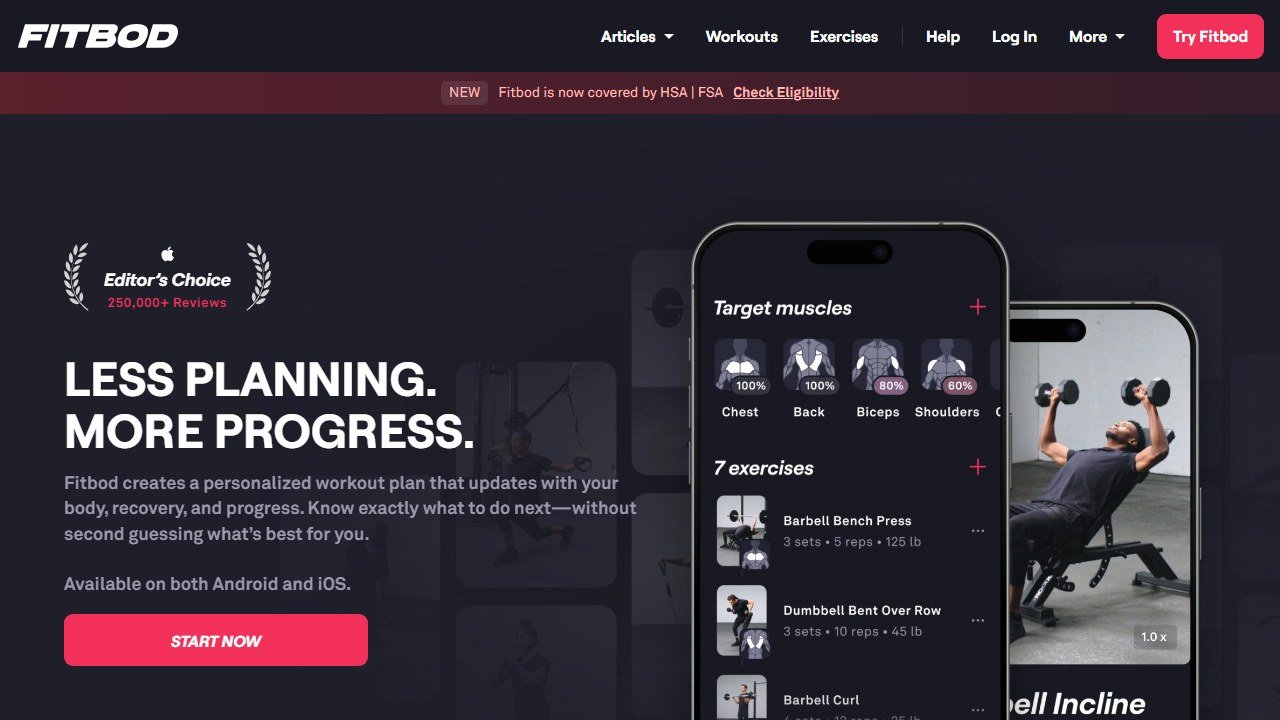
Fitbod has earned its top-ranked position through consistent delivery on the core promise of AI programming: workouts that actually change based on what you did last session. The app tracks muscle group fatigue across your full training history and uses that data to prioritize recovered muscles while protecting ones that are still under stress. In practice, this means you rarely hit a chest day when your pecs are still wrecked from Tuesday, a problem that plagues anyone following a static split.
Based on publicly available information from the App Store (4.8 stars across 300,000+ ratings as of early 2026), users consistently praise the exercise swap feature, which lets you replace any movement with equipment-appropriate alternatives without breaking the underlying logic. The app supports barbell, dumbbell, cable, machine, and bodyweight exercises across a library of over 600 movements, so it scales whether you train at a commercial gym or a home setup with a single adjustable dumbbell.
The main limitation is that Fitbod’s AI optimizes primarily for volume and muscle balance rather than periodized strength peaks. If your goal is a powerlifting meet or a specific one-rep max date, you may feel the programming lacks structure around a competition timeline. It is also worth noting the app does not currently incorporate heart rate variability or sleep data from wearables in a meaningful way, which more advanced athletes sometimes want for autoregulation.
- Pro: Excellent muscle recovery tracking that genuinely adapts session to session
- Pro: Over 600 exercises with video demos and equipment filters
- Pro: Clean, fast interface with minimal friction between opening the app and starting your set
- Pro: Reasonable annual pricing compared to hiring a coach
- Con: No periodization for peaking, not ideal for competitive powerlifters
- Con: Limited wearable integration for HRV-based autoregulation
2. Dr. Muscle: Best AI app for hypertrophy science
| Quick facts | Details |
|---|---|
| Starting price | $29/month (or $199/year) |
| Platforms | iOS, Android, Web |
| Best for | Science-focused bodybuilders who want periodized hypertrophy |
| Free plan | Yes (limited features) |
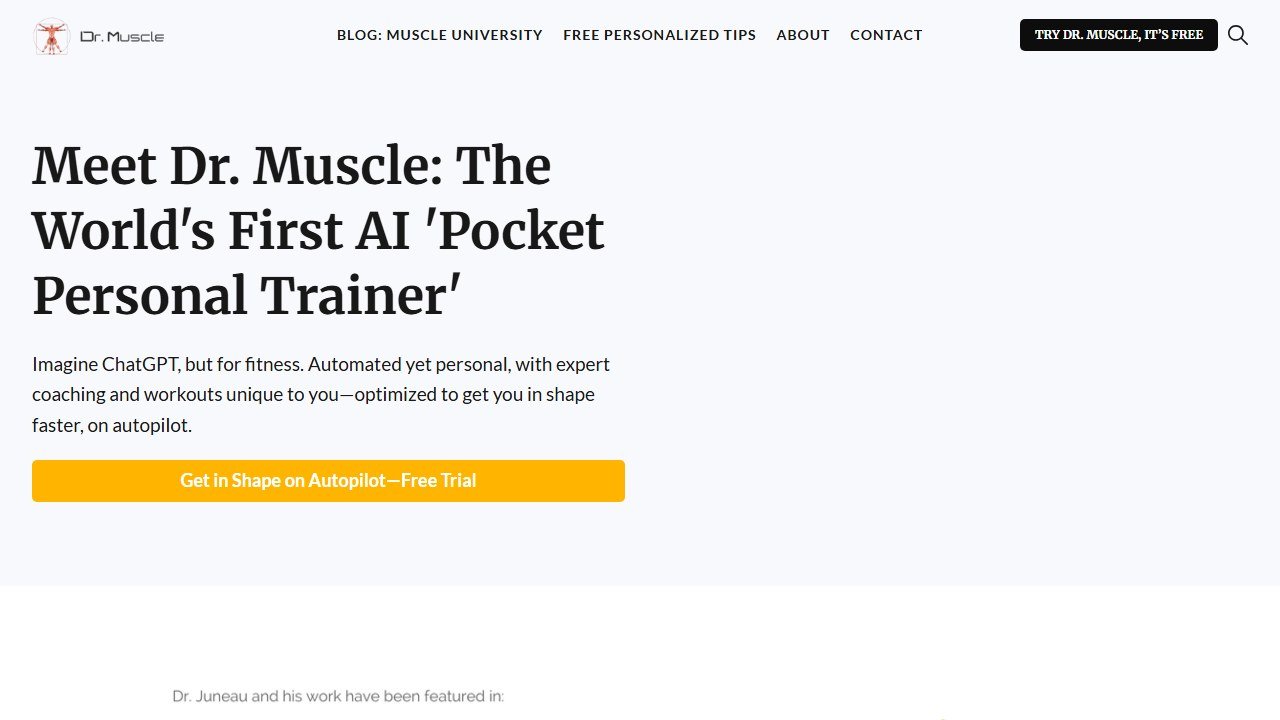
Dr. Muscle is built explicitly around hypertrophy research, citing work from researchers like Brad Schoenfeld and Mike Israetel to structure its progressive overload model. Where most apps track volume as a simple set-times-reps count, Dr. Muscle applies weekly volume landmarks: the minimum effective volume, maximum adaptive volume, and maximum recoverable volume thresholds that have become standard vocabulary in evidence-based bodybuilding communities. The app adjusts your weekly sets per muscle group as your capacity grows, which is the kind of long-arc planning most DIY lifters skip entirely.
Based on publicly available information from the Dr. Muscle website and documented user case studies, the periodization model runs in 8-12 week mesocycles with built-in deload weeks. The AI monitors rep performance trends and can trigger an early deload if your performance stalls for two consecutive sessions, a meaningful safety valve that prevents the common mistake of grinding through accumulated fatigue. The web app version is particularly well designed for logging on a desktop or tablet if you prefer not to use a phone at the gym.
The price point is the obvious sticking point. At $29/month Dr. Muscle is more than double the cost of Fitbod, and you need to engage with the underlying science to get value from it (the app assumes you care about volume landmarks and will read the explanations it provides). Casual gym-goers who just want to be told what to do will likely find it overwhelming. However, for a dedicated natural bodybuilder who wants their programming grounded in peer-reviewed hypertrophy research, there is no closer equivalent in app form.
- Pro: Built on published hypertrophy research with volume landmark tracking
- Pro: Automated mesocycle periodization with intelligent deload triggers
- Pro: Web app available for non-phone logging
- Con: Higher price than most competitors
- Con: Steeper learning curve, requires familiarity with volume landmark concepts
- Con: Exercise library is smaller than Fitbod or Jefit
3. Alpha Progression: Best AI app for progressive overload tracking
| Quick facts | Details |
|---|---|
| Starting price | $8.99/month (or $49.99/year) |
| Platforms | iOS, Android, Web |
| Best for | Lifters who want granular progressive overload management |
| Free plan | Yes (basic features) |
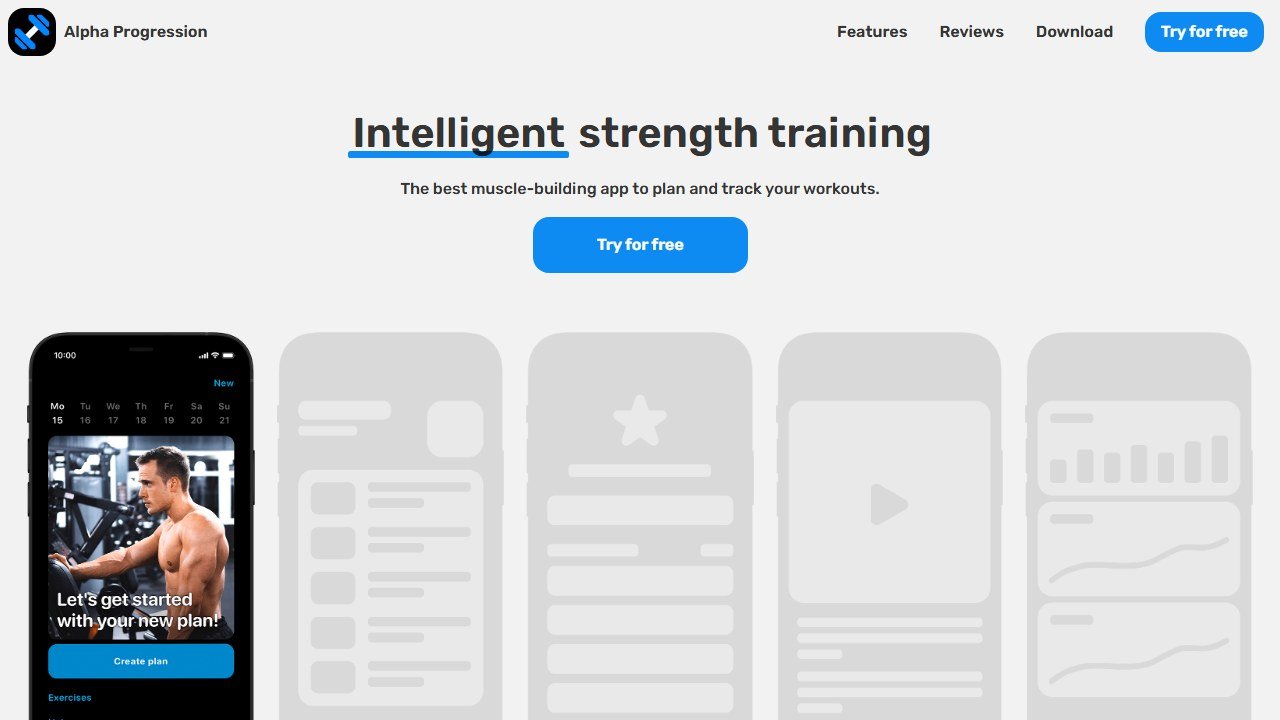
Alpha Progression takes a different approach from Fitbod and Dr. Muscle: instead of building out a fully adaptive AI coach, it focuses tightly on the one variable that matters most for muscle growth: progressive overload. The app tracks your performance on every set across every session and flags the exact moment you should increase weight, add a rep, or stay at the same load. The AI component is narrower in scope but extremely reliable for the specific problem it solves.
Based on publicly available information including the Alpha Progression feature documentation and user feedback on Reddit fitness communities, the app’s workout planner lets you create custom programs or follow built-in templates, and the overload suggestions are calibrated to your actual rep performance rather than fixed percentage jumps. If you hit 3×10 at RPE 7 consistently for two sessions, it nudges the weight up. If you stall, it suggests a small deload on that lift specifically rather than a full program reset. This lift-by-lift granularity is more useful than the blunt instrument of a one-size-fits-all deload.
Alpha Progression works best as a tracking layer on top of a program you already understand, since it does not hand you a fully designed mesocycle the way Dr. Muscle does. Lifters who are earlier in their training and need the program built for them from scratch may find the setup process requires more self-knowledge than they have yet developed. The price is among the lowest in this category, which makes it a strong value pick for experienced intermediate lifters who want accountability without paying for features they will not use.
- Pro: Best-in-class progressive overload tracking and suggestion engine
- Pro: Works with any custom program, not just built-in templates
- Pro: Affordable annual pricing
- Con: Not a full AI coach, requires you to bring your own programming knowledge
- Con: Less polished UI compared to Fitbod or JuggernautAI
4. Arvo: Best AI app for beginners entering bodybuilding
| Quick facts | Details |
|---|---|
| Starting price | $9.99/month (or $59.99/year) |
| Platforms | iOS, Android |
| Best for | Beginners and early intermediates building their first structured program |
| Free plan | Yes (limited workouts) |
Arvo entered the AI fitness app market with a clear positioning decision: make adaptive programming accessible to people who do not already have a training vocabulary. The onboarding experience is the most guided of any app on this list, walking new users through goal setting, equipment availability, and training frequency in a conversational flow rather than a configuration form. Based on publicly available information from the Arvo app page and documented feature set, the AI generates an initial program from those inputs and adjusts it after each session based on logged performance and user feedback.
What makes Arvo particularly useful for beginners is the exercise instruction quality. Each movement includes multi-angle video demonstrations, cue lists, and common mistake callouts, the kind of coaching context that normally requires a trainer standing next to you. For someone just stepping into bodybuilding who does not know the difference between a Romanian deadlift and a stiff-leg deadlift, this reduces the risk of training around an ingrained bad habit for months before noticing the problem.
The limitation is a natural consequence of the beginner focus: advanced lifters will find the program complexity ceiling too low. Arvo does not currently support highly specific powerbuilding or peaking protocols, and the volume progression model is more conservative than what experienced hypertrophy athletes need. It is the right tool for roughly the first 12-18 months of structured training, after which most users will want to graduate to Dr. Muscle or Alpha Progression for more nuanced control.
- Pro: Best onboarding experience for complete beginners
- Pro: High-quality exercise instruction with mistake callouts
- Pro: Friendly adaptive programming that does not require prior knowledge
- Con: Limited ceiling for advanced periodization
- Con: Smaller exercise library than Fitbod or Jefit
- Con: Less useful once you move into intermediate or advanced territory
5. JuggernautAI: Best AI app for powerlifters and strength athletes
| Quick facts | Details |
|---|---|
| Starting price | $29.99/month |
| Platforms | iOS, Android |
| Best for | Competitive powerlifters, strength athletes, and serious powerbuilders |
| Free plan | No |
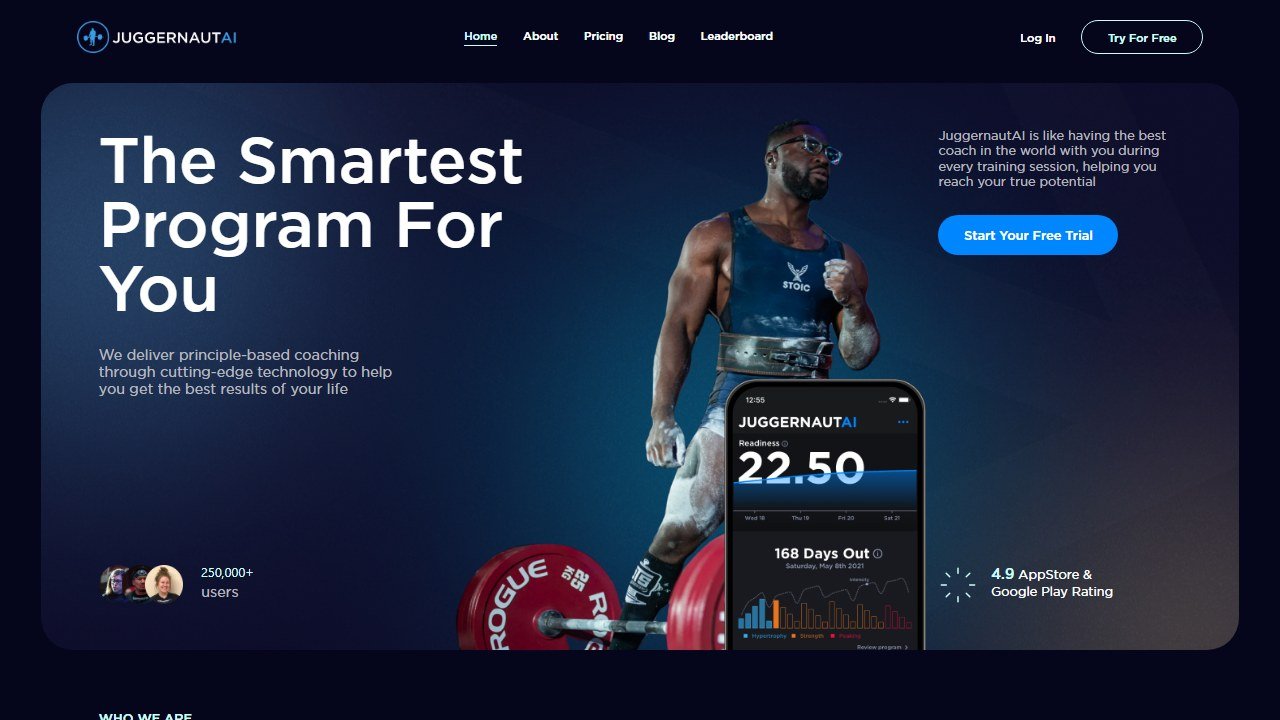
JuggernautAI was built by Chad Wesley Smith and a team with deep roots in competitive powerlifting, and that pedigree shows in every programming decision. The AI generates periodized blocks with wave loading, intensity cycles, and competition-day peaking that mirrors what elite strength coaches write for their athletes. Based on publicly available information from JuggernautAI’s website and the well-documented methodology behind the platform, the algorithm uses your history of competition totals, recent training maxes, and RPE feedback to build a program that peaks you for a specific competition date, a capability no other app on this list matches at the same depth.
The RPE (rate of perceived exertion) autoregulation system is particularly sophisticated. Rather than prescribing fixed weights, JuggernautAI prescribes a target RPE for each set, then uses your logged RPE versus actual performance to recalibrate the next session’s loads. If you come in stronger than expected, it moves faster. If life stress or poor sleep knocked your output down, the loads back off automatically. This is the same autoregulation framework that serious powerlifting coaches use manually, only executed by an algorithm that can process your training history in seconds.
JuggernautAI is not for casual gymgoers. The interface assumes you understand RPE, percentage-based programming, and powerlifting periodization concepts. The monthly price without an annual option makes it the most expensive ongoing commitment on this list. But for a competitive powerlifter or an advanced strength athlete who wants AI-assisted programming at a level that rivals a human coach, the value is real, especially when compared to the $200 to $400/month cost of an actual online coach.
- Pro: Best-in-class peaking protocols for competitive powerlifters
- Pro: Sophisticated RPE autoregulation that adapts day-by-day
- Pro: Built by actual competitive powerlifters with a documented methodology
- Pro: Competition date targeting that genuinely peaks you for meet day
- Con: Highest price on this list with no annual discount option
- Con: Steep learning curve, requires fluency in RPE and powerlifting programming concepts
- Con: No free plan to try before committing
6. FitnessAI: Best AI app for data-driven weight progression
| Quick facts | Details |
|---|---|
| Starting price | $12.99/month (or $59.99/year) |
| Platforms | iOS only |
| Best for | Data-oriented lifters who want statistically-informed weight suggestions |
| Free plan | Yes (7-day trial) |
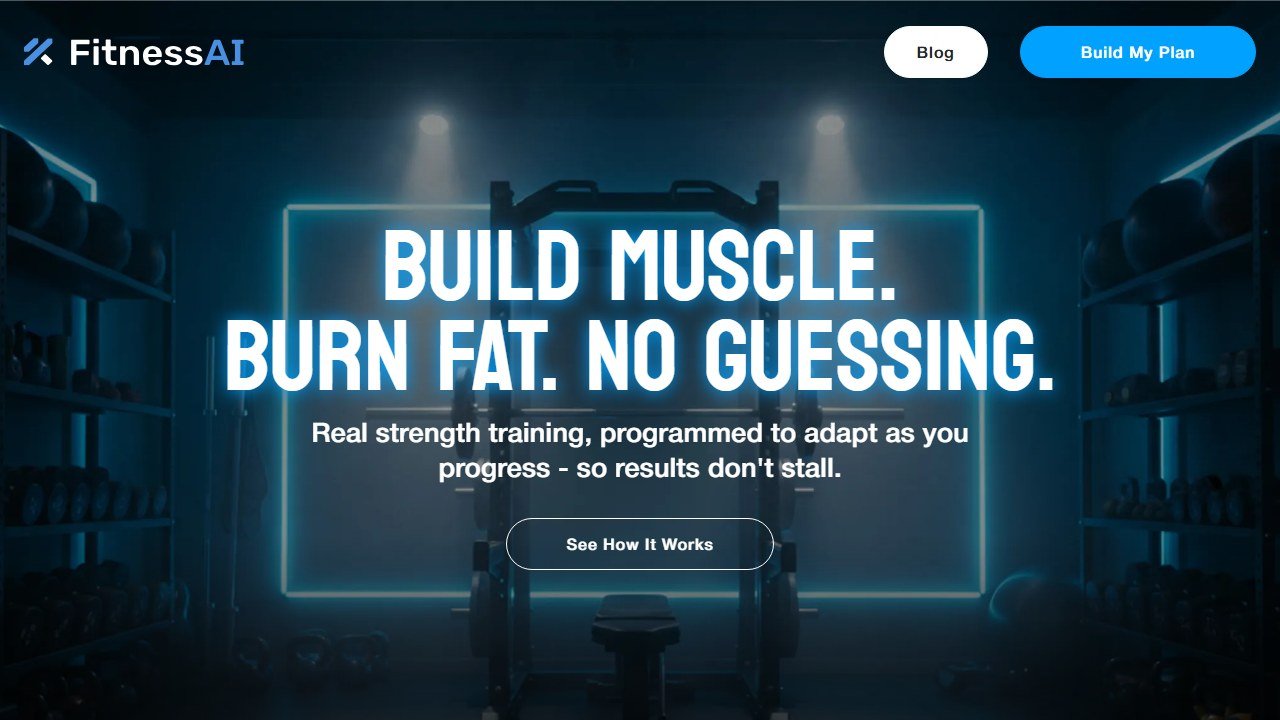
FitnessAI built its weight recommendation engine on a dataset of over 5.9 million workouts (based on publicly available information from the FitnessAI website), using that aggregate performance data to generate weight suggestions calibrated not just to your personal history but to what lifters at your level typically achieve on each movement. The result is weight recommendations that feel grounded in statistical reality rather than generic percentage jumps. When the app tells you to move from 185 lbs to 190 lbs on the bench press, it is drawing on how thousands of other lifters progressed through that same weight range.
The interface is clean and iPhone-native, which contributes to a fast, low-friction logging experience. Each workout is generated fresh based on your recent performance, and the app provides clear explanations for why it is suggesting specific exercises or load changes. For iPhone users who want a data-forward approach without the complexity of JuggernautAI or the premium price of Dr. Muscle, FitnessAI hits a comfortable middle ground.
The significant limitation is platform availability. FitnessAI is iOS-only, which immediately excludes Android users from consideration. The program design is also more structured than flexible, since the AI selects exercises for you rather than offering the deep customization that Fitbod or Alpha Progression provide. Lifters who have strong preferences about exercise selection or who train with unusual equipment setups may run into friction.
- Pro: Weight suggestions backed by a large aggregate dataset
- Pro: Clean, fast iOS interface with low logging friction
- Pro: Good price-to-feature ratio for iPhone users
- Con: iOS only, so Android users cannot use it
- Con: Limited exercise customization compared to Fitbod
- Con: Less periodization depth than Dr. Muscle or JuggernautAI
7. Jefit: Best AI app for lifters who want a large exercise database and community
| Quick facts | Details |
|---|---|
| Starting price | $6.99/month (or $39.99/year) for Elite |
| Platforms | iOS, Android, Web |
| Best for | Lifters who want a large exercise library, community plans, and flexible logging |
| Free plan | Yes (generous free tier) |
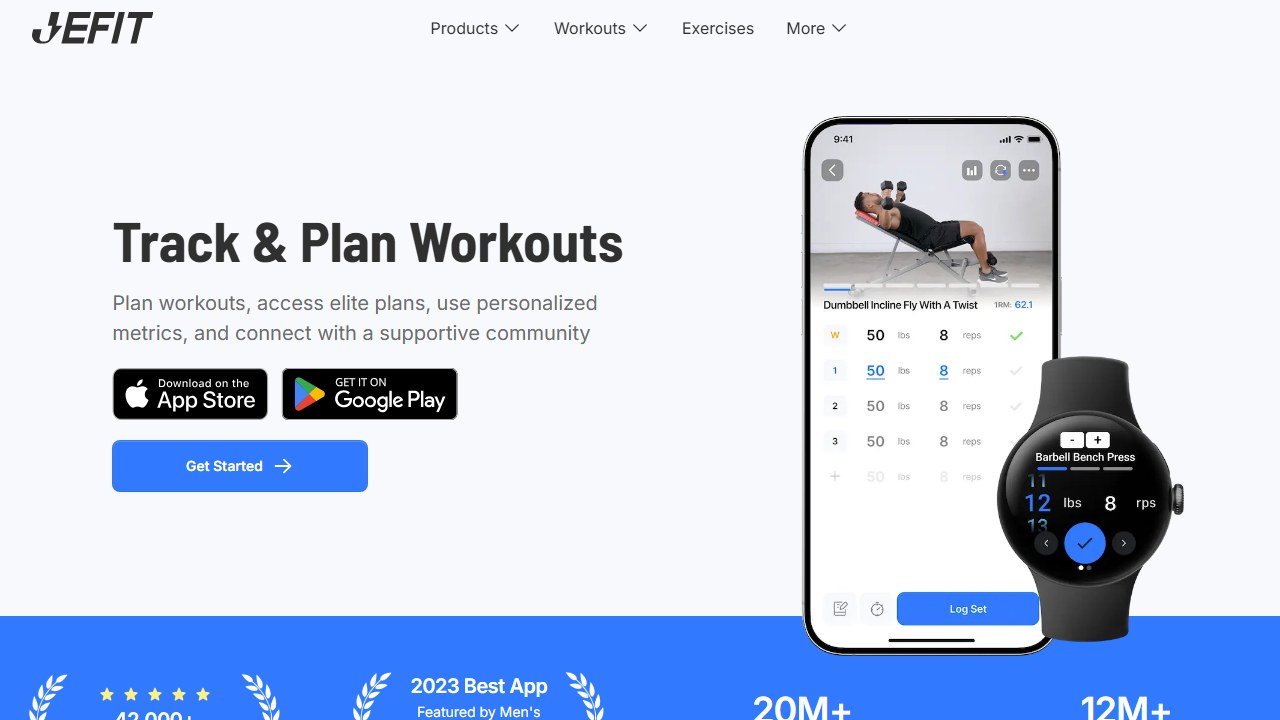
Jefit has been around since 2010, and its longevity reflects a product that consistently delivers on the basics. The app carries one of the largest exercise databases in this category, over 1,400 exercises based on publicly available information from the Jefit website, with community-contributed workouts that cover every training style from classic bodybuilding splits to athletic conditioning. The AI features are more recent additions that sit on top of this established foundation, providing workout recommendations and progression suggestions based on your logged history.
The community dimension is Jefit’s genuine differentiator. Users can share custom workout routines, follow programs built by other community members, and track progress against leaderboards. For lifters who are motivated by social accountability, seeing that other people are logging their workouts at the same time or tracking similar goals, Jefit provides a layer of engagement that solo-use apps do not replicate. The free tier is also meaningfully functional, which makes Jefit the strongest recommendation on this list for lifters who want to try an AI-assisted app before committing any money.
The tradeoff is that Jefit’s AI recommendation layer is less sophisticated than Fitbod, Dr. Muscle, or JuggernautAI. The algorithm’s suggestions are more rule-based than genuinely adaptive, and the periodization options are limited compared to dedicated hypertrophy or strength apps. Think of Jefit as a very well-organized training journal with smart suggestions rather than a true AI coach. For early-stage lifters or those who want community features alongside their tracking, that trade is worth it. For serious hypertrophy or strength athletes, the ceiling will feel low within a few months.
- Pro: Largest exercise database on this list (1,400+ movements)
- Pro: Strongest community features with shareable programs and leaderboards
- Pro: Most affordable premium tier and the best free plan
- Con: AI adaptation is less sophisticated than Fitbod or Dr. Muscle
- Con: Periodization depth is limited for serious athletes
- Con: Interface feels dated compared to newer apps
Master comparison: all 7 AI bodybuilding apps
| App | Starting price | Free plan | Platforms | Best for | AI depth |
|---|---|---|---|---|---|
| Fitbod | $12.99/mo | Yes (5 workouts) | iOS, Android | Overall best, intermediate lifters | High |
| Dr. Muscle | $29/mo | Yes (limited) | iOS, Android, Web | Hypertrophy science and periodization | Very high |
| Alpha Progression | $8.99/mo | Yes (basic) | iOS, Android, Web | Progressive overload tracking | Medium-high |
| Arvo | $9.99/mo | Yes (limited) | iOS, Android | Beginners and early intermediates | Medium |
| JuggernautAI | $29.99/mo | No | iOS, Android | Competitive powerlifters | Very high |
| FitnessAI | $12.99/mo | 7-day trial | iOS only | Data-driven weight progression | High |
| Jefit | $6.99/mo | Yes (generous) | iOS, Android, Web | Large exercise library and community | Medium |
How to choose the right AI bodybuilding app for you
The honest answer is that your current training experience and your primary goal narrow the field quickly. Here is how to think through it without overthinking.
If you are new to structured training, start with Arvo or Jefit. Both apps hold your hand through the early learning curve without assuming prior programming knowledge. Jefit’s free tier means zero financial commitment while you figure out whether you will actually use an app consistently. Arvo’s instruction quality means you are less likely to build bad movement habits in the first few months.
If you have 1-3 years of training and your main goal is building muscle, Fitbod is the safest bet for most people. The muscle recovery tracking, exercise library, and straightforward interface get out of the way and let you train. If you want to go deeper into the science of hypertrophy and are willing to invest more money and more mental engagement, Dr. Muscle is the step up.
If you already know your programming and just want a smarter tracking layer, Alpha Progression solves exactly that problem at the lowest price on this list. It will not design a mesocycle for you, but it will ensure that the program you are running stays progressive and flags when you are stalling on specific lifts.
If you are training for a powerlifting meet, JuggernautAI is the only app built around competition peaking in a way that can meaningfully replace a human coach. The price is real, but so is the programming quality. Every other app on this list will leave gaps in your meet prep.
If you are on iPhone and budget-conscious, FitnessAI provides solid AI-assisted progression at a mid-tier price with a dataset-backed approach that is more reliable than pure rule-based suggestions. Android users should look at Fitbod or Alpha Progression instead, since FitnessAI is not available on that platform.
One practical suggestion regardless of which app you choose: give it at least six weeks before forming a judgment. AI-driven programming improves as it accumulates your data, and most apps need several weeks of logged sessions before their suggestions become genuinely personalized. The first two weeks of any adaptive app will feel generic. By week six, the gap between an AI-programmed plan and a static spreadsheet becomes much more obvious in your favor.
If you mix cardio with your lifting, see our picks for the best AI running coach apps to round out your training plan.
For nutrition tracking and tool decisions, see our tested guides to AI macro trackers, AI meal-plan generators, the best AI personal-trainer apps for beginners, Trainerize pricing, TrueCoach pricing, Fitbod vs Strong, and Wodify alternatives.

Written by
FazFaz is the founder of AIToolsBakery. Some tools here are tested hands on. Others are assessed from vendor documentation and pricing verified on the live page, and every review says which one it is. Sponsors can buy a position in a guide. They cannot buy the score, the criticism, or silence about a better option.
How we test and how we make money →