Search for a tennis workout app or a padel training plan and most of what comes back is App Store pages, a few coaches selling video programs, and apps that film your forehand. Those swing analysis apps are a different job, and our guide to AI tennis coach apps covers video and match stats. This guide is about the hour you spend off court: the strength, conditioning, mobility and injury work that keeps a club player moving well in the third set, and the apps that claim to plan it for you with AI.
The useful question is not which app has the most exercises. It is what the “AI” in each app actually does, and whether the plan knows that you play on Tuesday and Saturday. Here the answers differ a lot. In one app an AI writes your whole plan. In another the plan comes from fixed rules and the AI only answers questions about it. One is a general gym coach that has learned to count padel matches, and one is a watch app that tells you how ready you are to play. Several padel and tennis fitness apps that show up in these searches make no AI claim at all, and we list those separately so you can compare.
How we reviewed these. We have not used these tools ourselves. Every price, rating, date and feature below comes from the app’s US App Store listing or the vendor’s own website, pricing page, help centre or privacy policy, read on 10 November 2026, and each source is linked. App Store prices are the in-app purchase prices Apple lists for the US store; prices a vendor shows in euros are given in euros as listed. No app paid for a place here.
What the AI in a racket fitness app actually does
Four different things get called AI in this category, and some apps in the same searches make no AI claim at all. It is worth knowing which one you are paying for before you compare prices.
The AI writes the plan
You answer questions about your sport, level, injuries, equipment and free days, and a model produces your weeks of training and changes them when something changes. Bivo Training works this way. The benefit is a plan that can bend around a moved match or a sore knee. The risk is the usual one with generated content: it can be wrong, so read each week before you lift it.
Rules write the plan, AI answers questions
CourtFit is open about this. Its website says the weekly plan “is not written by AI” and comes from a rules engine on your phone, so the same answers always give the same week. The AI part is a chat that explains a session or suggests a swap when the bench is taken. For a training plan that is no bad thing, since you can predict what it will do.
A general AI coach that counts your matches
Molec is a gym coach for anyone, not a racket app. It reads your sleep and heart data, adjusts the day’s session, and adds your tennis or padel to the week’s load. If you lift three times a week and play padel twice, that may be all you need.
Readiness from a watch, with no plan
Padel Fit scores matches on an Apple Watch and uses on-device AI to say how hard you worked and how ready you are today. It does not write workouts. It sits closer to a fitness tracker than a coach.
No AI at all
Padel Care, Just Muv and StrongSets build sessions from your level, time and kit, and Fit4Tennis and Built4Tennis sell coach-designed programs. None of them claims AI on its listing. For a lot of players, a fixed program written by a good strength coach is the safer starting point, so we include them as a benchmark.
AI tennis and padel training apps compared
| App | Sports | What the AI does | Plans around your matches | What you pay (10 November 2026) | Platforms | US ratings | Last updated |
|---|---|---|---|---|---|---|---|
| Bivo Training | Tennis, padel, pickleball, badminton | Writes and adapts the plan | Yes, matches and tournaments in its calendar | Website: €19.99 a month, €44.99 a quarter, €99.99 a year; US App Store: Basic from $12.99, Premium from $17.99 | iOS, Android | 5.0 (1) | 9 November 2026 |
| CourtFit | Tennis first; padel, pickleball, squash, badminton, beach tennis | Chat only; the plan comes from rules | Yes, match days and a competition date | $19.99 a month or $79.99 a year; one free workout | iPhone, Apple Watch companion | None yet | 8 November 2026 |
| Molec | Any; reads tennis and padel | General coach that adjusts each day | Counts them in the week’s load | Free, no in-app purchases | iOS, Android | 5.0 (1) | 2 November 2026 |
| Padel Fit | Padel | Readiness and match recaps on device | No plan | From $2.99 a week, $24.99 a year, lifetime options | iPhone with Apple Watch | 5.0 (1) | 7 November 2026 |
Read on 10 November 2026. Ratings are rounded to one decimal, with the number of US ratings in brackets, and last updated means the latest iOS version. Look at the rating counts first. No AI app here has more than one US rating, and all four first appeared between December 2024 and October 2026, three of them in 2026. That makes this a young category: you are relying mostly on what each developer says about its own product, which is why the sections below quote them closely.
How we chose and ordered these
Every app in the numbered list had to describe AI in its own words, plan or adjust off-court training for tennis or padel players, have an update in the last few months, and publish a privacy policy or privacy label we could read. Apps without an AI claim went into their own section. We ordered the list by how closely each app is built for racket players: the two racket-specific planners first, then the general coach, then the watch tracker. The order is not a score. Apps we left out are listed further down with the reason.
The four AI apps
1. Bivo Training: an AI strength plan for four racket sports
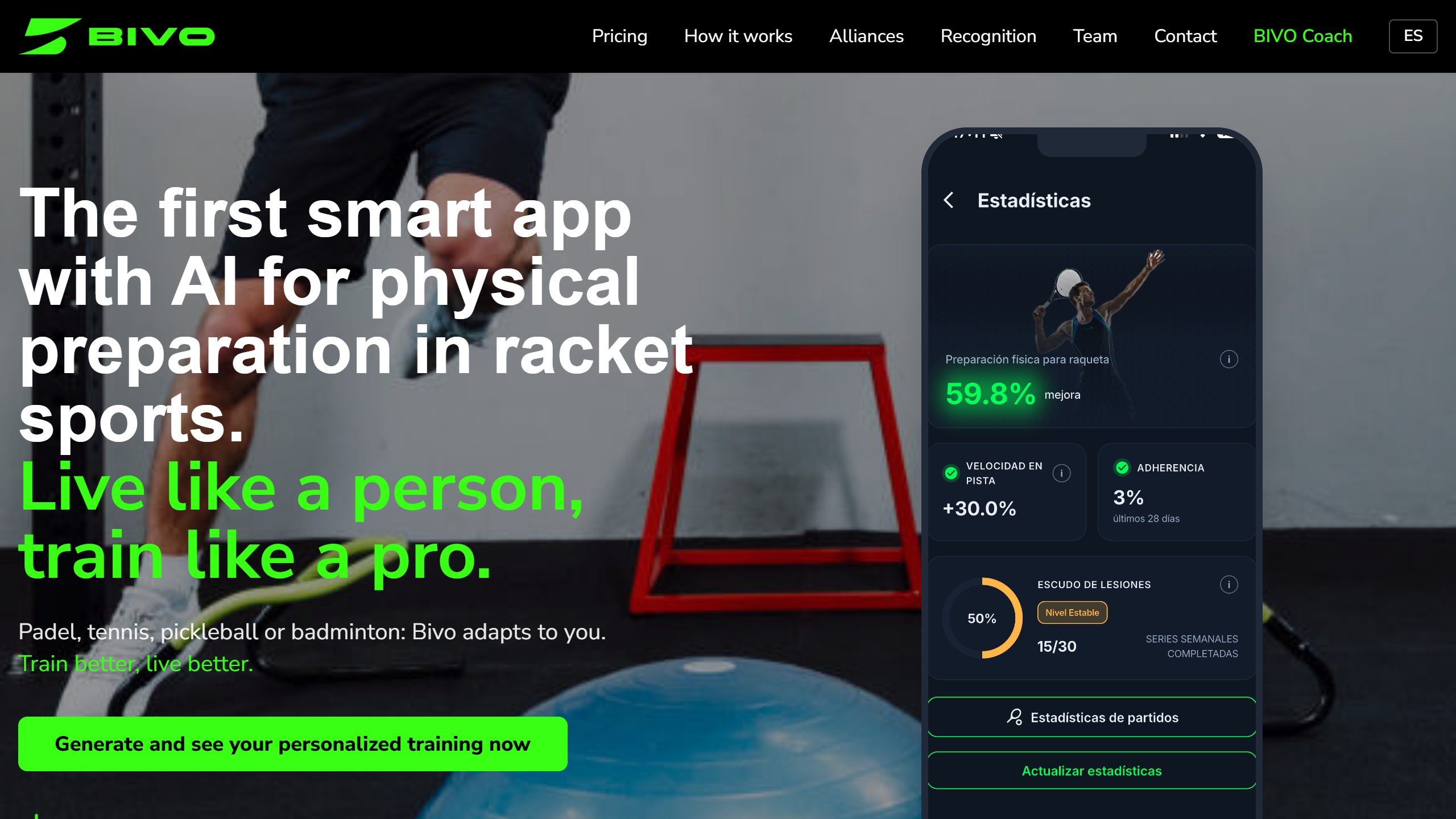
Bivo Training, from Bivo Training S.L. in Menorca, Spain, is built only for racket players. Its App Store listing calls it “the first AI-powered app designed specifically for physical training in racket sports: tennis, padel, pickleball and badminton”, which is the vendor’s claim, and says “Our AI adapts every training plan to your level, progress and availability, with or without fitness equipment.” It also says the app “synchronizes your matches and tournaments with your calendar so you can schedule your workouts at the optimal time”.
What the AI does. The website describes five steps: a first assessment of your level, sport, goals, past injuries and free time, a plan for your sport, progress statistics, a calendar that holds sessions, matches and rest days with “No overlaps”, and automatic changes: “Change your goal, get injured or have less time? Bivo recalculates your plan automatically.” The listing adds that the AI “adjusts intensity based on your actual effort.” Workouts are described as “designed by fitness trainers who work with elite players”, and the team includes a fitness trainer the site says has worked with ATP players. Bivo also sells BIVO Coach, a dashboard where clubs and coaches supervise AI plans for their players, and lists the Balearic Padel and Badminton Federations among its partners.
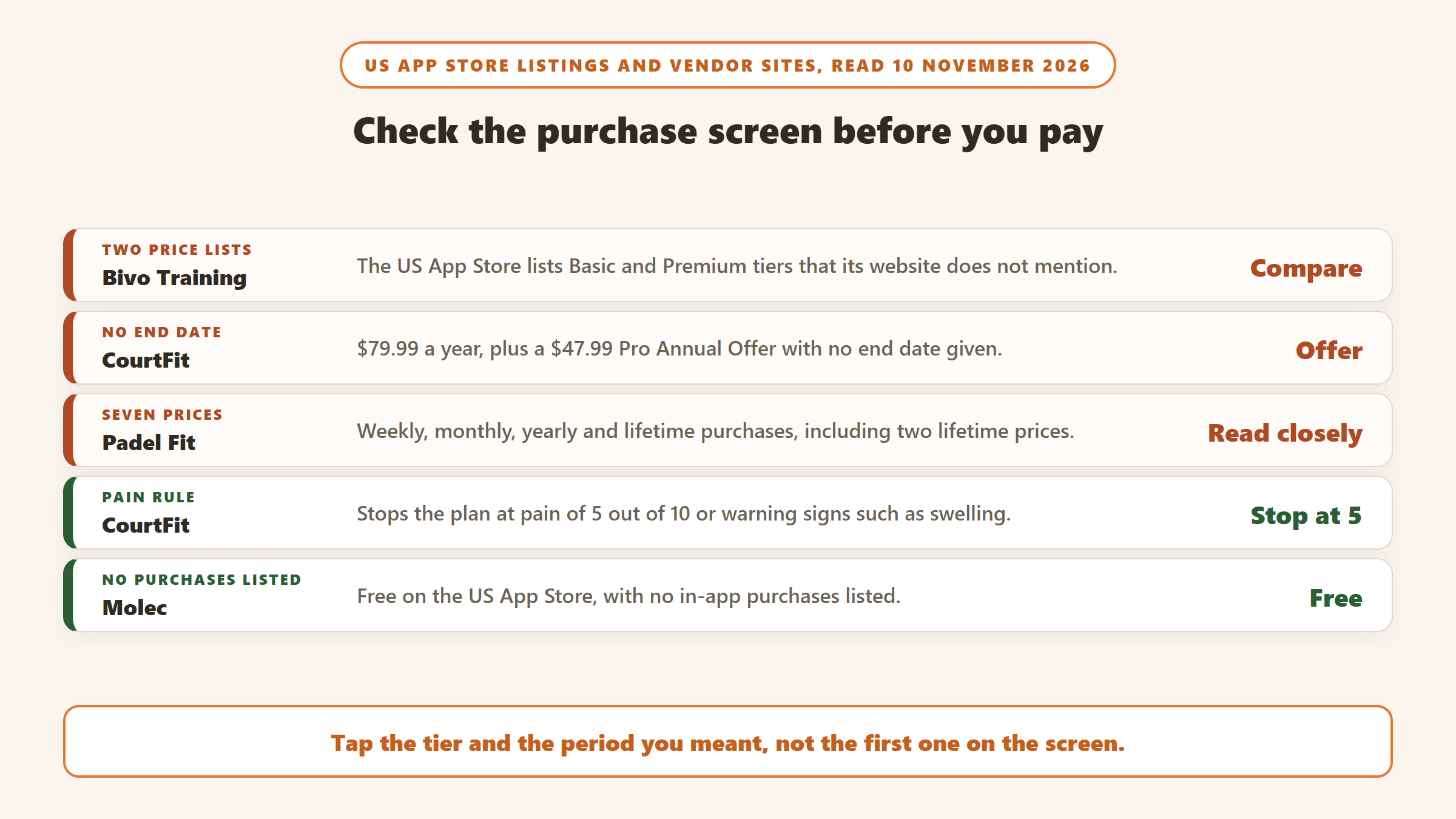
What you pay. The website lists €19.99 a month, €44.99 every 3 months, marked as a launch price, or €99.99 a year, with the first 7 days free. The US App Store shows two tiers that the website does not mention: Basic, at $12.99 a month, $29.99 a quarter or $69.99 a year, and Premium, listed at $17.99, $39.99 and $89.99 without the periods shown. The listing says a subscription is needed for “personalized training plans, AI-powered features, and all other app functionalities”, so there is no free plan after the trial. Check which tier you are buying on the purchase screen.
Data and age. The privacy policy is in Spanish only. It says Bivo may use automated systems, including artificial intelligence, to personalise training and make recommendations, and names Google, Firebase and Vercel among its providers, but does not name an AI company. It says minors may use the service, directly or through clubs and academies. The App Store label lists identifiers and usage data as used to track you across other companies’ apps and websites. The website notes that support is in Spanish.
The iPhone app had 5.0 from a single US rating and was updated on 9 November 2026.
Choose it if you want a plan built only for racket sports that knows your match calendar, and your club may join you on it. Skip it if you want a free tier after the trial, or English-language support and policies.
2. CourtFit: a rules-based tennis gym plan with an AI chat

CourtFit is a strength app for tennis players who lift. Its website says it reads your goals, matches, equipment and pain and writes your gym plan around them, from a library of 200 exercises, each tagged with the tennis skill it supports, such as the serve or the first step. Its App Store listing promises “Weekly plans based on your experience, availability and match days”. You can also choose padel, beach tennis, pickleball, squash or badminton.
What the AI does. Less than the name of the category suggests, and the developer says so. In its own FAQ: “The weekly plan is not written by AI”, and it comes from “a deterministic rules engine that runs on your phone, so the same answers always produce the same week.” The AI is CourtFit Coach, a chat that answers questions about the session you already have. It “never edits your plan and never overrides the safety screen”, and three questions a day are free. The match logic is rules too: a saved competition date triggers a match-day adjustment, and the site says “Match tomorrow? Your session already knows.”
The pain screen. CourtFit publishes a precise injury rule. You can flag your elbow, shoulder, lower back, knee or ankle and the plan reshapes around it, but a pain score of 5 or more out of 10, or swelling, numbness, night pain, recent surgery or a doctor’s advice not to train, stops the plan and points you to a professional. The site adds: “CourtFit cannot tell you whether it is safe for you to train.”
What you pay. The website shows no prices and sends you to the App Store. The US App Store lists CourtFit Pro at $19.99 a month or $79.99 a year, plus a “Pro Annual Offer” at $47.99 with no end date given. The listing says you start with one free workout, and the annual plan “may include a 3-day free trial for eligible users”; the monthly plan has none.
Data and age. The privacy policy (effective 1 October 2026) says your profile, plan, logs and pain answers stay on your iPhone, with no account needed. Coach questions, up to eight recent chat turns and a summary of your session go to the developer’s server, “which uses Google Gemini to generate the answer”. Meta and TikTok advertising tools switch on only if you allow tracking. The App Store label still lists purchases, identifiers and usage data as possibly used to track you, and rates the app 4+.
The app had no US ratings yet and was updated on 8 November 2026.
Choose it if you play tennis, lift in a gym, and want a plan whose logic you can predict and an injury rule you can read. Skip it if you want the AI to write and change the plan itself, or use an Android phone.
3. Molec: a free general AI coach that counts your padel
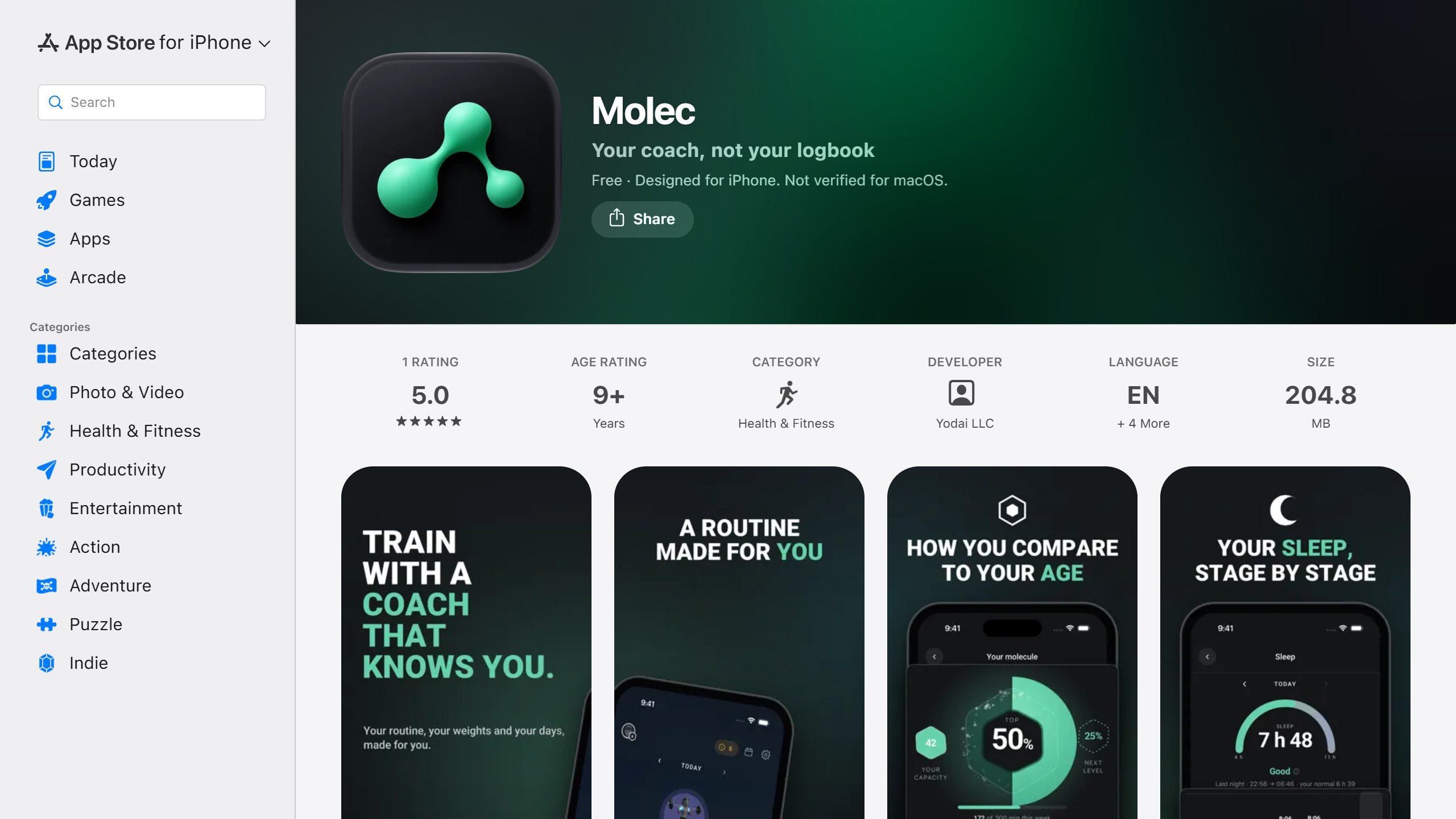
Molec, from Yodai LLC, is a gym coach for anyone, not a racket app, but it does something the racket apps mostly do not: it reads how you slept and adjusts today’s session. Its listing says it “reads your sleep, your heart rate variability and your resting heart rate from Apple Health” and, if you slept less than usual, “trims the session”. On racket sports it says: “If you go for a run or play tennis, Molec finds out through Apple Health and adds it to the week’s load.” Its latest release notes add a PADEL VS connection, so your padel level, ranking and matches come in and “The coach takes every match into account.”
What the AI does. It moves the plan when you skip a day, answers questions with your own numbers, and logs meals from a photo or barcode. It does not write padel or tennis specific work. Think of it as a general strength coach that knows when you have a match, which suits players who already lift and want the gym to make room for their court time.
What you pay. Nothing. The US App Store lists no in-app purchases, and the website, which is in Spanish, says it is free with no subscription and no purchases inside the app. It is on iPhone, Apple Watch and Android, and works best with an Apple Watch or Whoop.
Data and age. The privacy policy (last updated 3 November 2026) says training data lives on your phone with a copy in your account. Messages to the coach go to Anthropic, “which produces the response with its Claude models”, along with your goals, reported discomfort, plan, workouts, health metrics, nutrition and PADEL VS matches if connected. The App Store rates it 9+.
The app had 5.0 from a single US rating and was updated on 2 November 2026.
Choose it if you want a free AI gym coach that adjusts for sleep and matches, and you track your padel on PADEL VS. Skip it if you want sport-specific footwork, rotation and shoulder work written for tennis or padel.
4. Padel Fit: match tracking and readiness on an Apple Watch
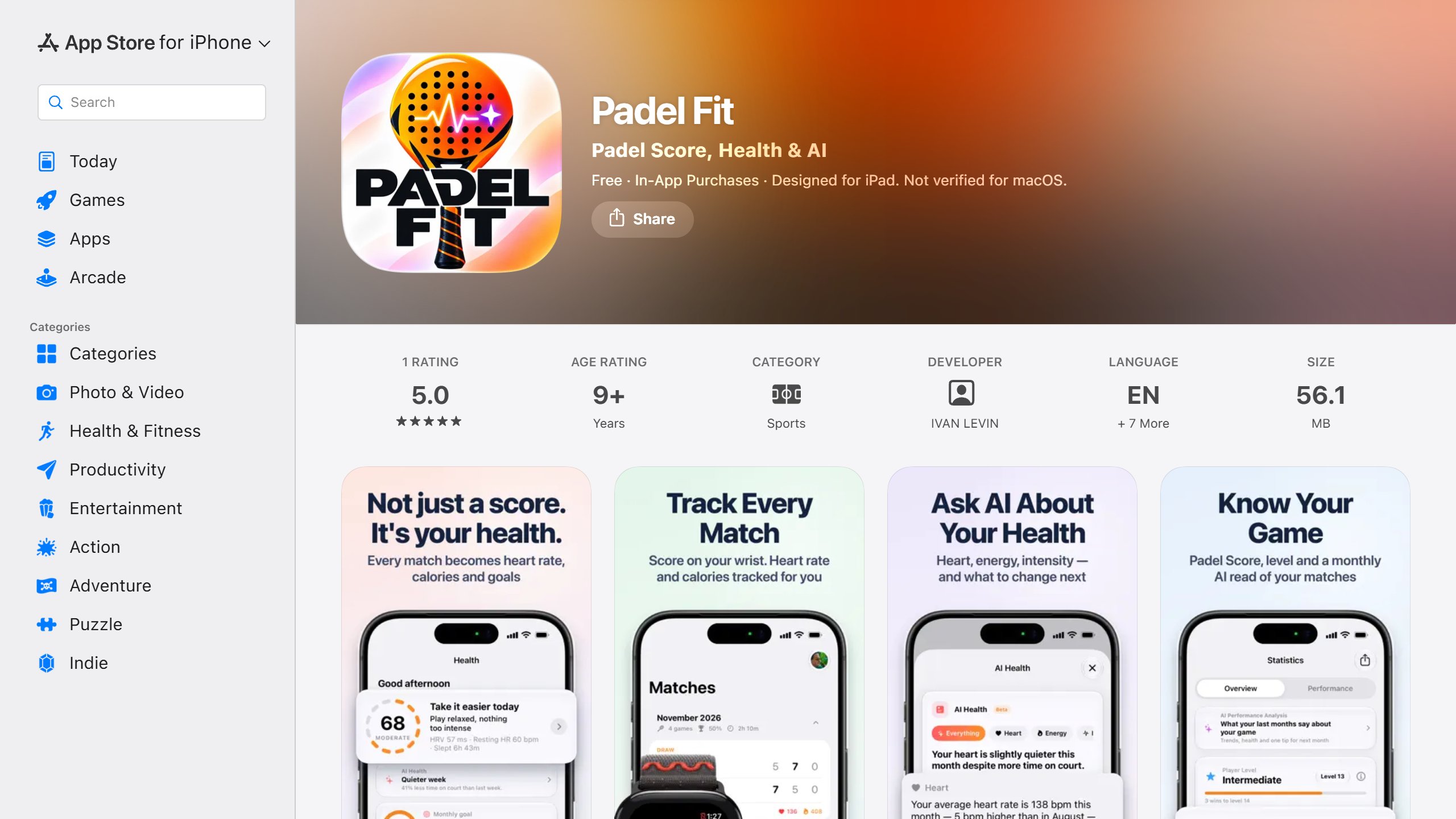
Padel Fit, from developer Ivan Levin, started as a padel scoreboard on your wrist and has been rebuilt around health. You keep score with one tap on an Apple Watch, and heart rate, calories and time on court land on your iPhone. The listing says “AI Health reads your heart rate, energy and intensity and tells you what to change next”, in plain words and on the device, and a recent update added a readiness card built from heart rate variability, resting heart rate and sleep, plus a 30-day Padel Score.
What the AI does. It interprets your match and recovery data. It does not write a strength or conditioning plan, so pair it with one of the planners above if you want sessions.
What you pay. The listing says “AI Health, fitness zones, AI match analysis and full stats are part of PadelFit Pro.” The US App Store lists seven purchases: weekly at $2.99 and $3.99, monthly at $3.99, yearly at $24.99, two “Lifetime Access!” prices at $44.99 and $49.99, and a “PadelFit Pro Lifetime” at $17.99. Read the purchase screen carefully. You also need an Apple Watch, and the AI features need an iPhone with Apple Intelligence.
Data and age. The linked policy page is shared with the developer’s travel and reading apps. It says the app does not “collect, use, or process any personal information that can identify you”, and its terms say users must be at least 13. The App Store label, though, lists purchases, identifiers and usage data as linked to you. We could not tell which is current.
The app had 5.0 from a single US rating and was updated on 7 November 2026.
Choose it if you play padel with an Apple Watch and want to know how hard matches are and how ready you are. Skip it if you want workouts, or use Android.
Fitness apps for tennis and padel with no AI claim
These apps came up again and again in searches for a tennis workout app or a padel training plan. None of them describes AI on its listing, but several do what a club player needs, and some are cheaper than the AI apps above. Prices are US App Store prices on 10 November 2026.
Padel Care. Padel Care, from Elevate Padel Inc, builds a warm-up, workout and cool-down from your level, time and kit. Its website says that part is “Free every day.” PadelCare+ costs $9.99 a month or $99.99 a year after a 14-day trial and adds a 4, 6 or 8 week program whose targets rise when you complete every set. Matches you add trigger reminders to warm up and cool down; the program itself is planned around the days you train. It had 5.0 from 4 US ratings, was updated on 6 October 2026, and is on iPhone and Android.
Just Muv. Just Muv, from Just Muv SpA, is functional training for padel and tennis “designed by a sports physiotherapist”, with 10 to 50 minute routines, injury prevention work for elbow, shoulder, back, knee and ankle problems, and a “Weekly planner that adapts to your matches”. It costs $24.99 a month, $64.99 a quarter or $199.99 a year. It had 5.0 from 1 US rating and was updated on 4 November 2026.
StrongSets. StrongSets, from Pune FitMantra Private Limited, offers “personalised strength & conditioning built specifically for padel players”, with 30, 45 or 60 minute sessions at three intensities. It is designed for a gym for now, with home workouts listed as coming soon. It listed no in-app purchases, had no US ratings, and we found no website for it.
Fit4Tennis. Fit4Tennis, from Tennis Beast LLC, is a members’ library of tennis strength, speed, agility and mobility video workouts built by tennis coaches, with coach-built programs. It costs $29.99 a month, $159.99 for six months or $299.99 a year, and had 4.8 from 17 US ratings, more than any other app in these two lists, updated on 30 October 2026.
Built4Tennis. The Tennis Fitness Program app is built around the methods of Jez Green, whom the listing names as a trainer of Alexander Zverev and Andy Murray, with narrated videos and a 6 to 8 week training block. Sections are sold one by one, or as a $59.99 bundle. It had 3.7 from 10 US ratings and was updated on 24 July 2026.
Tennis Fitness Gym Workouts. This app, from Dmitri Jurkin, gives a free 30-day tennis fitness program and paid gym programs listed at $9.99 and $71.99. It had 5.0 from 1 US rating and was updated on 30 October 2026.
Compared with these, the AI apps add one thing that matters: a plan that changes when your week changes. If your matches are on the same nights every week and you have no injuries, a fixed program from a good coach may serve you just as well.
Who plans around your matches, and what happens when it hurts
For a club player, these are the two features that separate a racket fitness app from a gym app. Here is what each vendor says it does:
- Your match calendar shapes the plan: Bivo holds matches and tournaments in its calendar. CourtFit adjusts for match days and a saved competition date. Molec adds tennis from Apple Health and padel from PADEL VS to the week’s load. Just Muv lists a weekly planner that adapts to matches.
- Your matches only trigger reminders: Padel Care.
- Fixed programs: Fit4Tennis, Built4Tennis and Tennis Fitness Gym Workouts.
- Published injury rules: CourtFit stops the plan at pain of 5 out of 10 or warning signs. Bivo says it adapts to injuries without publishing how.
- None of them is medical advice. CourtFit says so on its site and listing, Bivo’s privacy policy says its content is not medical, and tennis elbow or a sore knee that lasts belongs with a physio.
Who sees your training and health data
- Names the AI company: Molec sends coach requests to Anthropic’s Claude. CourtFit’s chat uses Google Gemini, and CourtFit says it keeps notes and pain values out of its analytics.
- Keeps most data on the phone: CourtFit (no account at all) and Molec (with an account copy). Padel Fit says its AI runs on the device.
- Does not name an AI company: Bivo, whose policy is in Spanish and mentions AI personalisation with Google, Firebase and Vercel as providers.
- Policy and label disagree: Padel Fit’s shared policy says it collects no identifying data, while its App Store label lists identifiers linked to you.
- Juniors: Bivo says minors may use it, including through clubs. Padel Fit’s terms set a minimum age of 13. If you are choosing for a junior player, a coach or physio should set the training load.
What a year costs
Using prices listed on 10 November 2026, here is a year of each paid option for one player, assuming prices hold:
- Molec: free.
- Padel Fit: $24.99 a year, or a one-off lifetime purchase, plus the Apple Watch you need.
- Bivo Training: $69.99 a year for Basic on the US App Store, or €99.99 on its website.
- CourtFit: $79.99 a year, or $47.99 if the annual offer is shown to you.
Many club players train hardest before a season or a tournament block. Monthly billing for two or three months can cost less than a year you only half use, and every paid AI app here has a free trial, a free workout or a free tier to try first.
What about ChatGPT?
A general chatbot will write a tennis or padel strength plan if you describe your week. What it will not do on its own is notice that your match moved, log your sets or change Friday’s session after you report a sore shoulder; you have to tell it each time and ask again. The apps above exist to hold that context for you. If you use a chatbot, give it your match nights, injuries and equipment, and check any plan with a coach before you load up.
What we left out, and why
Rivo, which turned up in early research for this topic, is a HYROX training plan app, not a racket sports app. ProTennisFitness was last updated in January 2024, Tennis Off-Court Training in June 2025 and WorkPadel in October 2024. TennisTrackAI logs training and gives AI insights, but had one release and its website did not load for us. Volley needs an on-court Volley Trainer machine at your club. Apps that film your strokes, such as Offcourtz and the many AI padel and tennis swing coaches, are covered in our tennis coach guide. Studio’s creator coaching apps mix stroke feedback, mindset and fitness, with prices behind a quiz. Club booking apps and scorekeepers are excluded. For pickleball, our guide to AI pickleball training apps covers apps that analyse your games as well as your fitness.
How to choose an AI tennis or padel training app
Start with your week
If racket sport is your main training and you want a plan written for it, Bivo is the racket-specific AI planner here, and CourtFit is the tennis lifter’s choice with rules you can predict. If you already lift and mostly want the gym to make room for padel, Molec does that for free.
Check the platform and the watch
CourtFit and Padel Fit are iPhone apps. Padel Fit needs an Apple Watch. Bivo and Molec have Android versions.
Find out what the AI touches
If you want a plan that rewrites itself, choose an app where the AI writes the plan. If you would rather the plan stayed predictable and the AI only explained it, CourtFit’s split is deliberate. Either way, the app is only as good as what you tell it, so enter your real match nights, equipment and injuries.
Use the free part first
Bivo gives 7 days, CourtFit one workout and three chat questions a day, Molec is free, and Padel Care gives a free daily workout. Look at what each one plans for the day after a match before you pay.
Keep a person in the loop
None of these apps watches you lift. If you are new to the gym, a few sessions with a strength coach for technique and an app for the week around it is a sensible mix. If you want broader options for general training, our guides to AI workout apps and AI workout apps for beginners cover apps that are not built for one sport.
Verdict
For a club tennis or padel player who wants an AI plan built only for racket sports and tied to a match calendar, Bivo Training is the closest fit, if you are happy with Spanish support and a subscription from day one. CourtFit suits tennis players who lift and want clear injury rules, with the AI kept to a chat. Molec is a free way to have a general gym plan respect your padel and your sleep, and Padel Fit is a tracker for Apple Watch owners rather than a planner. Every AI app here is new, with one rating or none, so use the trials, and treat the non-AI programs as the benchmark they have to beat.
Sources
- Bivo Training: website and pricing, privacy policy (Spanish), US App Store listing.
- CourtFit: website and FAQ, privacy policy, US App Store listing.
- Molec: website (Spanish), privacy policy, US App Store listing, Google Play listing.
- Padel Fit: US App Store listing, privacy policy and terms.
- Non-AI apps: Padel Care website, Padel Care, Just Muv, StrongSets, Fit4Tennis, Built4Tennis, Tennis Fitness Gym Workouts US App Store listings.
- All pages and listings read 10 November 2026.

Written by
FazFaz is the founder of AIToolsBakery. Some tools here are tested hands on. Others are assessed from vendor documentation and pricing verified on the live page, and every review says which one it is. Sponsors can buy a position in a guide. They cannot buy the score, the criticism, or silence about a better option.
How we test and how we make money →