The short answer
Fitbod does not publish a price on its website.
We checked on 30 August 2026. fitbod.me/pricing returns a 404, Page Not Found. The homepage carries no pricing link of any kind: no Pricing in the navigation, no Plans, no Subscribe, nothing in the footer. The only outbound commercial link on the page is to the App Store listing.
That is unusual enough to be the story. Most fitness apps at least state a headline figure.
Where the number actually lives
Fitbod sells its subscription through in-app purchase. That means the price is set and displayed inside the App Store or Google Play listing, and it is:
- Localised. The App Store shows the figure in your own currency at Apple’s own price points, not a converted version of a dollar price.
- Subject to store price tiers. Apple and Google use fixed price points, so a subscription does not sit at an arbitrary number.
- Changeable without any website update, because there is no website figure to keep in sync.
To see what you would actually pay: open the App Store or Google Play listing on your own device and look at the In-App Purchases section. That figure is authoritative for you in a way that any number published by a third party is not.
Why we are not quoting a figure here
We publish prices we have read from the vendor’s own page, with the date we read them. Fitbod gives us nothing to read.
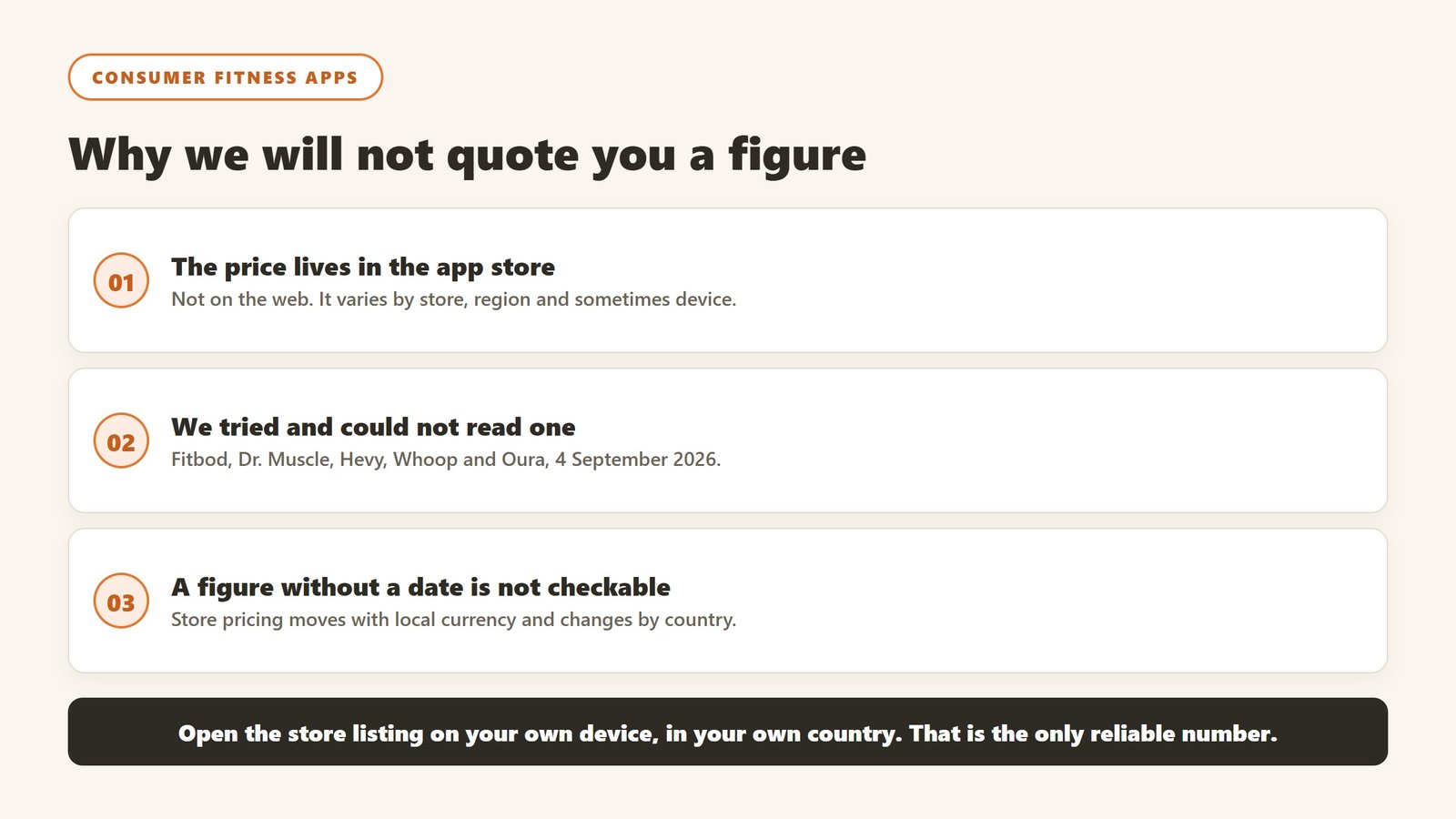
We could quote a dollar figure from somewhere else. We are not going to, for three reasons.
Second-hand app prices go stale silently. A subscription price changes in the store with no announcement and no page to update, so a figure copied from a blog post can be wrong for months before anyone notices.
In-app purchase prices are per storefront. A US number is not a UK number, and neither is an Indian one. Publishing one as though it were universal is misleading to most readers.
Our own connection resolves to India, so even if Fitbod did publish a figure we would have to handle geo-served pricing carefully. Several vendors we checked the same day served us rupees without offering a way to switch.
If you want the number, the store listing takes ten seconds and is correct for you specifically.
What we can tell you about the product side
Fitbod is an iOS and Android workout app built around adaptive strength training: it builds each session from your logged history, available equipment and recovery state, then adjusts as you train.
It has a free tier that allows a limited number of workouts before asking you to subscribe, which is the standard shape for this category. The subscription unlocks unlimited workouts.
We cover Fitbod in more depth in our review and in our roundups of AI workout apps. This page exists specifically to answer the pricing question, because it is the one Fitbod’s own site does not.
How this compares to the rest of the category
Of the fitness tools we have priced, Fitbod is the only one with no published figure at all.

| Tool | Publishes a price on its own site |
|---|---|
| PT Distinction | Yes. $19.90, $59.90, $89.90 a month, with per-client overage stated |
| Trainerize | Yes |
| TrueCoach | Yes |
| Fitbod | No. No pricing page, no pricing link |
Being app-store-only is a legitimate way to sell a consumer subscription, and Fitbod is far from the only app that does it. It does mean anyone comparing tools on cost has to leave the website to find out, which is worth knowing before you start looking.
What to check in the store listing
When you open it, four things decide what you actually pay.
| What to look at | Why it changes the number |
|---|---|
| Monthly against annual | Nearly every subscription app prices annual well below twelve months of monthly, and the store lists both as separate in-app purchases |
| Whether a free trial applies | Trials are set per subscription product and shown in the listing, not on the vendor site |
| Which storefront you are in | If your account is registered in one country and you live in another, the price you see is the account’s, not your location’s |
| Introductory versus renewal price | Stores show the first-period price prominently. What you pay at renewal can differ, and it is listed separately |
What buying through the App Store actually changes
It is not only where the price lives. Buying a subscription through Apple or Google changes several things that matter after you have paid.
Cancellation happens in the store, not in the app. You cancel a Fitbod subscription through your Apple ID subscription settings or your Google Play subscriptions, not by emailing Fitbod. People routinely miss this and assume deleting the app cancels the billing. It does not.
Refunds are Apple or Google policy, not Fitbod policy. If you want money back you are asking the store, and the store decides. A vendor with its own billing can make its own call. A vendor selling through in-app purchase largely cannot.
Family Sharing may or may not apply. Some subscriptions can be shared across an Apple family group and some cannot. It is set per product by the developer and shown in the store listing, so it is worth checking if more than one person in the house lifts.
Switching platforms is not always seamless. A subscription bought on iOS is an Apple subscription. Moving to Android generally means cancelling one and starting the other rather than carrying it across.
None of these are criticisms of Fitbod specifically. They apply to any app sold this way, and they are the practical consequences of a pricing model that lives entirely inside a store.
How consumer fitness apps are priced, and why the figures are hard to pin down
Consumer training apps behave differently from coaching platforms, and it makes them genuinely harder to compare honestly.
Most of them price through the app stores
We attempted to read pricing pages for several of the best known consumer apps on 4 September 2026, including Fitbod, Dr. Muscle, Hevy, Whoop and Oura, and could not extract a rate from any of them with the same method that read every coaching platform above. That is largely because subscriptions are sold inside the app rather than on the web, so the price you see depends on your store, your region and sometimes your device. We will not quote a figure we could not source.
What that means for any price you read elsewhere
Treat every specific consumer app price on the internet, including in comparison articles, as unverified unless it names a date and a source. Store pricing also changes by country and moves with local currency, so a figure that was right in one market can be wrong in yours by a wide margin. The reliable move is to open the app store listing on your own device before deciding.
The one that does publish clearly
JuggernautAI publishes on the web: $34.99 a month or $349.99 a year, with a two week free trial, which works out at roughly two months free on the annual plan. That is at the premium end of consumer training apps and it is aimed at serious strength athletes rather than general fitness, which is the honest framing for whether it is expensive.
Free trials in this category are short and auto-renewing
Two week and one month trials are the norm and almost all of them convert automatically. If you are testing several apps, note the conversion dates somewhere other than the app itself. This is mundane advice and it is the single most common way people end up paying for three training apps they stopped opening in February.
What AI form checking can and cannot actually see
Pose estimation from a phone camera is genuinely useful and routinely oversold. Knowing where the line sits protects you from both the hype and the injury risk.
It works well on large, planar, well-lit movement
A squat filmed from the side in good light, with the whole body in frame and reasonably fitted clothing, is close to the ideal case. Knee position, hip depth, bar path and tempo are all measurable from that, and feedback on them is real. If your use case looks like that, these tools do what they claim.
It degrades sharply outside those conditions
Accuracy falls away with loose clothing, poor lighting, an angled or moving camera, occlusion where one limb hides another, and any movement that happens largely in the depth axis away from the lens. Rotational movement, anything on the floor, and lifts where the critical detail is spinal position rather than joint angle are all much harder. A tool that is confident in those conditions is not more capable, it is less honest.
It cannot see the things that most often cause injury
A camera does not know your training history, whether that shoulder has been irritable for three weeks, how heavy the bar is relative to your capacity, or that you slept four hours. Most training injuries come from load management rather than from a visibly wrong joint angle in a single rep. Treat form feedback as one input among several rather than as a safety system.
The honest way to use it
Film the same lift from the same angle every few weeks and compare. Consistency of setup matters more than the sophistication of the model, and a fixed camera position turns these tools from a novelty into a genuine progress record. Use the feedback to prompt questions rather than to make decisions, and take anything about pain or persistent discomfort to a physiotherapist rather than to an app.
How to tell whether the tool was worth it
Fitness software is easy to evaluate honestly because the numbers are countable and small. The reason most coaches cannot say whether a platform helped is that nobody wrote down where they started.
Pick the metric the tool is supposed to move
For a coaching platform it is clients per coach and hours spent on programming and admin per client per week. For a consumer app it is sessions completed per week and adherence over eight weeks. For form checking it is whether you are still filming in month three. Each of those is countable and each needs a figure from before.
Record the time cost this month, before anything changes
Ask yourself or your coaches to log how long programming, check-ins and admin take across one normal week. It takes minutes and it is the only way the time saving is ever provable. Most of the honest value in this category is hours rather than revenue, and hours are measurable in advance and unprovable afterwards.
Give it two client cycles
Retention and adherence move slowly and seasonally. A four week read tells you about novelty rather than value. Judge a coaching platform over at least two full client cycles, and say so at the outset so an unremarkable first month is understood as expected.
Name the result that would end it
Write down before you subscribe what twelve months would have to look like for you not to renew. It converts renewal from a default into a decision, which matters more in a category where the monthly figure is small enough to stop noticing.
Where a fitness app should stop and a professional should start
This category sits close to health advice without being health care, and the distinction matters for the reader rather than for the vendor.
Nutrition tools estimate, they do not measure
Calorie and macro figures from photo recognition or database lookup carry meaningful error, both in portion estimation and in the underlying food data. That is fine for tracking a trend over weeks, which is what most people need. It is not fine as a basis for aggressive restriction, and anyone with a history of disordered eating should be pointed away from precise daily tracking rather than towards a better tracker.
Wearable recovery scores are directional, not diagnostic
Sleep staging, readiness and recovery metrics from consumer wearables are useful for spotting your own patterns over time and unreliable as absolute measurements on any given night. Use them to notice a fortnight of poor sleep. Do not use them to decide whether a symptom needs attention, and be wary of any app that encourages that reading.
Anything involving pain, pregnancy, injury or a medical condition needs a human
Postpartum training, rehabilitation, cardiac conditions, hypermobility, pregnancy and any current injury all need individual clinical assessment. An app can support a programme a professional has designed, and it cannot design one safely from a questionnaire. The good tools in these areas say so plainly on their own marketing; treat the ones that do not as a warning.
What a coach should check before recommending anything
Whether the app claims to diagnose or treat, what it does with health data, and whether it has any mechanism for escalating a red flag. If a client tells the app about chest pain during exercise, what happens? Most consumer tools have no answer to that, which is exactly why the coach relationship is the safety layer rather than the software.
Where the figures on this page come from
Every price here was read from the vendor’s own pricing page on 4 September 2026 and carries that date, because pricing in this category moves and a claim without a date is not checkable.
The pages we read
PT Distinction publishes $19.90, $59.90 and $89.90 a month with its marginal per client rates. Everfit publishes a rung for every client count from $19 to $290 monthly. TrueCoach publishes $26.34, $57.99 and $136.99 a month billed annually. My PT Hub publishes $25 and $59. FitBudd publishes $15, $79 and $149 with per client add-ons. Trainerize publishes a free tier and plans from $9. JuggernautAI publishes $34.99 a month or $349.99 a year.
The ones we could not read
Fitbod, Dr. Muscle, Hevy, Whoop and Oura did not yield a figure to the same method that read every vendor above, largely because consumer subscriptions are sold inside the app stores rather than on the web. That is not evidence they publish nothing, and we do not present it as such. Check the store listing on your own device, in your own country, before relying on any figure for those five.
One page worth reading twice
Wodify displayed $199 struck through and $99 a month per location, conditional on booking a demo by 31 August. We read it on 4 September 2026, after that deadline, and the discounted price was still shown. Ask which figure actually applies before budgeting on it.
How we checked this
We requested fitbod.me/pricing on 30 August 2026 and received a 404. We then loaded the homepage and enumerated every link on it, looking for anything matching pricing, plans, cost, subscription, premium or membership. The only match was the App Store listing.
We are not reporting a price because the vendor does not publish one, and we would rather say that plainly than repeat a figure from a source that cannot be checked.
This is a pricing page, not a hands-on review. Nothing here is scored and we make no claim to have used the product.
If Fitbod publishes pricing on its website in future, tell us and we will update this page with the figures and the date we read them.

Written by
FazFaz is the founder of AIToolsBakery. Some tools here are tested hands on. Others are assessed from vendor documentation and pricing verified on the live page, and every review says which one it is. Sponsors can buy a position in a guide. They cannot buy the score, the criticism, or silence about a better option.
How we test and how we make money →