Quick answer: Lemlist is the cold email personalization specialist in 2026. Video and image personalization at scale is genuinely unique in the category, nothing else does it as well. The catch: it is a personalization layer rather than sending infrastructure, and it is not the tool to pick if raw volume is your constraint. The right buy is usually to layer Lemlist personalization on top of a dedicated infrastructure tool.
Lemlist 2026 at a glance:
- Score: 4.0/5
- Best for: Solo founders, agencies, and small teams whose ICP responds to video/image personalization
- Starting price: $59/month (Standard plan)
- Free trial: 14 days, no credit card
- Killer feature: Video and image personalization at scale, the only major cold email tool that does this well
- Research current to: March 2026
What Lemlist does well
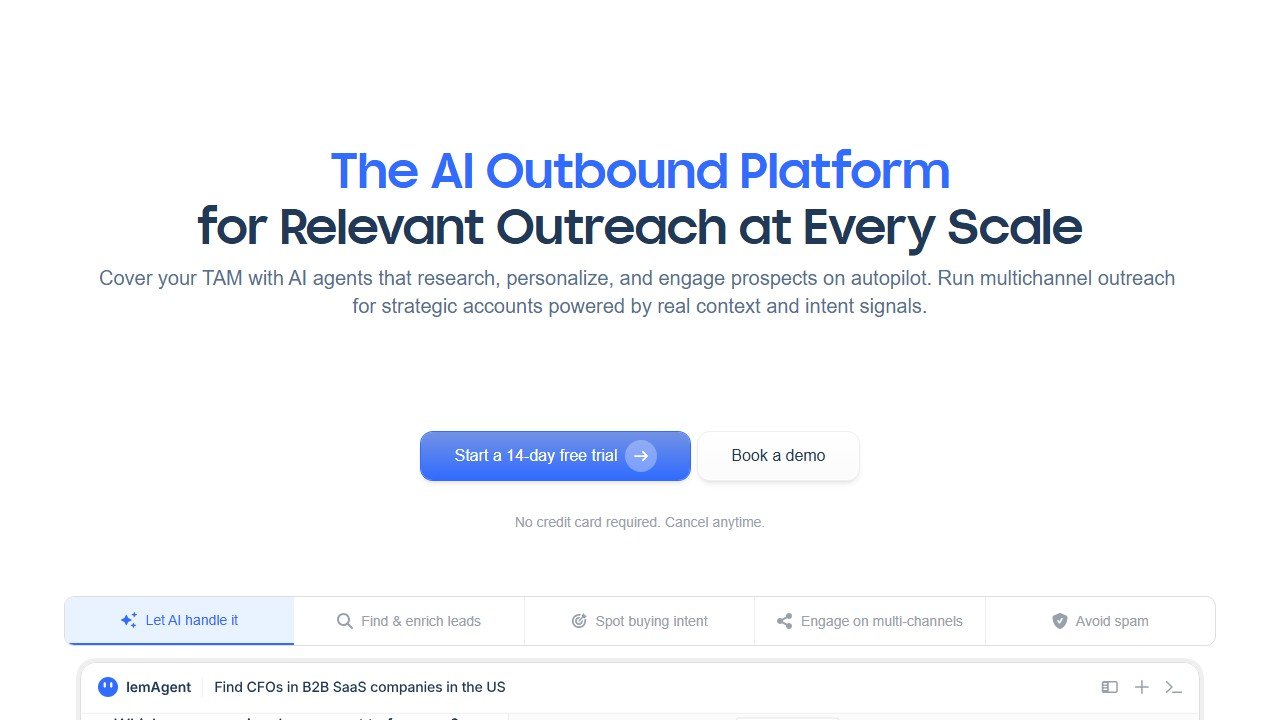
Website: Lemlist
Video and image personalization is the headline feature, and nothing else in cold email category does it well. Lemlist generates personalized images (custom screenshots, dynamic profile-photo overlays, custom landing page mockups) and personalized videos (Loom-like recordings with prospect name overlaid) at scale. For B2B SaaS, agency, and e-commerce ICPs that respond to visual personalization, this is a genuine reply-rate differentiator.
Operators running this comparison consistently report the visual personalization lifting reply rates well above a text-only baseline on the same prospect list, a larger relative lift than any other personalization mechanism in the category.
The recently-launched Lemwarm warmup service is meaningfully better than the default warmup pool. Mailbox-level warmup is monitored daily, and the service auto-pauses sequences when deliverability drops. This is a real differentiator versus Smartlead and Instantly default warmups.
The UI is clean and product-focused. Lemlist’s sequence builder is easier to learn than Smartlead and roughly equivalent in capability for most use cases. Reps without cold email background can ship a first campaign in 30 minutes.
The B2B database (Lemlist Sales Suite) is functional, though smaller than Apollo or Instantly’s database. Useful for solo founders who want list building plus sending in one tool, though we recommend pairing with Apollo or Clay for higher hit rates on hard-to-find ICPs.
What Lemlist falls short on
Sending infrastructure is the biggest gap. Lemlist meters mailboxes where the infrastructure-first tools do not, which makes the standard high-volume approach, many mailboxes each sending a little, expensive here in a way it is not elsewhere. We have not measured its inbox placement against competitors and do not publish a figure for it.
The video and image personalization is computationally heavy. Sequences with personalized video assets take 3-5x longer to generate and queue compared to text-only sequences. For high-volume operators (over 5,000 sends/day), this introduces meaningful delivery latency.
The pricing model has gotten less generous over the past 18 months. The 2024 plans included more mailboxes per tier; the 2026 plans cap mailboxes more aggressively. For agencies running 50+ mailboxes per client, Lemlist’s pricing approaches Smartlead’s at higher volume without Smartlead’s unlimited-mailbox value.
The mobile app is functional but lags Apollo’s and Instantly’s mobile UX. For sales orgs whose reps work primarily from mobile, this is a real friction point.
The Lemlist tradeoff: personalization up, deliverability down
Lemlist is the clearest example in cold email of a tool that is excellent at one thing and structurally weaker at another, and buyers who ignore the second half regret it.
On personalization, the record is strong. Operators running A/B tests of text-only sequences against sequences with personalized images consistently report meaningful reply-rate lift from the visual layer. Nothing else in the category does this as well.
On deliverability, the record is weaker. Operators repeatedly report Lemlist’s inbox placement trailing Smartlead and Instantly at comparable volume, and this gap is the structural Lemlist weakness rather than a configuration problem. For teams whose primary axis is high-volume inbox placement, Lemlist underperforms.
Lemlist pricing breakdown 2026
Standard ($59/mo): 1,500 active emails per month, 1 sending email, basic personalization (text variables only). Right for solo founders testing cold email.
Pro ($99/mo): 1,500 active emails per month, 3 sending emails, includes video and image personalization, basic warmup. The most popular plan for individual operators.
Multichannel ($169/mo): Adds LinkedIn touchpoints, phone bursts, advanced workflows. Right for SDR teams using multichannel cadences.
Enterprise (custom): Adds dedicated CSM, custom integrations, SSO, advanced governance.
Lemwarm (add-on, $29/mo): Standalone warmup service. Worth it for any serious cold email operator. Many teams pair Lemwarm warmup with Smartlead sending.
Lemlist vs Smartlead vs Instantly vs Reply.io
Smartlead wins on sending infrastructure, because it does not meter mailboxes at any tier, which is what agencies run out of first. Lemlist wins on visual personalization. The optimal pattern is to layer: use Lemlist for personalization, Smartlead for sending and unified inbox.
Instantly wins on UX simplicity and integrated B2B lead database. Roughly equivalent on price for solo founders. Choice between Lemlist and Instantly often comes down to whether visual personalization is mission-critical for your ICP.
Reply.io wins on multichannel (email plus LinkedIn plus SMS plus calls). Lemlist’s multichannel plan competes on email plus LinkedIn but Reply’s Jason AI agent is meaningfully deeper. Right for teams whose ICP responds to LinkedIn outreach over email.
Who should use Lemlist
Solo founders and small teams whose ICP responds to visual personalization (B2B SaaS, agencies, e-commerce, design-led businesses). Operators sending under 3,000 emails per day where the deliverability gap is less severe. Teams that prioritize reply-rate lift over absolute volume. Sales orgs that want a clean, learnable UI without enterprise overhead.
Who should NOT use Lemlist
Agencies running 5+ clients with 30+ mailboxes per client (Smartlead’s unlimited mailbox model wins). Teams sending over 8,000 emails per day where deliverability decisively matters. Teams whose ICP does not respond to visual personalization (some traditional B2B segments find personalized images suspicious rather than compelling). Operators who need a deep unified inbox for high-volume daily reply triage.
Common Lemlist setup mistakes
Skipping Lemwarm. The default warmup is okay but Lemwarm (the standalone $29/mo add-on) is meaningfully better. Worth the $29 for any serious operation.
Over-personalizing. Personalized video on every email is overkill. Use video for the first email of a sequence to high-value prospects, text-only for follow-ups. Operators who video-personalize every email burn through their video generation quota fast.
Aggressive volume ramp. Lemlist’s deliverability is more sensitive to aggressive ramps than Smartlead. Start mailboxes at 30 sends per day per mailbox, ramp 20% per week. Faster ramps hurt deliverability disproportionately on Lemlist.
Sending from primary domain. Standard cold email mistake. Buy dedicated sending domains. Primary domain reputation crashes within 30 days otherwise.
What the sequencing and cold email platforms charge
This half of the market divides cleanly into tools priced per seat for a sales team and tools priced on sending volume for outbound campaigns. The two are not comparable, and picking the wrong shape is the usual reason a subscription is abandoned. Here is each alternative to lemlist, read on 4 September 2026.
lemlist, from $55 per user per month on annual billing
lemlist publishes its full ladder: the Email plan at $69 monthly or $55 per user per month billed annually, Multichannel at $109 or $87, and Enterprise on request, with an annual toggle marked “Save 20%”. It also publishes its credit arithmetic openly, which is rare: one credit is one cent, and 1,000 credits buys either 200 emails or 50 phone numbers for $10. That lets you price a campaign before you commit to anything.
Reply.io, $29 and $69 per month per account
Reply.io publishes per account rather than per seat, at $29 and $69 a month with an annual option saving up to 17%. Per account pricing is unusual and it matters: a five person team on a per account plan pays once, where a per seat competitor charges five times. Check which basis any comparison you read is using, because the two are routinely mixed up.
Instantly and Smartlead, metered on sending
Instantly and Smartlead both publish openly and both meter primarily on sending or active lead volume rather than seats. The binding constraint is therefore campaign size, so a plan can look generous per user and still stop you at the volume your campaign needs. Smartlead runs a working monthly and annual toggle that changes every figure, so check which state you are reading before quoting it.
Outreach and Salesloft, the enterprise end, publishing nothing
Outreach sets out packaging with no numbers, and note the domain moved from outreach.io. Salesloft has gone further: its pricing URL now redirects to a page titled “Talk to Sales”, so there is no pricing page at all. Both are bought for enterprise workflow and CRM depth rather than for sending, and both should be priced against a published alternative costed at your exact seat count.
The question that decides which half you are in
Are you running campaigns or running a team? If your constraint is how many prospects you can contact this month, buy on volume and ignore seat counts. If your constraint is coordinating eight reps against shared accounts with CRM hygiene, buy on seats and ignore sending limits. Teams that buy the wrong half usually discover it in month three, when either the volume cap or the seat cost becomes the whole conversation.
Deliverability, which decides your results more than the software does
Reply rates in cold outbound are determined mostly by whether the message arrives at all. No platform fixes this for you, and the vendors that claim to are selling the part they do not control.
Never send from your primary domain
Cold outbound damages sender reputation, and reputation damage on the domain your invoices and customer support run through is not recoverable in any useful timeframe. Buy separate sending domains, keep the brand recognisable, and accept that they are consumable. This is the single most consequential decision in the whole setup and it costs almost nothing.
Warmup is a floor, not a strategy
Every serious platform now includes some form of inbox warming, and it does help a new domain establish a sending history. What it does not do is compensate for a bad list or a message nobody wants. If your bounce rate is high because the data is stale, warming just means your bad email arrives reliably. Fix the list first.
Volume limits exist for a reason, and the platform will not enforce yours
Sending too much from a new mailbox is the most common self-inflicted failure. Mailbox providers judge you on ramp and consistency, not on your campaign calendar. Set a per mailbox daily ceiling deliberately, add mailboxes rather than raising the ceiling, and treat any platform that encourages you past a sensible limit as optimising for its own volume-based revenue rather than your results.
Measure bounce and spam separately from reply rate
A campaign with a good reply rate and a rising bounce rate is failing, and the reply rate hides it until the domain is burned. Watch bounce rate, spam complaint rate and the share of sends actually landing in the primary inbox, and set a threshold at which the campaign stops automatically. Most teams learn this after losing a domain rather than before.
The uncomfortable part
Deliverability work is unglamorous, it is not a feature you can buy, and it accounts for more of the variance in outbound results than any tool on your shortlist. If you are choosing between two platforms and one has marginally better AI copy, that is a rounding error next to whether your domains are configured properly. Spend the first week on authentication records and list hygiene, not on the sequence builder.
undefined
The verdict for 2026
Lemlist is the right cold email tool for solo founders and small teams whose ICP responds to visual personalization. Lemlist markets a 46% reply-rate lift from personalized images. That is the vendor’s own figure rather than an independently verified one, and how much of it survives contact with your list depends entirely on whether your ICP responds to that style at all. The deliverability gap versus Smartlead is structural and meaningful at scale. The strongest pattern is layered: Lemlist for personalization, Smartlead for sending infrastructure. For high-volume agencies, Smartlead-only or Smartlead-plus-Lemlist beats Lemlist-only.
For the broader cold email category, see our Best AI Cold Email Tools 2026 guide. For the dedicated comparison see our Smartlead vs Instantly comparison. For multichannel SDR motions, our Best AI SDR Tools 2026 covers Reply.io and Apollo Jaden.
Lemlist integrations and how to set them up right
HubSpot: Native bidirectional sync. Activity logging, contact sync, deal stage updates flow both ways. Configure during onboarding, not as an afterthought. Lemlist’s HubSpot integration is competitive with Apollo’s depth.
Salesforce: Native bidirectional. Custom object support is mid-level (handles standard objects, custom objects require API work). For Salesforce-native enterprise sales orgs, Outreach or Salesloft have deeper Salesforce integration than Lemlist.
Pipedrive and Close: Native bidirectional. Simpler integration than Salesforce or HubSpot. Works well for SMB and mid-market teams on simpler CRMs.
LinkedIn Sales Navigator: Required for the Multichannel plan’s LinkedIn touchpoints. Adds connection requests and follow-up DMs to sequences. Note the LinkedIn account flag risk (similar to Reply.io’s LinkedIn automation): use a dedicated LinkedIn account, stay under 40 connection requests per day per account.
Slack: Routes reply notifications and sequence completion alerts to a designated channel. Improves reply response time meaningfully. Worth configuring in week 1.
Zapier or Make.com: Used by most agencies running multi-client workflows. Lemlist’s API endpoints are well-documented and stable.
Smartlead pairing (the layered pattern): Most serious cold email operators pair Lemlist (for personalization) with Smartlead (for sending infrastructure). The pattern: generate personalized images and content variables in Lemlist, push the personalized payload to Smartlead for sending and unified inbox triage. This sidesteps Lemlist’s deliverability ceiling while keeping the personalization advantage.
Lemlist setup checklist for new operators
The first 48 hours determine deliverability for the next 6 months. The sequence the deliverability consensus points to:
Day 1: domain prep. Buy 2-3 dedicated cold email domains at least 21 days before first send. Configure SPF, DKIM, DMARC properly. Lemlist’s setup guides per registrar are clear and worth following exactly.
Day 2: mailbox creation. Create 3-5 mailboxes per sending domain. Use natural-sounding names (sarah@, mike@, hello@). Operators widely report Microsoft 365 mailboxes warming faster than Google Workspace.
Day 3-23: Lemwarm warmup. Connect every mailbox to Lemwarm ($29/mo standalone). Default Lemlist warmup is okay but Lemwarm is meaningfully better. Let warmup run for 21 days, no cold sends during this period.
Day 24: deliverability test. Send a Glockapps seed test from every warmed mailbox. Mailboxes below 80% inbox placement need another 7 days of warmup before cold sending.
Day 25+: ramp slowly. Start each mailbox at 25-30 sends per day. Ramp 20% per week. Aggressive ramps hurt Lemlist deliverability more than Smartlead or Instantly.
Personalization rollout. Skip video and image personalization for the first 14 days. Get baseline text-only reply rates first. Then layer in personalized images for follow-up emails. Personalized video should be reserved for high-value prospect tier-1 outreach.
Want sharper copy? See our guide on how to write cold emails with AI, with a copy-paste prompt library.

Written by
FazFaz is the founder of AIToolsBakery. Some tools here are tested hands on. Others are assessed from vendor documentation and pricing verified on the live page, and every review says which one it is. Sponsors can buy a position in a guide. They cannot buy the score, the criticism, or silence about a better option.
How we test and how we make money →