We loaded the page so you do not have to
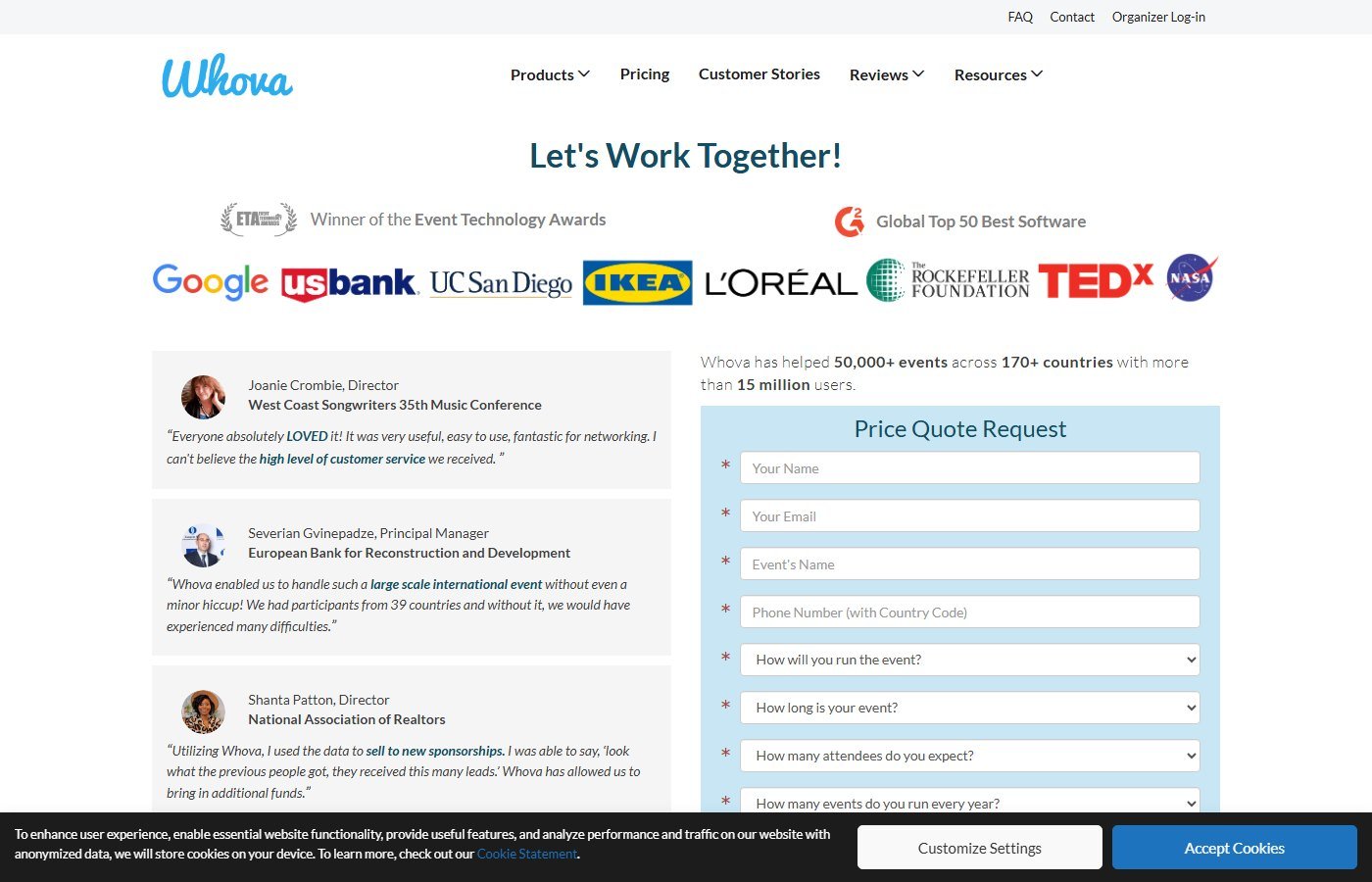
Whova’s pricing page, loaded 19 August 2026, rendered fully: navigation, customer testimonials, awards, a demo booking prompt, all under the page title “Whova Pricing 2026”.
The verdict on whether the product justifies the number is a separate question, and it lives in our Whova review.
It contains no currency figures and no percentages anywhere. Not a starting price, not a range, not a per-ticket fee.
We are being specific about this because “we could not find a price” and “there is no price published” are different claims, and only one of them is worth reading. The page loaded, it had real content, and there were no numbers in it. That is a finding about Whova, not a finding about our search skills.
Whova’s own help centre confirms the model rather than the cost: the attendee app is free to download and use, and event organisers pay for the service. A separate help article discusses registration fees existing, and notes they vary by country and currency configuration, without stating a rate.
So Whova will tell you that fees exist. It will not tell you what they are.
Who is actually answering this question
Here is the part that should change how you read every other page on this topic.
Ask Google about Whova pricing and its AI Overview assembles an answer largely from LineUpr and run.events. Both sell event software. Both compete with Whova directly.
Look at the rest of page one and the pattern holds. Eventtia, another competitor, ranks with a page whose headline is a pitch against Whova’s model. The neutral entries are a software directory, a Reddit thread and Whova’s own help centre.
There is currently no independent publisher in that answer.
This is not a conspiracy, it is a predictable consequence. Competitors have the strongest commercial reason to write thoroughly about a rival’s pricing, because they field the objection in every sales call. So they write the page, the page ranks because nobody else bothered, and it becomes the source that answer engines cite.
The figures in circulation, and their source
| Figure | Claimed by | Who they are |
|---|---|---|
| 3.0% + $0.99 per paid ticket, with some legacy contracts at 2.5% + $0.99 | LineUpr, Eventtia | Competitors |
| From $1,650 a year for 250 attendees on a 12-month licence | Eventtia | Competitor |
| Custom per-event base fee, scaling with attendee count and modules | LineUpr, Eventtia | Competitors |
| Add-ons reported up to $2,000 | Eventtia | Competitor |
| Free ticket registration carries no ticketing fee | LineUpr, and consistent with Whova’s own help centre | Competitor, corroborated |
| Pricing not publicly listed, quote only | Software Finder | Directory |
How much weight each deserves
The 3.0% + $0.99 per paid ticket figure is the most reliable of these. It appears independently in more than one competitor’s write-up, it is the kind of specific number a rival would be corrected on quickly if wrong, and it is consistent with Whova’s own help centre acknowledging that registration fees exist. Treat it as probable rather than confirmed.
The 2.5% legacy rate is worth asking about. Two sources mention that some contracts carry the lower rate. If that reflects older agreements, it tells you the rate has moved once and could move again.
Treat the $1,650 entry figure with real caution. It appears in a single competitor’s comparison table, tied to one specific configuration of 250 attendees on a 12-month licence, and we found no corroboration anywhere. It may be accurate. It may be a worst-case example chosen to make a point. On current evidence we would not quote it as Whova’s starting price and neither should you.
The “up to $2,000” add-on figure has the same problem: a single source, a ceiling rather than a rate, and no detail on which add-ons.
What the model means for your budget
Three layers, based on what is consistently reported.
A per-event platform fee, quoted individually, scaling with attendee count and which modules you want. This is the part with no public number at all, and it is likely to be the largest line.
Ticketing fees on paid registrations, reported at 3.0% + $0.99 per ticket. Work this one yourself because it scales fast. On a 400-person conference at $200 a ticket, that is roughly $2,800 on $80,000 of ticket revenue. On a 1,200-person event at the same price, it is roughly $8,400. The fixed $0.99 component matters more than it looks at low ticket prices: on a $25 ticket, the combined fee is about 6.9%, not 3%.
Add-ons, things like exhibitor portals, advanced branding, lead retrieval and document handling, reported up to $2,000.
If your event is free to attend, the ticketing layer reportedly drops away and you are negotiating the platform fee alone. That is a genuinely different conversation and worth separating in your own modelling.
What to ask for in a quote
The per-event base fee and the attendee band it assumes, plus the cost of exceeding it. Attendee bands are the standard structure here and going one over a boundary is where budgets break.
Whether your ticketing rate is 3.0% or 2.5%, and what determines it. If a lower legacy rate exists, ask directly whether it is still available and what qualifies you for it.
Which modules sit in the base and which are add-ons. Exhibitor management and lead retrieval are the two most commonly reported as separate line items.
Whether a genuinely free event carries no platform fee or only no ticketing fee. These are very different and the reporting only supports the second.
Multi-event pricing. Single-event quotes are the default. If you run three conferences a year, a programme rate should exist and you will only get it by asking.
What the renewal looks like. Per-event pricing feels commitment-free, but if you build your attendee experience around one platform, the second year is a weaker negotiating position than the first.
How to sanity-check the quote you get
You will get a number eventually. The problem is having nothing to judge it against. Here is how to build a rough expectation before the call, using only the reported figures and your own event.
Start with ticketing, because it is the only reported rate with any corroboration. Multiply your expected paid tickets by your ticket price, take 3.0%, then add $0.99 per ticket. That is your ticketing exposure. For a 600-person event at $150, that is $2,700 plus $594, so roughly $3,294.
Then treat the platform fee as the unknown you are actually negotiating. If the quote comes in as a single number, ask for it split into platform and ticketing. A vendor bundling both into one figure makes year-on-year comparison impossible and makes it hard to see what happens if your attendance misses forecast.
Test the quote against attendance sensitivity. Ask what the same quote looks like at 70% of forecast attendance and at 130%. If the platform fee is banded by attendee count, you want to know where the bands sit before you commit, not after registrations open.
Ask what the second year costs at the same scale. Per-event pricing looks commitment-free, which means there is no contractual protection against a rise once your attendee data, your app content and your team’s habits all live in one platform.
None of this gets you a published price. It gets you a quote you can interrogate, which is the realistic goal here.
The free-event case is genuinely different
Whova’s own help centre confirms the attendee app is free to download and that organisers pay. The consistently reported detail is that free ticket registration carries no ticketing fee.
If your event is free to attend, that removes the entire percentage layer and you are negotiating a single number: the per-event platform fee.
That is a meaningfully better position to negotiate from, and it is worth being explicit about it on the call. It also makes Whova harder to justify against free alternatives, because the whole cost is now one visible line rather than partly hidden inside ticket revenue you never see.
Community organisers, user groups and association chapters running free events should get that single number early, because it is the entire decision.
Why the silence costs Whova more than it used to
One more reason this matters beyond your own budget.
A buyer who searches for pricing used to land on a page and form an impression. Increasingly they land on a generated summary that has already picked its sources. For “whova pricing”, those sources are competitors.
That means the first description of Whova’s cost a prospective customer sees is written by companies whose business case depends on Whova looking expensive. Whova cannot correct it in that surface, because it has published nothing for the summary to cite.
A single public starting figure would change what those summaries can say. That is not our problem to solve, but it is the mechanism worth understanding when you read any confident claim about what Whova charges.
Whova against the category
Six event and fundraising platforms captured 19 August 2026.
| Platform | Publishes a price? |
|---|---|
| Little Green Light | Complete public table, $45/month up to 2,500 constituents |
| Donorbox | Yes, in depth. $0 Standard, $150/month Pro |
| Bizzabo | Yes. $499/user/month, 3 user minimum, from $17,999/year |
| Cvent Event Design | Yes. Free, $49, $150, $320 a month, with a buy button |
| OneCause | Partial, behind FAQ accordions, and two pages disagree |
| Whova | No |
| Cvent platform | No |
Who Whova suits
It suits conference and association organisers who want a strong attendee app and networking experience, and who are running an event big enough that a bespoke quote is worth the time it takes to get one. Whova’s reputation is built on the attendee-side experience, and if that is what you are buying, the platform is well regarded for it.
It does not suit small or first-time organisers who need a number before they can get budget approval. It does not suit anyone running a free community event, where a per-event platform fee is hard to justify against free or near-free alternatives. And it does not suit organisations with a short planning window, because a quote cycle takes time that a self-serve competitor does not.
There is a specific case worth flagging. If you are running a paid event with a low ticket price and high volume, the fixed $0.99 per ticket component is the number to model carefully, because it makes the effective rate much higher than the headline percentage suggests.
Method and limits
Whova’s pricing page was loaded on 19 August 2026 and every collapsed control was expanded before the text was read. The page rendered real content and contained no figures, which is why we can report an absence rather than a failure to find one.
We did not accept the site’s cookie prompt and no form was submitted, so nothing here comes from a sales conversation or a gated document.
The capture ran from an Indian IP. Whova served its US site with no locale redirect. Whova’s own help centre notes that registration fees vary by country and currency configuration, so regional variation is documented by the vendor and figures here should be treated as US-facing.
We have not used Whova and nothing here is a hands-on assessment. Every third-party figure is attributed, including where the source is a competitor, and none was independently audited. The per-ticket effective-rate calculations are our own arithmetic on a reported rate, not a confirmed one.
For vendors in the same category that do publish: Bizzabo pricing and the self-serve tiers covered in Cvent pricing.

Written by
FazFaz is the founder of AIToolsBakery. Some tools here are tested hands on. Others are assessed from vendor documentation and pricing verified on the live page, and every review says which one it is. Sponsors can buy a position in a guide. They cannot buy the score, the criticism, or silence about a better option.
How we test and how we make money →