You are planning a 1,200-person conference, your committee keeps asking when the schedule goes live, and your sponsors want to know what they actually get for their money. You have looked at the big enterprise platforms and walked away dizzy from the demos. Somewhere in your research, the same name keeps coming up from people who ran events like yours: Whova. It tends to show up not in vendor marketing but in the part of the review where an organizer says “and the attendees actually used the app.”
That last part matters more than most feature lists admit. Plenty of event platforms ship a mobile app that nobody opens after day one. Whova’s reputation is built on the opposite: attendees download it, fill out profiles, message each other, and check the agenda without being nagged. That is the angle worth testing.
A quick word on where we sit. AIToolsBakery is independent. We sell none of these tools, we take no placement money from Whova or its competitors, and we are not an affiliate list dressed up as a review. Search “Whova review” and you mostly get the vendor’s own pages or aggregator directories optimized to capture a referral click. We are neither. What follows is a straight buyer’s read on who Whova fits and who should look elsewhere.
The 30-second verdict: Whova is the strong mid-market pick when attendee engagement and a genuinely usable event app matter more than enterprise venue sourcing and deep financial controls. Easier than Cvent, beloved by attendees, custom-quoted. Great for conferences and associations. Less ideal for tiny events or finance-heavy enterprise procurement.
Quick facts
- Best for: Conferences, associations, academic and corporate events that want high attendee engagement and a fast setup.
- Pricing model: Custom per-event quote based on size and features, plus a per-paid-ticket fee on registration. Confirm current numbers with Whova.
- Standout: An event app attendees genuinely use, with networking, agenda, and community features that drive real interaction.
- Biggest drawback: Lighter than the enterprise incumbents on venue sourcing, complex financial controls, and deep brand customization.
What Whova is
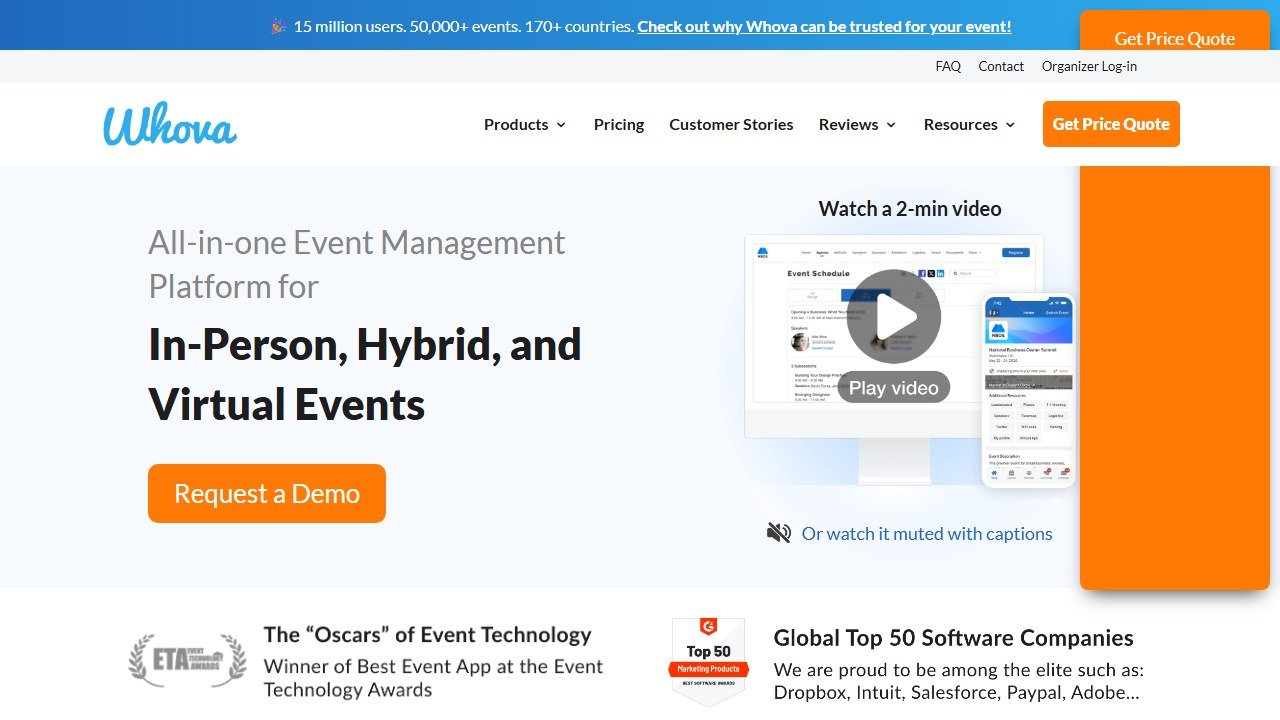
Website: Whova
Whova is an all-in-one event management platform built around a mobile event app. The app is the center of gravity. It carries the agenda, speaker profiles, announcements, attendee networking, live polls, session Q&A, community boards, and direct messaging. Around that app, Whova adds the rest of the event stack: registration and ticketing, an event website builder with ready templates, name badges and check-in, surveys and certificates, abstract and speaker management for academic programs, and exhibitor and sponsor tools with lead retrieval and QR scanning.
It supports in-person, virtual, and hybrid formats, so a single event can stream sessions to remote attendees while the in-room crowd uses the same app. Whova is used across corporate events, academic conferences, government functions, associations, trade shows, and festivals, and the company points to large organizations among its customers. The pitch on the homepage is consistent: save organizer time, increase attendee connections, and give sponsors measurable return.
What you are really buying is engagement infrastructure. Other platforms can register people and print badges. Whova’s distinguishing claim is that once those people are in the room, they actually use the software to find each other.
Who it is for
Whova fits best when your event lives or dies on attendee experience and you do not want to staff a certified admin to run the software. A few profiles where it lands well:
- Conference and association organizers running recurring multi-track events who want a polished agenda, networking, and a community feed without months of configuration.
- Academic and scientific conferences that need abstract submission, speaker management, and poster or session handling. This is a genuine strength and a reason Whova shows up heavily in higher-education circles.
- Lean event teams who need to be productive fast and cannot absorb a steep learning curve, a certification course, or a multi-week training program before their event date arrives.
- Sponsor-funded events where exhibitors expect lead retrieval, profiles, and gamification to justify their spend.
If you are an event professional mapping out your wider stack, it is worth reading our overview of AI tools for event planners alongside this, since Whova covers the event-app layer but not everything a planner touches. Corporate teams running internal summits and roadshows should also see our AI tools for corporate event planning guide for the pieces that sit around a platform like this.
What stands out
The app attendees actually use. This is the headline, and the reviews back it up. Whova consistently scores higher on ease of use than the enterprise incumbents, and a large share of positive reviews specifically praise the interface. The networking layer is the real differentiator: attendee profiles, interest-based matchmaking, community boards, and in-app messaging that get people connecting before, during, and after the event. When an app gets adoption, the agenda, polls, and Q&A all become more useful, because the audience is already living inside it.
Fast to stand up. Compared with platforms that require certification courses and a dedicated admin, Whova is something a small team can configure and launch without specialist training. For organizers who do not run events full time, that gap is the difference between shipping on schedule and not.
Academic and abstract management. Call for speakers, custom submission forms, and automated review workflows make Whova a practical pick for conferences with a formal program. Many event apps treat this as an afterthought. Whova treats it as a first-class workflow.
Sponsor and exhibitor value. Digital sponsor profiles, lead retrieval, QR scanning, and gamification give exhibitors something concrete to point at when they evaluate renewal. That matters because sponsor dollars often underwrite the whole event.
Hybrid and virtual built in. Live streaming and interactive sessions for remote attendees are part of the platform rather than a bolt-on, so a mixed audience shares one experience. Practically, that means a remote attendee can watch a session, ask a question in the same Q&A queue as the room, and vote in the same live poll, without you stitching together a separate webinar tool.
Logistics that quietly save time. The pieces organizers dread, name badges, kiosk self check-in, on-demand badge printing, surveys, and certificates, are handled inside the same system. None of these are glamorous, but they are exactly where event teams burn hours on the day, and consolidating them removes a stack of point tools and the handoffs between them.
Where it falls short
No tool is the right answer for everyone, and Whova has clear edges.
Not built for the smallest events. Whova is generally not the economical or sensible choice for very small gatherings, the kind with well under 100 attendees. The per-event pricing and feature depth are aimed at real conferences, not a 40-person workshop. For a tiny event, a lighter or free tool will serve you better, and our AI tools for party planners roundup points to options sized for that.
Lighter on enterprise venue sourcing and financial controls. This is the honest line that separates Whova from a platform like Cvent. If your procurement process leans on a global venue-sourcing database, complex approval chains, or deep financial reporting and budget controls, Whova is not designed to be the system of record for that. It is an event-experience platform first.
Customization and branding limits. Some organizers want the app and website to match their brand down to the pixel. Whova gives you templates and configuration, but reviewers occasionally note they could not bend the look-and-feel as far as they wanted. If a fully bespoke, white-label experience is non-negotiable, test this carefully in a demo.
Custom-quote pricing reduces transparency. Whova does not publish simple public package prices, which makes early budgeting harder and forces a sales conversation before you can compare on cost. That is common in this category, but it is still a friction point, and it makes apples-to-apples comparison shopping slower than it should be.
Pricing
Whova publishes no prices. We opened whova.com/pricing on 5 August 2026 and found a quote request form and nothing else. No plans, no rates, no ticketing fee. Every number you will read about Whova comes from somewhere other than Whova, so the useful question is where.
We traced the figures that circulate most widely. None of them hold up.
| Figure you will see | Where it appears | What backs it |
|---|---|---|
| 3.0% plus $0.99 per paid ticket | Eventify, LineUpr, CheckThat | Nothing. No source, document or screenshot on any of the three |
| About $2,000 for unlimited document uploads | LineUpr | Attributed to “organisers who’ve shared their experience on Reddit”, with no links to any post |
| $2,000 to $15,000+ per event | CheckThat | Nothing. No source given |
| $15,000 to $80,000+ a year for multi-event | CheckThat | Nothing. No source given |
Two of those three sites sell against Whova. Eventify is an event management platform that lists its own plans at $99 to $299 a month directly beneath its account of Whova’s pricing. LineUpr is an event app competitor. That does not make their numbers wrong, but a competitor’s unsourced estimate of your cost is not a budget input.
The one figure with a named human attached is second-hand, and we could not locate the original: Eventify quotes a reviewer who says they paid $2,999 and were refused a refund. Treat that as one reported contract value, not a rate.
What actually determines your quote
From Whova’s own sales material, the quote is built from attendee count, event format, how many events you run in a year, and which add-ons you switch on. Registration carries a separate per-paid-ticket charge that Whova does not publish. Document upload limits, sponsor and exhibitor tools, implementation and training are all add-ons rather than included.
How to get a real number
Bring your actual figures to the demo: attendee count, events per year, paid-ticket volume, and the specific features you need. Ask for one all-in annual figure with add-ons itemised, and ask for the ticketing percentage and the per-ticket amount in writing. Then compare that against a like-for-like Cvent or Bizzabo configuration, because neither of those publishes simple pricing either.
Pricing checked 5 August 2026. Whova published no rates on that date. We re-check quarterly and will publish a figure the moment one is verifiable.
How it compares and alternatives
The useful mental model is a spectrum. On one end sits the enterprise incumbent, broad and powerful and heavy. On the other sit focused engagement and networking tools. Whova lives in the productive middle: more app and engagement strength than the heavyweights bother to perfect, more breadth than a single-purpose tool.
Whova vs Cvent. This is the comparison most buyers are really running. Cvent is the enterprise default, with the widest feature surface, global venue sourcing, and deep financial controls, and it carries a matching learning curve and a higher, more opaque cost. Whova is easier to launch, scores better on ease of use, and wins on attendee-facing app engagement, while giving up ground on enterprise sourcing and finance. If you are weighing the incumbent, read our full Cvent review for the other side of this trade.
Whova vs Bizzabo. Bizzabo positions itself as a modern event-experience platform with strong B2B in-person features, smart-badge hardware, and marketing integrations. It competes with Whova on polish and engagement and tends to play up the enterprise end. If your shortlist is the two enterprise heavyweights rather than Whova, our Cvent vs Bizzabo comparison breaks down that specific matchup.
Whova vs Brella and Swoogo. Brella is networking-and-matchmaking-first, excellent at the connection layer but narrower as a full platform. Swoogo is registration-and-website-strong with a reputation for flexible event sites. Both can be the right answer when your priority is one specific job rather than an all-in-one app.
| Platform | Best for | App and engagement | Enterprise venue sourcing | Pricing model |
|---|---|---|---|---|
| Whova | Conferences, associations, academic events | Excellent, attendee-loved | Limited | Custom per-event quote plus ticket fee |
| Cvent | Large enterprise event programs | Solid, less loved | Strong, global RFP database | Custom, multi-layer, higher cost |
| Bizzabo | Modern B2B in-person events | Strong, polished | Moderate | Custom enterprise quote |
| Brella | Networking-led events | Excellent at matchmaking | Minimal | Quote, narrower scope |
| Swoogo | Registration and event websites | Moderate | Limited | Quote, registration-focused |
If your event is a wedding, gala, fundraiser, or social celebration rather than a structured conference, none of these platforms is really the right shape, and our AI tools for wedding planners guide points to software built for that world instead.
Our verdict
For the event it is built for, a real conference or association meeting where attendee engagement is the point, Whova is an easy recommendation. It earns its reputation in the place that is hardest to fake: attendees open the app, build profiles, and actually network inside it, which is exactly where most event apps quietly fail. Pair that with a fast setup, genuine strength in academic and abstract management, and concrete sponsor tooling, and you have a platform that does the core job well without demanding a certified admin to run it.
Buy Whova if you run conferences, associations, or academic events and you want engagement and speed over enterprise procurement depth. Look elsewhere if you need a global venue-sourcing database and heavy financial controls, in which case Cvent is the more complete, if heavier and pricier, system of record. And skip it for very small events, where a lighter or free tool will almost always cost less and fit better.
One honest caveat to close on: because pricing is quote-only, do not treat any figure in this review, ours or anyone else’s, as final. Get a written, all-in quote for your exact event, confirm the current ticketing fee on Whova’s own pricing page, and compare it against a like-for-like configuration from one competitor before you sign. Whova is a strong tool. The verdict you should trust is the one priced against your real numbers.
For the full cost breakdown, including what we could and could not verify, see our Whova pricing guide.

Written by
FazFaz is the founder of AIToolsBakery. Some tools here are tested hands on. Others are assessed from vendor documentation and pricing verified on the live page, and every review says which one it is. Sponsors can buy a position in a guide. They cannot buy the score, the criticism, or silence about a better option.
How we test and how we make money →