Google AI Mode is a different surface from AI Overviews, and most visibility tools were built before it existed. Some have added it properly. Some mention it in marketing and do not list it as an engine they track. One sells it separately from the plan you think you are buying.
This page sorts out which is which, using nothing but what each vendor publishes on its own site.
How we put this together. We have not run any of these tools. Every price and every engine list below was read off the vendor’s own pricing or product page on 28 September 2026, in a real browser, because every one of them renders prices with JavaScript and a plain fetch returns a page with no prices in it at all. Where a vendor does not name AI Mode, we say that rather than assuming.
The one finding worth the whole page
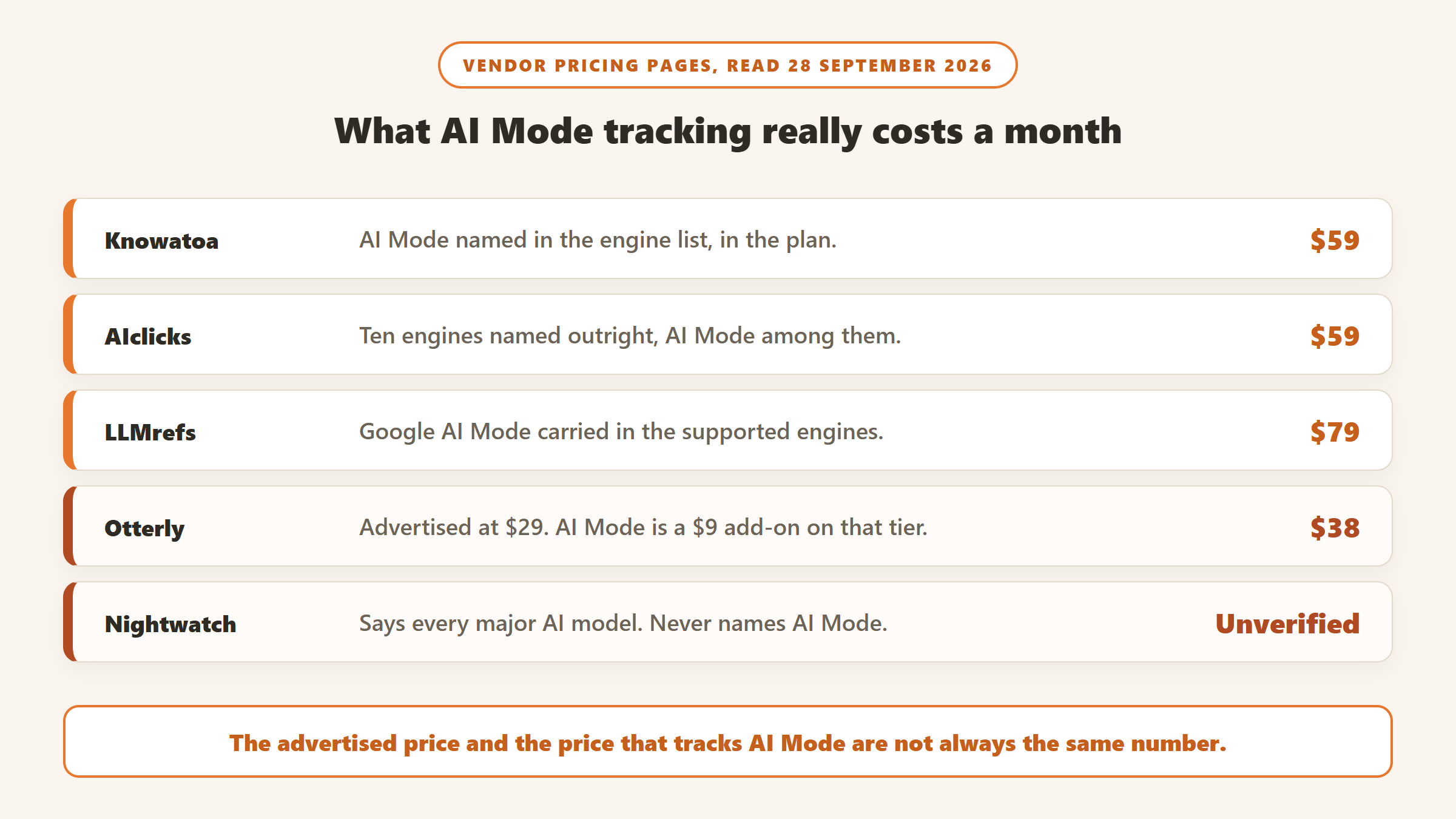
Otterly does not include Google AI Mode in any plan. Its Lite tier is $29 a month and its own feature list reads “Tracking of 4 AI Search Engines: ChatGPT, Google AI Overviews, Perplexity, MS Copilot”, followed by “Claude, Google AI-Mode, Gemini as extra Add-ons”.
The add-on is priced per tier:
| Google AI Mode add-on | Lite | Standard | Premium |
|---|---|---|---|
| Monthly | $9 | $59 | $149 |
| Annually | $93 | $610 | $1,540 |
So the real entry price for AI Mode tracking at Otterly is $38 a month, not $29. The advertised $29 buys a tool that does not watch AI Mode at all. That is not hidden, it is printed on their pricing page, but nobody reads a feature list that closely and no comparison we could find mentions it.
What Google AI Mode is, and why it needs its own tracker
AI Mode is Google’s conversational search surface. You ask a question, Google synthesises an answer, and it fans that question out into follow up queries behind the scenes to assemble it. That fan out is the reason it behaves nothing like the ten blue links your rank tracker was built for.
It is not AI Overviews. An AI Overview sits on top of a normal results page for a normal query. AI Mode is its own surface with its own conversation, and a site can be cited constantly in one and never appear in the other. Several of the tools on this page list them as two separate engines in the same feature list, which tells you the vendors treat them as different problems too.
Two practical consequences follow, and they are why a general AI visibility tool is not automatically an AI Mode tool.
The first is that there is no stable query to track. A conversation generates its own sub queries, so the thing being answered is often not the thing anyone typed. Tools that handle this well suggest prompts to watch rather than asking you to supply a keyword list.
The second is that it is a Google surface. It draws on the same index your existing SEO work already feeds, which makes movement in AI Mode more actionable than movement inside a model with its own separate training data. If you are going to pay for one AI surface to be watched, there is a decent argument this is the one.
What AI Mode checking actually measures
A traditional rank tracker reports one number: your position for a keyword. AI Mode checking is not one number, and a tool that pretends it is should be treated with suspicion. Four separate things are worth measuring, and the better tools are explicit about which of them they do.
The four measurements
Appearance rate. How often AI Mode generates an answer for your target queries at all, and how often your site is involved.
Citation frequency. How often you are actually named as a source in those answers. This is the closest equivalent to ranking.
Cited URL capture. Which specific page of yours gets cited, which is what you optimise against.
Competitor share of voice. Who else is cited for your queries, and how your share compares.
A tool that reports only “you appeared” is thin. Use those four as a scorecard while reading any vendor’s feature list.
Rank tracking versus citation tracking
Underneath those four sits a distinction most vendor lists blur. Rank tracking tells you where you sit in the answer’s ordered sources. Citation tracking tells you whether the synthesised answer is genuinely pulling sentences from your page and naming you. They are different measurements with different strategic weight, and a tool that only reports a position inside AI Mode is telling you less than one that shows which of your paragraphs the model lifted.
Two things that separate a serious tool from a basic one
Sentiment. AI Mode does not just cite you, it describes you. A citation that frames you as the expensive option is not the same win as one that frames you as the trusted default.
Prompt discovery. AI Mode answers fan out into follow up questions and sub queries, so the better tools suggest the conversational prompts worth tracking rather than making you guess a keyword list.
Which tools verifiably track Google AI Mode
Verified means the vendor names AI Mode in an engine list on its own site, not that it appears somewhere in the marketing copy.
| Tool | AI Mode | Entry price | Real cost for AI Mode |
|---|---|---|---|
| Knowatoa | Named in engine list | $59 | $59 |
| AIclicks | Named in engine list | $59 | $59 |
| LLMrefs | Named in engine list | $79 | $79 |
| Peec AI | Has an AI Mode tracker | $95 | $95 |
| SE Visible | Named in engine list | $99, or $79 annual | $99 |
| Rankscale | Named in engine list | $99 | $99 |
| Otterly | Paid add-on only | $29 | $38 |
| Profound | Named, but see below | No published price | Demo only |
| Scrunch | Not named | $250 | Unverified |
| Nightwatch | Not named | EUR 79 | Unverified |
All prices read 28 September 2026. Nightwatch prices in euros and we have not converted them.
The cheapest honest entry: Knowatoa and AIclicks at $59
Knowatoa runs a rotating engine list on its own homepage reading AI Overviews, AI Mode, ChatGPT, Claude and Perplexity, and its pricing runs $59 and $199. Its framing is the one we find most useful of the group: it leads on discovering where users search and what they ask, rather than on a visibility score. That is the prompt discovery problem from the section above, treated as the main event rather than an extra.
AIclicks publishes the most specific engine list at this price, naming ten platforms outright: ChatGPT, Perplexity, Gemini, Google AI Overviews, Google AI Mode, Claude, Grok, DeepSeek, Meta AI and Microsoft Copilot. Its tiers are $59, $189 and $499, and it also segments visibility by model and by region, which matters if you sell into more than one market.
AIclicks is one of two tools on this page whose prices have not moved since we last captured them in August. In a category where the newest entrant launched its pricing page this month, six weeks of a stable number is a small signal about how settled the business is.
Between the two at the same price, the split is straightforward. Knowatoa if you do not yet know which prompts matter and want help finding them. AIclicks if you already have your query list and want the widest engine coverage for the money.
The mid band: LLMrefs, Peec AI, SE Visible and Rankscale
LLMrefs at $79 carries a Google AI Mode engine icon in its supported list and leads on geo targeting across more than twenty countries and ten languages.
Peec AI runs $95 Starter, $245 Pro and $495 Advanced, and ships a feature it calls an AI Mode Visibility Tracker. The Starter tier covers fifty prompts, three models and one project, which is the constraint to watch rather than the price.
SE Visible from SE Ranking states its engines plainly: “Answer engines tracked: ChatGPT, Gemini, AI Mode, Perplexity, AI Overview”. AI Mode is in the base specification rather than an extra. It runs $99 monthly or $79 on annual billing, then $189 and $355.
Rankscale publishes the widest engine list of the group: “Track visibility in Google AI Overviews and AI Mode, plus ChatGPT, Perplexity, Muse Spark, Gemini, Claude, Copilot, and DeepSeek, all 17+ engines in one platform.” Pro is $99 for 1,200 credits, then $385 and $780. Also unchanged since August.
Profound: covered, but you have to dig for it
Profound is the biggest name in the category and the hardest to verify. Its pricing page publishes no price at all: a free seven day trial covering ChatGPT, Gemini and Google AI Overviews, then Enterprise at “Custom”.
More awkwardly, its answer engine insights page does list AI Mode, in a string reading “Prompt tracking across ChatGPT, Perplexity, Claude, Microsoft Copilot, Google AI Overviews, Google AI Mode, Google Gemini, Grok, and DeepSeek”. That string sits in the page source and does not render as visible text. Read the page normally and you would conclude the category leader does not track AI Mode.
We mention this because it is the kind of thing that produces a wrong comparison table elsewhere, and because a vendor that publishes no price is asking you to take more on trust than the others.
Two tools that never name AI Mode
Nightwatch says “every engine, every AI model” and “six from search engines, five from AI models”, and does not name Google AI Mode anywhere we could find. Its plans are EUR 79, EUR 159 and EUR 399 monthly, or EUR 948, EUR 1,908 and EUR 4,788 annually.
Scrunch at $250 carries no mention of AI Mode on its homepage at all.
Neither absence proves the tools cannot see AI Mode. It proves they will not say so in writing, which for a purchase decision amounts to the same thing. Ask them directly before paying, and get the answer in writing.
It is worth saying why we are strict about this rather than generous. Both companies predate AI Mode and both have real products: Nightwatch has been a rank tracker for years and its pitch of one keyword list checked across search engines and AI models in a single crawl is genuinely useful. But “every major AI model” is a claim that costs nothing to make and cannot be checked, and a vendor that lists nine engines by name is telling you something a vendor that counts to five is not.
Nightwatch is also the only tool here priced in euros, which matters if you are budgeting in dollars. We have not converted the figures, because a conversion we performed would be our number rather than theirs.
Check it free before you pay anyone
Every tool on this page automates something you can do by hand. Doing it by hand once is the fastest way to find out whether you need the automation at all, and it costs nothing.
The manual version, in about twenty minutes
Write down the ten questions a buyer would actually ask before choosing something you sell. Not keywords, questions, in the words a person would use. Ask each one in AI Mode. For each answer, record three things: whether your site was cited at all, which specific URL was cited if so, and which competitors were named alongside you.
That gives you a baseline on three of the four measurements above. What it does not give you is change over time, which is the entire product these tools sell. If your ten questions come back with you cited in eight of them, you do not have a visibility problem and you can stop here. If you are cited in none, you have a content problem rather than a monitoring problem, and paying $99 a month to watch a zero stay at zero will not fix it.
What the paid tools add that a manual check cannot
Three things, and they are worth naming because they are the actual product. Frequency, because a question asked once is a sample of one and AI Mode answers vary between runs. Scale, because ten questions is not a programme and a hundred is. And competitor share, because watching who else is cited across a hundred queries is the part no human does consistently.
If none of those three matter to you yet, you are early for this category.
What none of these tools can do
None of them can tell you why. They report that a competitor is cited more often than you. The reason sits in the content, and no dashboard on this page will hand it to you.
None of them see what a logged in user sees. AI Mode personalises. Results vary by account, history and location, and every tool here is sampling from somewhere that is not your buyer’s browser.
None of them are stable ground. This category did not exist two years ago and several of these companies will not exist in two more. Two of the ten on this page have changed nothing about their pricing since August, which counts as stability here.
How to choose without overbuying
Start with prompt count, not price
Every tool here meters prompts or credits, and the entry tiers are tighter than they look. Peec’s Starter is fifty prompts. Rankscale’s Pro is 1,200 credits a month. A list of the queries you actually care about will tell you more about which tier you need than any feature comparison.
Decide whether you need AI Mode separately at all
If your buyers are on ChatGPT and Perplexity rather than Google, every tool here covers those in the base plan and AI Mode is an expense you can defer. The case for paying for it specifically is that it is a Google surface, which means it draws on the same index your existing SEO work feeds.
Check what happens to the data when you leave
This category is young and several of these companies will not exist in two years. Exports and an API matter more here than in a mature category, and they are the first thing to check on a trial rather than the last.
Watch the prompt allowance, not the headline
The single most common way to overpay in this category is to buy on engine count and then hit a prompt ceiling in week two. Peec’s $95 Starter covers fifty prompts across three models and one project. Rankscale’s $99 Pro is 1,200 credits a month, which it converts into roughly 4,800 tracked answers depending on which engines you point it at. Otterly’s Lite is fifteen search prompts before any add-on.
Fifteen prompts is not a monitoring programme. If your list of buyer questions runs to forty, the entry tier at three of these vendors is already the wrong tier, and the price you should be comparing is the second one up.
The honest summary
If you want AI Mode tracking and nothing else matters, Knowatoa or AIclicks at $59 are the cheapest that include it outright. If you already use SE Ranking, SE Visible puts it in the base plan. If you want the widest engine coverage on one bill, Rankscale names seventeen.
And if you were about to buy Otterly at $29 because it looked like the bargain, budget $38, or you will be tracking four engines that do not include the one you came for.

Written by
FazFaz is the founder of AIToolsBakery. Some tools here are tested hands on. Others are assessed from vendor documentation and pricing verified on the live page, and every review says which one it is. Sponsors can buy a position in a guide. They cannot buy the score, the criticism, or silence about a better option.
How we test and how we make money →