A foundation grant typically takes 15 to 20 hours to write. A federal grant can take 100 hours or more. Development staff tenure averages 16 to 18 months, meaning organizations regularly rebuild institutional knowledge from scratch when writers leave.
Per the 2026 Virtuous/Fundraising.AI sector report, 68% of nonprofits say time is their primary challenge in grant seeking. Another 24% say lack of staff is their biggest barrier to applying at all.
AI grant writing tools promise to fix the time problem. The real question is whether they actually do, which ones are worth paying for, and which are vendor-marketed software that will not survive a real proposal deadline.
We went through every major tool in this category: not just the top results for “best AI grant writing tools” (most of which are written by the companies making the tools), but independent testing, pricing verification, and honest assessment of what each product does and does not do.
This is that assessment.
The best AI grant writing tools in 2026 are Grantable (best all-in-one at $50-$150/mo, 27,000+ users), Instrumentl (best for grant discovery at $179-$499/mo, 22,000+ active RFPs), and Granted AI (best for federal and research grants at $29-$89/mo). Grantboost is the best budget option with a usable free tier. Full breakdown of all 7 tools by use case below.
Last updated: April 22, 2026.
Related: See also: Instrumentl review | Grantable review | Grantable vs Instrumentl | Full nonprofit AI guide
How We Evaluated These Tools
Before getting to the list, here is what we actually looked at. Grant writing tools get evaluated on dimensions that most tech reviews ignore.
Writing quality: Does the output sound like a grant proposal or like a ChatGPT summary? Does it handle the narrative arc that effective proposals require? Can it adapt to specific funder priorities?
Funder matching: Is the database current? Are matches explained, or just listed? Does the tool understand geographic restrictions, funding focus areas, and award ranges?
Organizational memory: Does the tool remember your programs, mission, impact data, and funder relationships between sessions? Or do you paste your boilerplate in every time?
Pricing and value: What does the free tier actually include? Are there usage limits that matter? Is the pricing transparent?
Ease of use: Can a development director who is not technical set it up and use it without IT support?
Limitations and vendor honesty: Does the tool make realistic claims about outcomes, or does it promise things that grant writing cannot deliver?
One structural note: the biggest confusion in this market is between grant discovery tools (finding grants) and grant writing tools (writing proposals). Instrumentl is a discovery and tracking platform, not a writing tool. It keeps appearing in “best AI grant writing tools” lists because it is the market leader in its adjacent category, and it markets itself aggressively. But if you buy Instrumentl expecting it to write your proposals, you will be disappointed. We have covered it here because development teams legitimately need both functions, and because that confusion costs people real money.
Faz says: A few things you should know about how this list was built.
First: we do not have affiliate relationships with any of these tools. No one paid for a placement or sponsored a review. If that changes in the future, I will disclose it clearly.
Second: some of these tools are small bootstrapped operations. Small does not mean bad. Grantable has 8 employees and 27,000 users. That is a real product with real adoption. But it does mean you should factor company stability into your evaluation, especially if you are planning to build your grant workflow around a single platform.
Third: grant writing is a human skill that AI assists. The tools in this list are genuinely useful. None of them are magic. I have read enough vendor copy claiming “90% time savings” and “3x win rates” to know those numbers are marketing, not methodology. I will tell you what the tools actually do and let you assess the fit.
Quick Picks: All Tools at a Glance
| Tool | Best For | Starting Price | Free Tier | Discovery | Writing | Org Memory |
|---|---|---|---|---|---|---|
| Grantable | All-in-one | $50/mo | Yes (limited) | Yes (130K+ funders) | Yes | Yes |
| Instrumentl | Discovery only | $179/mo | No | Yes (22K+ RFPs) | No | No |
| Granted AI | Federal/research | $29/mo | No (money-back guarantee) | Yes (133K+ funders) | Yes | Limited |
| Grantboost | Budget/entry-level | Free / $19.99/mo | Yes (40 boosts/mo) | No | Yes | Limited |
| FundRobin | Small orgs / international | ~$24/mo | No | Yes (10K+ grants) | Yes | Limited |
| Grant Assistant | Federal/international | Quote only | No | No | Yes | Yes |
| Fundwriter | All content types | $22/mo | 7-day trial | No | Yes (grants + more) | No |
1. Instrumentl: Best for Grant Discovery and Tracking
Website: instrumentl.com
Price: $179/mo (annual, basic) to $499/mo (advanced AI tier)
Who it is for: Nonprofits focused on finding new grant opportunities. Grant consultants. Universities with active research funding pipelines.
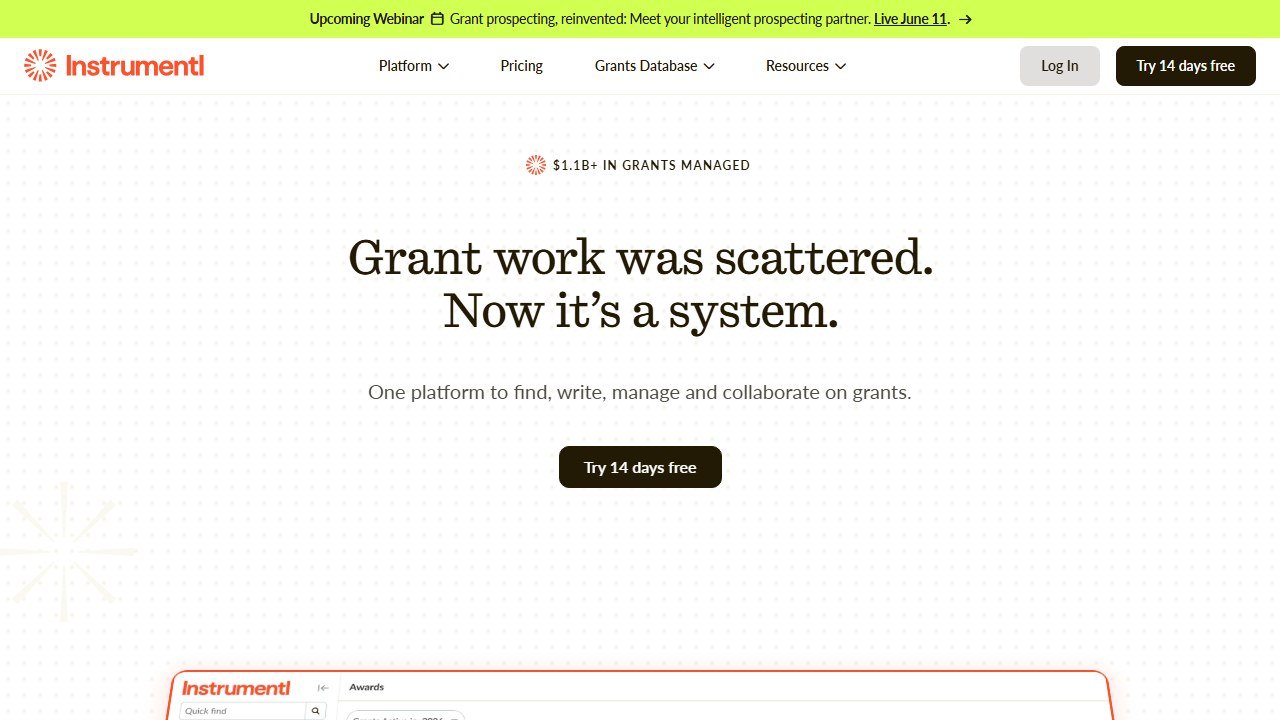
Let us get the most important thing on the table immediately: Instrumentl does not write grants. It finds them, tracks them, and manages your pipeline.
If you already know which funders you are targeting and need help drafting proposals, Instrumentl is not the right tool. If you are struggling to identify which foundations and federal programs you should be applying to in the first place, Instrumentl is the market standard.
The database covers 22,000+ active RFPs, with 250+ new opportunities added weekly by in-house research staff. That human-curated element matters: the database is not just scraped from public sources but actively maintained. The conversational AI “Prospecting Assistant” lets you describe your project or program in plain language and get matched opportunities without running keyword searches through a clunky interface.
Beyond discovery, Instrumentl handles the full grant pipeline: deadline tracking, application status management, team collaboration, reporting on your grant portfolio. For organizations managing 10+ active applications at any time, the pipeline management alone is worth evaluating.
The numbers: 4,500+ customers have used Instrumentl to win over $1B in grants and manage $6B+ in grant pipelines. The company raised $55.1M in April 2025 (led by Summit Partners), giving it the most external funding of any tool in this category. It has 107 employees.
The pricing reality: Starting at $179/mo billed annually, Instrumentl is meaningfully more expensive than the writing tools. The advanced AI tier at $499/mo is a significant investment for smaller organizations. For orgs where grants represent $200K+ in annual revenue and grant-seeking is a full-time activity, that cost is easily justified. For organizations pursuing 2 to 3 grants per year, it is harder to make the math work.
What it pairs with: Most Instrumentl users use a writing tool alongside it. Grantable and Granted AI are the most common combinations, with Instrumentl handling discovery and the writing tool handling drafts.
Verdict: 4.2/5. The market leader for grant discovery. The price point and the fact that it does not write proposals will rule it out for some organizations. For grant-focused teams who have the budget, it is the infrastructure layer the rest of your grant workflow sits on. Full breakdown in our Instrumentl review.
2. Grantable: Best All-in-One Grant Platform
Website: grantable.co
Price: Free (limited), $50/mo Starter, $150/mo Pro. Nonprofit discounts for orgs under $500K budget.
Who it is for: Grant writers and development directors who want discovery, writing, and management in a single platform.
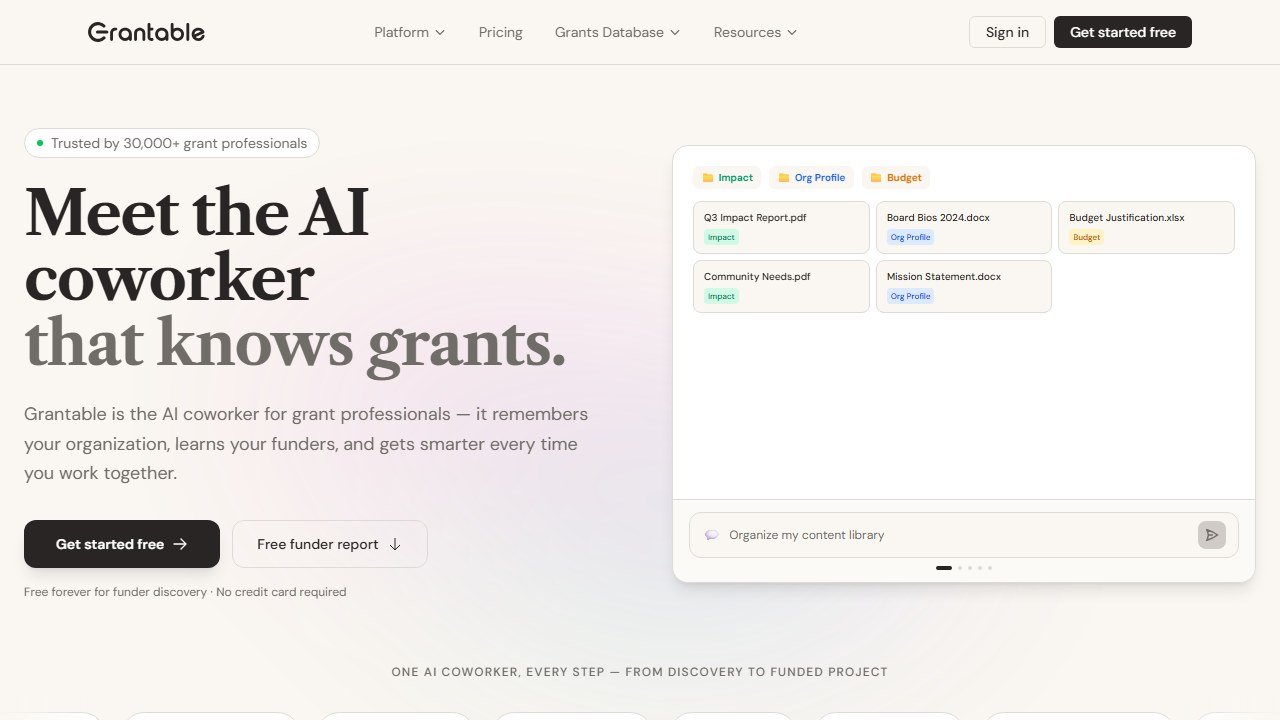
Grantable is the most practically useful tool for most nonprofits actively seeking and writing grants. It combines the three things a grant writer needs in one place: finding grants (130,000+ foundation database), drafting proposals (multi-model AI writing), and managing the full grant lifecycle.
The organizational memory feature is the real differentiator. Every grant writer knows the drill: you start a new application, and the first thing you do is paste in your mission statement, describe your programs, explain your theory of change, and outline your past impact. Then you do it again for the next one. And the next one.
Grantable builds a persistent profile of your organization from your documents, past proposals, and funder relationships. After setup, the AI knows who you are. New grant applications start from your context rather than a blank page. For development teams that write 10+ proposals a year, this compounds into significant time savings.
The multi-model approach is also worth noting. Grantable uses ChatGPT, Claude, and other AI models rather than committing to a single engine. This matters because different AI models have different strengths, and grant writing benefits from access to the best available tool for each task.
Funder matching from the 130,000+ database includes a “why they fit” explanation for each match, typical award ranges, and geographic overlap. This is more actionable than a raw database result that just lists funders without context.
The numbers: 27,000+ grant professionals and organizations. Founded 2020. Approximately 8 employees (bootstrapped, raised $100K including a $20K grant from 757 Accelerate in 2021). This is a lean operation relative to its user base.
The pricing reality: The free tier includes basic funder discovery and limited AI access. The $50/mo Starter plan is the practical entry point. The $150/mo Pro plan unlocks the full intelligence layer including the organizational memory and multi-model writing. For organizations under $500K in annual budget, discounts are available.
What it does not do: Grantable is not a donor CRM. It does not replace Virtuous or your donor management system. It is a grant-specific platform.
Verdict: 4.5/5. The best combination of discovery, writing, and workflow for most nonprofits. The organizational memory feature alone differentiates it from every writing-only tool in this category. The $150/mo Pro plan is reasonable for organizations actively writing grants. See our full Grantable review for a deep dive, and our Grantable vs Instrumentl comparison if you are trying to decide between them.
3. Granted AI: Best for Research and Federal Grants
Website: grantedai.com
Price: $29/mo Basic (3 active grants, unlimited drafts), $89/mo Professional (or $57/mo billed annually, unlimited grants, all features)
Who it is for: Nonprofits pursuing NIH, NSF, SBIR, foundation, or complex federal grants. Organizations that want peer-review-style quality checks on their proposals.
Granted AI’s headline feature is the AI Review Board: six independent AI reviewers, each with a different specialized role, evaluate your proposal independently and then deliberate to produce consensus-ranked findings.
The six reviewer personas are: domain expert, biostatistician, program officer, equity reviewer, budget analyst, and skeptic. Each evaluates the proposal from their disciplinary perspective. The deliberation output is a ranked list of findings with severity scores.
This process mirrors how peer review actually works in research grant contexts. NIH study sections involve reviewers from multiple disciplines. Federal program officers evaluate proposals against specific scoring rubrics. An equity reviewer is not a decorative addition. federal funders now score equity and inclusion criteria explicitly. The skeptic role mimics the critical reviewer who looks for weaknesses rather than strengths.
For foundation grants with simpler review processes, the full review board is more than you need. But for any organization pursuing federal or competitive research funding, the structured multi-perspective evaluation is genuinely useful rather than a gimmick.
Additional features: the platform covers 133,000+ foundations across all 50 states, reads full RFP documents to identify every required section, and includes compliance monitoring that cross-references IRS BMF, Pub78, revocations, and OFAC screening. The last feature matters for organizations working internationally or with funders who have complex regulatory requirements.
The “Granted Guarantee” is notable: if you do not win a grant within 12 months of using the platform, you get a full refund. That is either a bold and well-supported promise or a marketing claim that relies on the small number of users who actively pursue the refund. Either way, it is a more confident claim than any other tool in this category makes about outcomes.
The pricing reality: $29/mo Basic is the most accessible entry point in this category for a full-featured tool (Grantboost is cheaper but does not include discovery or compliance monitoring). The $89/mo Professional plan is competitive with Grantable’s Pro tier while offering a meaningfully different feature set.
Verdict: 4.3/5. The strongest tool specifically for research and federal grant contexts. The Review Board feature, compliance monitoring, and money-back guarantee make it a compelling choice for organizations in that lane. Foundation-only grant seekers may find Grantable’s org memory feature more day-to-day useful.
4. Grantboost: Best Budget Grant Writing Tool
Website: grantboost.io
Price: Free (40 AI boosts/month), $19.99/mo Pro (unlimited AI, templates), $29.99/mo Teams (multi-user, advanced controls)
Who it is for: Budget-constrained nonprofits, first-time AI grant writers, organizations that want to test AI before committing to a paid tool.
Grantboost is the entry-level option in this category. The free tier is genuinely usable: 40 AI boosts per month is enough for a small organization writing 2 to 3 grant proposals, provided you are selective about which sections you use AI assistance for.
The tool is focused narrowly on drafting. You provide your organizational context, upload relevant documents, and Grantboost generates proposal sections. Brand and tone controls let you push the output toward your organization’s voice rather than generic AI prose. Word and character count controls respect strict funder formatting requirements, which is a practical detail that matters when funders disqualify applications that exceed section limits.
What Grantboost does not have: organizational memory (you re-enter your context each session), a funder discovery database, grant pipeline management, or compliance monitoring. It is a drafting tool.
Specific user metrics are not publicly disclosed. Company funding and founding details are minimal. This appears to be a small, bootstrapped operation. That is not a disqualifier for what is essentially a text generation interface, but it is context worth having.
The free tier in practice: 40 boosts per month sounds like a lot until you are working on a 12-section federal proposal and each complex section requires multiple generation attempts to get usable output. For foundation grants with 5 to 8 sections, the free tier stretches comfortably. For federal applications, you will likely hit the limit.
Verdict: 3.8/5. The right starting point if you have no AI grant writing budget or want to evaluate whether AI fits your process before spending money. The free tier is honest about what it includes. Once you outgrow it, upgrade to Grantable rather than to the paid Grantboost tiers, because the organizational memory feature at that price point is more valuable than the incremental Grantboost Pro features.
5. FundRobin: Best for Small Orgs and International Nonprofits
Website: fundrobin.com
Price: From GBP 19/month (~$24 USD)
Who it is for: Small-to-mid nonprofits, UK and international charities, social enterprises, organizations that need end-to-end grant support at the lowest available price.
FundRobin is a UK-based platform that positions itself as the affordable alternative to Instrumentl, covering discovery and proposal writing in a single product. The “Smart Matching” feature uses NLP to score each grant 0 to 100% for relevance, which is more informative than unranked database results. The “Smart Proposal” feature reads funder guidelines and generates a complete first draft including narrative, outcomes, and budget sections.
The UK origin is genuinely relevant for international nonprofits. FundRobin was built with global compliance frameworks in mind, covering UK Charity Commission requirements and international grant regulations that most US-built tools simply do not address. Data privacy is clearly stated: organizational data is never used to train the underlying AI models.
Database coverage: 10,000+ federal and foundation grants worth $8B+. This is substantially smaller than Instrumentl’s 22,000+ or Grantable’s 130,000+, which is a real limitation for US-based organizations with broad grant programs. For UK charities and international NGOs, the coverage is more relevant.
FundRobin’s claims about time savings (75% reduction, 200 admin hours monthly for mid-sized charities) are vendor statistics. They are broadly consistent with what other tools in this category report, but treat them as directional rather than precise.
The CEO is Nahin Alamin, who has 12+ years of consulting experience at Capgemini, BT Group, and PwC. Founding date and external funding are not publicly disclosed.
Verdict: 3.7/5. For small US nonprofits on tight budgets, FundRobin’s price point is genuinely compelling. For UK and international organizations, it is the clear first choice given the global compliance framework. For US-based organizations with larger grant programs, the smaller database and less mature organizational memory features make Grantable or Instrumentl more appropriate.
6. Grant Assistant (FreeWill): Best for Federal and International Grants
Website: freewill.com
Price: Not publicly disclosed. Contact for quote.
Who it is for: Nonprofits with significant federal, foundation, or international development grant portfolios. Organizations with security and compliance requirements around their data.
Grant Assistant was originally a standalone AI grant writing platform built by a team including former USAID senior leaders. FreeWill, a planned giving platform serving 10,000+ nonprofits, acquired it in late 2025. It now functions as the AI grant writing layer within FreeWill’s broader product suite.
The training data is the product’s main differentiator: Grant Assistant was trained on 7,000+ successful real grant proposals, not general-purpose language model output. Grant writing has specific conventions, rhetorical patterns, and structural requirements that differ from general professional writing. A model trained on successful proposals is starting from a more relevant baseline than ChatGPT or Claude applied to grant writing prompts.
Former USAID leadership involvement matters in a similar way. Federal grant writing has specific compliance requirements, evaluation criteria, and formatting conventions that a commercial AI tool built without that expertise may miss. USAID experience means the team understood what federal program officers actually look for when scoring applications.
The closed-system architecture is a meaningful privacy point for larger nonprofits concerned about data security: your organizational data and proposal content are never used to train the underlying models.
The undisclosed pricing is a real limitation. “Contact for quote” creates friction and suggests an enterprise pricing model that smaller organizations may find inaccessible. There is no way to evaluate cost-effectiveness without going through a sales process.
Verdict: Not rated (pricing unavailable). The trained-on-real-proposals differentiation and federal grant expertise are genuine. If federal or international development grants are a primary revenue source, the discovery call is worth making to get pricing. Most small-to-mid nonprofits will find the other tools on this list more accessible.
7. Fundwriter: Best for All Fundraising Content
Website: fundwriter.ai
Price: $29/mo (or $22/mo billed annually). 7-day free trial with full feature access.
Who it is for: Development officers, communications directors, and marketing staff who produce high volumes of fundraising content across multiple formats.
Fundwriter is the outlier on this list. Every other tool is specifically a grant writing platform. Fundwriter is a fundraising copywriting AI that covers grants as one of 30+ writing models.
The breadth is the product’s differentiator. The same subscription that helps you draft a grant proposal also generates: fundraising appeal letters, personal donor emails, thank-you letters, social media posts, newsletter articles, and web content. For communications staff who need to produce a constant stream of fundraising content rather than just proposals, that breadth is more valuable than grant-specific depth.
What it is not: Fundwriter does not have a grant discovery database. It does not include organizational memory in the same persistent way as Grantable. It is a writing tool, not a platform.
At $22/mo billed annually with a 7-day full trial, it is the easiest tool on this list to evaluate without commitment.
Verdict: 3.9/5. The right tool for development teams who need fundraising content across many formats, not just grants. For pure grant writing workflows, Grantable or Granted AI will serve you better. For the generalist development officer writing grant proposals, appeal letters, and email campaigns, Fundwriter’s breadth earns its price.
Saru says: The grant success rate question comes up in every evaluation of AI grant writing tools, so let me address it with what the data actually shows.
The industry average grant proposal success rate is 10 to 30%, depending on the funder type, organization track record, and application category. Federal grants trend toward the lower end of that range; local foundation grants with relationship history trend higher.
AI grant writing tools do not directly improve your win rate on any individual proposal. What they change is:
1. Volume. If AI compresses a 15-hour proposal to 8 hours, you can apply to more grants with the same staff capacity. Applying to twice as many well-matched opportunities with a 20% success rate doubles your funded grants even if the per-application rate does not change.
2. Quality at scale. The organizational memory features (primarily in Grantable) help ensure each application accurately reflects your current programs and impact data, reducing the proposal quality degradation that happens when overworked development staff rush applications.
3. Discovery. Grant discovery tools surface opportunities that would not have appeared in a manual search, meaning more applications go to funders that are actually a good fit.
What the data does not support is the vendor claim that AI writing quality improves success rates on individual proposals in a measurable way. The available evidence is mostly anecdotal and comes from vendors, which is not a reliable source. Granted AI’s money-back guarantee is a more testable form of that claim, but the methodology for tracking it is not publicly documented.
The 68% of nonprofits who cite time as their primary grant-seeking challenge per the 2026 Virtuous/Fundraising.AI report are the right audience for these tools. If time is your bottleneck, AI grant writing tools address that problem directly.
Shopping specifically for a replacement for the category leader? Our dedicated guide to Instrumentl alternatives compares these tools through that exact lens, price point by price point.
The AI Grant Writing Ethics Question
This section gets skipped in most reviews. It should not.
Do funders accept AI-written grant proposals?
Most do not have a written policy. Per available sector data, only about 15% of foundations have written AI guidelines for applicants. That means 85% of funders have not told you where they stand, which is not the same as approval.
The absence of a written policy does not mean funders are indifferent. Conversations in the grant-making community consistently show that program officers notice AI-generated content when it is not edited, partly because it tends to be generic, slightly detached, and missing the specific organizational voice that experienced program officers recognize in strong proposals.
What this means practically:
Use AI tools for what they are good at: research, structure, first drafts, and funder matching. Then edit heavily. Proposals that sound like they were written by a person who knows their organization and understands the funder’s priorities have always performed better than technically competent but generic applications. AI does not change that dynamic. it just means the starting point for the draft is better.
The specific red flags funders report seeing in AI-assisted proposals:
- Mission descriptions that are accurate but generic (could apply to hundreds of organizations)
- Outcome statements that are plausible but lack the specific data and context of the organization’s actual work
- Language shifts mid-proposal where clearly human sections contrast with clearly AI sections
- “Placeholder” phrasing that survived editing: references to “your organization” or “the grant program” left in by accident
None of these are AI problems specifically. They are editing problems. An AI first draft that is reviewed, edited, and grounded in your organization’s real data and voice is indistinguishable from a strong human-written proposal, and will be evaluated on its merits.
Faz says: Here is my honest take on whether AI grant writing actually works.
Yes, it does. With qualifications.
The time savings are real. Every development professional I have talked to who uses these tools consistently reports that they are not going back to writing first drafts manually. The productivity gain on first drafts is significant enough that even imperfect AI output is more efficient than starting from scratch.
The quality ceiling is real too. AI grant writing tools are good at producing competent, structured prose about your organization and programs. They are not good at the things that make the best grant proposals actually compelling: the specific data point from your last evaluation report that proves your model works, the way you frame your theory of change to match exactly what this particular funder is trying to accomplish, the genuine relationship context that makes a program officer advocate for your proposal in a committee meeting.
Those things require human judgment, institutional knowledge, and funder relationships that no AI tool can replicate.
The organizations I see getting the most value from AI grant writing are using it exactly as it should be used: draft generation and structural assistance, combined with a human’s knowledge of the organization and the funder. The organizations that are disappointed are the ones who submitted AI output with light editing and expected the win rate to hold.
The tools are good. The workflow around the tools is what determines whether you see results.
For a practical, step-by-step guide to building an AI-assisted grant writing workflow, see our guide to how to use AI for grant writing.
AI writing tools for funder narratives
Grant writing is a writing problem first, fundraising tool second. Tools we recommend pairing with grant-writing AI:
- best AI rewriting tools. paraphrasing and tone-matching for funder voice
- Grammarly review. editorial polish for grant submissions
More AI tools for nonprofits
More nonprofit AI resources:
More AI tool guides worth reading: GiveSmart Review 2026, OneCause Review 2026 and Bonterra Guided Fundraising Review 2026.
Where AI helps in a grant cycle, and where it must not
The useful division is not by task but by who is accountable for the sentence. Anything a funder will hold you to needs a human author.
Genuinely useful: the first pass on structure
Turning a set of programme notes into a coherent outline against a specific funder’s question set is real work and models do it well. So is reformatting the same content for the fourth application this quarter, which is where most grants teams lose hours to no benefit. Start here, because the time saving is immediate and nothing is at risk.
Genuinely useful: reading the guidelines properly
Long funder guidelines hide eligibility rules, word limits and required attachments in the middle of paragraphs. Extracting those into a checklist is a task with a right answer, which is exactly the kind of task to automate. Verify the checklist against the source once, and you have saved the read on every future application to the same funder.
Where it must not go: outcomes, budgets and beneficiary stories
A model does not know what your programme achieved. If it writes an outcome, it is inventing one, and an invented outcome in a funded application is a serious problem rather than an embarrassing one. The same applies to budget assumptions and to anything describing a real person you serve. Those sentences are yours, and the review step that catches them is not optional.
The workflow that survives an audit
Draft with the tool, edit as a human, and keep the record of which is which. Practically: never paste a generated paragraph into a final document without reading it against a source you can point to, keep the funder guidelines and your evidence in the same folder as the draft, and have a second person read anything containing a number before it is submitted. None of this is exotic and all of it is what a funder assumes you already do.
What to tell your board
Say plainly which parts of the process are assisted and which are not. Boards react badly to discovering it after the fact and reasonably well to being told in advance, and the distinction that reassures them is exactly the one above: structure and reading are assisted, claims and outcomes are not.
What grant tooling actually costs, and what each type is for
Grant software is three products wearing one label, and buying the wrong one is the usual reason a subscription goes unused by month four. Here is where these tools sits and what the alternatives do.
Prospect databases, which answer “who might fund this”
These are search products over foundation filings and past awards. You are buying coverage and freshness, and the honest test is whether the database surfaces funders your team did not already know. Ask during the trial for the ten most relevant funders to one specific programme, then ask your grants lead how many were new. If the answer is one or two, the database is confirming rather than discovering, and that is worth much less than the price implies.
Writing assistants, which answer “how do I get this drafted”
These help produce narrative from material you already hold. Their value is real and it is time rather than money: a first draft in an hour rather than a day. Their limit is equally real. A model cannot know your programme outcomes, your budget assumptions or your board’s appetite for risk, so the draft is a scaffold and a human still writes the parts a funder actually reads. Treat any vendor claiming otherwise with suspicion.
Submission and workflow systems, which answer “how do we not miss the deadline”
Submittable and its peers manage applications, reviewers and deadlines rather than finding money or writing prose. Note that Submittable publishes no price at all, so any figure you see quoted for it, including figures we ourselves once carried and have since withdrawn, cannot be traced to the vendor. Ask for the quote in writing and ask what drives it: submissions, reviewers, programmes or seats.
What the surrounding stack costs, for scale
Grant tooling is rarely the whole budget, so keep the CRM figures in view. Verified 4 September 2026: Little Green Light from $45 a month, Salesforce Nonprofit Cloud at $70 per user (as of 4 October 2026) with ten free under Power of Us, Bloomerang from $125, Keela from $164. If a grants tool costs more than your database, it needs to be winning grants you would otherwise have missed, and you should be able to name them.
The question that decides the purchase
Are you short of prospects, short of writing time, or short of process? Most teams answer instinctively and are wrong, because the visible pain is usually the deadline crunch while the actual constraint is a thin pipeline. Look at last year: how many applications did you submit, how many were to funders you had not approached before, and how many were late. Those three numbers pick the product.
Tools mentioned in this guide

Written by
FazFaz is the founder of AIToolsBakery. Some tools here are tested hands on. Others are assessed from vendor documentation and pricing verified on the live page, and every review says which one it is. Sponsors can buy a position in a guide. They cannot buy the score, the criticism, or silence about a better option.
How we test and how we make money →