tool_score: 4.3
The phrase “responsive fundraising” sounds like marketing language until you understand what it means: your CRM reacts to donor behavior in real-time instead of waiting for your staff to notice signals, segment manually, and write a stewardship plan.
Disclosure: Zilwaris, the consultancy run by AI Tools Bakery’s founder, does paid advisory work for Gratefully, which did not pay for any placement on this page and is assessed on the same criteria as everything else on this site.
One alternative worth pricing before you commit. Virtuous is a full CRM, which means the real cost is the platform plus the migration plus the months of staff adoption. If your current CRM holds the records perfectly well and the actual problem is that nobody has time to think about what is inside it, an intelligence layer sits on top of what you already run and asks for no migration at all. That is a materially cheaper experiment and a much faster one. Our CRM versus donor intelligence guide sets out which problem is which, and the Gratefully review covers the layered approach in depth.
Faz’s First Take
I want to be upfront about something before diving into this review: Virtuous is not for everyone, and I think the company knows this. With no published price and the implementation complexity that comes with a full CRM rollout, this is a tool for organizations that have outgrown basic donor databases and are ready for something more sophisticated.
What caught my attention was the investment profile. $141 million raised, including a $100 million round from Susquehanna Growth Equity in 2024. Revenue quintupled in three years. Three acquisitions. A named Chief AI Officer. That’s not a company floating on hype. That’s a company that has product-market fit with serious nonprofits and is building aggressively.
The “responsive fundraising” philosophy also genuinely differentiates Virtuous from legacy CRMs. Most nonprofit CRMs are passive databases. Virtuous is trying to be an active partner in donor engagement. Whether that philosophy translates to practical results for your org depends heavily on whether you have the staff to act on what the AI surfaces. That’s the honest tension this review explores. For alternatives that publish their prices, see our guide to Virtuous alternatives.
Last updated: April 22, 2026.
Related: See also: Best AI tools for nonprofits 2026 | Best AI fundraising tools
What Virtuous CRM Does
Virtuous is a full-stack nonprofit CRM and fundraising platform. It handles donor management, fundraising campaign execution, marketing automation, volunteer management, and online giving in one platform.
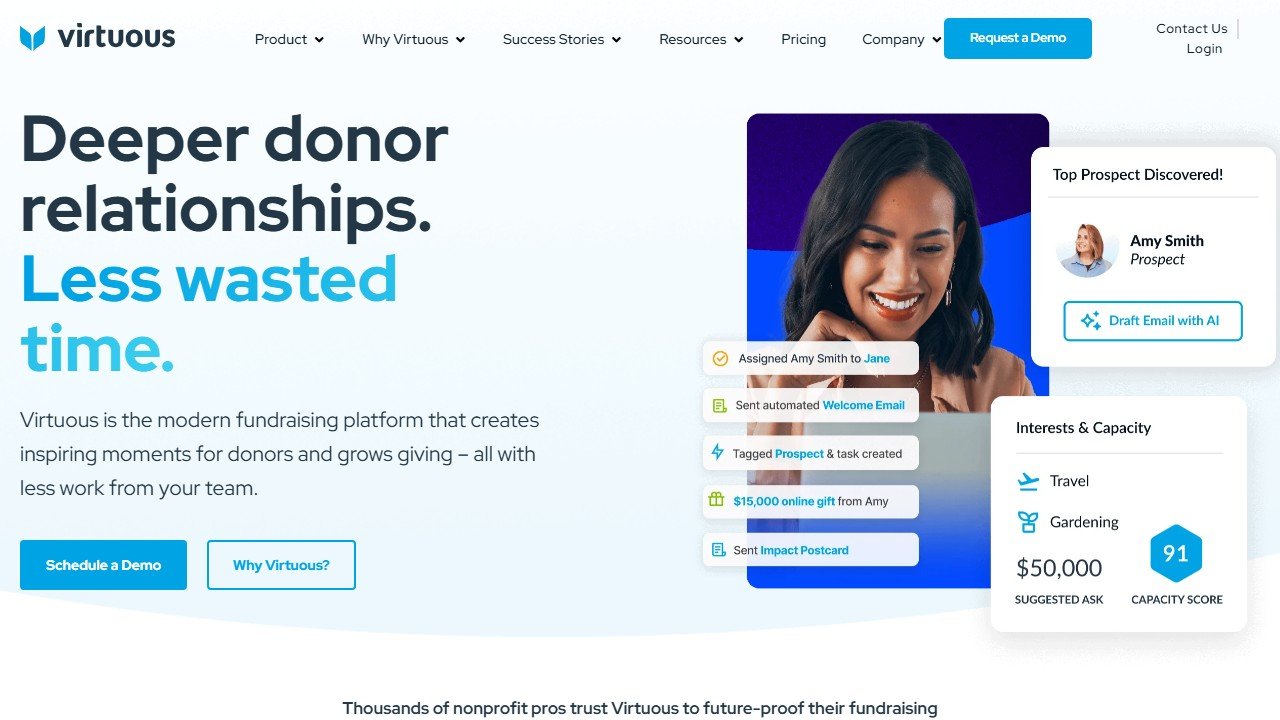
Website: Virtuous CRM
The company’s philosophy, which they call “responsive fundraising,” is the conceptual backbone of the product. Traditional nonprofit CRMs are records systems: you store donor information, log gifts, run reports, and build segments manually. The assumption is that development staff drive all the strategy and the CRM just holds the data.
Virtuous flips that model. The platform continuously monitors donor signals (giving history, email opens, event attendance, website activity, wealth indicators) and automatically triggers personalized engagement actions based on those signals. A donor who opens three emails but hasn’t given in 18 months gets a different communication sequence than a lapsed major donor who just moved. The system acts on those differences without a staff member having to build the segment manually.
This is genuinely differentiated from legacy competitors like Blackbaud’s Raiser’s Edge or DonorPerfect. Those platforms store data and generate reports. Virtuous is designed to take action on the data.
The AI capabilities come from two sources. First, Virtuous Insights, the built-in donor intelligence layer, enriches every donor profile with external data: wealth indicators, demographic information, digital engagement signals, and behavioral patterns. Second, Virtuous Momentum, acquired in August 2025, adds a conversational AI layer that drafts emails, prioritizes your inbox, and builds dynamic engagement plans.
The platform is the product of an aggressive acquisition strategy. Virtuous acquired Momentum (AI engagement tools), VOMO (volunteer management), and RaiseDonors (online giving platform). These acquisitions filled gaps in the product rather than adding redundant features, and the result is a genuinely comprehensive platform.
The company’s traction validates the product: 10,000+ customers, revenue quintupled in three years according to TechCrunch, and $141 million raised. Founded in Phoenix by Gabe Cooper in 2014, Virtuous is a Series C company with 200+ employees. They named Nathan Chappell as Chief AI Officer, making them one of the few nonprofit technology companies with a dedicated C-suite AI executive.
Key Features
Responsive Fundraising Engine
The core of what makes Virtuous different from a standard CRM is its responsive fundraising framework. Rather than quarterly or annual donor segmentation campaigns, the platform runs continuous signal detection on every donor record.
When a signal threshold is met (a lapsed donor’s engagement score increases, a mid-level donor makes a significantly larger gift, a prospect attends an event), the system triggers an automated response. That response can be a task for a gift officer, an automated email, a personalized communication plan, or an alert to development staff.
The practical result is that mid-level donors who might otherwise slip through the cracks between major gift officer attention and mass email campaigns get timely, personalized attention. For orgs with donor lists of thousands, this automation is the difference between reactive relationship management and proactive cultivation.
Virtuous Insights: AI Donor Enrichment
Virtuous Insights automatically enriches every donor profile with external data. This includes wealth screening data (real estate holdings, investment indicators, business affiliations), demographic information, and digital engagement signals.
The AI uses these enriched profiles to score donors on several dimensions: likelihood to give, likelihood to upgrade to a higher giving level, risk of lapsing, and readiness for a major gift conversation. These scores update continuously as new data comes in.
For prospect research, this replaces or supplements expensive standalone tools like DonorSearch (reviewed in the AI donor research tools guide). Having wealth screening data integrated directly into your CRM rather than requiring a separate import process saves meaningful staff time.
Virtuous Momentum: AI Email and Engagement
Momentum, acquired in August 2025, adds a conversational AI layer to the platform. Development staff can describe what they want to say to a donor and Momentum drafts a personalized email. The AI has context on the donor’s history, giving level, recent engagement, and your organization’s tone.
Beyond email drafting, Momentum prioritizes the development staff inbox. Rather than a flat list of tasks and follow-ups, Momentum surfaces the donors most ready for outreach today based on their engagement signals. This helps gift officers focus their limited time on the highest-value conversations.
Momentum also builds what Virtuous calls dynamic engagement plans: suggested sequences of touchpoints for each donor segment based on where they are in the giving journey. These aren’t static templates. They adapt as donor behavior changes.
Marketing Automation
Virtuous includes a full marketing automation engine for email and multi-channel campaigns. You can build segmented email sequences, set up trigger-based automations (welcome series for new donors, lapse prevention sequences, year-end giving appeals), and execute campaigns without switching to an external email platform.
The automation builder is visual and reasonably intuitive for users with some email marketing background. It’s not as powerful as a dedicated tool like Pardot or Marketo, but for the majority of nonprofit marketing needs, it covers the ground.
Unlimited emails included on the base plan.
Online Giving: RaiseDonors Integration
The RaiseDonors acquisition added online giving capabilities to Virtuous. You can create donation pages and embed giving forms on your website without using a third-party platform. The giving pages connect directly to the CRM so donations create or update donor records automatically.
This is functionally similar to what Givebutter offers for forms, but designed as part of a larger CRM ecosystem rather than as a standalone product. For orgs fully committed to Virtuous as their platform, having giving forms native to the CRM is clean and reduces integration complexity.
Volunteer Management: VOMO Integration
The VOMO acquisition added volunteer management. Nonprofits can recruit, schedule, and track volunteers in the same system as their donors. This matters because volunteers are often future donors, and having both datasets in one place enables relationship visibility that isn’t possible when volunteer data lives in a separate system.
Volunteer engagement history feeds into the responsive fundraising engine. A volunteer who attended three events in the last year and hasn’t been asked for a financial gift represents a cultivated prospect. Virtuous can surface this automatically.
Reporting and Analytics
Virtuous includes a built-in reporting engine with dashboards, standard nonprofit metrics (donor retention rate, average gift size, donor acquisition cost, LYBUNT/SYBUNT analysis), and custom report building.
The analytics are more sophisticated than basic CRMs and include some predictive elements through the AI scoring. For orgs that need board-ready reports, the standard dashboard templates are functional.
Deep custom analytics or business intelligence work still typically requires an export to a BI tool like Tableau or Power BI, which Virtuous supports via integrations.
Worth knowing before you ask: Virtuous publishes no prices at all. Its pricing page carries six Contact Us buttons, and its two tiers are split by your annual fundraising revenue at the $5 million line rather than by seats or contacts. It is also six separately priced products, not one. What to ask on the call is in Virtuous pricing.
Pricing Breakdown
| Plan | Monthly Cost | Users | Notes |
|---|---|---|---|
| Platform plan | Not published, quote only | Unlimited | Base features, CRM, marketing automation |
| Higher tiers | Custom pricing | Unlimited | Advanced AI, deeper analytics, more automation |
| Enterprise | Custom quote | Unlimited | Full Momentum AI, dedicated support, advanced features |
| Payment processing | Standard rates | N/A | Passed to donors or absorbed by org |
Virtuous does not publish pricing at all, which is a legitimate transparency complaint. Checked again on 4 September 2026: every product on the pricing page carries a Request Pricing button, and the only dollar figures anywhere on it are the $5 million revenue thresholds that split Platform from Enterprise. An earlier version of this review quoted $199 a month. That figure is no longer verifiable at source, so we have withdrawn it rather than carry it forward. What to ask on the call is in our Virtuous pricing guide.
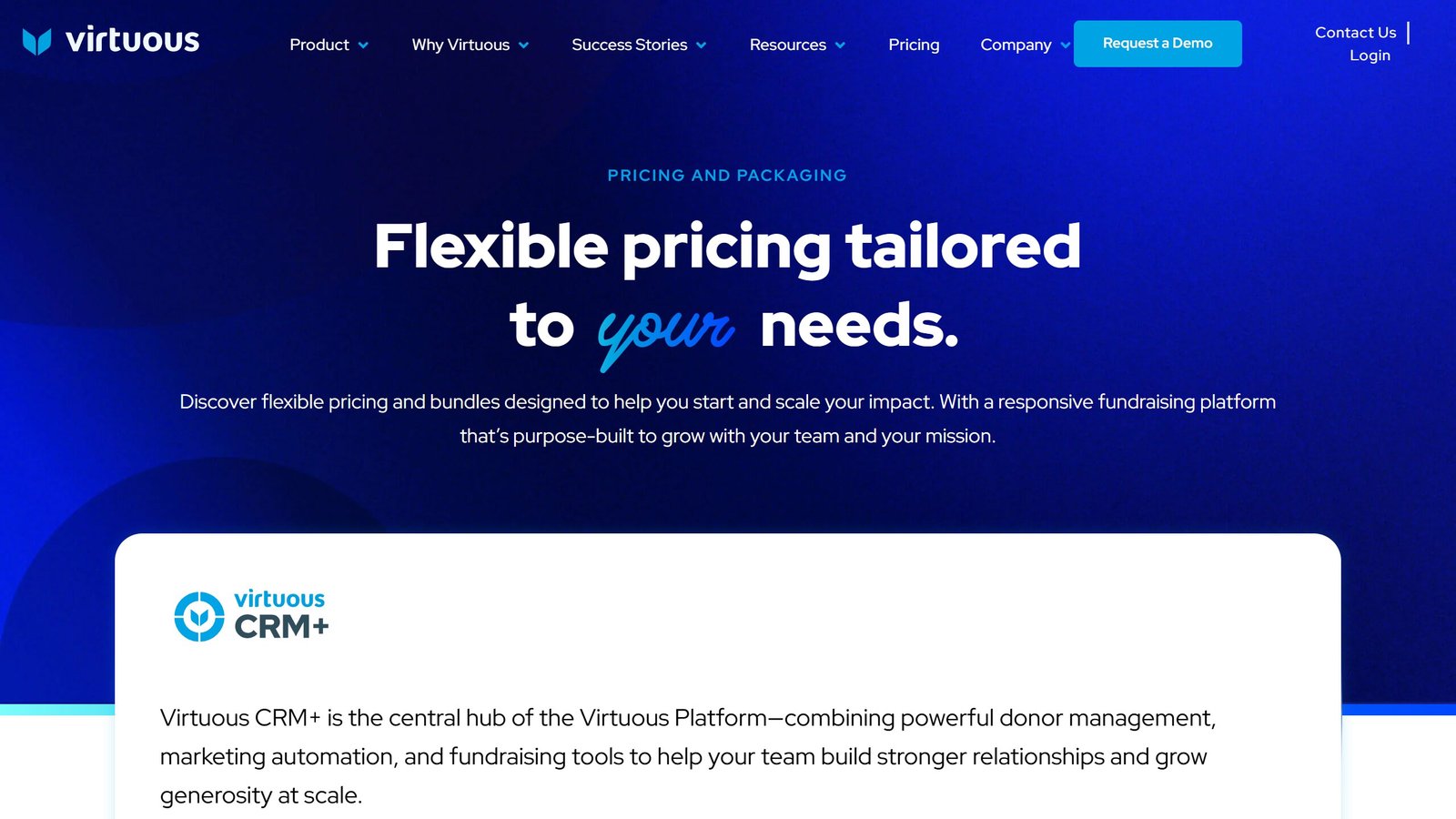
The unlimited users model is a meaningful advantage. Competing enterprise CRMs like Salesforce Nonprofit often charge per seat, which becomes expensive for organizations with large development teams or boards who need CRM access.
Saru’s Pricing Analysis
Virtuous will not tell you what it costs, so the only honest comparison is against vendors that do publish. Checked 4 September 2026:
• Bloomerang now prices by product rather than by record count, from $40/month for Fundraising and $125/month for CRM, billed annually
• Little Green Light from $45/month for up to 2,500 constituents
• Salesforce Nonprofit Cloud: 10 licences free via Power of Us, then $70 per user a month (as of 4 October 2026) billed annually, verified 4 September 2026
• Blackbaud Raiser’s Edge NXT: no published price, quote request form only
Where Virtuous sits against those is the one thing it will not tell you. For an organization raising $1M+ annually, a CRM with unlimited users, marketing automation, AI enrichment and online giving can be worth real money. You just cannot compare it on price until you have had the call.
The ROI calculation depends on the platform actually changing development staff behavior and outcomes. Virtuous claims their responsive fundraising model improves donor retention by 15-20%. For an org with $1M in annual giving and a 65% donor retention rate, a 5-point retention improvement adds $50,000+ in retained revenue. Whether that math works depends on a quote we cannot see, which is the problem.
The risk: the ROI requires your staff to actually act on the AI-generated signals and priorities. A CRM’s intelligence is only as valuable as the team capacity to execute it.
Virtuous is the AI benchmark in this category, but it is not the only CRM investing here. Our roundup of nonprofit CRMs with AI features compares how every major platform’s AI actually performs.
Who This Is For
Virtuous is well-suited for:
Mid-sized nonprofits ($500K-$5M annual revenue) with dedicated development staff (at least one full-time development director or equivalent). The platform’s value multiplies with staff capacity to act on the AI’s recommendations.
Organizations running diverse individual giving programs: a mix of small recurring donors, mid-level donors, and major gift prospects. Virtuous’s segmentation and responsive automation is designed for this complexity.
Nonprofits that want to consolidate their tech stack. If you’re currently using a basic CRM, a separate email platform, a separate volunteer management tool, and a separate online giving platform, Virtuous can replace all of them.
Organizations that are ready for a genuine CRM implementation project. Virtuous requires meaningful setup time (data migration, workflow configuration, staff training). This isn’t a tool you’re live on in a day.
Virtuous is not well-suited for:
Small nonprofits under $500K annual revenue. Virtuous bands its pricing on what you raise, and the implementation complexity is not proportionate at that scale. A free platform like Givebutter, which we cover in our Givebutter review, is the right starting point.
Organizations without dedicated development staff. Virtuous’s AI surfaces donor signals and priorities, but humans need to act on them. If there’s no one to make calls or personalize outreach, the intelligence goes unused.
Organizations expecting quick wins. Implementation takes weeks to months. Data quality cleanup, workflow configuration, and staff training all require time before the responsive fundraising model delivers value.
Organizations primarily focused on major gifts and higher education advancement. Gravyty, which specializes in AI-powered major gift officer workflows, is more targeted for that use case than Virtuous.
Pros
- Most holistic nonprofit platform available: CRM, fundraising, marketing automation, volunteer management, and online giving in one system, after the three acquisitions.
- Genuine AI investment: Appointed a Chief AI Officer (Nathan Chappell) and acquired Momentum specifically for AI capabilities. Not AI-washed, actually building.
- Unlimited users included: No per-seat costs as your team grows, which matters for organizations with large teams or boards needing CRM access.
- Responsive fundraising is differentiated: Real-time donor signal detection and automated response is meaningfully different from passive CRM record-keeping.
- 10,000+ customers validates scale: This is not a niche or emerging product. The customer base represents genuine product-market fit.
- Strong company fundamentals: $141M raised, revenue quintupled in three years, Series C. Institutional commitment to the product is clear.
- Virtuous Insights enriches donor profiles automatically: Wealth screening, demographic data, and engagement scoring built in rather than requiring separate prospect research tools.
Cons
- You cannot find out what it costs without a call: Virtuous publishes no price and establishes your annual fundraising revenue before quoting, which makes it hard to budget for and hard to compare.
- Complex to implement: Data migration, workflow configuration, and staff training require real project management. Organizations without technical capacity or consultant support will struggle.
- Pricing lacks transparency: There is no published price at all, let alone a documented tier structure. You need a sales conversation to understand what the full cost of the features you need will be.
- Overkill for simple operations: If your fundraising is primarily direct mail plus events, you don’t need responsive fundraising AI. The platform complexity would be wasted.
- Higher education and major gift depth trails Gravyty: Virtuous is strong for mid-level and recurring giving but less specialized for the specific workflows of university advancement offices or major gift officers managing portfolios of 50-100 prospects.
- New AI features require validation: Momentum was acquired in August 2025. The integration maturity and real-world performance of the AI email drafting and inbox prioritization is newer than the core CRM functionality.
Faz’s Honest Verdict
The honest version of this review is that Virtuous is an excellent platform for a specific type of nonprofit, and a poor fit for a large number of orgs who might look at the marketing and think it’s for them.
Here’s my litmus test: do you have at least one full-time development director who currently feels like they’re drowning in donor follow-up they can’t keep up with? If yes, Virtuous’s responsive fundraising engine is designed exactly for that problem. It surfaces the right donor at the right moment and reduces the cognitive load on your team.
If you don’t have that problem yet, either because you’re small enough that one person can track everything manually, or because your fundraising is primarily grant-funded, Virtuous is more than you need.
The $141M investment and 10,000+ customers tell me this product works at scale. The three acquisitions tell me the company is filling real gaps rather than resting on a static feature set. And naming a Chief AI Officer tells me they’re serious about AI as infrastructure, not just a feature label.
If you’re a mid-sized nonprofit with individual giving programs and a dedicated development team, book the demo. Just go in knowing that implementation is a project, not a weekend.
Integrations
| Integration | Type | Notes |
|---|---|---|
| Stripe | Payment processing | For online giving via RaiseDonors |
| PayPal | Payment processing | Supported via online giving module |
| QuickBooks | Accounting | Financial data sync |
| Xero | Accounting | Financial data sync |
| Mailchimp | Email marketing | Sync for orgs keeping Mailchimp |
| Constant Contact | Email marketing | Sync available |
| DonorSearch | Prospect research | Wealth screening integration |
| Zapier | Automation | Custom workflow connections |
| Salesforce | CRM migration | Data migration support |
| Google Analytics | Analytics | Campaign and web attribution |
| Social/advertising | Donor acquisition tracking | |
| Twilio | SMS | Text communications |
| iWave | Prospect research | Wealth intelligence integration |
| Wealth Engine | Prospect research | Wealth screening integration |
| Eventbrite | Events | Event attendance data sync |
An alternative worth a look: if you want AI-driven donor intelligence without switching your system of record, Gratefully is a donor-intelligence layer that works on top of your existing CRM, turning scattered donor data into a ranked daily action list with the reason behind each. See our AI tools for donor retention guide.
For the intelligence layer angle on top of this CRM, see our Gratefully vs Virtuous comparison.
Final Verdict
Virtuous CRM earns its 4.3/5 rating because it delivers genuine value for the specific audience it’s built for: mid-sized nonprofits with dedicated development staff that want to move from passive donor record-keeping to AI-powered, responsive engagement.
The score reflects real limitations: the pricing opacity, the implementation complexity, and the fact that the AI value (particularly Momentum, acquired August 2025) is newer and less battle-tested than the core CRM. The platform is also not right for small orgs or organizations without staff capacity to act on what the AI surfaces.
But for the nonprofit raising $1M-$5M annually with an active individual giving program and a development team that’s been manually trying to keep up with donor relationships, Virtuous is the best AI-forward platform in the market at a reasonable price point.
For the broader nonprofit CRM and AI tool landscape, see the best AI fundraising tools for nonprofits guide and the best AI tools for nonprofits pillar. For prospect research tools that complement Virtuous, see the AI donor research tools comparison.
Rating: 4.3/5
Saru’s Data Verdict
The investment data tells a clear story. $141M raised, $100M of that in a single round from Susquehanna Growth Equity in 2024. Revenue quintupled in three years (TechCrunch). 10,000+ customers. Three strategic acquisitions.
This is a company executing well, not a startup running on funding runway. The customer count and revenue trajectory both validate product-market fit.
The 4.3/5 score is held back by two data-driven concerns. First, the pricing opacity: a CRM in 2026 that doesn’t publish feature tiers on its pricing page is a friction point for the informed buyer. Second, the Momentum acquisition was August 2025. That’s recent. The AI email drafting and inbox prioritization capabilities are real, but they haven’t had two to three years of market validation the way the core CRM has.
For nonprofits in the target segment, the ROI math is favorable. Improved donor retention by even a few percentage points on a $1M fundraising program returns multiples of the platform cost. The question is implementation quality and staff adoption, neither of which a review can guarantee.
Rating: 4.3/5
References & further reading
For deeper data and primary sources on nonprofit fundraising and donor research:
- Candid (Foundation Center + GuideStar). authoritative nonprofit financial and grant data, the source most donor-research tools build on
- M+R Benchmarks Study. annual fundraising performance benchmarks across email, advertising, web, and donor metrics
- Nonprofit Quarterly. investigative reporting on nonprofit operations, governance, and fundraising effectiveness
More AI tool guides worth reading: DonorPerfect Pricing 2026, Bloomerang Pricing 2026 and Submittable Review 2026.
Tools mentioned in this guide

Written by
FazFaz is the founder of AIToolsBakery. Some tools here are tested hands on. Others are assessed from vendor documentation and pricing verified on the live page, and every review says which one it is. Sponsors can buy a position in a guide. They cannot buy the score, the criticism, or silence about a better option.
How we test and how we make money →