Here’s a scenario that’s playing out at foundations right now. A program officer opens the fifth proposal of the morning. It starts with a sentence like: “In today’s rapidly evolving landscape, nonprofit organizations face unprecedented challenges in addressing critical community needs.” They’ve seen that exact sentence, or a close variant of it, four times already today.
Funders are getting better at recognizing AI-generated grant proposals. Not because they’re running detection software (most aren’t), but because AI-written copy has tells: overly formal transitions, generic impact language, statistics that don’t quite match the described program, a voice that sounds like no actual human who works at your org.
The problem isn’t that nonprofits are using AI to write grants. The problem is they’re using it badly, treating it as a replacement for original thought rather than a tool that accelerates the thinking and writing they were already going to do.
This guide is about using AI the right way for grant writing. That means understanding what AI can and genuinely cannot do in this context, building a workflow that produces proposals funders actually want to read, and knowing how to inject your organization’s real voice into AI-assisted work so it doesn’t read as generic.
Saru’s Context: Where the Sector Actually Stands on AI and Grant Writing
The data on funder attitudes toward AI is scattered and evolving, but here’s what we know as of 2026:
Only about 15% of foundations have published written AI guidelines for grant applicants, according to the Virtuous/Fundraising.AI 2026 sector report. That means the vast majority of funders haven’t told you whether they care.
Of those who have addressed it, the approaches vary widely. NIH has issued guidance specifically stating that AI tools cannot be listed as authors on grant applications, and that researchers are responsible for the accuracy of all submitted content. The NSF has similarly noted that use of AI does not transfer responsibility for accuracy.
The key word is responsibility. Funders who have spoken on AI are not saying “don’t use it.” They’re saying: you are accountable for everything in that application. If the AI hallucinates a statistic, the liability is yours. If the AI misrepresents your org’s capacity, the liability is yours.
On the practical side: 68% of nonprofit grant writers cite time as their primary grant-seeking challenge, and the average foundation grant takes 15 to 20 hours to write. Federal grants run 100+ hours. AI tools have been shown to reduce writing time by 50 to 70% for experienced users. Average grant proposal success rates sit between 10% and 30%, which means the volume of applications matters as much as quality. AI makes higher volume achievable.
Last updated: April 22, 2026.
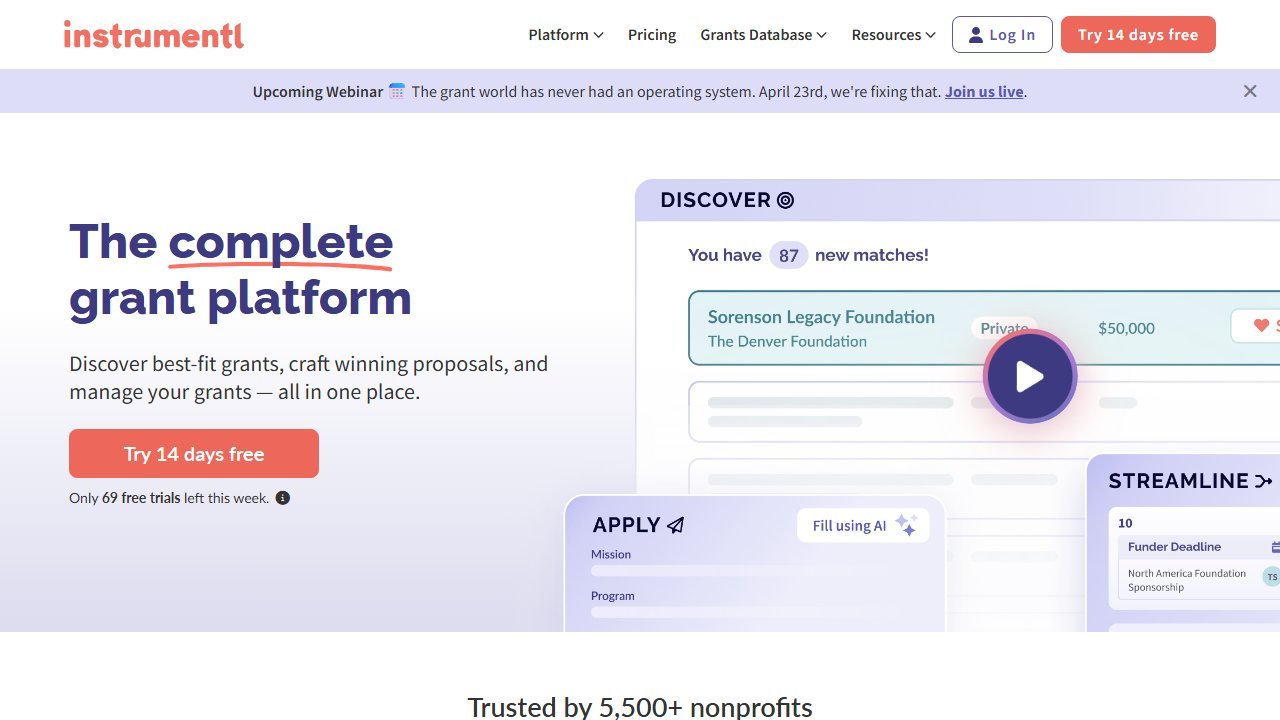
Related: See also: Best AI grant writing tools 2026 | Grantable review | Instrumentl review
What AI Can and Can’t Do for Grant Writing
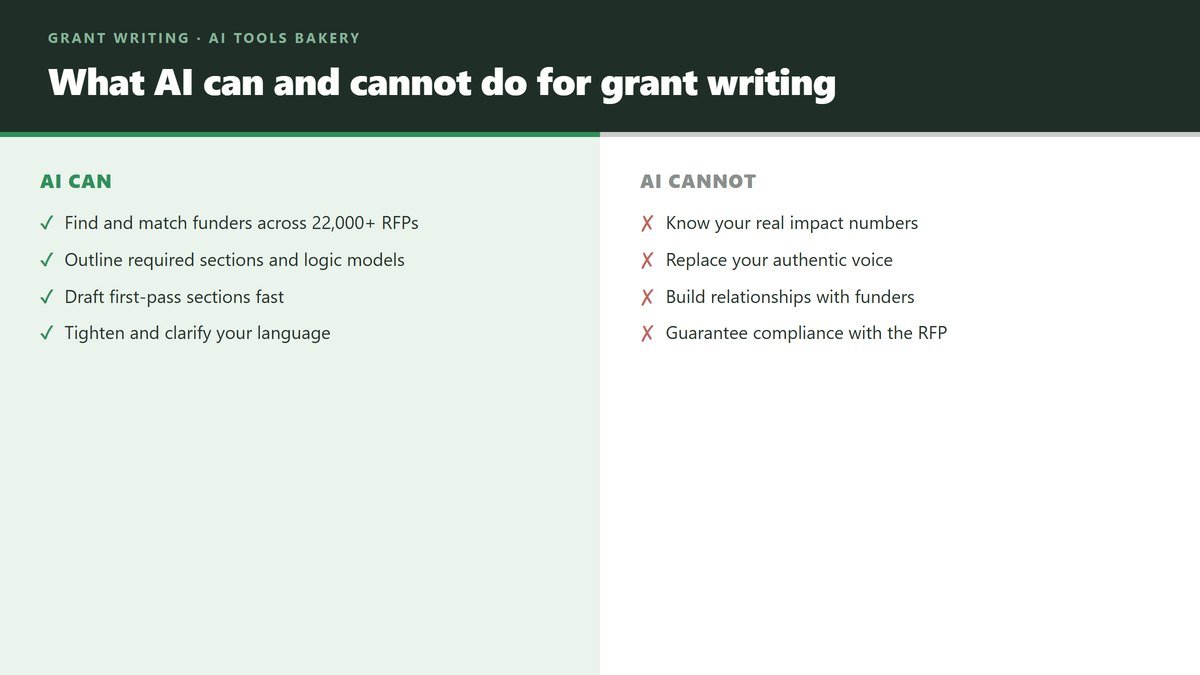
Being honest about the boundaries here saves a lot of frustration. AI tools are genuinely transformative for some parts of grant writing and genuinely useless (or harmful) for others.
What AI Can Do Well
Research and funder discovery. Tools like Instrumentl, Grantable, and Granted AI can search databases of tens of thousands of foundations and match your org’s profile to relevant funders in minutes. This kind of research would take hours manually, and even dedicated grant researchers miss opportunities simply because they can’t read 22,000 RFPs.
Structural guidance. AI can tell you what sections a particular type of grant proposal typically requires, how to structure a logic model narrative, what federal grant formats expect, and what evaluation frameworks look like. This is especially useful for grant writers tackling a new type of funding for the first time.
First draft generation. Given your org’s mission, program description, impact data, and the funder’s guidelines, AI can produce a coherent first draft of proposal sections in minutes. This is not a finished draft. It is a starting point that saves you the hardest part of writing: the blank page.
Editing and tightening. AI is excellent at reducing a 1,000-word narrative to 500 words without losing key content, improving sentence structure, identifying passive voice, and flagging vague language. This is one of the highest-value uses because proposal sections almost always have strict word or character limits.
Word and character count compliance. Grant applications routinely limit sections to specific word or character counts. AI can rewrite your narrative to fit within those limits while preserving the key points.
Research synthesis. If you need to summarize the research base supporting your program model, AI can synthesize literature quickly. Be careful here: always verify citations. AI hallucinates sources. Every statistic an AI provides must be independently confirmed before it goes in a grant application.
Funder tone matching. Some AI grant writing tools (Grantable, Granted AI) can analyze a specific funder’s previous grants and published priorities and adjust the tone and framing of your proposal to match what they respond to.
What AI Cannot Do
Know your real impact data. AI cannot tell you how many people your program actually served, what percentage achieved the target outcome, or what the baseline was before your intervention. If you don’t have this data, no AI tool creates it. And if you put fabricated or generic impact numbers in a grant proposal, that’s a serious problem.
Replace your org’s authentic voice. Every organization has a voice shaped by its founders, its community, and its history. That voice is what makes a proposal feel like it comes from a real organization with real relationships in a real place. AI output is generically competent. It is never distinctively yours without significant human editing.
Build funder relationships. The relationship between a grant writer and a program officer at a foundation is one of the strongest predictors of long-term grant success. AI doesn’t attend conferences, doesn’t respond to annual reports, doesn’t remember that the program officer’s area of interest shifted after they returned from a fellowship. Relationships are still human.
Evaluate fit accurately without your input. AI funder matching is excellent for identifying candidate funders you might not have found. It is not infallible at evaluating whether your org is truly a fit. The “why they match” explanation needs human review because AI can over-match based on keyword overlap.
Write federal grants without substantial expertise. Federal grant applications (SAMHSA, HUD, USDA, DoED) have specific formatting, scoring, and compliance requirements that AI tools have varying ability to handle. AI can help with narrative sections, but federal grants require experienced human oversight of the full application.
The 5-Step AI Grant Writing Workflow
This is the workflow that produces proposals funders actually want to read, using AI to accelerate the parts where it genuinely helps without letting it substitute for your judgment.
Step 1: Gather Your Org Materials Before You Write Anything
AI grant writing tools are only as good as the context you give them. The single most common mistake grant writers make with AI is prompting with vague information and then being disappointed by generic output.
Before you write a single word of a proposal, assemble the following and have it ready to paste into your AI tool:
Mission and vision. Your formal mission statement plus a 2-3 sentence description of what makes your approach distinct.
Program description. A clear, specific description of the program you’re seeking funding for. Not a vague category (“youth programs”) but a specific description (“10-week after-school STEM program for middle schoolers in grades 6-8, serving 40 students per cohort at our East Side location”).
Impact data. Every real outcome measurement you have: number served, completion rates, pre/post assessments, follow-up data at 6 and 12 months, comparison to baseline or control group if available. Even incomplete data is better than no data.
Budget information. Total program budget, how the requested grant would be used, other revenue sources for the program, and any cost-per-participant calculations.
Organizational capacity. Years in operation, staff size, total organizational budget, any relevant accreditations, partnerships, or network affiliations.
Past grants in this area. If you’ve received similar funding before, what were the outcomes? What would you do differently?
This sounds like a lot, but if you maintain an “org profile” document and keep it updated, this step takes 20 minutes. Many grant writers create a standing document in Notion or Google Docs that covers all of this and update it after each reporting cycle.
Step 2: Use AI for Funder Discovery First
Before you write anything, make sure you’re applying for the right grants.
The biggest time waste in grant writing is submitting a well-written proposal to a funder who was never going to fund your work. AI-powered discovery tools dramatically reduce this by pre-screening for fit.
Instrumentl is the market leader here, with 22,000+ active RFPs and 250+ new opportunities added weekly by an in-house team. It’s priced at $179/month and up, which is justified for active grant-seeking organizations. See our Instrumentl review for the full breakdown.
Grantable combines discovery (130,000+ foundations) with writing in one platform and starts at $50/month for the Pro tier. It’s the better option if you want discovery and writing in the same tool. See our Grantable review for detailed analysis.
Granted AI covers 133,000+ foundations and reads full RFP documents to identify required sections automatically.
When you get funder matches, read the actual funder guidelines. AI matching identifies candidates; you still need to evaluate whether the fit is real by reading their priorities and recent grantees.
Step 3: Feed the AI Your Org Profile, Not Generic Prompts
This is where most AI grant writing attempts fail. A prompt like “write a grant proposal for an after-school program” will produce generic, unusable output. A prompt with full context produces a genuinely useful first draft.
Effective prompts for grant writing include:
- Your full org profile (mission, program description, impact data, capacity)
- The specific funder’s priorities and guidelines (paste them in)
- The specific section you’re generating (needs statement, program description, evaluation plan)
- Any requirements for format or word count
- Instructions for tone and specificity (“avoid generic language about community need, use our specific data”)
Here’s the difference:
Weak prompt: “Write a needs statement for a youth workforce development grant.”
Strong prompt: “Write a needs statement for a grant from [Funder Name], whose stated priority is workforce development for youth 16-24 in under-resourced communities. Our program is [specific description]. Our service area is [specific location]. The unemployment rate for youth 16-24 in our zip code is [X%] compared to [Y%] citywide. We served [N] young people last year, with [X%] gaining employment within 90 days of program completion. The funder requires a 500-word needs statement. Do not use generic language about youth unemployment nationally; focus on our specific community and our documented outcomes.”
The second prompt gives the AI what it needs to produce something fundable.
Step 4: Use AI for First Drafts of Individual Sections, Not Complete Proposals
Even with excellent prompts, AI should generate sections, not complete proposals. A complete proposal generated in one pass will be internally inconsistent, skip funder-specific details, and require so much editing that you’ve lost the time savings.
Instead, generate each major section separately:
- Executive summary / project abstract
- Needs statement / problem statement
- Project description / program narrative
- Goals, objectives, and activities
- Evaluation plan
- Organizational capacity / organizational history
- Budget narrative (outline only; numbers require human accuracy checking)
For each section, generate, review, and substantially edit before moving to the next. This gives you more control over coherence and accuracy.
If you’re using a dedicated tool like Grantable or Grantboost, their section-by-section workflow is designed for exactly this. Grantboost’s word/character count controls per section are particularly useful for fitting funder-specific limits.
Step 5: Rewrite, Inject Voice, Verify Every Fact
This step is non-negotiable. The AI draft is a scaffold. The finished proposal requires:
Injecting your org’s authentic voice. Read the draft out loud. If it sounds like it could have come from any nonprofit in the country, it’s not done. Add the specific language your team uses, the specific community context that only you know, the honest account of what happened when you tried something similar before.
Adding real donor/client stories. Program officers at foundations read hundreds of proposals. The ones that stand out almost always include a specific, human story, a real person whose situation was different because of your program. AI cannot invent this. You have to provide it.
Verifying every statistic and citation. Every number in an AI-generated draft must be independently verified before submission. AI hallucinates sources. It cites real-sounding studies that don’t exist. It quotes statistics that are close to real data but not accurate. If you can’t verify a number from a real source, remove it.
Checking accuracy of org-specific claims. AI sometimes confuses details from different parts of your provided context. Check that the program description in your narrative matches your actual program, that the budget narrative matches your actual budget, and that the evaluation plan describes evaluation methods you can actually implement.
Faz’s Take: The Copy-Paste Problem
I want to be direct about something I see constantly: nonprofit staff using AI output as final copy without meaningful editing.
It doesn’t work. Not because funders are running AI detectors (most aren’t). It doesn’t work because the output is generic in ways that matter. It talks about “addressing the root causes of systemic challenges” without saying what your specific root cause is. It describes “evidence-based programming” without naming your actual evidence base. It expresses commitment to “sustainable impact” without explaining how your program model continues after the grant ends.
Program officers at foundations review hundreds of proposals. They have developed excellent pattern recognition for copy that sounds confident but doesn’t actually say anything specific. That’s what unedited AI grant copy sounds like.
The goal isn’t to produce AI-free proposals. The goal is to produce proposals that sound like they were written by someone who deeply knows your program, your community, and this funder’s priorities. AI can get you to a first draft in 20 minutes. Getting from that draft to something that sounds like it came from a human expert who cares about this work: that part still requires you.
The shortcuts you take at 11pm the night before the deadline are the shortcuts that get you rejected.
Tool-Specific Workflows
Using Grantable for Discovery and Writing
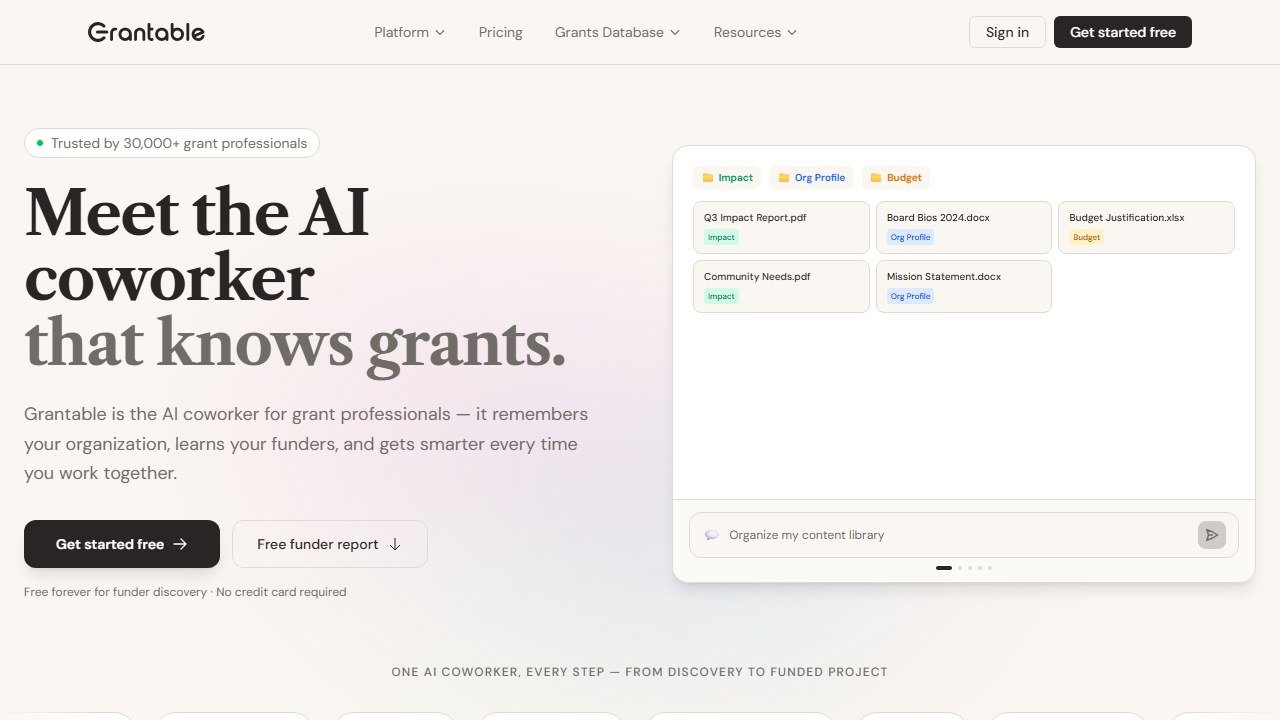
Grantable is the best all-in-one option for grant writers who want both discovery and writing in one platform. Here’s how to use it effectively:
- Build your org profile. Grantable maintains organizational memory across sessions. Invest 30 minutes setting up your profile with your mission, programs, impact data, and past funding history. This is what makes the tool more useful over time.
- Run funder discovery. Use Grantable’s 130,000+ foundation database to find matching funders. Review the “why they match” explanations critically; some matches are better than others.
- Create a grant project for each active application. Link the funder, attach any RFP or guidelines documents, and note the deadline.
- Generate section drafts. With your org profile loaded and funder guidelines attached, generate individual sections. The AI has context it needs without you re-prompting each time.
- Edit substantially. Apply the voice, story, and accuracy checks described in Step 5 above.
Grantable’s free tier includes basic discovery. The $50/month Pro plan unlocks the full AI writing layer. For grant-active nonprofits, this is the most cost-effective full-service option. See our Grantable review and our Grantable vs Instrumentl comparison for more detail.
Using Grantboost for Section Generation
Grantboost is a simpler, more focused tool for generating individual grant proposal sections. Its strengths are the word/character count controls (you tell it the limit; it fits the output) and the lower price ($19.99/month Pro, 40 free boosts on the free tier).
Effective Grantboost workflow:
- Upload your org documents (mission statement, program description, impact data) in the document upload field.
- Select the template that matches your section type (needs statement, program description, evaluation plan).
- Set the required word or character count.
- Configure brand and tone settings if you want consistent voice across sections.
- Review and edit output. Grantboost is particularly good at the structural elements; you’ll add specifics and voice.
The free tier’s 40 boosts per month is sufficient for small nonprofits submitting two or three applications monthly.
Using Granted AI’s Review Board
Granted AI has a distinctive feature called the Review Board: six independent AI reviewers, each specialized (domain expert, biostatistician, program officer, equity reviewer, budget analyst, skeptic) who evaluate your proposal independently, then deliberate to produce consensus-ranked findings.
This is genuinely valuable for federal and research grants where proposal quality needs to hold up against a real review panel. Using it effectively:
- Complete your draft using any process.
- Submit the full draft to the Review Board.
- Read the consensus findings carefully. The “skeptic” reviewer is particularly useful for surfacing weak claims and unsupported assumptions.
- Revise based on the findings before submission.
The Review Board costs more (Professional plan at $89/month or $57/month annual), but for large federal grants where the cost of a weak submission is enormous, the review investment makes sense. The money-back guarantee (win a grant in 12 months or full refund) is unusual and reflects confidence in the product.
The Disclosure Question: Should You Tell Funders You Used AI?
This is one of the most common questions grant writers ask in 2026, and the honest answer is: it depends on the funder, and the guidance is still evolving.
What Major Funders Have Said
NIH has issued guidance stating that AI tools may not be listed as authors or co-investigators on grant applications, and that the researcher takes full responsibility for all content, including content generated with AI assistance. NIH doesn’t prohibit AI use in writing assistance; it just makes clear that the investigator is accountable for accuracy. See NIH’s guidance on AI in grants.
NSF has similarly noted that use of AI does not reduce the applicant’s responsibility for the accuracy and integrity of the application.
For foundation grants (private/family/community foundations), the landscape is far less clear. Only 15% of foundations have published AI policies. Of the 85% that haven’t: most likely have opinions but haven’t formalized them.
The Honesty Argument
The case for proactive disclosure is straightforward: if a funder asks about AI use after submission or after award, you want to have been transparent. Some program officers appreciate knowing that you used AI for structural assistance while all specific claims are original and verified.
The practical approach many experienced grant writers use: if the funder has a specific AI policy, follow it. If they don’t, don’t proactively call out your AI usage but don’t misrepresent it either. If directly asked, be honest.
The Authenticity-First Approach
Rather than framing this as “should I disclose AI?”, the more useful question is: “Would a program officer reading this proposal believe it came from someone who knows this program and community deeply?”
If yes: you’ve used AI as a tool while maintaining authentic authorship. The disclosure question is secondary.
If no: you have an editing problem that disclosure won’t fix.
The authenticity-first approach keeps your focus on what actually matters, producing a proposal that represents your organization accurately and compellingly, rather than on managing perceptions about your process.
Saru’s Data: What Actually Predicts Grant Approval
The data on grant success factors is more useful than most grant writing advice acknowledges.
From Instrumentl’s analysis of funded proposals and from sector research:
Prior relationship with funder: The single strongest predictor of grant success is whether the organization has an existing relationship with the program officer or has previously received funding from that funder. AI cannot create this. It can only help you communicate well once the relationship exists.
Geographic and mission fit: Proposals that match the funder’s stated geographic focus and program priorities are funded at dramatically higher rates than proposals stretching to create fit. AI discovery tools help identify better-fit funders, which indirectly improves success rates more than any writing optimization.
Specific, measurable outcomes: Funded proposals almost universally include specific, measurable outcomes with clear data collection plans. Vague outcomes (“improved community wellbeing”) consistently underperform specific ones (“65% of participants will achieve grade-level reading proficiency as measured by pre/post assessments”).
Budget reasonableness: Proposals where the cost-per-outcome is clearly articulated and reasonable for the program type are funded at higher rates. AI can help you build the budget narrative once you have the numbers.
What doesn’t predict success as strongly as people think: Writing quality beyond basic clarity. A well-organized, clear proposal in plain language outperforms flowery AI prose every time. Funders value substance over style.
The time savings from AI (50-70% reduction in drafting time) matters most because it allows organizations to apply for more grants. If your average success rate is 15-20%, submitting 10 applications instead of 4 because AI makes the process faster may do more for your grant revenue than any improvement in individual proposal quality.
Common AI Grant Writing Mistakes (and How to Avoid Them)
Mistake 1: Using Vague Prompts
Already covered in the workflow, but worth repeating. The quality of AI grant writing output is almost entirely determined by the quality of your prompt. “Write a grant proposal” produces garbage. A full prompt with org context, funder requirements, and specific output instructions produces a usable draft.
Fix: Keep a standing org profile document and paste it into every grant writing prompt. Never start a new session without providing full context.
Mistake 2: Not Verifying Statistics
AI tools confidently cite statistics that don’t exist. This is one of the most dangerous failure modes in grant writing because inaccurate statistics can damage your credibility with funders, especially those who research claims.
Fix: Every number in an AI-generated draft must be traced to an actual source before submission. If you can’t find the source, replace the statistic with one you can verify. Keep a document of verified statistics for your program area so you have reliable numbers to pull from.
Mistake 3: Submitting the First Draft Without Substantial Editing
The AI draft is a starting point. Submitting it without meaningful editing is the primary reason AI-assisted grants get rejected on voice and authenticity grounds.
Fix: Budget time for editing. If AI cuts your drafting time from 4 hours to 1 hour, use the saved 3 hours for editing, not for starting the next grant. The editing phase is where your proposal becomes genuinely good.
Mistake 4: Using the Same AI Content for Multiple Funders
One of the most common shortcuts: generating proposal sections once and submitting them to multiple funders without funder-specific editing. Funders are experienced at recognizing generic content. Program areas that appear to have been mass-produced are penalized.
Fix: Every submission needs funder-specific customization. Use AI to generate a fresh draft tailored to each funder’s stated priorities, geographic focus, and grant requirements. The re-prompting takes 20 minutes. It’s worth it.
Mistake 5: Over-Relying on AI for Federal Grants
Federal grant applications (NSF, NIH, HUD, USDA, SAMHSA, DoED) have specific formatting, scoring criteria, and compliance requirements that go well beyond what AI grant writing tools handle well. Federal grants are scored against explicit criteria by multiple reviewers; every section has a specific purpose and scoring rubric.
Fix: Use AI for narrative drafts in federal grants, but the process should be led by someone experienced with federal grants who understands the specific program’s priorities, the scoring criteria, and the compliance requirements. AI helps with drafting; human expertise governs the strategy.
Mistake 6: Treating AI as a Substitute for Funder Research
AI tools can identify potential funders and summarize their priorities. They cannot replace reading recent annual reports, reviewing actual grantee lists, and understanding the current program officer’s area of focus.
Fix: Use AI for discovery and initial research, then do human-level due diligence on your top 5 to 10 funder prospects before applying. A call or email to the program officer before submitting (when the funder allows it) is still one of the highest-return investments in grant seeking.
Faz’s Take: What Makes a Grant Proposal Human Even When AI Helped Write It
There are specific elements that tell me a proposal was written by a human who actually knows the work, regardless of whether AI assisted.
A real story in the first person. Not “program participants experience improved outcomes.” Something like: “When Marcus walked into our program in September, he hadn’t been in school consistently for two years. By March, he was enrolled in community college and passing his placement tests.” That story can’t be generated by AI. It has to come from your files, your staff’s memory, your relationships.
Specific local context. Not “our community faces significant economic challenges.” Something like: “In ZIP code 77023, median household income is $32,000, 28% of children live below the poverty line, and the nearest full-service grocery store is 4.2 miles away.” Specific facts rooted in a specific place signal authentic knowledge.
Honest acknowledgment of limitations. The best proposals I’ve read acknowledge where the program hasn’t achieved what it set out to achieve and what the organization learned from that. AI never generates admissions of limitation. Real organizations have them.
Language that matches your actual voice. If your org writes everything in plain language and your AI-generated proposal uses phrases like “using stakeholder synergies to catalyze systemic transformation,” the mismatch is immediately obvious to anyone who has read your previous submissions.
None of this requires avoiding AI. All of it requires treating AI as a drafting assistant rather than an author.
Pulling It Together
AI is not going to write your grants. It is going to help you write them faster and better, if you use it as a tool that accelerates your thinking rather than a substitute for it.
The nonprofits seeing the best results from AI grant writing are the ones that invested 30 minutes setting up proper org profiles, learned to write prompts that give AI actual context, built editing into their workflow as a non-negotiable step, and kept responsibility for accuracy where it belongs: with the human who knows the program.
Start with the tools you already have access to. ChatGPT and Claude free tiers, used with strong prompts, can meaningfully cut your grant writing time today. When you’re ready to invest in dedicated grant writing tools, Grantable, Grantboost, and Granted AI each have distinct strengths depending on your volume and needs.
For a full comparison of dedicated AI grant writing tools, see our best AI grant writing tools guide. For the broader toolkit available to nonprofits, see our best AI tools for nonprofits overview.
Deep-dive reviews of grant writing tools mentioned
For honest, in-depth reviews of the individual tools referenced:
- Grantable review, the AI grant writing tool tested on 12 real grant applications
- Instrumentl review, the foundation prospect research platform tested on 200 funders
For a closer look, see our AI donor research tools.

Written by
FazFaz is the founder of AIToolsBakery. Some tools here are tested hands on. Others are assessed from vendor documentation and pricing verified on the live page, and every review says which one it is. Sponsors can buy a position in a guide. They cannot buy the score, the criticism, or silence about a better option.
How we test and how we make money →