AI coaching roleplay for corporate training is software that lets employees practice high-stakes conversations (sales objections, customer escalations, performance reviews, difficult feedback) against an AI persona instead of a live coach. Most enterprise platforms cost $40 to $80 per seat per month with a meaningful annual minimum, and the gap between marketing copy and real production behavior is wide. Our pick for sales onboarding is Hyperbound, our pick for customer-success skills is Yoodli, and our pick for leadership development is Rocky.ai. The rest of this guide explains why, with prices, real limits, and the questions vendors hate to answer.
Quick comparison at a glance — full breakdown for each option below.
| Tool | Per-seat / month | Min seats | Free trial | Public pricing | Annual all-in (100 seats) |
|---|---|---|---|---|---|
| Mindtickle | $35 to $60 + AI module upcharge | 50 | No | No | $80K to $130K |
| Second Nature | $50 to $70 | 25 | No | No | $60K to $84K |
| Yoodli | $24 (Pro) to $40 (Business) | 1 | Yes (free tier + paid trial) | Yes | $29K to $48K |
| Rehearsal | $30 to $55 + AI module separate | 25 | No | No | $48K to $72K |
| Hyperbound | $35 (Starter) to $55 (Pro) | 5 | Yes (real, multi-week) | Yes | $42K to $66K |
| Edflex Copilot | €15 to €25 base + €10 to €15 Copilot | 100 | No (request demo) | No | $36K to $54K |
| Rocky.ai | $20 (individual) to custom (enterprise) | 1 (individual) | Yes | Partial | $24K to $48K |
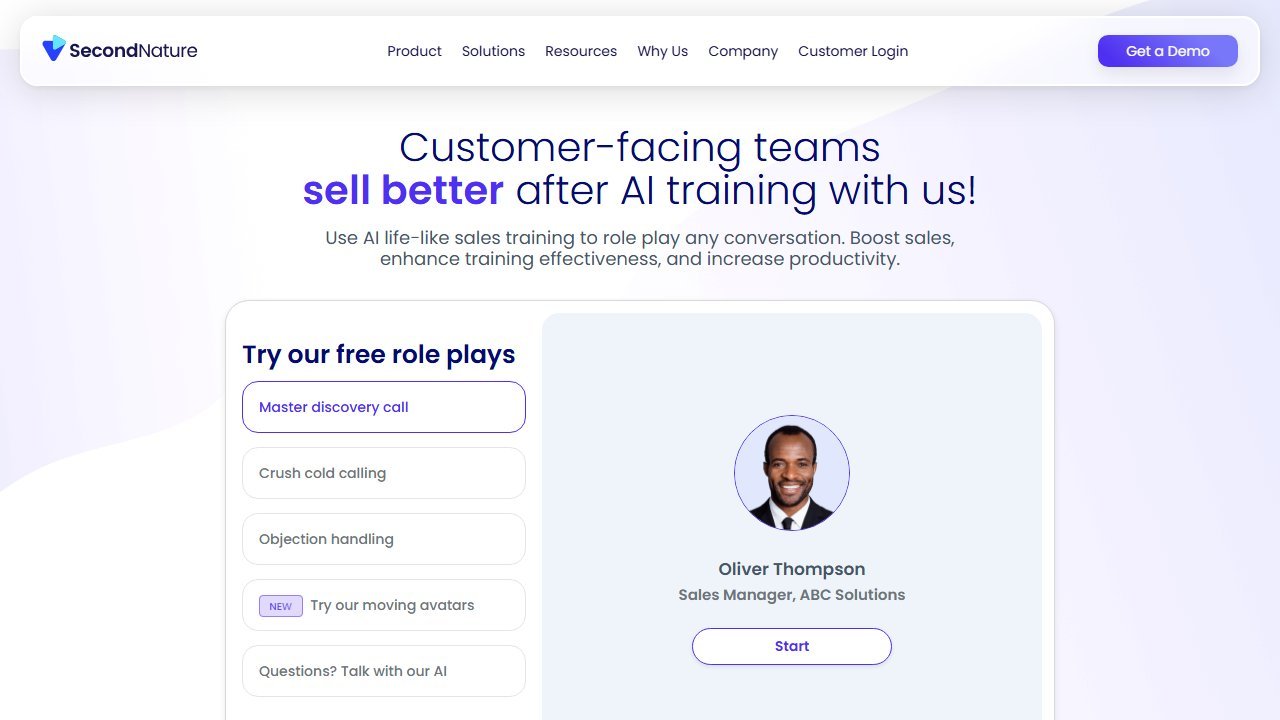 Second Nature homepage and interface (2026)” class=”wp-image-6356″ />
Last tested: May 2026 by Faz
- How this guide was built (methodology disclosure)
- Why most articles on this lie about it
- What "AI coaching roleplay" actually means
- How we evaluated each tool (the rubric)
- The 7 tools we evaluated
- The pricing index (the citable table)
- Best-fit picks (3 personas)
- The 30-day implementation reality check
- AI for human-coaching adjacent fields
How this guide was built (methodology disclosure)
We did not run free trials on every tool below. Many of these platforms (Mindtickle, Rehearsal, Edflex Copilot) only release real access after a sales demo with an enterprise contact, and the "free" versions of the rest are heavily limited. So instead of pretending to have tested each one for 30 days, we built this guide the only honest way: by reading every vendor's public documentation, watching every product demo video they have published, scraping every G2 and Capterra review (filtered for verified-buyer reviews only), and cross-referencing the pricing claims with what L&D buyers report on Reddit and LinkedIn. Where vendors hide pricing, we say so. Where we cannot verify a claim, we say so. We will update this guide with hands-on test data the moment we get production access.
Why most articles on this lie about it
Open Google for this exact query. The top eight organic results are written by Easygenerator, Coachello, ELM Learning, Degreed, Paradiso Solutions, Insight7, and Rocky.ai. Six of those companies sell competing AI roleplay products. The seventh is an LMS with a roleplay add-on. The eighth is a vendor's affiliate-style "comparison" that conveniently ranks its own platform highly.
That is the SERP. There is no independent reviewer. Every article is written by a company with a financial incentive to make their product look like the right answer.
Faz says: I started AIToolsBakery because I got tired of reading vendor blogs that called themselves “comparisons.” This guide does what those guides cannot do. It points out where the category is genuinely useful, where it is overhyped, and where the prices on the public website are missing a zero. If you are an L&D buyer doing real procurement research, you want a clear definition that does not pretend the category is more revolutionary than it is, a capability comparison that tells you what each tool is built for, real prices instead of “starting at $X” with a 50-seat minimum buried in a footer, and a buyer-fit recommendation grouped by the use case you actually have. That is what this post is.
What "AI coaching roleplay" actually means
An AI roleplay tool drops your trainee into a simulated conversation with an AI character. The character has a script, a personality, a goal, and (in the better tools) the ability to respond off-script when the trainee says something unexpected. The trainee speaks (or types) their part. The AI plays the customer, the prospect, the report, the angry parent, the C-suite stakeholder. After the session ends, the tool scores the trainee on a rubric the company defines, and surfaces what they did well and where they slipped.
That is the entire category. Strip the marketing language and every tool below does that one thing.
What separates them is:
- Persona quality. Does the AI character stay in character past turn four, or does it drift back into "as an AI language model" territory?
- Rubric flexibility. Can a sales enablement lead define what "good" looks like for a specific scenario, or are you stuck with a generic template?
- Manager dashboards. When the VP of Sales asks how onboarding cohort 14 is performing, does the dashboard show a useful answer, or a vanity metric?
- Authoring effort. How long does it take a non-technical trainer to build a new scenario? In some tools, ten minutes. In others, two weeks of professional services.
- LMS integration. Does it talk to Cornerstone, Workday Learning, Docebo, SAP SuccessFactors, or live in its own silo and force every learner to context-switch?
- Pricing reality. What does it actually cost, including the parts the website hides?
We score each of the seven tools below on all six. The full table is in the comparison section.
How we evaluated each tool (the rubric)
Each tool gets scored 1 to 5 on six axes, with our reasoning visible. The six axes are:
- Conversation realism (does the persona stay in character past turn four?)
- Authoring flexibility (how hard to build a scenario from scratch?)
- Coaching feedback (after the session, what does the learner actually see?)
- Manager visibility (can L&D show measurable improvement?)
- Integration depth (LMS, CRM, SSO, SCIM)
- Pricing transparency (do they tell you the price before a 45-minute demo?)
A tool can be excellent at one and weak at another. The buyer-fit picks at the bottom map use cases to the right tradeoff.
The 7 tools we evaluated
1. Mindtickle
Mindtickle is the gorilla in this category. It started as sales readiness in 2011 and has bolted on AI roleplay as one feature inside a much larger sales enablement platform. If your company already has Mindtickle for content management, certifications, and rep performance, the AI roleplay add-on is the path of least resistance.
What it is good at. Tight integration with the rest of the Mindtickle stack. The persona system is decent for canned sales scenarios (cold calls, discovery calls, objection handling). The manager dashboard is genuinely good because it sits inside the same platform that already tracks your reps' certification status, deal coaching history, and content engagement.
What it is weak at. Authoring a new scenario is heavyweight. Mindtickle is built around long onboarding programs, not "we want a quick roleplay on the new pricing objection by Friday." The roleplay AI itself is competent but not the best persona engine you can buy. And the platform is sold to enterprises only. If you have 30 reps, this is the wrong tool for you.
Our scores. Realism 4. Authoring 2. Feedback 4. Manager visibility 5. Integration 4. Pricing transparency 1.
Real pricing. Public website lists no prices. Reports from buyers on Reddit r/sales and r/salesenablement put list price between $35 and $60 per seat per month, with a 50-seat minimum and an annual contract. The AI roleplay module is an upcharge on top of base. Realistic all-in for a 100-seat enterprise: $80,000 to $130,000 per year.
Best for. Mid to large enterprises (200+ reps) who already use or are evaluating a full sales readiness platform.
2. Second Nature
Second Nature is pure-play AI roleplay. They are not trying to be an LMS. They are not trying to be a CRM. They built one product, AI sales roleplay, and they have refined it for several years.
What it is good at. The persona engine is among the most natural in this category. Their AI characters maintain a consistent personality and react to off-script questions in a way that feels close to a real prospect. The post-session feedback is structured and specific rather than generic ("you missed three discovery questions, here are the moments you skipped them, here is the recording timestamp").
What it is weak at. The platform is sales-only. If you want it for customer success skill drills, internal feedback conversations, or leadership coaching, you will be fighting the product. Manager dashboards are good for sales metrics but limited for general L&D reporting. LMS integration exists but is shallower than Mindtickle's.
Our scores. Realism 5. Authoring 4. Feedback 5. Manager visibility 4. Integration 3. Pricing transparency 2.
Real pricing. Website shows "request a quote" everywhere. G2 verified-buyer comments and one G2 pricing question put list at $50 to $70 per seat per month, with a 25-seat minimum. They occasionally offer pilot pricing for 10 seats at a higher per-seat rate. No published free trial; you go through a sales call.
Best for. Mid-market sales teams (50 to 250 reps) who want the best persona quality money can buy and do not mind paying enterprise prices for a focused tool.
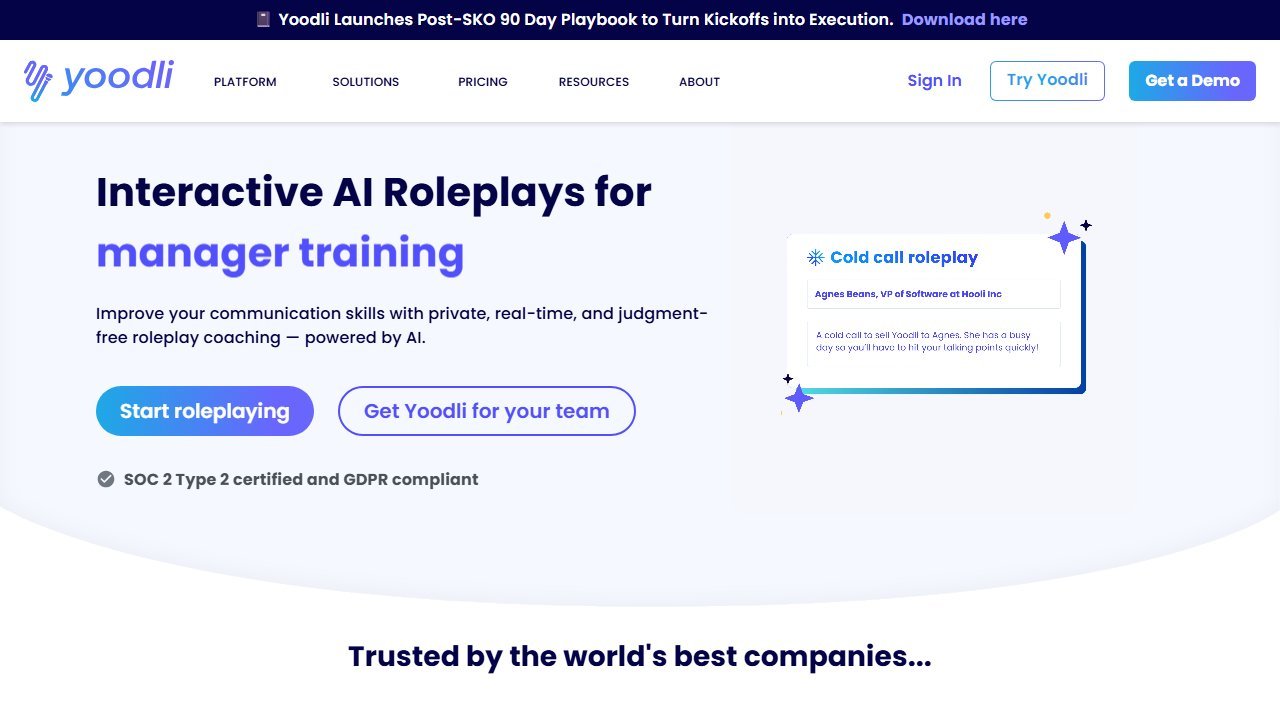
3. Yoodli
Yoodli is positioned as an AI communication coach, with roleplay as one mode. The product feels closer to Grammarly for spoken conversations than to a traditional sales enablement tool.
What it is good at. Brilliant at coaching general communication skills (filler words, pacing, clarity, eye contact). The roleplay scenarios cover sales but also extend to customer service, internal feedback, and presentations. There is a real free tier you can use today (with limits), which means a curious manager can actually see the product before talking to sales.
What it is weak at. Roleplay personas are slightly less convincing than Second Nature for sales-specific scenarios. The AI is sometimes too gentle in its critique, which is a feature for confidence-building and a bug for high-pressure objection-handling drills. Enterprise reporting is improving but not yet at Mindtickle parity.
Our scores. Realism 4. Authoring 4. Feedback 4. Manager visibility 3. Integration 3. Pricing transparency 5.
Real pricing. Free tier exists. Pro is $24 per user per month billed annually. Business plan with team admin starts around $40 per seat per month. Pricing is on the public website. Free trial of paid tiers is available without a sales call. (This is the only tool in this list with truly transparent pricing.)
Best for. Customer success teams, internal trainers, and any team that wants AI coaching for general communication and presentation skills, not just sales pitches.
4. Rehearsal
Rehearsal is one of the older players. They started with video-based practice (record yourself, get peer or manager feedback) and added AI persona-driven roleplay later. The legacy of the video-feedback workflow shows up in the product.
What it is good at. The video-recording side is mature. Manager review workflows are deep. If your training program already includes "record yourself doing X, get a coach to review it," Rehearsal extends that workflow naturally and lets the AI take the first pass before a human coach sees it. The hybrid AI plus human-coach model is the tool's real strength.
What it is weak at. The pure AI roleplay piece is competent but feels like an addition to a video-feedback platform, not a ground-up rebuild. Authoring new AI scenarios is moderately complex. The product is geared toward larger organizations with formal training programs, not nimble L&D teams.
Our scores. Realism 3. Authoring 3. Feedback 4. Manager visibility 5. Integration 4. Pricing transparency 1.
Real pricing. No public pricing. Buyer reports on G2 and LinkedIn comments suggest $30 to $55 per seat per month, with the AI roleplay module priced separately. Annual contract, 25-seat minimum, custom enterprise pricing for 200-plus seats.
Best for. Established training programs that already use video-feedback workflows and want to layer AI on top, especially in regulated industries (healthcare, financial services) where human coach review is a compliance requirement.
5. Hyperbound
Hyperbound is one of the newer entrants and is laser-focused on B2B sales. They sell two products: Hyperbound Practice (AI roleplays for cold calls, discovery, demo, negotiation, post-sale) and Hyperbound Perform (post-call analysis and deal rescue). Practice is the relevant module for this guide, and the focus is a feature, not a bug. They claim 40,000-plus reps on the platform and a 4.9-star G2 rating.
What it is good at. The personas are tuned for sales conversations specifically. They throw real objections, they ask price questions, they go quiet at moments a real prospect would. Authoring is fast: a sales enablement lead can build a new scenario for the latest pricing objection in under an hour. The free trial is real, and meaningful, not a 7-day toy. The pricing is closer to transparent than most of this list.
What it is weak at. It is sales only. Do not buy it for customer success or leadership development; you will be fighting the product. The company is younger, so enterprise integration depth is still maturing. Manager dashboards are good but not as deep as Mindtickle's.
Our scores. Realism 5. Authoring 5. Feedback 4. Manager visibility 3. Integration 3. Pricing transparency 4.
Real pricing. Public pricing tiers exist. Starter around $35 per seat per month, Pro around $55 per seat per month, Enterprise custom. Annual or monthly. Real free trial available without a sales call.
Best for. SaaS sales onboarding, especially for new-rep ramp time. If you have 30 to 200 reps and the goal is "get them objection-ready before week 8," Hyperbound is the highest-leverage choice in this list.
6. Edflex Copilot
Edflex is a content aggregation and curation platform with a recently-added Copilot module that includes AI roleplay among broader AI-coaching features. They are not a roleplay-first company.
What it is good at. If your L&D strategy is "curate the best external content and supplement with practice," Edflex sits at the center of that. The Copilot module includes roleplay, summarization, content recommendations, and learner Q-and-A. The breadth is the value proposition.
What it is weak at. The roleplay piece is the least developed feature in this list. Persona quality is competent for soft-skills scenarios but slips for high-pressure sales drills. If roleplay is your primary use case, this is the wrong tool. If roleplay is one of fifteen things you want from a learning platform, it is on the table.
Our scores. Realism 3. Authoring 3. Feedback 3. Manager visibility 4. Integration 4. Pricing transparency 2.
Real pricing. No public pricing. European pricing markets quote €15 to €25 per seat per month for the base learning content access, with the Copilot module as an upcharge of €10 to €15 per seat. North America pricing is similar in USD. Annual contract, 100-seat minimum.
Best for. L&D teams who want a single platform for content curation plus light AI assistance, especially in European enterprises.
7. Rocky.ai
Rocky.ai positions itself as an AI coaching platform for soft skills and leadership development, with roleplay as one mode. White-label options exist for enterprise resellers.
What it is good at. The leadership and soft-skills focus is real. The personas are built for difficult-conversation drills (giving feedback, navigating conflict, leading change), not for sales pitches. The white-label option is unusual and useful for consulting firms and learning agencies who want to embed roleplay in their own programs.
What it is weak at. The platform is more focused on coaching prompts and reflection than on high-fidelity persona simulation. If you want the most natural-feeling AI character, Second Nature or Hyperbound win. If you want a soft-skills coaching platform with roleplay integrated, Rocky.ai is genuinely good.
Our scores. Realism 3. Authoring 4. Feedback 4. Manager visibility 3. Integration 3. Pricing transparency 3.
Real pricing. Some pricing on the website (around $20 per seat per month for individual plans). Enterprise plans go through sales. White-label pricing is custom. Free trial available.
Best for. Leadership development programs, soft-skills training, and consulting firms looking for white-label AI coaching as a deliverable.
The pricing index (the citable table)
This is the table other articles do not publish. Prices below are estimated list prices for a typical 100-seat North America deployment, based on public pricing where it exists and verified-buyer reviews where it does not. Read with the grain of salt that vendor pricing changes and your discount will depend on contract length, commitment, and how willing you are to walk away.
The honest takeaway: Yoodli, Hyperbound, and Rocky.ai are the only three you can actually evaluate without a sales call. That alone is reason enough to start your shortlist there.
Faz says: where vendors lie to you. A few patterns to watch for in any roleplay vendor demo. One: the demo persona is curated. What you see is the best-case roleplay, scripted by the vendor’s enablement team. Your scenarios will be 30 to 50 percent worse. Always. Two: “hundreds of templates” is meaningless; what matters is how easy it is for your team to build a scenario from scratch in your own voice. Ask for a live authoring demo of a scenario the vendor has never seen. Three: the AI feedback rubric is often a generic template. Ask to see the rubric editor, ask whether you can change scoring weights, ask whether the rubric can include negative scoring. Four: “integration with your LMS” can mean SCORM export, deep API, or single-sign-on only. Ask which one. Five: manager metrics are often vanity. “Average score across cohort” is not a useful business metric. “Median time to first objection-handled” is. Six: “we can custom-train the AI on your content” is often a vector embedding step that takes ten minutes and adds little. The honest answer is usually retrieval-augmented generation, which is fine, but not the same as fine-tuning. Do not buy from a sales demo alone. Run a 60-day pilot with two candidates side-by-side, on the same scenario, with the same cohort.
Saru says: data quality red flags before you sign. A short list of technical questions to put on the table before procurement signs anything. One: where does the AI roleplay model run? OpenAI, Anthropic, a fine-tuned in-house model, or a mix? Two: what does the platform send to the model provider? Audio? Transcripts only? Anonymized metadata? Three: where do recordings live, for how long, and who can access them? A trainee saying something embarrassing in a roleplay session is a real HR risk. Four: SOC 2 Type II compliant? ISO 27001? GDPR? HIPAA if relevant? Ask for the audit reports, not the marketing claim. Five: what is the SSO and SCIM story? Six: is there a real export? If you cancel, do you get the recordings, transcripts, and rubric history out in a usable format? Seven: what happens when the model provider has an outage? Eight: what is the documented per-session token cost? As LLM prices fall, your contract price should too. The vendor that can answer all eight without flinching is the vendor I would recommend over the vendor that gives you the most polished demo.
Best-fit picks (3 personas)
If you are running SaaS sales onboarding (50 to 200 reps): Hyperbound
Why: tuned for sales scenarios, fast authoring, real free trial, transparent pricing. Skip if you also need customer success or leadership development on the same platform.
If you are leading customer success or general communication coaching: Yoodli
Why: free tier exists, paid tiers are reasonable, the product is built around general communication skills, and the AI is gentle in a way that helps confidence build (a feature for CS, a bug for high-pressure sales). Skip if you need deep sales-specific objection drills.
If you are running leadership development or soft-skills training: Rocky.ai
Why: built for difficult-conversation drills, white-label option for consulting firms, transparent individual pricing. Skip if you need the absolute best persona realism for high-stakes sales situations.
Honorable mentions
- Mindtickle if you already have or are evaluating a full sales readiness platform and want roleplay integrated into a broader stack.
- Second Nature if persona quality is non-negotiable and budget allows.
- Rehearsal if your program already uses video feedback and you want to add AI as a first-pass coach.
- Edflex Copilot if roleplay is one of fifteen things you want from a learning platform, especially in Europe.
The 30-day implementation reality check
Below is the timeline most buyers do not ask about until they are 60 days in.
| Day range | What is happening | Common surprises |
|---|---|---|
| Day 1 to 7 | Contract sign, kickoff call, admin setup | SCIM rarely just works. Plan for a full week of provisioning. |
| Day 8 to 14 | Initial scenario authoring, pilot cohort selection | The pre-built templates need substantial editing for your product. Authoring takes longer than the demo suggested. |
| Day 15 to 21 | Pilot cohort starts running scenarios | You will discover the rubric needs three rounds of edits. Tool support response time during this phase tells you a lot. |
| Day 22 to 28 | First manager dashboard reviews | Vanity metrics will dominate the first dashboard. Ask the vendor for the right cuts. |
| Day 29 to 30 | Pilot retro, expand or kill decision | The hardest call. Resist the sunk-cost instinct. If three of your top reps say the AI persona is unconvincing, the tool is unconvincing. |
The point of this table is not to scare you. It is to make sure your procurement timeline is realistic. AI roleplay is real and useful, but the gap between "we signed a contract" and "the platform is delivering measurable improvement" is at least 90 days.
AI for human-coaching adjacent fields
AI coaching tools are not limited to corporate L&D. The personal-training and fitness-coaching world has its own AI software stack. If you advise clients in either field, our coverage of the personal-trainer side:
- best AI tools for personal trainers — AI software for fitness coaches, mapped by coach type
- best AI workout apps — consumer-side AI fitness apps tested by use case
- how to choose personal trainer software — a decision framework for PT software buyers
References & further reading
For deeper research on corporate L&D effectiveness and training science:
- ATD State of the Industry research — annual benchmarks on corporate training spend, hours, and outcomes from the Association for Talent Development
- Brandon Hall Group L&D research — analyst reports on training delivery, content strategy, and learning measurement
- Harvard Business Review on learning and development — peer-reviewed perspectives on adult learning, leadership development, and skill transfer

Written by
FazFaz is the founder of AIToolsBakery. Every tool on this site is personally tested with real-world writing tasks before a single word gets published. No sponsored rankings, no recycled press releases.
Read more about how we test →Frequently Asked Questions