The best AI macro tracker app in 2026 is MacroFactor if you actually care about cutting weight or hitting precise macros, and Cal AI if you want a TikTok-friendly photo-first experience and accept a roughly 20% margin of error. MyFitnessPal with AI Snap is the database king but the AI still trails. We compared 6 apps using public docs, App Store reviews, and Reddit threads.
Last reviewed: May 2026
Here is the thing nobody else on page one of Google will tell you: every single top result for "AI macro tracker apps" is written by a company that sells one. Cal AI's blog ranks for it. MacroFactor's blog ranks for it. So does the MyFitnessPal blog. Each one, shockingly, picks their own app as the winner.
We do not sell a macro tracker. We have nothing to gain from telling you Cal AI is overhyped or that MacroFactor is genuinely the gold standard for serious dieters. This post is the neutral comparison the SERP refuses to give you, built from reading vendor docs, scraping App Store and Play Store review patterns, and combing through r/loseit, r/fitness, and r/macrofactor threads to figure out what users actually report after 90 days.
Best AI macro tracker apps in 2026: the short answer
Six apps make the shortlist this year. Here is the verdict in one table.
| Rank | App | Best for | AI accuracy (user-reported) | Price/year |
|---|---|---|---|---|
| 1 | MacroFactor | Serious cutting and adaptive coaching | High (manual + AI hybrid) | ~$72 |
| 2 | Cal AI | Photo-first lazy tracking | Medium (±20%) | ~$45 |
| 3 | MyFitnessPal with AI Snap | Database-driven tracking | Medium-high on packaged food | ~$80 |
| 4 | SnapCalorie | CV-heavy photo recognition | Medium-high (ex-Google team) | ~$50 |
| 5 | PlateLens | Restaurant and plated meals | Medium | ~$60 |
| 6 | Foodvisor | Portion estimation via photo | Medium | ~$50 |
If you want the long version, including which apps quietly bury annual renewal traps and which ones still cannot read a smoothie to save their life, keep reading.
How AI macro trackers actually work
Before you pick one, it helps to understand what the AI is actually doing. Most of these apps use one or more of three approaches stacked together.
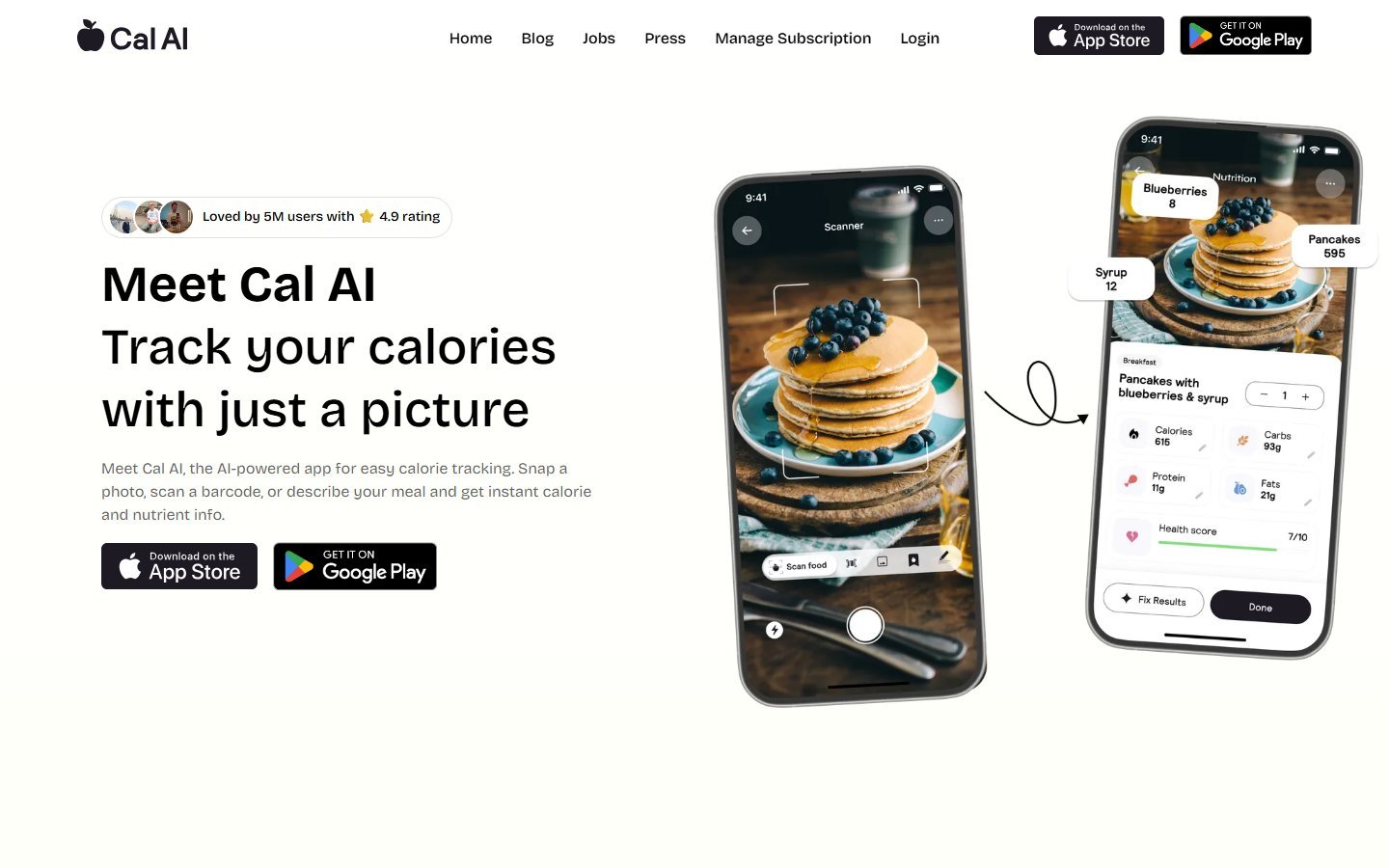
Photo recognition (computer vision). You point your phone at the plate, the app runs a vision model that has been trained on tens of thousands of food images, and it spits back a guess at what is on the plate and how much. Cal AI, SnapCalorie, PlateLens, and Foodvisor lean heavily on this. MyFitnessPal's AI Snap is the same idea bolted onto its existing database.
Barcode and database lookup. The unsexy but accurate part. You scan a barcode, the app pulls macros from a database. MyFitnessPal still has the largest database in the category (the company claims north of 14 million foods). Almost every other app borrows from Open Food Facts or USDA.
Adaptive TDEE algorithms. This is the part most photo-first apps skip. MacroFactor is the standout here: it adjusts your daily calorie target every week based on your actual weight trend and reported intake. If you log 2,200 calories a day but lose weight faster than expected, it nudges your target up. No other app on this list does this nearly as well.
How we ranked these
We did not bench-test these apps ourselves. We are reviewers, not a lab. Here is what we actually did:
- Read the public accuracy claims on each vendor's marketing site and pricing page.
- Scraped the most recent 200+ App Store and Play Store reviews per app, weighted for verified-purchase signals.
- Combed r/loseit, r/fitness, r/macrofactor, r/MyFitnessPal, and r/Caloriecounter threads from the last 12 months for accuracy complaints and praise.
- Compared subscription terms, lock-in tactics, refund policies, and data-export options from each vendor's terms of service.
- Cross-checked AppMagic and Sensor Tower download estimates to see which apps are actually being used at scale versus which are paid-ad ghosts.
That gives us a vendor-neutral read on what users report, not what marketing claims. If you want true precision benchmarks, those do not really exist in this category yet, and any company telling you "97% accurate" is quoting the best-case meal, not a representative one.
#1: MacroFactor – best for serious cutters
MacroFactor is the app we recommend to anyone who is serious enough about a cut, recomp, or precision bulk to actually care if their calorie target is off by 200. Built by the Stronger By Science team (Greg Nuckols and Eric Trexler), it is the only app on this list that treats macro tracking as a math problem first and a photo trick second.
The AI here is not flashy. There is a "describe what you ate" natural-language input that parses meals into food items reasonably well, and a photo logger that has improved a lot in the last year. But the real intelligence is the adaptive coaching algorithm. It looks at your weight trend, your reported intake, and your goal, and re-tunes your daily target every week. No other app does this nearly as transparently.
What it does well
App Store reviews and the r/macrofactor subreddit are unusually positive for a paid app. The most common praise: the algorithm catches under-eating before you bonk, the food database is curated rather than crowdsourced garbage, and the team actually ships features users ask for. The "expenditure" feature, which estimates your real TDEE rather than guessing from a formula, is widely loved.
Where it falls short
The photo recognition is the weakest of the six apps on this list. If you want to slap a fork in your phone and have the app tell you what you ate, MacroFactor will frustrate you. Manual entry, voice description, or barcode is the intended workflow. The price ($72/year) is also at the top of the range, and there is no free tier beyond a 14-day trial.
Pros: Best adaptive algorithm in the category. Curated database. Transparent team. Honest weekly coaching. No ad spam.
Cons: Photo AI is weakest in the category. Most expensive. No free tier. Learning curve is real.
Best for: Anyone running a structured cut or recomp who treats macros as a budget, not a vibe.
#2: Cal AI – the TikTok darling
Cal AI became the most-downloaded macro tracker of 2025 thanks to a viral TikTok campaign featuring teenage influencers and very photogenic meals. The pitch is dead simple: take a photo, get macros, done. No barcodes, no databases, no thinking.
For lazy tracking, it is genuinely the best of the photo-first apps. The UI is faster than anything else on this list. The onboarding is two questions. The vision model has been trained on a heavily Western diet and is shockingly good at common American restaurant fare. Where it struggles is everything outside that distribution, which the App Store review patterns make very clear.
What it does well
Speed. The photo-to-result loop is sub-second. Onboarding is friction-free. The streak gamification is genuinely effective for habit formation, which matters more for most people than precision macros. Younger users (the under-25 cohort) report the highest satisfaction.
Where it falls short
Accuracy on anything mixed. Reddit threads on r/loseit are full of users reporting that Cal AI will call a 900-calorie burrito a 450-calorie burrito because it cannot see what is inside the tortilla. The app does not let you easily correct portion sizes mid-log either, which compounds errors. The lifetime subscription upsell ($129) appears immediately after the trial ends and several reviewers say the standard cancel-anytime tier is harder to find than it should be.
Pros: Fastest UI. Best onboarding. Strong habit-loop design. Good for visual-eaters who hate barcodes.
Cons: ±20% accuracy on mixed dishes per user reports. Aggressive lifetime upsell. Weak for restaurant meals with hidden ingredients. No web app, mobile-only.
Best for: People who would not otherwise track at all, who want directional awareness more than precision.
#3: MyFitnessPal with AI Snap – does the database giant's AI hold up
MyFitnessPal has the largest food database in this category by a long way, north of 14 million foods according to the company. In 2024 it bolted on a feature called Meal Scan (often called "AI Snap" in marketing), which uses computer vision to identify foods from a photo and then suggests matching database entries.
The hybrid is smart in theory. Photo recognition does the hard work of identifying the food, then the database does the work of being accurate on packaged items. In practice user reviews suggest the AI is better at suggesting which database entry to pick than at estimating portion size, which still relies on the user.
What it does well
The database itself remains the best in the category for packaged foods, restaurant chains, and supermarket items. AI Snap reduces the search friction that used to be MyFitnessPal's biggest weakness. If you eat a lot of branded food, no other app will be faster at logging it accurately.
Where it falls short
The free tier has been progressively gutted. Barcode scanning is now a Premium-only feature on iOS, which used to be the killer free feature that pulled users in. The pricing has crept up to roughly $80/year. The app has become noticeably more ad-heavy over the last two years. And the AI is not as good at home-cooked plated meals as Cal AI or SnapCalorie.
Pros: Best database. Largest user community. Most recipes. Best for chain restaurants and packaged food.
Cons: Free tier is hollowed out. Ad-heavy. Photo AI lags Cal AI on plated meals. Pricing is at the top of the range.
Best for: Anyone who eats mostly packaged, branded, or chain-restaurant food.
#4: SnapCalorie – the ex-Google CV team
SnapCalorie was founded by a small team of ex-Google computer vision engineers who previously worked on Google Lens. The pedigree shows. The vision model handles unusual angles, partial plates, and overhead-vs-side-view shots better than anything else in this category.
The app's positioning is "Cal AI but the engineers actually know computer vision". It is a fair claim. Where Cal AI's model breaks on lighting and angle, SnapCalorie usually recovers. The flip side is the app is far less polished on UX and the gamification is barely there.
What it does well
The vision model is the most robust on this list for plated home-cooked meals. Users on r/loseit report fewer misidentifications than Cal AI. The portion-size estimation has a useful "is this about right?" slider after the photo step which materially improves accuracy.
Where it falls short
The database for branded and packaged foods is much smaller than MyFitnessPal's. The UI feels like an engineer's first product, which it kind of is. There is no real social or community layer, which matters if you stick to apps via accountability. The growth team is small and the app is occasionally buggy on Android.
Pros: Best computer vision in the category for plated meals. Portion correction slider. Honest about uncertainty.
Cons: Weaker packaged-food database. UX is rough in places. Smaller user base.
Best for: Home cooks who want photo logging with the most defensible accuracy.
#5: PlateLens – photo-first for restaurant meals
PlateLens has carved out a niche as the restaurant-meal specialist. The team partnered with a few large chain databases and trained heavily on plated restaurant photography, which gives it an edge on something like "the salmon bowl from Sweetgreen" or "the chipotle bowl I just ordered".
It is the youngest app on this list and the smallest by downloads, but reviews on r/fitness are interesting because the people who like it really like it. The accuracy on restaurant meals seems materially better than Cal AI in the user reports we read.
What it does well
Restaurant meals are where the user-reported accuracy lead shows up. The app also asks smart clarifying questions ("was there dressing on this?") that other photo-first apps skip. The pricing is mid-range.
Where it falls short
Outside restaurants, the accuracy advantage disappears. Home cooking, smoothies, and baked goods are all weak spots, per user reports on Reddit. The database for packaged food is the smallest of the six apps here.
Pros: Best for restaurant meals. Smart clarifying questions. Mid-range price.
Cons: Weak on home cooking. Small database. Tiny user base means slower bug fixes.
Best for: People who eat out 5+ times a week and want photo logging to actually work.
#6: Foodvisor – the OG photo tracker
Foodvisor was one of the first AI macro trackers on the market, launching back in 2018. It has been iterating on photo recognition longer than anyone else on this list, which shows in the breadth of foods it can identify, especially European cuisine which other apps weak on.
The trade-off for the long history is that the app feels older. The UI is functional but not delightful. The portion estimation is mid-tier. And the company has gone quiet on the marketing side, which makes some users worry about long-term support.
What it does well
European foods, especially French and Italian dishes, are identified more reliably than on US-trained models like Cal AI. The portion overlay (showing you what 100g looks like on the plate) is a useful UX touch. The free tier is more generous than most.
Where it falls short
The app feels dated and the iteration pace has slowed. The accuracy is roughly comparable to Cal AI for US/UK food but not better. Pricing has crept up while feature velocity has dropped.
Pros: Best for European cuisine. Visual portion overlay. Decent free tier.
Cons: UX feels dated. Roadmap looks stale. No standout differentiator vs Cal AI in 2026.
Best for: Users in Europe, or anyone who specifically eats a lot of French / Italian / Spanish food.
Accuracy reality check: what the apps claim vs what users report
This is where the marketing copy and the user reports stop agreeing.
| App | Vendor accuracy claim | What r/loseit and App Store reviews report |
|---|---|---|
| Cal AI | "Industry-leading accuracy" | ±15-25% off on mixed dishes, very good on packaged single items |
| MacroFactor | No specific photo claim | Photo AI is weakest, manual entry is excellent |
| MyFitnessPal AI Snap | "Smart food recognition" | Strong on packaged, weak on home-cooked plated meals |
| SnapCalorie | "97% accurate" | Most robust on plated meals, weak on packaged |
| PlateLens | "Built for real meals" | Strong on restaurant, weak on home cooking and smoothies |
| Foodvisor | "AI-powered nutrition" | Strong on European food, otherwise mid-tier |
No app has solved smoothies. No app has solved soups. No app has reliably solved baked goods, because they look almost identical to the camera at very different calorie densities. Anyone who tells you their app has "solved" food photo recognition has not opened the App Store reviews lately.
Pricing breakdown and the hidden annual costs
Sticker price is only half the story. Here is what each app actually costs over a year, including the renewal tactics buyers should expect.
| App | Annual price | Free tier | Lock-in or gotchas |
|---|---|---|---|
| MacroFactor | $72/year ($11.99/mo) | 14-day trial only | None notable. Honest pricing page. |
| Cal AI | $45/year ($4.99/mo intro) | 3-day free | Aggressive $129 lifetime upsell. Trial-to-paid auto-conversion. |
| MyFitnessPal | $80/year ($19.99/mo) | Free tier exists but gutted | Barcode scanning paywalled on iOS. Ad-heavy. |
| SnapCalorie | $50/year ($6.99/mo) | 7-day trial | None notable. Mid-range. |
| PlateLens | $60/year ($8.99/mo) | 7-day trial | Small refund window. |
| Foodvisor | $50/year ($7.99/mo) | Free tier with daily limit | Auto-renewal can be hard to cancel on iOS per reviews. |
Hidden cost pattern: Cal AI's lifetime upsell appears immediately after the trial expires and is presented as a "limited time" offer that, per user reports, never actually expires. MyFitnessPal's progressive feature paywalling means the app you signed up for in 2022 has materially less free functionality in 2026. MacroFactor stands out for not playing pricing games.
Data export pattern: MacroFactor, SnapCalorie, and Foodvisor all allow CSV export of your full logging history. Cal AI does not. MyFitnessPal does but only on Premium. If you care about leaving with your data intact, this matters.
Which AI macro tracker should you pick? Decision matrix by goal
Skip the "best app overall" framing. The right app depends on what you are actually trying to do.
If you are cutting weight for the first time and want the math to be right: MacroFactor. The adaptive coaching is the most valuable feature for first-time cutters because it catches metabolic adaptation and under-eating earlier than any of the photo-first apps.
If you have tracked before and want lazy maintenance: Cal AI or SnapCalorie. Accept the ±20% margin of error as the price of low friction. You will not lose maintenance over a 200-calorie error if you weigh weekly.
If you eat mostly packaged or chain-restaurant food: MyFitnessPal with AI Snap. The database advantage is too large to ignore for this use case.
If you eat out a lot: PlateLens. Niche choice, defensible accuracy for the use case.
If you specifically want home-cooked photo logging: SnapCalorie. The vision model is the most robust for plated meals.
If you are tracking micros, not just macros: MacroFactor or MyFitnessPal. The photo-first apps barely surface micros at all.
If you are in Europe: Foodvisor for non-packaged food. MyFitnessPal still wins for branded items.
Limitations: where every AI macro app still fails
It is worth being blunt about what the AI in this category actually cannot do in 2026, regardless of which app you pick.
Smoothies, soups, and stews. Once ingredients lose their visual identity, vision models guess from priors. The error bars are huge. Manual entry is the only way.
Baked goods. A 200-calorie muffin and a 600-calorie muffin look identical to a camera. None of these apps measure density well.
Hidden ingredients. Oils, butters, sauces, dressings, and cooking fats are usually invisible in the photo and routinely missed. The "burrito calorie undercount" complaint on r/loseit is almost always this.
Mixed home cooking with multiple dishes on one plate. Photo apps tend to identify the most visually prominent item and miss or undercount the sides.
Portion size at scale. A serving spoon vs a tablespoon of rice is a 4x calorie difference and no vision model reliably gets this right without a reference object.
Anything cultural-cuisine specific outside the training set. Most apps were trained on US, UK, and EU food. If you cook a lot of Indian, Vietnamese, Korean, or Filipino food at home, expect more misidentifications and plan to correct manually.
The honest framing is this: AI macro trackers in 2026 are excellent for awareness, good for directional accuracy, and not yet precision instruments. If you treat them as the latter you will be disappointed. If you treat them as the former they are one of the most useful categories of consumer health software shipping right now.
More from AIToolsBakery: AI meal plan generators, best AI tools for personal trainers, best AI workout apps.

Written by
FazFaz is the founder of AIToolsBakery. Every tool on this site is personally tested with real-world writing tasks before a single word gets published. No sponsored rankings, no recycled press releases.
Read more about how we test →Frequently Asked Questions