The short answer
Almost every guide to AI customer support agents compares features. Features are not what separates these products, because they all claim the same ones. What separates them is that this category abandoned per-seat pricing, and the unit it moved to is defined by the vendor.
| Vendor | Published rate | Unit as they define it | What is included first | |
|---|---|---|---|---|
| Fini, Enterprise | $0.49 | Resolved ticket, after the bundle | Unlimited resolved tickets, then metered | |
| Fini, Scale | $0.69 | Resolved ticket, after the bundle | 8,000 a month, plus 500 voice calls | |
| Fini, Growth | $0.89 | Resolved ticket, after the bundle | 2,000 a month | |
| Intercom Fin | from $0.99 | Fin outcome | Nothing bundled. No seats required | |
| Zendesk | US$2.00 | Automated resolution | Sold alongside seats, not instead of them | |
| Crisp | Not per resolution | Workspace, with AI credits | $45, $95 or $295 a month per workspace | |
| Ada, Sierra, Decagon, Forethought | Publish nothing | Quote only | ||
That is a 4x spread on the headline rate for something every one of these companies describes in near-identical language. And the rate is the smaller half of the problem, because a resolution at one vendor is not a resolution at another.
Why per seat pricing died here, and what replaced it
Support software was sold per agent for twenty years because agents were the constraint. An AI agent breaks that logic: the vendor’s cost rises with the number of conversations handled, not with how many humans have logins, and a customer who deflects most of their volume would pay almost nothing on a seat model while consuming the most.
The consequence buyers keep missing
Your bill now grows with your support volume. That is the opposite of the traditional promise, where handling more tickets with the same team meant flat cost. Under per resolution pricing, a successful quarter with more customers is a larger invoice, automatically.
It also means the vendor is paid more when the AI answers more, which is worth sitting with for a moment. Their incentive is to resolve, and your incentive is for the customer to be right first time. Those mostly point the same way and they are not identical, which is why the definition of a resolution matters so much.
The one genuinely different model in the set
Crisp has not gone this way. It sells a workspace at $45, $95 or $295 a month, with seats included at four, ten and more, and bundles AI credits worth $5, $25 and $75 which its page translates into roughly 90, 450 and 1,350 automated conversations a month. Divide the top tier out and the implied rate is far below anything else here.
That is not a like-for-like win. It tells you the products sit at different points: a workspace priced for a small team where the AI is a feature, against platforms priced for a support operation where the AI is the product. Read the included conversation count, not the monthly price.
Faz says: The moment a vendor prices per resolution, the contract negotiation is about the definition, not the rate. A better rate on a worse definition is a worse deal.
What counts as a resolution, and why it is the whole bill
Each vendor uses its own word. Intercom bills a Fin outcome. Zendesk bills an automated resolution. Fini bills a resolved ticket. Those are three different events, and none of them means what a support manager means by resolved.
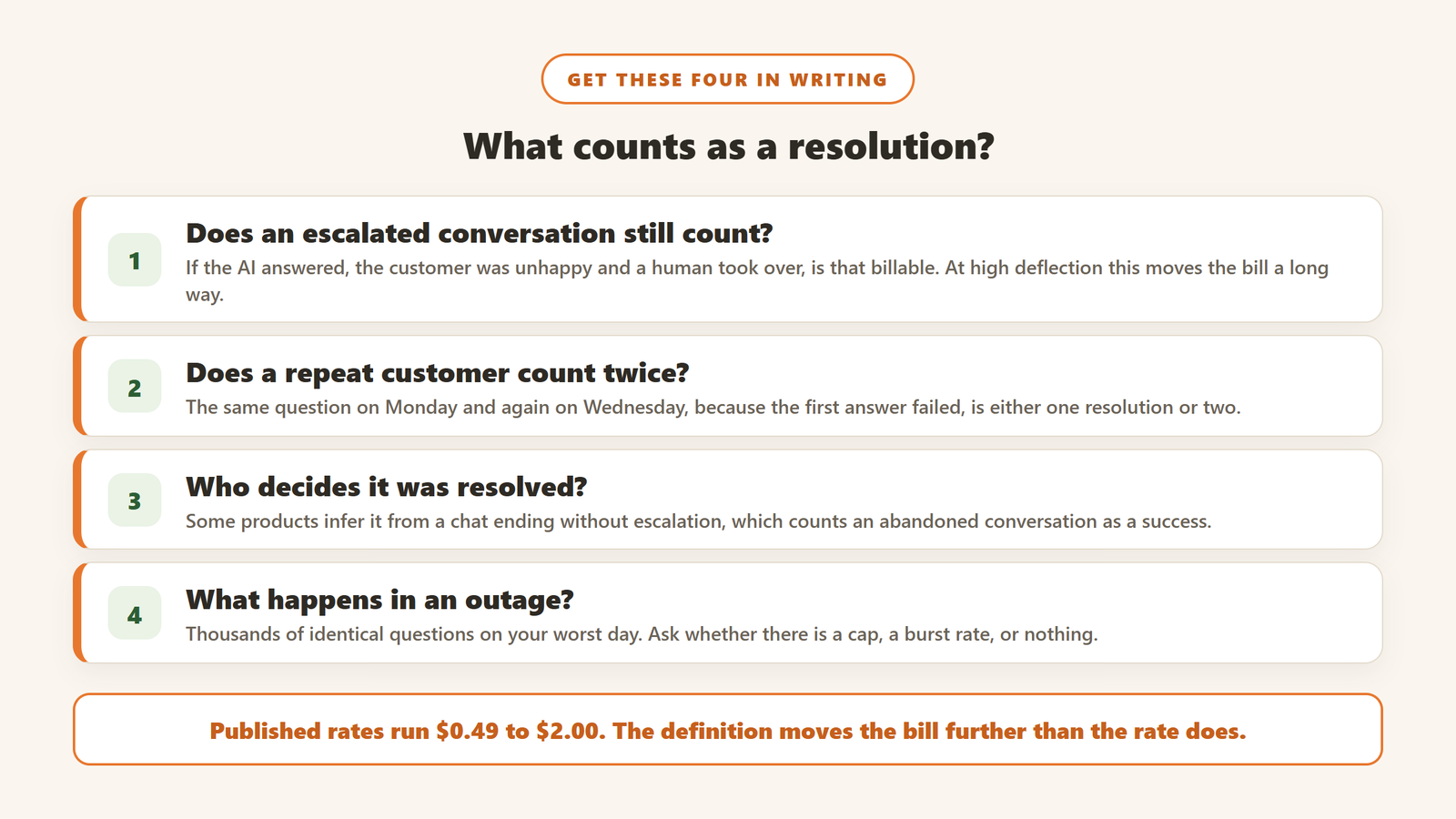
The questions that decide your invoice
Does an unresolved conversation count? If the AI answers, the customer is unhappy and a human takes over, was that billable. Vendors differ, and this single answer can move a bill by a large proportion at high deflection rates.
Does a customer who returns twice count twice? Someone asking the same question on Monday and again on Wednesday because the first answer did not work is either one resolution or two, depending on whose contract you signed.
Is a resolution counted when the customer says so, or when the system decides? Some products infer it from the conversation ending without escalation, which counts an abandoned chat as a success.
What happens in a spike? An outage or a shipping failure produces thousands of identical questions. Under per resolution billing that is your worst day and your largest invoice arriving together. Ask whether there is a cap, a burst rate, or nothing.
Ask for it in writing, with a worked month
Give any vendor last month’s real conversation volume and ask them to produce the invoice their contract would have generated from it. A vendor who will not do that arithmetic in the sales process will not be easier to pin down after you sign.
The arithmetic at a realistic volume
Ten thousand support conversations a month, half of them handled by the AI, so 5,000 billable resolutions. Published rates as read on 7 September 2026, and note the fixed component matters as much as the rate.
| Vendor and tier | Fixed | Metered | Monthly total |
|---|---|---|---|
| Intercom Fin | None required for Fin itself | 5,000 at $0.99 | about $4,950 |
| Fini Growth | $3,000 on annual, includes 2,000 | 3,000 at $0.89 | about $5,670 |
| Fini Scale | $7,500 on annual, includes 8,000 | None at this volume | $7,500 |
| Zendesk | Agent seats, priced separately | 5,000 at US$2.00 | $10,000 plus seats |
Three things that fall out of that table
The cheapest headline is not the cheapest bill. Fini Scale has a lower per resolution rate than Fini Growth and costs more at this volume, because the bundle is bigger than you need. Bundled tiers only win once you are reliably above the bundle.
Zendesk is roughly double, and it is also not standalone. Its automated resolutions sit alongside agent seats rather than replacing them, so the comparison above understates it. Intercom explicitly states that Fin works with an existing helpdesk including Salesforce and requires no seats, which is a genuinely different commercial shape.
Your deflection rate is the variable you can least predict and it drives everything. At 30% deflection the Intercom line is about $2,970 and at 70% it is about $6,930. Any vendor quoting you an annual figure has assumed a deflection rate. Ask what they assumed.
Training the agent is the part that decides whether any of this works
The phrase people search is training an AI support agent, and in this category training does not mean machine learning. It means grounding: pointing the model at your help centre, your past tickets and your policies so that it answers from your material rather than from the open internet.
What grounding actually consumes
The input is your existing documentation, and its quality sets the ceiling on everything above. An AI agent grounded on a help centre with forty out of date articles will confidently repeat all forty. This is the least glamorous and most decisive part of the project, and no pricing page mentions it.
Fini is unusual in leading with this rather than with the agent, positioning itself around training on your help centre content. Whether that is better in practice we cannot say from a desk read, but it is the honest framing of what the work is.
The four questions to ask about grounding
What does it read, and how often does it re-read it? A one-time import goes stale the day your policy changes.
What does it do when your documentation contradicts itself? Every help centre does somewhere. Silent invention is the failure mode.
What does it do when it does not know? The correct behaviour is to hand over. Ask to see that path in a demo with a question deliberately outside the documentation.
Can you see why it answered as it did? If you cannot trace an answer to a source article, you cannot fix a wrong one.
The measurement that should worry you
Deflection rate is the number every vendor reports, and it is a poor proxy for whether customers were helped, for the same reason completion is a poor proxy in training. A conversation that ends can end because the answer was right or because the customer gave up. Pair every deflection figure with a repeat contact rate inside seven days and a satisfaction score on AI-handled conversations specifically. If a vendor cannot break satisfaction out by AI versus human, you cannot see the thing that matters.
What actually differs once you get past the feature list
Every product here claims to answer questions, escalate to a human, work across channels and learn from your content. Those claims have converged and cannot help you choose. Five things underneath them still separate these products, and four of the five change what you pay.
Whether it can act, or only answer
This is the largest real division in the category. An agent that retrieves an answer from your help centre is doing search with better manners. An agent that can look up an order, process a refund, change an address or cancel a subscription is doing the work.
The second kind requires integrations into your commerce and billing systems, and that is where implementation time actually goes. When a vendor quotes a deployment timeline, ask whether it covers the read-only version or the version that can change something, because those are different projects. Intercom sells a separate product for customer operations alongside Fin at $99 a month, which tells you the company treats answering and acting as distinct things.
Whether voice is included or a separate meter
Voice is where costs surprise people. Fini bundles 500 answered voice calls a month into its Scale tier and 2,500 into Enterprise, and describes a standard rate card for voice beyond that. Voice minutes are a genuinely different cost base from text, so any vendor that folds voice into a single per resolution number without a separate line is either absorbing it or has not thought about it. Ask which.
How the handover to a human works
Ask to see the moment the AI gives up. What the customer sees, whether the transcript arrives with the human, whether the customer has to repeat themselves, and how long the handover takes when your queue is busy. Nothing damages a support experience more than a confident AI followed by a human who has clearly not read the conversation.
This also interacts with billing, which is why it is on this list. If a conversation that escalated still counts as a resolution, then the worst experiences in your queue are also the ones you paid for.
Which languages, and whether the quality survives them
Multilingual support is claimed everywhere and delivered unevenly. The check is not the language count on the marketing page, it is whether the agent is grounded on documentation that exists in that language. An agent answering in French from an English help centre is translating on the fly, which handles ordinary prose and mangles product names, sizes and regulated wording.
What the analytics let you see about the AI specifically
Covered above under deflection and worth repeating as a purchasing criterion. If the reporting cannot separate AI-handled conversations from human-handled ones on satisfaction, repeat contact and escalation, you have bought something you cannot manage. Zendesk publishes its automated resolution rate on the same page as its seat tiers, which at least makes the two halves of the bill visible together.
A 30 day evaluation that costs almost nothing
Because these products are metered rather than seated, you can evaluate one properly for a fraction of an annual commitment. Most buyers do not, and sign on a demo instead.
Week one: build the question set before you talk to anyone
Pull your last 200 real tickets and sort them into three piles: answerable from documentation, requires a system action, and requires judgement. The proportions are your realistic deflection ceiling, and they are specific to your business rather than to the vendor’s benchmark. A business whose volume is mostly the third pile has a much smaller opportunity here than any case study will suggest.
Week two: run the same twenty questions at every finalist
Use the actual wording customers used, typos included, not a cleaned-up version. Include three questions your documentation does not answer, and watch what happens. Confident invention on those three is disqualifying, and it is the single most useful thing you will learn in the whole process.
Weeks three and four: run it live on one channel
Pick your lowest-risk channel and let it handle real conversations with a human watching. Then count three numbers yourself rather than reading the dashboard: what proportion were genuinely resolved, what proportion came back within seven days, and what the invoice would have been under the contract you have been offered.
That last figure is the one to insist on. You now have a real month of volume, so any vendor can price it exactly. If the number they produce is materially different from the one implied by their own published rate, that gap is the conversation to have before signing rather than after.
Faz says: Do the three-pile exercise before the first demo. Half the disappointment in this category is buying against a deflection rate that was never achievable with that particular ticket mix.
Five vendors will not tell you the price
Of nine read on 7 September 2026, four publish a figure and five do not. Being precise about the difference between “publishes nothing” and “we could not read it” matters, so:
| Vendor | What we found |
|---|---|
| Ada | The pricing URL redirects to a demo request form. That is a deliberate choice, not an absence |
| Decagon | Both the pricing and plans URLs return 404. No pricing page exists |
| Sierra | The pricing URL timed out twice at 75 seconds. The product page loads and carries no figure |
| Forethought | No pricing page reached |
| Gorgias | The pricing page loads fully and rendered no currency figure to us on two attempts. We report that as what we saw, not as a claim that they publish nothing |
The pattern is worth naming. The vendors selling to enterprise support operations publish nothing, and the vendors selling to smaller teams publish everything. That is not a moral failing, it is what happens when the price depends on a volume negotiation. It does mean any comparison article you read that assigns figures to Ada, Sierra or Decagon has either got them from a customer, or made them up.
Faz says: If a review site quotes a specific monthly price for a vendor whose own site publishes none, that is the moment to stop trusting the rest of the page.
One more thing about the figures above
Two of the pricing pages in this batch served us a regional variant without being asked. Zendesk’s pricing resolved to a country-specific path and labelled its rate US$2.00 explicitly, which is the correct way to do it: the currency is stated rather than assumed.
Treat every number in this article as the number shown to us from our location on 7 September 2026, and confirm it from yours before you budget. A published price is increasingly a price served to a visitor rather than a price the vendor charges, and a figure quoted without its currency and billing basis attached will be repeated wrongly.
How we know this
Each price was read off the vendor’s own rendered pricing page on 7 September 2026, following the site’s own navigation, with the URL we landed on recorded rather than the one we requested. Where a page rendered without a figure we say that, and where a URL 404s we say that instead.
We have not deployed these products and we are not ranking them. The worked examples are arithmetic on published rates at a stated volume, not results, and they change the moment a vendor changes a bundle.

Written by
FazFaz is the founder of AIToolsBakery. Some tools here are tested hands on. Others are assessed from vendor documentation and pricing verified on the live page, and every review says which one it is. Sponsors can buy a position in a guide. They cannot buy the score, the criticism, or silence about a better option.
How we test and how we make money →