
If you are reading this, you have probably finished, or nearly finished, the CFP Board education requirement, and the exam is the next wall. It is a long one: 170 questions over two three-hour sections, scenario and case-study questions that tie tax, retirement, estate and insurance planning together, and a registration fee that starts at $825. Prep courses for it cost from nothing to nearly $3,000, and a growing number now mention AI somewhere on the page. Search for AI CFP exam prep and most of what comes back is either a prep company ranking itself or a May 2025 news story about CFP Board’s own AI app.
That news story is where this guide starts, because something changed. CFP Board launched an AI-powered study app with Prometric, the company that delivers the exam, and its announcement is still live. The product page it links to is not. On 18 November 2026 it redirected to CFP Board’s general exam prep page, which does not mention the app. So this guide does three things. It sets out what CFP Board publishes about the exam, including the tax year each testing window uses. It explains what happened to the official AI app, as far as CFP Board’s own pages show. And it compares the prep products that describe an AI feature, plus three well-known live reviews without one, on what the AI does, which package it sits on, what it costs and what the guarantee actually requires.
How we put this together. We have not used these tools ourselves. Every price and feature below comes from the vendor’s own website, and the exam facts come from cfp.net, CFP Board’s October 2026 candidate handbook and its published exam statistics, all read on 18 November 2026 and linked in the text. Prices were shown in US dollars and change with each exam window, so treat them as a dated snapshot. None of these companies paid to appear on this page, and nothing here is career, tax or investment advice.
What the CFP exam is, according to CFP Board
Prep sites restate CFP Board’s rules with small differences, so these facts come straight from CFP Board.
Format and timing
CFP Board’s exam format page describes a computer-based exam of 170 multiple-choice questions in two three-hour sections, 85 questions each, with every section split into two subsections. There are three question types. Stand-alone questions are two or three sentences long with four answer options. Short scenarios typically carry three questions each. Case studies run over several pages and typically carry eight to twelve questions. You can take an optional break after question 43 in the first subsection, and there is a 40-minute break between the two sections. The candidate handbook says the whole appointment lasts seven hours, including check-in and a lunch break, at one of more than 265 Prometric testing centres. You bring a dedicated, non-programmable financial calculator, and its memory is cleared before each session.
Once a subsection ends, you cannot go back to it. That detail matters for practice: a question bank that lets you flip freely between 170 questions is not training you for the real thing, while full-length timed mocks are.
Scoring and pass rates
The exam is pass or fail. CFP Board’s scoring page says each question is worth one point and that passing depends on your total across all sections. The pass mark comes from a process CFP Board calls Standard Setting, in which CFP professionals decide the minimum level of competence, and its About the Exam page states that CFP Board does not predetermine the pass rate or set a percentage of questions you must answer correctly. You see a preliminary result as soon as you finish. The official result arrives by email about four weeks after the window closes, according to the website, or four to six weeks according to the handbook. If you fail, you get a diagnostic report showing relative strengths and weaknesses by topic.
CFP Board publishes exam statistics for every window. For July 2026, 2,388 of 3,621 candidates passed, a 66% pass rate. Its historical file splits that further: first-time takers passed at 69% and repeat takers at 57%. March 2026 came in at 67% overall and November 2025 at 64%. Any provider’s pass rate should be read against those figures, and with its own conditions, which we cover below.
Dates, fees and attempts
The exam runs three times a year in eight-day windows. The late-2026 window ran from 29 October to 5 November 2026, which CFP Board’s September newsletter called the last chance to sit in 2026. The earlier 2026 windows ran from 17 to 24 March and 14 to 21 July, according to the Boston Institute of Finance’s dates page; CFP Board’s statistics confirm both sittings took place. For 2027, CFP Board’s dates page lists 16 to 23 March, 13 to 20 July, and 25 October to 1 November. The March 2027 window has a registration deadline of 2 March 2027 and an education verification deadline of 23 February 2027.
Registration costs $925 at the standard rate. An early bird rate of $825 runs until six weeks before the deadline, and a late rate of $1,025 applies in the final week. For March 2027, that means $825 until 19 January, $925 until 23 February and $1,025 until 2 March. Moving to a later window costs a $500 postponement fee, withdrawing gets you a $200 refund, and changing your Prometric appointment within the same window costs $35 or $100 depending on how close you are to the date, according to the rescheduling policy.
You can register before you finish your coursework, but CFP Board must receive verification by the deadline or your registration is withdrawn and the $500 postponement fee applies. The eligibility page also sets attempt limits: five attempts in a lifetime, and if you fail three times within 24 months you must sit out three exam cycles, a full year, before a fourth try. With each retake costing a new registration fee, the cost of an under-prepared first attempt is real.
The eight Principal Knowledge Domains
| Domain | Approximate share of the exam |
|---|---|
| A. Professional Conduct and Regulation | 8% |
| B. General Principles of Financial Planning | 15% |
| C. Risk Management and Insurance Planning | 11% |
| D. Investment Planning | 17% |
| E. Tax Planning | 14% |
| F. Retirement Savings and Income Planning | 18% |
| G. Estate Planning | 10% |
| H. Psychology of Financial Planning | 7% |
CFP Board’s content page lists 70 Principal Knowledge Topics under these eight headings and says every question links to at least one of them. It also says the exam puts less emphasis on factual recall and more on critical thinking and problem solving. Retirement and investment planning together make up 35% of the exam, and the Psychology of Financial Planning domain is the newest: it came out of CFP Board’s 2021 practice analysis, and the current blueprint was first used in March 2022. A prep product that still organizes its bank around the older topic list, with a separate education planning area, has not kept up.
The tax year your window tests
This is the detail to watch if you study with AI. CFP Board’s tax tables page lists which year’s tax rates, tables and law each window covers: the March 2026 window tested 2025, and the July and November 2026 windows test 2026. The October 2026 handbook adds that the March 2027 window will also test 2026. CFP Board provides the tax tables and a formula sheet during the exam, and its resources page carries a summary of the One Big Beautiful Bill Act’s key elements alongside older summaries of the 2017 tax act and both SECURE Acts.
The practical point: a prep question, a flashcard or a chatbot answer that quotes a limit, a threshold or a phase-out from the wrong year is simply wrong for your exam. Ask any provider which tax year its current bank uses, and check it against the window you booked.
Education, experience and ethics
The exam is one of four requirements. The education requirement is CFP Board-approved coursework in the eight areas plus a capstone course, and a bachelor’s degree in any subject, which you can finish up to five years after passing the exam. The experience requirement is 6,000 hours of professional experience or 4,000 hours on an apprenticeship pathway, before or after the exam. The ethics requirement is a signed Ethics Declaration and a background check under CFP Board’s Fitness Standards.
CFP Board approved updates to these standards in January 2026 and revised the dates in September. Nothing changes immediately. From the fourth quarter of 2027, experience on the standard pathway must cover at least three of the seven steps of the financial planning process, and up to 500 hours of qualified pro bono work will count. None of the changes alters the exam format.
The official benchmark: CFP Board’s Practice Exams and its AI app
Practice Exams I and II

What it is. CFP Board sells two full-length Practice Exams of 170 questions each, 340 different questions in total. CFP Board says most of them are retired exam questions, with some newer ones written for current content, and they cover the full range of the current topics. The clock runs three hours per session, as on exam day, and you can highlight text, strike out answers and mark questions. Each question has a Solution button with the reasoning. When you submit, you get a report of your percentage by domain, but no overall score.
Price. Practice Exam I comes free with your exam registration, and otherwise costs $225. Practice Exam II costs $225. The same page calls the free exam a $225 value in one place and a $249 value in another, and the format page also says $249, so take the $225 purchase price as the figure that matters.
Fine print. Each Practice Exam can be submitted once; after that you cannot retake it, and buying it again gives you the same 170 questions. It expires 160 days after it is added to your account. CFP Board says 69% of people who passed the exam took one of its Practice Exams during preparation, and it disclaims any claim that the Practice Exam is the only or best way to prepare.
Choose it if you want to see real retired questions in the real format, which no third party can sell you. Take Practice Exam I early to find weak domains and save Practice Exam II for later. Skip it if you expect a teaching tool; it measures, it does not teach.
The CFP Exam Practice App: launched, then unlisted
The AI. On 12 May 2025, CFP Board announced an AI-powered study app built with Prometric. Trade press at the time called it CFP Exam Prep; the announcement on cfp.net now calls it the CFP Exam Practice App. It describes AI-driven technology and microlearning tools, questions organized by the Principal Knowledge Domains, real-time performance tracking and feedback, customizable quizzes with unlimited retakes, detailed answer rationales and one year of unlimited access, in an app or a browser. The disclaimer at the bottom says more than the rest: CFP Board says the app’s content is AI-generated from existing practice exam material and reviewed by CFP professional peer reviewers, and that it does not guarantee a pass.
Plans and price. The announcement said it was available for purchase to all CFP Board account holders but gave no price, and we found no price on cfp.net or in the press coverage. On 18 November 2026, the product link in the announcement redirected several times and landed on CFP Board’s general CFP Exam Preparation page, which does not mention the app. The Exam Prep Resources page lists the two Practice Exams, review course providers, tax tables and study guides, and no app. We also found no App Store listing for it under CFP Board’s name.
Fine print. We cannot tell from public pages whether the app has been withdrawn, renamed again or simply moved inside the account dashboard. If you want it, ask CFP Board directly what it costs, whether it is still sold and which tax year its questions use. The disclaimer itself sets a useful standard for the rest of the market: AI-generated questions, from a stated source, reviewed by named professionals.
Choose it if CFP Board confirms it is still sold and tells you the price. Skip it if you cannot get that confirmation; the Practice Exams are the official material you can actually buy today.
AI CFP exam prep compared
| Product | What the AI does | Package that includes the AI | Price (18 November 2026) | Access | Pass guarantee |
|---|---|---|---|---|---|
| CFP Board Practice Exams | No AI | n/a | Exam I free with registration; Exam II $225 | 160 days, one submission each | n/a |
| CFP Board CFP Exam Practice App | AI-generated questions from practice exam material, peer reviewed | The app itself | No public price; page redirects | One year (per May 2025 announcement) | None |
| Kaplan Financial Education | AI Tutor: study tips, explanation breakdowns, resource recommendations | Premium only | $1,495 (Essential $650 has no AI) | Until the end of your exam month; QBank 12 months | PassProtection, Premium only, with conditions |
| Dalton Education | “AI Study Tools”, not described | Both packages | $1,659 or $2,495 | Not stated; most finish in 2 to 3 months | Guarantee to Pass package only, with conditions |
| FreeFellow | AI drafts the practice questions; people review them | The free question bank | Free; Fellow $39 a month or $79 a quarter | Free account, weekly usage limits | None found |
How we chose and ordered these
Every product had to sell CFP exam prep to US candidates on 18 November 2026, describe an AI feature on its own pages, and come from an established operator or have enough App Store ratings to judge. CFP Board’s material sits first as the benchmark because it writes and runs the exam. The numbered list is ordered by how clearly the vendor explains what its AI does and how much you pay to reach it. Kaplan explains its tutor and names the package it sits on. Dalton lists AI tools without describing them. FreeFellow is free, but its AI writes the questions rather than tutoring you, which is a different thing. Danko, Zahn and BIF show no AI on their pages, so they have their own section further down. The order says nothing about pass rates, because every provider’s pass rate is its own figure on its own basis.
The AI tools
1. Kaplan Financial Education: an AI Tutor on the Premium review
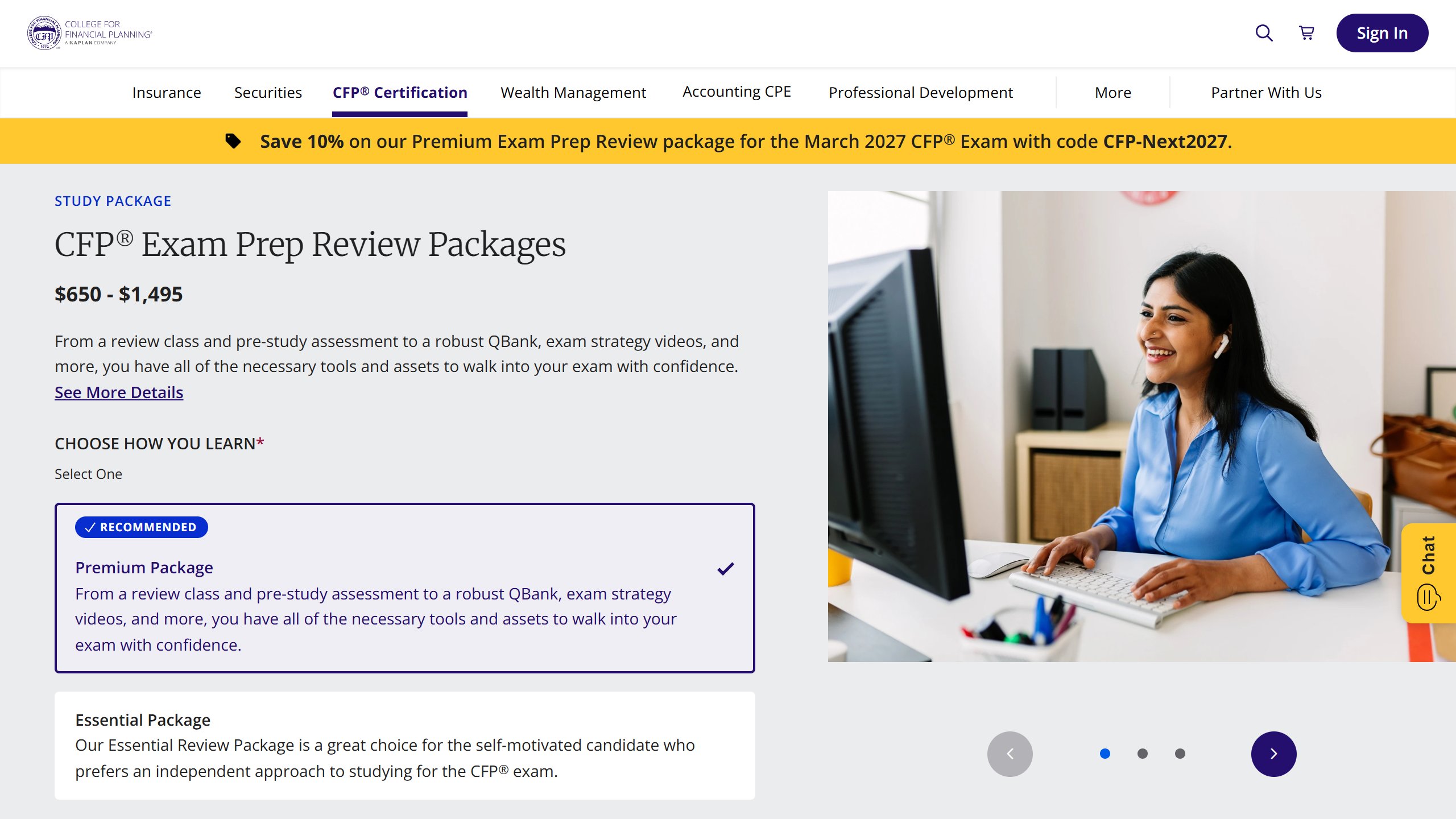
The AI. Kaplan’s CFP Exam Prep Review is run by the College for Financial Planning, a Kaplan company, which is on CFP Board’s list of review course providers. The package page lists an AI Tutor that gives personalized study tips, content explanation breakdowns and resource recommendations, alongside two other personalized tools: an Activity Feed that adjusts your weekly study schedule as you complete tasks or take time off, and a Performance Tracker that shows where to focus. Kaplan’s AI tools page confirms in a footnote that the tutor is included in CFP Exam Prep except the Essential Package. Kaplan does not name the model behind the tutor.
Plans and price. Premium costs $1,495. On 18 November the page also showed $1,345.50 with a 10% code for 2027 exams, with no end date given, so treat the discount as temporary. Premium is a ten-week program with a choice of four-day onsite classes, live online classes on weekdays or weekends, or on-demand classes, plus six textbook PDFs, calculator videos for the HP 10bII+ and TI BA II Plus, a 100-question pre-study assessment, a Review QBank of about 2,500 questions, a full online mock exam that simulates the six-hour day, and email access to instructors. Essential costs $650 and is aimed at independent self-study; it does not include the AI Tutor. Online materials expire at the end of the month you sit the exam, although the QBank lasts 12 months from first use.
Fine print. The PassProtection guarantee applies only to Premium and only if you sit within one year, three exam cycles, of enrolling. For your money back, you must score 80% or higher on both sessions of Kaplan’s mock exam and send your official score report within four months of its date. The alternative, a free repeat of the Premium review, needs only the score report within a year. Kaplan’s review page quotes a 98% first-time pass rate among surveyed Premium students; the footnote says the survey ran from 4 to 20 March 2026 and the figure rests on 116 first-time respondents. That is Kaplan’s survey, not CFP Board data.
Choose it if you want live or on-demand classes, a large question bank and an AI tutor in one package, and you can hit 80% on the mock if you want the refund option. Skip it if the AI is your main reason to buy, since it is only on the $1,495 tier.
2. Dalton Education: AI Study Tools inside a rebuilt Dalton Review
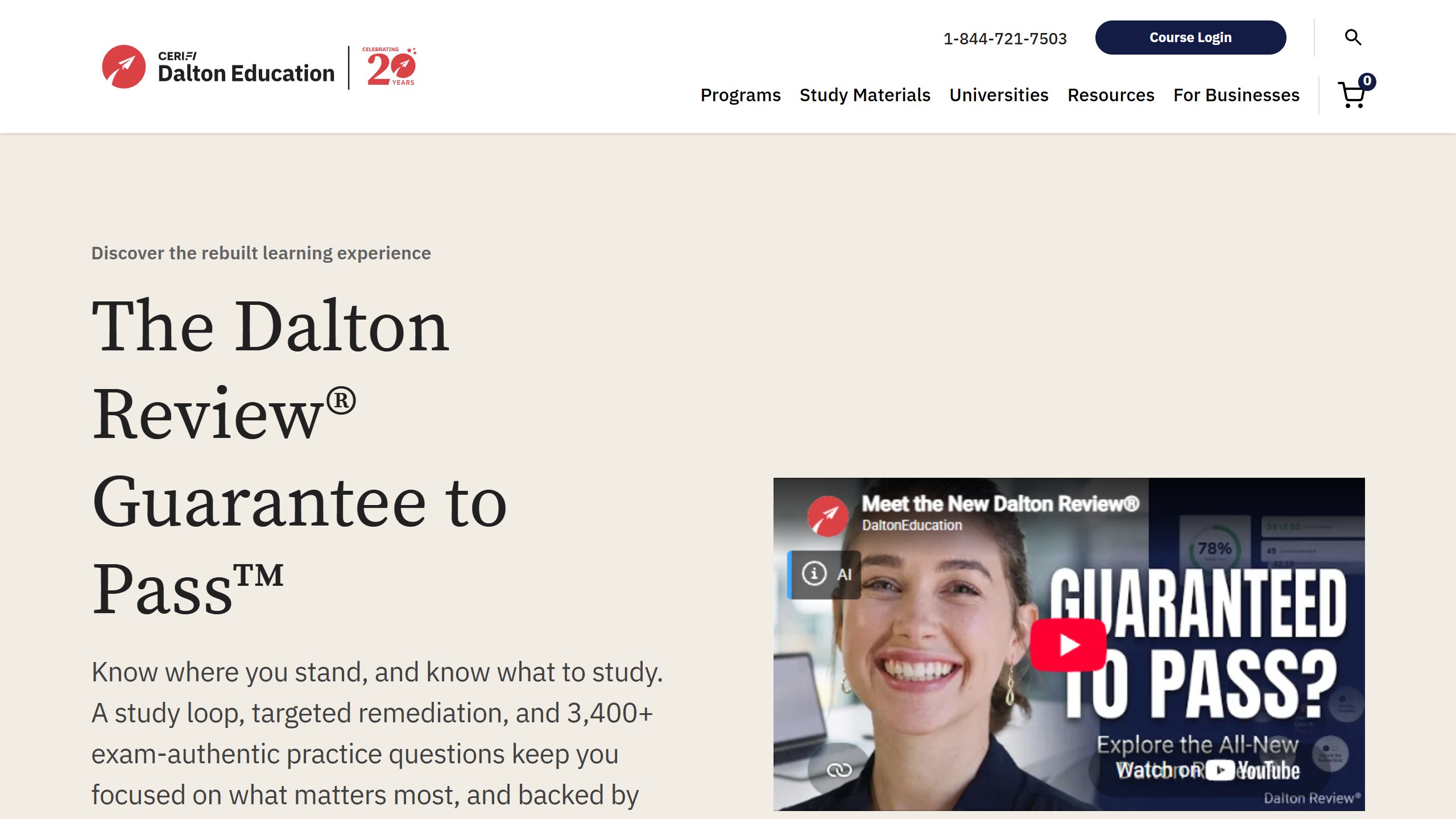
The AI. Both Dalton Review packages on Dalton’s review page list AI Study Tools. That is all the page says about them: there is no description of what they do, what they draw on or how they differ from the rest of the platform. Dalton is a CeriFi brand, and CeriFi describes AI search and a course chatbot on its own site, but Dalton does not say its AI Study Tools are the same thing, so we do not assume it. Around the AI line, Dalton describes a rebuilt platform with a Review Readiness Assessment, a proficiency report by domain, custom practice sets, unlimited mock exams, micro-learning units and an Exam Readiness Predictor, with 3,400+ practice questions including short scenarios and case studies.
Plans and price. The Dalton Review costs $1,659 and the Guarantee to Pass package $2,495. Both include e-book textbooks, live classes online or in person, office hours, recorded lectures and simulated exams. Guarantee to Pass adds individual coaching before and after the review, digital flashcards, a calculator book and an audio review; the flashcards and audio review are add-ons for the standard package. The weeknight option is a 15-week plan with 11 live sessions, and there are weekend and four-day options. Dalton says most students finish in two to three months, and it offers a free trial.
Fine print. The money-back guarantee is on the $2,495 package only. You sign a contract that sets the date by which you must sit the exam, and you must score 70% or higher on Dalton’s Exam Readiness Quiz, which you get once per cycle, two to three weeks before the exam; if you then delay, you take it again. Within 30 days of your result you send written notice with CFP Board’s diagnostic report and pass or fail document, and you choose a refund (returning materials) or continued access. The 99% pass rate on Dalton’s homepage is, by its own footnote, the average for students who scored 70% or higher on that same quiz, not for everyone who enrols.
Choose it if you want a structured schedule with live classes and coaching, and a money-back guarantee with clear rules. Skip it if you are buying for the AI: ask Dalton what its AI Study Tools actually do before you pay.
3. FreeFellow: an AI-drafted, human-reviewed question bank for free
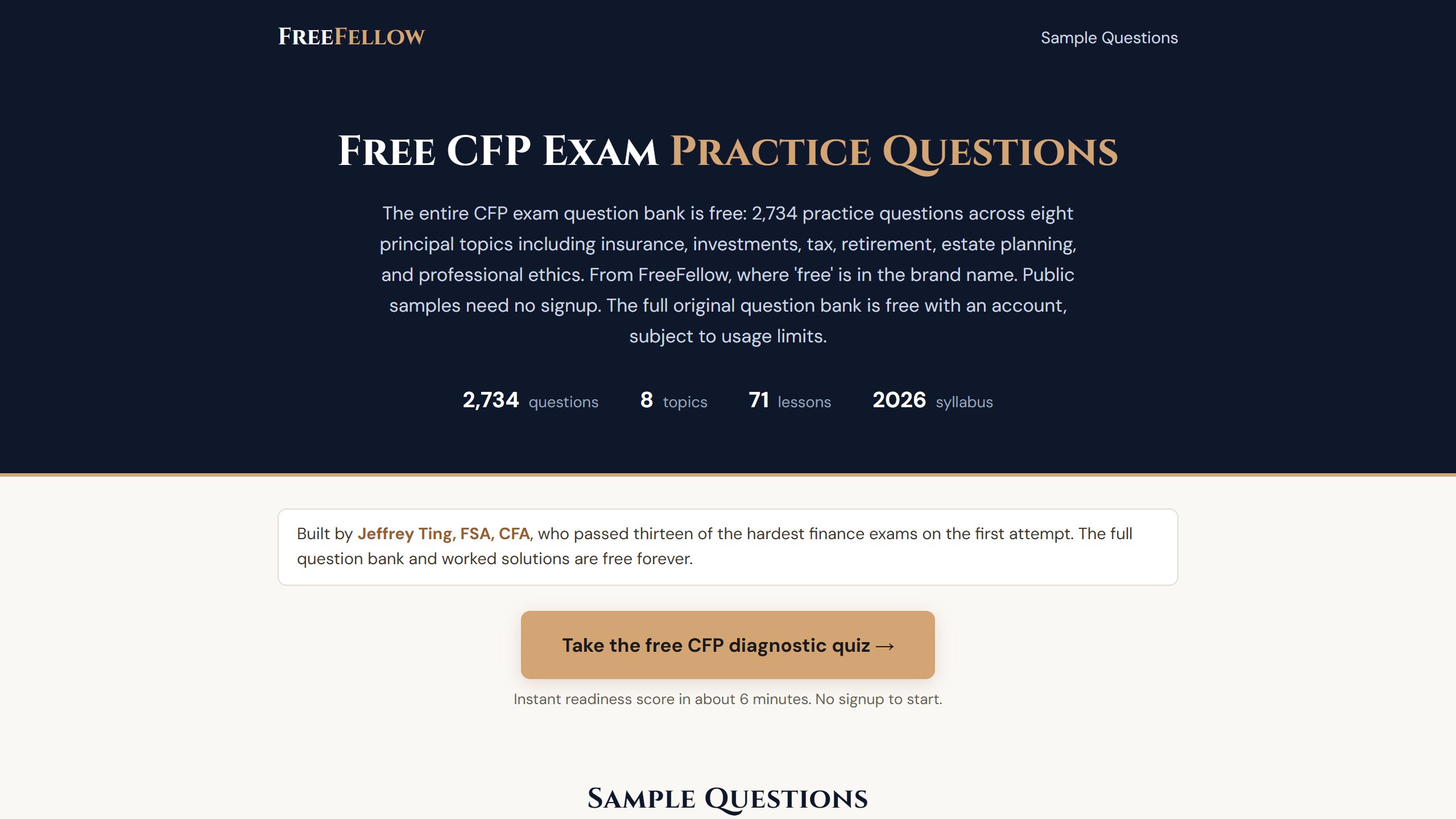
The AI. FreeFellow says plainly that it uses AI to draft original questions and that people review the drafts before they go live, and that the cost saving is why the bank is free. It also claims a raw AI draft has a material defect 30 to 40% of the time and that its own error rate is 1% or less; both figures are FreeFellow’s. That is a different use of AI from a tutor: the AI is behind the questions, not in a chat window beside them. It is also close to what CFP Board said about its own app.
Plans and price. The CFP question bank lists 2,734 practice questions across the eight domains, 71 written lessons, worked solutions, a formula sheet and readiness tracking, and says it is aligned to the 2026 syllabus. It is free with an account and no card, but the pricing page caps free accounts at 300 different questions a week, 120 a day and 60 an hour. Fellow, at $39 a month or $79 a quarter, adds timed mock exams, spaced-repetition flashcards, analytics and a study plan, and lifts the cap to 2,000 questions a week. Fellow Plus costs $49 a month, $99 a quarter or $199 a year, and a single timed mock costs $29. FreeFellow was built by Jeffrey Ting, an actuary and CFA charterholder, and covers dozens of finance exams.
Fine print. FreeFellow is not affiliated with CFP Board, offers no pass guarantee that we found, and publishes comparison posts about its competitors on its own blog. Its video lessons for the CFP are still being released on Fellow Plus. A free sample question on its page is written for 2026 tax figures, which is the right year for the windows through March 2027, but check the year on any question that quotes a limit.
Choose it if you want a large free bank to drill alongside your coursework or a paid course, and like knowing how the questions were written. Skip it if you want live teaching, a guarantee, or more than 300 questions a week without paying.
What about ChatGPT or another general chatbot?
A general chatbot is a reasonable free baseline, and this page gives no price for one because plans change often. It can walk you through a time value of money problem step by step, explain the difference between a revocable and an irrevocable trust, or quiz you on the eight domains, and you can ask it to question you before it explains, which helps with case-study reasoning.
The risk on the CFP exam is tax figures and rules, because they change every year and the exam fixes a year for each window. A chatbot may give you a contribution limit, an exemption or a phase-out from the wrong year, or mix the One Big Beautiful Bill Act’s changes with older law, with complete confidence. Tell it which tax year your window uses, check every figure against CFP Board’s tax tables and Key Elements summaries, and treat its answers on CFP Board’s Code of Ethics and Standards of Conduct as a draft to verify against the source. Never paste client details into it. If you came to the CFP from the brokerage side, our guide to AI Series 7 exam prep covers the FINRA exams, and if you are weighing the CFA as well, our guide to AI CFA exam prep tools covers that path.
The non-AI options
These three show no AI feature on their CFP review pages today, so they sit outside the numbered list. All three are on CFP Board’s list of review course providers, which CFP Board says it does not endorse, and all three are common choices.
Danko Education: a four-day live review after a long pre-study
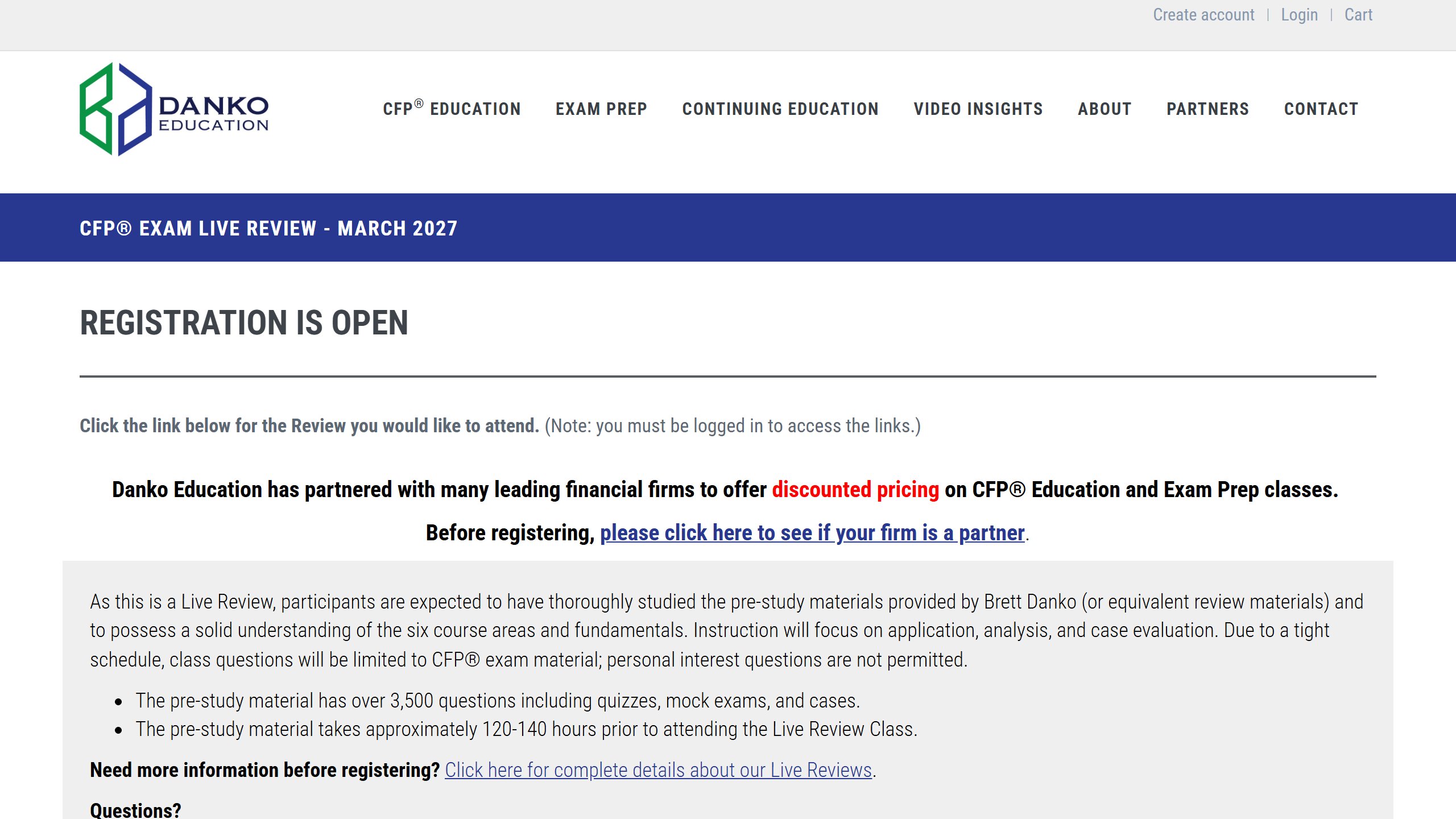
The AI. None listed on Danko’s Live Review page.
Plans and price. Virtual: $1,370 Comprehensive, $2,070 Signature and $2,770 PLUS. In person: $1,570, $2,270 and $2,970. Every package has a pre-study workbook with more than 3,500 questions across quizzes, mock exams and cases, which Danko says takes about 120 to 140 hours, then a four-day live review with 35 classroom hours, including calculator and investment formula sessions. Signature adds eight two-hour small-group sessions and one free virtual retake of the live review; PLUS adds recorded pre-study classes of about 20 to 25 hours per module, plus the retake.
Fine print. We found no money-back guarantee on the page. Danko says class questions are limited to exam material, and switching from in person to virtual brings no refund of the price difference.
Choose it if you want a heavy question load and an intensive live finish. Skip it if you cannot fit 120 hours of pre-study before the class.
Zahn Associates: one price, four days, 36 hours
The AI. None listed on Zahn’s Live Review page.
Plans and price. First-time tuition is $1,295 for pre-study materials, a four-day class of 36 hours in a hotel venue or a live virtual classroom, and post-study materials, plus a free app with podcasts and flashcards. Calculator videos cover the HP 10bII+, HP 12C and TI BA II Plus, and an Exam Analyzer shows weak areas on practice exams. A two-volume Test Bank and a Q&A Prep set are sold separately.
Fine print. No guarantee is listed. Zahn offers a reduced retaker tuition for returning students instead, and its claims of 30,000+ passes and pass rates more than 10% above the national figure are its own.
Choose it if you learn well in a short, intense class with one price. Skip it if you want a large question bank included without paying extra.
Boston Institute of Finance: an eight-week BIF Review
The AI. None listed on the BIF Review page.
Plans and price. Core costs $995 and Premium $1,795, both on an eight-week progressive schedule with books, video lessons, practice questions and flashcards. Premium adds more live instruction, a full-length mock exam, strategy modules, a student community and one Premium retake. The mock exam alone costs $249, and a financial calculations mini-course $295. BIF offers a 30-day free demo.
Fine print. No money-back guarantee is listed; the safety net is the Premium retake.
Choose it if you want weekly instruction at a lower price than a four-day intensive. Skip it if you want a refund-based guarantee.
What we left out, and why
Open Exam Prep, run by Bayview Global LLC, offers CFP material and comparison pages; we have kept it out of this lineup while we look at it across all our exam guides. Achievable publishes a CFP exam guide and a comparison of review courses but sells no CFP course. Pocket Prep’s professional app covers 21 exams, and the CFP is not one of them. On the US App Store, the CFP app with the most ratings in our search, Achieve’s, had 124 and makes no AI claim despite its domain name; CFP Mastery had 61 but was last updated in May 2017; and the remaining CFP apps had 14 ratings or fewer, so none made the list. For finance professionals moving into audit, our guide to AI CIA exam prep compares the AI study tools for the Certified Internal Auditor exam.
How to choose AI CFP exam prep
Start with CFP Board’s Practice Exam
Practice Exam I is free with registration and uses real retired questions in the real format. Take it early, read the domain report, and let it decide where your hours go. Add Practice Exam II at $225 near the end if you want a second real measure.
Check the tax year and the domain list
Ask which tax year the current bank uses and compare it with CFP Board’s table for your window: 2026 for the July and November 2026 windows and for March 2027. Check that the bank covers all eight domains, including Psychology of Financial Planning, and that it includes case studies of eight to twelve questions, not just stand-alone items.
Find out which package the AI is on
Kaplan’s AI Tutor needs Premium at $1,495; the $650 Essential package has none. Dalton lists AI tools on both packages from $1,659 but does not say what they do. FreeFellow’s AI is in how the free bank was written. If the AI is why you are buying, price the cheapest package that includes it, and ask for a description before you pay.

Decide what you want the AI to do
A tutor explains and points you to material; AI-written questions give you volume. Both can be wrong on figures. CFP Board’s own approach, AI-generated questions from a known source and peer reviewed, is the standard to ask other vendors about: what source, and who reviews.
Price the whole path
Add the registration fee ($825 early, $925 standard, $1,025 late) to the course, and remember a retake means another registration fee and another window, four months later. Check how long access lasts: Kaplan’s online material ends with your exam month, while a free bank does not expire.
Read the guarantee before you rely on it
Kaplan’s refund needs 80% on both mock sessions and a score report within four months. Dalton’s needs a signed contract, 70% on a one-time readiness quiz and the exam by your contract date, on the $2,495 package. Danko (on Signature and PLUS) and BIF (on Premium) offer a retake instead of a refund, and Zahn a reduced retaker tuition.
Verdict
Start with CFP Board’s free Practice Exam I and its tax table for your window, because both come from the people who write the exam. CFP Board’s own AI app was a notable launch, but on 18 November 2026 it had no public page or price, so confirm with CFP Board before counting on it. If you want an AI tutor inside a full review course, Kaplan Premium explains its AI more plainly than the others here, at $1,495, with a refund guarantee that asks for 80% on its mock. Dalton suits you if you want coaching and a contract-based guarantee, but ask what its AI Study Tools do before paying for them. FreeFellow is the free option, with AI drafting a bank that people then review, and it pairs well with any paid course. Danko, Zahn and BIF remain solid choices if you want live teaching and do not need AI. Whatever you pick, check every tax figure against the year your window tests.
Sources
- CFP Board: CFP exam requirement, Exam format, Principal Knowledge Domains and Topics, About the exam, Scoring and results, Exam statistics, Exam dates and registration, Eligibility, Rescheduling and cancellation.
- CFP Board: Practice Exam, Exam prep resources, CFP exam preparation, Tax tables and formulas, Exam review courses, CFP exam candidate handbook (October 2026), AI-powered practice exam tool announcement (May 2025), Competency Standards updates, Last chance to take the exam in 2026, Education requirement, Experience requirement.
- Kaplan Financial Education: CFP Exam Prep Review packages, CFP Exam Prep Review, PassProtection, AI Tools. Dalton Education: The Dalton Review, Home. FreeFellow: CFP questions, Pricing.
- Danko Education: CFP Exam Live Review. Zahn Associates: Live Review. Boston Institute of Finance: BIF Review.
- All pages read 18 November 2026.

Written by
FazFaz is the founder of AIToolsBakery. Some tools here are tested hands on. Others are assessed from vendor documentation and pricing verified on the live page, and every review says which one it is. Sponsors can buy a position in a guide. They cannot buy the score, the criticism, or silence about a better option.
How we test and how we make money →