
If you are reading this, you have probably passed the SIE and a broker-dealer has hired or is about to hire you. The Series 7 is the next step, and it is a different kind of purchase. You cannot sit it without a sponsoring firm, the firm may already have a prep provider it pays for, and the exam is longer and deeper than the SIE. Search for AI Series 7 prep and nearly every result is a prep company ranking itself, so the questions that matter go unanswered. Which plan actually includes the AI tutor? What does the AI do? What do you have to do to claim a pass guarantee? And does the product describe the exam as FINRA runs it today?
That last question is not a formality. FINRA trimmed the Series 7 in late 2025, from 135 items to 130, by cutting the unscored pretest questions from ten to five. It has also changed the rules on retakes from 19 January 2027. At least one well-known course page still describes the older format, and one still quotes an exam fee that does not match FINRA’s. This guide starts with what FINRA publishes, then compares six prep products that describe an AI feature in their own words, plus two well-known courses without one, on what the AI does, which plan it sits on, what it costs and what the guarantee really promises.
How we put this together. We have not used these tools ourselves. Every price and feature below comes from the vendor’s own website, and the exam facts come from finra.org, FINRA’s Regulatory Notice 26-18 and FINRA’s published content outlines, all read on 17 November 2026 and linked in the text. Prices were shown in US dollars and change with promotions, so treat them as a dated snapshot. None of these companies paid to appear on this page, and nothing here is career, legal or investment advice.
What the Series 7 is, according to FINRA
Prep sites restate FINRA’s rules with small differences, and a few have fallen behind, so these facts come straight from FINRA.
Format, fee and passing score
FINRA’s Series 7 page lists the General Securities Representative exam at 125 multiple-choice items, three hours and 45 minutes, a cost of $395 and a passing score of 72. Those 125 are the scored items. FINRA’s 2025 Series 7 content outline explains that every candidate also gets five unidentified pretest items that do not count, scattered at random through the exam, so you face 130 items in total, each with four answer choices. There is no penalty for guessing, so answer everything, and you may not bring reference materials into the test.
The passing score deserves a closer look. Several prep sites turn the 72 into a raw count: Achievable writes it as 90 of 125, and CertFuel says the same in its FAQ. FINRA’s outline describes the scoring differently. It places every candidate’s score on a common scale through a statistical process it calls equating, which accounts for small differences in difficulty between the sets of questions candidates receive, so everyone is held to the same passing standard. FINRA does not publish a fixed number of correct answers on the pages we read, so treat any “90 out of 125” target as the vendor’s rule of thumb rather than FINRA’s.
Sponsorship, the SIE and the 120-day window
This is the big difference from the SIE. FINRA says candidates for representative-level exams must be associated with and sponsored by a FINRA member firm, and that the SIE is a corequisite: you need both to hold the General Securities registration. Regulatory Notice 26-18 spells out the mechanics. For a representative exam, the firm files Form U4 for you, and once the enrollment request is processed FINRA’s system opens a 120-day testing window. Only the SIE can be booked by an individual on their own.
In practice that means your employer controls when your window opens, and many firms already buy prep for new hires. Several companies in this guide sell team or corporate packages, and CertFuel advertises 75% off for employees of listed firms who sign up with a work email. Before you spend your own money, ask your manager or licensing team whether the firm already has a provider, and whether it will reimburse a course you choose yourself.
What changed in late 2025, and what changes in January 2027
The previous Series 7 outline, dated 2021, described ten pretest items and 135 in total. The 2025 outline cut that to five and 130. The scored count, the four job functions and the time limit stayed the same. For your score, the change is small. As a sign of how closely a prep company maintains its course, it is useful: a product that still promises ten experimental questions has not caught up.
The second change has not taken effect yet. Under the waiting-periods FAQ, from 19 January 2027 the wait after a first or second failed attempt drops from 30 days to 15, and the wait after a third or later failure within two years drops from 180 days to 60. FINRA says the new periods apply to all its qualification exams, to new enrollments and to open windows without an appointment, and that it cannot shorten anyone’s wait before that date. Each attempt costs the full $395.
The four job functions and their weights
| Function | Share of scored items | Scored items |
|---|---|---|
| 1. Seeks business for the broker-dealer from customers and potential customers | 7% | 9 |
| 2. Opens accounts after obtaining and evaluating customers’ financial profile and investment objectives | 9% | 11 |
| 3. Provides customers with information about investments, makes recommendations, transfers assets and maintains appropriate records | 73% | 91 |
| 4. Obtains and verifies customers’ purchase and sales instructions and agreements; processes, completes and confirms transactions | 11% | 14 |
Function 3 is almost three quarters of the exam on its own: products, recommendations, suitability and records. The outline goes much further than these headings. Under each function it lists the topics and the FINRA, SEC, Cboe and MSRB rules the questions can draw on. It is free, it is written by the people who run the exam, and it is the nearest thing to a syllabus that exists.
There is no free FINRA Series 7 practice test
If you studied for the SIE with FINRA’s free practice test, you may expect the same here. FINRA’s Series 7 page links the content outline, an exam tutorial on taking the test by computer, and the SIE practice test, but no Series 7 practice test or sample questions. Every full-length Series 7 practice exam comes from a prep company, which makes the quality of a vendor’s question bank, and how recently it was updated, more important than it was for the SIE.
If you have not passed the SIE yet, start with our guide to AI SIE exam prep, which covers FINRA’s free SIE material and the prep companies that also sell Series 7 bundles.
Series 63, 65 and 66: the exams that usually come next
The Series 7 rarely stands alone. Many roles also need a state law exam, and FINRA’s site lists three North American Securities Administrators Association (NASAA) exams that FINRA administers. They are different exams with different jobs, which matters when you look at bundles.
Series 63
The Series 63, the Uniform Securities State Law Examination, is the short one: FINRA lists 60 scored and five unscored questions in 75 minutes, a $147 fee and a pass at 43 of the 60 scored questions, with no corequisites listed. CertFuel’s guidance pairs it with the Series 7 for state registration.
Series 65
The Series 65 is the NASAA Investment Advisers Law Examination, for investment adviser representatives. FINRA lists 130 scored and 10 unscored questions in 180 minutes, a $187 fee, a pass at 92 of 130 and no corequisite, so it does not need the Series 7 at all. If your role is advisory rather than brokerage, check with your firm before assuming you need both.
Series 66
The Series 66 combines the two roles. FINRA lists 100 scored and 10 unscored questions in 150 minutes, a $177 fee and a pass at 73 of 100. It has no prerequisite, but the Series 7 is a corequisite, and FINRA says it qualifies you as a representative of both a broker-dealer and an investment adviser. CertFuel calls the Series 7 and 66 the standard full-service pairing, and several companies below sell Series 7 and 66 or Series 7 and 63 bundles.
The typical order is the SIE on your own, then the Series 7 once a firm sponsors you, then the Series 63 or 66 your role requires. Your firm decides which state exam you need, so confirm it before buying a bundle.
AI Series 7 exam prep tools compared
| Product | What the AI does | Plan that includes the AI | Price (17 November 2026) | Access | Pass guarantee |
|---|---|---|---|---|---|
| FINRA content outline | No AI | n/a | Free | Open | n/a |
| Achievable | AI tutor for explanations and examples; adaptive review | The one Series 7 product | $199 once | One year | Refund if you passed one of its full practice exams in time and then fail |
| CertFuel | Aiden tutor on lessons and missed questions | Built into the course; the FAQ says you can add it to a free course | Free videos and practice exams; course price not shown on its public pages | Not stated | Paid courses only, with conditions |
| SecuritiesCE (Securities Institute of America) | TotalGenius tutor: answers, custom practice questions, cheat sheets | Complete Exam Prep Course, or bought separately | $289 with TotalGenius; TotalGenius alone $129 | Six months; TotalGenius alone 120 days | GreenLight Guarantee, with conditions |
| Pass Perfect | Smart Search, Smart Lookup and an AI Assistant chatbot | All three packages | $206, $309 or $396 | Seven months | Pass Promise package only, with conditions |
| Kaplan | AI Tutor for study tips and explanations | Premium only | $279 or $309 (Basic $139 and Essential $189 have no AI) | Five months | None found on the Series 7 page |
| Knopman Marks | KM Copilot chatbot, not in quizzes or exams | Platinum and Diamond | $710 or $1,110 (Gold $480 has no AI) | One year | None found on the Series 7 page |
How we chose and ordered these
Every product had to be on sale to US candidates on 17 November 2026, sell Series 7 prep specifically, describe an AI feature on its own pages, and come from an established operator or have enough App Store ratings to judge. FINRA’s outline sits first as the benchmark because FINRA writes and runs the exam. The numbered list is ordered by how much you must pay to reach the AI, how clearly the vendor explains what the AI does, and how plain the guarantee terms are. STC and ExamFX show no AI on their Series 7 pages today, so they have their own section further down. The order says nothing about pass rates, because every pass rate on these sites is the company’s own figure on its own basis, and we found no independent comparison.
The tools
Benchmark: FINRA’s Series 7 content outline
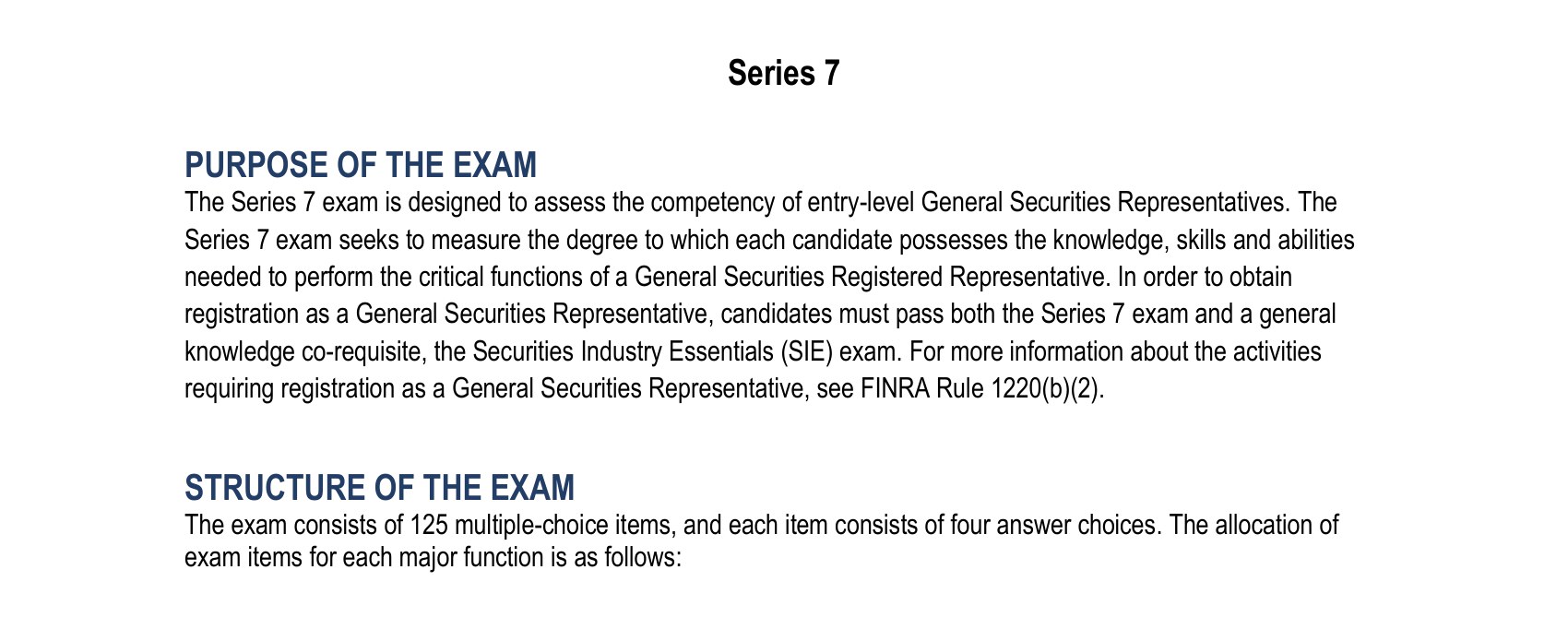
The AI. None. What FINRA offers is the source. The outline sets out the four job functions, the number of scored items in each, the topics under every heading and the rules the questions can draw on, plus the exam’s structure, timing and scoring.
Plans and price. Free to download. The exam tutorial linked from FINRA’s Series 7 page is also free.
Fine print. It is a syllabus, not a course. There are no lessons, no explanations and, unlike the SIE, no FINRA practice test to go with it. Use it to check that whatever you buy covers every listed topic and rule, and to decide where to spend your hours: Function 3 alone is 91 of the 125 scored items.
Choose it if you want to plan your study around FINRA’s own weights, or check a course’s coverage. Skip it if you expect it to teach you the material; it will not.
1. Achievable: an AI tutor inside a $199 course

The AI. Achievable’s Series 7 page describes the Ask Achievable AI Tutor as a tutor that replies immediately with clear explanations and real-world examples when you are stuck on a regulation or formula, and says it is fine-tuned to the exam’s structure, content, terminology and common pitfalls. Separately, the course uses adaptive learning: Achievable says it builds a model of your memory, tracks your retention of each learning objective and adjusts your quiz questions to match. It also says every piece of content is mapped to a framework of testable objectives and goes through expert review. It does not name the model behind the tutor.
Plans and price. One Series 7 product costs $199, paid once, for a full year of access. Achievable lists 35 full-length practice exams of 125 questions drawn from 4,400+ exam questions, 4,700+ practice questions with explanations in all, 1,800+ chapter review questions, and a textbook with 44+ videos and audio narration. Each new practice exam serves questions you have not seen first, and calculation questions come back with new numbers when you retake them. Bundles cost $249 for the SIE with Series 7, shown against $298, and $389 for six FINRA and NASAA courses, shown against $904. You can read the first lessons free without a card.
Fine print. The FAQ sets one condition for the pass guarantee: you must have passed at least one of Achievable’s full-length practice exams within the standard time before failing the real exam. You then email a picture of your score report and a valid state ID, and the refund follows verification. The 97% pass rate on the page is Achievable’s own figure for students who reach exam day, drawn from student self-reports and outcomes from its corporate clients, and it compares that with an industry figure of about 71% that it attributes to FINRA and NASAA reporting.
Choose it if you are paying yourself and want the AI, adaptive review and a deep bank of practice exams at one price with a simple guarantee. Skip it if you want live classes or a human instructor to call.
2. CertFuel: a lesson-aware tutor and a lot of free material

The AI. CertFuel’s Aiden page describes a tutor that reads the exact lesson you are on, and the whole unit around it, so you can ask a question without pasting context. It re-explains a section in plain English, works through an example with the numbers from the unit, makes a mnemonic for a fact that will not stick, tells you how the unit is weighted on the exam, and points you to a custom quiz, a practice exam or your flashcards when you are ready to drill. If you miss a practice question, an Ask Aiden button on the explanation hands it the question, your choice and the correct answer. CertFuel says Aiden nudges with a question before giving the full answer, does not look at your scores or history, and can make mistakes.
Plans and price. Much of CertFuel’s Series 7 material is free: it lists 335 short videos covering every testable subtopic with no signup, a free written lesson behind each, a free 130-question practice exam on its site, free practice exams inside its Series 7 course, 18 podcast episodes and a one-page cheat sheet. The site menu labels CertFuel’s SIE course free and does not label the Series 7 course that way, and we could not find a Series 7 course price on its public pages. Its discounts page offers 50% off paid courses for students with a .edu email and 75% off for employees of listed firms.
Fine print. The Aiden FAQ says Aiden comes built into your course and adds that on a free course you can add Aiden there too, without saying what that costs, so check inside the course. The pass guarantee covers paid courses. It asks for at least 2,000 study questions in the same course (practice exam questions and flashcards do not count), three full practice exams in a row at 80% or higher, and the real exam within 30 days of the third, with a claim within 30 days of the exam. You get back what you paid and keep your access. CertFuel’s Series 7 page already explains both the current retake waits and the January 2027 change. A comparison page on CertFuel’s site that ranked CertFuel first appeared in search results, but on 17 November that address showed the plain Series 7 page.
Choose it if you want to start free, like short videos, and want a tutor tied to the page you are reading. Skip it if you want to see the full price before you sign up, or prefer a long-established brand.
3. SecuritiesCE (Securities Institute of America): TotalGenius in the complete course
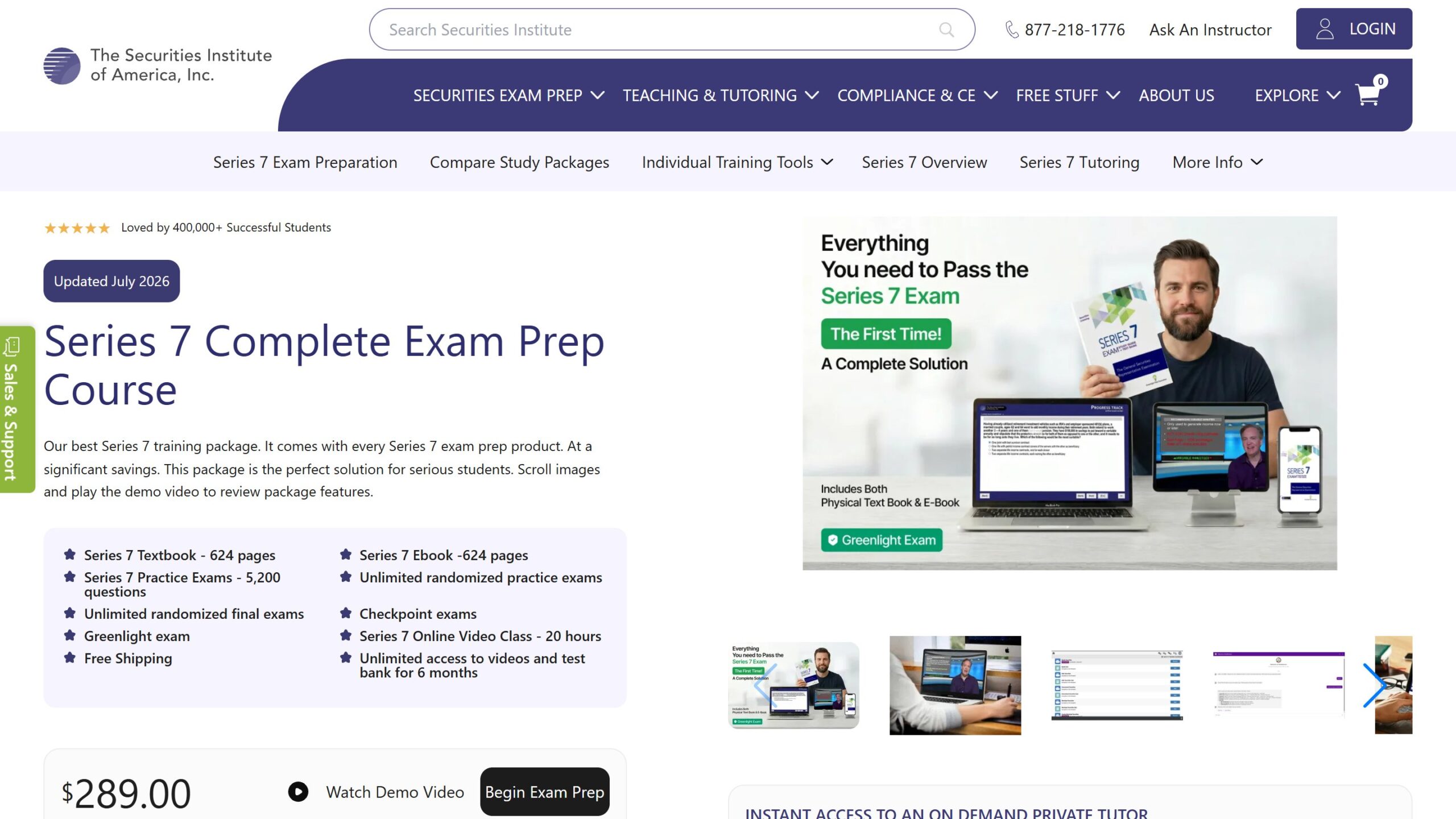
The AI. SecuritiesCE describes TotalGenius as an AI-powered exam prep tutor that answers any question in real time, generates custom practice questions aimed at your weak areas, and builds personalized cheat sheets you can save or print. You can type, talk or paste a question, and it says it can help with any FINRA, NASAA or NFA exam. The page says TotalGenius is Powered By OWEN without explaining what that is, and does not name an underlying model. A tutor that writes its own practice questions is useful for volume, but those questions are generated rather than reviewed, so weigh them below the course’s fixed bank.
Plans and price. The Series 7 Complete Exam Prep Course costs $289 and says it now comes with TotalGenius. It lists a 624-page textbook and ebook, 5,200 practice exam questions, unlimited randomized practice and final exams, checkpoint exams, a GreenLight exam and a 20-hour video class, with six months of access to the videos and test bank and free shipping. A video and test bank package costs $149 and a textbook and test bank package $209; neither lists TotalGenius as included. TotalGenius on its own costs $129 for 120 days.
Fine print. The GreenLight Guarantee works differently from the others. You must pass the GreenLight exam, which can be taken only once, within five days of your real exam; if you then fail, you get a refund of the software price, or the package price less $25 shipping and handling if it included a textbook. The page does not state what score counts as passing the GreenLight exam, so ask before you rely on it. You claim by emailing your certified score sheet. SecuritiesCE also calls TotalGenius the first AI-powered real-time instructor in securities exam prep, which is its own claim.
Choose it if you want a printed textbook, video classes and an AI tutor in one package, or want to add an AI tutor to another provider’s course for a fixed price. Skip it if you want more than six months of access or a guarantee with a stated pass mark.
4. Pass Perfect: three AI tools on every package

The AI. Every Pass Perfect Series 7 package lists AI Learning Tools. Pass Perfect links them to CeriFi, whose Learning with AI page describes three tools. Smart Search combines keyword matching with semantic search across the current chapter and the whole course. Smart Lookup gives a contextual explanation when you highlight a term. The AI Assistant is a Q&A chatbot that CeriFi says is fine-tuned to your course content. CeriFi says it does not use personally identifiable information to train its models, and its own disclaimer warns that generated content might be inaccurate, incomplete or misleading.
Plans and price. Pass Plus costs $206, Pass Plus Pro $309 and Pass Promise $396, each with seven months of access from purchase. All three include the AI tools, flashcards, a practice bank and chapter, mastery and final exams. Pro adds on-demand video review, instructor support and the ebook, and Pass Promise adds a live virtual review class and the guarantee. The page also offers savings of up to $99 when you bundle with the SIE.
Fine print. The Pass Promise applies only to the Pass Promise package. You must score 75% or higher on at least three practice final exams and sit the real exam within five days of passing the third; if you fail, you choose a full refund or free access until you pass. The Pass Promise page shows the Series 7 package starting at $345 while the Series 7 page lists $396, so confirm the price at checkout. The Series 7 page also contradicts itself on the exam fee: one section says $395, matching FINRA, while two FAQ answers say $245. It gives the current 30-day and six-month retake waits without mentioning the January 2027 change.
Choose it if you want AI help on the lowest tier of a structured course with exams at each stage. Skip it if you want the guarantee without paying for the top package.
5. Kaplan Financial Education: an AI Tutor on the Premium tier

The AI. Kaplan describes its AI Tutor on the Series 7 package page as a source of study tips, content explanation breakdowns and resource recommendations, created by its securities experts and adapting to your needs. Its AI tools page says the tutor is trained on Kaplan’s study program and compares it to having a securities expert available around the clock. Kaplan does not name the model.
Plans and price. The comparison table shows a check for the AI Tutor on the Premium package only, with a cross for Essential and Basic. Premium costs $279 OnDemand or $309 with a live online class and also adds the Mastery Exam, class notes and InstructorLink, which promises answers from securities content experts within two business days. Essential costs $189 and Basic $139. Every package includes the License Exam Manual, the SecuritiesPro QBank with unlimited randomly generated exams and a practice exam; Essential and Premium add checkpoint exams, a midterm and unit videos. Online access lasts five months, and a five-month extension costs $49.
Fine print. We found no pass guarantee on Kaplan’s Series 7 page. Its pass results page gives 84% for the Series 7, based on Kaplan’s own survey, and notes that the figure reflects students’ ultimate success, which may have needed more than one attempt. The practice exam, checkpoint exams and midterm can each be taken only once.
Choose it if your firm uses Kaplan, or you want a printed manual and video or live classes and are happy to pay for Premium to get the AI. Skip it if you want AI help on a budget tier or more than five months of access.
6. Knopman Marks: KM Copilot from the Platinum tier up

The AI. Knopman Marks describes KM Copilot as an AI-powered chatbot embedded in its courses for the Platinum and Diamond packages. You ask study questions as they come up and get explanations related to the material you are reviewing. The company says KM Copilot is trained exclusively on Knopman Marks course material, does not interact with quizzes or exams, and does not use or learn from individual student data. Candidates can also email Knopman Marks instructors, which the company describes as separate from the chatbot.
Plans and price. Gold costs $480, Platinum $710 and Diamond $1,110, each with one year of access. Gold covers video lectures, the textbook, quizzes, benchmark exams, flashcards and one call with faculty. Platinum adds KM Copilot, unlimited live classes, a Q&A video library, extra flashcard topics, study games and three faculty calls. Diamond adds a dedicated faculty advisor for a three-month term with weekly calls and a custom study plan. Upgrading from Gold to Platinum costs $230.
Fine print. The Series 7 page describes the exam as 125 graded questions plus 10 experimental, ungraded ones. FINRA’s 2025 outline says five. We found no pass guarantee on the page, and the 99% overall pass rate it quotes is the company’s own figure. Of the six, this is the highest price for reaching the AI.
Choose it if your firm is paying, or you want live classes and a faculty advisor with a chatbot on the side. Skip it if the AI is the main thing you want, since cheaper products include one.
What about ChatGPT or another general chatbot?
A general chatbot is a reasonable free baseline, and this page gives no price for one because plans change often. It can walk you through how a covered call works, compare a municipal general obligation bond with a revenue bond, or quiz you on the four job functions, and you can ask it to question you before it answers, which is the style CertFuel builds Aiden around.
The risk on the Series 7 is rules and numbers, and Function 3 is full of both. A model trained before late 2025 may tell you the exam has 135 items with ten pretest questions, and an older model may not know that retake waits change on 19 January 2027. It can also cite the wrong rule number, or the wrong threshold for an options or margin rule, with complete confidence. Check every rule, number and deadline against FINRA’s content outline, which lists the rules the exam draws on, and tell the chatbot which outline year you are studying. The prep companies above ground their tutors in their own course material for this reason. Never paste anything from your firm or a client account into a chatbot; your firm’s own policies on AI use apply too. If you are curious how AI is used on the investing side, our guide to AI stock research tools covers that ground, but it is a separate subject from passing the exam.
The non-AI options
These two show no AI feature on their Series 7 pages today, so they sit outside the numbered list. They are here because both are common choices, especially when a firm pays.
STC (Securities Training Corporation): firm-friendly courses with a guarantee on the upper tiers

The AI. None listed. STC’s Series 7 Top-Off page makes no AI claim.
Plans and price. Standard costs $273, Premier $479 and Premier Plus $576, all with six months of access. All three include an online and printed study manual, simulated final exams, chapter quizzes, an instructor hotline and free course updates. Premier and Premier Plus add flashcards, progress exams, Green Light exams and 23 hours of on-demand lectures, and Premier Plus adds a live virtual class, a recording of it and weekly Q&A sessions. STC also sells bundles with the SIE, Series 63 and Series 66.
Fine print. The STC Pass Guarantee is ticked for Premier Plus and Premier, not Standard. The page describes it as following STC’s study plan and meeting the requirements, but does not list the requirements, so ask before you buy.
Choose it if your firm uses STC or you want a Series 7 and state exam bundle from one provider. Skip it if you want an AI tutor.
ExamFX: AI promised, not yet on the Series 7
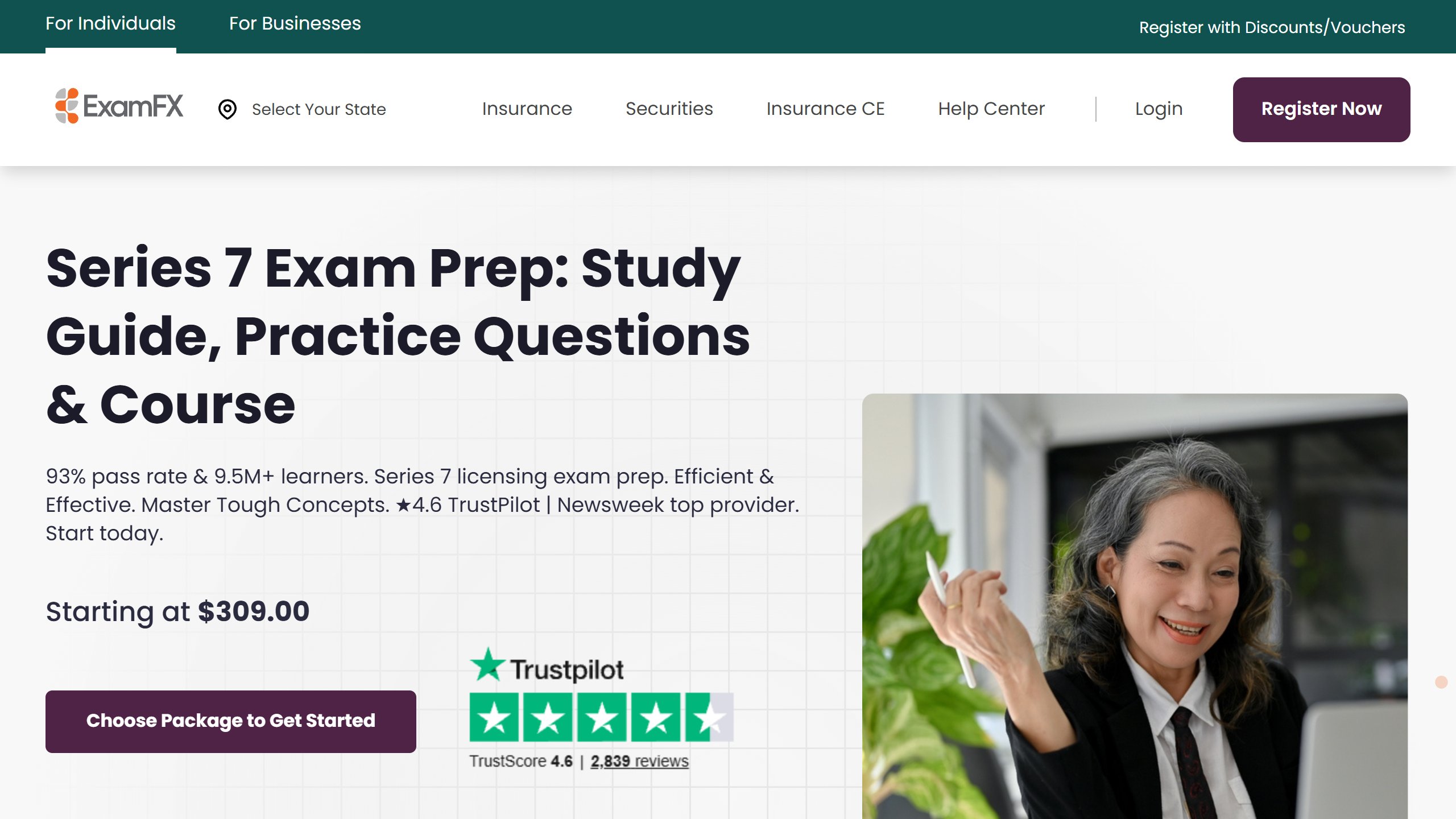
The AI. Not yet on the Series 7 course. ExamFX’s Claire AI page says its learning mentor is available in insurance courses and is coming to securities courses, including the Series 7, in November 2026. Its Series 7 page does not list it.
Plans and price. The Textbook Package costs $309 with 90 days of access, the Online Course Package $349 and the Live Online Package $449, both with 180 days. The page states the exam as 125 questions plus five unscored, matching FINRA’s 2025 outline, and quotes a 93% pass rate of its own.
Choose it if you like video courses with live webinars. Skip it if you need the AI today; check the course page again once Claire reaches securities.
What we left out, and why
Open Exam Prep, run by Bayview Global LLC, offers a free Series 7 study guide with practice questions and an Ask AI feature; we have kept it out of this lineup while we look at it across all our exam guides. On the US App Store, the Series 7 apps with the most ratings in our search make no AI claim: Series 7 Exam Center had 270 ratings but was last updated in August 2023, and the MastrAPI and Konnect apps had 40 and 51. The apps that advertise an AI tutor had 22 ratings or fewer, and many near-identical apps with “2026” in the name had none, so none made the list. Planning a move into financial planning later? Our guide to AI CFP exam prep shows which review package carries the AI.
How to choose an AI Series 7 exam prep tool
Ask your firm first
Your firm sponsors you, files your Form U4 and opens your 120-day window, and it may already pay for a provider. If it does, the choice may be made for you, and the question becomes whether to add a cheaper AI tutor on top. If it does not, ask whether it reimburses prep and whether it has a team discount.
Check the exam version
Look for 125 scored questions plus five unscored, 130 in all, and the four job functions with Function 3 at 73%. A product that says ten experimental items or 135 questions was written for the format before late 2025. Look for the January 2027 retake change too: a page that mentions it is being kept up to date.
Find out which plan the AI is on
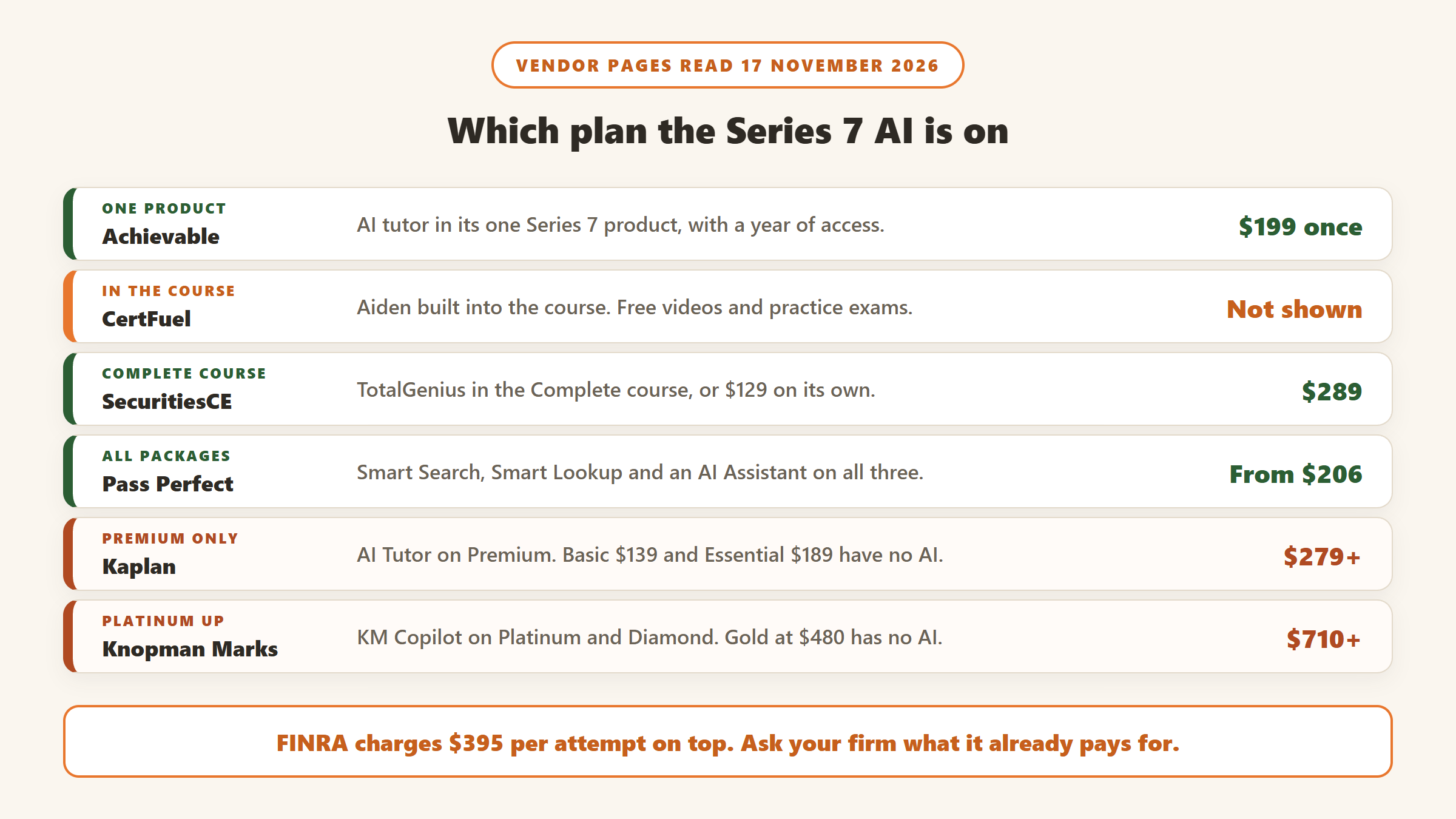
This is where the products differ most. Achievable includes its tutor in the one $199 product, CertFuel builds Aiden into its course, SecuritiesCE includes TotalGenius in its $289 package or sells it for $129, and Pass Perfect puts its AI tools on every package from $206. Kaplan’s AI Tutor needs Premium at $279 or more, and KM Copilot needs Platinum at $710 or more. If the AI is why you are buying, compare the price of the cheapest tier that includes it.
Decide what you want the AI to do
CertFuel’s Aiden is tied to the lesson in front of you and to questions you miss. Pass Perfect’s tools search and explain inside the course text. TotalGenius answers questions and also writes practice questions and cheat sheets. KM Copilot explains course material but stays out of quizzes and exams. Kaplan and Achievable describe a tutor that explains and recommends. None of them replaces a reviewed bank of practice exams, which matters more for the Series 7 because FINRA offers no practice test of its own.
Price the whole study window
Achievable and Knopman Marks give a year. Pass Perfect gives seven months, SecuritiesCE and STC six, Kaplan five with a $49 extension, and ExamFX 90 or 180 days. Your FINRA window is 120 days from enrollment, so a short course bought too early can run out before you book. Add FINRA’s $395 for every attempt, and price the SIE, Series 63 or Series 66 bundles if you still need those exams.
Read the guarantee before you rely on it
Ask what you must do to qualify and whether you get money back or more access. Achievable asks for one passed practice exam within the time limit. CertFuel asks for 2,000 study questions and three practice exams in a row at 80%, on paid courses. SecuritiesCE asks you to pass its one-time GreenLight exam within five days of the real one. Pass Perfect asks for three practice finals at 75% and the real exam within five days, on its top package only. STC lists a guarantee on two tiers without stating the requirements on its page, and we found none on Kaplan’s or Knopman Marks’ Series 7 pages.
Verdict
Start with FINRA’s free content outline, because it is written by the people who run the exam and tells you that Function 3 is 73% of your score. Then ask your firm what it already pays for. If you are buying for yourself, Achievable offers the simplest package here: one $199 price with the tutor, adaptive review, 35 practice exams and a guarantee with a single condition. CertFuel suits you if you want to start free and like a tutor tied to the lesson in front of you, as long as you check the course price inside. SecuritiesCE puts an AI tutor, a printed textbook and video classes in one $289 package, with a guarantee built around its own one-time readiness exam. Pass Perfect has AI on every tier but a tight five-day booking window for its guarantee. Kaplan and Knopman Marks make sense when the firm pays or you want live teaching, since their AI sits on the upper tiers. Whatever you pick, check that it describes the 130-item exam, and treat every AI answer about a rule or a number as a draft to verify against FINRA.
Sources
- FINRA: Series 7 exam, Series 7 Content Outline (2025), Series 7 Content Outline (2021), Waiting periods FAQ, Regulatory Notice 26-18, Series 63, Series 65, Series 66.
- Achievable: Series 7 exam prep, FAQ. CertFuel: Series 7, Aiden AI Tutor, Pass Guarantee, Discounts.
- SecuritiesCE: Series 7 Complete Exam Prep Course, TotalGenius. Pass Perfect: Series 7, Pass Promise. CeriFi: Learning with AI.
- Kaplan Financial Education: Series 7 study packages, AI Tools, Securities pass results. Knopman Marks: Series 7 exam prep.
- STC: Series 7 Top-Off. ExamFX: Series 7 exam prep, Claire AI.
- All pages read 17 November 2026.

Written by
FazFaz is the founder of AIToolsBakery. Some tools here are tested hands on. Others are assessed from vendor documentation and pricing verified on the live page, and every review says which one it is. Sponsors can buy a position in a guide. They cannot buy the score, the criticism, or silence about a better option.
How we test and how we make money →