
Three different products get sold as “AI stock research”. Some are assistants that answer a question and cite a source you can open. Some are score sellers that give a stock a number. Some are data terminals that turn up in AI roundups even though their own homepages make no AI claim. Those three things ask very different levels of trust from you, yet roundups often list them side by side.
That matters because many of those pages come from the vendors. AlphaSense publishes its own guide to stock research tools, Fiscal.ai has a post titled “Fiscal.ai is the Best Tikr Alternative”, and Trade Ideas’ AI trading software guide says “our pick is Trade Ideas. It is our own product”. This guide asks one question of nine tools: does the AI show you the document behind its claim, or does it only give you an answer or a score? Then it reads each vendor’s price page, performance claims and disclaimer.
This page compares software. It is not financial or investment advice, it recommends no stock, and no tool here can promise you a return. Every performance figure below is the vendor’s own and is attributed to it.
How we put this together. We have not used these tools ourselves; this is a research-based comparison. We created no accounts and started no trials. Every price, feature and quote comes from the vendor’s own pages or the US App Store, read on 2 November 2026, and each source is linked. Seeking Alpha’s performance report blocked our browser and we did not try to get around that, so we quote no figures from it. ChatGPT’s pricing page served us Indian rupees, which we report as regional and do not convert. All other prices were shown in US dollars. None of these companies paid to appear on this page.
Start with the regulators and the free baseline
What US regulators say about AI research
In a joint investor alert dated 25 January 2024, SEC staff, NASAA and FINRA wrote that AI-generated information “might rely on data that is inaccurate, incomplete, or misleading”, and that “Even when based on accurate input, information resulting from AI can be faulty, or even completely made up.” They also warn that chatbot conversations “could lead you to make misinformed, emotionally-driven or impulsive investment decisions”. Their advice is plain: “Confirm the authenticity of underlying sources and review multiple sources of information before making investment decisions.”
The same alert says to “Be wary of claims” that AI can guarantee returns, “even from registered firms and professionals”. It is a staff statement rather than a rule, but it gives you the test used throughout this page. If a tool does not let you confirm the underlying source, you cannot do what the regulators ask.
SEC EDGAR: the free baseline
EDGAR full text search is the SEC’s own tool, and the page says it “gives you access to the full text of electronic filings since 2001.” It has no AI, no summaries and no price. It covers filings made with the SEC, so companies that do not file there will not appear. Its value on this page is as the place to check an AI answer: when a tool gives you a revenue figure or a risk factor, this is where you can read the original 10-K or 10-Q yourself.
AI stock research tools compared
| Tool | Type | Does it show the source? | Entry price (2 November 2026) | What its own terms or footer say |
|---|---|---|---|---|
| Perplexity Finance | Assistant | Says every answer has citations; SEC integration since June 2025 | Free; Pro $17 a month billed annually | “not intended for trading purposes or financial, investment, tax, legal, accounting or other advice” |
| Fiscal.ai | Data terminal, plus a connector for AI tools | Says “Click-through auditability for every figure” | Pro $49 a month, or $39 billed yearly | Not an investment advisor, no recommendations |
| ChatGPT or Claude | General assistant | Depends on what you give it; check every figure | Claude Pro $17 billed annually or $20 monthly; ChatGPT regional | Claude’s consumer terms bar relying on it to buy or sell securities |
| Seeking Alpha Premium | Scores plus AI summaries | Summaries draw only on Seeking Alpha’s site, and are unreviewed | $299 a year plus tax | “does not offer any personalized investment advice” |
| Danelfin | Score | Shows signals behind a score, no filing link described | Free; Plus $29 a month, or $22 billed yearly | “does not constitute investment advice” |
| Morningstar Investor | Analyst research, with an AI assistant | Human analyst reports; AI assistant last described in 2024 | $34.95 a month or $249 a year | Fine print notes the rate can change without notice |
| TIKR | Data terminal, no AI claim found | Filings and transcripts in the product | Free US plan; Plus $24.95 a month, or $17.95 billed yearly | S&P content “not investment advice” |
| Koyfin | Data terminal, no AI claim found | Filings and transcripts from the Plus plan | Free; Plus $49 a month, or $39 billed yearly | “should not be construed as investment advice” |
| AlphaSense (professional) | Assistant over paid research | Says “sentence-level citations” | Quote only | AI may generate “incorrect, incomplete, misleading” output |
Prices read on 2 November 2026. Annual prices are per month and billed once a year, so check the toggle before you compare two vendors.
Assistants that show a source
These tools answer questions in plain language and say they link to where the answer came from. They are the group that fits the regulators’ test, as long as you actually click the link.
1. Perplexity Finance
Perplexity Finance is a free markets page with a summary, screener, watchlist, earnings section and an AI search box. In a post dated 5 June 2025, Perplexity announced an SEC/EDGAR integration for all investors and said “Every answer comes with direct citations to the source documents, so you can verify the information and dive deeper when needed.” Its Pro page repeats the promise: “Every answer includes inline citations from trusted sources”.
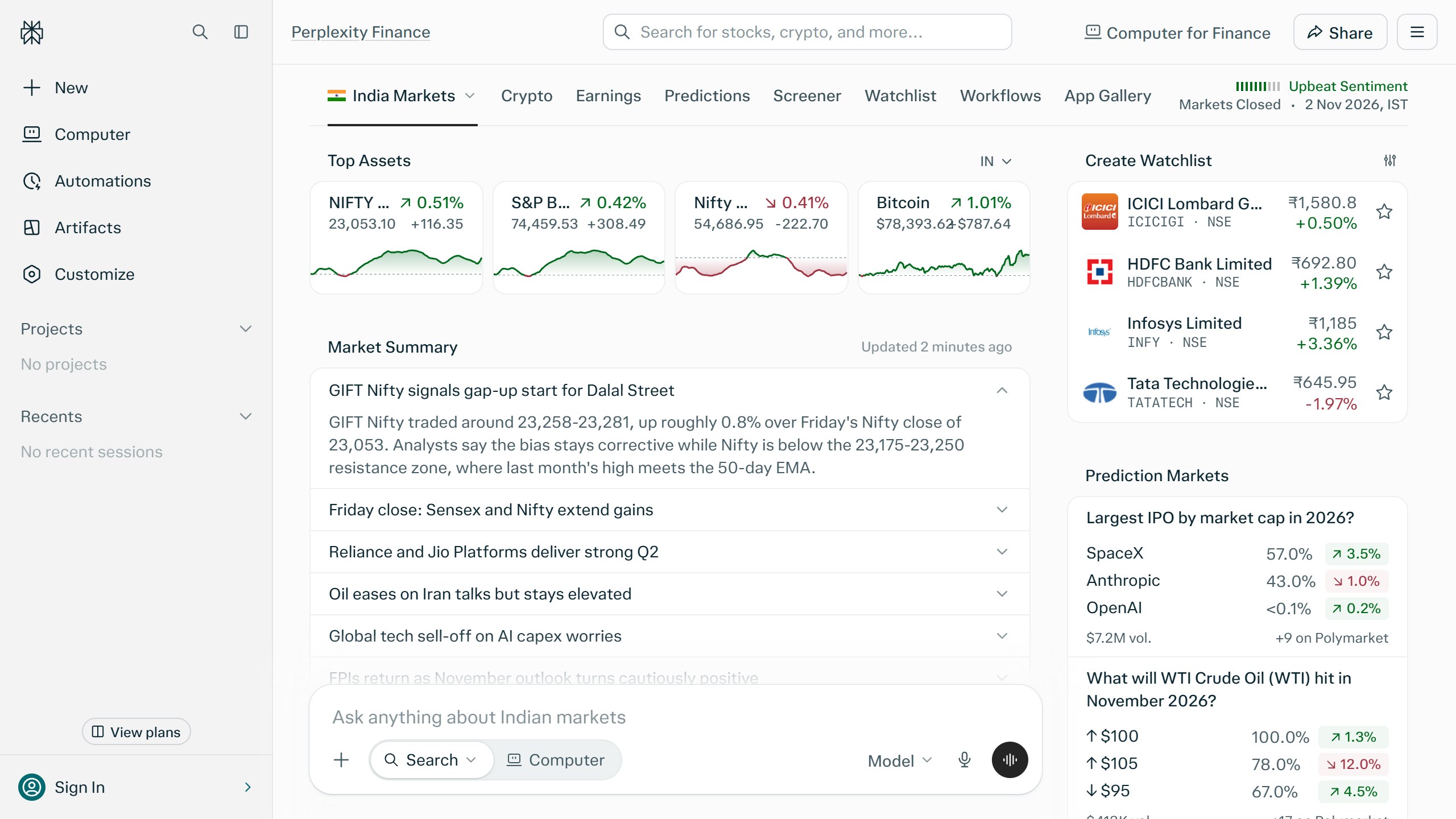
The Finance page names its data suppliers in the footer. Financial information comes from Financial Modeling Prep, and “Earnings transcripts, audio, and documents provided by Quartr”. The same footer says the data is “not intended for trading purposes or financial, investment, tax, legal, accounting or other advice.” A citation also tells you only where a sentence came from, so you still have to check that the source says what the answer claims.
Pro costs $17 a month and Max $167 a month, both billed annually. The page did not show us a monthly-billing price. Its help centre lists licensed connectors for Pro, Max and Enterprise users who already hold a licence with the data partner, including FactSet, Morningstar, Wisesheets (“linked filing citations”) and AlphaCreek, so those filing tools are extra subscriptions rather than part of Pro. The iPhone app had 4.8 stars from about 520,000 ratings, for Perplexity as a whole rather than for Finance.
Choose it if you want to ask questions for free and open the sources. Skip it if you want a spreadsheet-style terminal with years of comparable financials.
2. Fiscal.ai
Fiscal.ai was previously called FinChat, and it answers the “show me the filing” question directly. It lists “Source to Filing” as a data type: “Click-through auditability for every figure. Delivered in Image, PDF and URLs.” It also claims “Institutional-grade data, 100% auditable to source”, with human verification. That is the vendor’s wording, and it sets out what you should expect to see in the 7-day trial. Its help centre says fundamentals for US, Canadian, ADR, UK and EU companies use its own data, “while other geographies are sourced from S&P Capital IQ”, so test the click-through on a non-US or non-European company if those are what you research.
The AI story has shifted. Older roundups describe a chat Copilot, but the Terminal page we read does not mention one, and the newest Copilot entry we found in its changelog is dated 15 January 2025. What the site promotes now is Fiscal MCP, a connector that sends its data into “Claude, OpenAI, and others”, covering “13,000+ public companies across US, Canada, ADRs, UK & Europe”. If you want to chat inside the Terminal, confirm that before you pay. One more point of interest: the homepage quotes Perplexity’s head of finance product saying Fiscal.ai delivers data to Perplexity, so the two tools above are not fully independent checks on each other.
The Terminal costs $49 a month or $39 billed yearly for Pro, and $99 a month or $79 billed yearly for Max, with financial data exports on Max. MCP and API access are priced separately. The trial needs a credit card and “converts to a paid subscription” unless you cancel. The terms say monthly plans are non-refundable, while the help centre says annual plans bought in the past 30 days are “eligible for refund review”. The terms also state, in capitals, that the provider is not a tax, legal, financial or investment advisor.
Choose it if you want to check figures against filings, or feed clean data into your own AI assistant. Skip it if you do not want to give a card for a trial.
3. ChatGPT or Claude as a general baseline
You can paste a 10-K into a general assistant. That works best when you supply the document, because you then know what the answer was drawn from and can check the page it refers to. Without a document in front of it, a general assistant may give you a figure you have no quick way to trace.
Read the terms before you lean on either. OpenAI’s terms of use say “You should not rely on Output from our Services as a sole source of truth or factual information, or as a substitute for professional advice.” Anthropic’s consumer terms (effective 8 October 2025) go further. They list as a prohibited use relying on the service “to buy or sell securities or to provide or receive advice about securities”, adding that Anthropic “is not a broker-dealer or a registered investment adviser”. So summarising a filing is one thing, and asking which stock to buy is something Anthropic’s consumer terms say you must not rely on it for.
Claude Pro cost $17 a month billed annually or $20 billed monthly. ChatGPT Plus was served to us at ₹1,999 a month, which is a regional price, so check yours. Fiscal.ai sells its connector into both, as described above. If you are an investor in property rather than listed shares, our guide to AI tools for real estate investors covers that side.
Choose it if you already pay for one and want help reading a document you have supplied. Skip it if you want live market data or a stock opinion you can rely on.
Score sellers: a number instead of a document
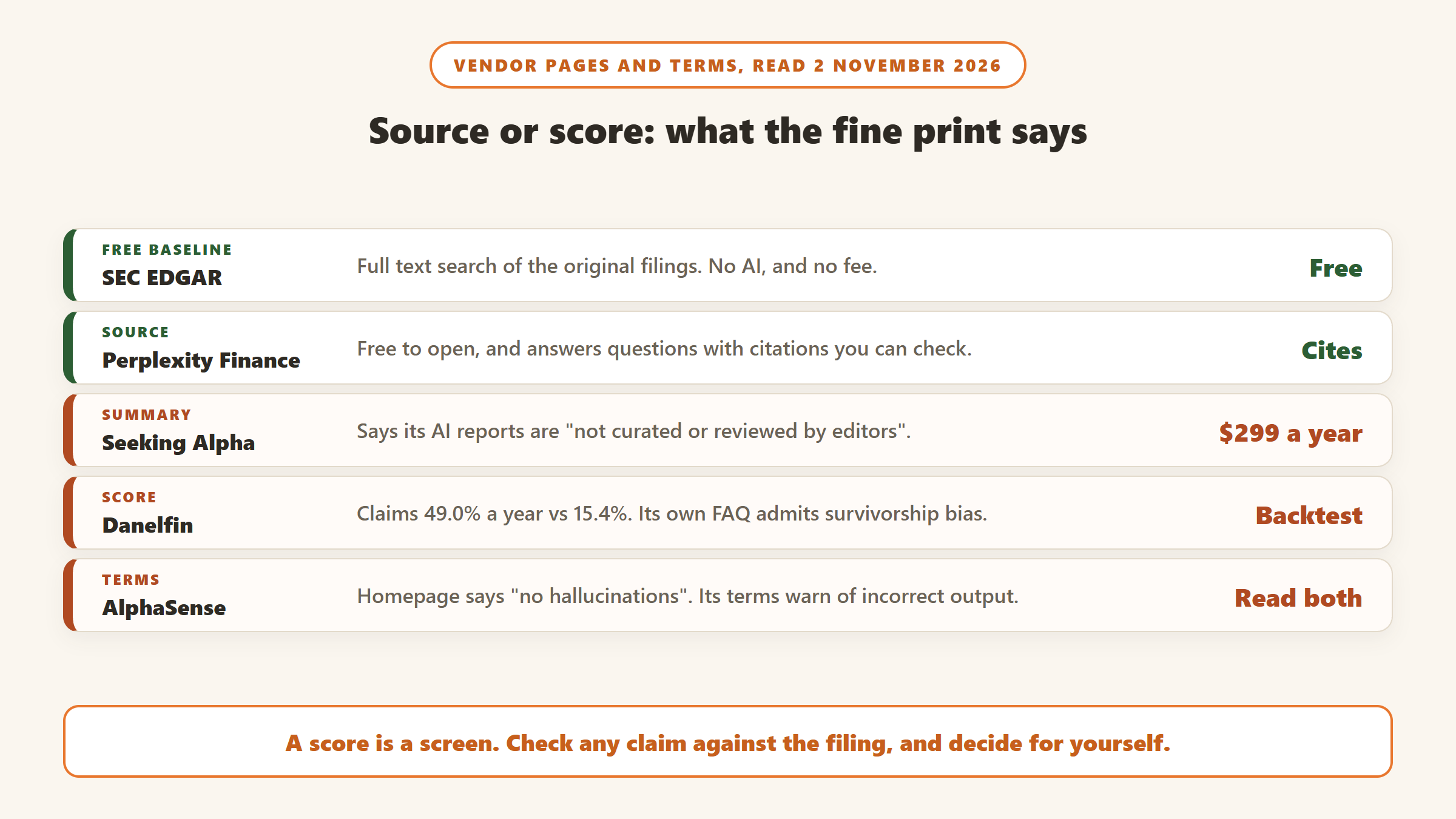
These tools rate stocks. A score can be a useful screen, but it does not show you the filing, and the performance evidence behind it deserves a careful read. A backtest applies a method to past data, which is different from having made those calls at the time.
4. Seeking Alpha Premium
Seeking Alpha is two things under one roof. Premium costs $299 a year plus tax where applicable, and includes “data-driven stock ratings and screeners”, analysis from its contributors, and “AI-powered research tools (such as Virtual Analyst Reports and Earnings Call Insights)”.
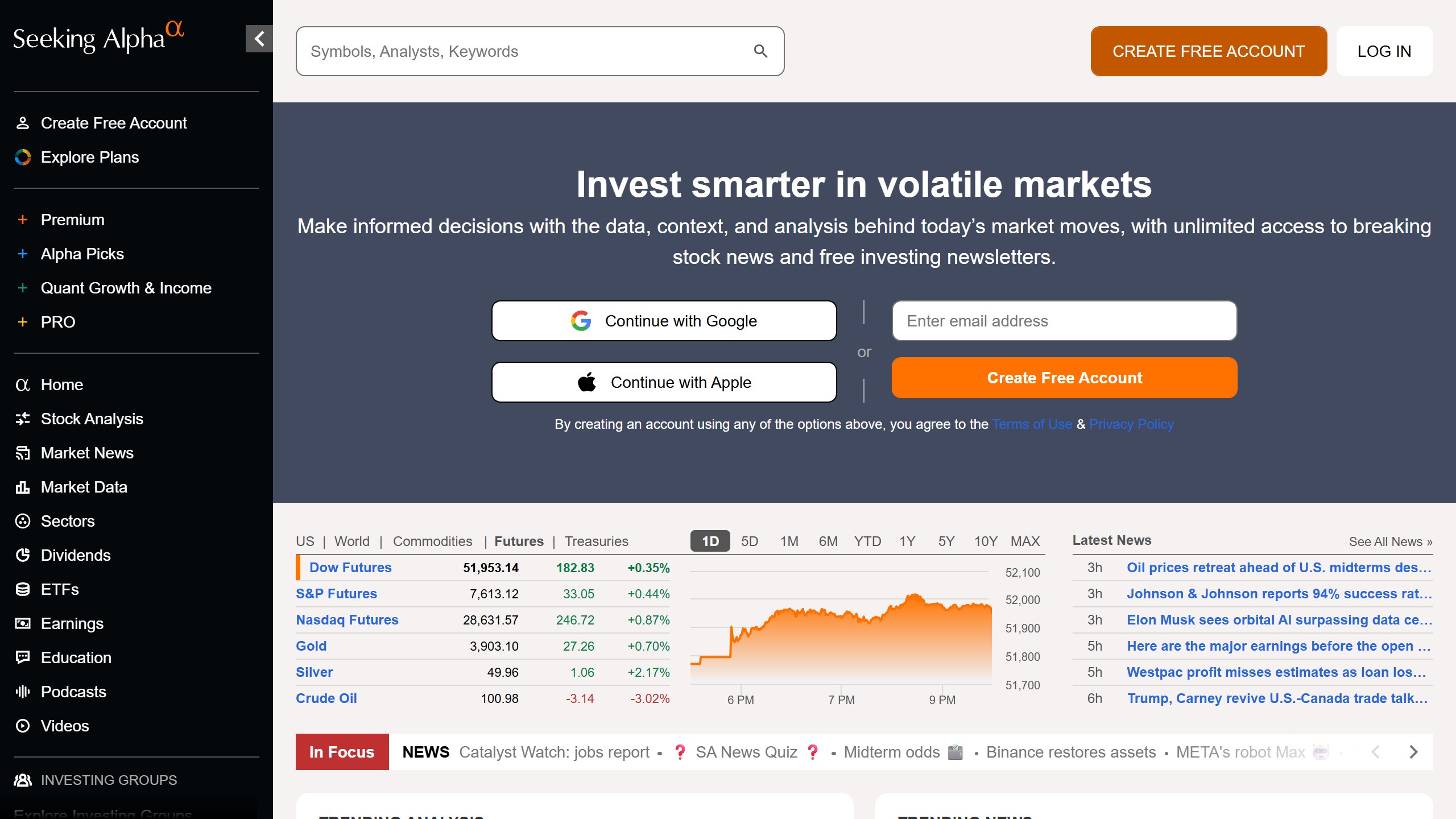
The AI reports, now called Summary Reports in the help centre, are “generated by an AI general-purpose language model (LLM)” and have five sections: company description, competitors and unique value, rating explanation, and the positives and concerns raised by analysts. The vendor’s disclosure is unusually direct. Its help page says “The reports are not curated or reviewed by editors and may contain errors.” Its sourcing page says each report is built from content on the Seeking Alpha website, including third-party research, Quant ratings and official company reports, and “does not consider any other information or perform any independent analysis”. So this summarises Seeking Alpha’s own contributors. It is not a fresh reading of the filings.
On performance, a Premium landing page says “Backtested over 10+ years, our ‘Strong Buy’-rated stocks have outperformed the S&P 500 by a wide margin.” The help centre confirms the ratings “have been tested against the S&P 500 Total Return Index” and points to a report that we could not open, so we quote no figures. The same landing page says “Past performance is no guarantee of future results”, that its analysts “may not be licensed or certified by any institute or regulatory body”, and that Seeking Alpha “does not offer any personalized investment advice”. The iPhone app had 4.8 stars from 126,659 ratings, updated on 31 August 2026.
Choose it if you want contributor analysis and ratings in one place, and you treat the AI summary as a starting point. Skip it if you need AI output checked against filings.
5. Danelfin
Danelfin is a pure score seller. Its AI Score runs from 1 to 10 and, on its homepage, “rates the probability of beating the market in the next 3 months”. This is machine learning on market data, not a chatbot. Its audit site says it uses about 500 gradient-boosted decision trees on 900 technical, fundamental and sentiment indicators, classified into about 10,000 features per stock each day. Its plans list the “alpha signals” behind a score, and the free plan shows only the top ones. We found no description of a link from a score to a filing.
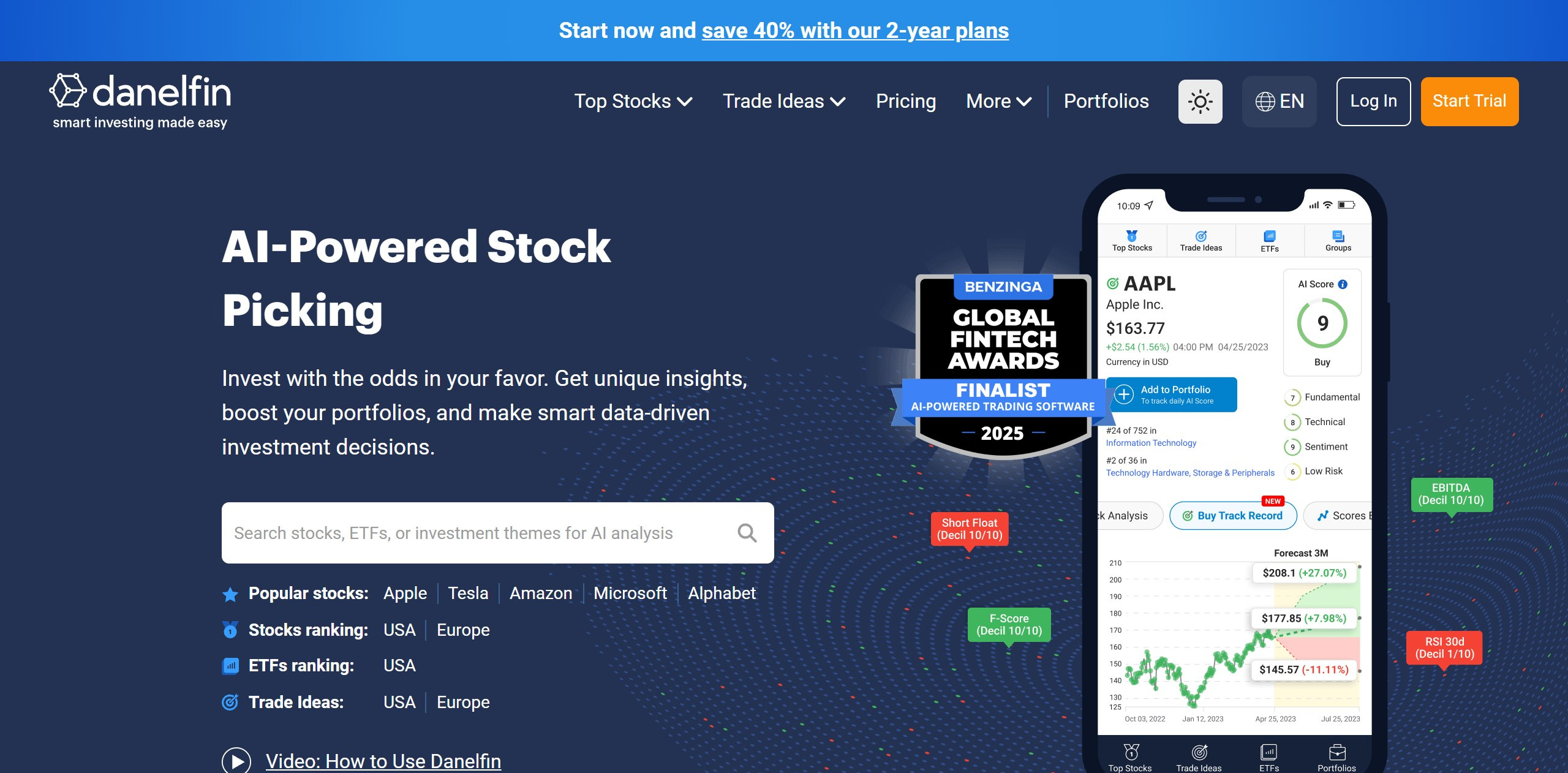
What sets Danelfin apart is how much its own audit gives away. The dashboard’s default view, with data as of 24 September 2026, says “The Top 20 strategy returned 49.0%/yr vs 15.4% for the S&P 500 over ~9.6 years”, and that stocks rated 10 beat the index by 1.97% on average while stocks rated 1 trailed by 11.11%. Those are Danelfin’s own backtested figures, and the page labels them as historical backtests. It also grades itself “AI Score Quality: 70/100” and shows the period was 75% bull market.
Now the fine print, from its own FAQ. Asked about bias, it answers “Yes, survivorship bias”. Companies that no longer trade, with Twitter, Silicon Valley Bank and Celgene as examples, are missing from past dates, and the size and direction of that bias “cannot be determined from this data”. It also says “Scores before Jul 7, 2025 were recalculated walk-forward by the current model (simulated backtest)”, and only scores from that date onward are “live, point-in-time”. So about eight and a half of those years are simulated. The FAQ describes the score as an edge that “works best across a basket of stocks, not as a conviction signal for one position”. The strategy page says “Backtested performance does not guarantee or indicate future results” and “does not constitute investment advice”. Credit to Danelfin for publishing this, and read it before you read the headline number.
Plus cost $29 a month or $22 billed yearly ($264), Pro $79 or $59 ($708), and Elite $179 or $134 ($1,608). The free plan allows 10 reports a month, and paid plans list a 14-day trial and a 30-day money-back guarantee. The iPhone app had only 14 ratings, updated on 30 October 2026.
Choose it if you want a quantitative screen across many stocks and accept that it is a statistical signal. Skip it if you want to understand a single company or see its filings.
Human research with some AI alongside
6. Morningstar Investor
Morningstar belongs here mainly as the contrast. Its product is written analyst research and ratings, and its offer page says its analysts are “truly independent from other Morningstar businesses”. The list price on that page is $34.95 a month or $249 a year, with a seven-day trial. The $199 first-year figure you may see elsewhere needs “a valid affiliate partner code”, which is worth knowing when a roundup quotes it.
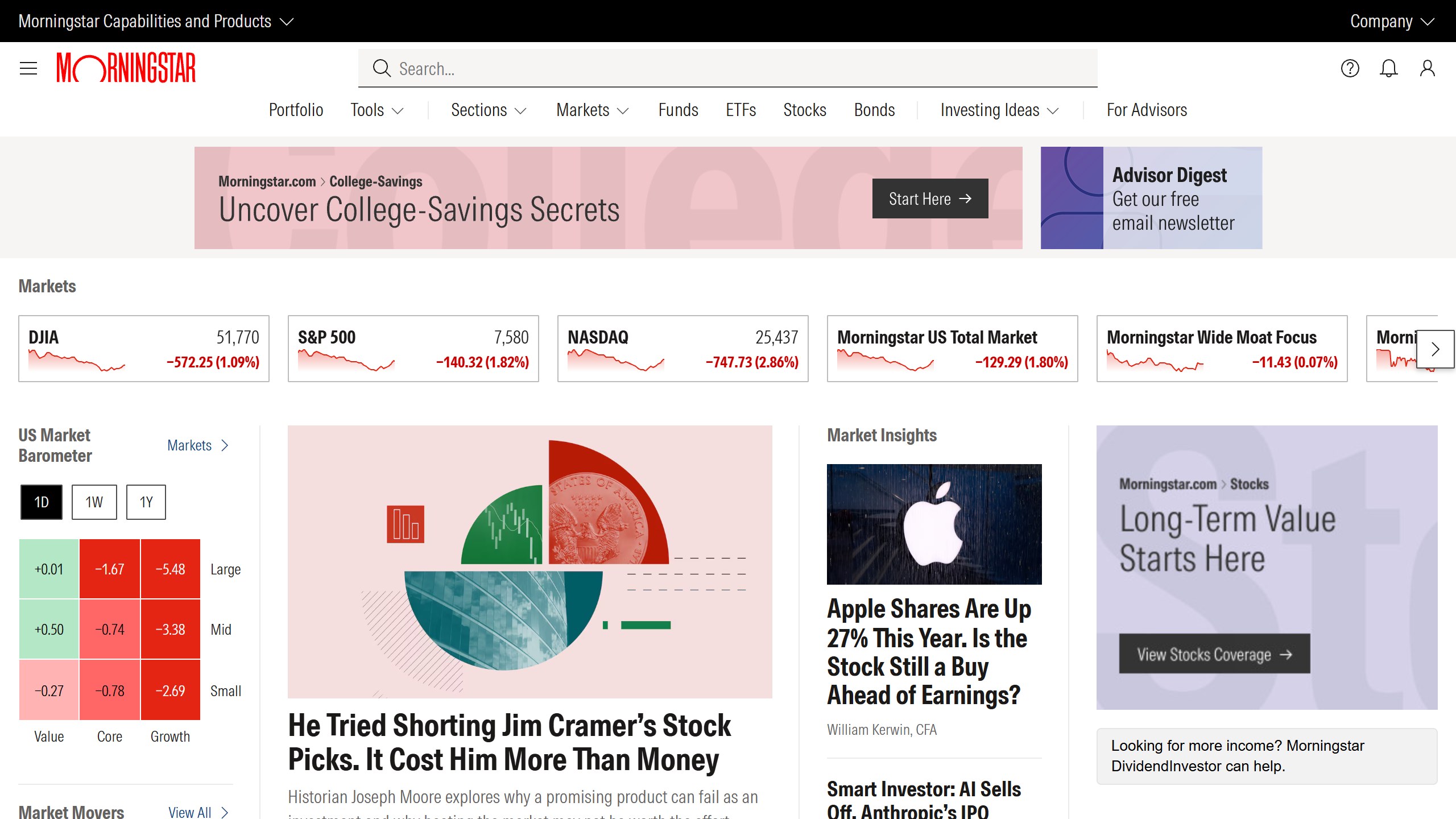
The AI part is harder to pin down. A Morningstar post about changes from August 2024 says subscribers “will still have access to Mo, Morningstar’s AI research assistant”. We found no newer retail page describing Mo, and the offer page does not mention it, so confirm it before you count on it. The iPhone app had 4.0 stars from 7,037 ratings, updated on 23 October 2026, a lower rating than the other apps listed here.
Choose it if you want analyst opinions and fair value ratings, with the reasoning written out. Skip it if AI is the reason you are shopping.
Two cheaper data terminals, with no AI claimed
TIKR and Koyfin appear in AI stock tool roundups, so readers ask about them. We read their homepages and pricing pages, and Koyfin’s features page, and found no AI research feature described. Koyfin’s site has buttons inviting you to ask ChatGPT, Claude or Gemini about Koyfin, which is not the same thing. A short read cannot prove a feature does not exist, so ask if it matters. They are worth knowing as a cheap way to check an AI’s numbers, not as AI tools.
TIKR says it covers more than 100,000 stocks across 92 countries with data from S&P Global CapitalIQ. Its pricing page lists a free US plan, then Plus at $24.95 a month or $17.95 billed yearly. Koyfin is built around custom dashboards and charts. Its pricing page shows Plus at $49 a month or $39 billed yearly, and filings and transcripts arrive with Plus rather than on the free plan.
The professional tier: expensive benchmarks
These are built for firms, and neither shows a price. They are here so you can see what the retail tools are compared against.
7. AlphaSense
AlphaSense runs AI search over company documents, expert transcripts and, per its pricing page, research from “1,000+ sell-side and independent firms”. That page says “Connect with our sales team for scalable pricing”, so it is quote only. Its value is the content a retail investor cannot otherwise reach.
Its homepage promises “sentence-level citations and no hallucinations”. Its terms say something more careful: AI “may still occasionally generate incorrect, incomplete, misleading, irrelevant, or nonsensical information”, users should verify it “through original source documents”, and it should not be interpreted as investment advice. Read the two side by side. The iPhone app had 4.4 stars from 81 ratings.
Choose it if a firm is paying and you need broker research with citations. Skip it if you are investing your own savings.
Benchmark: Bloomberg Terminal
The Bloomberg Terminal page describes ASKB as “a conversational AI interface that complements your existing Terminal” and offers “Request a Demo” with no price shown. We list it for reference only. It is aimed at market professionals, and nothing on that page suggests a retail plan.
What we left out, and why
Trade Ideas is a real-time trading tool rather than a research tool, so it sits outside this comparison. Its plans run $127 or $254 a month ($89 or $178 billed yearly), with Holly AI buy signals and auto trading on Premium. Its homepage says the signals shown “are selected examples. Results are not typical. Past results, including backtests, don’t guarantee future results.” Seeking Alpha’s Alpha Picks is a stock-picking service, and this page does not cover picks. We did not review the smaller vendors whose own guides appear in these search results.
How to choose an AI stock research tool
Decide whether you want a source or a score
If you want to understand a company, choose something that links to documents, and treat the AI as a fast reader. If you want a screen across thousands of stocks, a score may fit, as long as you treat it as a filter and do your own research on whatever it surfaces. For single-stock decisions, Danelfin’s own FAQ says to use the score “as one input alongside your own research”.
Run one check before you pay
Pick a company you know. Ask the tool for last year’s revenue and one stated risk, then click through to the filing on EDGAR. Does the number match, for the same period? Is the risk really in the document? The same habit applies anywhere AI cites things, as our comparison of AI legal research tools shows in a field where a bad citation has direct consequences.
Read performance claims in this order
First, is it a backtest or a live record? Second, when did live results begin? Third, are failed companies included? Fourth, are trading costs counted? Danelfin answers these on its audit site, including the uncomfortable parts. The regulators’ alert asks you to be wary of guarantee claims even from registered firms. We saw no guarantee of returns from either score seller, and both carry past-performance warnings.
Compare annual and monthly prices properly
Koyfin and Danelfin both open their pricing pages on annual figures, and the difference is large: Koyfin Premium is $79 versus $110, and Danelfin Plus is $22 versus $29. Fiscal.ai’s trial requires a card and converts to paid. Monthly Fiscal.ai plans are non-refundable, TIKR gives new users 14 days and Koyfin gives 30.
Check the data coverage
EDGAR covers SEC filers. Fiscal.ai uses its own data for the US, Canada, ADRs, the UK and the EU, and S&P Capital IQ elsewhere. TIKR says it covers 92 countries on paid plans, with US only on its free plan. Danelfin’s audit covers about 5,300 US stocks, and it also publishes a European ranking. If you hold shares outside the US, confirm coverage before anything else.
Keep the decision yours
Nearly all the terms and footers we read disclaim investment advice. If you need advice that fits your own finances, the regulators’ alert points to registered investment professionals, and to the free check on Investor.gov for confirming their registration.
Sources
- Regulators: SEC EDGAR full text search, SEC, NASAA and FINRA investor alert on AI and investment fraud.
- Perplexity: Finance, Answers for every investor, Pro, premium data sources, App Store.
- Fiscal.ai: homepage, Terminal, MCP, help centre, terms, changelog.
- OpenAI: terms of use, ChatGPT pricing. Anthropic: consumer terms, Claude pricing.
- Seeking Alpha: Premium, Summary Report, use of AI, report sources, backtesting, landing page, App Store.
- Danelfin: homepage, monthly plans, yearly plans, audit, how it works, audit FAQ, strategy, App Store.
- Morningstar: Investor offer page, Investor updates, App Store. TIKR: homepage, pricing, terms. Koyfin: homepage, pricing, features, terms, App Store.
- AlphaSense: homepage, pricing, terms. Bloomberg: Terminal. Trade Ideas: homepage, plans, AI trading software guide.
- All pages and store listings read 2 November 2026, except dated documents as stated.

Written by
FazFaz is the founder of AIToolsBakery. Some tools here are tested hands on. Others are assessed from vendor documentation and pricing verified on the live page, and every review says which one it is. Sponsors can buy a position in a guide. They cannot buy the score, the criticism, or silence about a better option.
How we test and how we make money →