Mindtickle is one of those platforms that sales leaders keep hearing about but rarely see priced. Search for “Mindtickle cost” and you hit a wall of “Request a demo” buttons. That is by design. Mindtickle sells almost exclusively to mid-market and enterprise revenue teams, and like most enterprise software, it keeps its real numbers behind a sales conversation. The product itself is genuinely strong: a deep, all-in-one sales-readiness suite that combines training, coaching, conversation intelligence, content management, AI roleplay, and an AI Copilot into one system. The question is not whether Mindtickle works. It clearly does, with a G2 score of 4.7 out of 5 across roughly 2,400 reviews. The question is whether what it costs (and we will get into the third-party numbers) is justified for your team. Mindtickle publishes no pricing at all, which we document in our Mindtickle pricing guide.
This review is written for the buyer who already knows Mindtickle is capable and now has to defend the line item. We dug into the official platform pages, G2 and Gartner data, and third-party procurement reports to reconstruct what Mindtickle actually charges, what drives the price up, and where it is overkill. If you are a 12-person SMB sales team, the short version is that this almost certainly is not for you. If you run a 200-rep global revenue org with a real onboarding and compliance problem, it might be exactly right.
We will give you the modules, the AI verdict, the pricing reality, a head-to-head against Gong, Highspot, and Allego, and an honest pros-and-cons before our score.
A note on our independence. We are AIToolsBakery, an independent AI-tools review site. We do not sell Mindtickle, we are not a reseller or affiliate, and we earn nothing if you buy it. When a post on this site is sponsored, we label it clearly, and a sponsorship never changes a verdict or a score. This review is not sponsored. Nobody at Mindtickle reviewed it before publication.
Quick answer: Mindtickle (4.4 out of 5) is one of the most complete sales-readiness platforms available: training, coaching, conversation intelligence, content, AI roleplay, and an AI Copilot in one suite. Excellent for large, structured revenue teams. The catch is hidden enterprise pricing, heavy implementation, and clear overkill for SMBs.
What Mindtickle actually is
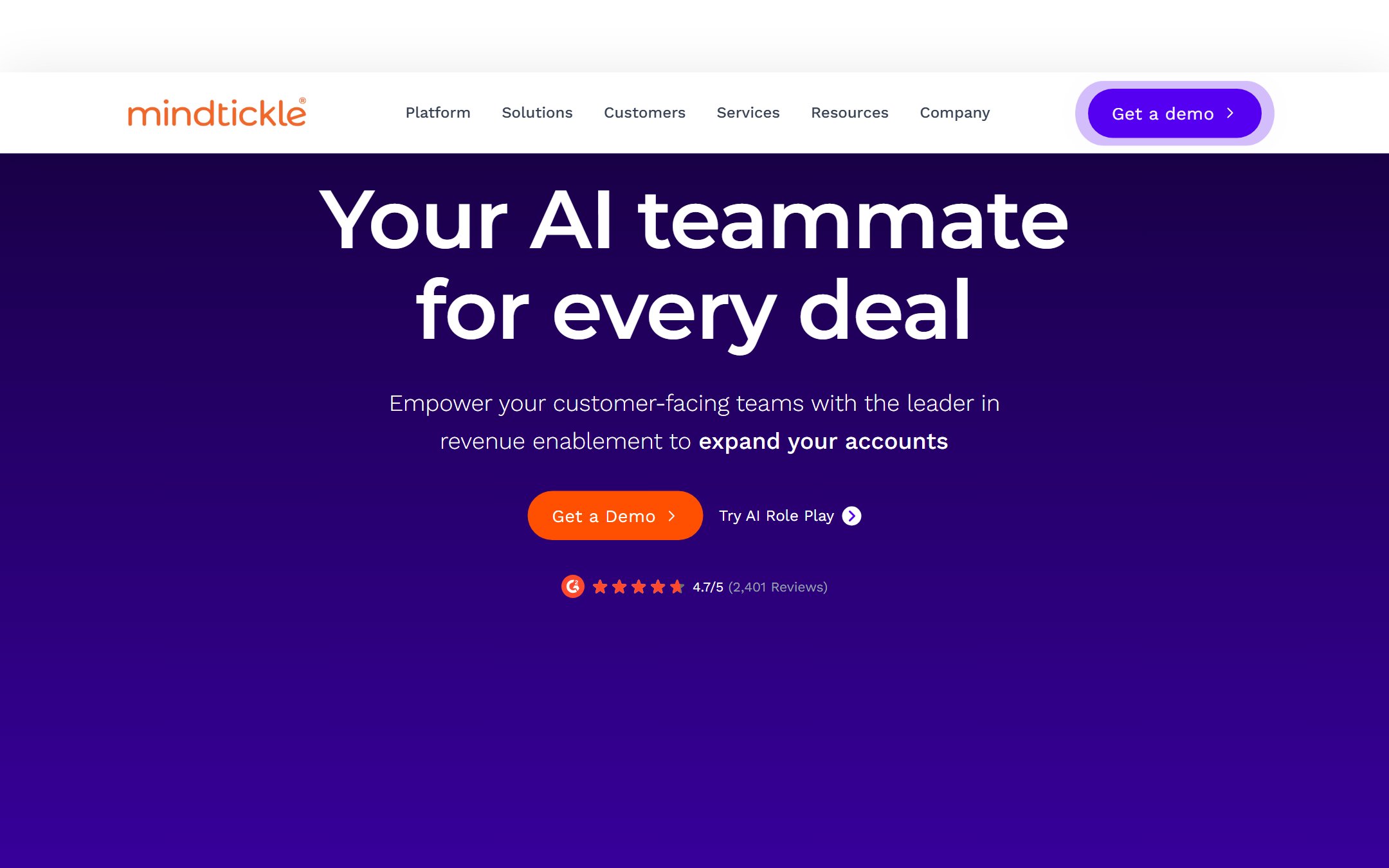
Website: Mindtickle
Mindtickle is a revenue-enablement and sales-readiness platform. “Readiness” is the word that matters and the one that separates it from most competitors. Where a content tool helps reps find the right deck and a conversation-intelligence tool tells you what happened on a call, Mindtickle is built around the idea of measuring and improving whether a rep is actually prepared to sell, before, during, and after the deal.
It is used by large organizations such as Johnson & Johnson, Splunk, Cisco, Wipro, and Thomson Reuters. That customer list is a tell: this is software for companies with big sales forces, formal onboarding programs, compliance requirements, and the budget to match. In April 2026 the company launched ElevateOS, which it markets as an “agentic operating system for revenue enablement,” layering AI agents on top of a decade of recorded rep-behavior data. Strip away the marketing language and ElevateOS is the AI connective tissue that ties the older modules together and lets them coach reps automatically in the flow of work.
The core promise is consolidation. Instead of buying a learning system, a coaching tool, a call-recording product, and a content platform from four vendors, you buy one Mindtickle. For a large org juggling vendor sprawl, that consolidation is often the entire business case.
The modules
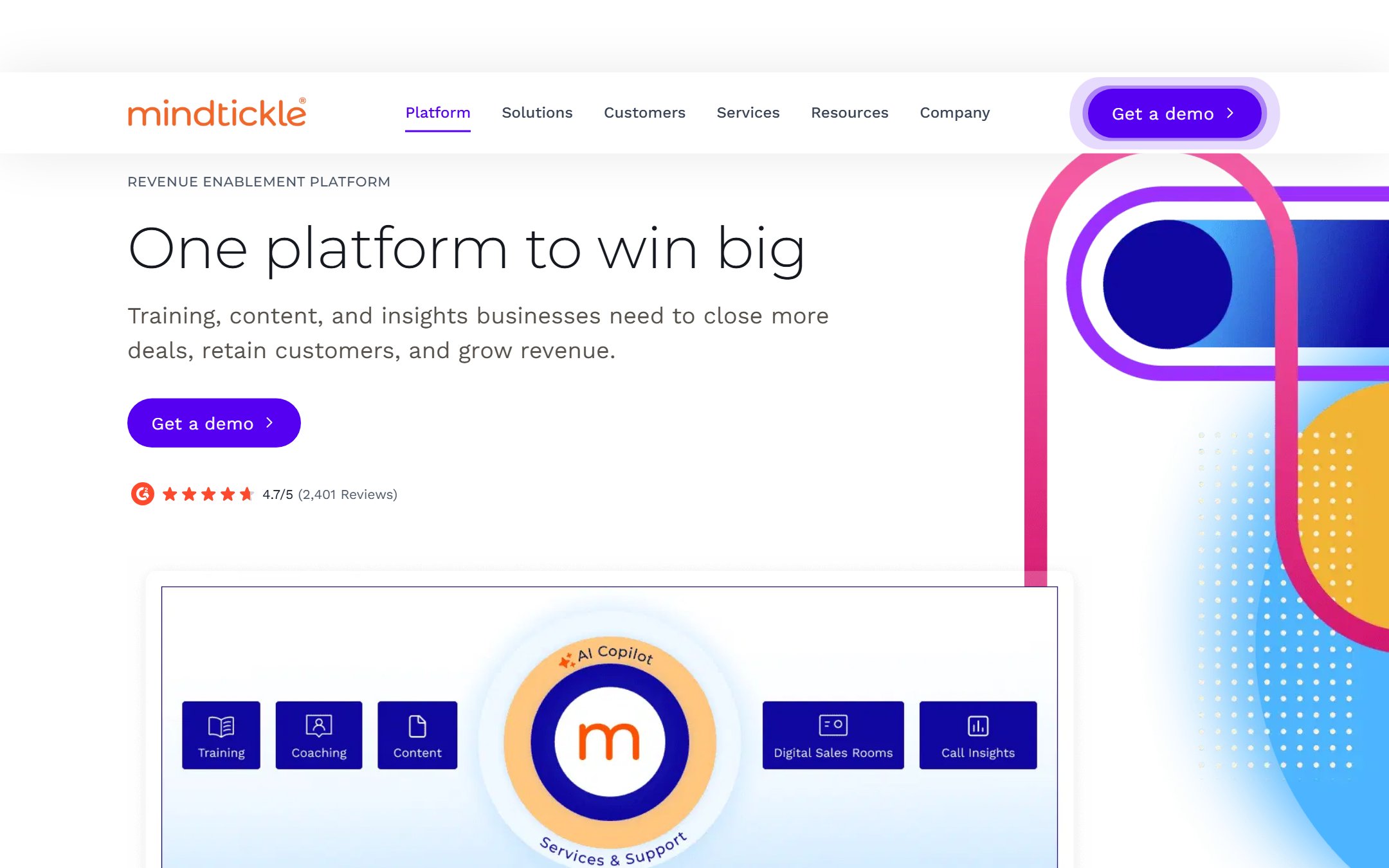
Mindtickle is modular, and almost nobody buys all of it. Here is what the suite contains.
Sales Training and onboarding. The original heart of the product. You build structured learning paths, certifications, and onboarding programs, then track completion and competency. This is genuinely best-in-class. If your problem is “we hire 40 reps a quarter and ramp is too slow,” this is the module that pays for itself.
Readiness Index. Mindtickle’s signature feature. It scores reps on knowledge, skill, and behavior, then benchmarks them so managers can see who is actually ready to sell rather than just who finished the course. It is the data backbone that makes the coaching meaningful.
Conversation Intelligence (Call AI). Records, transcribes, and analyzes sales calls, surfacing talk-time ratios, keywords, competitor mentions, and coaching moments. This is the module that goes head-to-head with Gong. It is solid and well integrated, though Gong remains the deeper standalone product for pure call analytics.
Sales Content Management. Surfaces the right content for the right deal stage and tracks how buyers engage with it. Competent, though Highspot and Seismic are the heavyweights in pure content management.
AI Role Play. Reps practice pitches against an AI buyer and get immediate, structured feedback on messaging, objection handling, and delivery. This is one of the strongest implementations of AI roleplay in the category and a major reason the platform stands out for training-heavy orgs. If you are evaluating this capability specifically, it is worth comparing against the broader field in our roundup of the best AI roleplay tools for corporate training.
Coaching. Pulls skill and performance data into manager-led coaching workflows, so coaching is tied to real behavior rather than gut feel.
Digital Sales Rooms. Shared, branded spaces where reps and buyers collaborate through a deal, with content and engagement tracking baked in.
AI Copilot. The productivity layer. It helps enablement teams spin up training fast (turning documents into videos, podcasts, and modules), localizes content into multiple languages, and helps reps analyze calls and decide next steps. Copilot is where most of the recent AI investment has landed.
How good is the AI?
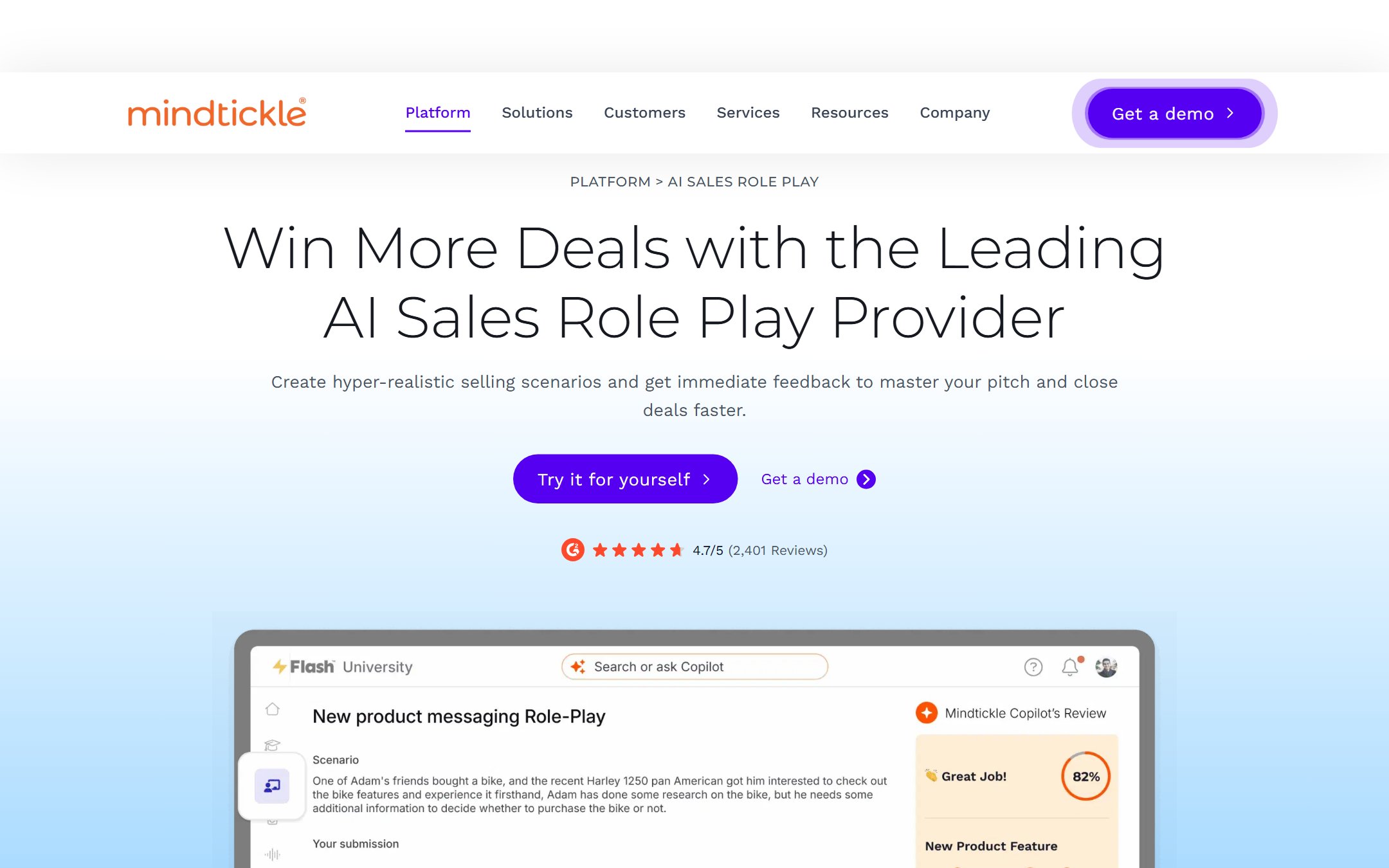
Good, and increasingly central. Mindtickle has leaned hard into AI, and unlike a lot of vendors bolting a chatbot onto an old product, its AI sits on top of years of structured rep-behavior data, which is exactly the kind of proprietary dataset that makes AI features useful rather than gimmicky.
The standouts are AI Role Play and the Copilot content engine. AI Role Play produces realistic practice scenarios with feedback specific enough to actually change rep behavior, which is hard to fake. The Copilot content creation tools meaningfully cut the time enablement teams spend building modules, and the localization feature is a real differentiator for global teams that previously translated training by hand.
ElevateOS and its “agentic” framing are newer and, as with most agentic-AI launches in 2026, deserve a wait-and-see attitude. The underlying modules are proven; the autonomous-agent orchestration on top is still maturing. Treat the agentic claims as a roadmap you are buying into rather than a finished capability, and ask hard questions in the demo about what runs autonomously today versus what is coming.
If you want the broader context on how AI is reshaping this whole category, our guide to the best AI corporate training tools puts Mindtickle’s approach next to the rest of the field.
The pricing question
Here is the part Mindtickle does not put on its website, and the reason this review exists.
Mindtickle publishes no list pricing. There is no pricing page, no public tiers, no “starts at $X” banner. Every quote comes through a sales conversation, and the number depends on how many users you license, which modules you turn on, the contract length, and how hard you negotiate. That opacity is normal for enterprise software, but it makes budgeting genuinely difficult, so here is what third-party data suggests. Treat all of these as approximate and externally reported, not as official figures.
- Average annual contract: procurement-data aggregators commonly cite an average around $90,000 to $92,000 a year, drawn from a few dozen real deals. Your number will vary widely.
- Per-user pricing: frequently reported in the range of roughly $30 to $50 per user per month at typical volumes, with figures climbing higher per seat for smaller deployments and premium module mixes.
- Deployment bands (third-party estimates): small deployments of 10 to 50 users reportedly land somewhere around $50K to $150K a year; mid-market 50 to 200 users around $150K to $400K; large enterprise rollouts of 200-plus users from roughly $400K into seven figures.
- Implementation: setup and onboarding fees are commonly reported around $3,000 to $5,000, though complex global rollouts run higher.
- Contract length: multi-year terms are standard, with 36-month commitments frequently cited.
- Add-ons: premium support (dedicated CSM, faster SLAs, strategic reviews) is typically a separate line that can add a meaningful percentage to the annual cost.
What drives the price? Three things. First, seat count, since this is per-user. Second, module mix: turning on Conversation Intelligence, Content Management, and the full AI suite costs far more than core training alone. Third, scope and services: global rollout, deep integrations, and premium support all stack on top.
The honest takeaway is that Mindtickle is an enterprise purchase priced like one. The numbers above are reconstructed from third-party reports because the company will not confirm them, so the only way to know your real cost is to contact Mindtickle sales and get a quote scoped to your team. Go in with seat counts and a clear module list, and expect to negotiate.
Mindtickle vs the alternatives
Mindtickle competes with several strong platforms, but each has a different center of gravity. The category also shifted in early 2026 when Highspot and Seismic announced a merger, with the combined company set to operate under the Seismic brand over time. Here is the short version.
| Platform | Core strength | Best for | Pricing transparency |
|---|---|---|---|
| Mindtickle | All-in-one sales readiness: training, coaching, roleplay, conversation intelligence, content | Large, training-heavy revenue orgs that want one suite | Hidden, enterprise-gated |
| Gong | Deepest conversation intelligence and revenue analytics | Teams whose primary need is call analysis and deal intelligence | Hidden, enterprise-gated |
| Highspot | Content management and governance at enterprise scale | Large orgs prioritizing content findability and brand compliance | Hidden, enterprise-gated |
| Allego | Readiness and video-first learning, often at lower cost | Mid-market teams wanting readiness without the top-tier price | Hidden, generally more flexible |
The simplest way to choose: if your dominant problem is call intelligence, Gong is the specialist. If it is content sprawl and compliance, Highspot or Seismic lead. If it is rep readiness and onboarding at scale and you want one platform to do most of it, Mindtickle is the strongest all-rounder. Allego is the value-leaning readiness alternative worth a look if Mindtickle’s price comes back too high.
Pros and cons
Pros
- Genuinely all-in-one: training, coaching, conversation intelligence, content, roleplay, and Copilot in one platform reduces vendor sprawl.
- Best-in-class onboarding, certification, and the Readiness Index for measuring rep competency, not just course completion.
- One of the strongest AI Role Play implementations in the category.
- Deep analytics tying learning and behavior to performance.
- Strong, sustained reputation: 4.7 out of 5 on G2 across roughly 2,400 reviews.
- Trusted by large, demanding enterprises with serious compliance needs.
Cons
- Expensive and enterprise-gated, with reported average contracts near $90K a year.
- Fully hidden pricing makes budgeting and comparison hard before a sales call.
- Heavy implementation and a learning curve; this is not a plug-and-play tool.
- Multi-year (often 36-month) commitments plus separate implementation and premium-support fees.
- Clear overkill for small teams; the breadth is wasted if you only need one or two functions.
- The newest “agentic” ElevateOS capabilities are still maturing relative to the proven core modules.
Who should (and should not) buy it
Buy Mindtickle if you run a mid-market or enterprise revenue team (roughly 100-plus reps is where the math starts to work), you hire and onboard in volume, ramp time is a measurable business problem, and you want to consolidate training, coaching, content, and call intelligence into one system instead of stitching together four vendors. If you have compliance-heavy selling or a global, multilingual sales force, the case gets stronger still.
Do not buy Mindtickle if you are an SMB or a small startup sales team. The breadth you are paying for becomes dead weight, the multi-year enterprise commitment is the wrong shape for a small org, and you will get more value per dollar from a focused point tool. If you mainly need call analysis, buy Gong. If you mainly need content management, look at Highspot or Seismic. If you want readiness on a tighter budget, evaluate Allego. And if your real need is AI roleplay for training, compare the dedicated options in our best AI roleplay tools roundup before committing to a full suite.
Our verdict
Mindtickle earns a 4.4 out of 5. As a product, it is close to the top of its category: a deep, mature, genuinely all-in-one sales-readiness platform with best-in-class onboarding, a standout Readiness Index, strong AI roleplay, and integrated conversation intelligence, all backed by a 4.7 G2 average across more than 2,400 reviews and a customer list of demanding enterprises. The AI investment is real and sits on a proprietary behavior dataset that gives it a durable edge.
What keeps it from a higher score is value clarity, not capability. The fully hidden pricing, the reported average contract near $90,000 a year, the heavy implementation, and the multi-year commitments all mean the price-to-value equation only works at scale. For a large, structured revenue org with a real readiness problem, Mindtickle is worth what it costs and the consolidation alone can justify it. For everyone smaller, the honest answer is that the price is not justified and a focused tool will serve you better. Decide which of those two buyers you are before you ever book the demo, then go in armed with seat counts, a module shortlist, and a request for the all-in three-year total cost in writing.
Why the price you see may not be the price we saw
This deserves its own section because it affects several tools in this category and almost no comparison article accounts for it.
What we actually observed
When we read Synthesia’s pricing page on 4 September 2026, every plan figure was in rupees, because our captures run from an Indian IP address and the site served local pricing automatically. HeyGen went further: a request to heygen.com/pricing redirected to its /en-in/ locale even when we sent a United States language header, meaning the routing is by IP rather than by browser preference.
Why this breaks most price comparisons
An article quoting a single global figure for a geo-priced tool is describing one country’s rate card and presenting it as the price. Regional pricing is not usually a straight currency conversion either; vendors set local rates deliberately, so the ratio between two markets can differ considerably from the exchange rate. That means you cannot fix the problem by converting, and we do not attempt to.
How to check your own number in thirty seconds
Open the vendor’s pricing page yourself, from the country where the contract will sit, and look at the currency symbol before you look at the number. If the URL contains a locale segment such as /en-in/ or /en-gb/, you are on a regional page. Where a vendor offers a currency selector, note that changing it sometimes changes the plan structure and not merely the symbol.
What to ask when the contract is cross-border
If your company is registered in one country and the team is in another, ask which entity is billed, in which currency, and whether the rate is fixed for the term or moves with a published exchange rate. Ask whether taxes are included, because several vendors here publish figures excluding tax. These questions are dull and they are the difference between a budget that holds and one that drifts by a fifth.

Written by
FazFaz is the founder of AIToolsBakery. Some tools here are tested hands on. Others are assessed from vendor documentation and pricing verified on the live page, and every review says which one it is. Sponsors can buy a position in a guide. They cannot buy the score, the criticism, or silence about a better option.
How we test and how we make money →Frequently Asked Questions