The contact form is the biggest leak in an agent’s funnel. A visitor lands on your site, faces a cold box asking for a name and an email, and most of them leave without filling it in. The ones who do hand over almost no useful information. Perspective AI takes a different approach: it replaces that static form with an AI-led conversation that qualifies a prospect in their own words. It is not a real-estate-only product, but its conversational lead-capture templates make it a genuinely useful tool for agents, and it is worth understanding for exactly what it is.
Verdict: Perspective AI is a versatile conversational AI platform that agents use to replace static contact forms with qualifying AI interviews. Free tier available, Pro from $99 per month. Best for agents and teams comfortable configuring their own capture flows. Not a purpose-built real estate CRM, so pair it with your system of record.
What Perspective AI does
Perspective AI is an AI-powered conversation and customer-research platform. In a real estate context, its value is at the top of the funnel: instead of a form, a website visitor has a natural back-and-forth with an AI interviewer that asks adaptive follow-up questions the way a good buyer’s agent would on a first call. It probes budget, timeline, financing readiness, and motivation, and produces a qualified, context-rich lead profile instead of a bare name and email address.
You build these flows from templates, including a home-buyer consultation template, a real estate lead-capture template, and a mortgage-prequalification screen, and you can stand one up in minutes. Because the conversation adapts to each answer, it captures the why behind a prospect’s situation, which is exactly the information that tells you whether a lead is worth calling today or nurturing for six months. For agents who spend real money driving traffic to a site or landing page, converting more of that traffic into qualified conversations is where the return shows up.
It is worth being clear about what Perspective AI is not. It is a broad conversational and research platform rather than a real-estate-native ISA or CRM. That flexibility is a strength, since you can shape it to your exact intake, but it also means the tool does not come pre-wired to your real estate stack the way a dedicated product might. Treat it as the smart front door to your funnel, not the whole system behind it.
Key features
Conversational lead capture
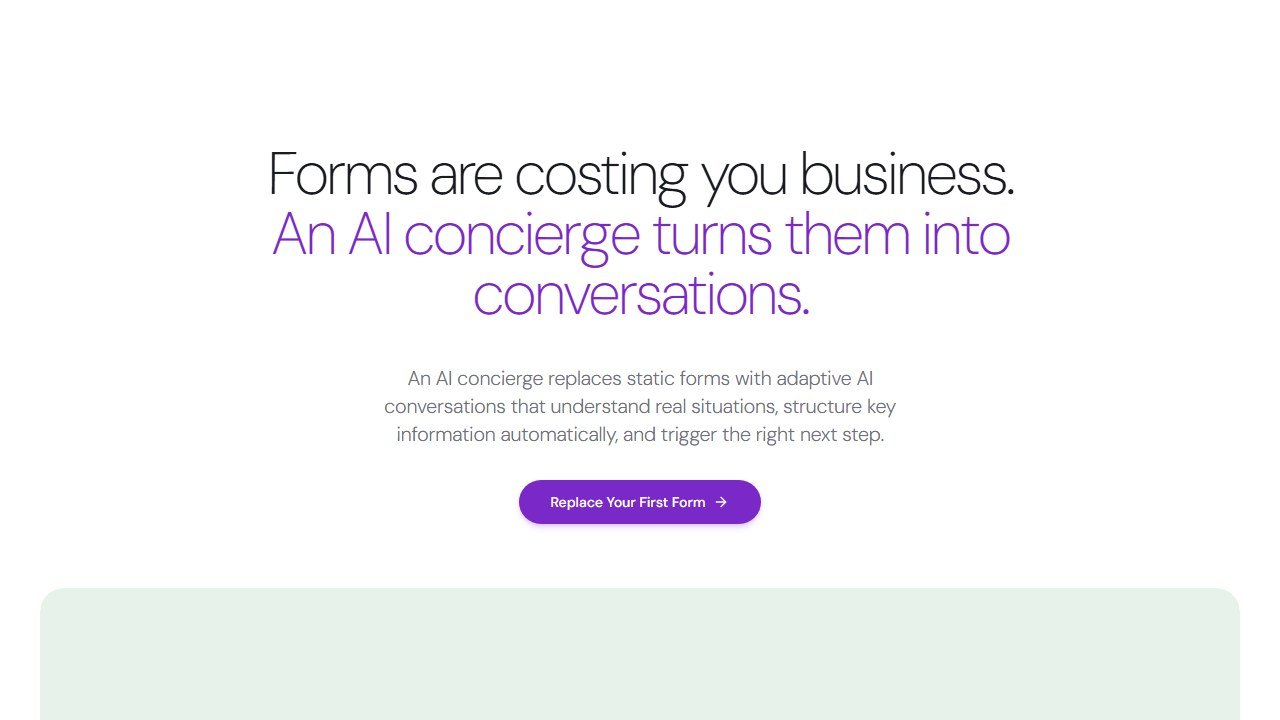
The core capability is replacing a static form with an adaptive AI conversation that qualifies intent, budget, timeline, and motivation in the prospect’s own words, producing a richer lead than any form field can.
Templates to launch fast
Ready-made templates for buyer consultations, lead capture, and mortgage prequalification let you deploy a working flow in minutes rather than building question logic from scratch.
Analysis and summaries
Because the platform is built for customer research as well as capture, it includes analysis tools and quick summaries that help you read patterns across many conversations, useful for a team wanting to understand its incoming leads in aggregate.
Pricing
| Plan | Price | Included |
|---|---|---|
| Free | $0 | 250 credits at signup |
| Pro | From $99/mo | 1,000 credits monthly, cancel anytime |
| Flex credits | Pay as you go | For occasional use |
| Enterprise | Custom | Higher volume and support |
Credits are consumed by conversations, with each AI interview costing more than a simple analysis action, so your real monthly cost depends on how many capture conversations you run. The free 250 credits are enough to build a flow and test it on live traffic before paying, which is the right way to judge whether the conversational approach lifts your conversion. Model your expected conversation volume against the Pro plan’s monthly credits before committing, and confirm how leads export into your CRM so a captured conversation does not strand in a second system.
Pros and cons
What we like: a genuinely better capture mechanic than static forms; adaptive questioning that yields rich, qualified lead profiles; fast setup from templates; a real free tier to test on live traffic; and flexibility to shape the flow to your exact intake.
What to weigh: it is a general conversational platform, not a real-estate-purpose-built system, so you will need to connect it to your CRM and workflow yourself; credit-based pricing means heavy use needs monitoring; and it captures and qualifies leads but does not run the long-cycle nurture a dedicated ISA like Structurely does, so it is one layer of the funnel rather than the whole thing. Used for what it is, though, it is a strong front end.
Who should use Perspective AI
Perspective AI fits agents and teams who drive traffic to a website or landing page and want to convert more of it into qualified conversations, and who are comfortable configuring a tool and wiring it into their own stack. It is especially useful where the quality of a lead matters as much as the quantity, since the conversational qualification filters better than a form. It is a weaker fit for an agent who wants a turnkey real estate product that works out of the box, or who needs the capture tool to also handle months of automated follow-up, which is a different job for a different tool.
How Perspective AI compares
In the lead-capture and qualification lane, Perspective AI competes with chat-first real estate qualifiers like Roof AI and FusionSync and, further down the funnel, with full ISA platforms like Structurely. Its distinction is the depth and adaptiveness of the conversational interview and its flexibility, at the cost of real-estate-native integration. See our roundup of the best AI lead qualification and inside sales tools for the head-to-head, and our guide to the best AI tools for real estate agents for the full workflow picture.
How to tell whether the tool paid for itself
Real estate software is unusually easy to evaluate honestly, because the outcomes are countable. Most teams still do not do it, and the renewal conversation becomes an argument about impressions.
Pick the metric the tool is supposed to move
For a lead platform it is cost per closed transaction. For property management software it is hours of admin per unit per month, and days to fill a vacancy. For staging it is days on market and list-to-sale ratio. For screening it is time to approve and the rate of problem tenancies. Each of those is available from records you already keep, and each needs a figure from before you started.
Take the baseline before you switch anything on
You need last year of the metric from a source the project did not touch. This is the step that gets skipped and it is the reason most of these purchases can never be evaluated. It costs an hour. Ask the two or three people whose work will change to record how long the target task takes them this month, because time saved is measurable in advance and unprovable afterwards.
Give it a full cycle before judging
Leasing and transactions are seasonal, so a six week read tells you very little. Judge lead tooling over at least two quarters, and property management tooling over a full turnover cycle, because the value shows up at move-out and move-in rather than in the quiet middle. Say that at the outset so an unremarkable month one is understood as expected.
Write the stop condition down first
Before purchase, name the result at twelve months that would mean you do not renew. It converts renewal from a default into a decision and it is the most effective discipline against a subscription that quietly becomes permanent. If nobody can name a result that would end it, the evaluation was never real.
How these purchases go wrong, and the early warning signs
Four patterns cover most of what we hear a year after a real estate software purchase, and all four are visible in the first month.
The migration that never finishes
The new system goes live, the old one stays open “for historical records”, and eighteen months later half the team still works in both. This is the most common and most expensive failure in property management software. Before signing, agree a cutover date, a named owner, and what specifically will not be migrated. Running two systems is worse than either.
Tenant-facing features nobody told the tenants about
Online payments, maintenance portals and application flows only save time when residents actually use them, and adoption depends entirely on how the change is communicated. A portal with 20% adoption creates more work than paper did, because you now run two processes. Plan the resident communication before go-live and measure adoption at thirty days.
The tool one person runs
One capable person builds the workflows and produces every report. They leave and it stops the same week. The warning sign is that nobody else has ever done a full month-end in the system. Have a second person do it once a quarter from written steps.
The fees that arrive after the subscription
Payment processing, screening, e-signatures, bank account setup and inspections are all charged separately by most vendors in this category and all of them are published. A business case built on the subscription alone will be wrong in year one, usually by a four figure sum. Build the model from the fee schedule, not the plan cards.
What agent CRMs and lead platforms actually charge
This half of the market divides into CRMs you fill with your own leads and platforms that sell you the leads as well, and the second is several times the price of the first. Here is each alternative to perspective ai, read on 4 September 2026.
Follow Up Boss, $69 per user per month, published plainly
Follow Up Boss publishes $69 per user per month plus tax, with a yearly option giving two months free and calling as a $39 per user add-on. It is a CRM rather than a lead source, which is the important distinction: you are buying the system that works leads you already have. At five agents that is $4,140 a year before the calling add-on, so price it at your real headcount rather than at one seat.
Wise Agent, $49 a month, and the cheapest published option here
Wise Agent publishes $49 a month, falling to $42 billed annually at $499 a year, with a higher tier at $69 and $59. Its annual toggle is marked as saving 15% and the saving holds. For a solo agent or a small team this is the published floor of the category, and the gap to a lead platform is an order of magnitude rather than a percentage.
Placester, from $59 a month, sold around the website
Placester publishes $59, $79 and $129 a month with a 20% annual discount, positioned around IDX websites and marketing rather than lead generation. If your gap is presence rather than pipeline, that is a materially cheaper problem to solve than buying leads, and it is worth being honest with yourself about which one you actually have.
The lead platforms, where almost nobody publishes
The platforms that sell leads alongside software, Lofty, CINC, Ylopo, Zurple, Sierra Interactive, Real Geeks, Market Leader and BoldTrail among them, largely quote rather than publish. We could not read a plan figure from Lofty’s own pricing page on 4 September 2026. That is normal in this corner of the market and it means your only real leverage is a published CRM priced at your team size, plus a clear view of what you currently pay per closed transaction.
Work out your cost per closing before any demo
Take last year: total spend on leads and CRM, divided by transactions closed from those leads. That single number is the benchmark every quote has to beat, and most agents have never calculated it. Without it you are comparing monthly figures against each other rather than against the thing that pays for them, which is how a $2,000 a month platform gets renewed for three years on the strength of a feeling.
Where the figures on this page come from
Every price here was read from the vendor’s own pricing page on 4 September 2026, not from an aggregator or a review site. Each figure carries that date, because pricing in this market moves and a claim without a date is not checkable.
The pages we read
Buildium publishes $62, $192 and $400 a month plus a detailed fee schedule. DoorLoop publishes $69, $149 and $209 a month billed yearly with per unit equivalents. TurboTenant publishes a free tier plus $12.42 and $16.48. TenantCloud publishes $15 to $50 a month on annual billing. RentRedi publishes $12 a month on the annual plan. Hemlane, Rentec Direct and Landlord Studio all publish in full, as do Follow Up Boss at $69 per user, Wise Agent at $49, and Placester from $59.
The ones we could not read
AppFolio, Innago, Top Producer and Hostaway did not yield a figure to the same method that read every vendor above, and Lofty’s pricing page carried no plan rates. We are not presenting that as proof they publish nothing, because a failed read is not evidence of absence. Treat any figure for those five from elsewhere as unverified.
What we do not do
We do not carry a figure we cannot source to the vendor. Where a number circulates and cannot be traced, we say so and withdraw it rather than repeating it with a hedge, and we have withdrawn our own published figures on that basis more than once.
Virtual staging and AI imagery, and the disclosure rules that come with them
AI staging is one of the few genuinely transformative tools in this industry, and also the one most likely to create a complaint if handled carelessly.
Disclose it, every time, on every image
Most MLS rules and state regulations require virtually staged photographs to be labelled as such, and the requirement is usually about the image itself rather than a note elsewhere in the listing. Label every staged image visibly. This is not a grey area worth exploring, the cost of compliance is a caption, and the cost of non-compliance is a complaint that follows the agent rather than the software.
Never alter what cannot be changed
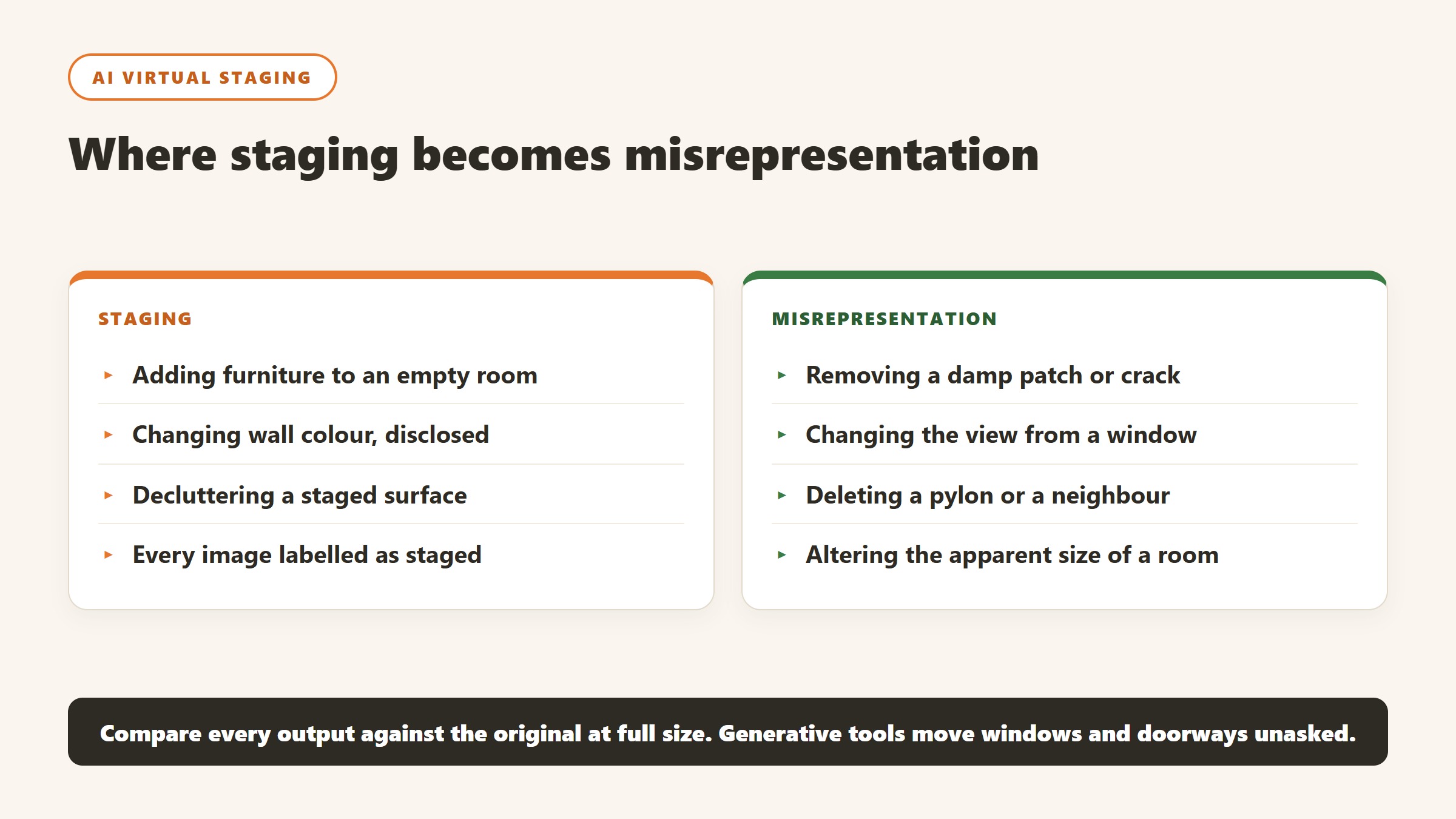
The line that matters is between furnishing an empty room and misrepresenting the property. Adding a sofa is staging. Removing a damp patch, straightening a subsiding wall, changing the view from the window, deleting a pylon or altering the apparent size of a room is misrepresentation, whichever tool produced it. Write that distinction into your process, because a generative tool will happily do all of them if asked.
Check what the model quietly changed
Generative staging frequently alters things nobody asked it to: a window becomes larger, a doorway moves, a radiator disappears, the floor changes material. Compare every output against the original at full size before publishing. This is the single most common failure in practice, it is entirely avoidable, and it is far more likely to cause a problem than the staging itself.
Price it against the alternative honestly
The comparison for AI staging is not another AI tool, it is what you were doing before: physical staging at a scale most listings never justify, a human virtual stager per image, or empty rooms. For a mid-market listing the honest question is whether the images shorten time on market or lift the price enough to notice. Track that on your own listings for a quarter rather than accepting a vendor case study, because your market is the only sample that matters.
The verdict
Perspective AI is a smart answer to a real and expensive problem: the leads you lose at the contact form. By turning capture into a conversation, it converts more visitors and qualifies them better than any static form can. The honest caveat is that it is a flexible, general-purpose conversational platform rather than a real-estate-native product, so it works best as the intelligent front door to a funnel you have built around it, connected to your CRM and paired with a nurture tool behind it. For agents who understand that and want to stop bleeding leads at the form, it earns a place in the stack, and the free tier means you can prove it on your own traffic before you spend a dollar.

Written by
FazFaz is the founder of AIToolsBakery. Some tools here are tested hands on. Others are assessed from vendor documentation and pricing verified on the live page, and every review says which one it is. Sponsors can buy a position in a guide. They cannot buy the score, the criticism, or silence about a better option.
How we test and how we make money →