Search “ylopo vs cinc” and almost every page that ranks was written by Ylopo. That is not a knock on Ylopo’s content team, it is just a fact about this SERP: buyers researching this matchup are mostly reading one vendor’s sales argument about its competitor. Ylopo’s own compare page claims CINC runs “$600 to $1,000 or more per month” and calls it a “walled garden.” Both of those framings are vendor claims from a self-interested source, and we will label them that way every time they come up.
Here is the thing, though. Once you strip out the marketing, there is a real and genuinely useful decision underneath, and it is not about which feature list is longer. It is about architecture. CINC is an all-in-one machine: built-in CRM, IDX website, and managed ad campaigns in one bundled contract. Ylopo is a lead generation and AI nurture layer that deliberately does not include a CRM. You bring your own, and everything Ylopo generates flows into it.
That single design choice cascades into everything else: what you pay, what AI you get, how the ads run, and, most importantly, what you keep when you leave. We have covered both platforms across our real estate stack for two seasons now, including full fee breakdowns in our Ylopo pricing guide and CINC pricing guide, so this post stays in its lane: a decision matrix, not a math rebuild.
Ylopo vs CINC decision matrix
| Decision factor | Ylopo | CINC |
|---|---|---|
| Architecture | Lead-gen + AI nurture layer, no built-in CRM | All-in-one: CRM + IDX website + managed ads |
| CRM | Requires an external CRM (Follow Up Boss for full features) | Built in, not sold standalone |
| Reported platform cost | ~$295 to $545/mo (reported, Luxury Presence 2026), ad spend billed separately | ~$899 to $1,500+/mo (reported, Luxury Presence 2026 and inboundREM 2025), ad spend on top |
| AI conversation layer | Ylopo AI: text plus voice (voice is Follow Up Boss only) | CINC AI: text qualification powered by Structurely, add-on from $200/mo (official) |
| Ad model | Managed dynamic listing ads and branded campaigns, spend billed separately | Managed Google + Meta campaigns bundled into the platform relationship |
| Website/domain at exit | Ylopo sites deactivate ~90 days after cancellation | CINC’s terms reserve ownership of CINC-provided URLs and domains (official T&Cs) |
| Database at exit | Lives in your CRM, stays with you | Lives in CINC’s CRM, export before you go |
| Contract posture | Advertises “No Long Term Contracts”; 90-day written cancellation notice, auto-renewal on longer terms (official platform agreement) | Reported 6 to 12 month terms; early termination without cause = pay the remaining term (official T&Cs plus reported) |
| Best fit | Teams of roughly 2 to 25, or anyone committed to an external CRM | Medium-to-large teams and brokerages, roughly 1 to 50+ users, wanting one vendor |
Every dollar figure in that table is a third-party report unless marked official. Both vendors gate their real quotes, which is exactly why we built the two companion pricing posts. Now let us walk the matrix.
The architecture question comes first
Before you compare a single feature, decide which shape of product you are buying, because the two do not overlap as much as the SERP suggests.
Ylopo: a layer that rides on your CRM
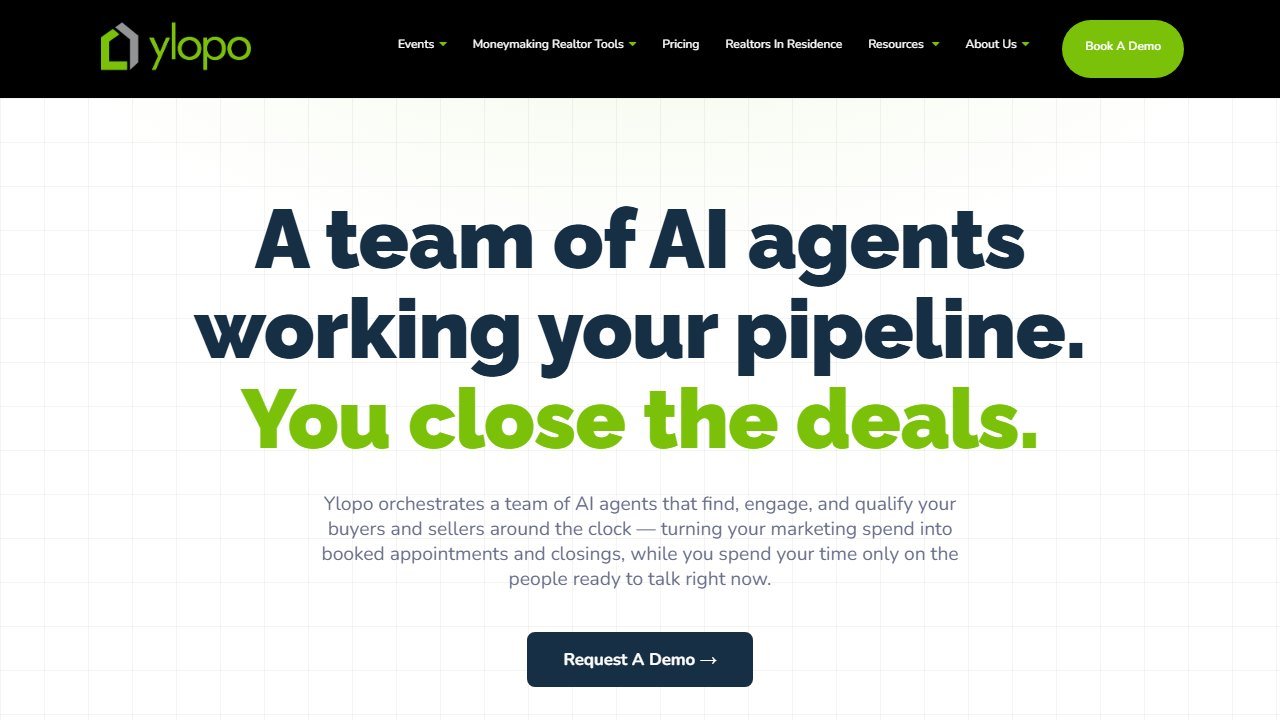
Ylopo generates leads through managed ad campaigns, runs branded and IDX search sites, and then works those leads with its AI nurture stack. What it deliberately does not do is store your database. Ylopo requires an external CRM, and everything it captures syncs into that CRM as the system of record.
In practice, the deepest integration is Follow Up Boss. Ylopo’s AI Voice, the feature that actually phones leads and holds a spoken conversation, currently works only on Follow Up Boss. AI Text is available more broadly across supported CRMs, but if you want the full Ylopo AI experience, the honest prerequisite is a FUB subscription on top, which we priced separately in our Follow Up Boss pricing breakdown. One naming note while we are here: Ylopo retired the old “rAIya” branding, and the current official name for the conversational stack is Ylopo AI. Older reviews still using rAIya are describing the same product under a dead name.
The upside of this shape is flexibility and exit safety, which we will get to. The downside is that you are running a two-vendor stack minimum, with two bills, two support queues, and an integration between them.
CINC: the all-in-one machine
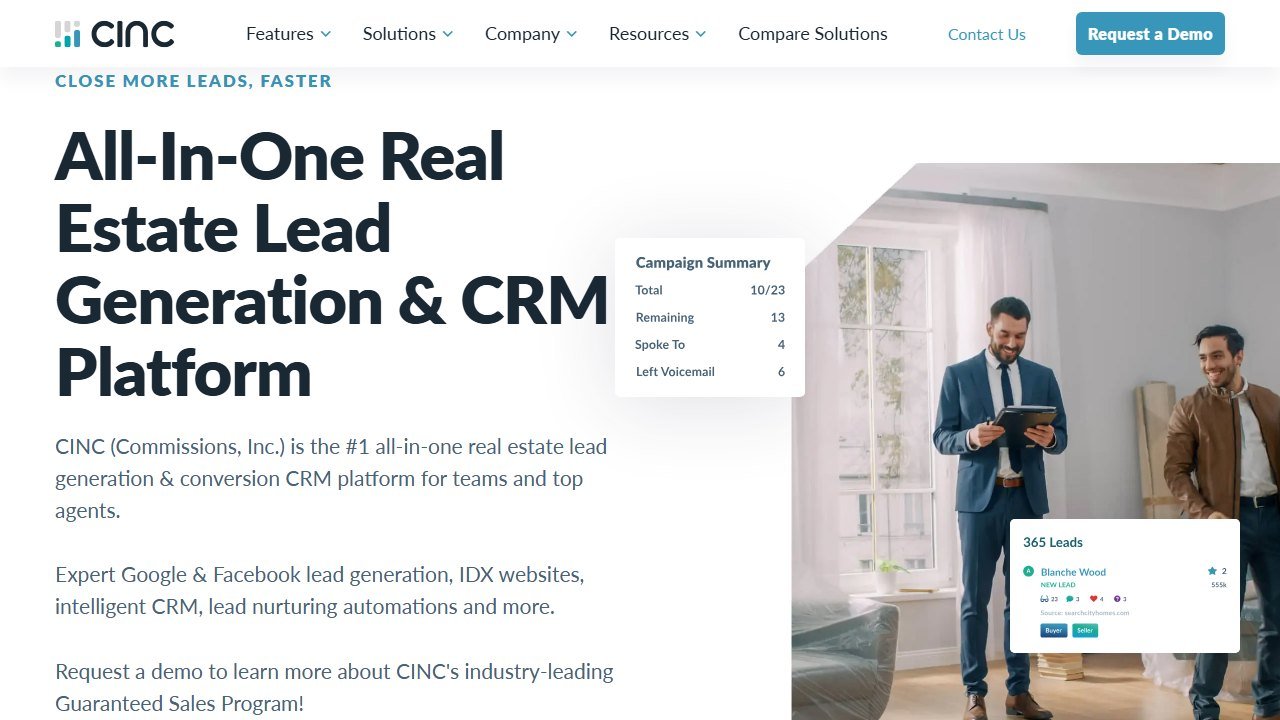
CINC (Commissions Inc, owned by Fidelity National Financial since a $229M deal that closed back in August 2016, so nothing recent) is the opposite bet. One contract gets you the IDX website, the built-in CRM, the managed Google and Meta ad campaigns, and the team routing and accountability tooling. CINC is a Google Premier Partner and Meta Business Partner and claims more than $30M in annual managed ad spend across 50,000+ agents. Those are vendor-claimed numbers from CINC’s own site, not audited figures, but they are consistent with what CINC visibly is: a lead machine that runs your paid acquisition for you at scale.
The CRM is not sold standalone. You cannot buy CINC’s ads and point them at Follow Up Boss, and you cannot buy the CRM without the platform. That bundling is the whole point of the product, and it is also the root of every exit-term issue we cover below.
Exit terms and data custody: where they actually diverge
Feature lists on these two platforms converge over time. Exit terms do not, and this is the section we most wish someone had written before we started covering this vertical.
What CINC keeps
CINC’s official terms and conditions reserve CINC’s ownership of CINC-provided URLs and domains. Read that plainly: the IDX website you spent 12 months ranking and running ads to does not leave with you. If you terminate early without cause, the reported and official terms combined say you pay out the remaining term, and third-party reports (Luxury Presence 2026, inboundREM 2025) put typical commitments at 6 to 12 months. On top of that, your entire database lives inside CINC’s CRM. Leaving CINC means exporting contacts, losing the site, losing the domain if CINC provided it, and rebuilding your web presence from zero.
None of that is scandalous, it is how most all-in-one platforms work. But it changes the real cost of a bad fit. A platform you can leave cleanly is cheaper than its invoice; a platform with high exit friction is more expensive than its invoice.
What Ylopo keeps
Ylopo’s official platform agreement has its own catches: cancellation requires 90 days written notice, sites deactivate 90 days after cancellation, terms longer than a month auto-renew for an equal duration, and fees are non-refundable. Its pricing page advertises “No Long Term Contracts,” and both things can be true at once, so read the agreement, not the banner.
The structural difference is the database. Because Ylopo requires an external CRM, every contact, note, and conversation Ylopo generated lives in a system you separately own. Cancel Ylopo and the ad machine stops and the sites eventually go dark, but your database does not move an inch. Third-party coverage (Luxury Presence and inboundREM, 2026) frames this the same way, and it matches the architecture: the layer leaves, the record system stays.
If you take one thing from this post: with Ylopo you lose the engine when you leave, with CINC you lose the engine, the storefront, and custody of the address book unless you export it first.
AI capabilities: Ylopo AI vs CINC AI
Both platforms lead their marketing with AI, and both have real conversational products, but they are shaped differently.
Ylopo AI covers both text and voice. The text side nurtures and requalifies leads over long horizons, and the voice side actually calls leads, with the Follow Up Boss-only restriction we flagged above. If your follow-up problem is speed-to-lead by phone, Ylopo is one of the few platforms in this price class with a shipping voice product, and that is a genuine differentiator, with an asterisk the size of a FUB subscription.
CINC AI is a 24/7 text qualification layer, and CINC’s official help center confirms it is powered by Structurely, a company we have covered extensively in its own right in our Structurely review. That is not a criticism, Structurely’s conversational engine is one of the better ones in the category, and CINC packaging it natively saves you an integration project. It is an add-on starting at $200 per month on all CINC tiers, one of only two prices CINC publishes officially (the other is a 3-line dialer at $75 per month). Old coverage still calls this product “Alex”; that branding is retired, the current name is CINC AI.
We are deliberately not re-ranking the conversational AI field here. If the ISA layer is your primary buying criterion rather than a tiebreaker, our best AI ISA tools for real estate roundup compares the standalone options head to head, including what it costs to buy Structurely directly instead of through CINC.
Ad models: two flavors of managed spend
Neither platform is a self-serve ad tool. Both run your campaigns for you, and both bill ad spend on top of the subscription, which is the line item that most inflates real monthly cost on either side.
CINC’s model is fully bundled management: Google search and Meta campaigns run by CINC’s in-house team, backed by that vendor-claimed $30M+ annual spend and partner status. Reported minimum viable ad spend is around $500 per month (Luxury Presence 2026), and reported all-in totals including platform, ads, and add-ons run $1,800 to $3,500+ per month. Ylopo’s model is managed dynamic listing ads and branded campaigns with spend billed separately from the reported $295 to $545 suite fee. Directionally, Ylopo’s floor is lower and CINC’s ceiling is higher, but every one of those numbers is a third-party report against quote-gated pricing, so we will say it once more: the fee math lives in the Ylopo pricing and CINC pricing posts, and your written quote overrides everything.
One more vendor-claim flag for the record: Ylopo’s own compare page asserts CINC costs “$600 to $1,000 or more per month” and describes CINC as a walled garden with limited published integrations. The cost figure is Ylopo characterizing a competitor’s gated pricing, the walled-garden framing is adversarial marketing language, and the integrations point comes from a biased source, so treat all three as claims to verify on your own sales calls, not established facts. What we can say neutrally is that Ylopo, by riding on Follow Up Boss, inherits FUB’s 200+ integration ecosystem, while CINC’s integration surface is smaller and less publicly documented. Ask CINC directly about API and Zapier access for the specific tools you run.
Fit by team size and existing CRM
Reading both companies’ own positioning side by side (fetched from both official sites, July 2026), the fit consensus is unusually clean for a rivalry this noisy:
Pick CINC if you are a medium-to-large team or brokerage, roughly 1 to 50+ users on CINC’s own tiering, you do not have a CRM you are attached to, and you want one vendor accountable for the whole funnel: site, ads, CRM, routing, AI. The bundle is the feature. Budget honestly for reported all-in costs, and go in with eyes open on the exit terms above.
Pick Ylopo if you are a smaller team, roughly 2 to 25 agents, or any size of team already committed to an external CRM, especially Follow Up Boss. You keep your record system, you get the strongest voice AI story in this matchup, and your exit risk is limited to the lead-gen layer itself. The cost is stack complexity: two vendors, two invoices, and FUB’s own bill in the total.
Neither is right if you mainly need a conversational AI without a lead-gen contract around it. That is a standalone ISA tool purchase, and the ISA roundup is the better starting point.
And one genuine curiosity from the archives: these two are not strictly mutually exclusive. A Ylopo academy webinar from March 2020 covered stacking Ylopo’s lead-gen and nurture layer on top of CINC’s CRM. We would not call it a mainstream configuration in 2026, and you would be paying two premium platforms at once, but teams mid-migration or locked into a CINC term sometimes run exactly this bridge.
And if neither side of this matchup fits, the full exit map is in our CINC alternatives guide, sorted by why you are leaving.
Our verdict
This is one of the rare compares where “it depends” is the technically correct answer and still not a cop-out, because the fork is structural, not aesthetic. If we were building a 3-person team on Follow Up Boss tomorrow, we would take Ylopo and keep custody of our database without a second thought. If we were running a 30-agent team with no CRM religion and the appetite for a reported $1,800+ all-in monthly spend, CINC’s single-throat-to-choke bundle wins, and we would negotiate the term length and confirm the data-export process in writing before signing anything.
Whichever way you lean, do the fee math on real numbers, not SERP estimates and not a competitor’s characterization: our Ylopo pricing and CINC pricing breakdowns are built for exactly that pre-sales-call homework. And if this stack-versus-suite decision is the part that resonated, the same architecture question plays out with a different cast in our Lofty vs Ylopo compare, and the wider field is mapped in Ylopo alternatives.
Where the figures on this page come from
Every price here was read from the vendor’s own pricing page on 4 September 2026, not from an aggregator or a review site. Each figure carries that date, because pricing in this market moves and a claim without a date is not checkable.
The pages we read
Buildium publishes $62, $192 and $400 a month plus a detailed fee schedule. DoorLoop publishes $69, $149 and $209 a month billed yearly with per unit equivalents. TurboTenant publishes a free tier plus $12.42 and $16.48. TenantCloud publishes $15 to $50 a month on annual billing. RentRedi publishes $12 a month on the annual plan. Hemlane, Rentec Direct and Landlord Studio all publish in full, as do Follow Up Boss at $69 per user, Wise Agent at $49, and Placester from $59.
The ones we could not read
AppFolio, Innago, Top Producer and Hostaway did not yield a figure to the same method that read every vendor above, and Lofty’s pricing page carried no plan rates. We are not presenting that as proof they publish nothing, because a failed read is not evidence of absence. Treat any figure for those five from elsewhere as unverified.
What we do not do
We do not carry a figure we cannot source to the vendor. Where a number circulates and cannot be traced, we say so and withdraw it rather than repeating it with a hedge, and we have withdrawn our own published figures on that basis more than once.

Written by
FazFaz is the founder of AIToolsBakery. Some tools here are tested hands on. Others are assessed from vendor documentation and pricing verified on the live page, and every review says which one it is. Sponsors can buy a position in a guide. They cannot buy the score, the criticism, or silence about a better option.
How we test and how we make money →