Search for an honest HireVue review and you hit a wall of noise. The first page is the vendor’s own marketing, a handful of affiliate roundups that earn a commission for every demo they funnel, and HR consultancies that resell the platform to their clients. None of them are incentivized to tell you that one-way video interviews are the single most common thing candidates complain about, or that the implementation can take six weeks before you screen a single applicant.
HireVue is also one of the most misunderstood tools in recruiting, because most of what people “know” about it is years out of date. The company built its early reputation on AI that analyzed candidates’ faces and tone, drew heavy criticism for it, and then quietly killed that feature in 2021. Plenty of reviews still describe a product that no longer exists. We wanted to cut through all of that and tell you what HireVue actually does in 2026, who it genuinely helps, and where your money goes.
This matters because HireVue is expensive, contracts run for multiple years, and there is no free trial to fall back on if it turns out to be the wrong fit.
We are AIToolsBakery, an independent AI-tools review site. We are not a HireVue partner, reseller, or affiliate, and we earn nothing whether you buy it or walk away. When a post is sponsored we label it clearly, and sponsorship never changes a score. This review is not sponsored. Our only goal is to help you spend your budget well.
The verdict in 30 seconds: HireVue (4.0/5) is a mature, enterprise-grade video interviewing and assessment platform that genuinely saves time when you are screening thousands of candidates. Its AI now scores the content of answers and validated assessments, not faces. The catch: it is opaque and costly, slow to implement, and many candidates dislike one-way video. Right for high-volume enterprise hiring, overkill for most small teams.
What HireVue is
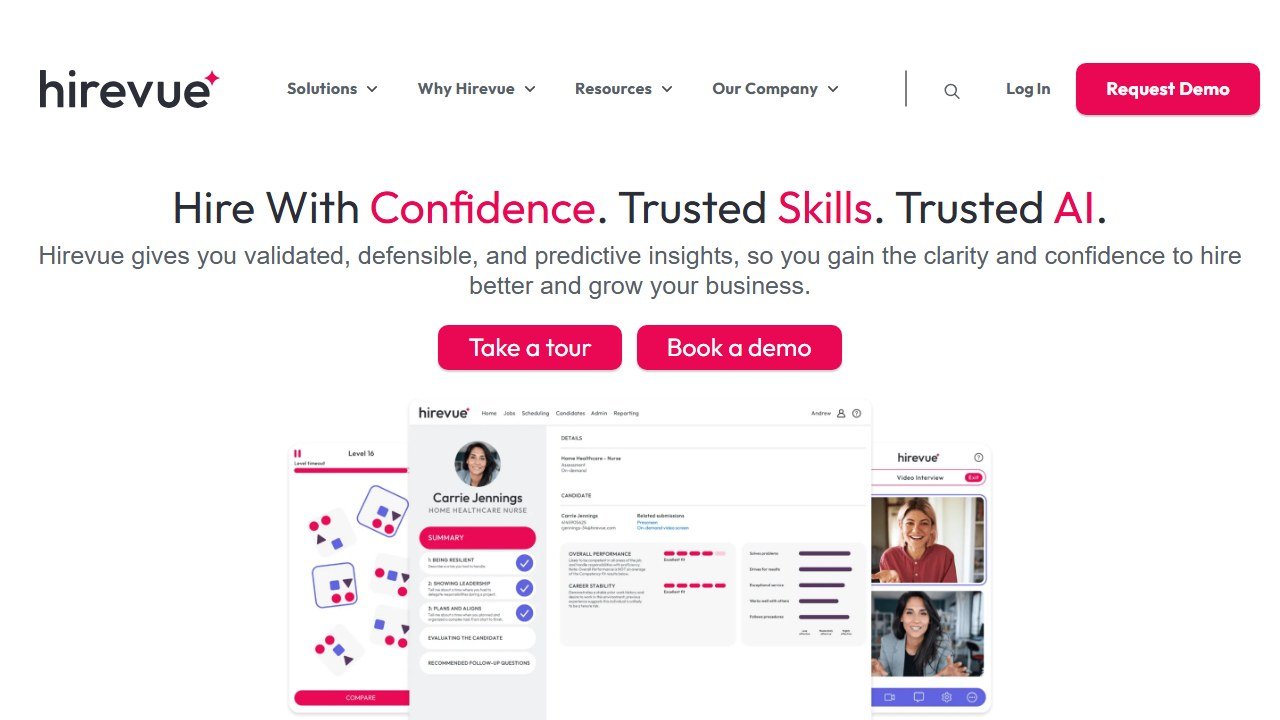
Website: HireVue
HireVue is a video interviewing and pre-hire assessment platform founded in 2004, making it one of the oldest names in the category. It has been owned by private equity firm Carlyle since 2019, brought on CEO Jeremy Friedman in January 2024, and has expanded through acquisitions including Modern Hire (May 2023) and Hireguide (March 2026).
The core product does three things. It runs one-way asynchronous video interviews, where candidates record answers on their own time. It runs live video interviews. And it layers on game-based assessments and coding assessments to measure skills before a human ever gets involved. The pitch is straightforward: replace the early phone-screen bottleneck with structured, scalable, AI-assisted screening.
The part everyone asks about is the AI, so let us be precise. HireVue discontinued facial and visual analysis, announced in January 2021 after a 2020 audit and sustained bias criticism. The company’s own data scientist noted that visual data added roughly 0.25 percent of predictive power, which is to say almost nothing. Today the AI scores the content of transcribed answers using natural language processing, plus competency and assessment scoring built by in-house industrial-organizational psychologists with adverse-impact testing. If you read a review claiming HireVue still judges candidates by their facial expressions, that review is out of date.
What HireVue does well
The clearest win is time savings at genuine scale. If you hire across campus programs, retail, call centers, or high-volume tech screening, one recruiter can review recorded answers far faster than scheduling and conducting hundreds of phone screens. Self-scheduling removes the calendar ping-pong that eats recruiter hours.
The platform is highly customizable, the assessments are validated rather than improvised, and the adverse-impact testing is more rigorous than most competitors bother with. HireVue holds FedRAMP authorization, which matters for government and regulated buyers, and customer support earns consistent praise. On review platforms it sits around 4.1 on G2 and 4.5 on Capterra, which is solid for enterprise software.
The pricing question, honestly
Here is the uncomfortable truth: HireVue publishes no pricing. There are no public tiers, no free trial, and contracts typically run multiple years. You have to talk to sales, sit through a demo, and negotiate.
Based on third-party estimates (treat all of these as rough, not quotes), entry deployments start around $35,000 per year, and the realistic range runs from roughly $35,000 to $145,000 or more per year depending on volume and modules. Implementation is commonly billed on top, with estimates in the $15,000 to $40,000 range. The slow rollout, often six weeks or more, is a real cost too, because you are paying before the system produces value.
For a large enterprise filling thousands of roles, that math can work. For a small or mid-sized team, the entry point alone is likely a dealbreaker, and you should look elsewhere.
HireVue is one option inside a larger stack. See where video interviewing fits in our best applicant tracking systems guide.
How HireVue compares
| Tool | Best at | AI focus | Pricing transparency |
|---|---|---|---|
| HireVue | High-volume video interviewing and assessments | NLP answer scoring, validated assessments | Quote-only, no trial |
| Paradox AI | Conversational screening and scheduling | Chatbot (Olivia), knockout questions | Quote-only, demo only |
| Eightfold AI | Talent intelligence and internal mobility | Deep-learning skills matching | Quote-only, enterprise |
| HireEZ | Outbound sourcing | AI candidate discovery and outreach | Quote-only, tiered |
HireVue is the specialist for the interview-and-assess stage at scale. If your bottleneck is earlier (sourcing) or you want a lighter conversational front door for hourly roles, the alternatives above fit better. For the broader landscape, see our best AI recruiting software guide and our roundup of the best AI interview tools.
Pros and cons
Pros:
- Massive time savings when screening at high volume
- Self-scheduling cuts recruiter coordination work
- Validated, customizable assessments with adverse-impact testing
- FedRAMP authorized, strong for government and regulated buyers
- Reputable customer support and a long enterprise track record
Cons:
- One-way video interviews are the top candidate complaint
- Mandatory account creation drives roughly 20 to 25 percent applicant drop-off
- Opaque, high pricing with no public tiers and no free trial
- Slow implementation, often six weeks or more
- Lingering distrust of black-box AI scoring among candidates
Who should (and should not) buy it
Buy HireVue if you are a large enterprise or high-volume employer in campus recruiting, retail, call centers, or tech screening, and your real pain is reviewing far more applicants than your recruiters can handle. The time savings and validated assessments justify the spend at that scale, and FedRAMP makes it a natural fit for government contractors.
Do not buy HireVue if you are an SMB, hire in low volumes, or fill mostly senior and relationship-heavy roles. The cost, the long contracts, the slow setup, and the candidate friction of one-way video all outweigh the benefit. A lighter tool, or simply better-structured human interviews, will serve you better.
Our verdict
HireVue is a serious, mature platform that does exactly what it claims for the buyers it is built for. The AI is more responsible than its reputation suggests, the assessments are genuinely validated, and at high volume the time savings are real. We respect that the company dropped facial analysis when the evidence said to.
The marks against it are equally real: opaque and steep pricing, a slow rollout, and a one-way video format that a meaningful share of candidates resent. Those are not bugs, they are the cost of doing business at this scale, and they make HireVue a poor fit for anyone outside high-volume enterprise hiring. Weighed honestly, the strengths and the friction balance out near the top of the “good but specialized” tier.
HireVue scores 4.0 out of 5.

Written by
FazFaz is the founder of AIToolsBakery. Some tools here are tested hands on. Others are assessed from vendor documentation and pricing verified on the live page, and every review says which one it is. Sponsors can buy a position in a guide. They cannot buy the score, the criticism, or silence about a better option.
How we test and how we make money →