The short answer
A clinical workforce platform is not one product. It is three, and most vendors are genuinely good at one or two of them.
| The job | What it has to do | Who it covers |
|---|---|---|
| Credentialing and privileging | Verify licences at source, track expiry, manage privileges, keep a provider file that survives an audit | Licensed providers, a small population |
| Competencies and continuing education | Assign, deliver and evidence mandatory training and annual competencies | Everyone who touches a patient, a large population |
| Scheduling and staffing | Fill shifts against skill mix and coverage requirements | Clinical staff by unit |
Work out which of the three is your actual problem before you take a demo, because the vendors that lead with one are usually thin on the others, and the pricing meters are completely different.
Which vendor describes which job
Read from each vendor’s own site on 1 September 2026. This is what they say they cover, not a test of how well they do it.
| Platform | Credentialing | Privileging | Competencies | Continuing education | Survey readiness | Scheduling |
|---|---|---|---|---|---|---|
| HealthStream | yes | yes | yes | yes | yes | |
| symplr | yes | yes | yes | |||
| QGenda | yes | yes | ||||
| Relias | yes | yes | yes | |||
| Certemy | yes | |||||
| Modio Health | yes | |||||
| MedTrainer | yes |
Two things worth taking from that grid.
HealthStream is the only one describing the full span, which is what you would expect from the vendor that has been in this category longest. Breadth is not the same as depth, and a platform that lists everything is also the one most likely to be sold to you as a suite when you needed one module.
Nobody here is primarily a workforce planning tool. If your problem is headcount forecasting or scenario modelling rather than compliance, this is the wrong shortlist entirely, and our AI workforce planning tools guide covers that category instead.
What it costs
Of the seven platforms we checked, one publishes a price.
| Platform | What they publish |
|---|---|
| Certemy | Track $3.00 per user per month. Track and Manage $6.00 per user per month. Primary source verification $1.00 per PSV. Lower figures of $2.40, $4.80 and $0.80 appear alongside each tier, consistent with an annual commitment |
| MedTrainer | Has a pricing page. It carries no figure |
| HealthStream | No pricing page. No pricing link in the navigation, and /pricing returns 404 |
| symplr | No pricing page. Same |
| QGenda | No pricing page. Same |
| Modio Health | No pricing page. Same |
| Relias | No pricing page. Same |
That is normal for healthcare enterprise software and it is still worth knowing before you build a budget, because it means every number you get will be scoped to your organisation and you will not be able to sanity check it against a list price. The same pattern holds one category across, where only two of the nine leading workforce planning tools publish a price, so if you are budgeting for both compliance and planning software expect a sales conversation on each.
The meter matters more than the rate
This is the part that changes the bill, and Certemy’s published pricing illustrates it better than any explanation because it uses two different meters in one product.
Per user per month is what you pay for tracking. Per PSV is what you pay each time the platform verifies a licence at primary source. Those scale on completely different things: one on how many people you employ, the other on how often you verify.
So before any vendor quotes you, count three populations separately:
Everyone who needs competencies and mandatory training. In a hospital this is nearly the whole payroll, including staff who never touch a licence. If a vendor prices per user across that population, a credentialing-led product gets expensive fast for capability most of those people will never use.
Licensed providers who need credentialing and privileging. A much smaller number, and the one a credentialing product should actually be priced against.
Verification events per year. New hires, renewals, and any re-verification your accreditor requires. This is the number that drives a per-PSV meter, and it is the one organisations most often fail to forecast, because it moves with turnover rather than headcount.
Ask which meter applies to which module, and get the overage or excess-verification rate in writing. A platform priced per user with verifications bundled behaves very differently in a high-turnover year from one priced per verification.
What compliance actually requires of the software
Worth being concrete, because “compliance” on a vendor page can mean anything.
Licence expiry that fails safe. The platform should know the expiry date, warn before it, and be able to show that it warned. A dashboard that shows current status but cannot evidence the alert history is not much use in a survey.
Primary source verification, not self-report. Verification means checking with the issuing board, not accepting an uploaded certificate. This is the distinction between a document store and a credentialing system, and it is worth asking about directly.
Competency evidence tied to a person and a date. Assigning training is easy. Producing, two years later, the record of who completed what and when is the part that matters when someone asks.
An export you own. If your compliance record only exists inside the vendor’s interface, changing vendor becomes a compliance risk rather than a procurement decision. Ask what the export contains and whether it includes historical evidence or only current state.
Compliance and safety training, where the record matters as much as the learning
This corner of the category has a different buyer and a different test. The question is not only whether people learned, it is whether you can prove what was delivered, to whom, and when.
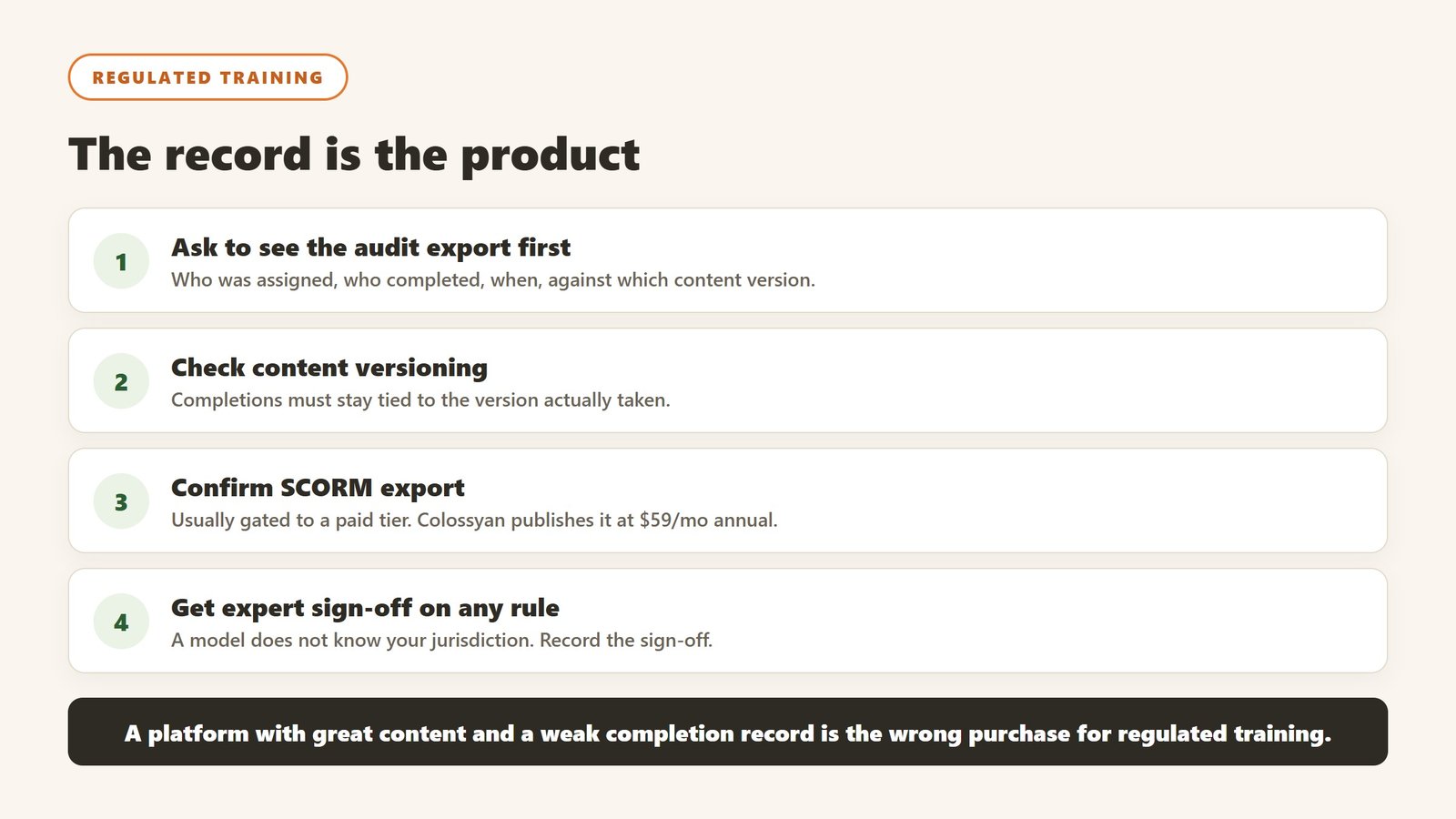
The record is the product
For regulated training, what you need at audit is a defensible record: who was assigned, who completed, on what date, against which version of the content. Ask any vendor to show you that export before anything else. A platform with excellent content and a weak completion record is the wrong purchase, and a plain one with an audit-ready export may be exactly right.
Content versioning is the detail people miss
Regulations change and content gets updated. When it does, you need to know which version each person completed, because “everyone completed the fire safety module” is not an answer if the module changed in March. Ask how the platform versions content and whether historical completions stay tied to the version that was actually taken.
SCORM export matters more here than anywhere
If completions have to land in a corporate LMS, the authoring or video tool must export a trackable package. Colossyan publishes SCORM export on its Professional tier at $59 a month billed annually, verified 4 September 2026. Check this before shortlisting on price, because a cheaper tool that cannot produce a trackable package is not doing the job at all.
Be careful with AI generated content in a regulated context
A model does not know your jurisdiction, your policy, or the specific standard you are being audited against, and confident wrong content in compliance training is worse than no content. Use generation for structure, scenarios and delivery, and have a named person with the relevant expertise sign off anything that states a rule. Record that sign-off alongside the content version.
Authoring tools and the per author licence model
Course authoring is priced per author per year, not per learner, which makes it one of the easier budgets to calculate and one of the more expensive to get wrong. Here is where clinical workforce sits, read 4 September 2026.
iSpring publishes the clearest per author rates
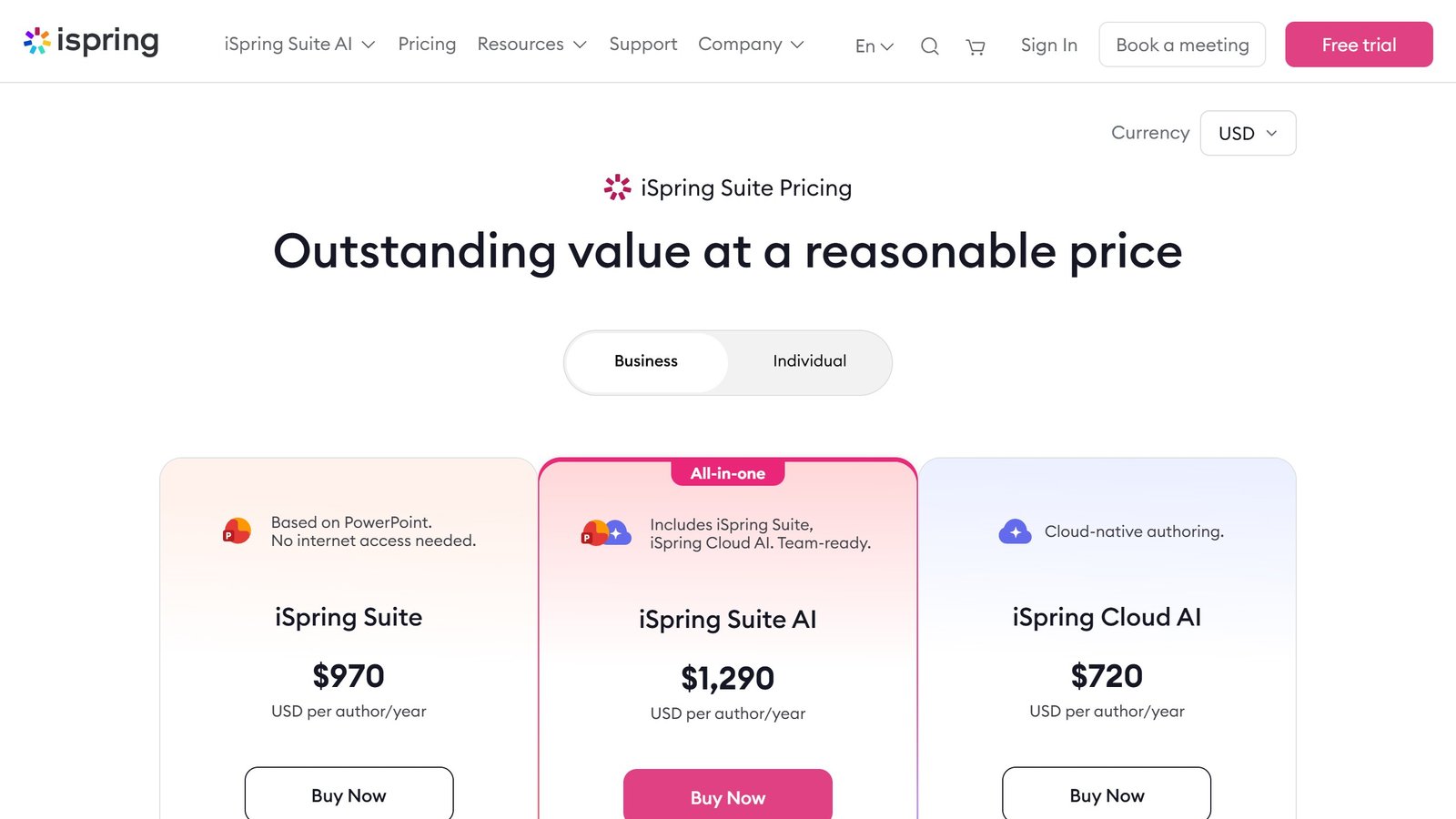
iSpring publishes iSpring Suite at $970 USD per author per year, iSpring Suite AI at $1,290 and iSpring Cloud AI at $720. Because the meter is authors rather than learners, the arithmetic is simple: two instructional designers on Suite AI is $2,580 a year regardless of whether you train fifty people or five thousand. That is the friendliest structure in this category for an organisation with a large workforce and a small L&D team.
Articulate is currently showing a limited-time offer, not a standard price
This one needs care. Articulate‘s canonical pricing URL redirected us to a special offer page on 4 September 2026, showing $1,198 USD per user per year against a struck-through $1,749, described as 31% off and a limited time offer, with an FAQ headed “Who is eligible for this special pricing offer?”. So the published figure is promotional. Ask what the price is outside the offer and what it renews at, because a 31% discount in year one against an undiscounted year two is a materially different deal from a $1,198 rate card.
The add-ons are priced separately and are not small
Articulate publishes Localization starting at $5,000 a year and Reach Pro starting at $3,600 for 1,200 active learners a year. Localization is the one that surprises people: if you train a multilingual workforce, translation management can cost more than the authoring seats. Price the combination you would actually deploy rather than the headline seat.
Per author is only cheap if authoring is centralised
The model rewards a small team of dedicated designers and punishes a federated approach where every department wants to build its own content. Decide which you are before buying. If fifteen people across the business each need to publish occasionally, a per author licence is the wrong shape and you should be looking at a tool priced differently, or accepting a bottleneck by design.
Measuring training, honestly
Training is the discipline most prone to measuring the wrong thing well. Four levels of rigour are available and most organisations stop at the first.
Reaction is easy and nearly worthless
Satisfaction scores at the end of a session tell you whether people enjoyed it, which correlates weakly with whether they can now do anything differently. Collect it if you like, and do not report it as evidence the training worked.
Completion is an activity metric
Completion percentage measures compliance with an instruction. It is genuinely necessary for regulated training, where the record is the point, and it is not evidence of capability anywhere else. Report it as what it is.
Behaviour change is where the real evidence starts
Pick one observable behaviour and measure it before and after: the proportion of discovery calls that reach a defined qualification step, the share of tickets resolved without escalation, the number of safety observations logged. It needs a baseline from before the training, which is why this gets skipped, and it is the first level that would survive a hostile question.
Business outcome, with the caveat stated out loud
Attributing revenue or incident rates to a training programme inside one year is genuinely hard, because everything else moved too. If you report an outcome, report what else changed in the same period. The most credible thing a training team can do is claim the behaviour change it can evidence and be openly cautious about the outcome it cannot.
Take the baseline in the week before launch
Whatever you choose, capture it before anything is switched on, from a source the project did not touch. It takes an hour and it is unrecoverable afterwards, which is the single reason most training investments can never be evaluated.
Rolling this out so people actually use it
The failure mode in corporate training software is not a bad product, it is a deployment that reaches week six with impressive licence numbers and no behaviour change.
Pick one team and one behaviour, not one platform
The instinct is to roll out to everyone because the licence covers it. The better move is one team, one measurable behaviour, and a fixed period. A discovery call structure, an objection, a specific product pitch. Narrow scope means you can tell whether it worked, and a result from one team persuades the rest far more effectively than a mandate.
Managers have to use it before reps do
Roleplay and coaching platforms live or die on whether managers review the output. If a rep completes a scenario and nobody ever mentions it, completion becomes a compliance task within a fortnight. Before launch, agree which existing meeting will use the output, ideally the one-to-one that already happens, and make somebody responsible for opening it there.
Mandatory completion produces completion, not skill
If the only metric is completion percentage, you will get a high completion percentage and learn nothing. Pair it with something qualitative from the start: a manager rating on a rubric, a before-and-after recording, or a call outcome. Otherwise the dashboard will look excellent while the sales floor is unchanged.
Plan for the second wave, which is where it usually dies
The first cohort is volunteers and enthusiasts and it always goes well. The second is everyone else, and their experience decides whether clinical workforce becomes part of how the team works. Budget real time for the second wave, expect more resistance, and do not read the first cohort’s enthusiasm as evidence the rollout is done.
Name the owner and the stop condition
One person whose job includes this, with the hours to do it, and a written statement of what twelve months would have to look like for you not to renew. Both are unglamorous and both are the difference between a platform that survives a budget review and one that quietly does not.
Where the figures on this page come from
Every price here was read from the vendor’s own pricing page on 4 September 2026 and carries that date. Where a page served us regional pricing we say so rather than converting it, because regional rates are set deliberately and are not a currency conversion.
The pages we read
Yoodli publishes $8 and $20 a month billed annually plus a free tier. Colossyan publishes a free plan and Professional at $59 a month annually with $30 per additional member. HeyGen publishes $0, $29, $49 and $149 a month with team seats at $20. iSpring publishes $970, $1,290 and $720 USD per author per year. Deputy publishes $5, $6.50 and $9 per user per month excluding tax. Synthesia served us rupee pricing, reported as such above.
The ones that publish no figure
Second Nature, Hyperbound, Mindtickle, Highspot and Visier all declined to show us a price, and Allego publishes a pricing page with no currency figure on it at all. Articulate publishes only a limited-time offer, currently $1,198 per user per year against a struck-through $1,749. Treat any other figure for those seven as unverified.
What we do not do
We do not convert currencies, and we do not carry a figure we cannot source to the vendor. Where a number circulates and cannot be traced, we say so and withdraw it rather than repeating it with a hedge.
How we checked this
We have not run a hands-on trial of any of these platforms. This is desk research and here is exactly what it consisted of.
We loaded each vendor’s site on 1 September 2026, followed the pricing link in their own navigation where one existed, and read the rendered page. Where no pricing link existed we then tried the conventional /pricing path directly, and where that returned 404 we have said the platform has no public pricing page rather than inferring anything from a single failed read. Capability coverage is taken from each vendor’s own descriptions of what their product does, across their homepage and pricing page, and is a record of what they claim rather than a judgement of how well they do it.

Written by
FazFaz is the founder of AIToolsBakery. Some tools here are tested hands on. Others are assessed from vendor documentation and pricing verified on the live page, and every review says which one it is. Sponsors can buy a position in a guide. They cannot buy the score, the criticism, or silence about a better option.
How we test and how we make money →