
AI app builders make the first version of an app in an afternoon. Then comes the question every builder answers differently: where should it live? Lovable, Bolt, Replit and Base44 all host apps themselves. v0 sends you to Vercel. And each of them lets you export the code to run somewhere else.
The pages that rank for this question are mostly written by one hosting company, plus a few how-to guides from static hosts. We read them, and found three gaps. Nobody prices the same app on different hosts. Nobody says what each free tier actually does when you hit its limit. And most of the guides still tell you to upload a folder of static files, which no longer works for new Lovable projects.
How we put this together. We have not deployed apps on these hosts ourselves; this is a research-based guide. Every price, limit and rule below comes from the vendor’s own pricing page or documentation, read on 13 October 2026. The monthly costs are our own arithmetic on those published rates, with the assumptions stated in full below. They are estimates, not bills. Prices are as displayed to us, in dollars; some pages do not name the currency.
First, check what kind of app you have
This decides which hosts can run your app at all, and it is the step most guides skip.
- A static app. Older Lovable projects and Bolt projects built with Vite are static apps. Building them produces a
distfolder of plain files that any static host can serve. - A server-rendered app. Lovable’s own deployment guide says projects created from 13 May 2026 use TanStack Start and “need a host that runs a server”. If your
package.jsonlists@tanstack/react-start, a static-only host will not run it. v0 projects are typically Next.js apps, and a Next.js app with server actions or route handlers needs a server too. - A backend. Your database, sign-in and file storage usually live somewhere else: Lovable Cloud, Bolt Database, Supabase or Base44’s backend. Moving the front end does not move these, and none of the costs below include them.
If you are not sure, open the exported code and look for that TanStack line, or for next in the dependencies. That one check rules hosts in or out before price matters.
What each builder’s own hosting gives you
Staying put is the easiest option, and for many small apps it is the right one. Here is what each builder includes, from its own docs.
| Builder | Free hosting | Custom domain from | Code export |
|---|---|---|---|
| Lovable | lovable.app address, HTTPS, all plans | Pro, $25 a month | Git sync on every plan; zip download on paid plans |
| Bolt | bolt.host address, public sites only on Free | Pro, $25 a month | GitHub sync, owner only |
| v0 | Deploys to Vercel | Through your Vercel project | GitHub sync to a private repo |
| Replit | Static publishing free, plus $0.05 per GB transferred | Not stated on the page we read | Manual copy |
| Base44 | base44.app address on every app | Starter, $16 a month billed annually | Zip and GitHub from Builder plan |
Lovable
Lovable says it hosts your app, that traffic “isn’t capped by plan”, and that a live site does not use credits on its own, although high-traffic apps may draw on your credit balance. It does not publish a rate for that. The plans page lists Pro at $25 a month and Business at $50. Custom domains need a paid plan.
Bolt
Bolt’s pricing lists Free with “up to 333K” web requests and Pro at $25 a month with “up to 1M”. It does not say what counts as a web request or what happens above the cap. Bolt’s own hosting launched on 14 August 2025 and replaced Netlify as the default, which is why older guides disagree on whether Bolt hosts apps. You can still pick Netlify, but a project already published on Bolt hosting cannot switch.
v0
v0 deploys to Vercel, so your hosting bill is a Vercel bill, separate from your v0 plan. v0’s own plans run from Free to Plus at $30 per user a month.
Replit and Base44
Replit’s deployment pricing makes static hosting free with transfer at $0.05 per GB, and server apps on Autoscale from a $2 monthly base. Base44 includes hosting on every app; custom domains start on Starter at $16 a month billed annually.
The 10 hosts compared
| Host | Runs | Free tier | Paid entry | At the limit |
|---|---|---|---|---|
| Hostinger Web Apps | Static and Node.js | None, 30-day money-back | $3.99 a month on 48 months, renews at $16.99 | Flat price, fair usage policy; may need to upgrade |
| Cloudflare Workers | Static, server code on Workers | 100,000 requests a day; static files free | $5 a month | Free plan has a daily request limit; what happens then is not stated on the pricing page |
| Vercel | Next.js, TanStack Start, Vite | Hobby, non-commercial only | Pro, $20 a month including $20 usage | Hobby waits 30 days; Pro bills on demand |
| Netlify | Vite, TanStack Start | 300 credits a month | Personal $9, Pro $20 | Free pauses every site on the account |
| Railway | Containers, Node servers | $1 a month credit | Hobby $5 including $5 usage | Bills total usage above $5 |
| Render | Static and Node services | Free services spin down after 15 minutes | See its pricing page | Free services suspended to month end |
| DigitalOcean App Platform | Static and containers | 3 static apps, 1 GiB transfer each | Container from $5 a month | Bills overage at $0.02 per GiB |
| Fly.io | Containers | None for new organizations | About $2.19 a month for the smallest machine | Pay as you go |
| Firebase App Hosting | Next.js, Angular | No-cost usage on the Blaze plan | Blaze, card required | No built-in cap |
| The builder’s own hosting | Whatever the builder makes | Builder subdomain | $16 to $25 a month for a custom domain | Varies by builder |
The same app at three traffic levels
This is the comparison no ranking page makes. We priced one small static app (an older Lovable or Bolt build) on each host at 10,000, 100,000 and 1 million visits a month.
Our assumptions: each visit transfers 1 MB and makes 20 requests, the site is deployed 10 times a month, one person on the team, monthly billing unless noted, taxes excluded. That makes 10 GB at 10,000 visits, 100 GB at 100,000 and about 1 TB at 1 million. We treat GB and GiB as equal, which is about 7% off. Your real numbers will differ, so use the method, not just the totals.
| Host and plan | 10k visits | 100k visits | 1M visits |
|---|---|---|---|
| Cloudflare Workers Free | $0 | $0 | $0 |
| Hostinger Web Apps, 48-month intro | $3.99 | $3.99 | $3.99 (fair use) |
| DigitalOcean free static | $0.18 | $1.98 | $19.98 |
| Fly.io smallest machine | $2.39 | $4.19 | $22.19 |
| Railway Hobby | $7.50 | $12.00 | $57.00 |
| Netlify | $9 (Free would pause) | $20 | $170 |
| Vercel Pro | $20 | $40 | $120 |
| Render, bandwidth over the free 5 GB | $0.75 | $14.25 | $149.25 |
| Firebase App Hosting, bandwidth only, half cached | about $0 | about $14.54 | about $161 plus requests |
| Lovable Pro, own hosting | $25 | $25 | $25 plus unpublished credit use |
| Bolt Pro, own hosting | $25 | May pass the 1M request cap | Over the cap |
How we got these numbers
- Cloudflare: its Workers pricing says requests to static assets are “free and unlimited” with no charge for bandwidth.
- Hostinger: a flat Web Apps Hosting price of $3.99 a month on a 48-month term, renewing at $16.99, with no usage fees under a fair usage policy. The renewal is what you pay from year five.
- DigitalOcean: transfer above the free 1 GiB at $0.02 per GiB.
- Fly.io: the smallest shared machine at $2.19 a month plus $0.02 per GB of North American and European traffic.
- Railway: about $5 of memory and $2 of CPU for a small always-on container, plus $0.05 per GB out. Above the included $5 you pay the whole usage.
- Netlify: its credit pricing charges 20 credits per GB, 2 per 10,000 requests and 15 per production deploy. That is 390 credits at 10,000 visits, more than the free 300, so the Personal plan. At 1 million it is about 24,150 credits: Pro’s 3,000 plus 15 packs of 1,500 at $10.
- Vercel: Pro at $20 plus the Flat Rate CDN tier that fits the request count: included at 10,000 visits, $20 at 100,000, $100 at 1 million. Vercel’s pricing page and its Pro plan docs describe overage differently; these figures follow the most recently dated doc.
- Render: $0.15 per GB over the 5 GB included on Hobby. We have left out its plan fees because its pricing page did not show them to us.
- Firebase: transfer above the free 10 GiB at $0.15 per GiB cached and $0.20 uncached, assuming half is cached, with requests extra at 1 million visits.
What the table tells you
At 10,000 visits, almost everything costs under $10, and the choice is about custom domains and commercial-use rules, not money. At 100,000, Vercel’s free plan is over its 1 million request cap and Netlify’s free plan has long since paused. At 1 million, bandwidth decides everything: the same files cost $0 on Cloudflare and about $170 on Netlify Pro.
If your app is server-rendered
New Lovable projects and v0 Next.js apps with server actions run server code, which adds compute charges. We added two server calls per visit at 50 milliseconds of CPU each. Only hosts that run server code are listed.
- Cloudflare Workers: 50 ms per call is over the free plan’s 10 ms limit, so the $5 Paid plan is the realistic choice. It covers 10,000 and 100,000 visits; at 1 million, extra CPU brings it to about $6.40.
- Hostinger: still $3.99 on the intro term. Hostinger does not publish the memory and CPU on that plan, so a busy app may need the Cloud Startup plan at $7.99 a month on 48 months, renewing at $25.99.
- Vercel Pro: function costs at 10,000 and 100,000 visits fit inside the $20 credit. At 1 million, about $124.76 before memory charges, which we did not model.
- Railway and Fly.io: a container already runs a server, so the static figures above are a floor. Real CPU and memory needs at 1 million visits are unknown.
- Firebase App Hosting: Google’s own example prices 1 million visits at about $69.58, on its assumptions rather than ours.
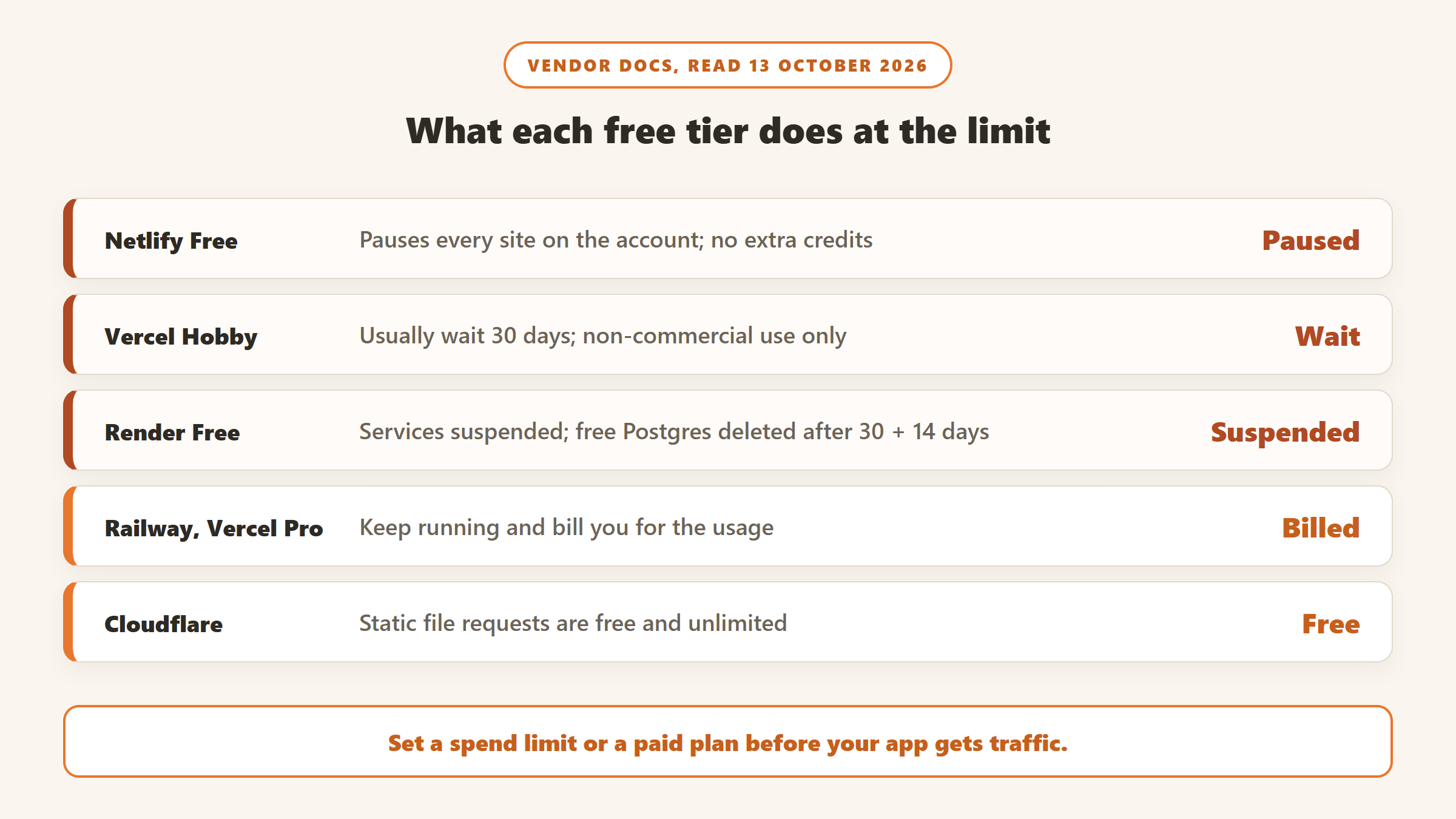
What each free tier does when you hit the limit
Free tiers fail in very different ways, and this matters more than the price when your app suddenly gets traffic.
- Netlify Free: when credits run out, “all of your web projects” are paused, and you cannot buy extra credits on the free plan. One busy app takes down every site on the account.
- Vercel Hobby: Vercel says that in most cases you wait until 30 days have passed. Hobby is also limited to non-commercial, personal use, so a paid product should not be on it at all.
- Render Free: free services spin down after 15 minutes idle and are suspended to the end of the month when free hours run out. Free Postgres databases expire after 30 days, then are deleted after a 14-day grace period.
- Railway and Vercel Pro: they keep running and bill you. Vercel Pro has a $200 default spend alert and an optional hard pause; set one before you launch.
- Cloudflare: static files are never charged; server code on the free plan has a daily request limit.
- Hostinger: no overage fees, but its FAQ says each plan has resource limits and you “may need to upgrade”.
The export checklist: what breaks when you move
These come from the builders’ and Supabase’s docs. Work through them before you switch the domain.
- Wrong host type. A TanStack Start or Next.js app with server code will not run on a static host.
- Refreshing a page gives a 404. Single-page apps need a rule that sends every path to
index.html. Each host has its own file for this. Lovable warns not to use that fallback for TanStack Start, which routes on the server. - Settings are baked into the build. Lovable notes that
VITE_variables are embedded at build time, not runtime, so change them on the new host and rebuild. Lovable Cloud apps need their Supabase URL, key and project ID set. - Sign-in breaks on the new domain. In Supabase the Site URL defaults to localhost, and it drives confirmation and password-reset emails. Set it to your live domain, add your preview addresses to the allowed redirect URLs, and update Google or GitHub sign-in settings.
- Your data does not come with the code. Lovable’s ownership guide says exports omit database rows and stored files. Its data export allows one export every 24 hours, and users have to sign in again after a move. Base44’s eject command creates a new app with “an empty database”.
- Edge functions and scheduled jobs. They must be redeployed separately, and old and new backends can run the same job twice if you leave both on.
- Builder AI features stop. Lovable’s connectors and AI calls run through Lovable and must be replaced. A Base44 front end still talks to the Base44 backend.
- The builder keeps publishing and billing. Lovable’s Publish button still updates the lovable.app version, and moving does not cancel your subscription. On Bolt, disconnecting GitHub is permanent. On v0, deleting the repo can make the code unrecoverable.
- Lockfile mismatch. If only a Bun lockfile exists, use Bun on the new host or generate an npm one.
- You now run the operations. Deploys, SSL, backups, monitoring and AI provider bills are yours.
The hosts, one by one
Cloudflare Workers: cheapest at any traffic level
For a static app, nothing beats free bandwidth and free static requests. Server code is cheap on the $5 plan. The trade-off is setup: Workers is a developer platform, so expect to configure builds yourself.
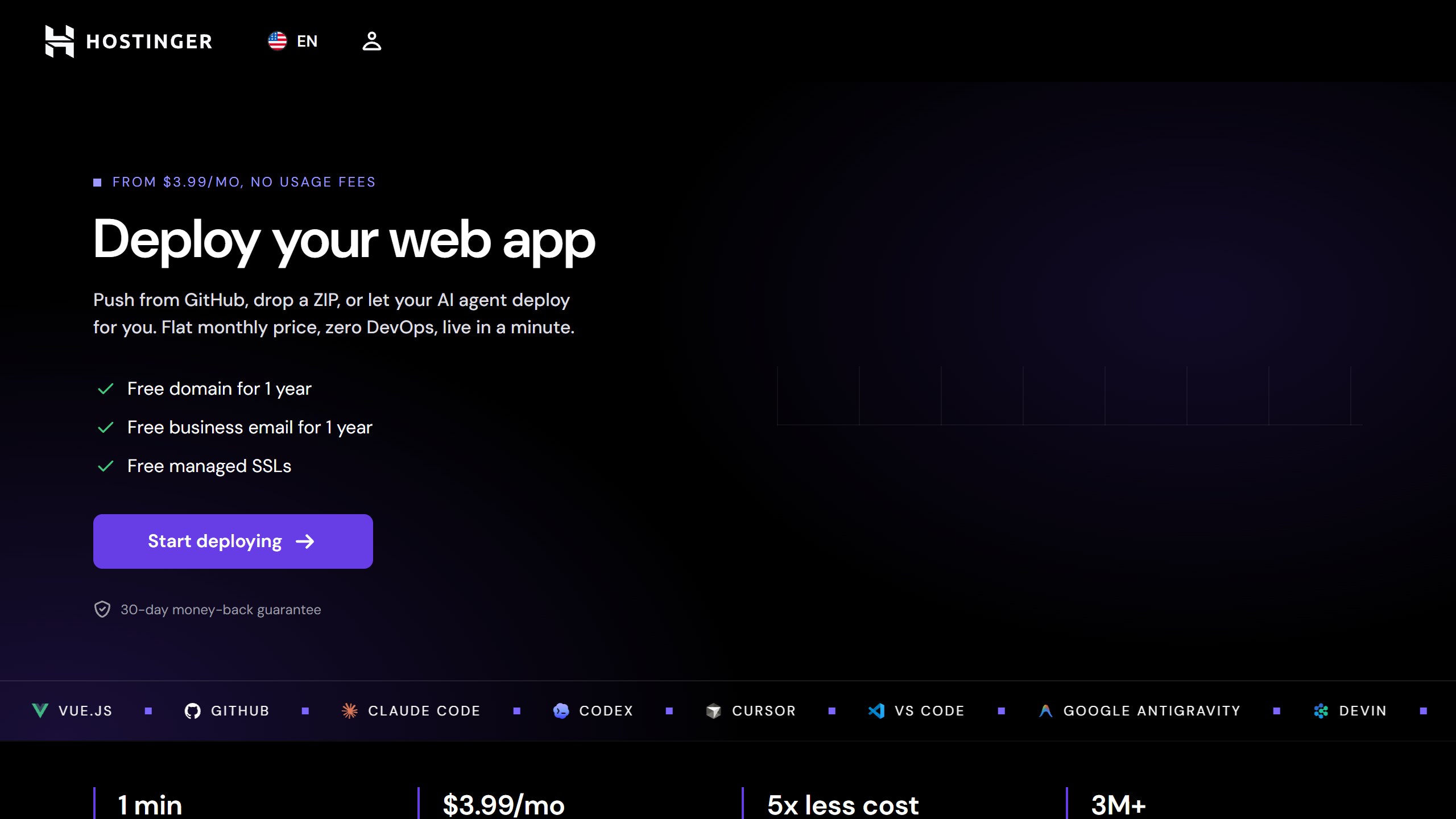
Hostinger Web Apps Hosting: one flat price
Hostinger names Lovable, Bolt, v0, Replit, Base44 and Firebase Studio on its page, deploys from GitHub, a zip file or an AI coding assistant, and connects to Supabase. It is the only host here with no usage billing. Remember the term: $3.99 a month is the 48-month price, $191.52 upfront, and it renews at $16.99.
Vercel: the home of v0
If you built with v0, Vercel is already your host. Move to Pro the moment the app earns money, because Hobby does not allow commercial use, and set a spend limit.
Netlify: simple, but watch the free plan
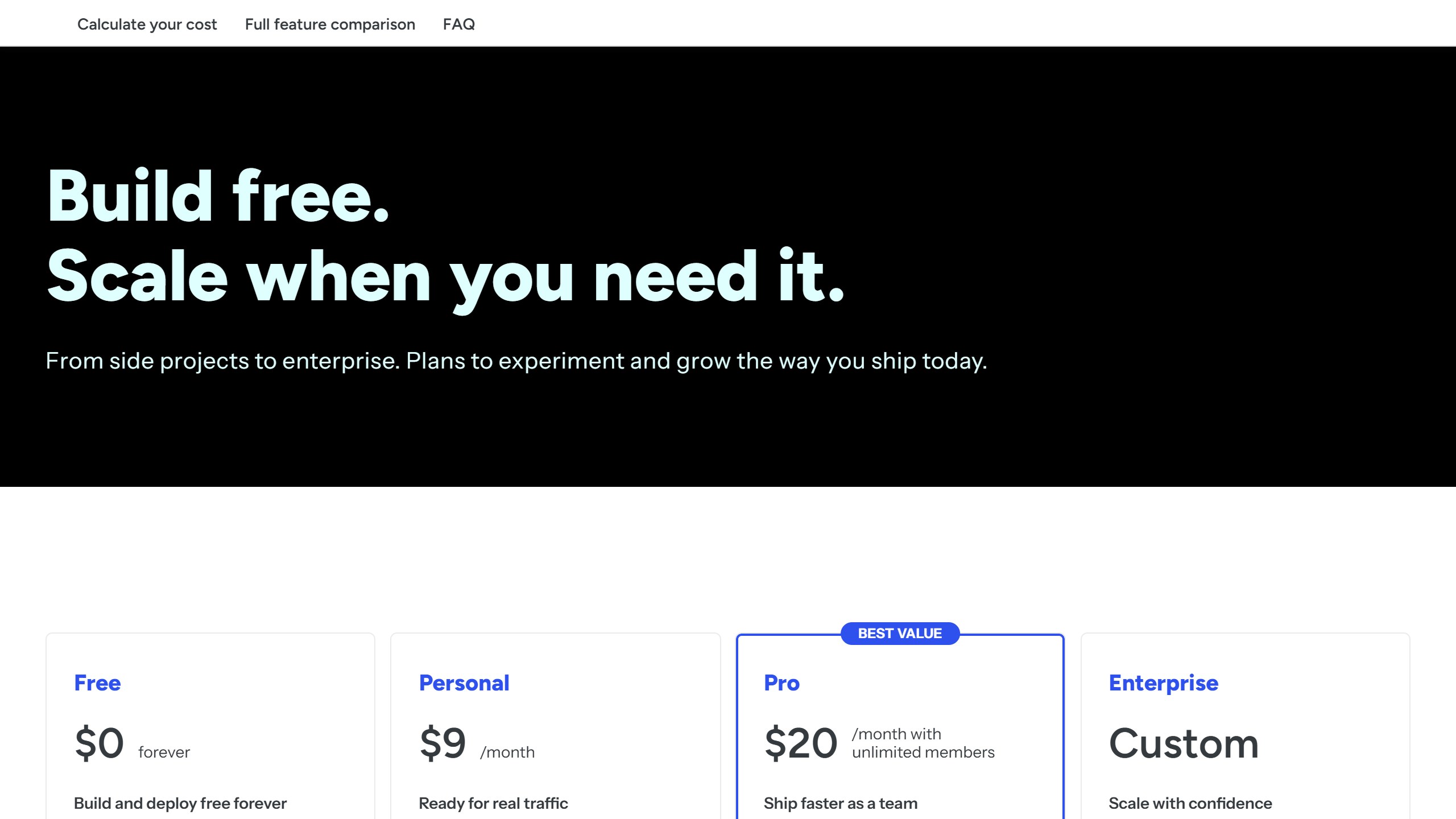
Netlify supports Vite and TanStack Start apps and its credit system is clear. Do not run a growing app on Free, because hitting the limit pauses every site you have.
Railway, Fly.io and DigitalOcean: for full-stack apps
These run containers, so they suit apps with a real server and a database next to it. DigitalOcean’s free static apps are a good small option; Railway and Fly.io bill by the second. If you are hosting an AI agent rather than an app, see our guide to OpenClaw and Hermes agent hosting, and for a .ai address, what a .ai domain really costs.
Render and Firebase
Render’s free tier is fine for demos but suspends services and deletes free databases. Firebase App Hosting needs the pay-as-you-go Blaze plan and has no built-in spending cap, so set a budget alert. If you are self-hosting an automation tool such as n8n rather than an app, see our n8n hosting guide.
Black Friday on app hosting
Hostinger’s Black Friday page says its sale runs from 19 October to 14 December 2026 and lists Web Apps Hosting among the plans; no sale price was shown when we read it. None of the other builders or hosts we checked, all of them except Cloudflare and Firebase, showed a Black Friday offer on its own pages on 13 October. If you lock in a long hosting term during a sale, compare the renewal price, not the intro price. We track verified offers on our AI tools Black Friday deals page.
So where should you host?
If your app is small or still a test
Keep it on the builder’s own hosting. Pay for a custom domain only when you need one.
If you want the lowest bill as traffic grows
Cloudflare, for static apps and for server code on the $5 plan.
If you want one predictable price
Hostinger, with the renewal price in your plan.
If you built with v0
Vercel Pro, with a spend limit set.
For the builders themselves, see our best AI website builders guide.
Sources
- Lovable: hosting, external deployment, ownership, plans. Bolt: pricing, publishing, Netlify, Git.
- v0: deployments, GitHub, pricing. Replit deployment pricing. Base44: pricing, eject.
- Hostinger Web Apps Hosting, Vercel pricing, Hobby, Flat Rate CDN, Netlify pricing, Cloudflare Workers pricing.
- Railway pricing, Render free tier and bandwidth, DigitalOcean App Platform, Fly.io pricing, Firebase App Hosting costs, Supabase redirect URLs.
- All read 13 October 2026. Monthly costs are our arithmetic on published rates.

Written by
FazFaz is the founder of AIToolsBakery. Some tools here are tested hands on. Others are assessed from vendor documentation and pricing verified on the live page, and every review says which one it is. Sponsors can buy a position in a guide. They cannot buy the score, the criticism, or silence about a better option.
How we test and how we make money →