Search for AI PANCE exam prep and nearly every result on the first page is a prep company describing its own product, an App Store listing, or an app report site. That is normal for exam prep. What is less normal is how often those vendor pages disagree with the exam itself. The National Commission on Certification of Physician Assistants (NCCPA) changed the PANCE content blueprint for every administration from January 2025, and when we set the vendors’ own blueprint claims beside NCCPA’s document, several did not match. One still says its bank is based on the 2019 blueprint. Another publishes percentages NCCPA does not use. An AI tutor is only as useful as the question bank and the blueprint behind it.
This guide starts with the PANCE as NCCPA describes it, and with the official practice material NCCPA sells, which is the benchmark for everything else. It then compares six prep products that describe an AI feature: what the AI does in the vendor’s own words, what the vendor says about the blueprint, what it costs, and whether it renews. After that come established banks with little or no AI, a section on general chatbots, a note on look-alike apps, what we left out, and a guide to choosing. It is written for PA students and new graduates preparing for the PANCE. If you are comparing notes with nursing or medical friends, our guides to AI FNP exam prep and AI USMLE prep tools cover their exams.
How we put this together. We have not used these tools ourselves. Every price, rating and feature below comes from the vendor’s own website, help pages, terms or US App Store listing, and the exam facts come from NCCPA’s own pages and PDFs, all read on 18 November 2026 and linked in the text. Two vendor websites, Smarty PANCE and Osmosis, showed an automated bot check to our scripts, so we read those pages in a normal browser. None of these companies paid to appear on this page, and there are no affiliate links. Nothing here is clinical advice; for anything about patient care, follow current guidelines and NCCPA’s own references.
The PANCE in 2026: what NCCPA says
Every product below claims to prepare you for one exam, so it is worth being precise about what that exam is. All of the figures in this section come from NCCPA.
Format, fee and scoring
NCCPA’s Become Certified page describes the PANCE as five blocks of 60 questions, so 300 questions, with 60 minutes for each block. You also get 45 minutes of break time to spread between blocks, which you manage yourself, and 15 minutes for a tutorial, making six hours of seat time for five hours of exam. You test at a Pearson VUE centre, and NCCPA says there are more than 300 of them. The application fee is $550. Once your application is complete you get a 180-day window to test, you can apply no earlier than 180 days before your program completion date, and the earliest you can test is seven days after you complete your program.
Scores sit on a scale of 200 to 800, and the passing standard is 350, according to NCCPA’s exam development and scoring page. NCCPA uses scaled scores to even out small differences in difficulty between exam forms, so the number of correct answers you need varies from one candidate to another. That matters when a prep app promises to tell you a percentage you need: NCCPA does not publish one. According to NCCPA’s PANCE at a Glance presentation, results arrive about two weeks after your exam.
Attempt limits
Two rules limit retakes. You can take the PANCE once in any 90-day period or three times in a calendar year, whichever is fewer, according to NCCPA’s policies PDF. On top of that sits the six-years-six-attempts rule: if you graduated on or after 1 January 2003 and have never been certified, you have six years from program completion and six attempts in total, and you lose eligibility when either runs out. The only way to regain it is to complete an accredited PA program again. With a $550 fee per attempt and those limits, the cost of a failed attempt is much more than the fee. NCCPA’s key dates page lists PANCE administration windows from 2 January to 18 December in both 2026 and 2027.
The January 2025 blueprint
The PANCE content blueprint applies to all administrations from January 2025. It splits the exam two ways. By medical content: Cardiovascular 11%, Pulmonary 9%, Gastrointestinal System/Nutrition 8%, Musculoskeletal 8%, Infectious Diseases 7%, Neurologic 7%, Psychiatry/Behavioral Science 7%, Reproductive 7%, Endocrine 6%, Eyes, Ears, Nose and Throat 6%, Hematologic 5%, Renal 5%, Dermatologic 4%, Genitourinary 4%, and Professional Practice 6%. By task: History Taking and Performing Physical Examination 16%, Using Diagnostic and Laboratory Studies 10%, Formulating the Most Likely Diagnosis 18%, Health Maintenance, Patient Education and Preventive Measures 11%, Clinical Intervention 16%, Pharmaceutical Therapeutics 15%, Applying Foundational Scientific Concepts 8%, and Professional Practice 6%.
Three details from the same document are worth keeping in mind. Professional Practice, covering topics such as medical ethics, informed consent, the PA role and scope of practice, is its own 6% category and is not coded to a task. Surgical topics make up 8% to 10% of the exam and pediatric conditions 12% to 15%. And there are 14 organ systems, not 10. Those are the numbers to check any prep product against.
Pass rates
NCCPA’s five-year pass rate table shows 13,145 first-time takers in 2025 and a first-time pass rate of 91.5%, after 92.4% in 2024 and 92.0% in 2023. Across all 14,669 exams given in 2025, including repeat attempts, 88.4% passed. Keep those figures in mind when prep marketing quotes pass rates: a high pass rate among a vendor’s users says little when roughly nine in ten first-time candidates pass anyway.
PANRE and PANRE-LA are different exams
Many prep products bundle PANCE with PANRE, so it helps to know the difference. The PANCE is the initial certification exam. Once certified, PAs follow a 10-year maintenance process with 100 CME credits every two years, and must pass either the PANRE or the longitudinal PANRE-LA by the end of the tenth year, according to NCCPA’s certification maintenance page. PANRE-LA runs over 12 quarters in years 7 to 9 of that cycle. None of that applies to you yet, so a product’s PANRE features should not drive your choice.
The benchmark: NCCPA’s own practice material
NCCPA writes the PANCE, so its practice material is the yardstick for every product below. It has no AI feature.
NCCPA practice exams

NCCPA’s practice exams page lists three PANCE practice exams at $50 each. Each has 120 multiple-choice questions in two sections of 60, with 60 minutes per section, and you can pause and come back, as long as you finish within 180 days. You can take each exam once per purchase but buy it again as often as you like, and NCCPA issues no refunds on practice exams. The detail that sets them apart is in NCCPA’s FAQs: the questions were used on previous administrations of PANCE and PANRE, and once used on a practice exam they no longer appear on the real exam. Commercial banks write their own questions in the PANCE style instead.
There are limits. NCCPA does not provide answers or explanations, so you learn which areas are weak, not why a given answer was wrong. Instead you get a performance profile showing relative strengths and weaknesses across the blueprint areas. NCCPA also says the practice exams are not meant to predict your performance, and that 120 questions sample each area thinly: around 5% of the blueprint is hematology, so a practice exam holds only three or four hematology questions.
Sample questions and the blueprint itself
NCCPA also publishes a free sample questions PDF with 13 questions, each with a critique explaining the right and wrong options and the content category, and a set of adult laboratory values. The blueprint PDF itself runs to 21 pages and lists the diseases and disorders under each system, which makes it a free study checklist.
AI PANCE exam prep tools compared
| Product | What the AI does | Blueprint claim | Price (18 November 2026) | Renewal and guarantee |
|---|---|---|---|---|
| AMBOSS | AI Mode: study copilot, quizzes from your notes, adaptive Qbank sessions | Mapped to the NCCPA 2025 blueprint | $298, $338 or $448 (1, 3 or 12 months of Qbank, each with 12 months of library) | Auto-renews; the $448 bundle renews at $149 a year; 30-day refund |
| Smarty PANCE | AI Tutor and built-in hints in the QBank | Help article lists the 2025 blueprint, with one wrong weight | $55 for 2 weeks, $65 for 3 months, $79 a year | Does not auto-renew; 60-day refund; pass guarantee as refund or 12-month extension |
| Prepia | Pia chat tutor explains the question in front of you | 14 systems, no Professional Practice category | $24.99, $39.99 or $59.99 for 1, 3 or 6 months, one-time | Web plans do not renew; full refund if you fail |
| Lecturio | AI Tutor with optional hints; Lexi assistant | Qbank page says 2019 blueprint | Premium $134.97 for 3 months to $455.76 for 2 years | Auto-renews; 7-day free trial |
| Osmosis | Osmosis AI answers from Elsevier textbooks; makes flashcards and quizzes | Not shown to us | App plans from $16.99 a month to $249 a year | 7-day free trial in the app |
| BoardMaster | Writes PANCE-style questions from your lectures; Cortex assistant | PANCE page percentages differ from NCCPA | Free plan; $39.99 a month or $399.96 a year | 30-day money-back guarantee |
How we chose and ordered these
Each product had to describe an AI feature in its own words, offer PANCE preparation, and be live and updated in 2026. We ordered them by three things: how closely the vendor’s stated blueprint matches NCCPA’s January 2025 document, how clearly it explains what its AI does and which plan includes it, and how clear its price, renewal and refund terms are. This order says nothing about pass rates, and we found no independent study comparing these tools.
The six AI tools
1. AMBOSS: a bank mapped to the 2025 blueprint, with AI Mode in every subscription

The AI. AMBOSS calls its assistant AI Mode Learning and describes it as an AI study copilot built into the platform. You can start from an open question or upload notes or slides, and AI Mode explains concepts, compares look-alike conditions, builds targeted quizzes from your own lecture material, suggests Anki cards and recommends Qbank sessions based on your performance. AMBOSS says its answers are grounded in its own medically verified content rather than the open web. Its FAQ says AI Mode is currently included in all AMBOSS subscriptions, and that AMBOSS reserves the right to move it into a Premium subscription later. The model is not named.
The questions. AMBOSS’s PANCE page lists 2,000+ PANCE questions and says the bank is mapped to the NCCPA 2025 content blueprint and weighted to its specifications, the clearest blueprint statement in this lineup. One design choice stands out: if you answer wrong, AMBOSS does not show you the correct answer straight away, so you keep reasoning, with Tips that nudge you along. A single Qbank purchase also opens AMBOSS’s didactic and end-of-rotation sets, which helps if you are still in rotations.
Plans and price. The PANCE page sells 12 months of library access with Qbank access for 1 month ($298), 3 months ($338) or 12 months ($448). Without the Qbank upgrade, a membership gives 50 questions a month. AMBOSS’s pricing page says the $448 bundle renews annually at $149 unless you cancel, and that monthly and yearly memberships auto-renew. There is a 5-day free trial and a 30-day money-back guarantee on purchases made directly with AMBOSS. Its main iPhone app, AMBOSS Medical Knowledge, had a 4.91 rating from 13,967 ratings and was updated on 13 October 2026.
Choose it if you want a bank that states the current blueprint plainly and an AI assistant included in the price. Skip it if you only need a few weeks of questions, since even the 1-month Qbank comes bundled with a year of library access at $298, or you dislike auto-renewal.
2. Smarty PANCE: an AI tutor with hints on a membership that does not renew

The AI. Smarty PANCE, a PANCE and PANRE specialist, says on its QBank page that the bank has built-in hints and an AI Study Tutor to guide your thinking on tricky vignettes without spoiling the answer. The same page announces that Smarty PANCE now connects to your own AI tool, which builds custom exams from your weak areas, included with the membership. It does not name the model behind the tutor. Membership details come from its help centre.
The questions. The help centre says every current membership includes the main site’s blueprint-based lessons and the QBank with more than 5,200 questions, plus custom exams, mock exams, rationales and analytics. Its QBank guide adds custom practice by blueprint category, organ system, topic and difficulty, an adaptive mode, daily five-question quizzes, 3,500+ flashcards and full-length virtual PANCE exams with lab values and timed breaks. Smarty’s study guide article lists the 2025 blueprint’s organ systems correctly, but gives Pharmaceutical Therapeutics as 6% of the exam, where NCCPA’s blueprint says 15%. That looks like a typo, but it is the kind of error to watch for.
Plans and price. The sign-up page lists three All Access passes, each including the QBank, unlimited exams and the PANCE and PANRE courses: $55 for two weeks, $65 for three months and $79 for a year. The terms are favourable: Smarty’s refund article, updated on 18 August 2026, says memberships do not renew automatically, offers a full refund within 60 days if you are unsatisfied, and describes a PANCE and PANRE pass guarantee under which eligible members can ask for a refund or a free 12-month extension within one year, if the policy’s requirements are met. The guarantee does not cover end-of-rotation exams. The help centre also says the membership does not include official NCCPA questions.
Choose it if you want a PA-only platform with lessons and a large bank, an AI tutor that hints rather than tells, and no renewal to cancel. Skip it if you want to compare prices before you click through, since its website would not show us one.
3. Prepia: a low one-time price and an AI tutor, on a small bank
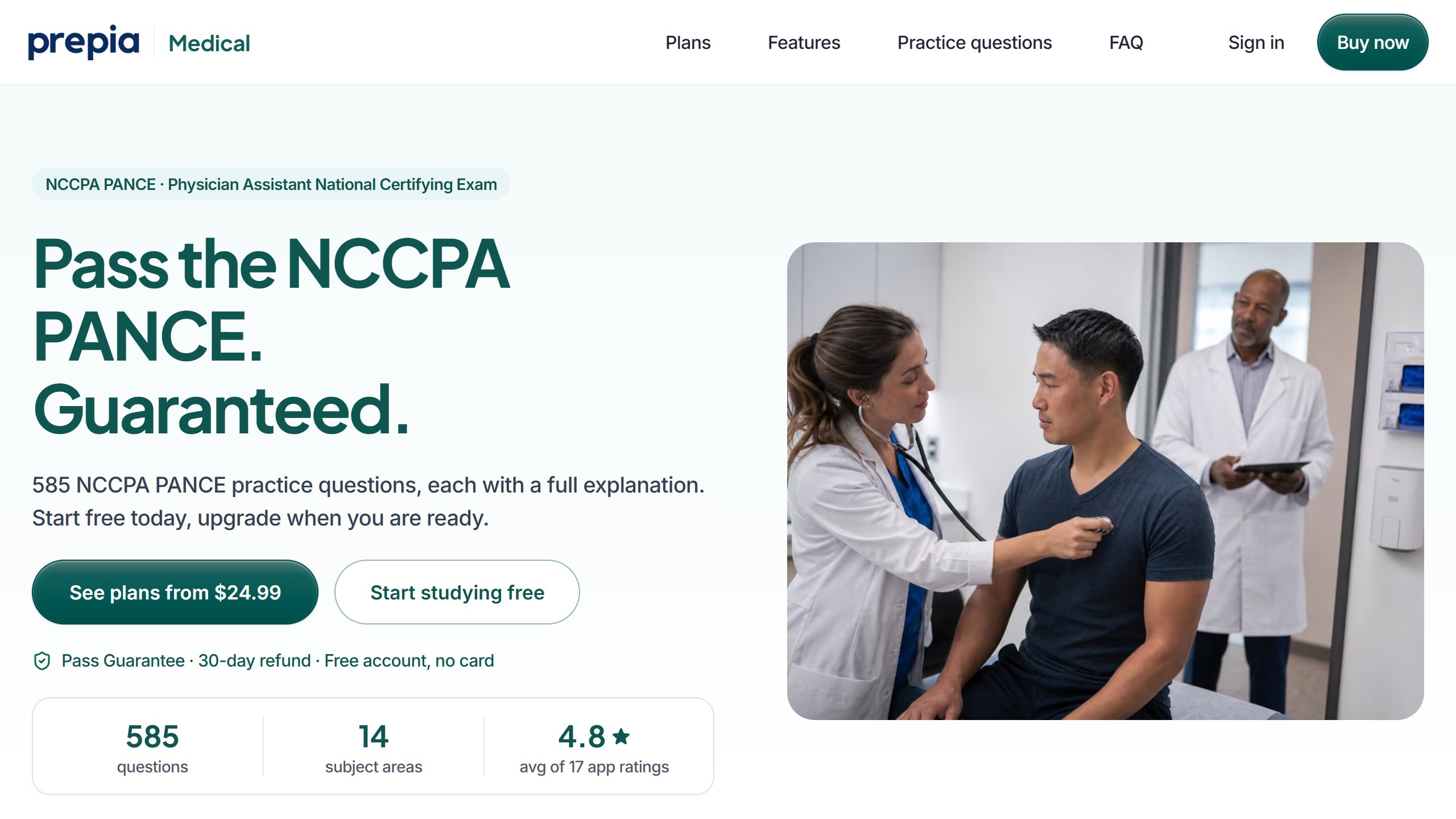
The AI. Prepia’s tutor is called Pia. Its PANCE page says: “Pia is the AI study tutor built into Prepia. Ask about the question in front of you and get the reasoning in plain words, with a diagram when a picture helps.” You open it under an answer explanation, and you can ask it to quiz you in the chat. Every plan lists a Personal Medical AI Tutor as included. Prepia does not name the model, and the sample chat shown on its PANCE page is a nursing-style example rather than a PANCE one.
The questions. The bank is 585 questions across 14 subject areas, from Cardiovascular (99) and Pulmonary (68) down to Genitourinary and Renal (13 each). There is no Professional Practice category, which is 6% of the real exam, and Cardiovascular makes up about 17% of the bank against 11% on the blueprint. Prepia says its banks are updated as exam content changes, but does not name a blueprint year.
Plans and price. On prepia.com, plans cost $24.99 for 1 month, $39.99 for 3 months or $59.99 for 6 months, each a single payment that does not renew, with a free account and no card needed to start. Prepia’s Pass Guarantee, updated on 29 September 2026, refunds a website purchase in full if you do not pass, without asking for a score report. The iPhone app, NCCPA PANCE Exam Prep 2026, is priced differently: its App Store page lists a $7.99 weekly subscription alongside monthly, 3-month and 6-month plans, and refunds for app purchases are decided by Apple or Google. The app had a 4.78 rating from 18 ratings, was updated on 14 November 2026, does not mention the AI tutor in its description, and its privacy label lists data used to track you.
Choose it if you want an AI tutor and a supplementary bank for a fixed, low price. Skip it if you want one bank to carry your whole preparation, or you would only buy inside the app.
4. Lecturio: an AI tutor with hints and a big video library, but a 2019 blueprint label
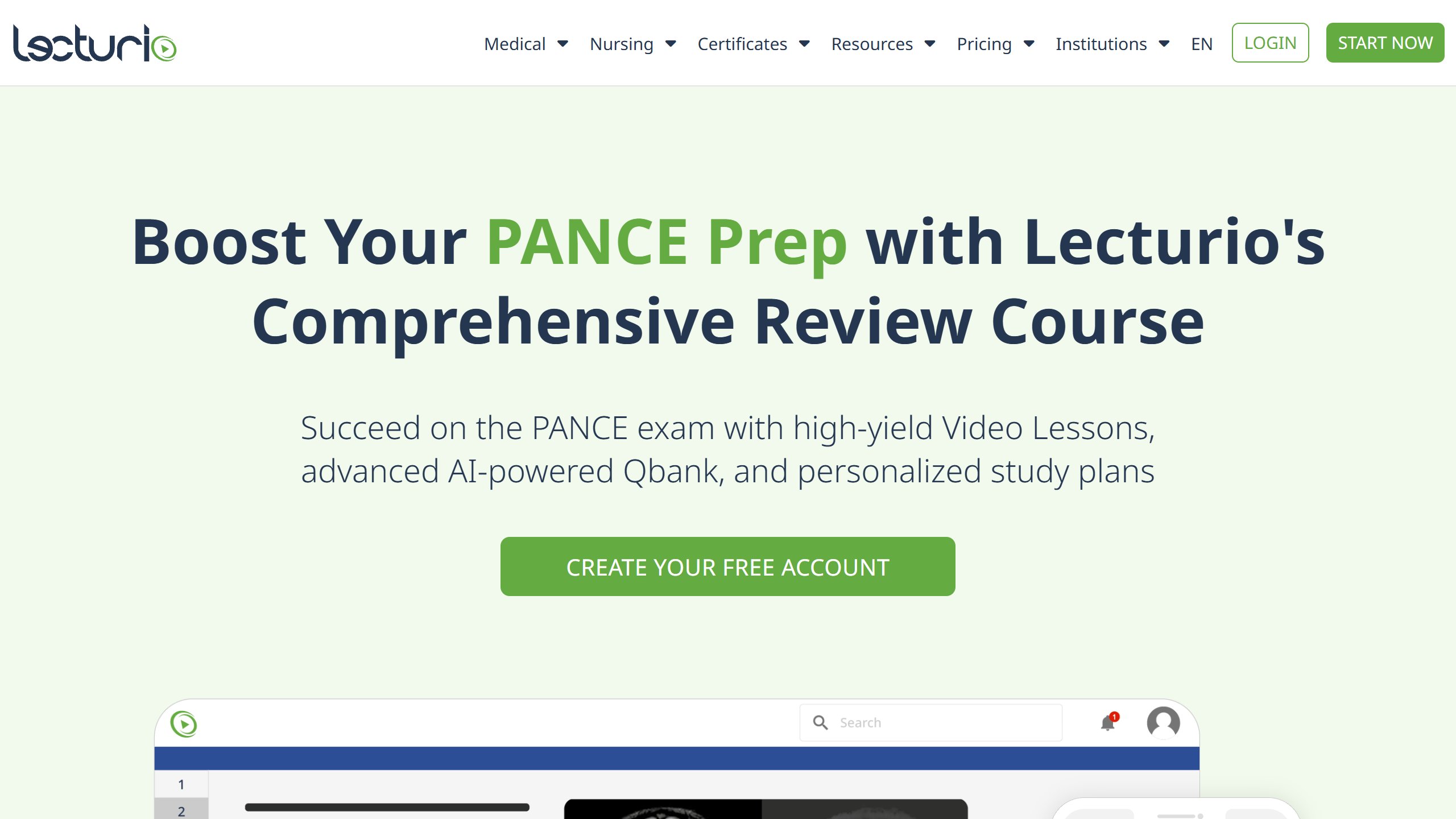
The AI. Lecturio has two AI features. Its PANCE page says an AI Tutor in the Qbank assists you in reaching the correct answer through conversational guidance, and its Qbank page describes it as giving optional hints and guiding your thought process. Separately, Lexi, Lecturio’s AI Assistant, answers medical questions using Lecturio’s videos, concept pages and Qbanks. Lecturio’s own pricing FAQ is candid about Lexi: its answers are not reviewed by a medical professional, so minor errors may occur, and you should check the source material.
The questions. The PANCE Qbank has 460+ questions with explanations and First Aid references, alongside 2,500+ video lectures, 900+ Clinical Medicine PA videos and 1,450+ concept pages. The catch is on the Qbank page itself, which says the bank is based on the 2019 PANCE blueprint, with professional practice “coming soon”. NCCPA replaced that blueprint for every administration from January 2025, so check with Lecturio before relying on this bank’s balance of topics.
Plans and price. The Qbank and AI Tutor sit on Medical Premium, not Basic. Lecturio’s pricing data lists Premium at $134.97 every 3 months ($44.99 a month), $335.88 a year ($27.99 a month) or $455.76 every 2 years ($18.99 a month). Each period is paid up front, and the FAQ says the membership renews automatically at the end of each billing period unless you turn renewal off. There is a 7-day free trial. Lecturio’s Medical Education iPhone app had a 4.80 rating from 4,283 ratings and was updated on 19 October 2026.
Choose it if you learn from video and want an AI tutor that hints rather than answers. Skip it if you want a bank built to the current blueprint, or a plan that ends on its own.
5. Osmosis: AI answers grounded in Elsevier textbooks, inside a video platform

The AI. Osmosis is a medical video and study platform. Its PANCE page says Osmosis AI, a conversational study companion, is available with PA subscriptions, and its App Store listing says you can ask Osmosis AI for evidence-based answers grounded in Elsevier medical textbooks and linked to Osmosis videos, and generate flashcards, quizzes, summaries and mnemonics on demand. The model is not named.
The questions. The listing names PANCE among the exams Osmosis covers and mentions board-style questions with explanations, but it gives no PANCE question count. Its PANCE page talks about review playlists based on the PANCE blueprint, but it gives no question count and does not say which blueprint year it follows.
Plans and price. The App Store lists Osmosis plans from $16.99 a month (Full Access) to $199.99 a year, and Suite Access from $49 a month to $249 a year, with a 7-day free trial; it does not say which plan suits PA students, so check before you buy. The app, published by Knowledge Diffusion, Inc. and copyrighted to Elsevier, had a 4.82 rating from 3,884 ratings and was updated on 15 October 2026. Its privacy label lists data used to track you.
Choose it if you learn best from short videos and want AI-made flashcards and quizzes tied to a textbook publisher’s content. Skip it if you want a PANCE bank whose size and blueprint you can check before paying.
6. BoardMaster: questions written from your own lectures, but no PANCE bank
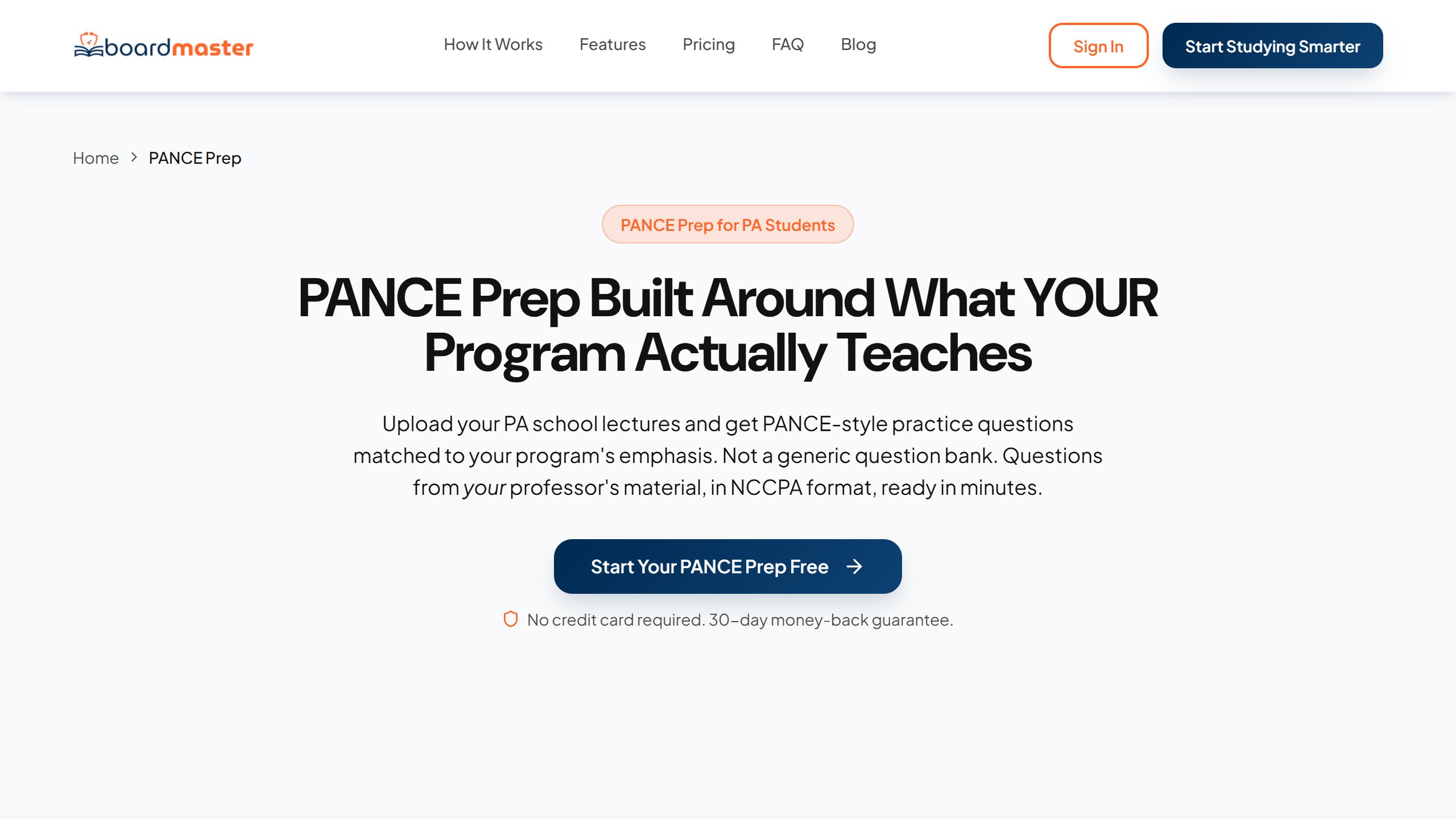
The AI. BoardMaster’s PANCE page pitches one main idea: upload your PA school lectures as PowerPoint, PDF, Word files or photos of handwritten notes, and its AI Question Generator writes PANCE-style questions from them, 200+ per upload according to the page. It also offers AI flashcards, AI patient encounters for OSCE practice, AI study podcasts and an assistant called Cortex. That is useful for module and end-of-rotation exams, where your professor’s emphasis matters. Questions written from your notes are only as accurate as your notes, though, so treat them as recall practice rather than a measure of PANCE readiness.
The questions. Two things are worth checking. BoardMaster’s QBank page describes its 5,000+ physician-written questions as covering Step 1, Step 2 and COMLEX Level 1 and 2; it does not list PANCE. And the PANCE page’s own blueprint table does not match NCCPA’s. It says the exam covers 10 organ systems, gives Cardiovascular 14% and Pulmonology 10%, and groups tasks into History Taking and Diagnosis at 48% and Clinical Intervention at 40%. NCCPA’s January 2025 blueprint has 14 organ systems plus Professional Practice, Cardiovascular at 11%, Pulmonary at 9%, and eight task categories.
Plans and price. BoardMaster’s home page lists a free plan with one document upload and 75 AI flashcards a month, and 40 QBank questions per subject. Monthly costs $39.99 and Annual $399.96 a year, which BoardMaster expresses as $1.09 a day. Both paid plans include unlimited uploads, and there is a 30-day money-back guarantee. Its footer says it is not affiliated with PANCE.
Choose it if you are in your didactic year and want practice questions built from your own lectures. Skip it if you need a PANCE question bank weighted to the real blueprint for dedicated study.
Established PANCE banks with little or no AI
These products describe no AI feature, or mention one only in passing, so they are not in the numbered list. They are the fair comparison for anyone deciding whether an AI tutor is worth paying for.
Blueprint PA (formerly Rosh Review)
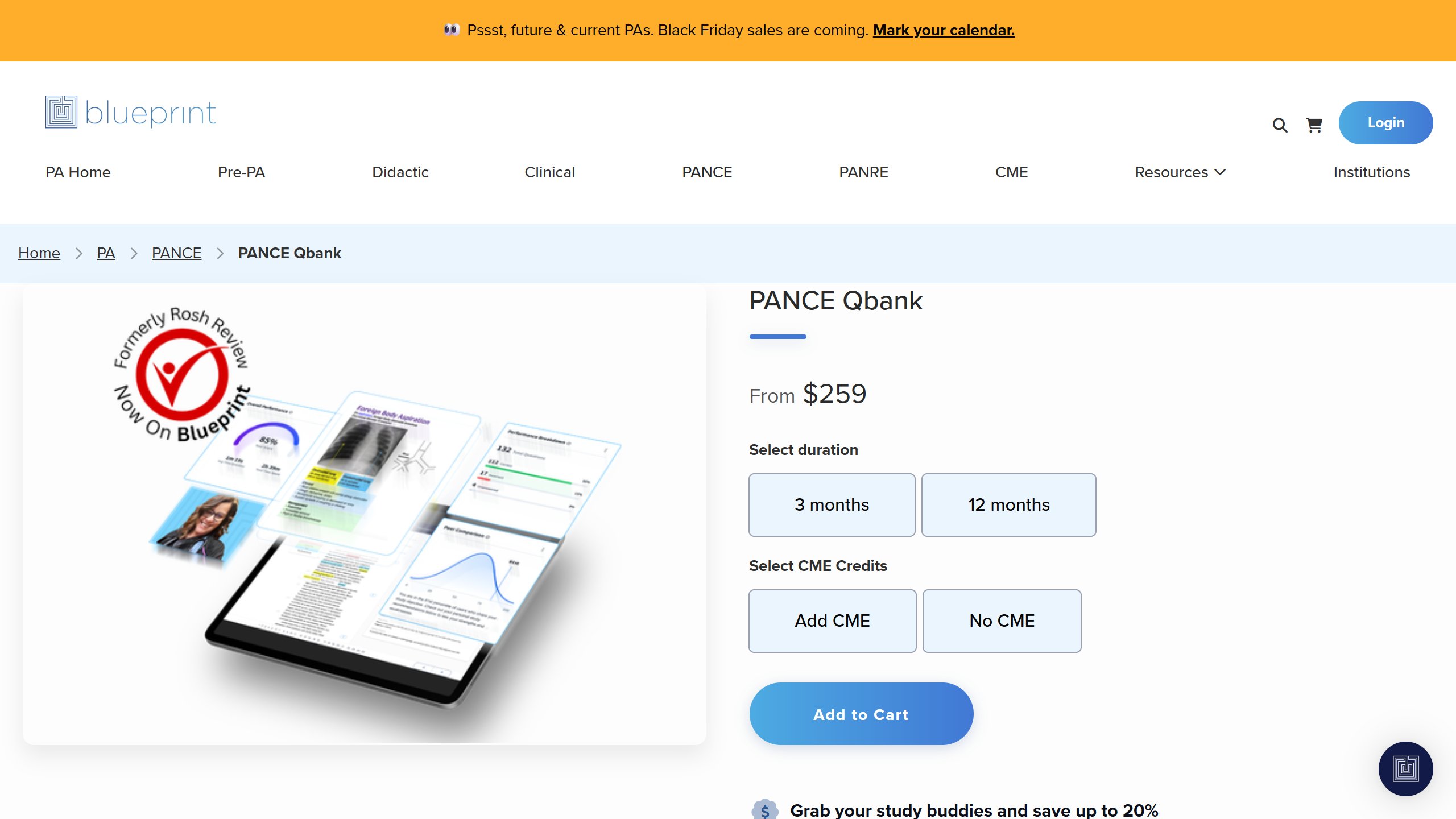
Blueprint’s PANCE Qbank is the former Rosh Review bank. It lists 3,800 NCCPA-formatted questions with explanations, a rapid review and a bonus question after each explanation, one year of access, the option to write to Blueprint’s PA-Cs when you are stuck, and an optional add-on of 100 AMA PRA Category 1 CME credits. It starts at $259, and a banner on the page said Black Friday sales were coming. The page describes no AI feature. Its Blueprint PA Prep iPhone app had a 4.84 rating from 557 ratings and was updated on 11 November 2026. The old Rosh Review app still shows 8,183 ratings but was last updated in October 2023, so use the new one.
UWorld PA

UWorld PA lists 2,050+ case-based questions and says its bank mirrors the official NCCPA blueprint, without naming a year. Its QBank costs $309 for 90 days, $349 for 180 days and $399 for 360 days, and QBank Plus, which adds medical videos, costs $408 to $498. The only AI on the page is one line in the Medical Library section about an AI-powered study assistant, with no detail on what it does. Refunds are case by case, only for subscriptions longer than 30 days, and carry a 10% processing fee.
PANCE PANRE Mastery (Higher Learning Technologies)

This iPhone app lists 1,100+ adaptive questions and 125+ videos and says it covers the latest blueprint, including the Professional Practice category. It makes no AI claim. Watch the pricing: its listing offers $9.99 for the first month, then an auto-renewing $17.99, and similar introductory prices for 3 and 12 months that renew at $44.99 and $169.99. It had a 4.78 rating from 748 ratings and was updated on 3 September 2026.
PANCE Prep Pearls
Dwayne A. Williams’s PANCE Prep Pearls is a long-standing review book with no AI. Its publisher’s website did not load for us on 18 November 2026, so we could not confirm the current edition or whether it follows the 2025 blueprint. Check the edition before buying a used copy.
What about ChatGPT or another general chatbot?
A general chatbot can explain a mechanism, compare two differentials, or turn your notes into flashcards, and it costs little or nothing. Four limits matter here. First, clinical accuracy: guidelines and first-line treatments change, and a chatbot can give an outdated or wrong answer with full confidence. Even Lecturio says its own assistant’s answers are not reviewed by a medical professional. Check every clinical fact against your course and current references, and never treat a chatbot answer as clinical advice. Second, the blueprint: a model trained on older material may give you the 2019 weights or invent a breakdown, so paste in NCCPA’s January 2025 blueprint and ask it to work from that. Third, NCCPA’s policies treat PANCE content as confidential and prohibit copying, sharing or reconstructing exam questions, so do not use a chatbot to collect remembered questions. Fourth, never paste real patient details from your rotations.
Look-alike apps: check the developer
Search the US App Store for PANCE and you will find a run of near-identical titles: PANCE Exam Prep 2026 from Changsha Deep Space Gravity (20 ratings, last updated in December 2025), PANCE Test Prep 2026 from Shenzhen New Beginning (8 ratings), PANCE Exam Prep Practice 2026 from Exam Prep OU (25 ratings), and several more from other developers with no ratings at all. An older AAPA PANCE/PANRE Qbank app from Hippo Education carries a 1.96 rating and was last updated in January 2020. Before you subscribe to any PANCE app, check the seller name under the title, the number of ratings, the last update date, and whether it says which blueprint it follows.
What we left out, and why
Open Exam Prep, run by Bayview Global LLC according to its terms, offers a free PANCE study guide and practice questions with an Ask AI feature; we have kept it out of this lineup while we look at it across all our exam guides. Pocket Prep, which we cover for other exams, lists no PANCE exam on its site. Neural Consult is a general AI study platform that lists PANCE among many exams; we found no PANCE-specific bank to assess. A.T. Still University’s PANCEPal chatbot is for that university’s own students and is not open to the public. Several App Store apps had a handful of ratings or no recent updates, as described above. For nurse practitioner students in psychiatric mental health, our guide to AI PMHNP exam prep compares the AI tools for the ANCC and AANPCB exams.
How to choose AI PANCE exam prep
Check the blueprint first
Find the vendor’s blueprint statement before anything else. You want January 2025, 14 organ systems, and a Professional Practice category at about 6%. AMBOSS states the 2025 blueprint. Lecturio’s Qbank page says 2019. Prepia’s bank has no Professional Practice category. BoardMaster’s PANCE page shows percentages NCCPA does not use. If a product will not tell you, ask.

Use NCCPA’s practice exams as checkpoints
Take one $50 NCCPA practice exam early to find weak areas, and another a few weeks before your test date. The questions come from previous PANCE and PANRE administrations, but there are no explanations, so pair them with a bank that explains its answers. NCCPA’s free sample questions and blueprint PDF cost nothing.
Check where the AI sits and what it is
AMBOSS includes AI Mode in every subscription for now. Smarty PANCE builds its AI Tutor and hints into the QBank. Prepia includes Pia on every web plan. Lecturio’s AI Tutor and Lexi need the Premium plan. Osmosis’s AI generates study material from Elsevier content. BoardMaster’s AI writes questions from your uploads. Tutors that explain the question in front of you and question writers that turn your notes into quizzes do different jobs, so pick the one that fits how you study.
Read the renewal and refund terms
Prepia’s web plans and Smarty PANCE memberships do not renew. AMBOSS and Lecturio renew automatically, and BoardMaster’s plans are monthly or yearly. App store plans, including Prepia’s $7.99 weekly option and HLT’s introductory prices, renew through your Apple account until you turn them off. Refund promises run from Prepia’s full refund if you fail, to Smarty PANCE’s refund or 12-month extension, to 30-day money-back windows at AMBOSS and BoardMaster.
Check facts against official sources
Whatever tool you use, check what it tells you against your program’s materials and NCCPA’s blueprint. With a $550 fee, a 90-day wait between attempts and a six-attempt lifetime limit, passing first time is worth far more than any refund. If you are also helping a nursing friend, our AI NCLEX prep guide covers that exam.
Verdict
Start with NCCPA’s own material: the free blueprint and sample questions, and one or two $50 practice exams built from retired PANCE questions. For AI help on top, AMBOSS is our pick, because it states the January 2025 blueprint plainly and includes AI Mode in every subscription, though you should plan around its auto-renewal. Smarty PANCE suits PA students who want a PA-only platform with an AI tutor and no renewal, and at $79 a year it is the cheapest full-year option here. Prepia is a cheap one-time supplement with an AI tutor, but its 585-question bank skips Professional Practice. Lecturio’s AI Tutor is appealing, but its Qbank page still names the 2019 blueprint. Osmosis suits video learners, and BoardMaster is a didactic-year tool rather than a PANCE bank. Whatever you choose, check the blueprint line and the developer name before you pay. Pharmacy students facing their own licensing exam can use our guide to AI NAPLEX exam prep, which compares UWorld, Prepia, TrueLearn and more.
Sources
- NCCPA: Home, Become Certified, PANCE content blueprint (effective January 2025), Exam development and scoring, PANCE pass rates, Key dates, Practice exams, FAQs, Sample PANCE questions, PANCE policies and procedures, Maintain certification.
- AI tools: AMBOSS PANCE, AMBOSS AI Mode Learning, AMBOSS pricing, Smarty PANCE membership, Smarty PANCE QBank, Smarty PANCE sign-up, Smarty PANCE QBank guide, Smarty PANCE refunds and pass guarantee, Smarty PANCE study guide, Prepia NCCPA PANCE, Prepia Pass Guarantee, Prepia PANCE, App Store, Lecturio PANCE, Lecturio PANCE Qbank, Lecturio pricing, Osmosis PANCE, Osmosis, App Store, BoardMaster PANCE, BoardMaster pricing, BoardMaster QBank.
- Little or no AI, and left out: Blueprint PANCE Qbank, UWorld PA, PANCE PANRE Mastery, App Store, Open Exam Prep, Open Exam Prep terms.
- All pages read 18 November 2026, except that dates in the text are those shown on each page.

Written by
FazFaz is the founder of AIToolsBakery. Some tools here are tested hands on. Others are assessed from vendor documentation and pricing verified on the live page, and every review says which one it is. Sponsors can buy a position in a guide. They cannot buy the score, the criticism, or silence about a better option.
How we test and how we make money →