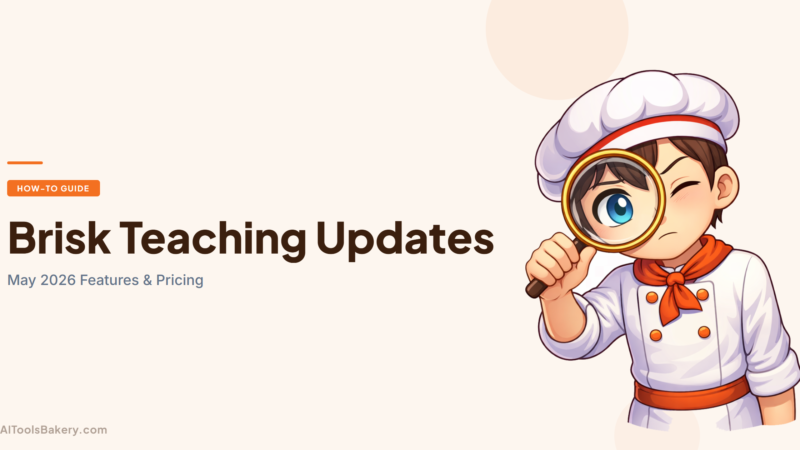
Search for an AI NCLEX prep tool and one name keeps coming back: GoodNurse, which is itself a vendor and ranks itself first. Its homepage comparison table marked UWorld and Kaplan as having no AI tutor when we read it on 5 November 2026, and its March 2026 article says “UWorld does not have an AI tutor.” On the same day UWorld was selling UAsk, which it calls “Your AI NCLEX Tutor”, and Kaplan listed an AI Tutor on its entry NCLEX-RN plan.
So the old choice between an AI tutor and a question bank no longer describes the market. Several established banks now have a chat tutor attached, and the differences sit in the detail: how many prompts you get, who wrote the questions, what the published pass rates actually count, and what a guarantee pays if you fail. This guide compares eight NCLEX prep products on those points, using the official test plan and exam statistics from NCSBN, the body that runs the exam, as the benchmark. If you want wider study tools for nursing school, such as note summarisers and mnemonic apps, our guide to AI tools for nursing students covers those. This page is only about passing the licensing exam.
How we put this together. We have not used these tools ourselves. Every price, rating and feature below comes from the vendor’s own website, NCSBN’s websites, or the app’s US App Store and Google Play listing, read on 5 November 2026, and each source is linked. That means we cannot tell you whose questions feel closest to the real exam or how good an AI answer is. Pass rates and question counts are the vendors’ own claims. None of these companies paid to appear on this page. This is exam prep guidance, not clinical or medical advice.
What the NCLEX asks of you in 2026
The 2026 NCLEX-RN test plan took effect in April 2026, and NCSBN says test plans are updated every three years. Any prep tool worth paying for should be working from it.
The exam is adaptive. “All RN candidates must answer a minimum of 85 items”, up to a maximum of 150, within five hours that include your breaks. A minimum-length exam breaks down into 52 content items, 18 items in three clinical judgment case studies, and 15 unscored pretest items that you cannot tell apart from the real ones. Each case study has six items that follow one client through six steps: recognize cues, analyze cues, prioritize hypotheses, generate solutions, take action and evaluate outcomes. Clinical judgment is also measured by stand-alone items, at about 10% of the exam. The Next Generation NCLEX format behind this launched on 1 April 2023.
Scoring matters for how you practise. NCSBN’s FAQ says there is partial credit “for items for which more than one key exists”, using three methods: plus/minus, zero/one and rationale scoring. A tool that marks a multi-part item simply right or wrong is teaching you less than the exam measures, so check for partial credit during any free trial.
Content weights range from 15 to 21% for Management of Care and 13 to 19% for Pharmacological and Parenteral Therapies, down to 6 to 12% each for Health Promotion and Maintenance, Psychosocial Integrity, and Basic Care and Comfort. The test plan is free, and it is the cleanest way to check whether a study plan is spending your time in proportion.
What NCSBN gives you for free
NCSBN’s Prepare page offers a Sample Pack that “Includes 3 RN case studies, 2 PN case studies and additional examples”, an Exam Preview, a Candidate Tutorial of the Pearson exam software, the 2026 Candidate Bulletin and the test plans. These pages list no AI tutor from NCSBN, and its FAQ says it “does not recommend or endorse any review courses or study materials”, so no prep product on this page carries its approval.
The fee rises on 1 February 2027
This one is easy to miss. NCSBN’s fees page says “Effective Feb. 1, 2027, the NCLEX registration fee will be $350 in the United States and Australia.” The US fee is $200 today. Its FAQ adds that “The date of registration determines the fee, not the exam date”, that “The NCLEX fee has not changed since 2000”, and that the same fee applies to retakes. There are “no refunds of NCLEX fees for any reason.” Its registration page says registrations stay open 365 days while you wait for eligibility from your nursing regulatory body. So if you expect to test in 2027, ask your board about timing before February, because that $150 is more than several of the plans below cost. NCSBN also says NCLEX Online “is not launching in 2026.”
AI NCLEX prep tools compared
| Product | What the AI does | Entry price (5 November 2026) | About 3 months | Stated question bank | Pass promise |
|---|---|---|---|---|---|
| UWorld | UAsk chat tutor inside lessons and questions, capped at 250 to 1,000 prompts | $139 for 30 days | $229 for 90 days | 2,800+ on the 90-day card, 600+ Next Gen | None found |
| NCLEX Bootcamp | Ask Bootcamp AI chat | $59 for 1 month | $129 | 2,800+, 50 video cases | Full refund on 2 and 3 month plans, conditions apply |
| Kaplan | AI Tutor for explanations, definitions and recommendations | From $99 | PassTrack from $349 | 2,200+ at entry, 3,800+ on PassTrack | Refund or 3-month repeat on PassTrack, conditions apply |
| Lecturio Nursing | AI Tutor with Socratic prompts, plus an AI Assistant | $49.99 a month (US App Store) | $89.99 (US App Store) | 3,000+ | None found |
| GoodNurse | AI tutor during quizzes, custom quizzes, 50+ languages | $9.99 a month | $24.99 (US App Store) | 2,000+ to 2,673, depending on the page | Money back, 30 days on the site, 120 days in the terms |
| CliniqueRN | CliniAI coach, readiness predictor, performance report analyzer | Free plan, then $25 a month | $50 | 1,800+ | 2 extra months on SurePass only |
| Archer Review | No AI claim found; human tutors | $79 for 1 month | $129 | 3,100+ | Refund, extension or slot replacement on Sure PASS ($189 for 3 months), conditions apply |
| ATI Virtual-ATI | No AI claim found; personal nurse educator | BoardVitals bank $137 for 12 weeks | $567 with BoardVitals | 3,700+ RN, 200+ Next Gen | 12 more weeks after a Green Light fail |
| General chatbot (baseline) | Open chat, no NCLEX bank or exam interface | ChatGPT has a Free plan | Varies | None | None |
Prices as shown on 5 November 2026, for NCLEX-RN, before any promo code. Several appeared against a higher crossed-out figure, and most pages gave no end date for the offer. Kaplan showed “from” prices, so check your exact access length.
How we ordered these
Six of the eight describe an AI feature in their own words on their NCLEX pages. We ordered those by how clearly the vendor explains what the AI does and limits it to, who it says wrote the questions, how complete the bank is, and how plainly the guarantee and pass rate are stated. Archer Review and ATI come last because we found no AI claim on the pages we read, but they belong here as comparisons: plenty of students will weigh them against an AI option. This order does not rank question realism.
1. UWorld: UAsk, with a prompt allowance on every plan
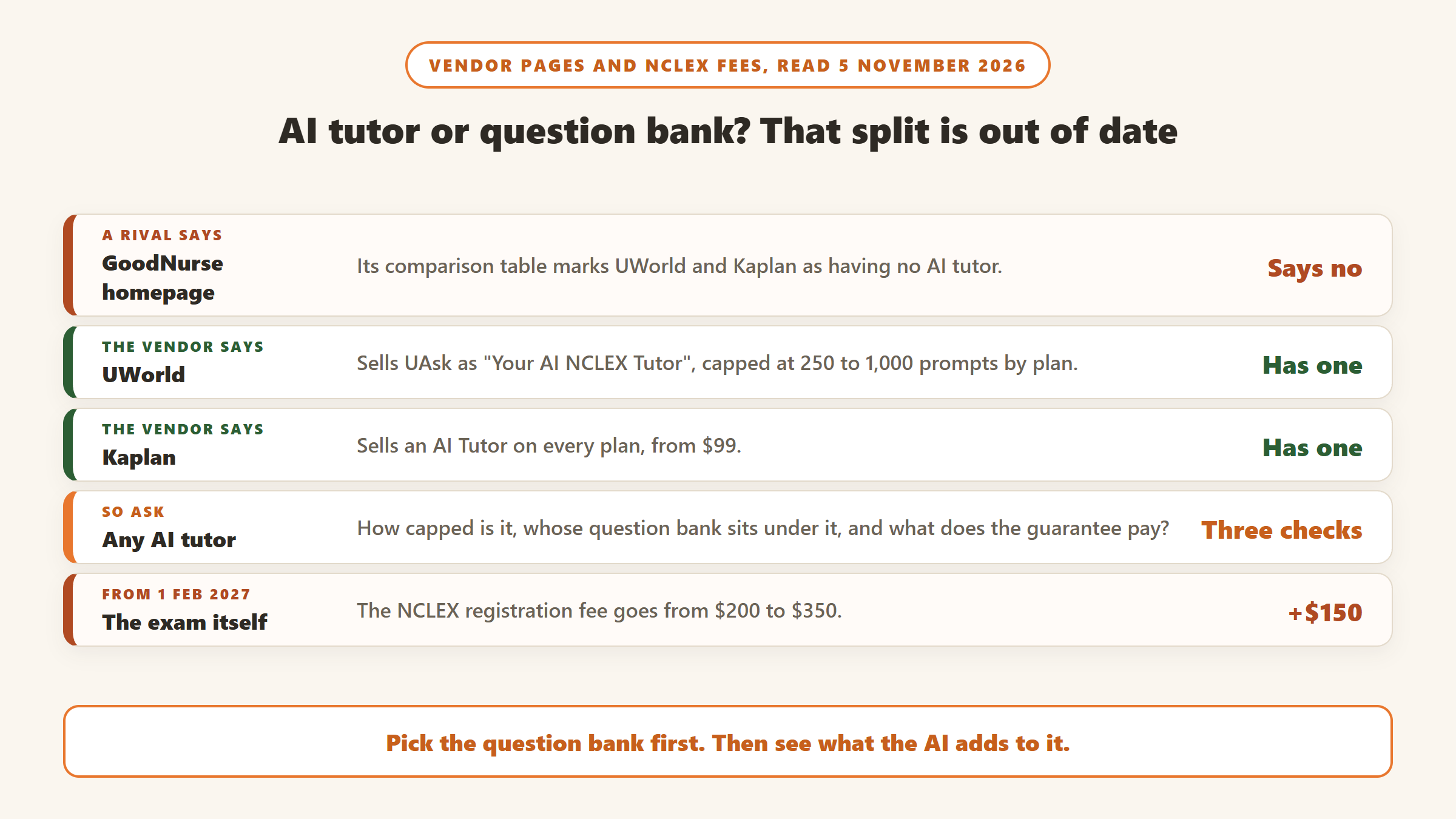
UWorld says its NCLEX-RN questions are “Written by 40+ practicing registered nurses and nurse educators”, and its AI sits on top rather than replacing that. UAsk “works inside your lessons and practice sessions, giving you explanations in context”. UWorld says it is “trained by our nursing experts” and is context-aware, meaning it “identifies the specific QBank question or UBook lesson you are studying”. UWorld says UAsk is included in all NCLEX and FNP subscriptions, and that it works alongside your study plan rather than replacing it.
The detail the comparisons we saw leave out is the cap. The plan cards list 250 UAsk prompts at 30 days, 500 at 60 days and 1,000 from 90 days up. On 5 November 2026 access cost $139 for 30 days, $169 for 60, $229 for 90, $329 for 180, $389 for 360 and $449 for 730. The 30-day plan has no Dynamic Study Planner, and self-assessments rise from one on the 30-day plan to six at 360 days. There is a 7-day free trial with 50 questions.
The question count needs a caution. The plan cards say 2,600+ to 3,100+ questions “Incl. 600+ NGN Questions”, with 2,800+ on the 90-day card. A banner on the same page says the 90-day plan has “3,100+ Practice Questions (750+ NGN)”, and a comparison table says 3,400+ including 750+ Next Gen. UWorld says its bank has “Case Studies, Bow-Ties, and Trend items”. Its 98% first-time pass rate applies to users “who completed at least 75% of the QBank”. We found no pass guarantee. The iPhone app had 4.7 stars from 2,113 ratings, updated 9 October 2026, and the Android app had 4.6 stars from 1.86K reviews, updated 20 October 2026.
Choose it if you want a nurse-written bank and an AI tutor that knows which question you are on. Skip it if you want a guarantee, or you ask a lot of questions and only have 30 days of access.
2. NCLEX Bootcamp: low price and a refund guarantee
NCLEX Bootcamp says it is “Updated for the 2026 NCLEX-RN Test Plan” and made by “a small team of passionate nurse educators” who are masters or doctorally prepared. It says little about its AI: “Ever get stuck on a question, or want to clarify a concept? Just ask Bootcamp AI.” It lists no prompt cap, and Ask Bootcamp AI appears on all three plans.
The upgrade page listed $59 for one month (crossed out from $79), $99 for two months (from $159) and $129 for three (from $239). Each includes 2,800+ questions, 50 NCLEX cases with video explanations, crash course videos, 4 CAT readiness exams, more than 140 cheat sheets, a schedule creator and a Pass Targets tracker. The video cases are the clinical judgment angle: you watch someone reason through a case instead of reading a rationale.
The guarantee pays money. If you fail after meeting all three Pass Targets, Bootcamp says “we’ll refund your entire payment”. It applies to the 2 and 3 month plans, bought at least 30 days before your exam, and you must give your accredited US or Canadian program’s name and your failed result. The 1-month plan has no guarantee. Bootcamp’s “99% of our students who meet all targets pass” counts only people who hit those targets. Its general terms say fees are non-refundable beyond its discretion and that subscription services renew automatically, while the upgrade page does not say whether these plans renew, so check at checkout. The multi-exam Bootcamp.com iPhone app had 4.9 stars from 18,053 ratings, updated 26 May 2026, and the Android app 4.8 from 3.4K reviews, updated 21 May 2026.
Choose it if you want video case walkthroughs and a cash guarantee for under $130. Skip it if you want to know how the AI works before paying, or your exam is under 30 days away and you want the guarantee.
3. Kaplan: an AI Tutor from the entry plan, and a Decision Tree
Kaplan lists an “AI Tutor trained on Kaplan expertise for instant explanations, definitions, and personalized study recommendations” on its CAT + Qbank plan, and each higher plan says it includes everything below it. It says the tutor was “developed by top nurse educators”. The rest of the product is built around Kaplan’s Decision Tree, a method for working through questions.
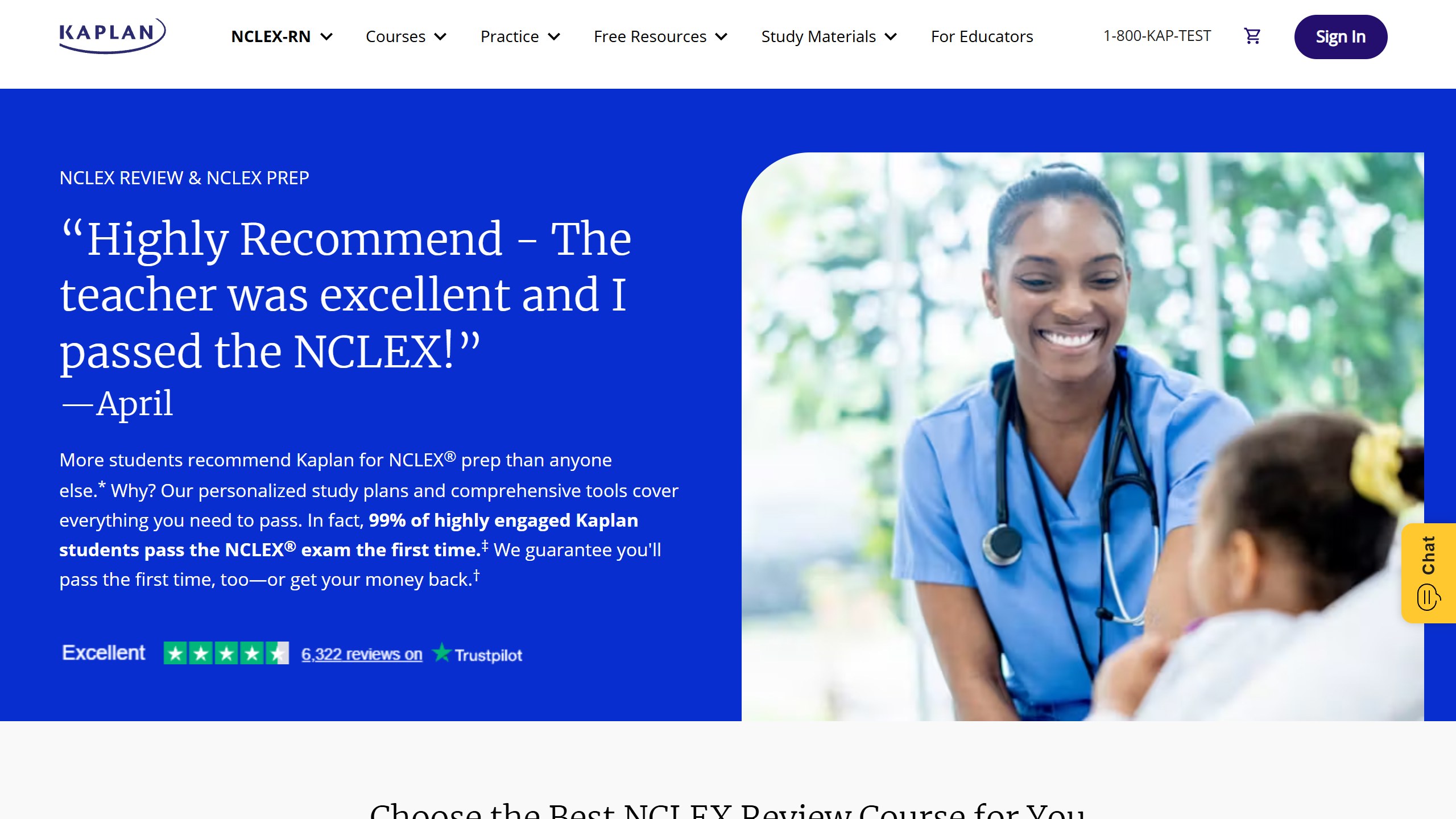
Plans were shown as “from” prices: CAT + Qbank from $99 with 3 CATs and 2,200+ questions, Practice Pack from $119 with videos and live events, PassTrack Self Paced from $349 and PassTrack Live Online from $399, both with 3,800+ questions and 18 hours of instruction. Tutoring plus PassTrack started at $900. A free trial lasts 7 days.
Read the headline pass rate closely. Kaplan says “99% of highly engaged Kaplan students pass the NCLEX exam the first time.” Its footnote says the data comes from self-reported surveys of 324 first-time NCLEX-RN takers, of whom 307, or 95%, passed, and that “49 completed all of the recommended Kaplan activities”. So the 99% describes 49 people. To its credit, Kaplan publishes that arithmetic. It also labels Test Prep Insight, a site quoted on the page, as “a Kaplan affiliate.”
Under the guarantee terms, graduates of accredited programs taking the exam for the first time within 6 months of graduation can get “either a 100% tuition refund or a 3-month free repeat”. You must take the diagnostic and readiness tests, attend all class sessions, answer all questions on the seven Question Trainer tests, call within 20 days of your exam, and stay out of the Online Study Center after exam day to keep the refund option. It covers the original 3-month enrollment, not renewals. The Kaplan Nursing iPhone app had 2 stars from 26 ratings, updated 16 September 2026, so plan to study on the web.
Choose it if you want a method and live teaching with an AI tutor on the side. Skip it if you are a repeat taker relying on the guarantee, which is written for first attempts.
4. Lecturio Nursing: an AI tutor that asks questions back
Lecturio describes a “Qbank with AI Tutor” of 3,000+ NCLEX-RN questions and says the tutor uses “Socratic guidance”, so it is positioned to walk you toward the reasoning rather than simply state it. It also has three practice exams, a CAT simulation, video lessons and a free 30-minute sample test “with partial credit scoring”. Lecturio says its team consists of licensed nurses and names a Chief Nursing Officer.
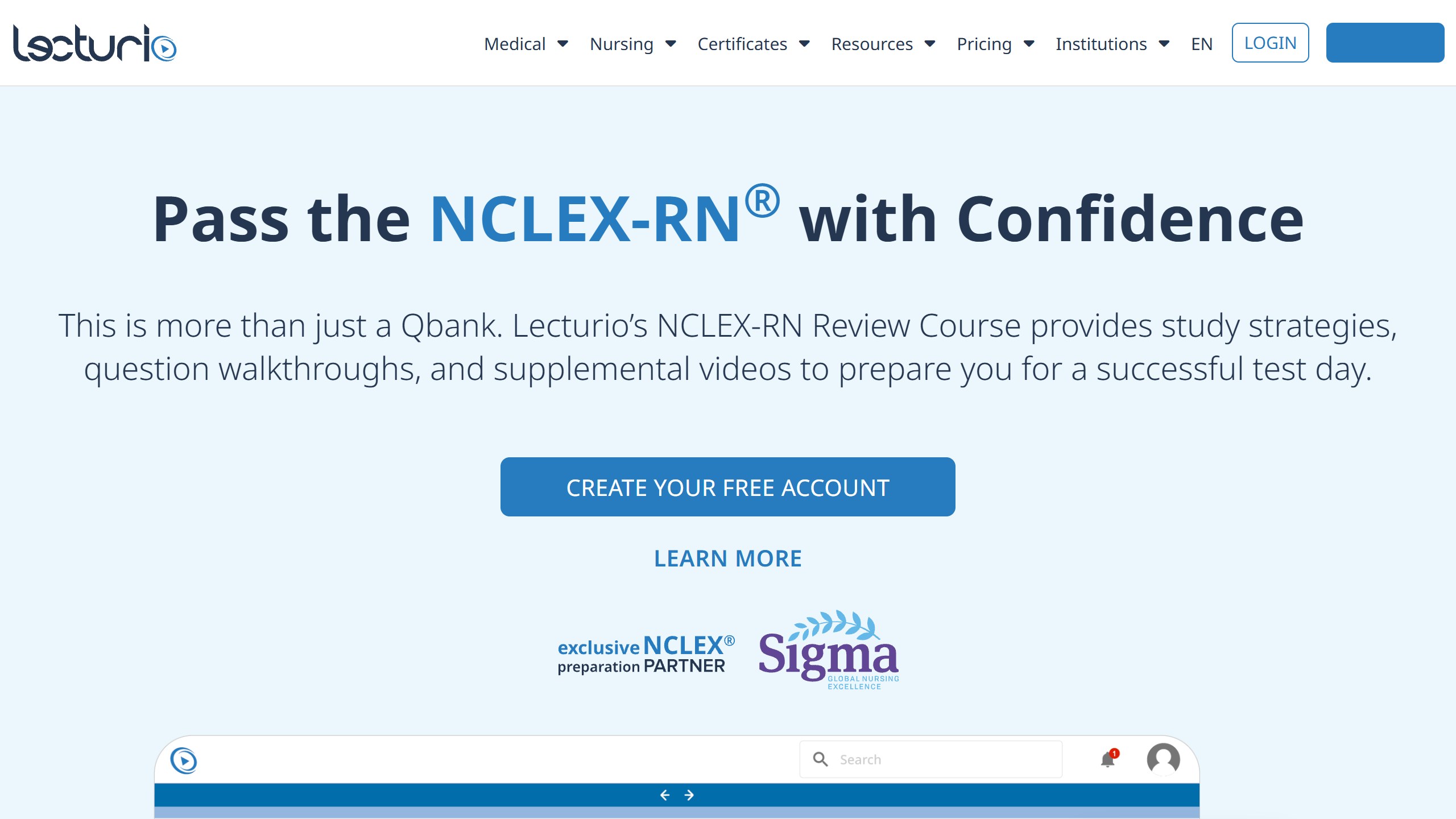
Pay attention to the plan. The pricing page says Nursing Basic comes “without Qbank and smart exam prep features”, while Nursing Premium has the “Powerful Qbank with AI-tutor” and an AI Assistant. So the cheaper plan does not suit NCLEX prep. The website showed us prices in Indian rupees, which we will not convert. The US App Store listing gave Premium at $49.99 for 1 month, $89.99 for 3 and $239.99 for 12, and Basic at $24.99, $59.99 and $191.99. Web prices in your country may differ. There are 7 free days, and the wording is “Pay after 7 days, cancel anytime”, so cancel in time if you are only trying it. We found no pass guarantee on its NCLEX page. The app had 4.8 stars from 3,250 ratings, updated 19 October 2026.
Choose it if you are still building content knowledge and want videos with a tutor that prompts you to think. Skip it if you are in the final weeks and only want questions.
5. GoodNurse: the low-cost AI tutor
GoodNurse calls itself “The first AI tutor built by nurses, for the NCLEX”, and the product leads with the tutor rather than the bank. It offers “a 24/7 AI NCLEX Coach that clarifies rationales, breaks down tough concepts, helps you understand, and builds custom quizzes on demand”. You can ask it to explain an answer during a quiz, paste or photograph a question, and work in more than 50 languages, which may help if English is not your first language. It says its bank was “created by expert nurse educators”, while the pages we read do not say how the AI-built custom quizzes are checked.
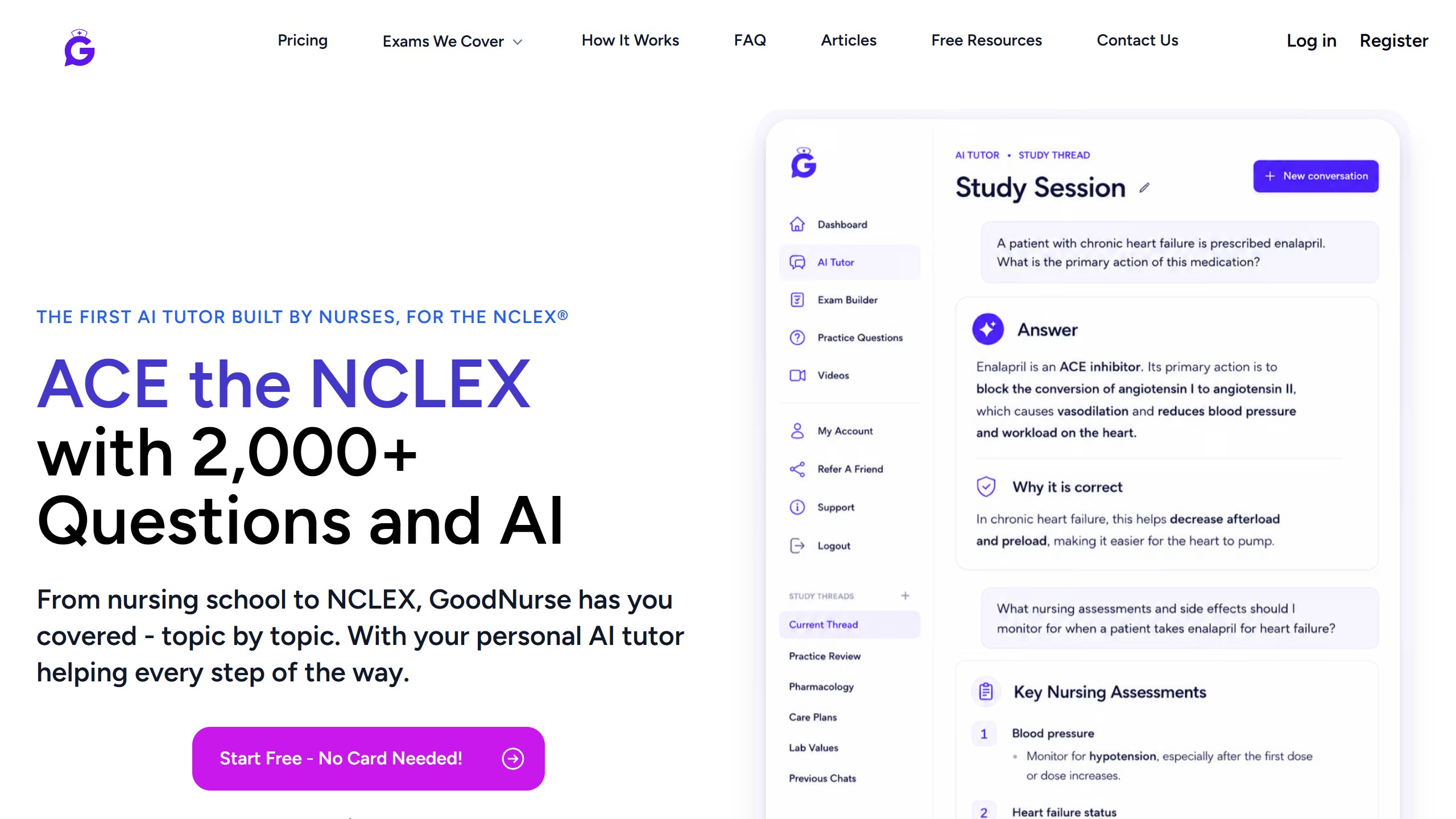
At $9.99 a month it costs far less than the others here, and the App Store listing also shows $24.99 quarterly and $79.99 a year. Features are not split into tiers. The numbers on the site vary: question counts appear as 2,000+, 2,500+ and 2,673. The 97% first-time pass rate comes, according to its About page, from its dashboard and “subscriber outcome surveys”, with no sample size shown. An article of its own headed “Voted by Nursing Students in 27 Nursing Colleges” gives no number of voters that we could find. The iPhone app had 4.8 stars from just 27 ratings, updated 1 August 2026.
Two points need checking. The site promises a 30-day money-back guarantee, but the terms (effective 19 July 2024) say you may contact it “within 120 days of purchase for a full refund”, so ask which applies before relying on the longer period. And its privacy policy says “We may use your conversations with GoodNurse AI for training and support purposes”, while the terms take a perpetual licence over what you submit. Keep real patient details out of your chats, on this tool or any other. When a comparison on its site covers other vendors, check the claim on their pages: its March 2026 comparison of NCLEX apps put UWorld at about $349 to $399, against the $139 to $449 on UWorld’s own page in November.
Choose it if money is the deciding factor and you want to chat through rationales, or want a second explainer next to another bank. Skip it if you want a long independent track record.
6. CliniqueRN: AI readiness scoring and report analysis
CliniqueRN points its AI at whether you are ready to sit the exam. Its AI Readiness Predictor “scores your readiness, spots weak areas, and tells you exactly what to fix”, CliniAI is “Your AI Coach During Every Practice Question”, and AI feedback follows each practice test. The feature repeat takers should note is the CPR Analyzer: “Upload your NCLEX Candidate Performance Report and get AI-powered analysis with a personalized study plan”. The company describes its content as “expert-written” without naming authors, and we saw no validation data for the predictor on the homepage, so treat the score as a study prompt rather than a forecast.
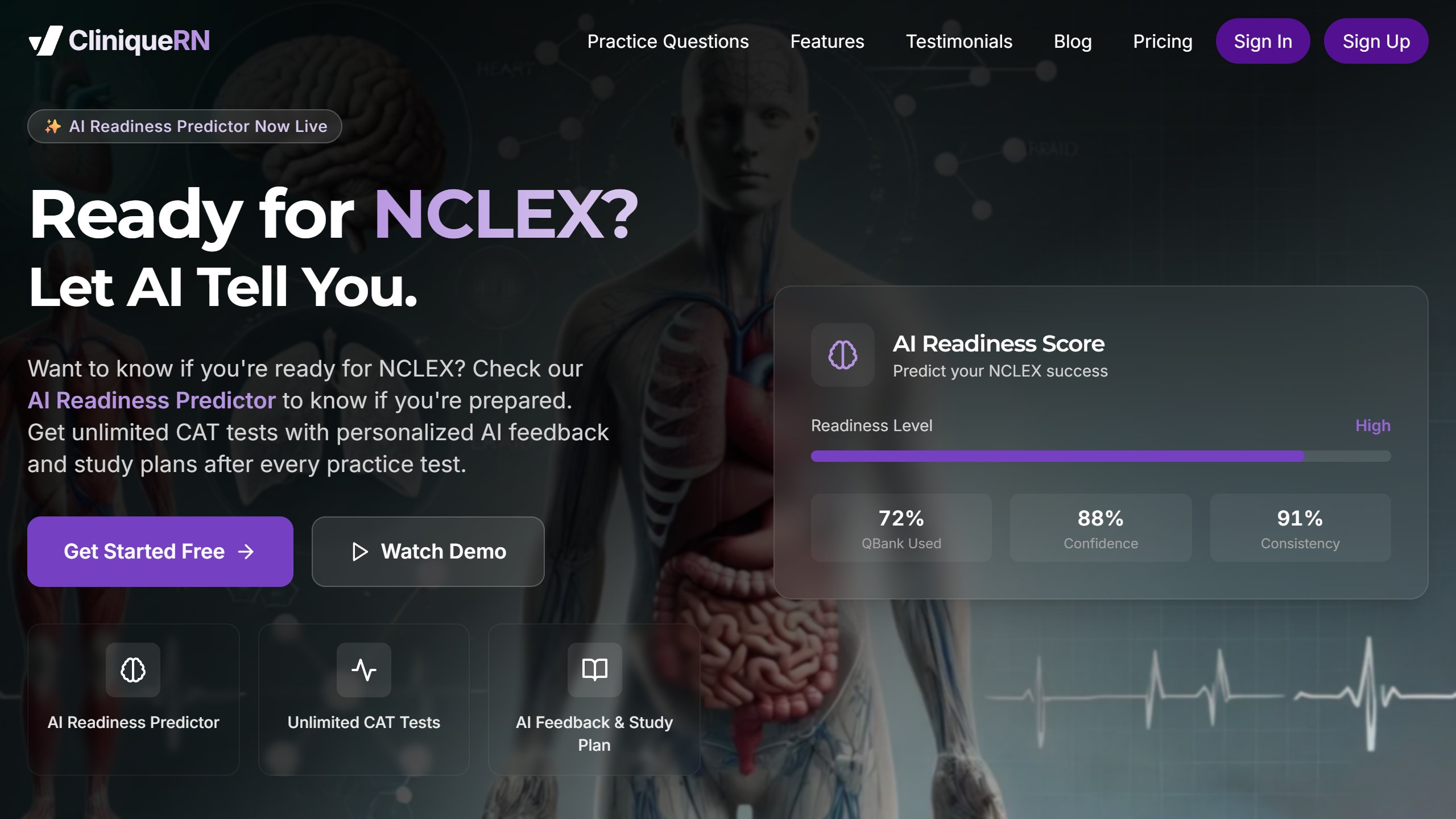
The pricing page listed QuickPass at $25 a month, FocusedPass at $50 for 3 months and SurePass at $75 for 6 months, all marked as a limited-time 50% discount (crossed out from $49, $99 and $149), with no end date shown. Each has 1,800+ questions and unlimited CAT simulations. A free plan gives 5 practice tests of 25 questions and one CAT simulation, with no card. Video lectures and live tutoring were marked “Coming Soon”. Only SurePass carries the “Pass Guarantee or 2month extended access”, so the remedy is more time. The terms say “All fees are non-refundable unless otherwise stated.” The 94% first-time pass rate shows no base, and we found no App Store app under its name. We found less public detail about this company than about the others on this page.
Choose it if you failed and want your performance report turned into a plan, cheaply, as an add-on. Skip it if you want a large, long-established bank as your main resource.
7. Archer Review: no AI claim, heavy on readiness testing
Archer Review is here as the price comparison. Its NCLEX page mentions no AI on the pages we read; the support it describes is human, with tutors and live reviews. It lists a “3,100+ question NGN Q-Bank” (its iPhone listing says 2950+), more than 30 readiness assessments and CATs, and formats including “unfolding case studies, extended multiple choice, matrix multiple response, bow-tie questions, and more.”
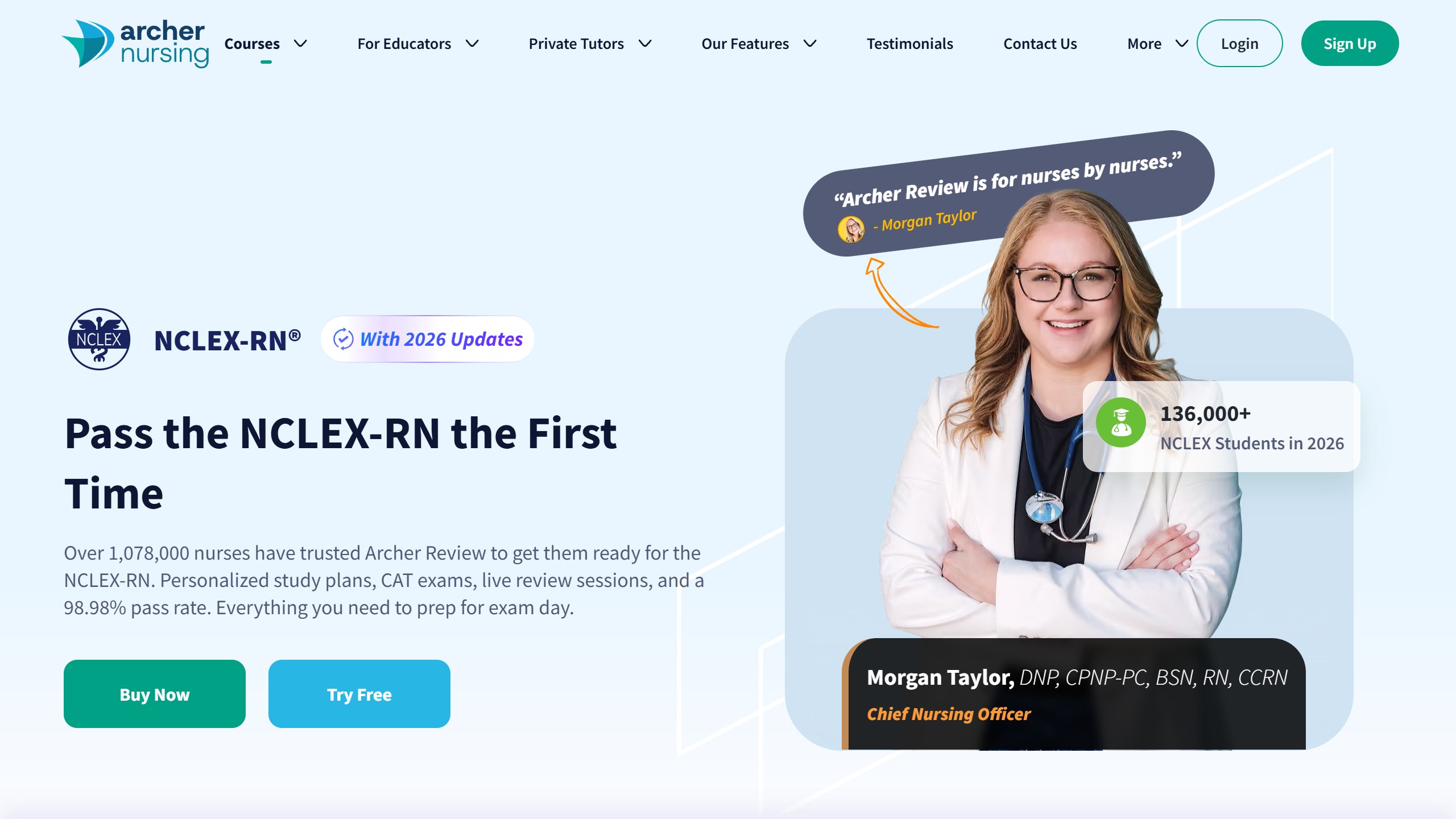
Q-Bank + CAT cost $79 for 1 month, $99 for 2, $129 for 3 and $149 for 6. Adding videos raised it to $99, $109, $139 and $179. Sure PASS cost $159, $169, $189 and $209, and Intense PREP, which Archer aims at repeat takers, $399 for 3 months and $599 for 6. Its usage claim that more than 52.7% of 2025 test takers used it is, by its footer, an internal count for January to June 2025.
The Sure PASS terms offer a “100% money-back refund”, a program extension or a slot replacement “on an individual student basis”, so you may not get to pick. You must be a first-time Q-Bank user, complete at least 80% of the Q-Bank on the 6 or 12 week plan, attend at least 80% of the 3-day live review, and score four or more consecutive high or very high readiness assessments. The advertised pass rate is 98.98%, and the footer says its “99% pass rate is based on self-reported outcomes from users who completed all Sure PASS program requirements.” The standard refund window is 24 hours, if you have not completed the baseline assessment. The iPhone app had 4.9 stars from 22,751 ratings, updated 5 October 2026, and the Android app 4.9 from 6.63K reviews, updated 21 October 2026.
Choose it if you want a lot of readiness testing at a low price and do not need AI. Skip it if an AI tutor is the point of your search.
8. ATI Virtual-ATI: a person instead of a bot
Virtual-ATI is the human alternative, and the pages we read make no AI claim. You get 12 weeks with an ATI Nurse Educator, who works with you one-on-one and gives a “Green Light” when they consider you ready. Virtual-ATI with BoardVitals cost $567 for RN and $510 for PN. BoardVitals alone cost $137 for 12 weeks, with 3,700+ RN questions and 200+ Next Gen questions.
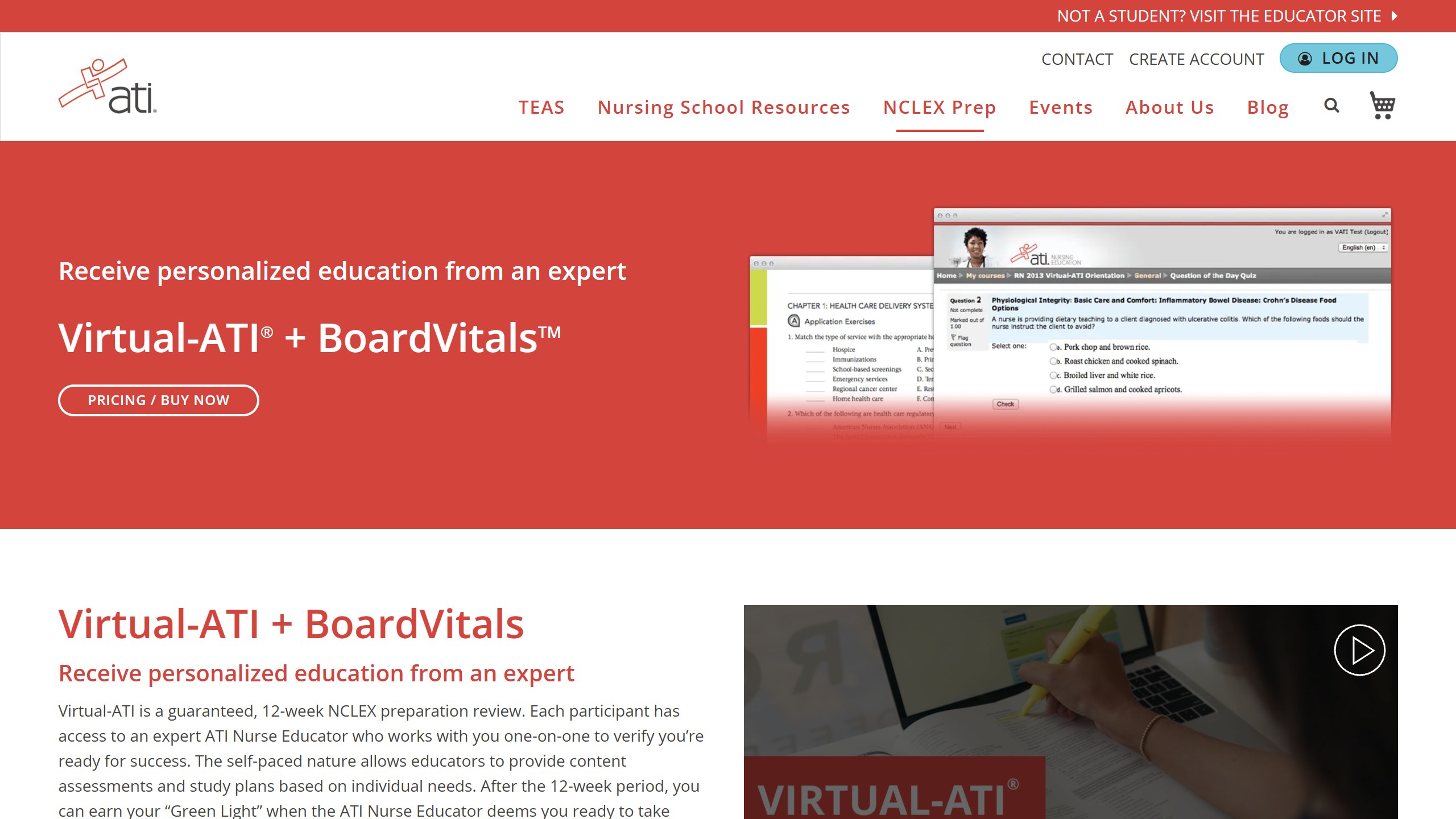
The guarantee is more access: if you get the Green Light, test within three weeks and fail, ATI offers another 12 weeks at no cost, provided you tell it in writing within three weeks of your score. Its pass claim is 98% for Green Light students against an 88% national figure for the first half of 2026, and ATI itself says these are self-reported and “descriptive in nature and do not reflect a true experimental design.” Credit for saying so. ATI’s Live Review has a similar promise: fail your first attempt after attending every day, tell ATI within 3 weeks, and you get Virtual-ATI at no additional cost.
Choose it if you want a real educator checking your readiness, and your school may already work with ATI. Skip it if budget is tight.
Baseline: a general AI chatbot
ChatGPT has a Free plan, so it is the baseline any paid tutor must beat. It can explain a concept or quiz you, but it has no NCLEX bank, CAT engine or exam interface. One peer-reviewed 2024 study in JMIR Medical Education found ChatGPT 4.0 answered 88.67% of 150 NCLEX-RN multiple-choice practice questions correctly, against 75.3% for ChatGPT 3.5. Those were practice questions from a website, in older multiple-choice format rather than Next Generation case studies, on older models. So roughly one answer in nine was still wrong, with no case studies involved. NurseLearn AI and similar generators turn your own notes into questions, which suits class exams, but the pages we read do not say a nurse reviews what they generate. Our guide to AI tutoring apps covers general tutors further.
Choose it if you want free concept explanations alongside a real bank. Skip it if you are hoping to replace a bank with it.
What the pass rates really count
Most of these vendors advertise a pass rate above 90%. Here is who each figure counts, next to NCSBN’s 2025 statistics, which cover every candidate rather than a chosen group.
| Source | Figure | Who it counts |
|---|---|---|
| NCSBN, first-time US-educated RN, 2025 | 86.7% | All 192,916 candidates |
| NCSBN, repeat US-educated RN, 2025 | 52.7% | All 42,513 candidates |
| NCSBN, first-time internationally educated RN, 2025 | 47.3% | All 52,827 candidates |
| Kaplan | 99% | 49 highly engaged students, self-reported (95% of the 324 surveyed) |
| UWorld | 98% | Users who completed at least 75% of the QBank |
| Bootcamp | 99% | Students who meet all Pass Targets |
| Archer Review | 98.98% | Self-reported, completed all Sure PASS requirements |
| Virtual-ATI | 98% | Self-reported, received a Green Light |
| GoodNurse | 97% | Subscribers, from outcome surveys, no base shown |
| CliniqueRN | 94% | Comprehensive plans, no base shown |
None of these compares students who used a product with similar students who did not. Someone who finishes three quarters of a question bank is already a committed student, and people who fail may be less likely to fill in a survey. Treat these figures as marketing, not evidence, and treat a vendor that shows its base as more candid than one that does not. NCSBN’s quarterly first-time rate also moved in 2025, from 89.1% in April to June down to 81.2% in October to December, so even the official figure depends on when you look.
How to choose an AI NCLEX prep tool
Pick the bank first, then the AI
Exam practice comes from questions, so the deciding factor is who wrote them and how well they copy the exam. None of the eight says on these pages that its main bank is written by AI, and UWorld, Kaplan, Bootcamp, GoodNurse and Lecturio all point to nurses or nurse educators behind the product. The AI mostly explains. Use free trials to compare the rationales, the case studies and the partial-credit scoring, with NCSBN’s Sample Pack as your reference.
Check Next Generation coverage in numbers
Three case studies appear on every exam, so ask for case numbers. Bootcamp states 50 cases, UWorld 600+ or 750+ Next Gen items depending on the part of the page you read, and BoardVitals 200+ Next Gen questions. CliniqueRN says only “Next-Gen NCLEX Included”, and Kaplan’s FAQ mentions a “wide variety of question types”. NCSBN’s test plan sends you to its tutorial for formats, so that is where to learn them before judging a bank.
Look for the cap and the plan
UWorld publishes prompts per plan. Lecturio keeps its AI tutor on Premium. Bootcamp, Kaplan and GoodNurse list no cap on the plan descriptions we read, which is not a promise of unlimited use. Ask before you rely on it in a heavy final week.
Read the remedy, not the headline
Money back appears at Bootcamp and at Kaplan’s PassTrack, and at Archer as one of three possible remedies. Virtual-ATI and CliniqueRN give more time. All of them come with conditions you must meet and prove before the exam, so screenshot your progress as you go.
If you are a repeat taker
Only about half of repeat US-educated candidates passed in 2025, so a change of approach makes sense. The 2026 Candidate Bulletin says you can test eight times a year with at least 45 test-free days between attempts, though it tells you to check your own board’s policy. Start from your Candidate Performance Report and put your time into your weak content areas. Check eligibility before you buy, because Kaplan’s guarantee requires a first attempt within 6 months of graduation, and Archer’s requires a first-time Q-Bank user. Archer’s Intense PREP and ATI’s educator-led review are aimed at this situation, and CliniqueRN’s report analyzer is a cheap add-on. A new bank also gives you questions you have not already memorised.
Add memory tools separately
Pharmacology and lab values reward spaced repetition. Our AI flashcard apps guide covers that, and both UWorld and Kaplan bundle flashcards. Studying for medical boards alongside a nursing path? See AI tools for medical students.
Verdict
Start with NCSBN’s free material. On paper, UWorld or NCLEX Bootcamp makes the sensible main resource: UWorld if you want a chat tutor tied to each question and accept the prompt cap, Bootcamp if you want video cases and a refund guarantee at $99 or $129. Kaplan suits students who want live teaching. GoodNurse works well as a cheap tutor beside a bank, and Lecturio if you still need content teaching. If you test in 2027, sort out your registration date with your board before 1 February.
Sources
- NCSBN and NCLEX.com: 2026 NCLEX-RN Test Plan (listing), Prepare, Fees and payment, FAQs, Registration, Next Generation NCLEX, NCLEX Online, 2026 Candidate Bulletin, 2025 NCLEX Examination Statistics.
- UWorld: NCLEX-RN prep, UAsk, US App Store, Google Play.
- NCLEX Bootcamp: homepage, plans, terms, US App Store, Google Play.
- Kaplan: NCLEX prep, guarantee, US App Store. Lecturio: NCLEX, pricing, US App Store.
- GoodNurse: homepage, About, terms, privacy, GoodNurse vs UWorld, NCLEX apps comparison, US App Store. CliniqueRN: homepage, pricing, terms.
- Archer Review: NCLEX-RN, terms, US App Store, Google Play. ATI: Virtual-ATI, BoardVitals, Live Review.
- Chatbots: ChatGPT pricing, Wu et al., JMIR Medical Education, 2024, NurseLearn AI.
- All pages and store listings read 5 November 2026.

Written by
FazFaz is the founder of AIToolsBakery. Some tools here are tested hands on. Others are assessed from vendor documentation and pricing verified on the live page, and every review says which one it is. Sponsors can buy a position in a guide. They cannot buy the score, the criticism, or silence about a better option.
How we test and how we make money →