tool_score: 4.5
Instrumentl is the closest thing the grant world has to a Bloomberg terminal: indispensable if you live and breathe grant prospecting, expensive if you just need to find a few opportunities each year.
What it is: A grant discovery and pipeline management platform with 22,000+ active RFPs, an AI prospecting assistant, and deadline tracking. It is NOT a grant writing tool.
Who it’s for: Grant writers, development directors, and consultants who spend serious time finding and tracking grant opportunities at mid-to-large nonprofits or consulting firms.
Pricing: $179/month (billed annually) to $499/month. No free tier.
Our rating: 4.5/5
Faz says: I want to flag something before we go any further, because it trips people up constantly. When I first heard about Instrumentl, I assumed it was another AI grant writing platform. It is not. Instrumentl helps you find grants. It does not help you write them. That distinction matters a lot when you’re deciding whether to spend $179 to $499 per month on a single tool. I’ve seen small nonprofits sign up expecting an AI proposal writer, then cancel within 60 days because they didn’t understand the product. This review will be crystal clear about what Instrumentl actually does, and whether it earns that price.
Last updated: April 22, 2026.
Related: See also: Grantable vs Instrumentl | Grantable review | Best AI grant writing tools
What Instrumentl Does
The platform was founded around 2014-2015 and has spent a decade building what is now the most actively maintained grant database in the market. That database is not scraped and left to go stale. Instrumentl employs in-house researchers who add 250+ new opportunities every week, verifying eligibility criteria, deadlines, and award ranges by hand. That human curation is the product’s biggest defensible advantage.
| Plan | Price | What You Get |
|---|---|---|
| Entry | ~$179/month (billed annually) | Database access, basic search, deadline tracking, pipeline management |
| Standard | ~$299/month | Entry features plus AI Prospecting Assistant, advanced filters, team collaboration |
| Advanced AI | ~$499/month | Standard features plus enhanced AI, additional workflow automation |
| Additional users | $5/month each | Per seat beyond the included user |
Instrumentl is a grant discovery and tracking platform. Its core job is to surface relevant grant opportunities from a database of 22,000+ active RFPs, and then help your team track those opportunities through a pipeline from prospect to award.
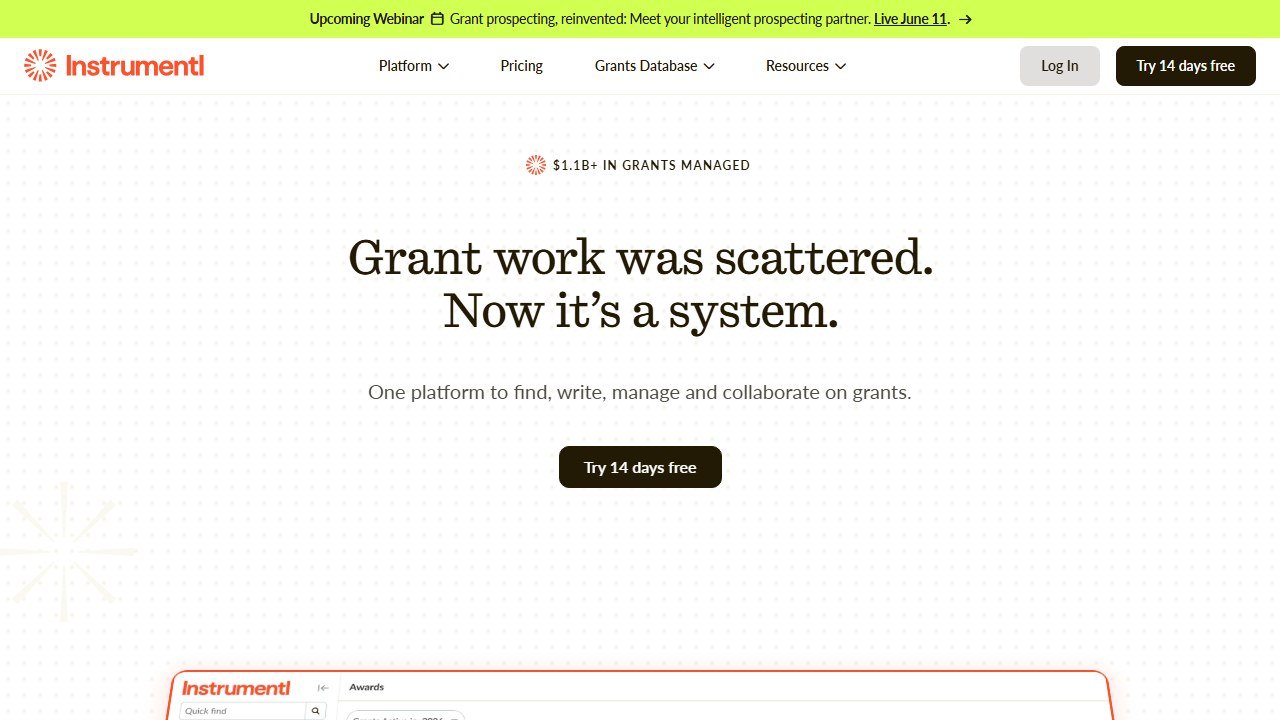
Website: Instrumentl
Here is what Instrumentl does in practice:
You describe your project or organization in plain language. The AI Prospecting Assistant reads what you’ve written and matches you against the database. Instead of keyword searches that miss opportunities phrased differently, you get matches based on understanding your mission, geography, and program area. You review the matches, star the ones worth pursuing, and move them into a pipeline.
From there, the pipeline management tools take over. Deadlines appear on a calendar. Tasks can be assigned to team members. Status updates track each grant from “researching” through “submitted” through “awarded” or “declined.” For teams managing 30, 50, or 100 grant opportunities simultaneously, this is not a nice-to-have. It is the difference between missing a deadline and winning a grant.
What Instrumentl does not do: draft your proposal narrative, generate answers to application questions, or produce a letter of inquiry. For writing support, users typically pair Instrumentl with tools like Grantable, Grantboost, or Granted AI. Instrumentl is the discovery hub. The writing happens elsewhere.
Key Features
The Grant Database (22,000+ Active RFPs)
The database is the product. Everything else Instrumentl offers is built on top of it. At 22,000+ active RFPs, it is the largest actively maintained grant opportunity database available to nonprofits. The emphasis on “active” matters: many competing tools scrape foundation websites and include opportunities that closed 18 months ago or that require an invitation to apply. Instrumentl’s human research team continuously verifies that every listing in the database is currently accepting applications or will open soon.
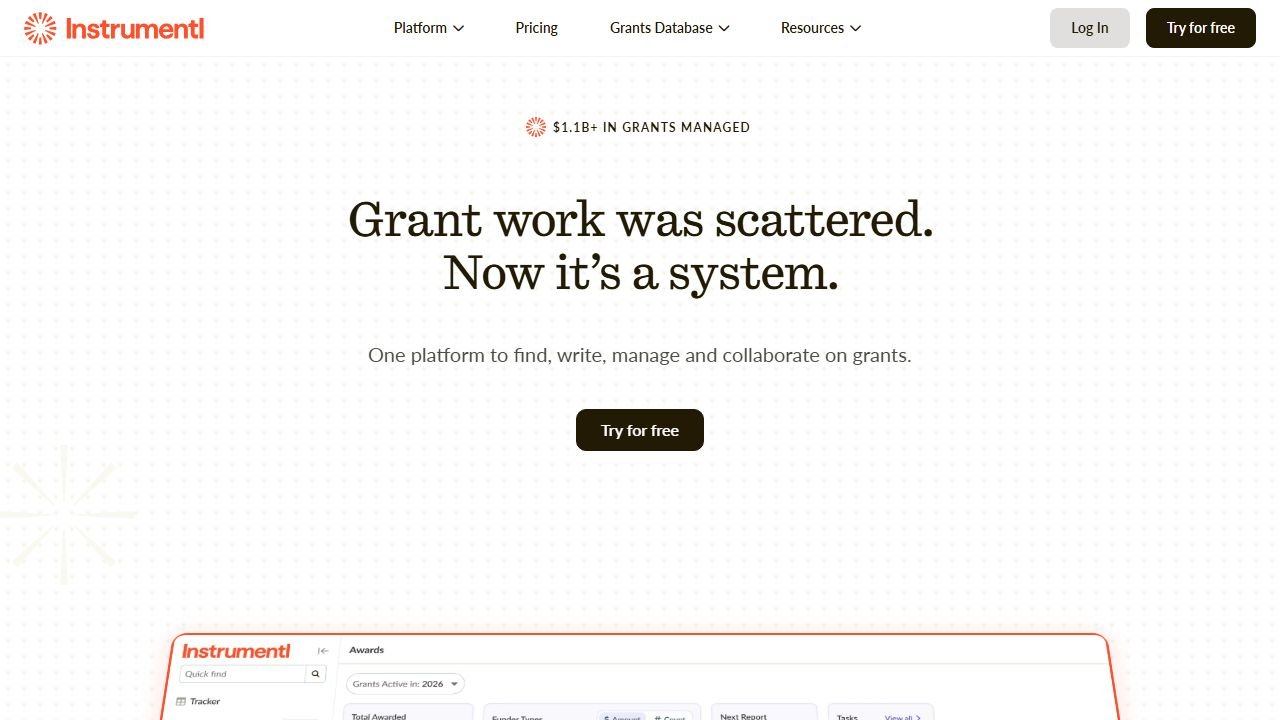
Each listing includes the grant’s eligibility requirements, geographic restrictions, program area focus, typical award range, application deadlines, and direct links to the original RFP. For federal grants, this includes program descriptions from Grants.gov and agency websites. For private foundation grants, Instrumentl has built its own database from 990 filings, foundation websites, and direct outreach.
The 250+ new opportunities added each week is a meaningful number. At most nonprofits, a development director checks new opportunities once or twice a week. Instrumentl’s curation pace means there is always a fresh batch waiting when they log in.
For grant consultants who serve multiple clients across different sectors, the database is the main reason to subscribe. One consultant covering education, environmental, and human services clients has access to opportunities across all three sectors in one platform.
AI Prospecting Assistant
The Prospecting Assistant is Instrumentl’s answer to AI-powered discovery. Rather than requiring exact keyword searches, it accepts plain language descriptions of your project or organization. You might type: “We run afterschool STEM programming for middle school students in rural West Virginia, ages 11-14, with a focus on first-generation college-bound students.” The assistant maps that description against the database and surfaces grants that match on geography, population, program area, and income/demographic targeting.
This is genuinely useful. Keyword searches miss opportunities because funders describe the same work differently. A foundation funding “workforce readiness for disconnected youth” and a foundation funding “career pathways for opportunity youth” are both potentially relevant to the same program, but a keyword search for “workforce” would miss one of them. Natural language prospecting reduces that problem.
The assistant is available on the Standard and Advanced AI plans. It is not available on the entry-level plan. That is a meaningful limitation for users who are specifically interested in AI-powered discovery, and worth noting when you compare pricing tiers.
Deadline Tracking and Calendar
Missed grant deadlines are career-ending at small nonprofits where the development director may be the only full-time fundraising staff. Instrumentl’s deadline tracking converts every grant’s due date into a calendar item. Deadlines appear in a visual calendar view, in list view sorted by proximity, and in email reminders.
The system also tracks LOI deadlines, notification dates, and reporting deadlines separately from application deadlines. A grant won in January may have a progress report due in August. Instrumentl tracks the full lifecycle, not just the application submission date. For organizations managing 20+ active grants plus 20+ active applications, this calendar function alone may justify the subscription cost.
Pipeline Management and Team Collaboration
The pipeline view is Instrumentl’s project management layer. Each grant opportunity moves through stages: Researching, In Progress, Submitted, Awarded, Declined, and custom stages you define. Team members can be assigned to specific grants. Notes and documents attach to each grant record. Status updates are visible to the whole team without anyone having to send update emails.
For organizations with a small development team (which is most nonprofits), this removes the “tracking everything in a spreadsheet” problem. The spreadsheet approach breaks down the moment a second person gets involved. Instrumentl gives the team a shared view of the entire pipeline.
The collaboration features extend to tracking who is responsible for writing which sections, logging funder communications, and attaching previous proposals for reference. On the Advanced AI plan, these features expand with additional workflow automation.
Fit Score and Eligibility Screening
Every grant match includes a fit score, a numerical indication of how closely the opportunity aligns with your organization’s profile. The fit score accounts for geographic restrictions, program area alignment, organizational budget range (some funders have minimum or maximum budget requirements for grantees), and mission overlap.
This matters because not all grants in your results are actually worth applying to. A fit score below 60% often means a geographic restriction that disqualifies you, or a program area focus that is adjacent to but not directly aligned with your work. Filtering by fit score above 75% gives you a working list of genuine prospects rather than a list you have to comb through manually.
The eligibility screening flags common disqualifiers: whether the funder accepts applications from your state, whether your organization type (501(c)(3) public charity vs. fiscal sponsor vs. school district) is eligible, and whether the typical award range matches what you need.
Reporting and Analytics
Instrumentl tracks your pipeline value (the total dollar amount of grants in each stage), win rates by funder type, average time from application to decision, and revenue forecasts based on your pipeline. These reports answer questions like: “What percentage of our federal grant applications resulted in awards last year?” and “Which program area generates the most grant revenue?”
For development directors reporting to boards or executive directors, this data is valuable. Most nonprofits track grants in a spreadsheet with no historical analytics. Instrumentl turns the pipeline data into reporting that looks professional and surfaces real patterns in what is working.
Pricing Breakdown
| Plan | Price | What You Get |
|---|---|---|
| Entry | ~$179/month (billed annually) | Database access, basic search, deadline tracking, pipeline management |
| Standard | ~$299/month | Entry features plus AI Prospecting Assistant, advanced filters, team collaboration |
| Advanced AI | ~$499/month | Standard features plus enhanced AI, additional workflow automation |
| Additional users | $5/month each | Per seat beyond the included user |
Pricing is billed annually on all plans. Monthly billing is available at a higher rate. There is no free tier, and no trial period listed on the public pricing page.
The $5/month per additional user pricing is genuinely affordable compared to the base cost. A team of five can be on Instrumentl for $319/month on the Standard plan ($299 + $20 for four additional seats). For a consulting firm or larger development team, the per-seat cost is not a meaningful barrier.
Saru says: Let me put the pricing in context. Instrumentl’s $179 to $499/month range sits in the middle of the market for specialized grant tools. Here is what the math looks like at the Standard plan ($299/month, $3,588/year): if your organization wins one additional grant of $10,000 because Instrumentl surfaced an opportunity you would have missed, the ROI is 2.8x in year one. If that grant is $25,000, ROI is 7x. Instrumentl claims its customers manage $6B+ in grants collectively. That is not revenue they generated, that is pipeline they tracked. But it validates that the platform is being used at scale by serious grant-seeking organizations. The 4,500+ customer count and $1B+ in grants won through the platform suggests the math works for mid-to-large nonprofits. Where the economics break down is for small nonprofits with budgets under $500K who are applying for 5-10 grants per year. For them, $3,588/year on discovery alone, before paying for a writing tool, is a hard sell.
Who This Is For
Development Directors at mid-sized nonprofits ($1M-$10M budget): This is Instrumentl’s core customer. An organization in this range typically has one to three development staff managing 20-50 grant applications per year across federal, state, and foundation sources. The time savings from not doing manual prospect research, combined with the missed-deadline prevention, makes the ROI case straightforward.
Grant Writing Consultants: Consultants serving five or ten clients across different program areas use Instrumentl as their prospecting engine. The economics work differently here: one subscription covers research for all clients, and the consultant’s hourly rate makes the per-hour time savings significant. Many consultants build the Instrumentl cost into their client retainer fees.
Universities and Large Nonprofits: Instrumentl is used by universities and hospitals managing complex grant portfolios across multiple departments. The team collaboration features and pipeline analytics are particularly relevant at this scale, where multiple staff members are working on different grants simultaneously.
Grant seekers who already have writing support: If your organization has a skilled grant writer on staff or retainer, Instrumentl’s lack of writing tools is not a gap. You bring your own writing capability. Instrumentl handles the discovery and tracking layer.
Who it is NOT for:
- Very small nonprofits (under $500K budget) applying for fewer than 10 grants per year. The cost is hard to justify relative to a free tools approach using Grantboost’s free tier plus Google searching.
- Organizations primarily seeking a grant writing tool. Instrumentl will not write your proposals.
- Organizations needing a free or low-cost entry point. There is no free tier.
Pros
- Largest actively maintained grant database in the market (22,000+ RFPs, 250+ added weekly by humans)
- AI Prospecting Assistant understands plain language descriptions, not just keywords
- Deadline tracking covers full grant lifecycle, not just application due dates
- Team collaboration features work well for multi-staff development operations
- Fit scores and eligibility screening reduce time spent on non-viable prospects
- 4,500+ customers and $1B+ in grants won provides real-world validation
- Pipeline analytics give development teams data to report upward
Cons
- No free tier, no trial period listed on public pricing
- Does not write grant proposals (requires a separate writing tool, adding cost)
- $179-499/month is steep for organizations under $500K annual budget
- Standard plan ($299/month) is required to access the AI Prospecting Assistant
- Annual billing required for listed pricing (monthly billing costs more)
- Small nonprofits applying for few grants per year may not see ROI
Faz says: My honest take is that Instrumentl earns its price for the right organization. If you are a development director managing 30+ grant opportunities per year, or a consultant with multiple clients, the database quality and pipeline management tools are worth the subscription. The AI Prospecting Assistant is a genuine time-saver. The deadline calendar has probably saved more than a few development directors’ jobs.
But I keep coming back to the “no writing tools” gap. You are paying $179 to $499/month for discovery and tracking, and then you still need to pay for a writing tool on top of that. Grantable’s Pro plan is another $150/month. At the Standard tier, you could be spending $450/month before you have written a single word. That is a real number for a small nonprofit to absorb.
If your budget is under $500K and you are applying for fewer than 15 grants per year, I would look hard at whether Grantable’s all-in-one approach (discovery plus writing for $150/month) covers enough of your needs before committing to Instrumentl’s stack. If you are running a serious mid-to-large grant program, Instrumentl is the market standard for good reason.
Saru says: The numbers behind Instrumentl’s market position are worth knowing. $55.1M raised, led by Summit Partners in April 2025. 107 employees. 4,500+ customers. $6B+ in grant pipeline managed across the platform. This is not a startup experiment. It is a growth-stage company with institutional funding and a clear market position. For enterprise buyers and consultants evaluating platform longevity, Instrumentl’s funding and employee count compare favorably to most competitors in the grant tech space. The risk here is not company stability. The risk is cost-to-value fit for smaller organizations. Rating: 4.5/5. Market leader for grant discovery. Price and the missing writing layer prevent a perfect score.
Integrations
| Integration | Type |
|---|---|
| Salesforce | CRM sync |
| Bloomerang | CRM sync |
| Little Green Light | CRM sync |
| Raiser’s Edge | CRM sync |
| Gmail | Email integration |
| Outlook | Email integration |
| Google Calendar | Deadline sync |
| Outlook Calendar | Deadline sync |
| Grantable | Workflow pairing (not native integration) |
| Grantboost | Workflow pairing (not native integration) |
Instrumentl’s native CRM integrations with major nonprofit CRMs (Salesforce, Bloomerang, Little Green Light, Raiser’s Edge) are relevant for larger organizations that want grant pipeline data to live alongside donor data. The calendar integrations are useful for teams that live in Google Calendar or Outlook and want grant deadlines to appear alongside other organizational commitments.
The “workflow pairing” entries for Grantable and Grantboost reflect the fact that many Instrumentl users export opportunities from Instrumentl and paste them into their writing tool of choice. There is no built-in handoff between the platforms. This is a friction point that the grant tech market has not fully solved.
If the price tag or the discovery-first focus gives you pause, we compared every credible option in our guide to the best Instrumentl alternatives, from budget tools to full writing platforms.
Final Verdict
Instrumentl is the market-leading grant discovery platform, and the title is earned. The combination of a 22,000+ RFP database with active human curation, an AI Prospecting Assistant that understands plain language searches, deadline tracking that covers the full grant lifecycle, and pipeline management tools that work for teams of one or ten makes Instrumentl the most complete answer to the question “how do I find and track grant opportunities?”
The limitations are real. There is no free tier. The $179 to $499/month range is a serious cost for small nonprofits. And Instrumentl does not write grants. If you budget $299/month for Instrumentl and then need another $150/month for Grantable to handle writing, you are spending $450/month on grant tools before you touch a proposal. That math works for organizations with serious grant programs and professional development staff. It does not work for a small nonprofit with a part-time grant writer and $400K in annual revenue.
For mid-to-large nonprofits, grant writing consultants, and universities with active grant programs: Instrumentl is probably the best discovery tool available, and the price is justifiable relative to the grant revenue at stake. For smaller organizations: look carefully at whether an all-in-one platform like Grantable covers enough of your needs at a lower combined cost. The comparison post walks through the tradeoffs in detail.
Rating: 4.5/5
The database quality and AI prospecting push Instrumentl to the top of the discovery category. The missing writing layer and high price floor keep it from a perfect score for the organizations that need it most.
Related reading: Best AI Grant Writing Tools | Grantable vs Instrumentl | How to Use AI for Grant Writing | Best AI Tools for Nonprofits
Workflow guides and adjacent tools
How-to guides on the same workflows:
- how to use AI for grant writing. step-by-step practical guide
- best AI donor research tools. donor prospecting tools reviewed
References & further reading
For deeper data and primary sources on nonprofit fundraising and donor research:
- Candid (Foundation Center + GuideStar). authoritative nonprofit financial and grant data, the source most donor-research tools build on
- M+R Benchmarks Study. annual fundraising performance benchmarks across email, advertising, web, and donor metrics
- Nonprofit Quarterly. investigative reporting on nonprofit operations, governance, and fundraising effectiveness
More AI tools for nonprofits
More nonprofit AI resources:
- 7 Best AI Fundraising Platforms for Nonprofits.
- Best AI Grant Tools for Nonprofit Development Teams.
- How to Use AI for Nonprofit Fundraising: a Step-by-Step Practical Guide.
- Best Free AI Tools for Nonprofits in 2026.
Tools mentioned in this guide

Written by
FazFaz is the founder of AIToolsBakery. Some tools here are tested hands on. Others are assessed from vendor documentation and pricing verified on the live page, and every review says which one it is. Sponsors can buy a position in a guide. They cannot buy the score, the criticism, or silence about a better option.
How we test and how we make money →Frequently Asked Questions