Quick Answer: FirstRep is an AI lead generation and sales automation tool built specifically for fitness businesses. gyms, studios, and PT businesses. It captures, qualifies, and follows up on leads automatically. Not a coaching platform. Pricing by enquiry. Best for fitness businesses spending money on ads who need faster lead response times.
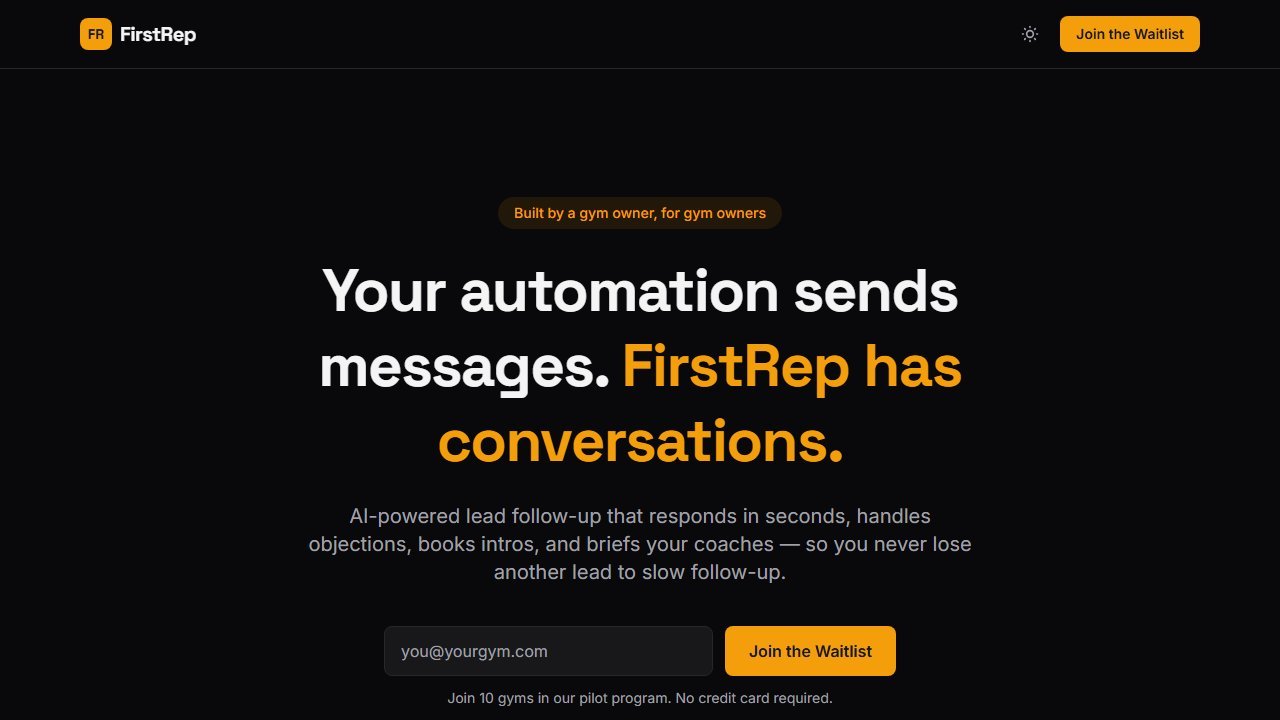
Website: FirstRep
Last updated: April 22, 2026.
Related: See also: Best AI tools for personal trainers 2026 | FitBudd review
What FirstRep actually is
Most gym owners and fitness studios have the same problem: a prospect fills in a “book a free trial” form at 10pm on a Tuesday. The gym owner sees it Wednesday morning. By then, the prospect has signed up somewhere else, or simply lost momentum.
Studies on B2C lead response show that the difference between responding within 5 minutes vs 30 minutes is a 100x reduction in lead qualification rate. For fitness businesses where lead flow is the main growth driver, slow follow-up is a serious revenue problem.
FirstRep addresses this directly. When a lead comes in through your website, SMS, or Facebook ads, FirstRep’s AI responds immediately, engages in a natural conversation, answers common questions about membership and classes, handles price objections, and books an intro session directly into your calendar.
The positioning is clear: “Your automation sends messages. FirstRep has conversations.” Standard gym automation tools (Mindbody, Glofox, Trainerize’s automations) send templated messages. FirstRep generates responses based on what the prospect actually says, not a fixed sequence.
Who built it and why it matters
FirstRep was built by a gym owner, not a software developer who consulted a gym owner. The homepage says “Built by a gym owner, for gym owners,” which might sound like marketing copy but makes a difference in how the product is scoped.
The specific pain point FirstRep targets. leads going cold before a human can follow up. is one that gym operators experience but general CRM software doesn’t solve well. General AI chatbots (ChatGPT-based plugins, etc.) can answer questions but can’t integrate with your booking system, understand fitness objections, or hand off to a coach at the right moment.
FirstRep’s claim is that it does all of that in a fitness-specific way.
What we know about the product
As of April 2026, FirstRep is in a pilot program with approximately 10 gyms. The product is functional. the pilot is live. but public access requires joining a waitlist.
What it reportedly does:
- Responds to leads within seconds across web forms, SMS, and social media leads
- Handles common fitness objections (“I need to think about it,” “It’s too expensive,” “What results can I expect?”)
- Books intro sessions directly into the gym’s calendar
- Briefs coaches before the intro session with context from the AI conversation
- Logs the full conversation so staff can review
What is not yet known:
- Public pricing (no pricing page, no published rates)
- Integration depth (which booking systems are supported. Mindbody? Glofox? Custom calendar?)
- Cancellation and refund terms
- How the AI performs in real-world conversations vs. scripted demos
Who this is for. and who it isn’t
It’s for fitness businesses with lead flow problems, not coaching delivery problems.
If you own a gym, run a studio, or operate a group fitness business and your conversion from inquiry to first visit is below 30%, FirstRep addresses something real. Lead response time is almost always a factor in low conversion, and an AI that responds in seconds changes that dynamic.
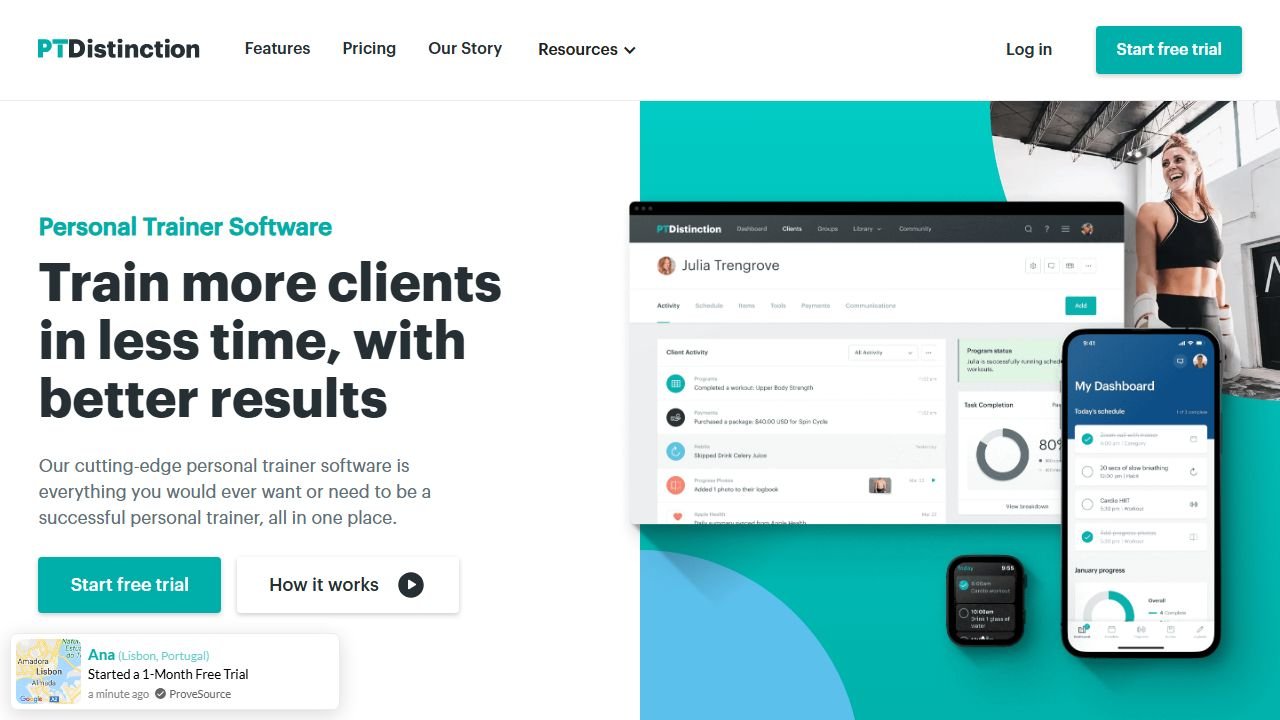
It is not personal trainer software. It doesn’t build workout programs, manage clients, or track progress. It’s a sales and lead conversion tool. Coaches looking for TrueCoach, Everfit, or PT Distinction alternatives won’t find that here.
The distinction matters because the SERPs for “AI tools for personal trainers” will likely show FirstRep in a category it doesn’t quite fit. Knowing what it is helps you evaluate it correctly.
The early-stage risks
FirstRep is early. Ten gyms in a pilot is not a validated product with a proven track record. There are things that won’t be known until it scales:
Does the AI conversation quality hold up with real prospects? Fitness objections can be nuanced. “I had a bad experience with a gym before” requires empathy and specificity that generic AI struggles with. The promise is that FirstRep is trained specifically on fitness conversations. the proof will come with the pilot data.
What happens when the conversation goes off-script? Edge cases (unusual prospects, complex pricing questions, requests outside the AI’s scope) are where early-stage tools often fail. Without public reviews from real pilot gyms, this is unknown.
Pricing unknown. For a tool that positions as an upgrade to existing automation, the ROI calculation depends heavily on cost. A gym that closes one extra membership per month from faster lead response might justify $200-300/mo. At $500+/mo, the math gets harder.
Who should watch FirstRep
It’s worth joining the waitlist if:
- You own or manage a gym, studio, or group fitness business (not solo coaching)
- Lead response time is a documented problem in your business
- You’ve tried standard automation tools (email sequences, SMS blasts) and they’re not converting well
- You’re willing to be an early adopter and can give feedback to the team
Wait for more data if:
- You need proven reliability before adopting
- Budget control requires knowing pricing before committing
- You’re a solo coach. this is a gym operations tool, not a coaching delivery platform
Where FirstRep fits in the market
The closest competitors are not other PT software tools. They’re general AI sales tools (like Drift, Intercom AI) applied to fitness, or fitness-specific CRM tools with automation (Mindbody’s automations, Glofox CRM).
FirstRep’s edge, if the product delivers, is fitness-specific conversation training. General AI chatbots don’t know that “I’m scared of commitment” in the context of a gym inquiry is an objection about contract length, or that “I’ll start after the holidays” is a delay tactic with specific counter-approaches. If FirstRep’s training data covers these fitness-specific conversations properly, it will outperform general tools in conversion rate.
That edge only exists if the AI quality is there. The pilot will answer this question. Check back in Q3 2026.
Related personal trainer & fitness AI guides
Other tools and comparisons we have reviewed in this category:
- best AI tools for personal trainers. where FirstRep fits for gym-side AI
- best Trainerize alternatives. gym software alternatives
- best free personal trainer software. free-tier PT platforms
References & further reading
For deeper context on programming, periodization, and training science behind the tools we evaluate:
- NSCA: peer-reviewed strength and conditioning research. evidence-backed programming principles from the National Strength and Conditioning Association
- ACSM physical activity guidelines. official exercise prescription standards from the American College of Sports Medicine
- PubMed sports science database. searchable archive of peer-reviewed studies on resistance training, hypertrophy, and recovery
Tools we recommend instead
Since firstrep.app appears to be unavailable at the time of testing, here are the closest functional alternatives for personal trainers looking for similar features. We have full reviews for each below.
What FirstRep does for personal trainers in 2026
FirstRep is a coaching platform built around fast client check-ins and lightweight programming for online personal trainers. The 2026 product differentiates from TrueCoach and Trainerize by aiming at trainers with 10 to 40 clients who want minimal admin overhead. The core features: weekly client check-in templates, simple program builder, photo-based form review, and habit tracking that does not require complex setup.
The strongest use case: trainers building their book from zero to 30 clients who do not need enterprise features. FirstRep ramps faster than TrueCoach for new coaches because the interface is simpler. The less strong use case: established coaches with proprietary programs and complex client management needs. Those coaches usually outgrow FirstRep within 12 to 18 months and migrate to TrueCoach or similar.
FirstRep pricing and the trainer buyer’s framework
FirstRep prices in the lower end of the coaching platform category in 2026, typically $19 to $49 a month depending on client count. Annual plans save around 20 percent over monthly. The free trial covers full features for two weeks. For new trainers building their first 10 to 20 clients, the math is favorable; the platform pays for itself with one retained client per year.
The honest decision framework for trainers comparing FirstRep to alternatives. Pick FirstRep if you want simplicity, fast setup, and a price that fits a small book. Pick Trainerize if you want a mid-market platform that scales to 50+ clients with strong client-app polish. Pick TrueCoach if you want the premium feature set for video feedback and program building. Pick CoachAccountable if you prefer an all-in-one CRM plus coaching tool.
Final 2026 verdict
FirstRep is a credible 2026 pick for new and growing online personal trainers who value simplicity and reasonable pricing. It will not match TrueCoach on power features, but most trainers under 30 clients do not need those features. The product is mature enough for serious daily use, and the pricing fits the income profile of trainers building their business.
Per client pricing, and the crossover most coaches miss
Almost every platform here charges on active clients, and the marginal rate matters more than the headline. Here is the same roster priced across the vendors that publish, using their own rates read 4 September 2026.
| Active clients | PT Distinction | Everfit, monthly | Everfit, annual | FitBudd |
|---|---|---|---|---|
| 5 | $31.90, Basic +2 | $19 | $16 | $27 |
| 20 | $59.90, Pro | $49 | $41 | $79 |
| 50 | $89.90, Master | $95 | $79 | $139 |
| 100 | $169.90, Master +50 | $140 | $117 | $239 |
Upgrade before you hit the allowance, not after
On PT Distinction, 25 clients on Basic would cost $151.90 against $59.90 on Pro, because the marginal rate on the entry tier is $6.00 a client against $2.40. The included allowance is not the point at which you should move; the point is wherever the marginal rates cross, and that is usually far earlier. Work it out once and set a calendar reminder at that client count.
Annual billing is a real discount here, unusually
Everfit at 100 clients is $140 a month billed monthly and $117 billed annually, a saving of $276 a year. TrueCoach publishes one month free on Starter and two months free on Standard and Pro. FitBudd gives two months free on yearly billing. In a category where client numbers fluctuate seasonally, the question is whether you are confident enough of your floor to commit, and most established coaches are.
Count active clients, not total clients
The meter is people currently assigned programming, not everyone who has ever trained with you. Coaches routinely over-buy because they price on their contact list. Before choosing a tier for firstrep review or anything else, count the clients who received a programme in the last thirty days. That is your number, and it is usually smaller than expected.
What software should cost as a share of coaching revenue
The useful test is not whether a platform is cheap but whether it is a sane fraction of what it helps you earn, and that arithmetic is straightforward in this business.
Work it out per client, per month
At 20 clients on Everfit billed annually you are paying $41 a month, which is about $2.05 per client. If your average client pays $150 a month, software is roughly 1.4% of revenue. At the same roster on FitBudd’s $79 tier it is $3.95 a client, or 2.6%. Both are defensible. What is not defensible is paying a per client rate that approaches a meaningful share of what each client pays you, and that happens most often on the entry tiers where marginal rates are highest.
The branded app question is a business decision, not a software one
My PT Hub publishes a custom branded app at $95 one-time and a white label app at $145 a month. FitBudd’s own-app tier is $149 for 20 clients with a $100 setup fee. A branded app is worth it if you are selling to your own audience at scale and the app is part of the product you charge for. It is not worth it if you have 15 clients who already message you on WhatsApp, however good it looks.
Price the tier you will be on in six months
Coaching rosters grow in steps rather than smoothly, usually after a launch or a referral run. Buying for today’s client count and re-evaluating quarterly is fine; buying an enterprise tier for a roster you hope to have is how coaches end up paying for capacity they never use. The published ladders in this category make it easy to model both, so model both.
What the platform does not fix
Software does not sell coaching. If your constraint is that you have twelve clients and want thirty, no feature on any of these pages changes that, and the money is better spent on whatever actually brings people in. Buy a platform when delivery is the bottleneck, not when demand is.
Client retention, and the small number of things that actually move it
Coaching businesses live and die on retention rather than acquisition, and this is where software genuinely helps, though not in the way the feature lists suggest.
The check-in is the product
Clients renew because they feel seen, and the single highest leverage feature in any of these platforms is whatever makes a consistent, personal check-in easy to deliver at scale. Everything else is secondary. When evaluating, time how long it takes you to review a week of one client’s data and send something meaningful back, then multiply by your roster. That number is your real capacity.
Automation helps until it is noticed
Automated messaging is the standard feature here and it works right up to the moment a client realises the encouraging note arrives every Monday regardless of what they did. Use automation for logistics, reminders and structure. Keep anything that reads as personal actually personal, because the cost of being caught is the relationship rather than the message.
Watch the first six weeks
Most coaching churn happens early, before habit forms and before results arrive. If your platform gives you an activity view, the one report worth opening weekly is the list of clients who have not logged anything in seven days, filtered to those in their first six weeks. Acting on that list is worth more than any feature comparison.
Measure retention before you change anything
Take your current three month and twelve month retention rates from your own records before switching platforms, because you cannot reconstruct them afterwards and every vendor conversation will otherwise be about features. If retention does not move within two full client cycles, the platform was not the constraint.
Tools mentioned in this guide

Written by
FazFaz is the founder of AIToolsBakery. Some tools here are tested hands on. Others are assessed from vendor documentation and pricing verified on the live page, and every review says which one it is. Sponsors can buy a position in a guide. They cannot buy the score, the criticism, or silence about a better option.
How we test and how we make money →