tool_score: 4.3
Grantable is the best all-in-one grant platform at the $150/month price point, and its organizational memory feature is the most genuinely useful AI innovation in the grant writing space right now.
Faz says: I’ve tested a lot of AI grant tools in the past year, and most of them share the same core problem: every time you start a new application, you are explaining your organization all over again. Your mission, your history, your programs, your past funders, your outcomes data. It is tedious and it introduces inconsistency. Different staff members describe the same program differently. The AI generates a first draft that sounds generic because it does not really know you.
Grantable’s org memory feature addresses this directly. The AI learns your organization once, from documents and past proposals you upload, and then carries that knowledge into every grant application it helps you write. That is not a small thing. That is the difference between a generic AI writing assistant and a tool that actually functions like a knowledgeable colleague. I want to walk through what Grantable actually does, where it delivers, and where it has limitations.
Last updated: April 22, 2026.
Related: See also: Grantable vs Instrumentl | Instrumentl review | Best AI grant writing tools
What Grantable Does
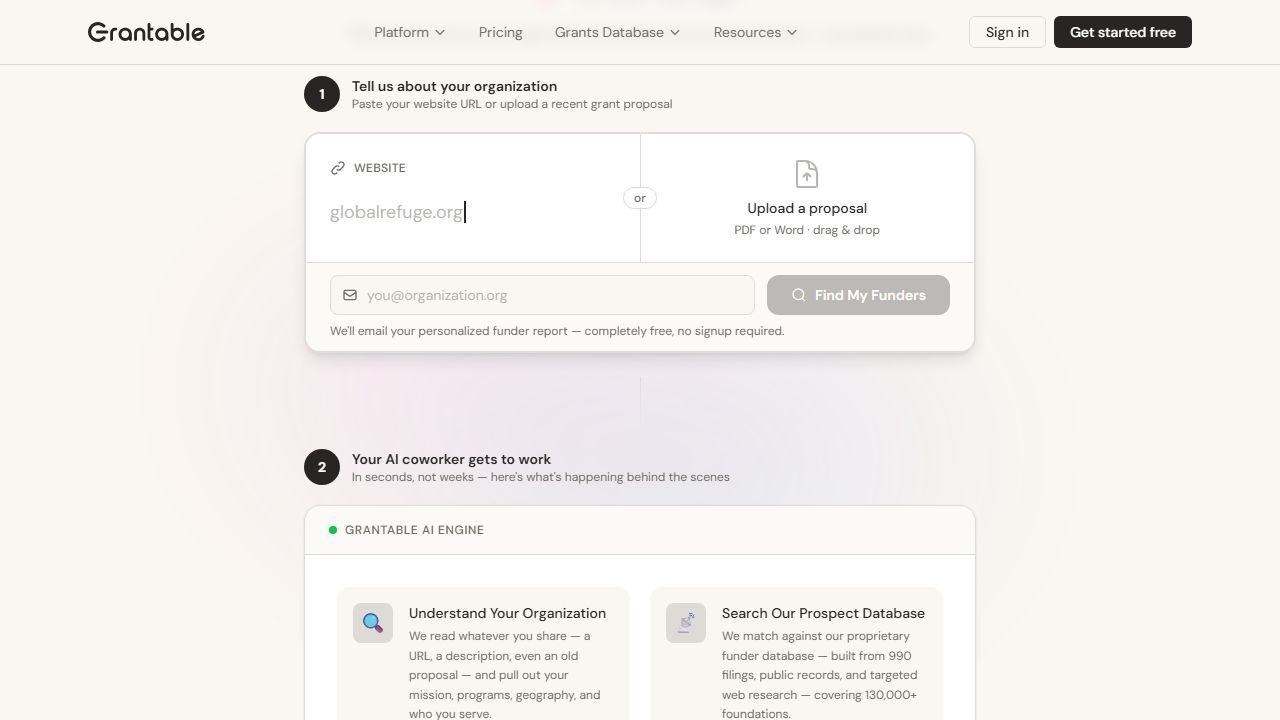
The funder discovery side covers 130,000+ foundations, built from 990 tax filings, public records, and web research. This is a meaningful number. Foundations that do not have a public-facing grants page and do not list on Grants.gov still show up in 990 filings. Grantable ingests those filings to build a more complete picture of the funding landscape than most organizations can access through Google searches alone.
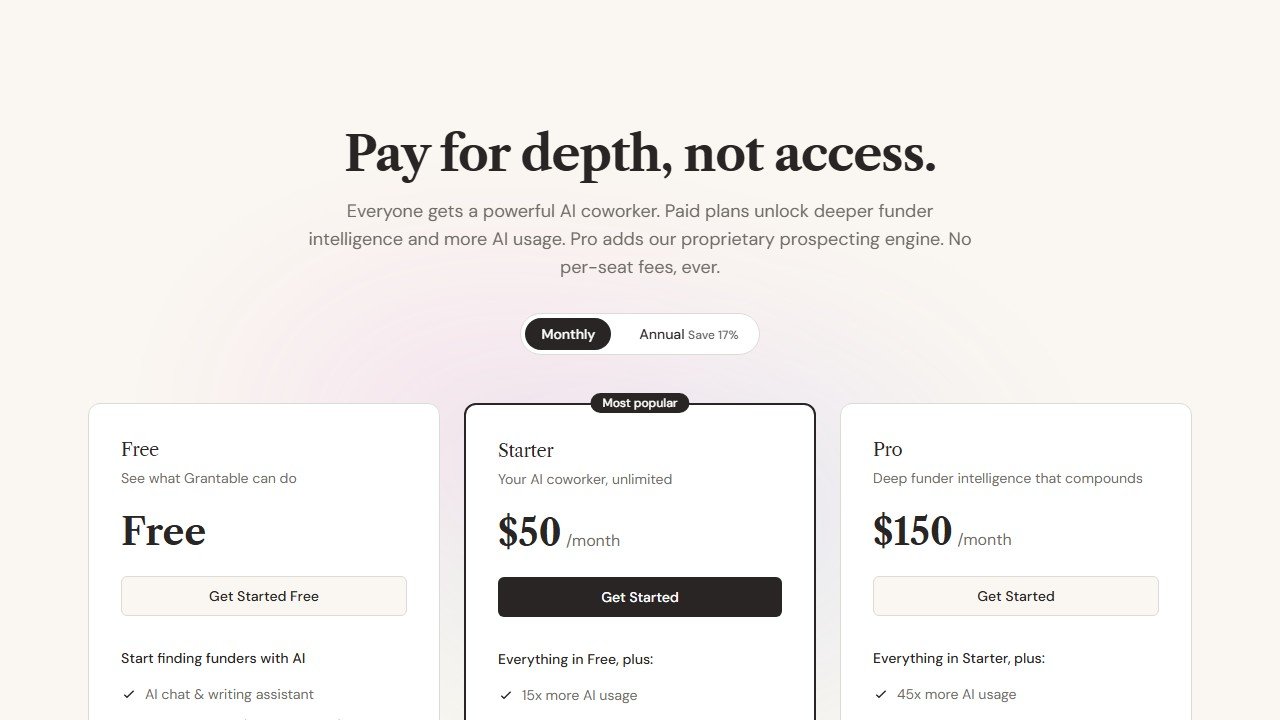
| Plan | Price | What You Get |
|---|---|---|
| Free | $0 | Funder discovery (130K+ foundations), basic AI writing |
| Starter | $50/month | Full funder matching, deeper AI writing, basic org memory |
| Pro | $150/month | Full intelligence layer, deep org memory, multi-model AI, full lifecycle management |
| Nonprofit discount | Varies | Reduced pricing for orgs under $500K budget |
Grantable is an AI-native platform that covers three distinct jobs in the grant process: finding funders, writing proposals, and managing the application lifecycle. Most tools in this space handle one or two of those jobs. Grantable is built to handle all three, and the integration between them is the point.
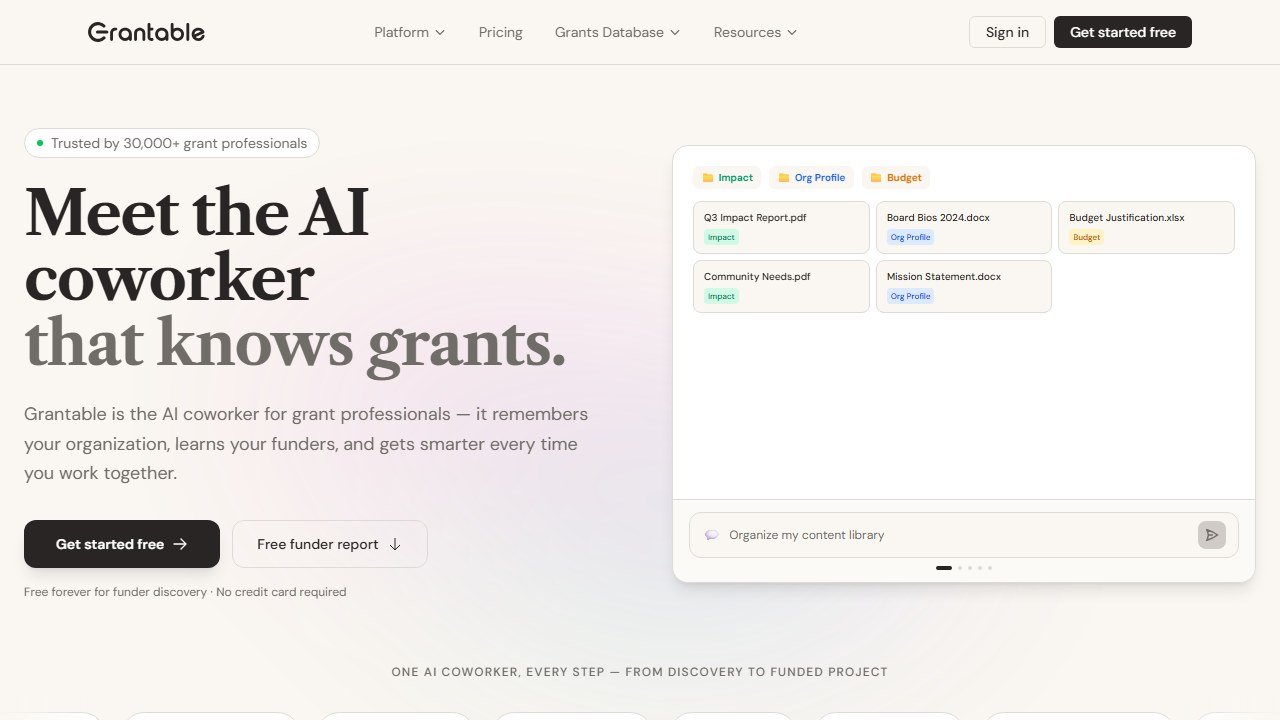
Website: Grantable
What makes Grantable’s discovery different from a raw database search is what it tells you about each match. Every funder result includes an explanation of why this foundation is a good fit for your organization, the typical award range, geographic overlap with your service area, and the foundation’s stated priorities. You are not just getting a list of names. You are getting a research brief on each potential funder.
The writing side is where the org memory feature comes in. When you set up your Grantable account, you upload your organization’s materials: your mission statement, program descriptions, past proposals, outcome data, annual reports, logic models. Grantable’s AI processes these materials and builds a persistent knowledge base specific to your organization. When you use the AI writing assistant to draft a grant section, it draws on that knowledge base. It knows your programs. It knows your outcomes. It knows how you have described your work in the past.
The platform uses multiple AI models (including ChatGPT, Claude, and others) for different writing tasks, selecting the model best suited to each type of content. Grant narrative generation, budget justification language, and executive summaries may draw on different underlying models.
The lifecycle management layer handles deadline tracking, application status, funder communication logs, and team collaboration. This mirrors what tools like Instrumentl offer, but integrated with the writing layer rather than separate from it.
Key Features
Organizational Memory (The Core Differentiator)
The org memory feature is Grantable’s most important differentiator and the main reason to consider it over general-purpose AI writing tools. Here is how it works in practice.
When you first set up your account, you upload your organization’s foundational materials. This might include your strategic plan, program descriptions, past grant proposals that were funded, outcome reports from completed grants, staff bios, budget summaries, and your mission statement. Grantable processes all of these documents and builds a searchable knowledge base that the AI can draw on during writing sessions.
When you open a new grant application and ask the AI to draft the program description section, it does not start from a blank slate. It draws on the program descriptions in your uploaded documents. It pulls in outcome data from your previous reports. It maintains consistency with how your organization has described its work in past funded proposals. This matters because funded proposals often contain language that resonated with a specific type of funder. The AI can pattern-match against what has worked before.
The org memory also means that different staff members using the same Grantable account get consistent output. If your development director and a program manager are both working on different sections of the same application, the AI is drawing on the same organizational knowledge base for both. The executive director’s voice in the mission description matches the program officer’s voice in the program narrative.
Over time, as you upload more proposals, more outcome reports, and more organizational documents, the knowledge base grows richer. The AI’s output becomes more precisely calibrated to your organization’s voice and history. This compounding improvement is the feature that most differentiates Grantable from competitors.
Funder Discovery (130,000+ Foundations)
The discovery database covers 130,000+ foundations sourced from 990 filings, public records, and web research. This is the broadest coverage in the dedicated grant writing tool category. For comparison, Instrumentl’s database focuses on 22,000+ active RFPs, which means opportunities with current open application windows. Grantable’s 130,000+ figure includes foundations that operate on invitation cycles, that have irregular grant cycles, and that do not publicly advertise open applications.
For a nonprofit doing prospecting work, this distinction matters. Some of the most significant grant opportunities come from foundations that do not broadly advertise. They fund organizations they have researched proactively or been introduced to. Finding these foundations requires accessing 990 data, which is what Grantable does.
Each funder result in Grantable includes a fit explanation. Rather than showing you a foundation name and address and leaving you to determine relevance, Grantable explains why this foundation might fund your work: “This foundation has historically prioritized workforce development programs serving adults with barriers to employment. Your program serving justice-involved individuals aligns with their stated equity focus and geographic concentration in the mid-Atlantic region.” That context turns a list of names into actionable research.
Award ranges are included where available. A foundation with a typical award of $5,000 to $15,000 is not worth the same investment as one with a typical award of $50,000 to $150,000. Knowing this upfront helps with prioritization.
Multi-Model AI Writing
Grantable uses multiple AI models (ChatGPT, Claude, and others) rather than locking into a single model. The platform selects models based on the task type: narrative generation, compliance checking, budget justification language, and formal correspondence may each be handled by different underlying models.
The practical advantage of this approach is flexibility. Different AI models have different strengths. Claude tends to produce more nuanced and careful prose in contexts where tone matters. ChatGPT handles certain structured content types efficiently. By not being model-locked, Grantable can optimize the output quality for each type of grant content.
For users, this mostly happens behind the scenes. You write a prompt or ask for help with a section, and Grantable determines which model to deploy. The output is attributed to “Grantable” rather than to a specific model. You are working with the writing assistant, not managing API calls.
Word and character count controls allow you to target the specific length limits that many funders impose. A funder asking for a program description of no more than 500 words gets a draft calibrated to that limit.
Grant Lifecycle Management
The lifecycle management tools cover the full span of a grant from prospect to reporting. Applications move through stages: Identified, In Progress, Submitted, Awaiting Decision, Awarded, Declined, and Reporting. Each application record stores the relevant documents, deadlines, notes, and funder contact information in one place.
Deadline tracking covers application deadlines, LOI deadlines, notification dates, and reporting deadlines. Calendar integration exports these deadlines to Google Calendar or Outlook.
Funder relationship logging lets you track correspondence with program officers. If you emailed a program officer at a foundation, got a positive response, and want to note that relationship for future applications, that context lives in the Grantable record for that funder. When you revisit the same foundation for a second grant cycle, the relationship history is there.
For small development teams managing a significant grant portfolio, having discovery, writing, lifecycle management, and funder relationship tracking in one platform reduces the number of tools in the stack and the amount of context-switching during a grant writing session.
Free Tier (Discovery Plus Basic AI)
Grantable offers a genuinely usable free tier. Free accounts access the funder discovery database and basic AI writing features. The 130,000+ foundation search is available without a paid subscription. Basic AI assistance for drafting sections is included.
The free tier does not include the full organizational memory (the deep document upload and persistent knowledge base), the complete multi-model writing intelligence, or the lifecycle management tools at full depth. But for a small nonprofit testing whether Grantable’s funder database is relevant to their programs, the free tier provides real value before committing to a paid plan.
This is an unusual pricing decision. Most tools in this category require a paid subscription to access any meaningful functionality. Grantable’s free tier creates a meaningful on-ramp for organizations with tight budgets.
Nonprofit Discounts
Grantable offers pricing discounts for organizations with annual budgets under $500K. The exact discount amount varies and requires direct inquiry, but the policy signals awareness of who their customers are. Grant writing tools that charge $150/month without acknowledging that many nonprofits operate on shoestring administrative budgets end up with churn from the organizations that need them most.
Pricing Breakdown
| Plan | Price | What You Get |
|---|---|---|
| Free | $0 | Funder discovery (130K+ foundations), basic AI writing |
| Starter | $50/month | Full funder matching, deeper AI writing, basic org memory |
| Pro | $150/month | Full intelligence layer, deep org memory, multi-model AI, full lifecycle management |
| Nonprofit discount | Varies | Reduced pricing for orgs under $500K budget |
At $150/month for Pro, Grantable is positioned below Instrumentl’s entry tier ($179/month for discovery only) while offering discovery plus writing plus lifecycle management in one subscription. For organizations weighing the two-tool stack (Instrumentl for discovery plus a writing tool for proposals), Grantable’s all-in-one pricing is a legitimate alternative worth modeling.
Saru says: The pricing comparison math is interesting. Instrumentl Standard ($299/month) plus Grantable Pro ($150/month) as a combined stack totals $449/month for discovery, writing, and pipeline management. Grantable Pro alone at $150/month covers all three functions, though Instrumentl’s discovery database (22,000+ curated active RFPs) is more deeply maintained than Grantable’s broader but less actively curated 130,000+ foundation list. The question for each organization is whether Instrumentl’s database quality justifies adding $299/month on top of a $150/month writing tool. For organizations with $1M+ budgets and 30+ active applications per year, the combined stack probably makes sense. For organizations under $1M budget managing 10-20 applications per year, Grantable Pro alone is the more defensible budget allocation. At $50/month, the Starter plan is one of the best entry points in the market. Org size under $500K and applying for fewer than 10 grants per year? Start with Starter or free, and upgrade when you hit the limits.
Who This Is For
Small-to-mid nonprofits managing 5-25 grants per year: Grantable’s sweet spot is organizations with a real grant program but not yet at the scale where a dedicated $299-499/month discovery tool is necessary. At this volume, the all-in-one approach reduces tool costs and context-switching.
Grant writers who re-apply to similar funders across multiple organizations: The org memory feature is particularly valuable when you are writing for multiple organizations with different missions and program areas. Each organization gets its own knowledge base in Grantable, and the AI does not bleed between them.
Development directors at organizations with high staff turnover: Grant writing at small nonprofits is disproportionately affected by staff turnover. When a development director leaves, organizational knowledge walks out the door. The org memory provides continuity. New staff who upload their organization’s documents to Grantable have access to the institutional history of past funded proposals and outcome language.
Budget-conscious organizations testing AI grant tools for the first time: The free tier and $50/month Starter plan create a genuine on-ramp. Organizations that are skeptical of AI grant writing can test Grantable’s discovery tools without financial commitment.
Who it is NOT for:
- Very large nonprofits or universities with enterprise grant programs that need the deepest possible discovery coverage and dedicated account management. For these organizations, Instrumentl’s enterprise features and customer success support are more appropriate.
- Organizations primarily concerned about company stability. Grantable is a small team (approximately 8 employees, $100K raised total). This is a real longevity consideration for enterprise buyers committing multi-year workflows to the platform.
- Organizations seeking a donor management or fundraising CRM. Grantable is a grant tool. It does not cover donor cultivation, major gifts, or online fundraising.
Pros
- Org memory is a genuinely differentiated feature that compounds in value over time
- 130,000+ foundation database is the broadest in the dedicated grant writing tool category
- Each funder match includes a fit explanation and typical award range (not just a list of names)
- Multi-model AI approach (ChatGPT, Claude, others) optimizes for different content types
- Free tier provides real discovery value without requiring a credit card
- $50/month Starter and $150/month Pro are among the most affordable full-featured options
- Nonprofit discounts available for organizations under $500K budget
- All-in-one (discovery plus writing plus lifecycle) reduces tool stack and cost vs. Instrumentl plus a separate writing tool
Cons
- Small team (approximately 8 employees) creates longevity risk for enterprise buyers
- Total funding raised ($100K) is minimal compared to competitors: Instrumentl has $55M, Fundraise Up has $82M
- Some features may still be in development or refinement
- Discovery database breadth (130K+ foundations) does not equal Instrumentl’s active curation depth (22K+ verified active RFPs)
- Pro at $150/month may be difficult for very small organizations even with nonprofit discounts
- Limited third-party reviews and case studies compared to more established tools
Faz says: Here is my honest verdict after testing Grantable. The org memory feature is real and it is useful. If you take the time to properly set up your organizational knowledge base by uploading your best past proposals, your program descriptions, your outcomes data, you will get meaningfully better AI writing output than you get from a generic ChatGPT prompt. That setup investment pays off across every proposal you write after the first one.
The funder database is broad and the fit explanations are genuinely helpful for triage. The all-in-one pricing is the most defensible value in the market for organizations under $1M budget.
But I cannot ignore the company size concern. Eight employees and $100K raised is tiny for a software company with 27,000+ users. That is an unusual ratio, and it raises questions about long-term support, feature development pace, and what happens if the company runs into difficulties. For a small nonprofit using Grantable as a supplemental writing aid, this risk is manageable. For a large organization building core grant workflows around the platform, I would want to see more stability signals before committing deeply.
My bottom line: Grantable is the best value in the market for small-to-mid nonprofits who want an all-in-one grant tool. But if you are an enterprise buyer, look carefully at the company size before committing.
Saru says: The traction numbers tell an interesting story. 27,000+ grant professionals and organizations is a large user count for a company with 8 employees and $100K raised. For context, Instrumentl has 4,500+ customers with 107 employees and $55M raised. Grantable’s user-to-employee ratio suggests either a highly efficient bootstrapped operation or a freemium model where most users are on the free tier rather than paying Pro subscribers. The $100K total funding figure suggests the latter, which means paid customers are a smaller subset of the 27,000+ headline number. This matters for a buyer evaluating support quality and feature development capacity. Instrumentl’s $55M raise and 107 employees translate to real engineering and support capacity. Grantable’s 8-person team is doing impressive things with limited resources, but capacity limits are real. Rating: 4.3/5. Best all-in-one value in the category. Org memory is a genuine product innovation. Company size is the main risk factor.
Integrations
| Integration | Type |
|---|---|
| Google Calendar | Deadline sync |
| Outlook Calendar | Deadline sync |
| Google Drive | Document import/storage |
| Dropbox | Document import |
| ChatGPT (OpenAI) | Underlying AI model |
| Claude (Anthropic) | Underlying AI model |
| Instrumentl | Workflow pairing (copy opportunities from Instrumentl into Grantable for writing) |
Grantable’s native integrations focus on document storage and calendar sync, which reflects the platform’s priority on ingesting organizational documents for the memory feature and keeping deadline tracking visible in existing calendars. The underlying AI model integrations (ChatGPT, Claude) are embedded in the product rather than user-managed connections.
The Instrumentl pairing is a workflow rather than a native integration: users who subscribe to both platforms copy grant opportunity details from Instrumentl into Grantable to begin writing. Some teams find the combination optimal: Instrumentl’s superior active RFP database for discovery, Grantable’s org memory and writing tools for proposals. The combined cost ($150 + $179 to $299) is the main objection.
Final Verdict
Grantable is the most thoughtfully designed all-in-one grant platform in the $50 to $150/month price range, and the organizational memory feature is the most genuinely innovative capability in the grant writing tool market right now. The idea that an AI assistant should learn your organization deeply and carry that knowledge across every proposal you write, is the right product direction. The execution in Grantable is functional and improving.
For small-to-mid nonprofits (roughly $200K to $2M budget, 5-25 grants per year), Grantable’s combination of broad funder discovery, org memory-powered writing assistance, and lifecycle management in one subscription represents the best value available. The $50/month Starter plan provides a real entry point, and the $150/month Pro plan is competitive against both the cost of Instrumentl alone and the combined cost of Instrumentl plus a dedicated writing tool.
The company size concern is legitimate and cannot be dismissed with a note about how “great the product is.” Eight employees with $100K raised is a small team to support 27,000+ users. For organizations building deep workflows around a grant writing platform, the longevity and support questions are worth asking directly before committing. For smaller organizations using Grantable as a writing aid with lower dependency risk, the product’s capabilities far outweigh the company-size concern.
If you are comparing Grantable to Instrumentl, the key question is whether you need Instrumentl’s superior active RFP database or whether Grantable’s broader but less curated foundation list covers your prospecting needs. If Grantable’s discovery is sufficient, you save $150 to $350/month and gain integrated writing assistance. See the Grantable vs Instrumentl comparison for the full breakdown.
Rating: 4.3/5
The best all-in-one grant platform at this price point. Org memory is a genuine product innovation that compounds in value. Company size is the main risk factor preventing a higher score.
Related reading: Best AI Grant Writing Tools | Grantable vs Instrumentl | Instrumentl Review | How to Use AI for Grant Writing | Best AI Tools for Nonprofits
References & further reading
For deeper data and primary sources on nonprofit fundraising and donor research:
- Candid (Foundation Center + GuideStar). authoritative nonprofit financial and grant data, the source most donor-research tools build on
- M+R Benchmarks Study. annual fundraising performance benchmarks across email, advertising, web, and donor metrics
- Nonprofit Quarterly. investigative reporting on nonprofit operations, governance, and fundraising effectiveness
More AI tool guides worth reading: Best AI Grant Tools for Nonprofit Development Teams.
Tools mentioned in this guide

Written by
FazFaz is the founder of AIToolsBakery. Some tools here are tested hands on. Others are assessed from vendor documentation and pricing verified on the live page, and every review says which one it is. Sponsors can buy a position in a guide. They cannot buy the score, the criticism, or silence about a better option.
How we test and how we make money →Frequently Asked Questions