tool_score: 4.4
Update, 4 September 2026: Fundraise Up no longer publishes a percentage. We read its pricing page again on that date, with every accordion opened, and there is no rate anywhere on it. The page now reads “performance-based pricing” and asks for a demo. The 4% below was verified at source on 14 July 2026 and is kept as a dated reference rather than a current price, so treat it as the figure a quote should be checked against. Its published donor fee coverage claim has also moved, from 87% to 80%. Full detail in our Fundraise Up pricing breakdown.
Every fundraising tech company claims their AI increases donations. Fundraise Up shows you the receipts.
Faz’s First Take
When a company’s clients include UNICEF USA, the Canadian Red Cross, and the American Heart Association, you pay attention. These are not organizations that adopt unproven tools. They have procurement committees, legal review, and technical teams that vet vendors carefully.
That’s the first data point that told me Fundraise Up is worth reviewing seriously.
The second is the specific nature of their AI claim: 10-15% more revenue when AI suggestions are enabled. That’s not “AI-powered” as marketing fluff. That’s a testable, measurable result with a specific range. And given that they’re on a 4% transaction fee model, they have a financial incentive to prove that number because their revenue grows when yours does.
I went into this review looking for where the 4% bites and whether the AI lift is real. The short version: the math works out for orgs at scale, and the AI does what it claims.
Last updated: April 22, 2026.
Related: See also: Givebutter vs Fundraise Up | Givebutter review | Best AI fundraising tools
What Fundraise Up Does
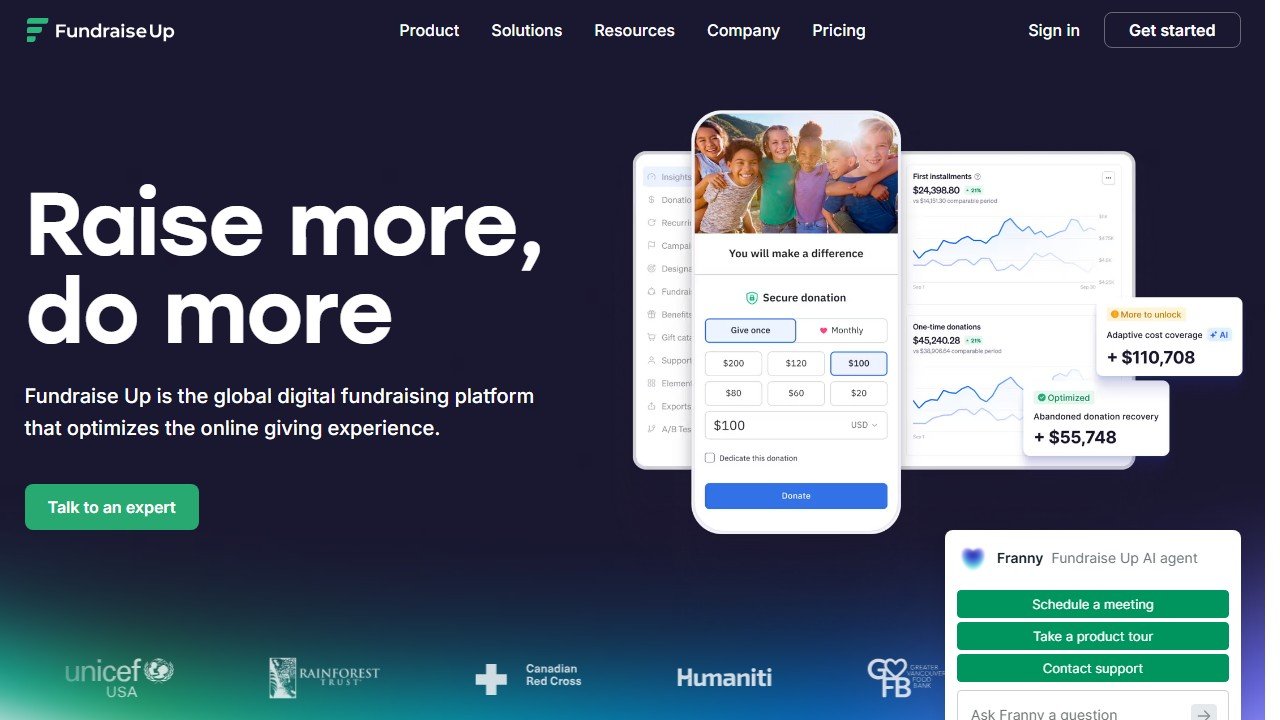
The platform replaces your existing donation forms and checkout experience with an AI-optimized widget. When a donor arrives at your donation page, the Fundraise Up widget presents them with a personalized suggested donation amount based on real-time behavioral signals and historical donor data. It also presents payment options (credit card, Apple Pay, Google Pay, Venmo, PayPal, ACH bank transfer) in a clean, mobile-first interface designed to minimize friction and maximize completion rates.
| Cost Component | Rate | Details |
|---|---|---|
| Platform fee | 4% of each donation | Charged on all transactions |
| Payment processing | Stripe standard rates (~2.9% + $0.30) | Separately itemized |
| Monthly subscription | $0 | No subscription fee |
| Setup / onboarding | $0 | Self-serve or assisted |
| Additional users | $0 | Unlimited team access |
| Feature tiers | None | All features included |
Fundraise Up is not trying to be your CRM, your email platform, or your event ticketing system. It does one thing: maximize the revenue you generate from online donations.
Website: Fundraise Up
The AI layer is the product differentiator. Rather than showing every donor the same suggested amounts ($25, $50, $100, $250), the system reads signals about this specific visitor and adjusts the suggestion in real-time. First-time visitors see different suggestions than returning donors. Someone who arrived from a major gift email sees a different suggestion than someone who clicked a social media ad. The system learns continuously from conversion data across all the nonprofits on the platform.
Fundraise Up reports that enabling AI suggestions produces an additional 10-15% in revenue compared to static suggested amounts. That figure comes from their internal testing across thousands of campaigns. The mechanism is straightforward: better-calibrated donation amount suggestions lead to more donors giving at or above the suggested amount, which raises average gift size.
The platform supports campaign pages, recurring giving programs, localization for international donors, and a basic set of reporting and analytics. It integrates with major CRMs so donation data flows into your existing donor management system.
What Fundraise Up is not: it’s not a CRM, it’s not an email platform, it’s not a peer-to-peer fundraising tool, and it’s not an event platform. This is a deliberate product decision. Fundraise Up is built to be the best possible donation checkout experience, not a kitchen-sink platform. If you need a full-featured platform, the Givebutter review covers that angle.
The company raised $82.33 million total, including a $70 million round from Summit Partners in January 2025. At that funding level, with those clients, Fundraise Up is a serious enterprise-grade product.
Key Features
AI Donation Optimization
This is the core of the product and the reason mid-to-large nonprofits pay for it.
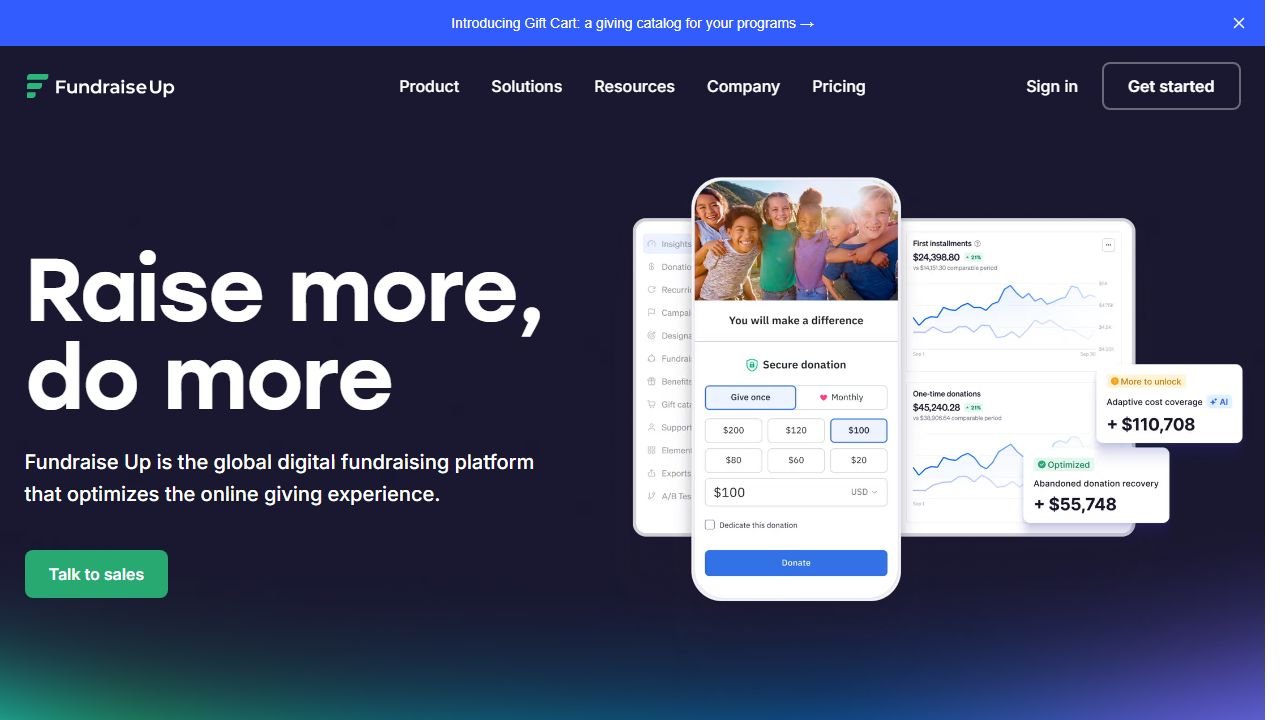
The AI engine analyzes real-time signals to personalize the donation ask for each visitor. Factors the system uses include: the campaign the donor came from, their geographic location, device type, time and day, and aggregate behavioral patterns from the broader Fundraise Up donor network.
The result is that two donors visiting the same donation page in the same hour might see different suggested amounts. A donor who came in from a major gift cultivation email might see a $500 suggestion. A donor who clicked a social media awareness ad might see $35. Both are more likely to give at or near the personalized suggestion than at a generic static amount.
The 10-15% revenue increase claim is based on A/B testing across Fundraise Up’s client base comparing AI-on versus AI-off configurations. It’s not a universal guarantee, but the directional finding is consistent: personalized suggestions outperform static ones.
Nonprofits can also set hard minimum and maximum parameters, ensure the AI never suggests below a certain floor amount, and control the framing (one-time vs. monthly first).
Turnkey Payment Methods
Fundraise Up supports every major payment method US donors expect: credit and debit cards, Apple Pay, Google Pay, Venmo, PayPal, and ACH bank transfers. All of these are presented natively in the checkout widget without redirects.
For the donation context specifically, Apple Pay and Google Pay dramatically reduce checkout friction on mobile. A donor who would have abandoned a long-form credit card entry on their phone can complete a gift in two taps. Fundraise Up reports this contributes meaningfully to their donor acquisition numbers (they claim 2x donor acquisition when AI and full payment options are enabled).
Recurring Giving
Fundraise Up’s recurring giving module converts one-time donors to monthly supporters. The widget can be configured to default to monthly giving, to offer a monthly option alongside one-time, or to use AI to decide which to show first based on donor signals.
Recurring donor retention management is included: failed payment recovery, annual donation summary emails, and giving history access for donors.
Campaign Pages
Fundraise Up creates hosted campaign pages that are separate from your main website. These work well for specific fundraising drives (year-end appeal, emergency response, specific project funding) where you want a focused, high-converting page without competing navigation.
Campaign pages include goal thermometers, recent donor activity feeds, and social sharing. They’re designed to convert, not to inform. They’re not your main website donation page but a targeted conversion destination for specific campaigns.
International and Localization Support
Fundraise Up handles currency conversion and localization for international donors. The platform automatically detects a donor’s location and presents the appropriate currency, localized payment methods, and localized content where available.
This is particularly relevant for global organizations like UNICEF USA that raise from international supporters alongside US donors.
Reporting and Analytics
The analytics dashboard shows donation volume, conversion rate, average gift size, payment method breakdown, recurring vs. one-time split, and campaign performance. The reporting is functional but not deep. It gives your development team what they need to understand performance and report to leadership, but it’s not a sophisticated BI tool.
For deeper donor analytics, Fundraise Up integrates with your CRM where the full picture lives.
CRM Integrations
Fundraise Up is designed to feed data into your existing CRM, not replace it. Native integrations exist for Salesforce, HubSpot, Virtuous, Bloomerang, DonorPerfect, and others via API and Zapier. Donation records, donor contact info, and campaign attribution flow automatically.
This integration-first approach is a deliberate design choice. Fundraise Up believes their job is to maximize your online donation revenue, and your CRM’s job is to manage donor relationships. They connect cleanly but stay in their lane.
Pricing Breakdown
| Cost Component | Rate | Details |
|---|---|---|
| Platform fee | 4% of each donation | Charged on all transactions |
| Payment processing | Stripe standard rates (~2.9% + $0.30) | Separately itemized |
| Monthly subscription | $0 | No subscription fee |
| Setup / onboarding | $0 | Self-serve or assisted |
| Additional users | $0 | Unlimited team access |
| Feature tiers | None | All features included |
The effective rate math:
Fundraise Up reports that 87% of their donors choose to cover all transaction costs (platform fee + processing) when given the option. This means most nonprofits see effective platform costs near zero because donors absorb the fees.
On $200,000 in annual online donations:
- Gross donations: $200,000
- If 87% of donors cover costs: nonprofit receives approximately $197,500-$199,000 depending on donor mix
- Fundraise Up’s 4% on those donations: approximately $8,000 total fee
- Amount covered by donors: approximately $6,960 (87%)
- Net cost to nonprofit: approximately $1,040
Compare to a $299/month platform subscription: $3,588/year at the same volume, with the nonprofit paying the full amount regardless of donor behavior.
The fee model favors high-volume organizations because the 4% scales up significantly at $1M+ in online giving. At $1M, the 4% is $40,000. If 87% is covered by donors, the nonprofit nets approximately $4,800 after the portion donors didn’t cover. That’s still reasonable, but it’s a different conversation than the small org math.
Saru’s Pricing Analysis
Let me build the ROI case directly.
Scenario: mid-sized nonprofit raising $300,000 online annually. Currently using a basic donation form (no AI optimization).
Adding Fundraise Up at 4% fee: $12,000 in fees, with $10,440 covered by donors (87%). Net cost: $1,560/year.
If the AI produces a conservative 10% revenue lift: $30,000 in additional donations.
Net gain after fees: $30,000 minus $1,560 = $28,440 in additional annual revenue.
That’s an 18x return on the net platform cost. Even if the AI only delivers half the claimed lift (5%), the net gain is still $13,500 vs. $1,560 in net fees.
The math changes at very high donation volumes or if your donor base has unusually low fee coverage rates. But for the typical mid-sized nonprofit in the $250K-$2M online giving range, the ROI on Fundraise Up is compelling.
The risk: if the AI lift doesn’t materialize for your specific donor base, you’re paying 4% for a nice-looking checkout page. That’s why I’d recommend piloting with a specific campaign before full rollout.
For a direct comparison of cost structures against Givebutter, see the Givebutter vs Fundraise Up comparison.
The percentage model looks simple until you run it against your own donation volume. Our Fundraise Up pricing guide does exactly that math, tier by tier, so you know the real annual cost before the demo call.
Who This Is For
Fundraise Up is the right choice for:
Mid-to-large nonprofits ($500K+ in online donations annually) where a 10-15% revenue lift justifies the 4% fee structure. The ROI math is strong at this scale.
Organizations with high online donation traffic. The AI optimization works by learning from your specific donor behavior patterns. The more traffic, the faster the model calibrates and the better the results.
Global organizations that need multi-currency support and localized payment methods. Fundraise Up handles this well.
Nonprofits with an existing CRM that they want to keep. Fundraise Up is designed to integrate, not replace. If you’re invested in Salesforce or Virtuous, Fundraise Up slots in cleanly.
Organizations that want a premium checkout experience. The payment method breadth (Apple Pay, Google Pay, Venmo, PayPal, ACH) is important for reducing mobile abandonment.
Fundraise Up is not the right choice for:
Very small nonprofits (under $100K in online giving). The complexity of setup and the 4% fee may not be worth it at that volume. Start with Givebutter free.
Organizations that need a full-featured platform. If you need CRM, email marketing, event ticketing, peer-to-peer, and donation forms in one place, Fundraise Up covers only one piece of that. See the Givebutter review or the best AI fundraising tools guide.
Organizations with very limited technical staff. Implementation requires some technical setup (replacing existing donation forms, CRM integration). It’s not difficult, but it’s not entirely self-serve for non-technical teams.
Pros
- AI optimization actually delivers: 10-15% revenue lift is a measurable, specific claim, not vague marketing language. The company’s fee-based model aligns their incentives with yours.
- All features included, no tiers: Everything in the platform is available to all users. No upsells, no feature gating, no “enterprise plan required” frustrating surprises.
- 87% donor fee coverage reduces net cost dramatically: Most of the 4% is absorbed by donors who choose to cover transaction costs.
- Turnkey payment methods: Apple Pay, Google Pay, Venmo, PayPal, ACH included. Reduces mobile checkout friction significantly.
- Enterprise client validation: UNICEF USA, Salvation Army UK, Canadian Red Cross, American Heart Association. These organizations validate quality.
- International support: Multi-currency, localized payment methods for global organizations.
- Clean integration model: Designed to feed your existing CRM rather than compete with it.
Cons
- 4% fee adds up at high volumes: At $1M+ in online giving, the fee structure becomes a significant line item even after donor coverage. Large orgs need to model this carefully.
- Not a full platform: Fundraise Up is a donation optimization tool, not a complete fundraising platform. You still need a CRM, email marketing, and event tools separately.
- Enterprise-focused complexity: Implementation is more involved than signing up for Givebutter. Technical resources help. Very small orgs may find the onboarding challenging.
- AI lift varies by org: The 10-15% average hides a distribution. Some orgs will see more, some less. Results depend on traffic volume, donor base characteristics, and baseline optimization of your current setup.
- Pricing lacks transparency on one component: While the 4% is clear, the exact percentage your donors cover is a variable that depends on how you configure the fee presentation and your donor base behavior.
- Limited built-in analytics: The reporting dashboard is functional but not sophisticated. Deep donor analytics require your CRM.
Faz’s Honest Verdict
If I’m advising a mid-sized nonprofit that already has a CRM and does $400K+ in online giving annually, Fundraise Up is a straightforward recommendation. The math is clear: you’re trading a modest fee (mostly covered by donors) for a meaningful revenue lift.
Where I’d slow down: very small orgs where the setup complexity and fee model don’t pencil out, and orgs expecting Fundraise Up to be a full platform replacement. It’s not. It’s a precision tool for one specific thing. That’s not a criticism. That’s its design.
The enterprise client list isn’t window dressing. The Canadian Red Cross doesn’t run a pilot of your software if it doesn’t work. That’s the clearest signal in this review that the product delivers on its claims.
For orgs comparing this to Givebutter: they’re different tools for different needs. Givebutter is the free all-in-one platform that works well for the majority of nonprofits. Fundraise Up is the AI-optimized donation engine for orgs that want to maximize online giving specifically and have the scale to justify it.
Integrations
| Integration | Type | Notes |
|---|---|---|
| Salesforce | CRM | Native integration, donation and contact sync |
| HubSpot | CRM | Native integration |
| Virtuous | CRM | Native integration |
| Bloomerang | CRM | Native integration |
| DonorPerfect | CRM | Native integration |
| Blackbaud Raiser’s Edge | CRM | Integration available |
| Zapier | Automation | Connects to 5,000+ apps for custom workflows |
| Stripe | Payment processing | Primary processor |
| PayPal | Payment processing | Native support |
| Apple Pay | Payment processing | Native, no redirect |
| Google Pay | Payment processing | Native, no redirect |
| Venmo | Payment processing | Native support |
| ACH / bank transfer | Payment processing | Direct bank giving option |
| Google Analytics | Analytics | Conversion tracking and campaign attribution |
| Facebook Pixel | Analytics | Social media attribution |
Final Verdict
Fundraise Up earns its 4.4/5 rating because the core value proposition is real and measurable. AI-powered donation optimization works. The enterprise client list validates the technology at scale. The fee model aligns the company’s incentives with yours, since they earn more when you raise more.
The score reflects two genuine limitations: the 4% fee requires careful modeling at high volumes, and the narrow product scope means orgs that need a full platform have to build a stack around it.
For mid-to-large nonprofits with meaningful online giving and an existing CRM they want to keep, Fundraise Up is one of the clearest ROI decisions in nonprofit technology.
For the full nonprofit fundraising tool landscape, see the best AI fundraising tools for nonprofits guide. For a direct comparison against Givebutter, see the Givebutter vs Fundraise Up comparison. For the broader nonprofit AI tool category, see best AI tools for nonprofits.
Rating: 4.4/5
Saru’s Data Verdict
The financial fundamentals support the score.
$82.33M raised with $70M from Summit Partners (the same firm that backed Instrumentl in April 2025) signals institutional confidence in the business model. Summit doesn’t write checks that size on unproven technology.
The client roster (UNICEF USA, Canadian Red Cross, American Heart Association, Salvation Army UK) represents billions of dollars in annual fundraising operations. Those organizations are conservative technology adopters. Their continued use of Fundraise Up is stronger validation than any case study.
The 4% fee is the main risk factor in the score. At $1M in online giving, that’s $40,000 gross before donor coverage. The 87% donor coverage figure reduces this significantly, but it introduces a variable that not every development director accounts for in their budget modeling.
Score is 4.4/5 rather than higher because of the platform scope limitation (no CRM, no P2P, no events) and the fee scalability question. For orgs in the target audience, this is a strong platform choice.
Rating: 4.4/5
References & further reading
For deeper data and primary sources on nonprofit fundraising and donor research:
- Candid (Foundation Center + GuideStar). authoritative nonprofit financial and grant data, the source most donor-research tools build on
- M+R Benchmarks Study. annual fundraising performance benchmarks across email, advertising, web, and donor metrics
- Nonprofit Quarterly. investigative reporting on nonprofit operations, governance, and fundraising effectiveness
More AI tool guides worth reading: Little Green Light Review 2026, Dataro Review 2026 and Donor Data Privacy in AI Fundraising.
Tools mentioned in this guide

Written by
FazFaz is the founder of AIToolsBakery. Some tools here are tested hands on. Others are assessed from vendor documentation and pricing verified on the live page, and every review says which one it is. Sponsors can buy a position in a guide. They cannot buy the score, the criticism, or silence about a better option.
How we test and how we make money →