The best AI workout apps in 2026 are Fitbod (best for hypertrophy and general strength), JuggernautAI (best for powerlifters and Olympic lifters), and Dr. Muscle (best for progressive overload automation). These are consumer apps, not coaching platforms. If you are a coach, see our best AI tools for personal trainers guide instead. Full breakdown below.
Quick comparison at a glance. Full breakdown for each option below.
Comparison table
| Fitbod | JuggernautAI | Dr. Muscle | |
|---|---|---|---|
| Monthly price | $15.99 | $34.99 | $49 |
| Annual price | $79.99 | $349.99 | ~$588 |
| Best for | General fitness / recreation | Competitive powerlifting | Hypertrophy / DUP |
| Exercise consistency | Rotates for recovery | Squat/bench/deadlift focused | Same exercises per cycle |
| Progressive overload | Recovery-managed | RPE/MRV blocks | DUP (daily undulating) |
| Competition peaking | No | Yes | No |
| Beginner-friendly | Yes | No | No |
| Equipment flexibility | Excellent | Limited | Moderate |
| Community/coaching | No | Yes (weekly Q&As) | Developer responsive |
| Cancellation reliability | Easy (App Store) | Good | Poor (documented issues) |
| Free trial | 7 days | 2 weeks | No |
Last reviewed May 2026. AI workout apps in 2026 sit in three buckets: powerlifting-specific (JuggernautAI), hypertrophy-specific (Dr. Muscle), and general-fitness adaptive (Fitbod). The leaders all shipped programming-engine refinements in Q1. Deep dives: Fitbod review, JuggernautAI review, Dr. Muscle review, plus our Fitbod vs JuggernautAI comparison.
Last updated: April 22, 2026.
Related: See also: Fitbod review | JuggernautAI review | Dr. Muscle review | Best AI tools for PTs
Why “best AI workout app” depends on your goals
Most “best AI workout app” lists rank tools by features: exercise library size, periodization options, wearable integrations. This is the wrong framework.
The right framework is: what are you training for, and which algorithm serves that goal?
A recreational gym-goer who wants to stay active and look better has different needs from a competitive powerlifter who wants to squat 250kg. Giving both the same app recommendation is worse than useless.
We researched these apps with specific use cases in mind, from what each vendor, help centre and app store listing says. Here’s how they line up.
Best for general fitness and recreational lifting: Fitbod
Price: $15.99/mo, or $79.99 to $95.99/yr depending on the price point you are offered (the US App Store lists both yearly prices; Fitbod’s help centre quotes $95.99). New users get a 7-day free trial.
Downloads: 15M+ | App Store: 4.8/5 (250,000+ reviews)
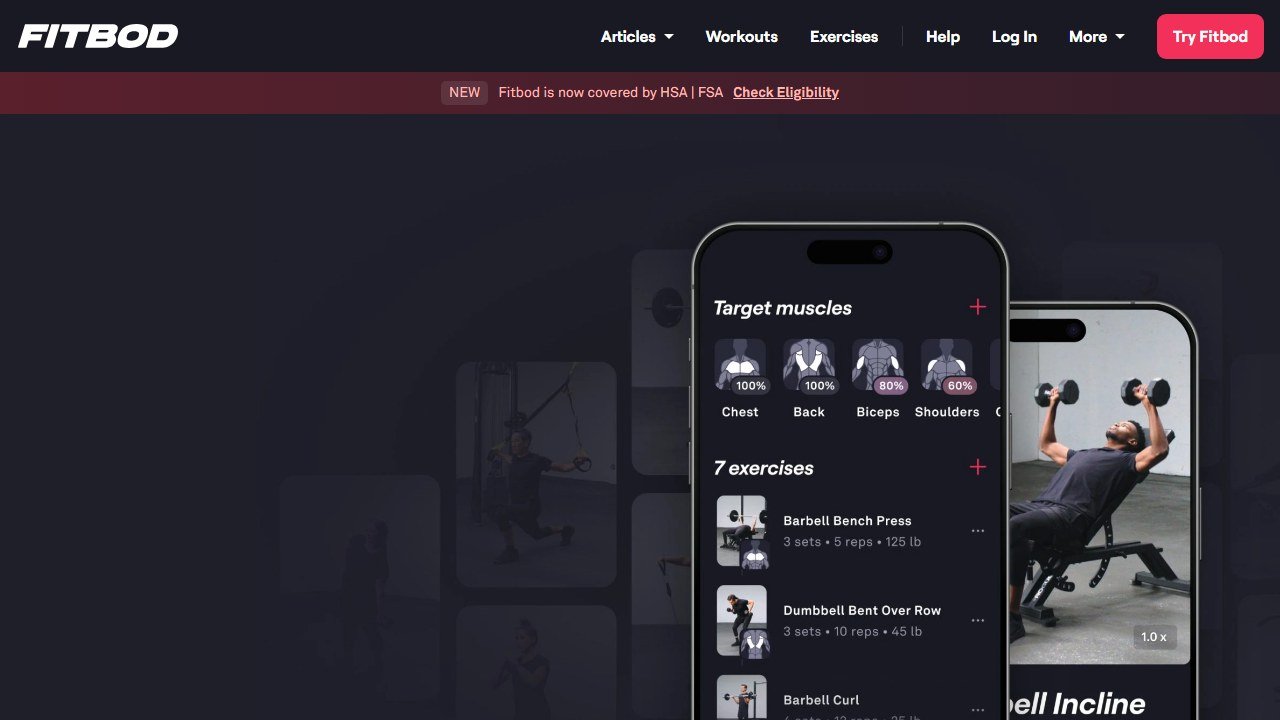
Fitbod’s muscle recovery algorithm tracks fatigue state per muscle group and generates sessions that balance training stimulus against recovery. The result: workouts that feel appropriately challenging, adapt to whatever equipment you have, and don’t grind the same muscles into the ground every session.
What it does better than any alternative:
- Equipment flexibility: configure available gear per session, not just per account
- Recovery management: genuinely adjusts based on what you’ve trained recently
- Interface: the best-designed consumer workout app in the category
The real limitation:
Fitbod rotates exercises based on recovery. If you want to systematically get stronger at a specific movement. get your deadlift from 150 to 200kg. the rotation prevents the consistent repetition that drives movement-specific adaptation. For general fitness, rotation is fine. For strength goals, it’s a constraint.
Best for: Recreational lifters, gym regulars who train for health and aesthetics, people who train in multiple environments, beginners who want structure without complexity.
Not for: Anyone with specific strength targets on specific lifts, competitive powerlifters, or anyone whose primary goal is hypertrophy through progressive overload.
Best for competitive powerlifting: JuggernautAI
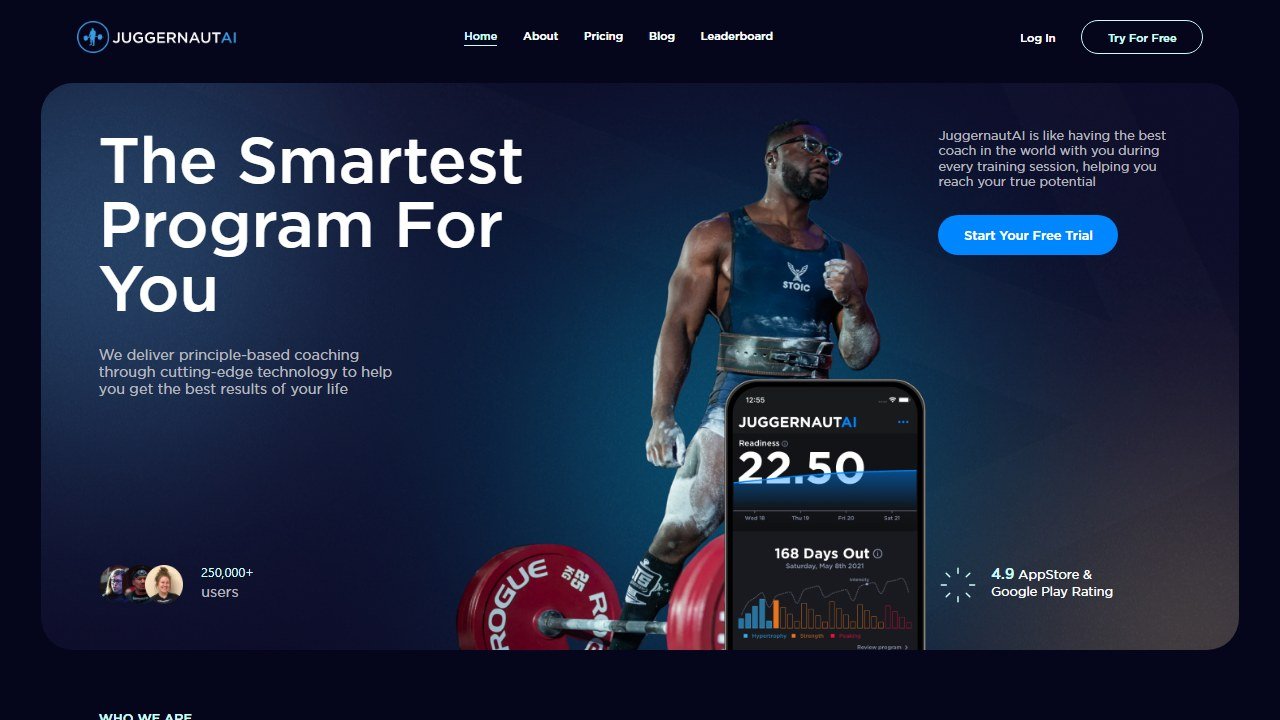
Price: $34.99/mo or $349.99/yr
Creator: Chad Wesley Smith (world record squat holder, coach of multiple world champions)
JuggernautAI is the most sophisticated periodized powerlifting program available in app form. The Juggernaut Method uses RPE (Rate of Perceived Exertion), MRV (Maximum Recoverable Volume), and block periodization to structure training across an entire competitive cycle and peak you on a competition date.
This is how elite powerlifters actually train. Most AI workout apps ignore periodization entirely. JuggernautAI is built around nothing else.
What it does better than any alternative:
- Block periodization with competition peaking. set your meet date, the app structures your training to peak on it
- RPE-based progression. adapts to how you actually performed, not just theoretical percentages
- Access to the Juggernaut coaching system: weekly Q&A sessions with coaches, 300+ technique videos, community
- At $349.99/yr, significantly cheaper than remote powerlifting coaching ($150-300/mo for a qualified coach)
The real limitation:
It’s exclusively squat, bench, and deadlift. If you want upper body aesthetics work, conditioning, or any training outside the big three, JuggernautAI doesn’t cover it. It also requires honest RPE logging. users who game their RPEs (reporting sets easier than they were to avoid harder sessions) get programming that doesn’t serve them.
Best for: Competitive powerlifters (local to elite), serious recreational powerlifters who train the big three as primary movements, coaches and athletes who want Chad Wesley Smith’s methodology in software form.
Not for: Beginners who don’t know RPE, recreational gym-goers who want variety, anyone whose primary goal is aesthetics rather than strength performance.
Best for hypertrophy and progressive overload: Dr. Muscle
Price: $49/mo
Methodology: DUP (Daily Undulating Periodization)
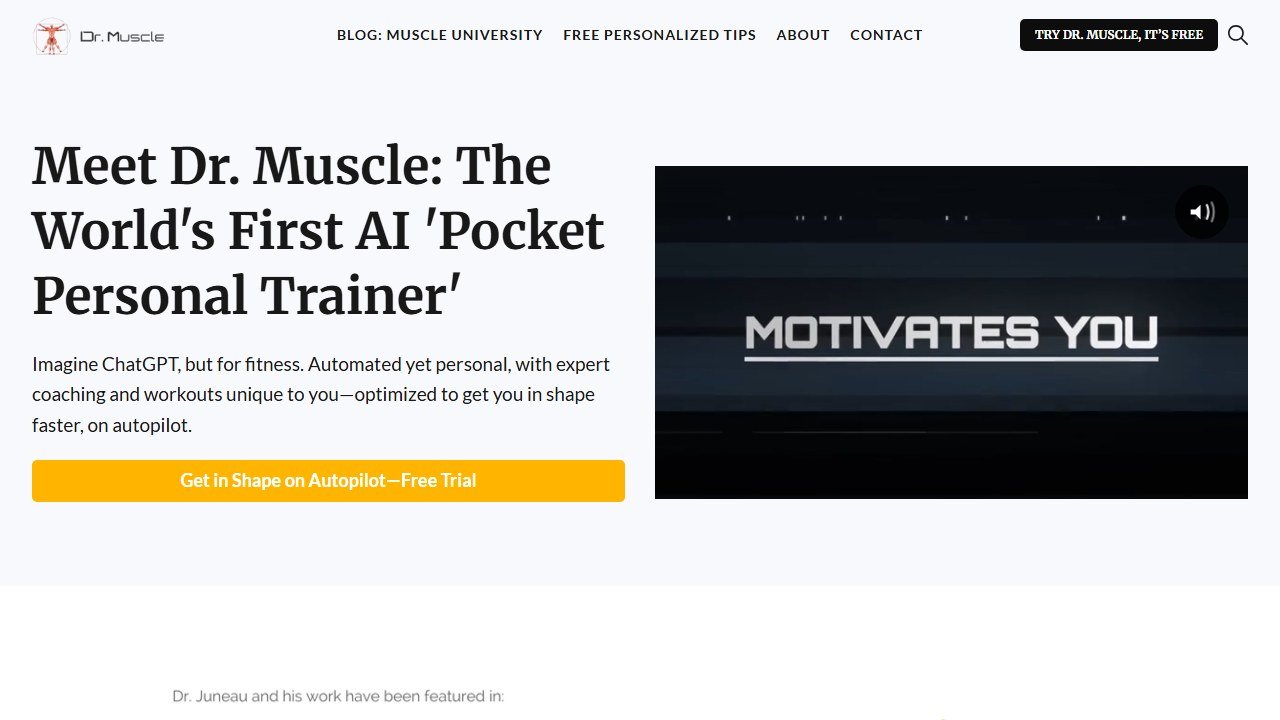
Dr. Muscle sits in a specific gap: it’s built for people who want Fitbod’s adaptivity but care about systematic progressive overload on specific exercises. Where Fitbod rotates exercises, Dr. Muscle keeps you on the same movements for a full training cycle and progresses the load week over week using DUP principles.
DUP varies intensity and volume day-to-day (heavy/moderate/pump within a single week) while keeping the exercise selection consistent. This delivers variety without sacrificing movement-specific strength tracking.
What it does better than any alternative:
- Consistent exercise selection across a training cycle. you track your bench, your squat, your rowing pattern over weeks, not days
- DUP methodology is genuinely science-backed for hypertrophy
- Developer responsiveness: Dr. Carl Juneau (PhD exercise science) is reportedly responsive to users
The real limitation:
$49/mo is the highest price in the consumer workout app category. The interface is widely described as dated. And the cancellation process has documented issues on Trustpilot. subscribe through the App Store if possible to avoid direct billing complications.
Best for: Intermediate-to-advanced lifters focused on muscle building, lifters who have hit a plateau on generic programming, anyone who has found Fitbod’s rotation prevents them from tracking strength progress on specific movements.
Not for: Beginners, powerlifters, inconsistent trainers (the DUP model needs consistent data to work properly), or anyone on a tight budget.
Best for runners adding strength training: Runna
Price: ~$14.99/mo
Focus: Running training with integrated strength
Runna is not primarily an AI strength app. it’s an AI running coach. But it deserves a mention here because it covers a gap none of the other apps address: athletes who run as their primary sport and want structured strength training alongside it.
For runners, Fitbod’s recovery-aware workout rotation works reasonably well because general gym variety is fine as a strength complement to running. But Runna integrates the strength sessions into the overall training load calculation. if you ran 12km this morning, Runna knows not to give you a heavy leg session today.
Best for: Runners who want strength training to complement running, not replace it.
What AI workout apps still can’t do
Understanding the limitations of these tools is as important as knowing their strengths. For sport-specific coaching, we compare AI tennis coach apps, basketball training apps and boxing coach apps separately.
They can’t coach you. An AI app can prescribe a session. It cannot watch you move, identify a breakdown in your squat patterning, and cue the fix. That requires a human coach.
They work as well as your logging. Every AI workout app improves with accurate data. Fitbod’s recovery model is only as good as your workout logging. JuggernautAI’s RPE adaptations are only as good as your RPE honesty. Inconsistent logging produces inconsistent programming.
They’re not personalised beyond their algorithm. You’ve entered your goals, your equipment, and your training history. The app doesn’t know about your recent job stress, your poor sleep last week, or the shoulder twinge you got from moving boxes. These factors affect your actual training capacity. The app doesn’t know.
For beginners, a real coach is still better. AI workout apps assume you can execute the prescribed movements safely. If you’re new to training, that assumption isn’t valid. A few sessions with a human coach to learn fundamental movement patterns is worth more than any AI app at the start.
Which AI workout app is right for you
Answer these questions:
What are you training for?
- General fitness and staying healthy: Fitbod
- Competitive powerlifting: JuggernautAI
- Building muscle systematically: Dr. Muscle
- Running + strength: Runna
How much training experience do you have?
- Beginner (under 6 months): Fitbod or consider a real coach first
- Intermediate (6 months to 3 years): Fitbod for general fitness, Dr. Muscle for hypertrophy
- Advanced (3+ years, specific goals): JuggernautAI for powerlifting, Dr. Muscle for hypertrophy
What’s your budget?
- Under $100/yr: Fitbod annual plan ($79.99)
- $100-400/yr: JuggernautAI ($349.99) if powerlifting-focused
- Under consideration: Dr. Muscle ($588/yr) only if the use case is specific and you’ve hit a plateau
References & further reading
For deeper context on programming, periodization, and training science behind the tools we evaluate:
- NSCA: peer-reviewed strength and conditioning research. evidence-backed programming principles from the National Strength and Conditioning Association
- ACSM physical activity guidelines. official exercise prescription standards from the American College of Sports Medicine
- PubMed sports science database. searchable archive of peer-reviewed studies on resistance training, hypertrophy, and recovery
How we reviewed every tool on this list
This list is built from research, not from our own training blocks. We have not used these apps ourselves, so nothing here is a test result. Here’s the methodology we hold every entry to.
Primary sources first
Every feature claim comes from the vendor’s own site, its help centre or its app store listing, and we say which. Where a help centre admits a limit the marketing page leaves out, the help centre wins.
Pricing transparency
We checked the live pricing page, calculated the real annual cost (including any required add-ons), and noted any hidden caps or seat minimums. Pricing in this category changes; we update each tool’s pricing block when a vendor announces a change.
Free tier reality check
We read each free tier and trial against the vendor’s own terms, not its marketing. A free trial that needs a plan selected up front is a trial, not a free app, and we say which is which. For apps you can use without paying, see our guide to the best free workout apps.
Update cadence
This list is reviewed every quarter. Tools that ship meaningful updates move up. Tools that stagnate move down or get removed. New entries replace tools that no longer earn their spot. The date stamp at the top of this article shows when we last verified every entry.
Who this list is and isn’t for
If you’re looking for the cheapest tool that technically does the job, this list may be too curated. If you’re looking for the right tool for a serious use case, this list is built to save you 10-20 hours of independent research.
For the business and decision-making side of fitness AI, see our deep dives on Trainerize pricing, TrueCoach pricing, Fitbod vs Strong, the best Wodify alternatives for CrossFit gyms, how to use AI in your personal-training business, and AI tools for yoga instructors.
The 2026 AI workout app category in three sentences
AI workout apps in 2026 split into three buckets. Adaptive AI generators that build workouts from your goals and equipment (Fitbod, Future, Caliber). Smart loggers with light AI features for tracking and progression (Strong, Hevy, RP Hypertrophy). Hybrid coaching platforms where AI augments a real human coach (Future, Caliber, FitBudd). The right bucket depends on whether you want automation, accountability, or community.
For solo lifters who want to skip the planning phase, adaptive generators win. For lifters who already know what to do and just want clean logging, smart loggers win. For lifters who need motivation from a real human, hybrid platforms win at higher price points.
The final 2026 pick by lifter profile
Beginners (under 6 months training experience): Fitbod or Caliber. Both adapt to your fitness level and have strong onboarding. Intermediate lifters (6 months to 3 years): Strong or Hevy for logging, Fitbod or Dr Muscle for programmed workouts. Advanced lifters (3+ years, competing in a sport): JuggernautAI or RP Hypertrophy. General fitness lifters (no specific goal): any of the above; pick by interface preference.
Budget by tier: Free tiers exist for Strong, Hevy, and Trainerize; expect to outgrow them within 6 to 12 months. $10 to $20 per month: Fitbod, Strong Pro, Dr Muscle. $40 to $80 per month: JuggernautAI, RP Hypertrophy. $150 to $400 per month: hybrid AI plus real coach via Caliber or Future.
Final verdict
The best AI workout app in 2026 is the one you use four times a week. Apps are tools; consistency is the result. Pick a tool that matches your training style and price tolerance, commit to using it for 90 consecutive days, and only switch if the data shows it is not working. Most lifters quit good apps before giving them time to compound.
More AI tool guides worth reading: Best AI Swimming Coach Apps, Best AI Yoga Apps with Real-Time Form Correction and Best AI Apps for Postpartum Fitness Recovery.
What AI form checking can and cannot actually see
Pose estimation from a phone camera is genuinely useful and routinely oversold. Knowing where the line sits protects you from both the hype and the injury risk.
It works well on large, planar, well-lit movement
A squat filmed from the side in good light, with the whole body in frame and reasonably fitted clothing, is close to the ideal case. Knee position, hip depth, bar path and tempo are all measurable from that, and feedback on them is real. If your use case looks like that, these tools do what they claim.
It degrades sharply outside those conditions
Accuracy falls away with loose clothing, poor lighting, an angled or moving camera, occlusion where one limb hides another, and any movement that happens largely in the depth axis away from the lens. Rotational movement, anything on the floor, and lifts where the critical detail is spinal position rather than joint angle are all much harder. A tool that is confident in those conditions is not more capable, it is less honest.
It cannot see the things that most often cause injury
A camera does not know your training history, whether that shoulder has been irritable for three weeks, how heavy the bar is relative to your capacity, or that you slept four hours. Most training injuries come from load management rather than from a visibly wrong joint angle in a single rep. Treat form feedback as one input among several rather than as a safety system.
The honest way to use it
Film the same lift from the same angle every few weeks and compare. Consistency of setup matters more than the sophistication of the model, and a fixed camera position turns these tools from a novelty into a genuine progress record. Use the feedback to prompt questions rather than to make decisions, and take anything about pain or persistent discomfort to a physiotherapist rather than to an app.
Tools mentioned in this guide
Training for size? See our ranked guide to the best AI bodybuilding apps.
Training for distance? See our ranked guide to the best AI running coach apps.

Written by
FazFaz is the founder of AIToolsBakery. Some tools here are tested hands on. Others are assessed from vendor documentation and pricing verified on the live page, and every review says which one it is. Sponsors can buy a position in a guide. They cannot buy the score, the criticism, or silence about a better option.
How we test and how we make money →