Grant development is one of the most labor-intensive functions inside any nonprofit. A single competitive proposal can require 20 to 40 hours of research, writing, and revision, and that’s before you factor in the time spent hunting for opportunities that are even worth pursuing. Development teams at small and mid-size nonprofits are often running that process with one or two staff members, a shared Google Drive, and a spreadsheet for tracking deadlines. The math does not work in their favor.
AI grant tools have changed the calculus considerably. Based on publicly available information, the current generation of platforms can cut prospect research from days to minutes, adapt successful proposal language to new funders automatically, and flag compliance deadlines before they become crises. The challenge is that the category has exploded. In 2026 there are now purpose-built AI grant platforms for research, for writing, for pipeline management, and for end-to-end lifecycle tracking, plus a growing number of general-purpose AI tools that grant writers have pressed into service. Choosing the right combination requires understanding what your team actually needs.
What to look for in an AI grant tool
Before comparing platforms, it helps to be clear on what problem you are actually trying to solve. Most nonprofit development teams have one of three core bottlenecks: finding the right funders, writing competitive proposals, or keeping track of a busy pipeline. The best tools address one or more of these well. Here are four criteria worth weighting heavily.
1. Funder database depth and freshness
A grant discovery tool is only as useful as its underlying data. Look for platforms that pull from current 990 filings, maintain active RFP feeds, and update their records at least weekly. A database with 300,000 funders that is 18 months stale is less useful than a smaller database refreshed daily. Pay attention to coverage of corporate giving programs and community foundations, which are often underrepresented in smaller databases.
2. Organizational memory and context retention
The biggest productivity gain from AI grant tools comes from the system knowing your organization’s mission, programs, budget, and past proposal language without you having to re-enter it every session. Tools that retain organizational context across sessions dramatically reduce the time needed to generate a first draft. Ask specifically how each platform stores and applies this memory before committing.
3. Funder-aligned writing, not generic output
Generic AI writing is easy to spot and tends to underperform with experienced program officers. The better platforms pull funder-specific data (giving history, stated priorities, average grant size from 990 records) and use it to shape the proposal language. The difference between a generic draft and a funder-informed one is significant in competitive grant cycles.
4. Pipeline and compliance tracking
Writing a great proposal and then missing the submission deadline is a painful and common failure mode. Platforms that include deadline tracking, report reminders, and post-award compliance tools save development staff from relying on calendar alerts and sticky notes. For teams managing 20 or more active grants at a time, this feature alone can justify the subscription cost.
The 7 best AI grant tools for nonprofit development teams in 2026
1. Instrumentl: Best all-in-one grant operating system
| Feature | Details |
|---|---|
| Starting price | $179/month (billed annually) |
| Best for | Teams that want research, writing, and pipeline in one platform |
| Free plan | No (14-day free trial available) |
| Nonprofit discount | Not publicly listed; contact for custom pricing |
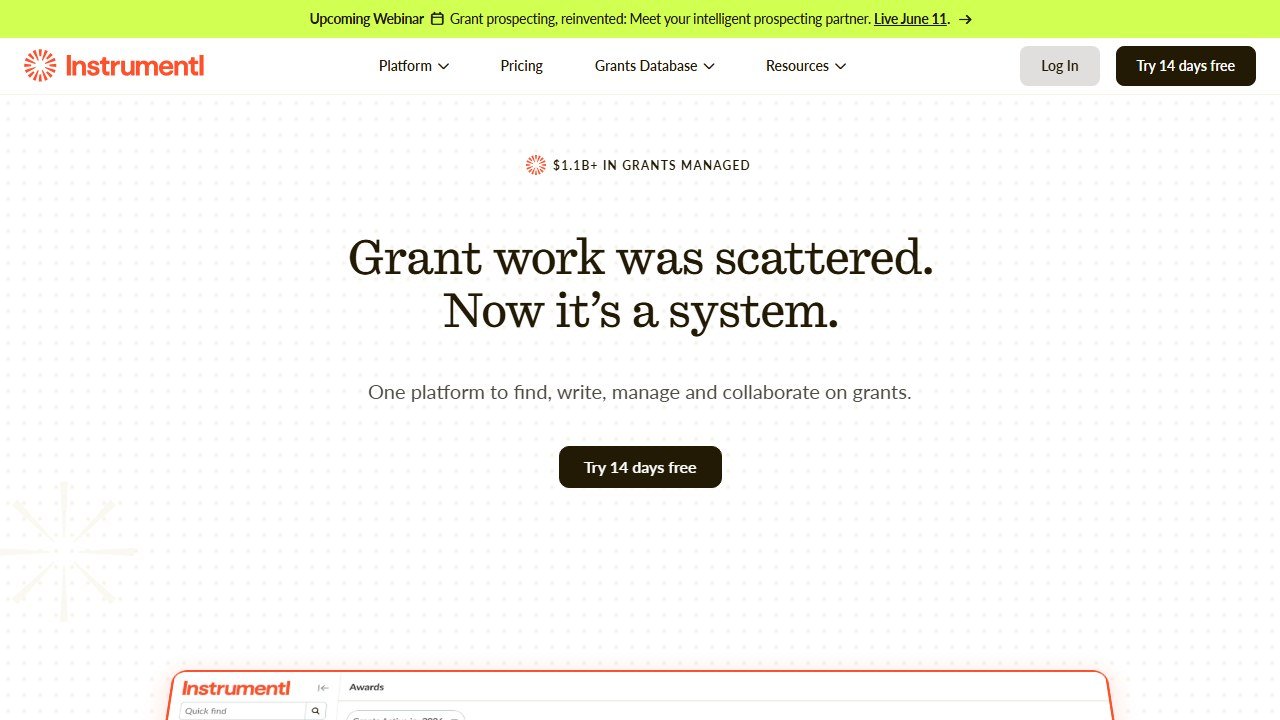
Instrumentl is, based on publicly available information, the most comprehensive AI grant platform available to nonprofit development teams in 2026. The platform maintains a database of 450,000 or more funder profiles and 33,000-plus active RFPs, and its AI-powered matching engine analyzes your organization’s programs and priorities against funder history to surface relevant opportunities. The system pulls from over 10 years of 990 data to inform which angles to emphasize in each proposal, not just which funders to pursue.
Where Instrumentl separates itself from pure discovery or pure writing tools is the post-award side of the platform. Teams can track grant budgets with live expense syncing from accounting software, receive spend alerts for over- or under-budget line items, and manage reporting deadlines in a unified compliance calendar. That kind of end-to-end coverage is unusual at any price point. Based on data published by Instrumentl, teams using the platform report an average increase of $1.4 million in annual grant revenue and save roughly 192 hours per year.
The main friction is cost and learning curve. At $179/month on the Starter plan, Instrumentl is among the pricier options in this roundup, and new users typically need a few weeks to work through all the features. The platform rewards teams that invest in setup: uploading past proposals, filling out organizational profiles, and configuring funder alerts. Teams that skip the setup phase tend to underuse the platform’s most powerful capabilities.
- Pros:
- 450,000+ funder profiles with AI-powered matching against your programs
- Post-award spend tracking synced to accounting software
- 10+ years of 990 data informing proposal strategy
- Trusted by 5,500+ nonprofits with verifiable outcome data
- Cons:
- Higher starting price than most alternatives ($179/month)
- Meaningful setup investment required to unlock full value
- Smaller nonprofits with light grant volume may not hit ROI quickly
2. Grantable: Best AI writing assistant for budget-conscious teams
| Feature | Details |
|---|---|
| Starting price | $50/month (Starter); $25/month for nonprofits under $500K budget |
| Best for | Small-to-mid nonprofits prioritizing AI-assisted proposal writing |
| Free plan | Yes (basic funder discovery and limited AI) |
| Nonprofit discount | Yes, discounted tiers for organizations under $500K annual budget |
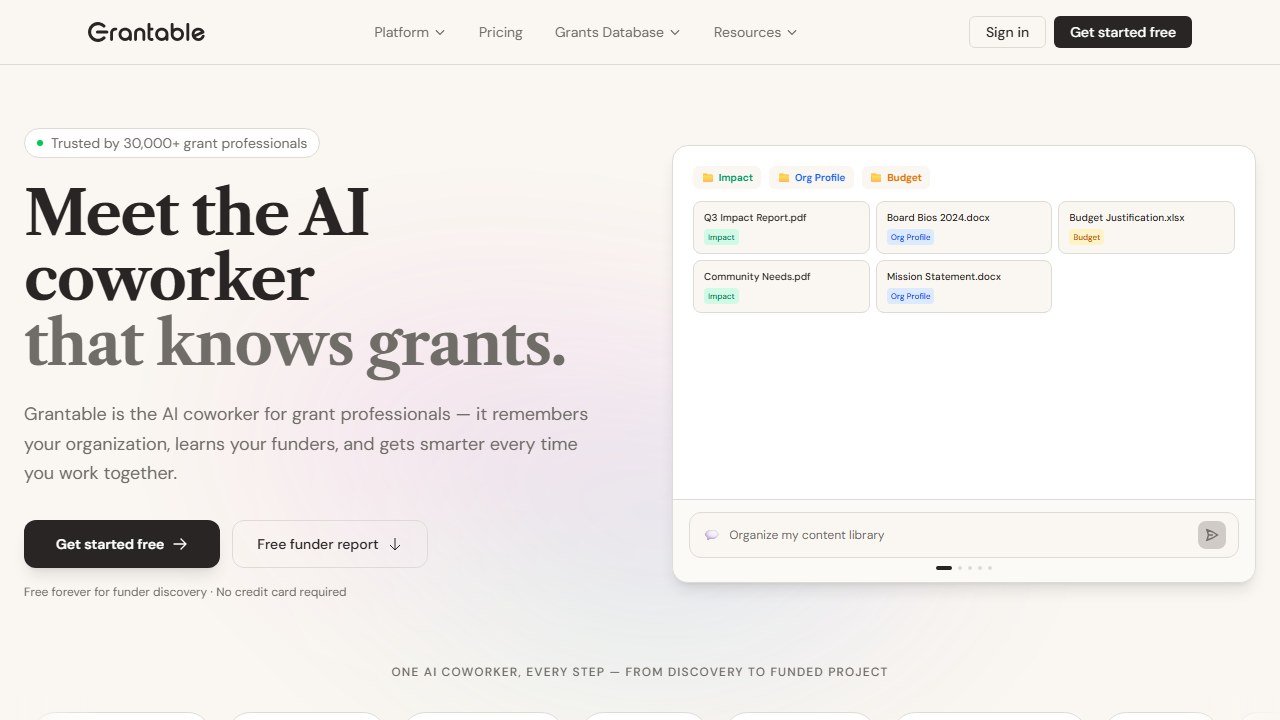
Grantable positions itself as an AI-native grant writing and management platform built around the idea of an AI coworker that remembers your organization. The organizational memory model is the core of the product: once you feed in your mission, programs, past proposals, and impact data, the platform uses that context to generate proposal drafts that actually sound like your organization rather than a generic nonprofit boilerplate. The funder discovery layer, which pulls from 990 data, is reasonably reliable for a platform at this price point.
Based on publicly available information, Grantable’s Pro plan at $150/month includes the full intelligence layer, while the Starter plan at $50/month (or $25/month with the nonprofit discount for organizations under $500K) covers core AI writing assistance. That pricing makes Grantable one of the most accessible dedicated AI grant platforms available, especially for lean development teams or individual grant writers working across multiple clients. The Agency Hub add-on ($300/month) extends the platform to multi-client use with consolidated billing and cross-client reporting.
The trade-off relative to Instrumentl is scope. Grantable does not offer the same depth of post-award compliance tracking, and the funder database, while functional, is smaller than platforms that index federal and state RFP feeds directly. Teams that handle mostly foundation grants and need strong writing assistance will find Grantable well-matched to their workflow. Teams managing a mixed portfolio of federal, state, and foundation funding at scale may find they need to pair Grantable with a dedicated discovery tool.
- Pros:
- Genuine nonprofit pricing tiers starting at $25/month for eligible organizations
- Strong organizational memory that persists across sessions
- Free tier available for funder discovery and basic AI assistance
- Agency Hub option makes it viable for grant writers managing multiple clients
- Cons:
- Funder database smaller than Instrumentl or Candid’s Foundation Directory
- Post-award and compliance tracking is limited compared to all-in-one platforms
- Full feature set requires the Pro plan at $150/month
3. Fundsprout: Best for automated eligibility screening and RFP analysis
| Feature | Details |
|---|---|
| Starting price | $99/month (Starter) |
| Best for | Teams that spend too much time reading RFPs to assess fit |
| Free plan | Not publicly listed |
| Nonprofit discount | Not publicly listed; contact for details |
Fundsprout’s clearest differentiator in this category is its automated eligibility screening. Based on publicly available information, the platform scans 275,000 or more grant sources across federal, state, local, and foundation databases on a daily basis and applies eligibility criteria against your organizational profile before surfacing opportunities. Each match comes with a stated “match score” and competitive analysis, so your team is not spending time reading through RFPs to rule out geographic restrictions or budget minimums that would disqualify you at the outset.
The RFP analyzer is worth calling out specifically. When you upload or link to an RFP, Fundsprout extracts the requirements structure and generates a customizable proposal outline. From there, the AI can generate narrative sections aligned to funder priorities. For development directors who are managing high application volume, the ability to go from RFP to structured outline in minutes rather than hours is a meaningful time saving. The Growth plan at $295/month adds unlimited drafting and compliance tracking on top of the core discovery features.
The Starter plan at $99/month is positioned for newer or smaller nonprofits formalizing their grant function for the first time. It provides database access and light drafting support, which is a reasonable entry point. The jump to Growth at $295/month is significant, however, and teams will need to evaluate whether the volume of applications they submit justifies the cost. Fundsprout also offers a Done-For-You tier at custom pricing for organizations that want Fundsprout’s team to manage the grant process end-to-end, an uncommon but useful option for very lean teams.
- Pros:
- Daily scanning of 275,000+ grant sources with automated eligibility filtering
- Match scores and competitive analysis for each opportunity
- RFP analyzer converts requirements into structured proposal outlines quickly
- Done-For-You tier available for organizations without dedicated grant staff
- Cons:
- Significant price jump between Starter ($99/month) and Growth ($295/month)
- Nonprofit discount not clearly published on pricing page
- Less established brand recognition than Instrumentl among nonprofit practitioners
4. Granter AI: Best for fast proposal drafting on a tight budget
| Feature | Details |
|---|---|
| Starting price | $49/month (Basic, 5 proposals/month) |
| Best for | Executive directors and small teams drafting proposals without dedicated grant staff |
| Free plan | Yes (free trial with limited proposals and watermarked exports) |
| Nonprofit discount | Not publicly listed |
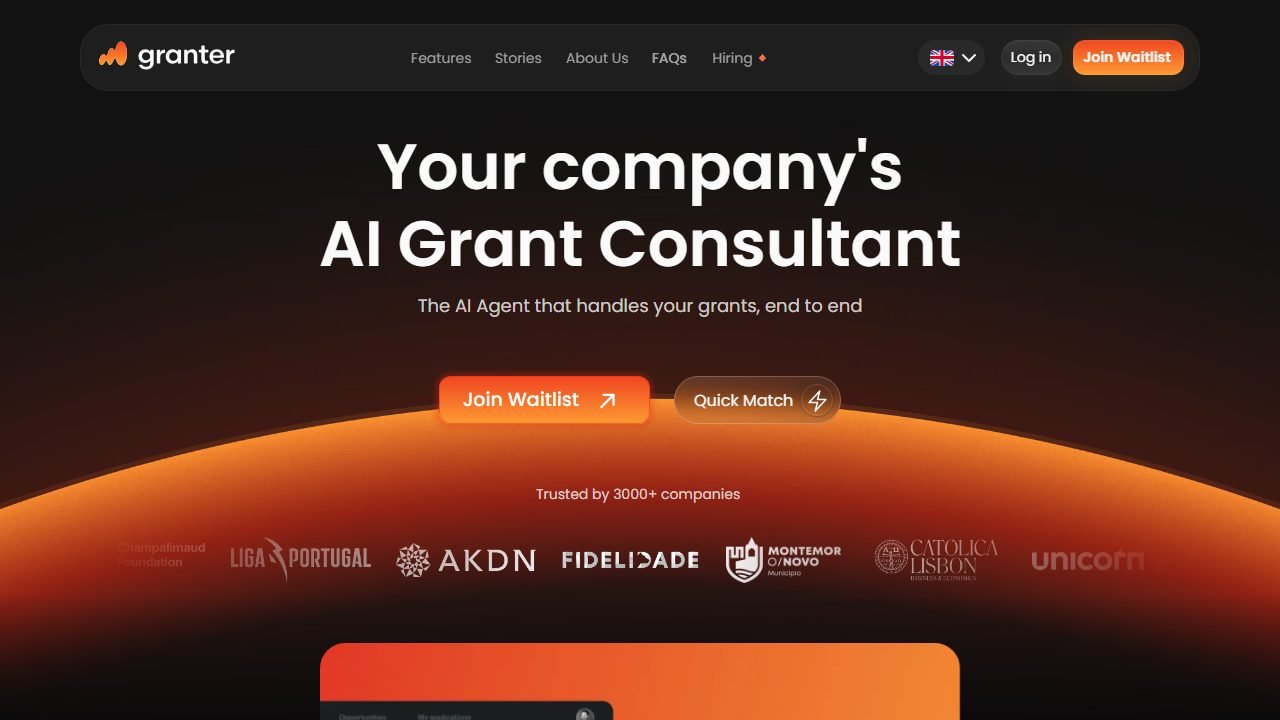
Granter AI occupies a clear niche: it is a focused proposal drafting tool for resource-constrained nonprofits that do not have a dedicated grant writer on staff. Based on publicly available information, the platform uses natural language processing to interpret RFP requirements and generate proposal drafts that are aligned to funder-specific language. Users provide project details, upload past applications if available, or respond to AI-guided prompts, and the system generates a structured draft with sections mapped to the solicitation requirements.
The Basic plan at $49/month covers five proposals per month, which is realistic for smaller nonprofits applying to a handful of foundations per grant cycle. The Professional plan at $129/month increases that to 20 proposals per month and adds team collaboration and advanced proposal optimization features. Enterprise pricing is available for organizations with unlimited proposal volume. The free trial allows users to test the core drafting workflow before committing, though exports are watermarked at that tier.
The honest caveat with Granter AI, based on available information, is that it sits closer to the “AI writing assistant” end of the spectrum than the “AI grant operating system” end. It does not include a funder discovery database, pipeline tracking, or compliance management. For an executive director who needs to get a proposal draft out the door for a funder they have already identified, it does that job well. For a development team managing a full portfolio, it would need to be paired with a discovery and tracking tool.
- Pros:
- Affordable entry point at $49/month for up to five proposals
- AI guided by funder-specific language and RFP requirements
- Free trial available with core drafting functionality
- Good fit for executive directors without dedicated grant staff
- Cons:
- No built-in funder discovery, pipeline tracking, or compliance management
- Five-proposal limit on the Basic plan restricts high-volume teams
- Less organizational memory depth than Grantable or Instrumentl
5. Candid Foundation Directory (FDO): Best funder research database
| Feature | Details |
|---|---|
| Starting price | Varies by organization size; small nonprofits under $1M revenue may qualify for subsidized access |
| Best for | Teams that need the deepest, most reliable funder research database available |
| Free plan | Limited free access; Gold Seal nonprofits (under $1M) qualify for Candid Premium |
| Nonprofit discount | Yes, sliding scale by organization size and budget |
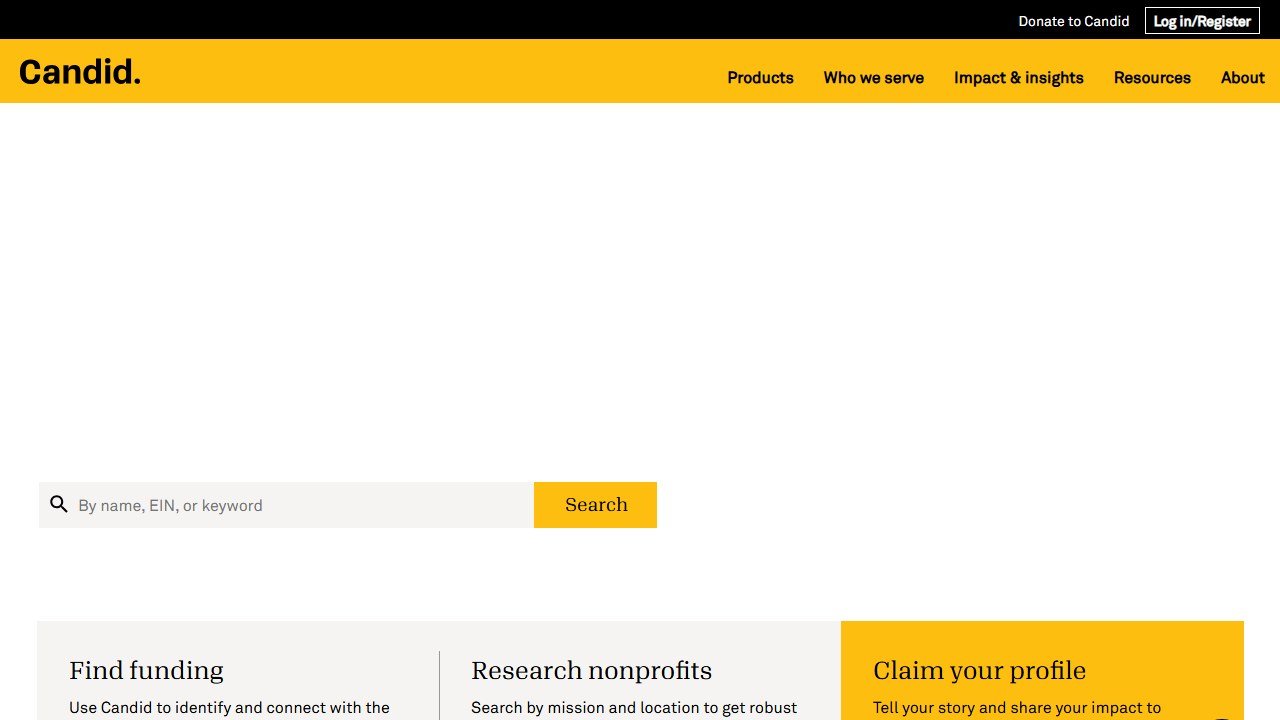
Candid’s Foundation Directory Online (FDO) is the oldest and most comprehensive funder research database in the nonprofit sector, and it has evolved substantially in recent years to incorporate AI-assisted search and data synthesis. Based on publicly available information, the platform indexes 325,000 or more grantmakers, 1.9 million organizations, 3 million annual grant transactions, and $180 billion in annual grant dollars. That depth of 990 data, giving history, and funder contact information is unmatched among the tools in this roundup.
Candid launched a unified search experience that consolidates its nonprofit, funder, and grant data into a single interface. For teams doing serious prospect research, including analyzing a foundation’s giving history, mapping relationships between funders, or identifying trustees with connections to your board, FDO remains the most reliable source of truth in the sector. The platform also provides access to verified contact information for program officers, which can be difficult to find reliably through other channels.
The pricing model is worth understanding carefully. Candid uses a sliding scale tied to organization size, with lower rates for smaller nonprofits, made possible by higher pricing for corporate and foundation clients. Nonprofits with under $1 million in revenue or operating expenses that have earned a Gold Seal of Transparency through GuideStar can access Candid Premium at no cost, a significant benefit. Larger organizations should expect to pay more and should contact Candid directly for a quote. FDO is not an AI grant writing tool, but it is an essential data layer that many of the AI writing platforms pull from, and there is a case for using it directly alongside a writing-focused platform.
- Pros:
- 325,000+ grantmakers and 3 million grant transactions, the deepest database in the sector
- Verified program officer contact information
- Free or subsidized access for small nonprofits with Gold Seal status
- 990 data going back many years for thorough giving history analysis
- Cons:
- Not an AI grant writing tool; needs to be paired with a drafting platform
- Pricing is not transparent and can be expensive for mid-size organizations
- Interface, while improved, requires more manual effort than AI-native discovery platforms
6. Submittable Discover: Best free discovery-to-application workflow
| Feature | Details |
|---|---|
| Starting price | Free to search and apply |
| Best for | Nonprofits applying to foundations and corporations that use Submittable for submissions |
| Free plan | Yes, free for applicants |
| Nonprofit discount | N/A (applicant-side is free) |
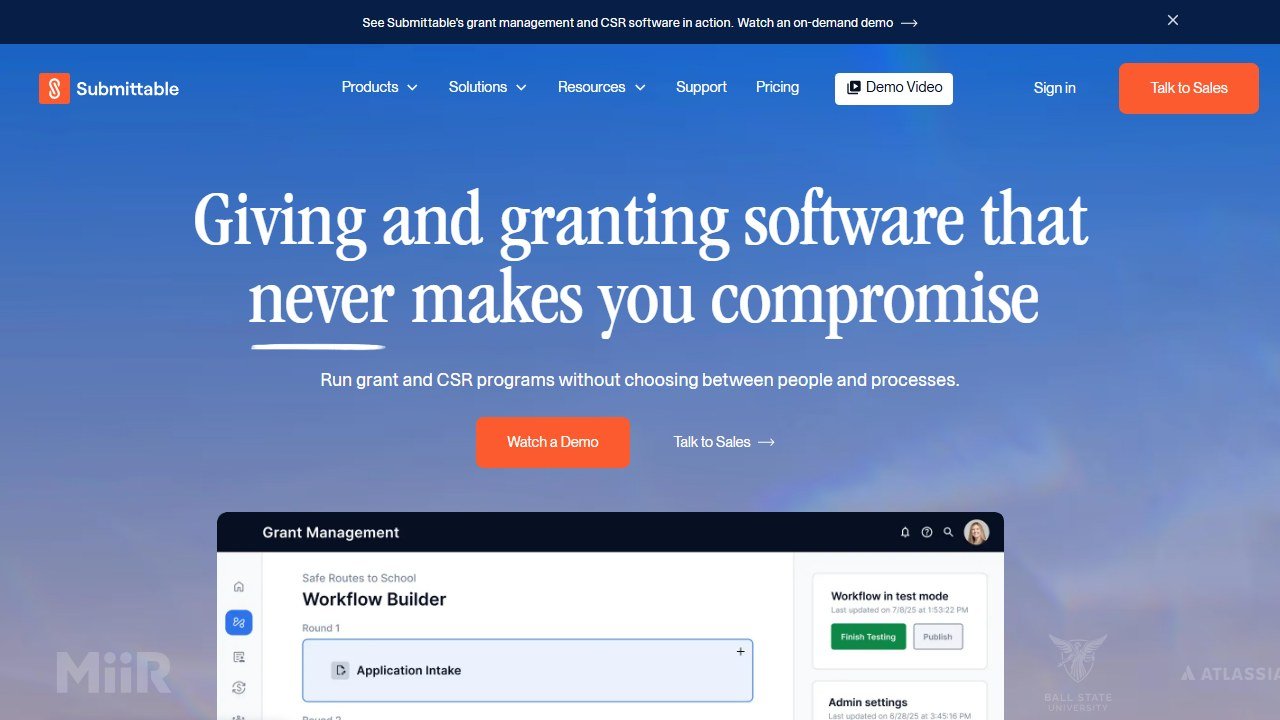
Submittable Discover occupies a unique position in this roundup. It is not a traditional grant database and it is not an AI writing assistant. It is a public-facing marketplace of funding opportunities from organizations that use Submittable’s submission management software, and it is free to use on the applicant side. Based on publicly available information, users can search for grants, fellowships, and awards from many foundations and corporations, filter by tags and deadlines, and follow specific organizations to receive notifications when new calls open.
The practical advantage is the integrated application workflow. When you find an opportunity through Submittable Discover, you apply through the same interface, which means no bouncing between websites or learning new form systems for each funder. For nonprofits that frequently apply to arts foundations, corporate social responsibility programs, and progressive funders, a meaningful share of open opportunities are managed through Submittable, making Discover a genuinely useful free layer to add to any grant research workflow.
The limitation is by design: Submittable Discover only surfaces opportunities from funders using Submittable’s platform. Large federal grantmakers, many community foundations, and funders using other submission systems (Fluxx, SurveyMonkey Apply, and similar) are not represented. It should be understood as a complement to a full discovery platform rather than a replacement. For teams on a tight budget, though, pairing Submittable Discover with Grantable’s free tier gives you a no-cost starting point for both discovery and drafting.
- Pros:
- Completely free for applicants to search and apply
- Integrated discovery-to-application workflow in a single interface
- Clean, modern interface with deadline filtering and organization-follow features
- Useful complement for arts, corporate, and progressive foundation grants
- Cons:
- Only includes funders using Submittable’s submission management system
- No AI writing assistance built in on the applicant side
- Coverage gaps for federal, state, and many community foundation opportunities
7. Grantboost: Best for straightforward AI-assisted writing with a large user community
| Feature | Details |
|---|---|
| Starting price | Free tier available; Pro at $19.99/month; Teams at $29.99/month |
| Best for | Grant writers who want accessible AI drafting without a steep learning curve |
| Free plan | Yes |
| Nonprofit discount | Not publicly listed |
Grantboost is one of the most widely adopted AI grant writing tools on the market, with a reported community of over 5,000 grant writing teams and more than 3.5 million words processed monthly. Based on publicly available information, the platform’s approach is deliberately simple: users complete a brief intake survey covering their organization’s mission and funding goals, input the grant opportunity they are targeting, and receive an AI-generated draft aligned to that opportunity. A Personalized Memory feature builds on this over time by learning your organization’s writing style.
The pricing structure is among the most accessible in this roundup. The free tier provides basic access and is a genuine on-ramp, not just a time-limited trial. The Pro plan at $19.99/month unlocks unlimited templates and advanced brand controls. The Teams plan at $29.99/month adds collaboration features for development teams working together on proposals. For organizations exploring AI grant writing for the first time and reluctant to commit to a $100-plus monthly subscription, Grantboost provides a low-risk way to test the workflow.
The trade-off for that simplicity and affordability is scope. Grantboost is a proposal drafting tool, full stop. It does not include funder discovery, database access, pipeline tracking, or post-award compliance management. The template-based approach works well for common grant types and well-known solicitation formats, but may produce less useful output for highly specific or unusual RFPs. Teams that have already identified their target funders and need to move quickly from blank page to polished draft will find Grantboost well-suited to that specific task.
- Pros:
- Very accessible pricing with a genuine free tier
- Large active community of 5,000+ grant writing teams
- Simple, low-friction workflow that non-technical users can adopt quickly
- Personalized memory that improves drafts over time
- Cons:
- No funder discovery, pipeline tracking, or compliance management
- Template approach may underperform on highly specific or unusual RFPs
- Needs to be paired with a discovery platform for a complete grant workflow
Master comparison table
| Tool | Starting Price | Discovery | AI Writing | Pipeline Tracking | Free Plan | Best For |
|---|---|---|---|---|---|---|
| Instrumentl | $179/mo | Yes (450K+ funders) | Yes | Yes (full lifecycle) | No (trial only) | All-in-one teams |
| Grantable | $25/mo (nonprofit) | Yes (990 data) | Yes | Limited | Yes | Small nonprofits, writing focus |
| Fundsprout | $99/mo | Yes (275K+ sources) | Yes | Yes (Growth plan) | Not listed | Eligibility screening and RFP analysis |
| Granter AI | $49/mo | No | Yes | No | Yes (trial) | Fast drafting on a tight budget |
| Candid Foundation Directory | Sliding scale by org size | Yes (325K+ grantmakers) | No | No | Yes (Gold Seal nonprofits) | Deep funder research |
| Submittable Discover | Free | Yes (Submittable funders) | No | No | Yes | Free discovery and direct application |
| Grantboost | Free; $19.99/mo Pro | No | Yes | No | Yes | First-time AI grant writers |
How to choose the right AI grant tool for your team
The decision comes down to your team’s size, budget, and primary bottleneck. Here is a framework based on the most common situations development teams face.
If you are a solo development director or small team with a mixed foundation and government portfolio, Instrumentl is worth the investment. The $179/month entry price is real money for a lean nonprofit, but the combination of funder discovery, AI-assisted writing, and pipeline management in a single platform eliminates the coordination overhead of running three separate tools. Teams at this stage typically see the strongest ROI because they are replacing the most time.
If your primary need is writing assistance and your budget is tight, start with Grantable’s free tier or Grantboost’s free tier and upgrade only when you are hitting the limits of what the free plan provides. Both tools offer genuine value at no cost and let you test AI-assisted drafting before committing monthly budget. Grantable’s nonprofit discount ($25/month for organizations under $500K) makes it the stronger long-term choice for eligible organizations because of its organizational memory capabilities.
If your team is drowning in RFP evaluation and eligibility assessment, Fundsprout’s automated screening is worth evaluating seriously. The ability to get a match score and structured outline from an RFP in minutes rather than hours can meaningfully increase the number of competitive applications your team submits per cycle without burning out your staff.
If you need deep funder intelligence for major campaigns or capital projects, Candid’s Foundation Directory should be part of your toolkit regardless of which AI writing platform you use. Its 990 data depth and relationship mapping capabilities are not replicated anywhere else in the market. Check whether your organization qualifies for Gold Seal subsidized access before paying full price.
For teams new to AI grant tools entirely, the lowest-risk approach is to pair Submittable Discover (free) with Grantboost’s free tier. That combination gives you a functional discovery-to-drafting workflow at zero cost, and it helps your team develop informed opinions about what features matter most before you evaluate paid platforms. Most teams find after 60 to 90 days of using free tools that they can identify exactly what they wish the tool did better, which makes the paid platform evaluation much more focused and efficient.
One final note: no AI grant tool, regardless of price, replaces the relationship-building work that drives grant success over time. Based on publicly available research across the sector, funders consistently cite relationship history, organizational credibility, and program alignment as their top decision factors. AI tools help your team do more of the research and writing work faster. The strategy, relationship cultivation, and program design decisions still require human judgment. The best-performing development teams in 2026 are using AI to clear time for that higher-value work, not to replace it.
If your development team also manages a major-gifts program, our guide to AI donor research tools covers the best platforms for prospect screening and wealth scoring.
If your team also runs an annual fund or peer-to-peer campaigns, see our guide to the best AI fundraising platforms for nonprofits.
Tools mentioned in this guide
- Grantable: AI grant writing assistant
- Instrumentl: foundation prospect research
- Foundation Search: foundation grants database
- Candid: the deepest free nonprofit data source
- Claude and ChatGPT: general LLMs for narrative drafting
Tools paired with grant workflows in 2026
Grant teams typically pair their AI grant writing assistants with donor management and prospect research platforms. Bloomerang handles donor stewardship; DonorSearch handles wealth screening; Donorbox covers the small-org processor slot. Our AI grant writing workflow walks through the writing side end-to-end. For the comparison most teams run before picking a payment platform, see Fundraise Up vs Donorbox. The small-nonprofit AI stack guide ties the full picture together.

Written by
FazFaz is the founder of AIToolsBakery. Some tools here are tested hands on. Others are assessed from vendor documentation and pricing verified on the live page, and every review says which one it is. Sponsors can buy a position in a guide. They cannot buy the score, the criticism, or silence about a better option.
How we test and how we make money →