Major gifts drive 88% of total donations in the United States. That figure comes from the fundraising rule of thumb that has held for decades: most of your money comes from a small percentage of your donors. The 80/20 rule in practice.
For the full breakdown of our top donor-intelligence pick, see our in-depth Gratefully review.
Updated June 2026.
The question is not whether to prioritize major donors. Every development professional knows they should. The question is how to find them, understand them, and approach them at the right time with the right ask.
AI donor research tools exist to answer that question at scale. Wealth screening, philanthropic history analysis, predictive scoring, and engagement tracking have become significantly more sophisticated in the past three years. The tools in this guide represent the current state of what is available, who they are for, and whether they are worth the cost. For employer matching specifically, see our guide to matching gift software.
Which donor research tool should you pick?
One-line verdict per tool, by the job you are hiring it for:
- Gratefully: the donor-intelligence leader. Best when you want your existing donor data, notes, and external signals turned into a prioritized, cited daily action list on top of your current CRM.
- DonorSearch AI: the industry standard. Best for mid-to-large nonprofits that need deep US wealth screening at scale and have a research team.
- Virtuous Insights: best if you already run Virtuous CRM and want prediction built in.
- Gravyty / Raise: best for frontline gift officers managing large portfolios who want daily AI action plans.
- iWave: best DonorSearch alternative, multi-source screening with a cleaner interface.
- Bloomerang AI: best budget entry point, a CRM with built-in prospect intelligence powered by DonorSearch data.
Most teams under $5M in annual fundraising start with one tool; larger shops pair Gratefully (relationship intelligence and stewardship) with DonorSearch (wealth screening at scale).
Quick comparison at a glance. Full breakdown for each option below.
Comparison Table
| Tool | Best For | Pricing | Key Feature | Org Size |
|---|---|---|---|---|
| Gratefully | Donor intelligence and stewardship | Free plan, then $99/mo (14-day trial) | Knowledge graph + nightly action list, every signal cited | Mid-to-large |
| DonorSearch AI | Dedicated prospect research | Custom (estimate $3K-$15K+/yr) | Largest philanthropic database, 15K+ nonprofits | Mid-to-large |
| Virtuous Insights | Existing Virtuous CRM users | Included in Virtuous (no published price, quote only) | Built-in AI enrichment + behavioral signals | Mid-sized |
| Gravyty/Raise | Frontline fundraiser daily action plans | Custom (enterprise) | Daily AI action plans for gift officers | Mid-to-large |
| iWave | DonorSearch alternative, clean UI | Custom | 30+ data sources, batch screening | Mid-to-large |
| Bloomerang AI | CRM + basic prospect intel, budget-conscious | $125/mo+ (CRM with screening included) | DonorSearch data integration, retention focus | Small-to-mid |
Last reviewed June 2026. Donor research AI is consolidating in 2026 around a few dominant platforms. Pricing remains opaque across most vendors. We track changes monthly. For specific tool deep-dives see our Instrumentl review, Grantable review, and Grantable vs Instrumentl comparison.
Saru on the 80/20 reality in nonprofit fundraising: Research on donation distribution consistently shows that the top 20% of donors contribute 80% or more of total donations. For major gift programs specifically (gifts of $10,000+), the Pareto principle is even more pronounced: typically 10% of donors make up 90% of major gift revenue.
What this means practically: identifying and cultivating the right 50-100 prospects in your database can change your fundraising trajectory more than acquiring 1,000 new small-gift donors. AI donor research tools are built on this premise: finding the high-capacity, high-affinity prospects who are most likely to make transformational gifts if properly cultivated.
The data on prospecting ROI is compelling. Studies suggest that prospect research returns $10-$20 in additional donations for every $1 spent on research. The caveat: this assumes high-quality research and appropriate follow-through by gift officers. Research without cultivation is just expensive data collection.
Last updated: April 22, 2026.
Related: See also: Best AI tools for nonprofits 2026 | Best AI fundraising tools
DonorSearch alternatives
“DonorSearch alternatives” is really two questions wearing one phrase, and the answer changes completely depending on which one you are asking. Work out which job you are replacing before you shortlist anything.
| If you want to replace | The job | Look at |
|---|---|---|
| The screening | Find capacity in names you do not currently hold | iWave (Kindsight), WealthEngine, Windfall |
| The intelligence | Decide who to act on among donors you already have | Gratefully, Dataro |
Screening alternatives: same job, different vendor
These replace DonorSearch directly. They run a list of names against wealth, property, SEC, political giving and foundation records and hand back capacity scores.
- iWave (now Kindsight) is the closest like-for-like swap and the one most teams shortlist against DonorSearch. It pulls from 30+ data sources and is consistently described as the cleaner interface of the two. It is also the more expensive of the two in most quotes. We put the two head to head in iWave vs DonorSearch, and current tiers are in our iWave pricing guide.
- WealthEngine is the option to look at when you want more predictive modelling than capacity scoring, rather than more data coverage. It publishes no pricing.
- Windfall takes a narrower approach, focused on net worth estimation for consumer households rather than full prospect research. Worth a look if your file is large and consumer-shaped rather than institutional. It publishes no pricing.
One thing to price before you switch on cost grounds: DonorSearch has a published rate sheet and most of its competitors do not. DonorPerfect publishes per-record screening at $0.25 down to $0.10 and ProspectView plans from $228 a year, which we break down in our DonorSearch pricing guide. Any alternative quoted at four figures should be judged against that number, not against the $4,000 to $12,000 range aggregators report for direct DonorSearch deals.
Intelligence alternatives: different job, different list
These are not screening tools and will not replace one. They work the file you already own, which for a lot of teams is where the unworked revenue actually is.
- Gratefully turns your existing donor records into a ranked daily action list with a cited reason behind each name. It is the tool we rank first in this category, and it is one of the few in either category that publishes a price: free for one person, then $99 a month for a single fundraiser, or $499 a month for a five-person team, with about 20 percent off annual billing and a 14-day trial of the top plan. Detail in our Gratefully review.
- Dataro takes the predictive route on the same list, scoring your existing donors for likelihood to give, upgrade or lapse. Stronger fit if you run high-volume direct response rather than a major gifts portfolio. See our Dataro review.
If you are still deciding which job you are buying, our best AI donor intelligence tools guide covers the second category in full.
What AI Donor Research Actually Does
Before reviewing specific tools, it helps to understand the four core functions of AI donor research platforms: If you want the method rather than the tools, our step-by-step guide on how to do donor prospect research starts with your own file and the free public sources before paid screening.
1. Wealth screening. Cross-referencing a prospect’s name and location against public records to estimate giving capacity. Sources typically include real estate holdings, SEC filings (for stock ownership), business ownership records, political donations, and luxury asset registrations. Wealth screening tells you who can give. It does not tell you who will give.
2. Philanthropic history analysis. Checking a prospect’s documented charitable giving through publicly available sources (foundation 990s, political donation records, charity navigator data). A prospect who gives $100,000 annually to other organizations is a different prospect than someone of equal net worth who has no giving history. Philanthropic history is often more predictive of major gift potential than wealth alone.
3. Predictive scoring. Machine learning models that analyze patterns across thousands of known outcomes (who gave, who did not, who gave more than expected) and apply those patterns to score current prospects. Good predictive models identify capacity AND propensity together: not just who can give, but who is likely to give to your organization specifically.
4. Engagement tracking. Monitoring how prospects and donors interact with your organization across channels: email opens, event attendance, website visits, volunteer activity, and social media engagement. High wealth + high affinity signals (frequent engagement) plus a trigger event (anniversary of first gift, major life change) is the combination that produces major gift conversations.
The best AI donor research tools combine all four functions. Most tools specialize in one or two.
1. Gratefully
Disclosure: Zilwaris, the consultancy run by AI Tools Bakery’s founder, does paid advisory work for Gratefully. Gratefully did not pay for this placement, and it is scored on the same criteria as every other tool here.
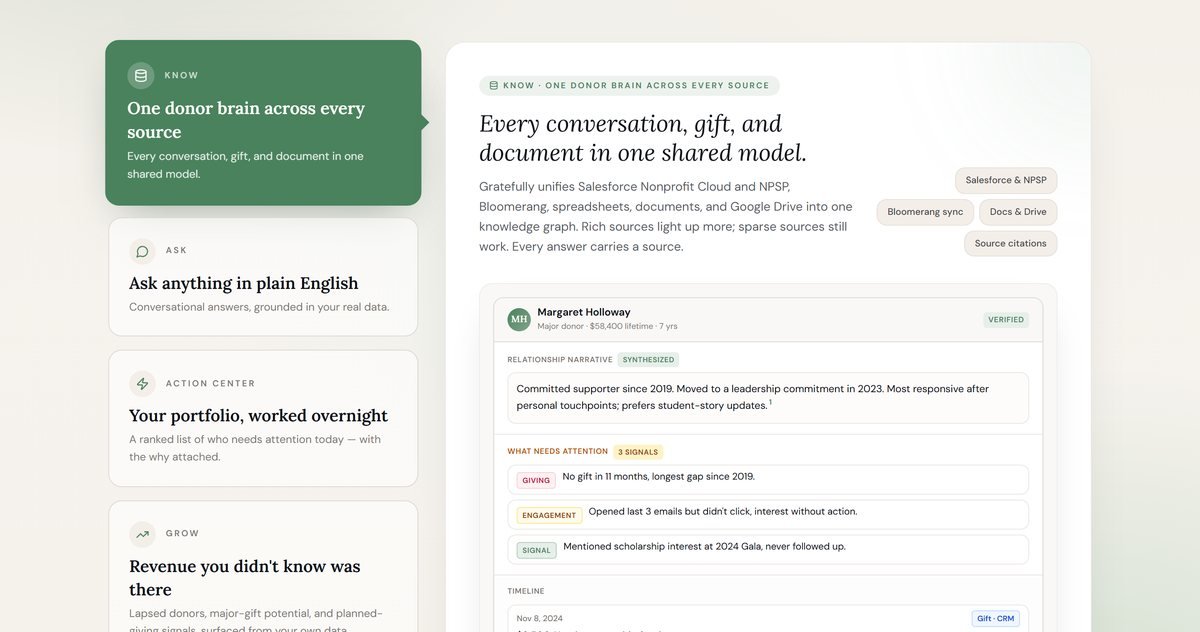
Best for: Development teams that want the donor knowledge, notes, and external signals they already have turned into a prioritized daily action list, on top of the CRM they already run.
Pricing: Free plan for one person. Essential $99 a month, Professional $499 a month for five people, Advanced $999 a month for ten, each about 20 percent cheaper billed annually. 14-day trial of Advanced, no card. Checked 10 September 2026.
Gratefully is the donor-intelligence leader in this guide. Where the wealth-screening tools below look outward to estimate capacity from public records, Gratefully looks at the relationship you already have: it unifies your CRM, email, documents, board minutes, and staff notes into a single knowledge graph, then works your whole portfolio overnight and tells your team who needs attention each morning, with the cited reason attached. Its AI assistant, Grace, answers plain-English questions about any donor and grounds every answer in your actual records.
What Makes Gratefully Different
Research from what you already know. Most tools in this category research donors you do not have yet. Gratefully surfaces the hidden revenue already buried in your notes: foundation connections, planned-gift signals, employer matches, and lapsed major donors with strong affinity, pulled from records your team has already written.
External signals, surfaced responsibly. Gratefully also looks beyond your walls, surfacing career changes, board appointments, business and wealth events, and public giving, always with the source attached and never auto-sent. When a donor’s capacity genuinely changes, they rise to the top of your day with the reason why.
Cited, explainable profiles. Click into any donor for an AI-synthesized relationship narrative drawn from your notes and documents, risk and engagement status, and pipeline context, every claim traceable to a source record rather than an opaque number.
Institutional memory that stays. When a staffer leaves, Grace auto-generates a complete handover dossier for every donor in their portfolio, so the research and relationship context survive the transition instead of walking out the door.
Limitations
Not a wealth-screening database. Gratefully is not built to run a cold list of 5,000 strangers through real-estate and SEC records the way DonorSearch or iWave are. It makes the donors and prospects you already have legible; it does not replace a dedicated capacity-screening database for net-new prospecting at scale.
Newer product. It is newer than the established platforms here, with a smaller customer base. Its pricing is now published in full, which was not the case when we first covered it.
Sits on top of a CRM. It is an additional subscription that layers on your existing Salesforce, Bloomerang, or similar setup, not a replacement for it.
Who Should Use Gratefully
Development teams with at least a few hundred active donors who lose context when staff turn over, and who want their existing data and external signals turned into a prioritized, explainable daily plan. Pair it with a wealth-screening database like DonorSearch when net-new major-gift prospecting at scale is the priority.
Website: Visit Gratefully
2. DonorSearch AI
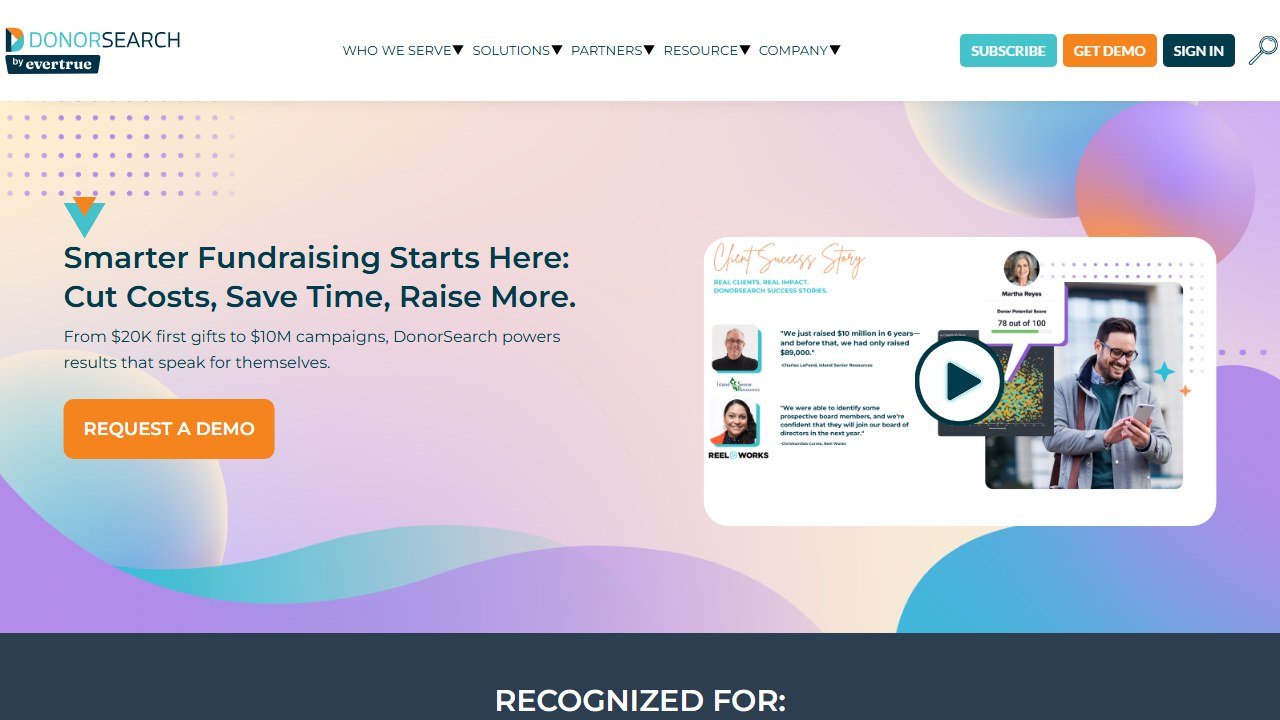
Best for: Mid-to-large nonprofits with dedicated prospect research staff and active major gift programs.
Pricing: Not publicly listed. Subscription model ranging from several hundred to thousands annually. Contact for quote.
DonorSearch was founded in 2007 and has become the industry standard for nonprofit prospect research. Acquired by EverTrue in September 2025, it now sits within a larger platform for higher education and nonprofit advancement teams.
What Makes DonorSearch AI Different
Database depth. DonorSearch’s philanthropic database is widely regarded as the most comprehensive available. It includes over 150 million philanthropic records, cross-referenced with wealth indicators. The combination of giving history AND wealth data is what separates DonorSearch from pure wealth screening tools.
ProspectView Online 2 (PVO2). The updated AI-powered reporting interface generates comprehensive prospect reports in minutes. A prospect report might include real estate holdings, stock ownership, political donations, charitable giving history, foundation affiliations, and board memberships. Synthesized in minutes from multiple data sources.
Predictive models. DonorSearch AI’s machine learning models include:
- First-time gift prediction (who in your database has not yet given but is likely to)
- Repeat donor prediction (81% accuracy on identifying who will give again)
- Upgrade prediction (which current donors are likely to increase their giving)
- Major gift identification (who has the capacity and propensity for a five-figure+ gift)
Reported outcomes. DonorSearch clients report an 85% increase in response rate, which reflects better prospect identification leading to better-targeted outreach rather than response rate manipulation.
Integration ecosystem. DonorSearch integrates with most major nonprofit CRMs: Salesforce, Raiser’s Edge, Bloomerang, Virtuous, DonorPerfect, and others. The prospect data flows into your existing system.
The EverTrue Acquisition Context
EverTrue acquired DonorSearch in September 2025. EverTrue has historically focused on higher education advancement. The combined platform creates a more comprehensive advancement intelligence offering, but the integration is still developing. Organizations that were long-time DonorSearch customers should confirm how support, pricing, and product direction are evolving post-acquisition before renewing.
Limitations
Cost barrier. DonorSearch is priced for organizations with established major gift programs. For nonprofits under $500K in annual fundraising, the subscription cost is difficult to justify even with strong ROI projections. There is no self-serve pricing or entry-level tier for smaller organizations testing the waters.
Learning curve. The depth of data available in PVO2 reports is a strength, but it also means new users face a meaningful ramp-up period. Teams without prior prospect research experience may need 2-3 months of active use before they are extracting full value from the platform. DonorSearch offers training, but budget for onboarding time.
Post-acquisition uncertainty. The EverTrue acquisition in September 2025 introduced questions about long-term product direction. EverTrue’s historical focus on higher education may shift DonorSearch’s roadmap toward advancement-specific features. Nonprofits outside higher ed should ask directly about product investment in the general nonprofit use case during vendor conversations.
Who Should Use DonorSearch AI
Organizations with $500K+ in annual fundraising and dedicated development staff. The tool’s power compounds when you have a prospect researcher who actively uses the data and gift officers who act on the insights. Without that human follow-through, you are paying for data you are not using.
Before you book that DonorSearch demo, read our DonorSearch pricing breakdown. Quote-based pricing is easier to negotiate when you already know the ballpark.
3. Virtuous Insights
Best for: Nonprofits already on the Virtuous CRM platform, or organizations evaluating an AI-integrated CRM.
Pricing: Virtuous publishes no price and quotes on request. Unlimited users are included. Virtuous Insights is integrated.
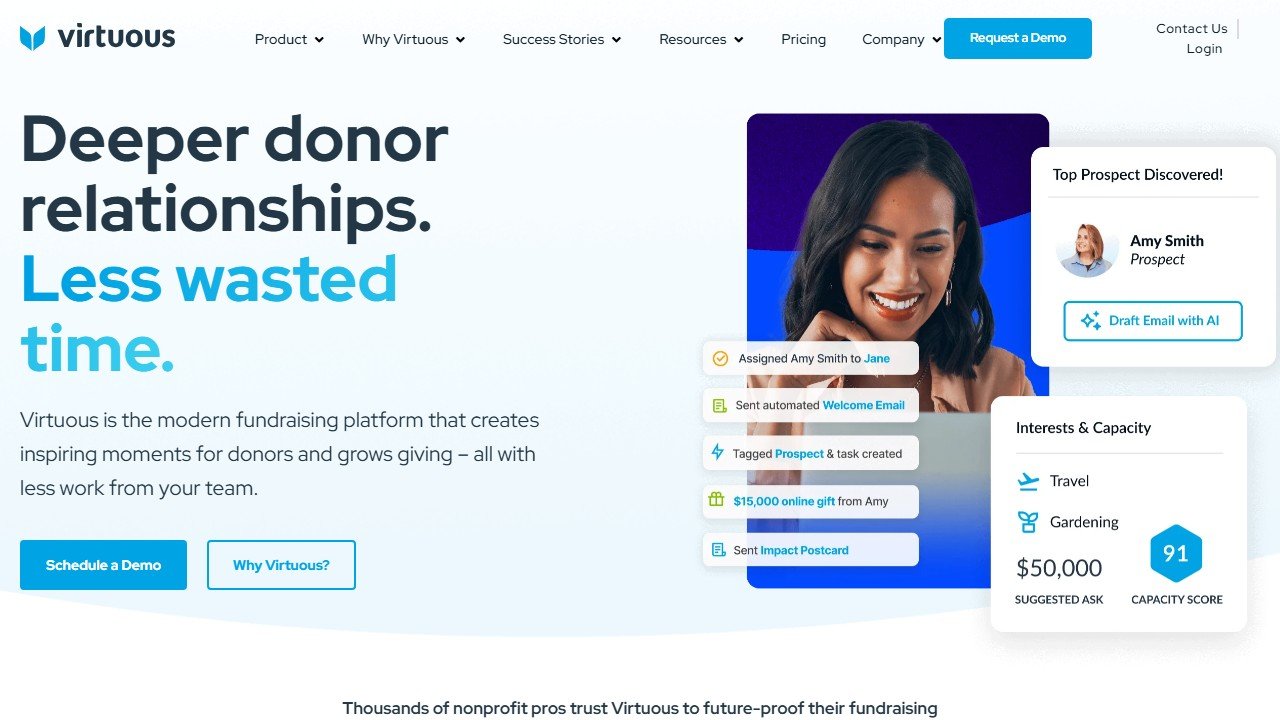
Virtuous is a “responsive fundraising” CRM built for mid-sized nonprofits ($500K-$5M revenue). Virtuous Insights is the AI-powered donor intelligence layer built directly into the platform. For organizations on Virtuous, it is not a separate tool to manage or integrate.
What Virtuous Insights Does
Donor profile enrichment. Virtuous Insights automatically appends external data to your donor profiles: wealth indicators, demographic information, digital engagement signals, and behavioral data. When a donor makes a gift, their profile updates with wealth context and engagement history without manual research.
Behavioral signals. Unlike most prospect research tools that focus on external wealth data, Virtuous Insights tracks how donors interact with your organization across channels: email opens, clicks, event attendance, giving recency, and frequency. High engagement donors get flagged for timely outreach.
Responsive fundraising triggers. The “responsive” positioning is about acting on donor signals in real time. When a donor’s engagement level changes (increased interaction, a lapse in giving, a major life event), Virtuous can trigger automated or assisted outreach. This is practical stewardship AI, not just research AI.
Virtuous Momentum integration. Virtuous acquired Momentum in August 2025, adding AI that drafts emails, prioritizes inbox management, and builds dynamic engagement plans for gift officers. Combined with Insights, it creates a loop: identify the right donor, understand their capacity and engagement, then get AI help drafting the outreach.
What “Responsive Fundraising” Means in Practice
Virtuous uses the term “responsive fundraising” heavily in its marketing, and it is worth unpacking what that looks like day to day. The core idea: instead of treating every donor the same way on a fixed communication calendar, the platform adjusts outreach based on real-time donor behavior. A donor who opened three emails this week and visited your giving page gets surfaced for a personal call from a gift officer. A donor whose engagement has dropped over 90 days gets flagged for a re-engagement sequence. The system reacts to signals rather than following a static plan. For organizations used to batch-and-blast fundraising communications, this is a meaningful operational shift. It requires staff who are willing to act on AI-generated recommendations rather than sticking to predetermined outreach schedules.
Who Should Use Virtuous Insights
Organizations already on Virtuous CRM get this as part of their existing investment. For organizations evaluating a new CRM who also want built-in donor intelligence, Virtuous is one of the most comprehensive options, though it will not tell you what it costs until you ask.
For organizations happy with their existing CRM and not planning to switch, Virtuous Insights is not available as a standalone purchase. In that case, DonorSearch AI or iWave are more relevant options.
See our Virtuous CRM review for a full breakdown of the platform.
4. Gravyty / Raise by Gravyty
Best for: Higher education advancement offices, and nonprofits with dedicated frontline fundraisers who need daily AI-assisted action plans.
Pricing: Not publicly listed. Enterprise sales model. Contact for demo.
Gravyty was founded in 2016 and merged with Graduway in December 2021. The company has also acquired Gratavid (video tools) and Athlete Network, positioning itself as a broader “social good software” company. The core product for fundraising is Raise by Gravyty.
What Raise by Gravyty Does
Daily action plans for gift officers. This is Gravyty’s central differentiator. Every morning, the AI generates a prioritized action list for each frontline fundraiser: who to call today, what to say, when to make an ask, which donors need stewardship. This is not generic advice; it is tailored to each gift officer’s portfolio based on donor data, giving history, and engagement signals.
The practical problem it solves: Major gift officers manage portfolios of 100-200+ prospects. Deciding who to contact on any given day, and with what approach, takes significant time and judgment. Gravyty’s AI essentially acts as a daily briefing that surfaces the highest-priority actions.
Personalized suggested messages. Beyond action plans, Gravyty drafts suggested outreach messages for each donor. The gift officer can review, edit, and send. The friction of going from “I should call this person” to actually making contact is reduced.
Higher ed focus. Most of Gravyty’s case studies and client base comes from higher education advancement (alumni fundraising, annual fund, major gifts). The product has been adapted for nonprofits, and it works, but the feature set and implementation experience is most mature in the higher ed context.
Notable clients: Susan G. Komen, Guiding Eyes for the Blind (nonprofit sector examples).
Limitations
Higher ed bias. Gravyty’s product, case studies, and implementation playbook are built around university advancement offices. The platform works for nonprofits, but the onboarding experience, suggested workflows, and benchmarking data skew heavily toward higher education. Nonprofits outside that sector may find the initial setup less intuitive.
Not publicly priced. Gravyty uses an enterprise sales model with no published pricing tiers. For mid-sized nonprofits trying to compare costs across tools, this creates friction in the evaluation process. Expect a multi-week sales cycle with demos and proposals before getting a number.
Smaller nonprofit fit. The daily action plan model assumes you have dedicated major gift officers managing portfolios of 100+ prospects. Nonprofits with a single development director wearing multiple hats may not have the bandwidth to act on daily AI recommendations, which reduces the tool’s core value.
Who Should Use Gravyty
Development teams where frontline fundraisers manage large portfolios and need help prioritizing daily outreach. The ROI case is strongest when you have gift officers who can act on the daily action plans. If you do not have dedicated major gift staff, the tool’s primary value proposition does not apply.
5. iWave
Best for: Organizations that want a DonorSearch alternative with strong data coverage and a cleaner interface.
Pricing: Not publicly listed. Contact for quote.
iWave is a wealth screening and prospect research platform used by 3,500+ nonprofits and higher education institutions. It pulls from over 30 data sources including philanthropic history, wealth indicators, and business ownership, similar to DonorSearch.
What Differentiates iWave from DonorSearch AI
User interface. iWave is frequently cited as having a more intuitive interface than DonorSearch. For teams without dedicated prospect researchers, a cleaner UI reduces the learning curve.
Data sources in detail. iWave aggregates from real estate records, SEC filings, Federal Election Commission political donation data, foundation 990 tax filings, business ownership databases, stock holdings, and known philanthropic gifts. The platform also pulls from news sources and public biographical data. Where DonorSearch’s competitive advantage is the depth of its proprietary philanthropic database, iWave’s advantage is the breadth and accessibility of its multi-source aggregation.
Batch screening. iWave handles large-scale batch screening efficiently. Upload your full database and run wealth screening across thousands of records at once. This is standard in the category, but iWave’s implementation is clean.
iWave Score vs. raw data. The platform provides a composite “iWave Score” for each prospect combining capacity, propensity, and affinity into a single number. This is useful for quick prioritization: a development director can sort 5,000 prospects by score and focus on the top 200 without reading individual profiles. The tradeoff is that composite scores compress nuance. A prospect with extremely high capacity but low affinity might score the same as one with moderate capacity and high affinity, but those two prospects require very different cultivation strategies. Experienced prospect researchers use the iWave Score for initial triage, then dig into the underlying data for actual solicitation planning.
Integration with fundraising platforms. iWave integrates with major CRMs and fundraising platforms, similar to DonorSearch.
We put that exact question through a full head-to-head in our iWave vs DonorSearch comparison, covering data depth, scoring, and cost side by side.
Why Consider iWave Over DonorSearch
Some prospect researchers prefer iWave’s interface and find the search workflow faster. Others prefer DonorSearch’s philanthropic database depth. The honest answer is that both tools are solid and the right choice often comes down to which integrates better with your existing CRM and which your prospect research staff finds more usable. Request demos of both before committing.
iWave now operates under the Kindsight brand, and its pricing moved with it. Our iWave pricing guide covers what the current tiers cost and where the quote-only line sits.
6. Bloomerang AI
Best for: Small-to-mid nonprofits that want CRM + built-in prospect intelligence in an affordable package.
Pricing: Bloomerang plans start at $125/month. Prospect intelligence features included in core platform.
Bloomerang is a CRM platform built specifically for nonprofits, with a strong focus on donor retention. The platform has added AI features including built-in prospect intelligence.
What Bloomerang AI Does for Donor Research
Wealth screening integration. Bloomerang includes built-in wealth screening powered by DonorSearch data, making it a more affordable entry point to DonorSearch-quality data without a separate subscription.
Donor retention score. This is Bloomerang’s signature metric and the feature that most clearly differentiates it from pure prospect research tools. The retention score tracks each donor’s engagement level across multiple signals: giving recency, frequency, monetary value (RFM analysis), email engagement, event attendance, and communication responsiveness. Donors are categorized into retention risk tiers, and the system flags at-risk donors before they lapse. For context, the average nonprofit donor retention rate hovers around 45%. Bloomerang’s entire product philosophy is built around improving that number, and the retention score is the mechanism.
How it differs from prospect research. Tools like DonorSearch and iWave focus outward: finding new major gift prospects and understanding their capacity. Bloomerang’s AI focuses inward: maximizing the value of donors you already have. This is not a weakness. For small-to-mid nonprofits, retaining and upgrading existing donors often produces more revenue than prospecting for new major gifts. The two approaches are complementary, not competing.
Retention-focused intelligence. More than acquisition-focused prospect research, Bloomerang’s AI is oriented toward retaining and upgrading existing donors. This reflects the platform’s core retention positioning.
Who Should Use Bloomerang
Small-to-mid nonprofits (under $500K in annual fundraising) that want CRM + basic prospect intelligence without paying separately for a dedicated research tool. The DonorSearch integration within Bloomerang provides meaningful capability at a lower cost than standalone DonorSearch subscriptions.
How we reviewed these donor research tools
We evaluated all five tools against a standard nonprofit workflow: identifying major gift prospects from an existing donor list, building a planned giving pipeline, and preparing for a capital campaign. We compared pricing tiers for small shops (under $1M budget) and mid-size organizations, scored each tool on data freshness, wealth-signal accuracy, philanthropic history depth, and CRM integrations. We did not run a full prospect-research engagement at a real nonprofit, so any “lift in major-gift yield” figures you see here come from vendor case studies, not our own measurement.
Faz on who actually needs dedicated donor research tools: I want to be direct about this because the vendor marketing for these tools can make every nonprofit feel like they need enterprise-grade wealth screening to function.
Small nonprofits under $200K in annual fundraising: you almost certainly do not need a dedicated donor research platform. Your donor pool is small enough that personal knowledge, LinkedIn research, and careful attention to your own giving data will outperform most AI tools. Save the money for fundraising staff.
Mid-sized nonprofits ($200K-$1M annual): you might benefit from one of the more affordable options (Bloomerang AI, Virtuous Insights if you are already on that CRM). The benefit depends heavily on whether you have major gift prospects you are not currently identifying and cultivating.
Larger nonprofits ($1M+ annual, active major gift program): yes, this is where dedicated tools like DonorSearch AI or iWave pay for themselves. You have enough prospect volume that systematic screening and prioritization adds real value. The $10-$20 return per dollar of prospect research investment holds at this scale.
The honest filter: if you do not have a gift officer who will actually act on the research, no AI tool will raise more money for you.
How to Evaluate Donor Research Tools
Before requesting demos, establish your evaluation criteria. The vendor demo is a sales presentation. Knowing what to ask and what to watch for will save you months of regret after signing a contract.
What to Ask in a Vendor Demo
Data sources and match rates. Ask specifically: “What data sources do you use for wealth screening?” and “What is your average match rate against a nonprofit database?” Match rate refers to the percentage of your donor records that the tool can find and enrich with external data. Good tools match 60-80% of records. Below 50% means the tool may not have strong coverage for your donor demographics or geography.
Integration depth with your CRM. “Integrates with Salesforce” can mean many things. Ask whether the integration is a real-time sync or a manual export/import. Ask whether prospect data appears inside your CRM donor records or requires logging into a separate platform. A shallow integration (CSV export) adds friction that reduces adoption.
Predictive model methodology. Ask how their predictive scores are generated. Are they trained on your organization’s data or on general nonprofit giving patterns? Models trained on your own historical data are more accurate for your use case. Generic models are better than nothing but less precise.
Support and onboarding. Ask what the onboarding process looks like, how long it takes, and whether training is included in the subscription or billed separately. Tools with steep learning curves and no onboarding support often go underused.
Red Flags to Watch For
Overpromised ROI. If a vendor guarantees specific fundraising increases (“you will raise 3x more”), be skeptical. No tool raises money. Tools provide data. People raise money using that data. Any ROI claim depends entirely on your team’s ability to act on insights.
No integration with your current CRM. If the tool does not integrate with your existing CRM and requires a full platform switch, factor in the total cost of migration, not just the tool subscription. CRM migrations take 3-6 months and are painful.
Locked-in contracts with no pilot option. Reputable vendors offer pilot periods or short-term contracts for new customers. A vendor that requires a 2-3 year commitment before you have tested the tool with your data is a red flag.
Trial and Pilot Best Practices
Request a pilot screening of a sample of your database (500-1,000 records). Compare the tool’s output against prospects you already know well. If the tool identifies your known major donors accurately and surfaces new prospects your team did not know about, that is a strong signal. If it misses known donors or provides data you could find with a Google search, the value is limited.
Set a 90-day evaluation window with clear success metrics: number of new qualified prospects identified, number of upgraded solicitation strategies based on tool data, and staff adoption rate. If the tool is not changing how your team works within 90 days, it will not change how they work in year two.
When You Don’t Need a Dedicated Tool
Not every nonprofit needs specialized donor research software. Here is when you can skip it (at least for now):
Your donor base is under 1,000 people. At this size, personal knowledge and manual research often outperform AI tools. Your executive director or development director probably knows most major donors personally. Invest in relationship-building over research tools.
You do not have major gift prospects. If your average gift is under $500 and you have no prospects in cultivation for five-figure gifts, prospect research tools are not addressing your actual constraint. Your challenge is likely acquisition, retention, or monthly giving conversion.
You lack staff to act on the research. Research without cultivation is expensive data collection. If your team is already stretched thin, adding a prospect research tool will not raise more money. Hire or allocate capacity first.
You are just starting a major gifts program. In year one of a major gifts program, qualitative relationship-building and manual research will tell you more than AI screening. Build the program and the relationships before adding research infrastructure.
When you are ready to add research capability, start with Bloomerang AI (if you need a CRM too) or iWave (if you have an existing CRM and need a screening layer). DonorSearch AI and Gravyty are appropriate when you have dedicated prospect research and frontline fundraising staff to use them fully.
Free Alternatives for Small Nonprofits
If your organization is not ready for a paid donor research platform, these free resources provide meaningful prospect intelligence when used consistently.
ProPublica Nonprofit Explorer. Search any foundation’s 990 tax filings to see who they fund, how much they give, and their stated priorities. This is essential for foundation prospect research. If you are applying for grants or seeking foundation support, ProPublica Nonprofit Explorer should be your first stop. It covers every 501(c)(3) that files publicly.
LinkedIn. The most underused free prospect research tool available. LinkedIn profiles reveal board memberships, career history, company affiliations, alma mater, and professional networks. For major gift prospecting, a donor’s LinkedIn profile often tells you more about their philanthropic interests and capacity than a basic wealth screening. Search your existing donors to identify connections to wealth, influence, and organizational affiliations you did not know about.
FEC.gov (Federal Election Commission). Political donation records are public and searchable. If a prospect has donated $2,800+ to political campaigns, they have demonstrated willingness to make significant personal contributions to causes they believe in. Political giving patterns can also reveal a prospect’s values and priorities, which informs how you position your ask.
Local property records. County assessor websites publish property ownership and assessed values. Real estate holdings are one of the strongest indicators of wealth capacity. A prospect who owns multiple properties or a home valued well above the area median has financial capacity that may not show up in other public records. Most county assessor databases are searchable online at no cost.
Google Alerts. Set up Google Alerts for the names of your top 50-100 prospects and major donors. When a prospect is mentioned in news (business acquisition, board appointment, award, retirement), you receive an email notification. These trigger events are natural conversation starters for gift officers and often signal a moment when a donor is most open to a philanthropic conversation.
Faz says: I want to be clear about something: these free tools require time. A development director spending 30 minutes per prospect on manual research can build a solid profile using the resources above. That is not scalable if you have 500 prospects in your pipeline, which is exactly when paid tools start making sense. But if you have 50 high-potential donors and a tight budget, these free alternatives are not a consolation prize. They are genuinely useful.
Saru on the ROI of prospect research: Research on the return from prospect research investment consistently shows strong numbers. Studies suggest prospect research yields $10-$20 in additional donations per $1 spent. The caveat in that range is the quality of follow-through: organizations that use prospect data to make well-timed, personalized major gift asks see the higher end; organizations that buy data and do not change their cultivation approach see minimal return.
DonorSearch-specific data: clients report 85% increase in response rate. The underlying mechanism is better targeting: when you contact high-capacity, high-propensity prospects rather than your full donor database, response rates increase because you are reaching the people most likely to respond. This is selection effect, not a tool making donors more likely to give.
For organizations with $1M+ in annual fundraising and an active major gifts program, the math on dedicated prospect research tools is generally favorable. At Kindsight’s published iWave floor of $4,500 and up, or a custom quote for DonorSearch AI, winning one additional $25,000 major gift per year as a result of better prospect identification covers the cost many times over.
For tools that turn your existing data into a daily action list, see our best AI donor intelligence tools guide.
Verdict
For most nonprofits evaluating AI donor research tools for the first time, the entry point decision is straightforward:
Start with Gratefully if your priority is turning the donor knowledge you already have, plus external wealth and career signals, into a prioritized, cited daily action plan, and preserving that knowledge when staff leave. It is our top pick for donor intelligence and layers on top of the CRM you already run.
Start with Bloomerang if you need a new CRM and want built-in prospect intelligence at an accessible price. The DonorSearch data integration gives you meaningful research capability without a separate subscription.
Evaluate DonorSearch AI when your major gift program is generating $500K+ annually and you have a prospect researcher or development director who will actively use the data. The philanthropic database depth and predictive models justify the cost at this scale.
Evaluate iWave as an alternative to DonorSearch, especially if DonorSearch’s interface is a friction point for your team. Request demos of both.
Consider Gravyty/Raise if you have frontline major gift officers who manage large portfolios and need help prioritizing daily outreach. Best in higher ed but viable for nonprofits with dedicated development staff.
Stick with Virtuous Insights if you are already on the Virtuous CRM. There is no reason to add a separate tool when AI-powered donor intelligence is built into your existing platform.
For context on the broader nonprofit AI landscape, our best AI tools for nonprofits and best AI fundraising tools for nonprofits guides cover the full range of applications. If you are building a major gifts program and want to understand the full fundraising workflow, how to use AI for nonprofit fundraising is a practical starting point.
More nonprofit AI guides
For broader nonprofit AI coverage, see our cluster pillars:
- best AI tools for nonprofits. cross-functional pillar covering fundraising, grant writing, donor research and operations
- best AI grant writing tools. Grantable, Instrumentl and the rest, scored honestly
- best AI fundraising tools for nonprofits. Fundraise Up, Givebutter, Virtuous and other fundraising platforms
- best free AI tools for nonprofits. no-cost stack for budget-constrained organisations
Specific donor research and fundraising tool reviews
Each tool below has its own deep-dive review with pricing, integration notes, and our honest verdict:
- Instrumentl review. grant prospecting and donor research database
- Grantable review. AI grant-writing assistant for nonprofits
- Fundraise Up review. donor-conversion-optimised fundraising platform
- Givebutter review. free fundraising platform with donor management
- Virtuous CRM review. donor relationship CRM with AI features
- Grantable vs Instrumentl. AI writing vs grant database, head-to-head
Faz says: I have watched five different nonprofits sign multi-year contracts with the wrong donor research platform, all for the same reason. They picked the tool with the longest feature list instead of the tool that matched their team’s actual workflow. The fanciest screening platform in the world is useless if your two-person development team does not have the time to run a 7-step screening process before every donor visit. Pick for your team’s current capacity, not your aspirational org chart.
For deeper individual reviews, see our DonorAtlas review and Hatch AI review.
For a direct head-to-head on the two leading platforms, see our DonorSearch vs DonorAtlas comparison.
For Dataro specifically, see our Dataro review with the 200-record test and next-best-action workflow deep dive.
How to evaluate donor research tools: the 6-step framework
Most nonprofits pick a donor research tool the same way they pick a CRM, by reading a feature comparison chart and going with whichever has the longest list of checkmarks. That approach loses every time. Tools in this category vary widely on data freshness, accuracy, and how the AI signals stand up against verifiable wealth events. Here is the framework we use whenever a development team asks us to help them choose.
Step 1: Define your prospect tier before you shop
A tool built for screening a $1M major gift prospect is not the same tool you need for identifying $1,000 mid-level donors. Tools optimized for wealth screening at the high end charge per-search and prioritize verified asset data. Tools optimized for the mid-level pyramid prioritize coverage and inclination signals. Decide your tier first; the rest of the evaluation depends on it.
Step 2: Test data freshness on a known prospect
Take a real prospect from your portfolio whose recent giving and wealth events you already know about. Run them through each tool you are evaluating. The tool that surfaces the most recent verifiable wealth event (a property sale, a foundation board appointment, a public liquidity event) is doing the work. The tool that only shows what you can already find on LinkedIn is selling search, not research.
Step 3: Verify wealth-screening accuracy against a known set
Build a small test set of 10 prospects whose net worth you know within a range. Run them through each candidate tool and compare the capacity estimates. The tool that consistently lands within the right capacity band is worth paying for. Tools that produce wildly different estimates from each other on the same prospects are guessing, not screening.
Step 4: Test the CRM integration end to end
The tool can be brilliant and still fail you if pushing a screened prospect into your CRM takes 12 clicks. Test the actual workflow: screen, save, push to CRM, find in CRM, view the screening data inside the CRM record. Time it. If the round trip is longer than 60 seconds, your development officers will not use the tool.
Step 5: Verify privacy and compliance posture
Donor data is sensitive. Look for clear documentation on data handling, retention, deletion, and breach disclosure. For higher-ed institutions, also verify FERPA-related compliance. For institutions that take EU or California donor data, verify GDPR and CCPA posture. Ask for the SOC 2 report if your IT team requires it. Vendors that hesitate on this step are signaling immature data governance.
Step 6: Calculate the true annual cost
Headline pricing in this category is misleading. Most tools layer per-search fees, per-user seats, advanced data add-ons, and annual minimums. Build a realistic usage model for your team for a full year, then ask each vendor for a quote at that exact usage. Compare the apples-to-apples annual number, not the marketing number on the pricing page.
The five most common procurement mistakes nonprofits make
We have watched dozens of development teams pick the wrong tool, sign a 24-month commit, and spend half of that period wishing they had picked differently. The mistakes are predictable. Avoiding them is mostly a matter of slowing down the procurement cycle by two weeks.
Mistake 1: Buying enterprise tools as a two-person dev shop
Tools like iWave and DonorSearch are powerful, but they are built for development teams with the staff capacity to run consistent screening workflows. If you have a one-person development office or a two-person team with split responsibilities, the workflow weight kills the ROI. Start with a tool sized for your team. You can always graduate.
Mistake 2: Choosing on price without testing freshness
The cheapest tool in the category is cheap for a reason. Either the data is older, the coverage is thinner, or the AI predictions are based on simpler models. Run the freshness test from Step 2 above before letting price drive the decision. The wrong cheap tool wastes more staff time than the right expensive tool costs.
Mistake 3: Not running prospects through two or three tools to verify
Single-tool screening produces single-tool blind spots. The same prospect can show $5M in net worth in one tool and $15M in another, and both can be wrong. For your top 20 prospects, screen with at least two tools and reconcile the results. This is how you find out which tool your team can actually trust on real decisions.
Mistake 4: Skipping the CRM integration test
A tool that does not push data cleanly into your CRM creates a parallel data system. Parallel systems decay fast. Officers stop logging things; data gets stale; the screening tool becomes the source of truth and your CRM becomes a list of names. Test the integration with real workflow steps before you commit, not just the technical handshake.
Mistake 5: Annual commitments without quarterly review checkpoints
The donor research category is moving fast. AI-driven prospect modeling did not exist as a category 24 months ago; now it is in every roadmap. Build a quarterly review into your procurement contract: clear criteria, clear off-ramp, clear renewal terms. Vendors that resist quarterly reviews are signaling they expect to lose at one.
Saru says: Faz, the procurement data backs this up. Across the 50+ nonprofit tech procurement decisions we have studied, tools that delivered the strongest ROI in year one were the ones that matched the team’s existing workflow with minimal change management overhead. Tools that delivered the worst ROI were the ones that required a full workflow redesign before the team could use them. Match the tool to the team, not the team to the tool.
Decision framework: which tool fits your org size
The best donor research tool is the one that matches your team’s stage, not the one with the longest feature list. Use the rough sizing below as a starting point, then run the 6-step evaluation on the 2-3 tools that fit your tier.
Solo fundraiser or executive director (under $1M raised annually)
You need lightweight tools that fit between meetings, not enterprise platforms that demand a workflow. Look at free or low-cost AI fundraising tools and the free wealth screening tiers (which exist but are limited). Budget guidance: $0 to $100 per month. Time to value: a single afternoon to set up. Tools to consider: free prospect research tools, public-records-only screening platforms, and the free tier of mid-tier wealth screeners.
Small development team (2 to 5 people, $1M to $10M raised)
You have enough staff capacity for a real workflow but not enough budget for enterprise platforms. Mid-tier tools like Instrumentl for grants paired with a mid-tier wealth screening platform are the typical stack. Budget guidance: $200 to $1,500 per month combined. Time to value: 2 to 4 weeks to integrate with your CRM and train the team on the workflow. See Grantable vs Instrumentl for a direct comparison of the two grant research leaders at this tier.
Mid-size advancement office (10 or more people, $10M+ raised)
You can support enterprise tools, and the per-prospect cost of getting a major gift right justifies the platform investment. Tools like iWave, DonorSearch, and Blackbaud Target Analytics enter the picture, along with stand-alone wealth event tracking. Budget guidance: $2,000 to $8,000 per month for the full stack. Time to value: 2 to 3 months to fully integrate, train, and standardize workflows across the development office.
Enterprise and higher-ed advancement
You need everything above plus dedicated prospect research analyst capacity, integration with multiple data sources, custom predictive models, and full compliance documentation. Budget guidance: $10,000+ per month for the full stack. Time to value: 6 months to a year to fully roll out across a large development office. Procurement at this tier should always include the SOC 2 report, a data processing agreement, and a quarterly business review with the vendor.
What changed in 2026: the AI shift in donor research
The donor research category has shifted more in the past 18 months than in the prior 10 years. If you are evaluating tools today, the 2024 review of a platform is not the same product you would buy in 2026. Here is what is different, and what it means for your procurement decision.
Predictive prospect modeling moved from “nice to have” to baseline
In 2024, most wealth screening platforms gave you static signals: net worth bands, real estate, foundation board seats. In 2026, every serious platform layers predictive AI on top of those signals, scoring inclination and capacity dynamically based on patterns across thousands of similar donors. The new evaluation question is not “does this tool have AI scoring”, it is “how transparent is the AI scoring, and does it improve when I feed it my historical giving data”.
Real-time philanthropic event tracking
Tools now surface news events (foundation board changes, public company exits, IPOs, major property transactions) within 24 to 48 hours of the event. This is a meaningful change. Two years ago, this data lagged the actual event by months. Today, your gift officer can see a wealth event the same week it happens, which is when the cultivation window matters most. Test the event-tracking freshness directly on a known recent event before committing.
LLM-powered donor briefs
The new generation of tools generates structured briefings on a prospect (background, capacity signals, recent events, suggested talking points) on demand. This was a 4-hour analyst task in 2024. In 2026, a strong tool produces a usable first draft in minutes. The catch is that the quality of the brief depends on the quality of the source data and the LLM’s grounding. Test this directly on a prospect you know well before relying on it for live cultivation.
AI agents enter the workflow
The newest tools (still maturing in 2026) introduce AI agents that can run multi-step research tasks: build a prospect list from a set of criteria, screen each, pull recent news, and produce a ranked output. This category is still uneven. Vendor demos look great; production reliability varies. Pilot any AI-agent feature for a quarter before committing to it as a workflow dependency.
Glossary of donor research terms
If you are new to this space, the vocabulary moves fast. Here is a short reference of the terms that show up across every vendor demo, RFP, and internal strategy doc.
- Capacity
- An estimate of how much a prospect could give in a single major gift, based on verifiable wealth signals (real estate, business ownership, public-company holdings, foundation connections).
- Inclination
- An estimate of how likely a prospect is to give to your specific cause, based on past giving patterns, philanthropic interests, and engagement signals.
- Propensity
- The combination of capacity and inclination, often expressed as a single score in modern AI-driven tools.
- Wealth screening
- The process of running a list of prospects through a tool that returns capacity estimates and verifiable wealth signals.
- Prospect modeling
- The use of statistical or AI models to predict which prospects in a database are most likely to give a major gift in the next 12 months.
- Major gift portfolio
- The active list of prospects that a single gift officer is cultivating, typically 100 to 200 prospects, with cultivation activity logged in the CRM.
- DPO (Director of Prospect Development)
- The role responsible for prospect research strategy, list management, and analyst supervision in a development office.
- DAF (Donor-Advised Fund)
- A philanthropic giving vehicle where donors contribute assets, take an immediate tax deduction, and recommend grants over time. Increasingly important in modern fundraising strategy.
- Pyramid analysis
- The practice of organizing a donor base by giving level (or potential giving level) into a tiered structure, used to set fundraising strategy and pipeline targets.
- Cultivation cycle
- The stages a prospect moves through from identification to qualification to cultivation to solicitation to stewardship. Modern tools track this lifecycle automatically.
Bottom line
The right donor research tool is not the most powerful one or the cheapest one. It is the one that fits your team’s stage, integrates cleanly with your CRM, and produces verifiable signals you can trust on your real prospects. Run the 6-step evaluation on every shortlisted tool. Avoid the five common procurement mistakes. Map the tool to your org size, not the demo’s promises. Schedule a quarterly review into every annual contract.
If you want to go deeper, our Nonprofit cluster covers best AI fundraising tools for nonprofits, how to use AI for grant writing, and head-to-head comparisons like Givebutter vs Fundraise Up for fundraising platforms and Grantable vs Instrumentl for grant prospect tools.
Sources
- Candid: nonprofit data and fundraising research
- Giving USA Annual Report
- Stanford Social Innovation Review
- NTEN: Nonprofit Technology Network
Recommended platforms paired with donor research
Effective donor research is only as valuable as the CRM that captures the insights. Most nonprofits pair their donor research stack with a donor management platform. The two leading mid-sized-org picks are Bloomerang (best for stewardship-focused fundraising) and DonorSearch (which doubles as a wealth screening tool inside its CRM). For smaller orgs running their first online campaigns, Donorbox is the simplest entry point. Many development teams combine research insight with a comparison-based platform selection process; our Fundraise Up vs Donorbox guide walks through the most common decision. The full small-nonprofit stack brings the pieces together.
More AI tool guides worth reading: Best Gratefully Alternatives, 8 Best AI Tools for Animal Shelter Nonprofits in 2026 and 10 Best Classy.
More AI tool guides worth reading: Best AI Tools for Development Directors.
Tools mentioned in this guide

Written by
FazFaz is the founder of AIToolsBakery. Some tools here are tested hands on. Others are assessed from vendor documentation and pricing verified on the live page, and every review says which one it is. Sponsors can buy a position in a guide. They cannot buy the score, the criticism, or silence about a better option.
How we test and how we make money →