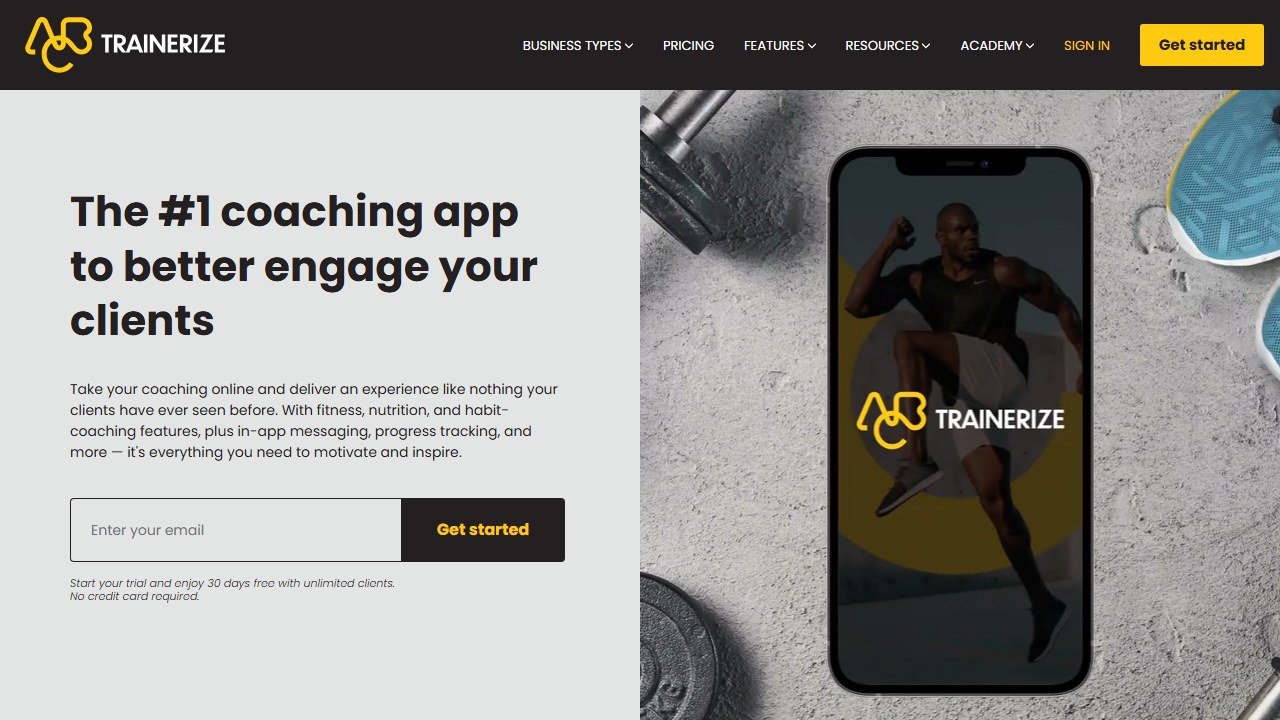
Trainerize, now branded ABC Trainerize, prices its personal training software by the number of clients you coach, then adds optional add-ons on top. The plan price is easy to find; the total for the features you actually use takes a little more work. This guide sets out every plan, the Pro price at each client count, the add-ons, and what a realistic setup costs at 15, 30 and 50 clients.
Trainerize has a free Basic plan for 1 client. Grow costs $10 a month ($9 billed annually) for 2 clients. Pro runs from $25 a month for 5 clients to $250 for 200 ($23 to $225 billed annually). Studio Plus starts at $275 a month per location. Add-ons such as Business ($25) and Advanced Nutrition ($20 or $45) cost extra.
How we put this together. Every figure below was read on Trainerize’s pricing page on 17 September 2026, in US dollars, with both the monthly and annual billing options checked. An earlier version of this page listed plans and prices (Solo, Grow at about $35, Pro at about $99, Studio at about $139) that no longer match Trainerize’s own page; we have replaced them. We have not used Trainerize on a paid plan ourselves. For the product itself, see our Trainerize review.
Trainerize pricing plans (2026)
Trainerize has four plans. The price of Pro depends on how many client seats you choose, and annual plans are billed once a year.
| Plan | Client seats | Billed monthly | Billed annually (per month) |
|---|---|---|---|
| Basic | 1 | Free | Free |
| Grow | 2 | $10 | $9 |
| Pro | 5 to 200 | $25 to $250 | $23 to $225 |
| Studio Plus | 500, 1,000 or more | $275 per location | $248 per location |
Trainerize says all prices are in US dollars and subject to applicable taxes.
Pro pricing by client count
| Pro seats | Billed monthly | Billed annually (per month) | Per client, annual |
|---|---|---|---|
| 5 | $25 | $23 | $4.60 |
| 15 | $50 | $45 | $3.00 |
| 30 | $79 | $71 | $2.37 |
| 50 | $135 | $122 | $2.44 |
| 75 | $180 | $162 | $2.16 |
| 100 | $225 | $203 | $2.03 |
| 200 | $250 | $225 | $1.13 |
The per-client column is our arithmetic. Two patterns stand out. The cost per client falls as you add seats, with one exception: 50 seats cost slightly more per client than 30. And the step from 100 to 200 seats adds only $22 a month on annual billing, so a coach approaching 100 clients should price the 200 tier before assuming they need to stay small.
What each plan includes
Basic (free)
One client seat, the iOS and Android mobile app, workout programs and delivery, basic in-app messaging, and habit and lifestyle coaching. It is enough to learn the platform and coach a first client.
Grow ($10 a month, or $9 billed annually)
Two client seats and everything in Basic, plus the AI Workout Builder, custom client programs, client meal and macro tracking, a Trainerize.me website profile, and integrations with client apps and wearables. The paid add-ons become available from this plan.
Pro (from $25 a month, or $23 billed annually)
From 5 to 200 client seats and everything in Grow, plus custom exercise videos, custom welcome emails, custom consultation forms, advanced in-app messaging, and leaderboard and threshold challenges. Pro is the first plan that can add a custom branded app.
Studio Plus (from $275 a month per location, or $248 billed annually)
For 500, 1,000 or more client seats, with everything in Pro plus one-to-one and group video calls, custom recipes and meals, referral links and prospect booking, access to partner add-ons, personalised onboarding support and full API access. It includes the Business, Advanced Nutrition, Video Coaching and Stripe add-ons and a Studio-level custom branded app, and the price applies to each location you add.
The add-ons: where the real cost sits
Most of the difference between the plan price and your bill comes from add-ons. None is available on the free plan, and Studio Plus includes them.
| Add-on | Price | What it adds |
|---|---|---|
| Business | $25 a month (Grow, Pro) | Automation and product selling, premium scheduling, referrals, live and on-demand classes, and access to the Stripe and Video Coaching add-ons |
| Advanced Nutrition Coaching | $20 a month (Grow, Pro 5, Pro 15); $45 (Pro 30 to 200) | 2,400+ recipes, smart meal plans for up to 7 days, shopping lists, custom recipes |
| Video Coaching | $10 a month (Grow, Pro) | 50 hours of video calls and 100 hours of streaming a month |
| Stripe Integrated Payments | $10 a month (Grow, Pro) | Online payments, automated product delivery, session booking |
| Custom Branded App | $169 one-time setup (Pro) | Your own white-labelled version of the app; not available on Free or Grow |
| FitMetrics | From $6 per client | AI assistant, check-ins, AI meal analysis and compliance dashboards, on paid plans |
Note the dependency: Trainerize lists access to the Stripe and Video Coaching add-ons under the Business add-on, so a coach who wants integrated payments should budget for Business as well. Stripe’s own card processing fees apply on top; Trainerize’s pricing page does not list a separate processing rate, so check your Stripe account rather than relying on a figure from elsewhere.
What Trainerize really costs at 15, 30 and 50 clients
Here is a common setup, Pro plus Advanced Nutrition, Business and Stripe payments, priced from the published figures on annual billing. The add-on prices are listed per month on Trainerize’s page. This is our arithmetic, not a quote.
| Clients | Pro (annual) | + Advanced Nutrition | + Business and Stripe | Monthly total |
|---|---|---|---|---|
| 15 | $45 | $20 | $35 | $100 |
| 30 | $71 | $45 | $35 | $151 |
| 50 | $122 | $45 | $35 | $202 |
On monthly billing the same setups come to $105, $159 and $215. Add a one-time $169 if you want a branded app on Pro. If you only need workouts and messaging, the Pro price alone is the whole bill, which is why two coaches with the same number of clients can pay very different amounts.
A year of growth, priced out
Client numbers rarely stay still, so it helps to price a year rather than a month. Take a coach who starts the year with 10 clients, reaches 25 by month five and 40 by month nine, and runs Pro with Business, Stripe and Advanced Nutrition throughout. Using the annual-rate figures as a monthly guide:
- Months 1 to 4, Pro 15: $45 plus $20 nutrition plus $35 for Business and Stripe, $100 a month, or $400.
- Months 5 to 8, Pro 30: $71 plus $45 plus $35, $151 a month, or $604.
- Months 9 to 12, Pro 50: $122 plus $45 plus $35, $202 a month, or $808.
That is about $1,812 for the year, before card processing and any branded app setup. Two things change the real figure. Annual plans are paid up front, so ask Trainerize how an upgrade to a larger seat count mid-year is charged and whether unused months are credited. And the jump in the nutrition add-on from $20 to $45 at 30 seats is easy to miss when you move up a tier. This is our arithmetic on published prices, not a quote.
Trainerize’s pricing page also says you can start a trial with no credit card required, which is the cheapest way to check the add-ons you think you need before you pay for them.
How Trainerize compares with TrueCoach and Everfit
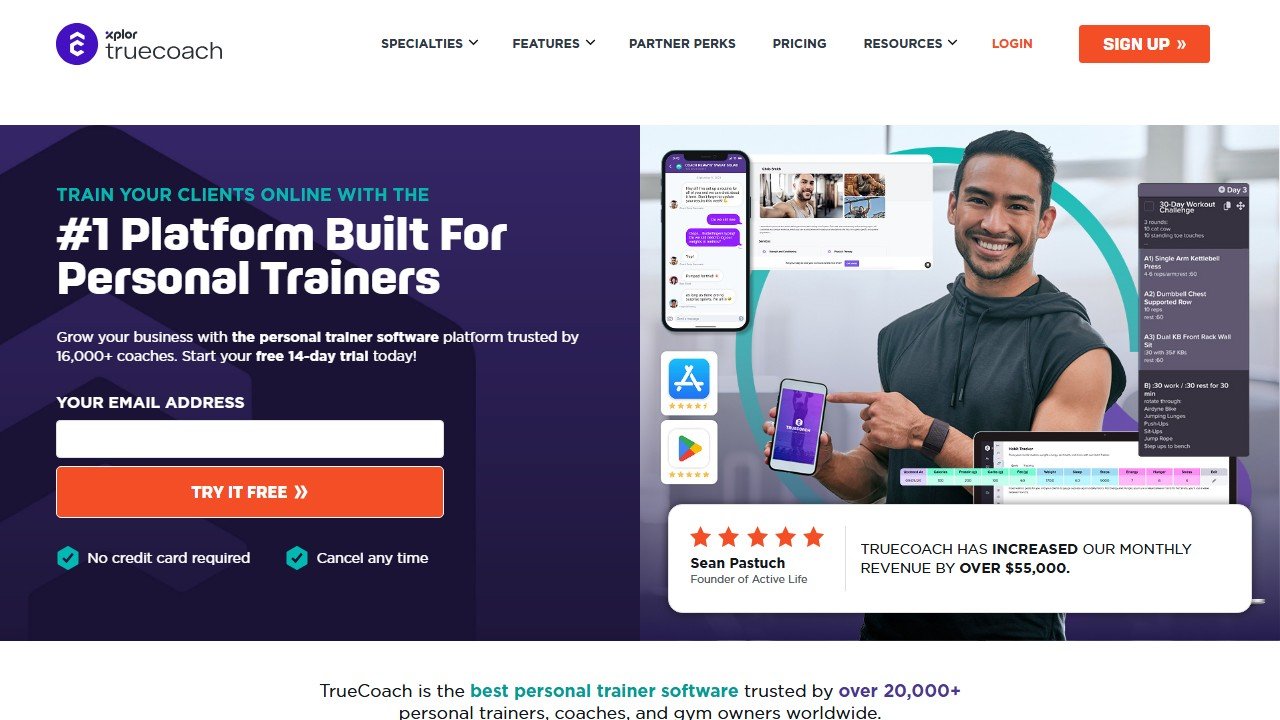
Both main alternatives publish their prices too. TrueCoach lists Starter for up to 5 clients at $29.98 a month, or $26.34 billed annually, Standard for up to 20 at $69.98 or $57.99, and Pro for up to 50 at $164.98 or $136.99. Everfit has a free Starter plan for up to 5 clients, Pro from $19 a month for 5 clients and Studio from $105 a month for 50, billed monthly.
| Clients | Trainerize Pro (annual) | TrueCoach (annual) | Everfit (monthly) |
|---|---|---|---|
| 5 | $23 | $26.34 | Free (Starter) or from $19 (Pro) |
| 20 | $71 (30 seats) | $57.99 | See Everfit’s per-client ladder |
| 50 | $122 | $136.99 | From $105 (Studio) |
The base prices are not like for like. TrueCoach’s Standard and Pro plans list a custom-branded app, wearable data integration and free automated payments, which Trainerize sells as add-ons or setup fees. On the bare plan, Trainerize is the cheaper of the two at 5 and 50 clients; once you add payments and a branded app, TrueCoach can come out ahead. Our TrueCoach vs Trainerize comparison and Trainerize alternatives guide go further.
Is Trainerize worth it?
If you are just starting out: the free Basic plan and the $10 Grow plan are a low-risk way to learn the platform with your first clients.
If you coach 10 to 50 clients online: price Pro at your real seat count, then add only the add-ons you will use. If you need payments, nutrition plans and a branded app, compare the total with TrueCoach, which includes more of that in its plan price.
If you run a large or multi-location business: Studio Plus bundles every add-on and a branded app, and is priced per location, so it is simpler to budget than stacking add-ons on Pro.
If cost is the main concern: see our guide to free personal trainer software, and our best AI tools for personal trainers guide for the wider field.
Questions to settle before you subscribe
- Which add-ons do you actually need? List them and add their monthly prices to the plan price.
- Do you need integrated payments? Budget for the Business add-on alongside Stripe.
- How many active clients will you have in six months? The seat ladder is steep in places, so price the next tier too.
- What happens if you cancel an annual plan? Ask Trainerize for its refund terms in writing before paying for a year.
- Is there a current promotion? Ask, but budget on the published price.
- How will you move your clients? If you are switching from another platform, ask who moves programs and client history, and what it costs.
Client retention, and the small number of things that actually move it
Coaching businesses live and die on retention rather than acquisition, and this is where software genuinely helps, though not in the way the feature lists suggest.
The check-in is the product
Clients renew because they feel seen, and the single highest leverage feature in any of these platforms is whatever makes a consistent, personal check-in easy to deliver at scale. Everything else is secondary. When evaluating, time how long it takes you to review a week of one client’s data and send something meaningful back, then multiply by your roster. That number is your real capacity.
Automation helps until it is noticed
Automated messaging is the standard feature here and it works right up to the moment a client realises the encouraging note arrives every Monday regardless of what they did. Use automation for logistics, reminders and structure. Keep anything that reads as personal actually personal, because the cost of being caught is the relationship rather than the message.
Watch the first six weeks
Most coaching churn happens early, before habit forms and before results arrive. If your platform gives you an activity view, the one report worth opening weekly is the list of clients who have not logged anything in seven days, filtered to those in their first six weeks. Acting on that list is worth more than any feature comparison.
Measure retention before you change anything
Take your current three month and twelve month retention rates from your own records before switching platforms, because you cannot reconstruct them afterwards and every vendor conversation will otherwise be about features. If retention does not move within two full client cycles, the platform was not the constraint.
How to tell whether the tool was worth it
Fitness software is easy to evaluate honestly because the numbers are countable and small. The reason most coaches cannot say whether a platform helped is that nobody wrote down where they started.
Pick the metric the tool is supposed to move
For a coaching platform it is clients per coach and hours spent on programming and admin per client per week. For a consumer app it is sessions completed per week and adherence over eight weeks. For form checking it is whether you are still filming in month three. Each of those is countable and each needs a figure from before.
Record the time cost this month, before anything changes
Ask yourself or your coaches to log how long programming, check-ins and admin take across one normal week. It takes minutes and it is the only way the time saving is ever provable. Most of the honest value in this category is hours rather than revenue, and hours are measurable in advance and unprovable afterwards.
Give it two client cycles
Retention and adherence move slowly and seasonally. A four week read tells you about novelty rather than value. Judge a coaching platform over at least two full client cycles, and say so at the outset so an unremarkable first month is understood as expected.
Name the result that would end it
Write down before you subscribe what twelve months would have to look like for you not to renew. It converts renewal from a default into a decision, which matters more in a category where the monthly figure is small enough to stop noticing.
Where the figures on this page come from
Every price here was read from the vendor’s own pricing page on 4 September 2026 and carries that date, because pricing in this category moves and a claim without a date is not checkable.
The pages we read
PT Distinction publishes $19.90, $59.90 and $89.90 a month with its marginal per client rates. Everfit publishes a rung for every client count from $19 to $290 monthly. TrueCoach publishes $26.34, $57.99 and $136.99 a month billed annually. My PT Hub publishes $25 and $59. FitBudd publishes $15, $79 and $149 with per client add-ons. Trainerize publishes a free tier and plans from $9 a month billed annually; we re-read it with both billing options on 17 September 2026. JuggernautAI publishes $34.99 a month or $349.99 a year.
The ones we could not read
Fitbod, Dr. Muscle, Hevy, Whoop and Oura did not yield a figure to the same method that read every vendor above, largely because consumer subscriptions are sold inside the app stores rather than on the web. That is not evidence they publish nothing, and we do not present it as such. Check the store listing on your own device, in your own country, before relying on any figure for those five.
One page worth reading twice
Wodify displayed $199 struck through and $99 a month per location, conditional on booking a demo by 31 August. We read it on 4 September 2026, after that deadline, and the discounted price was still shown. Ask which figure actually applies before budgeting on it.
Tools mentioned in this guide

Written by
FazFaz is the founder of AIToolsBakery. Some tools here are tested hands on. Others are assessed from vendor documentation and pricing verified on the live page, and every review says which one it is. Sponsors can buy a position in a guide. They cannot buy the score, the criticism, or silence about a better option.
How we test and how we make money →