It is six weeks out from your company’s annual sales summit. The registration page still is not live, the agenda has three speakers who have not confirmed, finance wants the budget reconciled by Friday, and your VP just asked whether you can “do something with AI” to make the whole thing easier. You do not need a chatbot that writes you a poem about networking. You need the actual work done faster.
We are AIToolsBakery, an independent review site. We sell none of the tools below, take no affiliate cut from the platforms, and have no demo quota to hit. That matters here because almost every “best AI tools for corporate events” list at the top of the search results is published by Cvent, Bizzabo, Whova, or another platform that wants you to buy the thing the article recommends. Those guides are not lies, but they are sales documents. This one is not.
So this guide is organized around the jobs a corporate planner actually has to ship, not around one vendor’s feature grid. We will tell you where AI genuinely saves hours, where it is marketing gloss on an old feature, and what the honest price is.
The 30-second answer: There is no single AI tool for corporate events. You run a stack. Enterprise platforms (Cvent, Bizzabo, Swoogo) handle registration, agenda, and matchmaking with built-in AI. A general model (ChatGPT or Claude) drafts copy and reconciles spreadsheets. Add a transcription tool and a survey tool. Most teams need three or four pieces, not fifteen.
Registration, ticketing, and attendee data
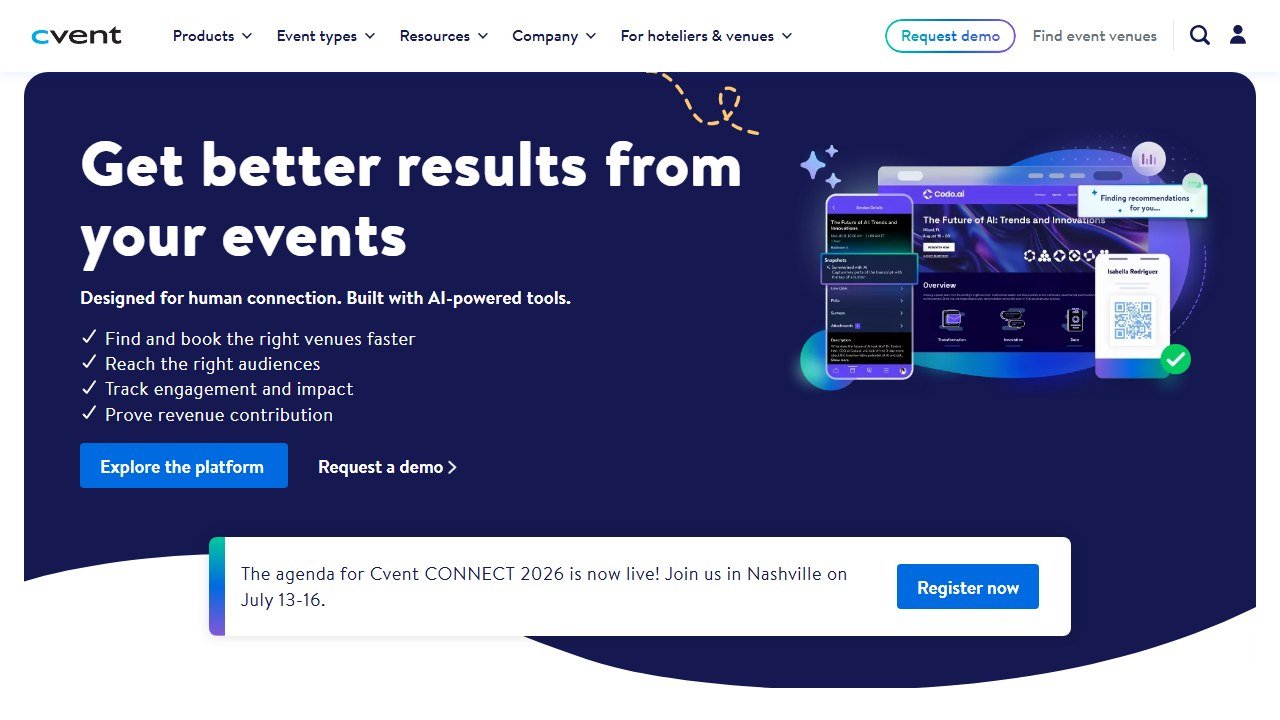
This is the load-bearing wall of any corporate event, and it is where the enterprise platforms earn their keep. Cvent is the incumbent for large conferences and trade shows. In 2026 its Attendee Hub app runs on CventIQ, an AI assistant that learns from attendee behavior to surface relevant sessions and exhibitors. Cvent now charges roughly $7 per registrant per event for the Attendee Hub plus event app, with annual increases scheduled. That per-head model gets expensive fast at a 2,000-person summit, which is the trade-off for its depth.
Swoogo is the answer for teams running many mid-sized events. Its pricing is flat (roughly $11,800 to $26,000 a year depending on tier) with unlimited events and unlimited registrants, so you stop doing budget math every time marketing wants another webinar. The trade-off: it is leaner on the on-site app and matchmaking side than Cvent or Bizzabo.
Bizzabo sits in enterprise territory too, starting around $18,000 a year. Its Command Center pulls registration, sessions, and marketing into one real-time view, and its AI Companion (branded Bizzy) answers attendee questions. For a single annual flagship event with a real budget, it is a strong contender. For five small internal events, it is overkill.
Agenda and session building
Building an agenda is jigsaw work: room capacities, speaker availability, track conflicts, breaks that do not collide with catering. The AI inside Cvent and Bizzabo can flag scheduling conflicts and suggest session times, and that genuinely helps on a multi-track conference. But for the first messy draft, where you are just trying to get a shape on paper, a general model is faster.
Paste your speaker list, session topics, and time constraints into ChatGPT or Claude and ask it to propose a balanced two-day agenda with no track overlaps. It will not be final, but it turns a blank page into something you can edit in ten minutes. The honest limitation: these models cannot see your venue contract or catering window, so every constraint you forget to mention is a constraint it will happily violate. Treat the output as a draft, never a plan of record.
If you live in Notion, its built-in AI is a reasonable place to keep the run-of-show, assign owners, and ask questions of your own planning docs. It will not build the registration flow, but as a planning brain for a small team it is cheap and flexible.
Speaker, sponsor, and attendee matchmaking
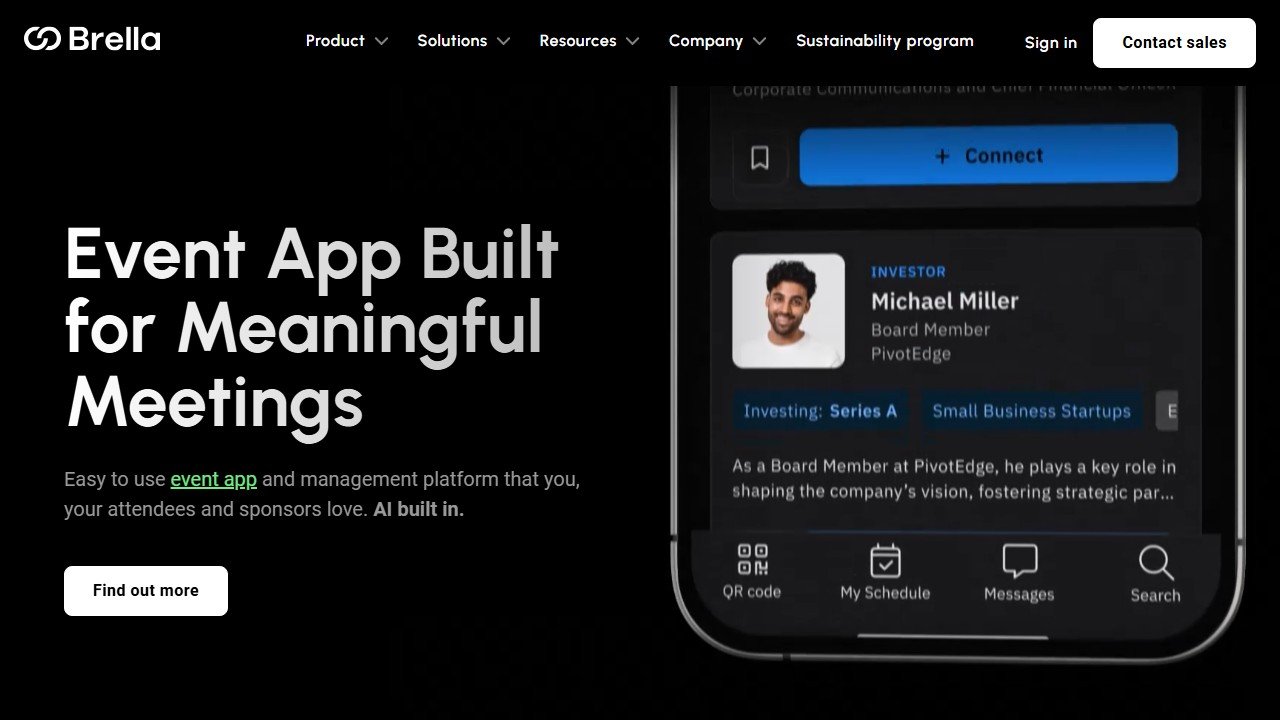
Matchmaking is the AI feature corporate platforms push hardest, and for B2B events it is the one that earns the hype. Brella built its reputation on AI matchmaking that pairs attendees by stated interests and goals, which lifts the quality of networking at a summit or trade show. Brella does not publish prices; it quotes per event based on headcount and features. Bizzabo and Cvent both bundle their own matchmaking, so if you already own one of those, test the native version before buying a separate tool.
For sponsor management, the real AI win is on the reporting side, not the matching side. Bizzabo’s Sponsor ROI engine, for instance, ties booth scans and session attendance to a sponsor’s spend, which is the number your sponsors actually ask for in the post-event call. If your sponsors keep asking “what did we get,” that feature pays for itself in renewals.
Event marketing, email, and copy
This is where a general model saves the most raw hours and costs the least. Drafting the invitation email, the reminder sequence, the speaker bios, the LinkedIn posts, the agenda blurbs: all of it is fast with ChatGPT or Claude. Feed it your event details and your brand voice, ask for five subject-line options, and edit down. We cover the broader copy and outreach workflow in our guide to AI tools for event planners, and most of it applies directly here.
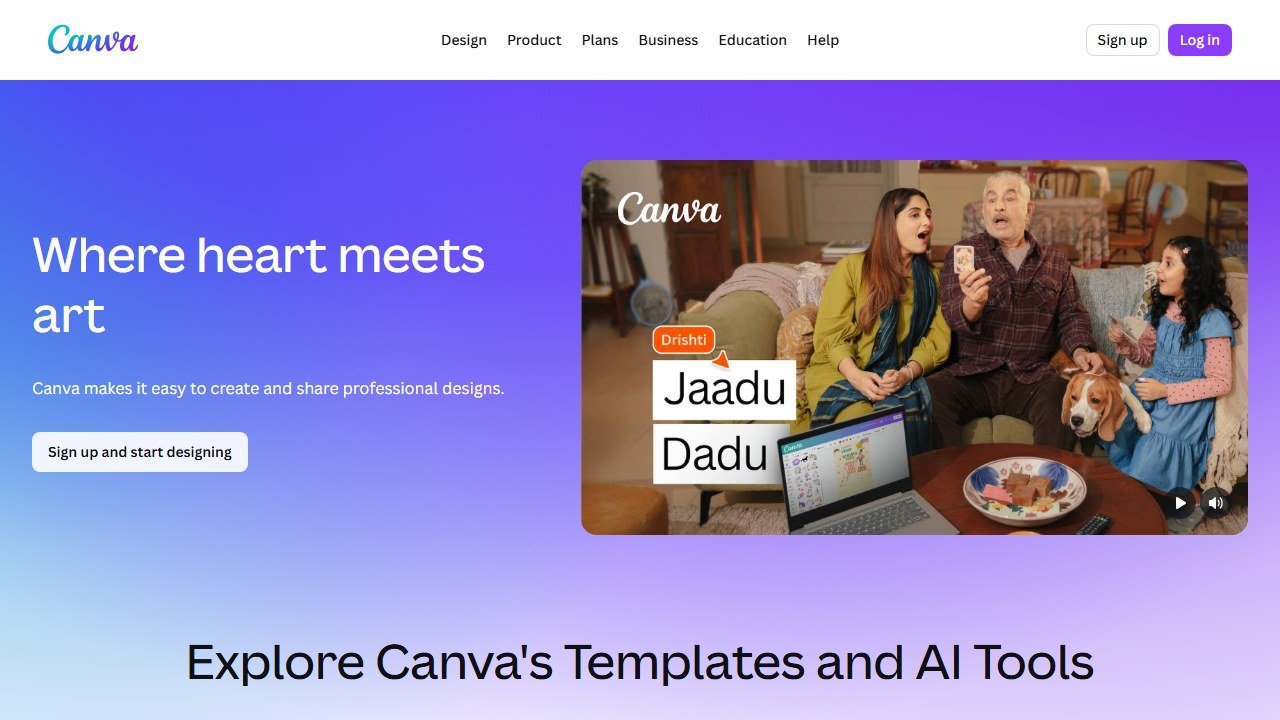
For the visual side, Canva is the default. Its AI features (Magic Design, background removal, text-to-image) turn a brand kit into a full set of social graphics, name badges, signage, and slide templates without a designer in the loop. The free tier covers a lot; the Pro tier (around $15 a month per user, or roughly $120 a year) unlocks brand kits and the heavier AI tools, which is worth it if your event has any visual consistency requirement.
A caution on AI-generated marketing copy: it drifts toward generic. If every event email in your industry was written by the same three models, they all start to sound identical. Use AI for the draft, then put a human voice on top.
Budgeting, approvals, and vendor coordination
Nobody markets “AI budgeting for events” because it is unglamorous, but this is a real time sink. A general model with file upload (ChatGPT or Claude) is genuinely useful for reconciling a vendor quote against your budget spreadsheet, drafting the cost-comparison table for finance, or summarizing five catering bids into one decision memo. Upload the documents, ask for a side-by-side, and check the math yourself.
The hard limit: do not trust a model’s arithmetic on a live budget without verifying it. Language models are confident and occasionally wrong on totals. Use them to structure and summarize, then confirm every number that goes to finance. For approvals and vendor contracts specifically, AI can draft the chase email and summarize the contract terms, but a human signs and a human reads the liability clauses.
On-site logistics and the event app
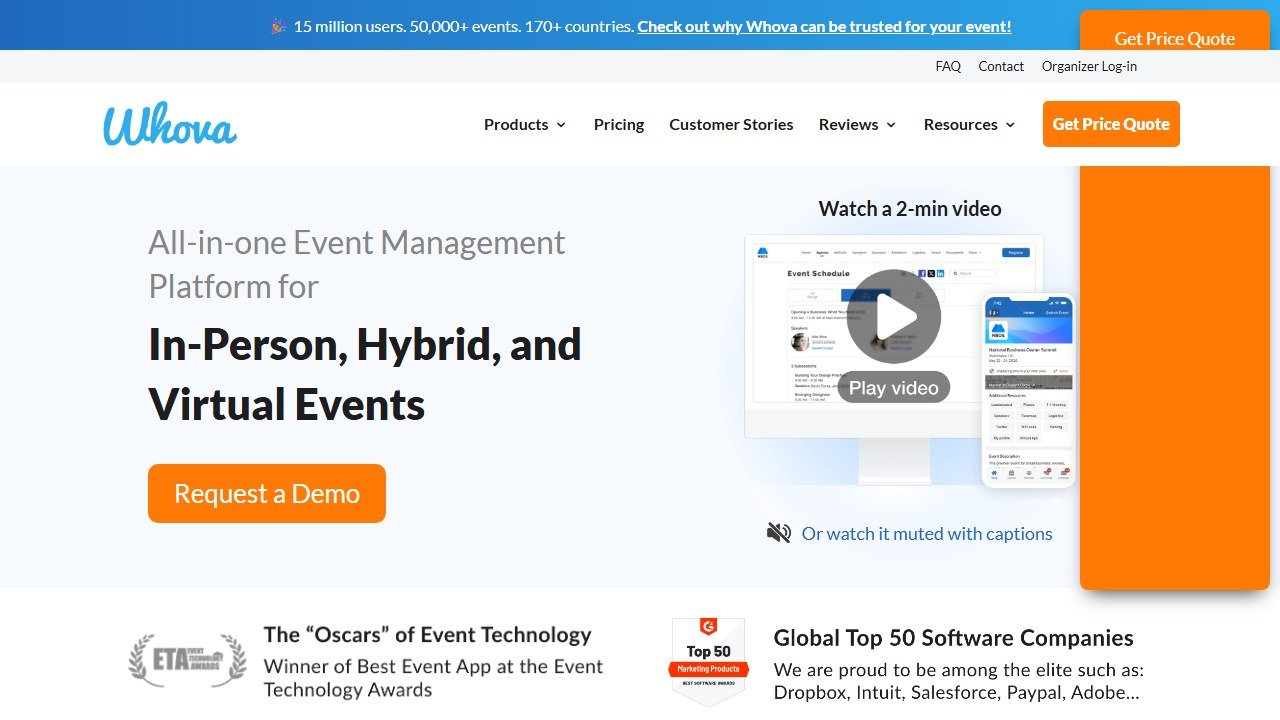
The mobile app is where attendees experience your event, and the AI inside Whova and the enterprise platforms handles personalized agendas, session recommendations, and live Q and A. Whova does not publish full pricing; it quotes per event and adds a per-ticket fee (around 3% plus a small flat charge) on paid tickets. It is popular for conferences that want a strong app without Cvent-level commitment.
For floor plans and seating, Social Tables (now part of Cvent) handles room layouts and capacity. The AI assist here is modest; the value is the diagramming, not the intelligence. Be honest with yourself about whether you need a dedicated tool or whether your venue already provides layouts.
Transcription, content capture, and repurposing
A corporate summit produces hours of sessions, and almost none of it gets reused. This is the most underrated AI win on the list. A transcription tool turns every keynote into a transcript, a summary, and a stack of pull quotes you can repurpose into blog posts, social clips, and the post-event recap email.
Otter.ai starts around $8 a month per user and is strong on live transcription accuracy. Fireflies.ai offers a free tier (around 800 minutes a month) and paid plans from roughly $10 to $19 a month, and is built for live capture. For turning a recorded session into a full content set (show notes, social posts, blog drafts) in one pass, Descript is the editor-friendly choice because it lets you trim the recording and export clips alongside the transcript. The limitation across all of them: accuracy drops with crosstalk, accents, and bad room audio, so a session recorded on a phone in a noisy ballroom will need cleanup.
Post-event surveys, reporting, and ROI
The post-event survey is how you prove the event worked, and AI has made it faster to build and faster to read. SurveyMonkey (individual paid plans roughly $39 a month and up) has an AI survey creator, sentiment summaries on open-text answers, and bias detection that flags leading questions. Typeform (from around $25 a month) builds a survey from a description and gets better completion rates because the format feels less like a form.
The genuinely useful part is on the analysis side: feed 400 open-text comments into the AI sentiment summary and get the themes in seconds instead of reading them all by hand. For ROI reporting, the enterprise platforms tie attendance and engagement data back to spend, and a general model can turn that export into a clean one-page board summary. Just confirm the underlying numbers are real before they go upstairs.
Comparison table: AI tools for corporate event planning
| Tool | What it does | Best for | Free tier / entry price |
|---|---|---|---|
| Cvent | Registration, app, agenda, CventIQ AI assistant | Large conferences and trade shows | No free tier; ~$7 per registrant per event |
| Swoogo | Registration and event management, flat pricing | Teams running many mid-sized events | No free tier; ~$11,800+/year, unlimited registrants |
| Bizzabo | All-in-one platform, AI Companion, sponsor ROI | Enterprise flagship events | No free tier; ~$18,000+/year |
| Brella | AI attendee matchmaking | Networking-heavy B2B summits | Quote per event |
| Whova | Event app, personalized agenda, live Q and A | Conferences wanting a strong app | Quote per event + ~3% ticket fee |
| ChatGPT / Claude | Copy, agenda drafts, budget reconciliation | Every planner, every event | Free tiers; paid ~$20/month |
| Canva | Graphics, badges, signage, AI design | In-house marketing and design | Free tier; Pro ~$15/month |
| Otter / Fireflies | Session transcription and summaries | Capturing and repurposing content | Otter ~$8/mo; Fireflies free tier |
| SurveyMonkey / Typeform | Post-event surveys, AI sentiment analysis | Feedback and ROI measurement | SurveyMonkey ~$39/mo; Typeform ~$25/mo |
A lean starter stack for corporate events
You do not need every tool above. Most teams over-buy. Here is a stack that covers the real jobs without a five-figure platform contract, suitable for internal events, smaller summits, and teams testing the water:
- A general model (ChatGPT or Claude, ~$20/month). Copy, agenda drafts, budget summaries, vendor comparisons. This is the highest-leverage $20 you will spend.
- A registration platform sized to your volume. Swoogo if you run many events and want flat pricing; a per-registrant platform only if you run one big event a year.
- Canva Pro (~$15/month). Every graphic, badge, and slide template for the event.
- A transcription tool (Otter or Fireflies free tier to start). Capture every session so the content does not evaporate.
- A survey tool (Typeform or SurveyMonkey). Build the post-event survey and let AI summarize the responses.
Scale up to Cvent, Bizzabo, or Brella only when the event size and the matchmaking or app requirements genuinely demand it. For adjacent contexts, our guides to AI tools for party planners and AI tools for wedding planners cover lighter-weight stacks that overlap with smaller corporate gatherings.
What AI still cannot do for corporate event planning
AI cannot read the room when a keynote is dying and the agenda needs to flex in real time. It cannot call the venue at 11pm when the loading dock is locked and the AV truck is waiting. It cannot sense that your CEO is nervous and needs a quieter green room, or that a sponsor is quietly unhappy and one good conversation away from not renewing.
It cannot own the relationship with the caterer you have trusted for six years, negotiate a contract with judgment about what is actually fair, or take responsibility when something goes wrong on the day. AI will draft your apology email; it will not be the person who walks over and fixes the problem.
And it cannot be accountable for attendee data. Registration lists, badge scans, and dietary or accessibility details are personal information your company is responsible for protecting. A model can help you handle that data; it cannot decide what is safe to collect, who gets access, or how long you keep it. Those are human calls, and they stay human.
The job, at its core, is still hospitality under pressure with real money and real reputations on the line. AI clears the busywork so you have more attention for the part only a person can do. That is the right way to use it.

Written by
FazFaz is the founder of AIToolsBakery. Some tools here are tested hands on. Others are assessed from vendor documentation and pricing verified on the live page, and every review says which one it is. Sponsors can buy a position in a guide. They cannot buy the score, the criticism, or silence about a better option.
How we test and how we make money →