You are running a 600-person user conference, a roadshow across five cities, and a dozen webinars in the same fiscal year, and your spreadsheet of attendees has become a liability rather than a tool. So you start searching for “best event management software,” and within two clicks every result is either a vendor selling you something or an affiliate page that earns a commission when you book a demo. Cvent sits at the top of that pile, and it has for years.
We are AIToolsBakery. We are independent, we sell none of the tools we cover, and we take no commission when you sign a contract. That matters here more than usual, because the search results for Cvent are dominated by the company itself and by affiliate lists that grade every product an easy 9 out of 10. We are neither. Our job is to tell you what Cvent is genuinely good at, where it will frustrate you, and the specific kind of team that should walk away and look elsewhere.
This review is the buyer verdict the first page of Google does not give you. If you are still scoping the wider category, our guide to AI tools for event planners maps the landscape, and our breakdown of AI tools for corporate event planning covers the enterprise tier where Cvent actually lives.
The 30-second verdict: Cvent is the enterprise default for a reason: nothing matches its breadth, venue-sourcing network, or analytics. But it is complex, expensive, and quote-only, with a steep learning curve. Buy it if you run high-volume, multi-event programs and have someone to own it. Skip it if you run a handful of events a year.
Quick facts
- Best for: Large organizations and agencies running many events a year, with a dedicated events team or platform owner.
- Pricing model: Quote-only, layered. An annual platform license plus per-registrant fees plus implementation. Not published; our Cvent pricing guide collects the figures we could verify.
- Standout: The global venue-sourcing network and the depth of reporting and integrations. Few tools come close.
- Biggest drawback: Complexity and cost. The learning curve is real, and the all-in price climbs fast once you add modules and attendees.
What Cvent is
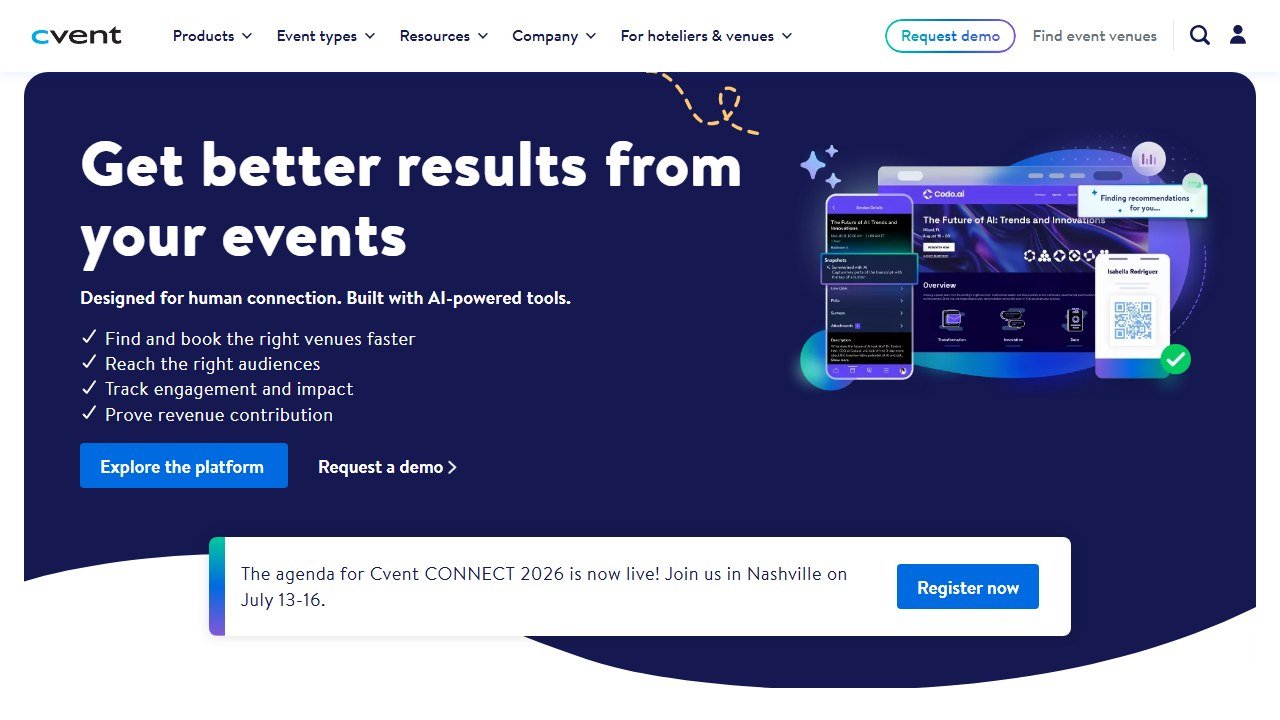
Website: Cvent
Cvent is an end-to-end event management platform aimed squarely at the enterprise. It is not an app you spin up for a single workshop. It is a system that tries to own the entire event lifecycle, from the moment you start sourcing a venue to the post-event report that lands on a VP’s desk.
The platform breaks down into a few major pillars. Registration and marketing covers branded event websites, drag-and-drop site builders, customizable registration flows, secure payment processing, and automated email campaigns. Venue sourcing is the piece that genuinely sets Cvent apart: a supplier network the company describes as hundreds of thousands of venues, with a global RFP system that lets you send and compare proposals from hotels and meeting spaces without a chain of back-and-forth emails.
On the day of the event, the Attendee Hub is the mobile app that attendees use for the agenda, networking, and session content. OnArrival handles check-in and on-site badge printing. After the event, the analytics and reporting layer is where Cvent tries to prove the program paid for itself, calculating engagement, cost, and a defensible return-on-investment number that integrates with your CRM and marketing stack.
Cvent also markets an AI layer it calls CventIQ, positioned as AI for planning, marketing, and on-site execution, including narrowing venue results from its large supplier database. As with most vendor AI claims in 2026, treat the marketing language with healthy skepticism and ask for a live demo on your own data rather than a polished sales reel.
Who it is for
Cvent earns its keep when scale is the actual problem. If your organization runs dozens of events a year across registration-heavy conferences, roadshows, and webinars, the per-event efficiency and the single source of reporting truth start to justify the cost and the setup effort.
It fits best for a few specific profiles. Large enterprises with a centralized events or marketing-operations function that needs governance, approval workflows, and consistent branding across many teams. Associations and organizations that run recurring high-attendance conferences where venue sourcing and registration volume are the core challenge. And event agencies managing programs on behalf of multiple clients, who benefit from one platform that can flex across many events at once.
The common thread is that someone owns it. Cvent rewards organizations that can dedicate a person or a small team to learning it properly. It punishes the part-time admin who logs in three times a year.
It is worth being honest about the inverse, too. If your event calendar is a few internal town halls, a single annual customer day, and the occasional webinar, you are not the customer Cvent was built for, no matter how impressive the demo looks. The platform’s value compounds with volume and with the need for governance across many teams. Strip those away and you are buying a freight train to do grocery runs. We have seen organizations sign up because Cvent is the name everyone recognizes, then quietly use ten percent of it while paying for all of it. The brand recognition is real, but it is not a reason to buy.
What stands out
The venue-sourcing network is the single feature that competitors struggle to replicate. The ability to broadcast an RFP across a vast supplier database and compare structured responses turns one of the most painful parts of event planning into something close to a search query. For teams that book a lot of hotel and meeting space, this alone can justify a serious look.
The breadth is the second genuine strength. Most event tools do one or two things well and gesture at the rest. Cvent actually delivers registration, marketing, sourcing, the on-site stack, the attendee app, and analytics as one connected system. When it works, data flows from a registration form straight through to a post-event ROI report without anyone exporting a CSV.
The analytics and integration depth is the third. Cvent connects to major CRM and marketing-automation platforms, which means event data can become pipeline data your revenue team actually trusts. That closed loop is the argument that gets event budgets approved, and Cvent makes it more credible than most. When a marketing leader has to defend the events line in next year’s budget, “here is the sourced pipeline our events generated, tracked end to end” is a far stronger case than a stack of attendance screenshots.
The on-site experience deserves a mention as a fourth strength. OnArrival check-in and badge printing turn the registration desk, historically a chaotic bottleneck, into something that moves. For large in-person events where a slow check-in line is the first thing every attendee remembers, having the same vendor own registration data and the on-site stack removes a class of day-of failures that plague stitched-together solutions.
Where it falls short
The complexity is the headline weakness, and it is not a minor one. Cvent consistently scores at the bottom of its category for ease of use in independent review aggregators. The interface is dense, the configuration options are endless, and tasks that feel like they should take minutes can take an afternoon until you have learned the platform’s logic. New users routinely need formal training, and the onboarding period is measured in weeks, not days.
The pricing structure compounds the pain. Cvent does not publish pricing, and the layered model, with an annual license, per-registrant fees, and implementation costs stacked on top, makes it hard to predict your true all-in number before you are deep in a sales process. Costs scale with attendance, so a single large event can move your bill materially.
There is also a sales-process caveat we hear often enough to flag. Reps have a tendency to oversell newer or beta features during the demo, presenting capabilities as mature that are still rough in practice. Insist on seeing every feature you care about working live, on your own use case, and get the contract to name exactly which modules you are paying for.
Finally, Cvent can simply be too much. For a team running a handful of events a year, you will pay for and maintain capability you never touch. The strength that serves an enterprise becomes dead weight for a small one.
Support and turnaround are worth probing during evaluation as well. At enterprise scale, with a complex platform, the speed and quality of the help you get when something breaks during a live event is not a nice-to-have, it is the whole game. Ask current customers, not the sales team, how responsive support is when a registration flow misbehaves the morning of a 500-person conference. The answer should weigh as heavily in your decision as any feature on the comparison grid.
Pricing
Cvent is quote-only, so anyone publishing a clean price list is estimating. With that caution stated plainly, here is the honest shape of it.
The pricing is layered. You pay an annual platform license, then per-registrant fees on top of that, then a one-time implementation or onboarding cost in your first year. The per-registrant model is the part that surprises buyers, because it means your bill grows with the size of your events rather than staying flat.
In rough terms, smaller organizations tend to land in the low-to-mid five figures per year all-in, while enterprise programs with high event volume and full module coverage commonly run well into the higher five or six figures annually. Implementation in year one can add a substantial one-time sum on its own. Because every one of these numbers depends on your event volume, the modules you select, and how well you negotiate, you must confirm the current figures directly on the Cvent pricing page and in your own quote. Treat any third-party number, including the ranges above, as a starting point for the conversation, not a contract.
The practical takeaway: budget for the license, the per-attendee fees, and implementation as three separate things, and model your worst-case attendance, not your best-case. The tool is fairly priced for what an enterprise gets. It is expensive for what a small team needs.
How it compares and alternatives
Cvent is the incumbent, which means most alternatives define themselves against it. The right comparison depends on what is driving your decision: breadth, ease of use, budget, or a specific job like networking.
Bizzabo positions itself as a more modern enterprise platform with a sleeker experience and a strong B2B in-person story, including smart badges and wearables. If you like Cvent’s tier but find its interface dated, Bizzabo is the natural head-to-head, and we walk through that decision in detail in Cvent vs Bizzabo. Whova is the mid-market favorite, easier to adopt and beloved for its attendee app, though lighter on enterprise venue sourcing and financial controls; our Whova review covers exactly who it fits. Swoogo is the pick when flexible, customizable registration is your real need rather than a full event-operations suite. Brella is the specialist when attendee networking and matchmaking is the core outcome you are buying.
| Tool | Best for | Pricing model | Standout | Watch out for |
|---|---|---|---|---|
| Cvent | High-volume enterprise event programs | Quote-only, layered license + per-registrant | Venue sourcing network, breadth, analytics | Complexity, cost, steep learning curve |
| Bizzabo | Modern B2B in-person enterprise events | Quote-only, enterprise | Sleeker UX, smart badges and wearables | Still enterprise-priced |
| Whova | Mid-market all-in-one with great app | Quote-only | Attendee engagement and networking app | Lighter enterprise sourcing and finance |
| Swoogo | Flexible, customizable registration | Quote-based | Registration flexibility | Not a full ops suite |
| Brella | Networking and matchmaking | Quote-based | AI-driven attendee matchmaking | Narrower scope |
If your events are smaller or less frequent, do not assume an enterprise tool is the safe choice. Our roundups of AI tools for party planners and AI tools for wedding planners cover lighter, cheaper options that fit those jobs far better than a platform built for 600-person conferences.
Our verdict
Cvent is a buy for one clear profile: the organization or agency running many events a year, at meaningful scale, with a dedicated owner who will learn it properly and a budget that can absorb a layered, quote-only price. For that buyer, the venue-sourcing network, the breadth, and the analytics genuinely earn the cost, and few competitors can match the full package.
For nearly everyone else, it is a skip, or at least a “look elsewhere first.” If you run a handful of events a year, if you do not have someone to own the platform, if ease of use is a real constraint for your team, or if a predictable published price matters to your finance partner, the complexity and cost will outweigh the capability. Look hard at Whova or Swoogo before you sign, and read Cvent vs Bizzabo if you have already decided you want a platform at this tier.
The honest summary: Cvent is not overrated, but it is over-bought. It is the right tool for the events team that genuinely operates at enterprise scale, and the wrong tool for the team that merely aspires to. Be honest about which one you are, confirm the current pricing directly with the vendor, and demand a live demo on your own use case before you commit.
For the full cost breakdown, including what we could and could not verify, see our Cvent pricing guide.

Written by
FazFaz is the founder of AIToolsBakery. Some tools here are tested hands on. Others are assessed from vendor documentation and pricing verified on the live page, and every review says which one it is. Sponsors can buy a position in a guide. They cannot buy the score, the criticism, or silence about a better option.
How we test and how we make money →