
If you run conferences, user summits, or a busy calendar of B2B events, you have almost certainly landed on a shortlist of two: Cvent and Bizzabo. Both are enterprise event platforms. Both want a sales call before they will tell you a price. And both will happily explain why they are the obvious choice. The problem is that the people doing the explaining are the vendors themselves.
Search “Cvent vs Bizzabo” and you mostly get two kinds of pages: each company’s own comparison (which, unsurprisingly, concludes that they win), and affiliate roundups that earn a commission no matter which one you pick. We are neither. AIToolsBakery is independent, we sell none of these platforms, and we make nothing if you choose one over the other. What follows is the tradeoff as we actually see it, so you can decide which one fits the team you have, not the team a sales deck imagines you have.
The short version: these are not the same kind of product wearing different logos. They overlap heavily on the core event workflow, but they were built around different priorities, and that difference is the whole decision.
The 30-second answer: Pick Cvent if you run a high volume of complex events, lean on venue sourcing, and have staff who can master a deep platform. Pick Bizzabo if you want a modern, marketing-integrated experience, faster onboarding, and standout onsite engagement through Klik smart badges. Both are enterprise-priced and quote-only.
What each one actually is
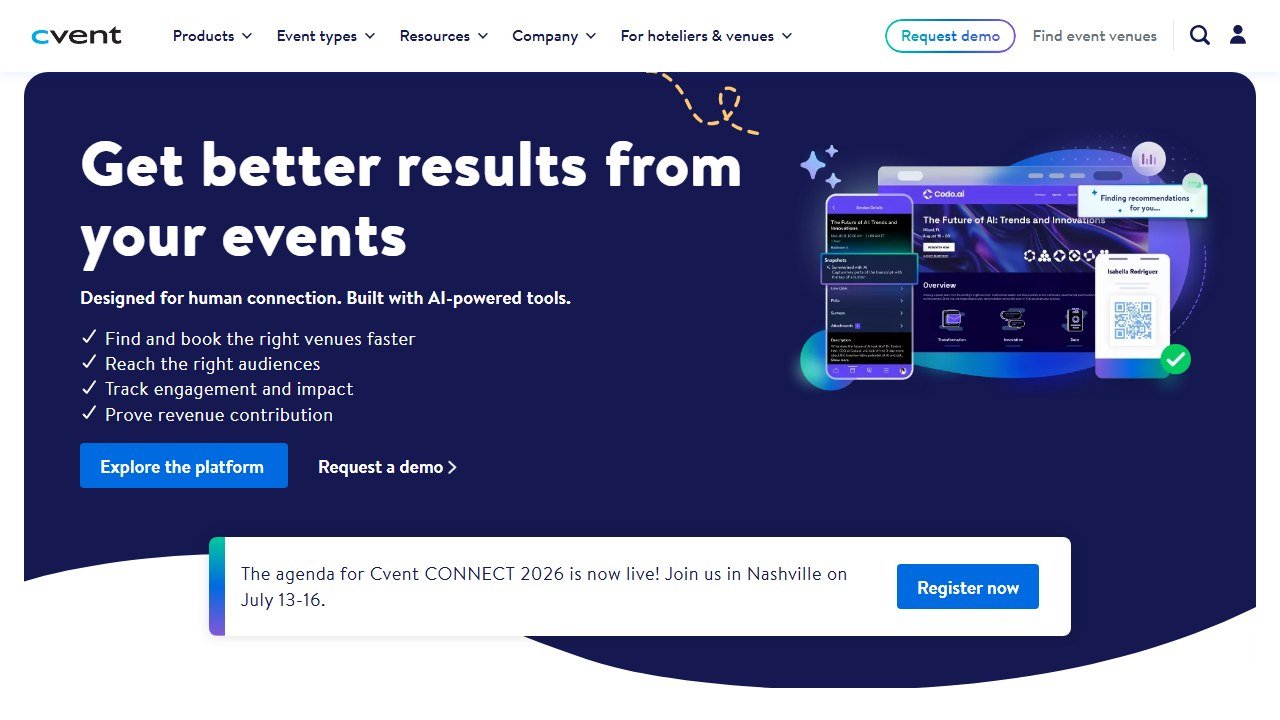
Cvent is the category incumbent. It has been around longer than most of its competitors and has grown into a sprawling suite that covers registration, attendee management, a huge global venue-sourcing and RFP database, the Attendee Hub event app, OnArrival onsite check-in and badge printing, in-platform budgeting, and deep analytics. If event management has a feature, Cvent probably ships it somewhere. That breadth is its reason for existing and the source of most of its friction.
Bizzabo positions itself as an “Event Experience Operating System.” In plain terms, it is a more modern, more tightly designed platform built around the full lifecycle of an event: planning, promotion, attendee engagement, and ROI measurement. Its signature differentiator is Klik, a line of smart event badges and wearables that handle click-to-connect networking, sponsor lead capture, session tracking, and live event heatmaps. Bizzabo trades some of Cvent’s raw depth for a cleaner experience and a faster path to running your first event.
If you are still mapping out which platform category you even need, our guide to AI tools for corporate event planning is a useful step back before you commit to either of these.
Workflow and breadth
This is where Cvent’s age works in its favor. For organizations that run dozens of events a year across multiple regions, Cvent’s connected modules mean you can source a venue, build registration, push an event app, run onsite check-in, and pull financials inside one ecosystem. The venue-sourcing and RFP database in particular is genuinely hard to match. If finding, negotiating, and contracting spaces across cities is a core part of your job, Cvent’s depth there is close to unrivaled, and that single capability is the reason many large enterprises stay.
Bizzabo covers the same core workflow, registration through analytics, but its strength is the experience layer rather than the back-office sourcing layer. AI-assisted matchmaking for networking, smart 1:1 meeting scheduling, sponsor management, automated speaker communications, and studio-quality virtual production with built-in live streaming, Q&A, and polling are all first-class. Onsite, the Klik badges turn networking and lead capture into something measurable rather than a stack of business cards. What you will not find is Cvent’s level of venue-sourcing machinery, because that is not the problem Bizzabo set out to solve.
The honest read: if your events are operationally complex and sourcing-heavy, Cvent’s breadth pays off. If your events are about engagement, brand, and pipeline, Bizzabo’s narrower-but-sharper toolkit fits better.
It is also worth naming what “breadth” costs in practice. A platform with a module for everything still needs someone to configure, maintain, and connect those modules, and the more there are, the more surface area there is to get wrong. Teams that adopt Cvent and use only a third of it end up paying for complexity they never benefit from while still carrying the overhead of navigating it. Bizzabo‘s tighter scope means fewer levers, which is a downside when you need an obscure one and a quiet upside the other ninety percent of the time. Before you weigh features, list the three to five capabilities your events genuinely depend on. If venue sourcing and intricate financial controls are on that list, Cvent earns its breadth. If they are not, you are likely paying for a warehouse to store a toolbox.
Ease of use and onboarding

This is the cleanest split between the two. Cvent is powerful and, by widespread account, hard to learn. Users consistently report a steep learning curve and navigation that feels cumbersome, and Cvent regularly posts some of the lower ease-of-use scores in its category. The platform assumes you will invest in training and, often, in dedicated staff who become Cvent specialists. That is a real cost, even though it never shows up on the invoice.
Bizzabo is the faster onboarding story. Teams describe a shorter ramp and a more intuitive interface, which matters a great deal when you need to launch and run events quickly without turning someone into a full-time platform expert. The tradeoff is that some of the deepest, most configurable corners of Cvent simply are not there. For most teams that is a feature, not a loss. For a few teams with genuinely intricate requirements, it can be a ceiling.
Integrations and the marketing stack
For B2B and demand-gen teams, this section can decide the whole thing. Bizzabo leans hard into marketing integration, with native connections to platforms like HubSpot and Salesforce so that event data flows into your pipeline rather than sitting in a silo. Combined with Klik’s lead-capture data, that makes attributing pipeline to events meaningfully easier, which is exactly what a marketing-owned events function needs to justify its budget.
Cvent also integrates with major CRMs and marketing tools, and at the enterprise tier its integration catalog is broad. The difference is one of emphasis. Cvent’s center of gravity is event operations; integrations are a supporting capability. Bizzabo’s center of gravity is the event-to-revenue story, and the integrations reflect that. If “prove the events team drove pipeline” is your mandate, Bizzabo’s framing maps to it more directly out of the box.
A practical test before you sign with either: ask each vendor to walk through exactly what an attendee record looks like after your event, and how it lands in your CRM. Does a session a person attended sync as an activity? Does a lead a sponsor captured on a Klik badge flow into the right owner’s queue? Does a no-show get tagged so marketing can re-target them? These are the unglamorous details that decide whether the integration actually saves your team work or just technically exists. Both platforms can check the box “integrates with Salesforce.” Only a real walkthrough tells you whether that integration carries the data your reporting actually needs, in the shape your reporting actually needs it.
Pricing and value
Here is the part both vendors make deliberately hard: neither publishes simple pricing, and both structure cost around variables like event volume, attendee count, and which modules you turn on. Treat every number below as a directional signal and confirm the real figure on the vendor page and in your own quote.
Cvent is built as a layered model: an annual license plus per-registrant and per-event costs, with onsite tools like OnArrival priced separately. Third-party purchasing data has put a typical annual spend in the high tens of thousands, with smaller deployments lower and large enterprises well beyond that. Components like the Attendee Hub event app are priced per registrant per event, which means cost scales directly with how many people attend. For a large conference, those per-head fees add up fast.
Bizzabo is also quote-only and enterprise-priced. Public references point to its Event Experience OS starting in the high teens of thousands per year, billed annually with a small minimum user count, and Klik smart-badge pricing handled as a custom add-on. The takeaway is not “one is cheap.” Neither is. The takeaway is that both prices move with your event volume and scope, so the only number that matters is the one in your signed contract.
For value, the honest framing is this: Cvent’s price buys breadth and sourcing depth you may or may not use. Bizzabo’s price buys a tighter, more modern platform and standout onsite engagement. Paying enterprise money for capabilities your team never touches is the most common way to overspend on either one.
One more cost that rarely makes the comparison chart: the people cost. A platform that needs a dedicated specialist to run well is carrying a salary alongside its license fee, and that hidden number can rival the software itself. Cvent’s depth often implies that role, formally or informally. Bizzabo’s lighter footprint more often lets an existing team member absorb the platform without it becoming their whole job. Neither answer is automatically cheaper, but the only fair value comparison is total cost to operate, license plus the human hours to run it, not the license line alone.
Support and the implementation reality
Both vendors offer enterprise-grade support, and both have customers who praise it and customers who do not. The pattern worth knowing: Cvent’s complexity means implementation is a project, sometimes a long one, and the platform’s power often requires ongoing internal expertise to use well. Budget for training and a designated owner. Bizzabo’s lighter footprint generally means a faster, less painful rollout, and teams tend to reach “running real events” sooner.
One recurring caution we have seen with large platforms generally, and it is worth raising in any sales conversation: do not let a demo of a polished or beta feature drive your decision. Ask explicitly which capabilities are generally available today, which are roadmap, and what your specific events will look like in the platform with your real data. Verify on the vendor’s current page rather than the slide.
Who each one is for
Cvent fits the large or fast-scaling organization that runs many complex events, depends on venue sourcing and RFPs, needs deep financial and operational controls, and has, or will hire, staff who can master a demanding platform. If your events calendar is the operational backbone of the business, Cvent’s depth is the safer bet.
Bizzabo fits the marketing-led or experience-focused team that wants a modern, intuitive platform, strong attendee engagement, native marketing-stack integration, and a faster path to launch. If your events exist to build brand and pipeline, and onsite networking and lead capture matter more than multi-region sourcing, Bizzabo is the more natural fit.
Plenty of teams sit in between, and for them the deciding factor is usually honest self-assessment of internal capacity. A powerful platform that nobody has time to learn is worse value than a focused one your team actually adopts. If you are still scoping the whole toolkit, our overview of AI tools for corporate event planning and our broader AI tools for event planners roundup both help size the decision.
Cvent vs Bizzabo at a glance
| Dimension | Cvent | Bizzabo |
|---|---|---|
| Best for | High-volume, complex, sourcing-heavy event programs | Marketing-led, engagement-focused B2B events |
| Core strength | Breadth + global venue sourcing / RFP database | Modern experience + Klik smart badges and wearables |
| Onsite | OnArrival check-in and badge printing | Klik click-to-connect, lead capture, event heatmaps |
| Ease of use | Steep learning curve, deep configuration | Faster onboarding, more intuitive UI |
| Integrations | Broad enterprise catalog, ops-centric | Strong marketing-stack focus (HubSpot, Salesforce) |
| Pricing model | Layered license + per-registrant + per-event, quote-only | Annual OS subscription + custom Klik add-on, quote-only |
| Learning investment | High, often needs dedicated specialists | Lower, faster team adoption |
| Verify pricing | Quote only, confirm on cvent.com | Quote only, confirm on bizzabo.com |
Our verdict
There is no universal winner here, and any page that declares one is usually selling something. Cvent is the deeper, broader, more demanding platform, and it is the right call when your events are operationally complex and sourcing is central, provided you have the team to run it. Bizzabo is the more modern, more approachable, marketing-aligned platform, and it is the right call when engagement, pipeline, and speed to launch matter more than raw breadth. Match the tool to your team’s real capacity and your events’ real shape, and the decision usually makes itself.
When the honest answer is a third tool: if Cvent feels like overkill but you still want strong attendee engagement, look at a mid-market app like Whova, which attendees genuinely tend to like and which costs less to adopt. And if your needs are lighter still, smaller and more affordable platforms may serve you better than either of these enterprise systems. If you want the full single-tool breakdown on the incumbent before you commit, our Cvent review goes deeper on its strengths and where it falls short. Whatever you choose, get a written quote for your actual event volume before you sign, because with both of these the published numbers are only a starting point.

Written by
FazFaz is the founder of AIToolsBakery. Some tools here are tested hands on. Others are assessed from vendor documentation and pricing verified on the live page, and every review says which one it is. Sponsors can buy a position in a guide. They cannot buy the score, the criticism, or silence about a better option.
How we test and how we make money →