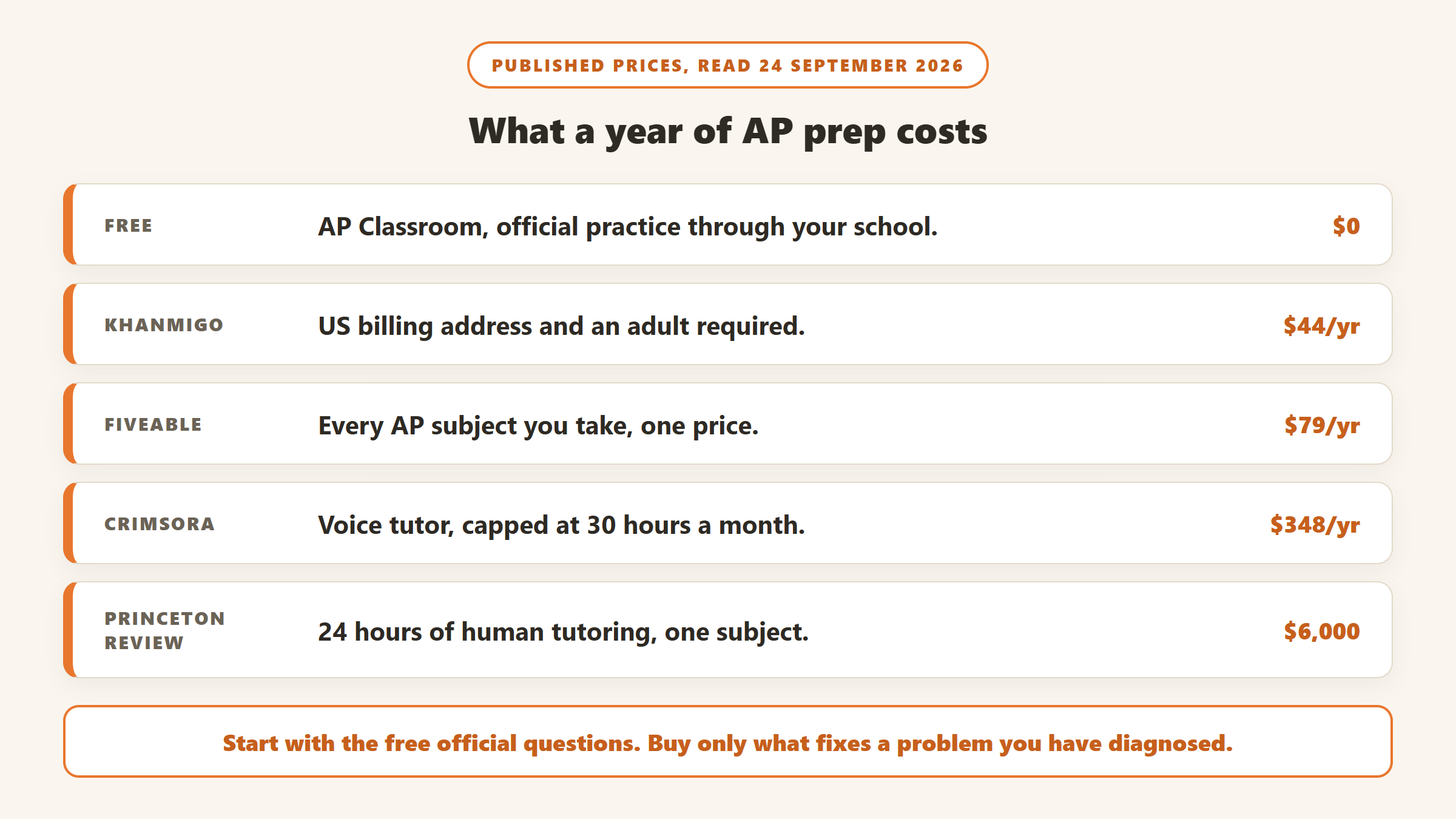
Every AP student hits the same wall in October. The class is moving faster than the textbook, the first unit test did not go well, and the exam is seven months away. Private tutoring is the traditional answer, and The Princeton Review will sell you 24 hours of it at $250 an hour. That is the number to keep in your head while you read the rest of this page, because the AI tools below cost between nothing and $588 a year and are all trying to replace some part of that $6,000.
How we put this guide together. We have not used these apps ourselves. This is a research-based guide built from each company’s own pricing, product and help pages, plus College Board’s published policies, all read on 24 September 2026. Every price below is quoted from the vendor’s own page on that date, and where a company does not publish a price we say so rather than guess. Nothing here is a test result, and no company paid to be included.
The 9 Best AI AP Exam Prep Tools in 2026
| Best for | Tool |
|---|---|
| All-round AP study across every subject | Fiveable |
| Learning out loud with a voice tutor | Crimsora |
| The cheapest credible AI tutor | Khanmigo |
| A free tier you can actually live in | Knowt |
| Buying one subject and nothing else | Albert |
| Exam-style question difficulty | UWorld |
| Memorising terms and formulas | Quizlet |
| Official practice, at no cost | AP Classroom |
| A human who is accountable for the score | The Princeton Review |
1. Fiveable. Best All-Round AP Study Tool
Fiveable covers all 38 AP subjects with unit-by-unit study guides, multiple-choice practice including stimulus-based questions, free-response practice, cheatsheets and score calculators. Its pricing page puts the Student Workspace at $79 a year or $29 a month, with a $129 a year tier that adds printable PDFs of guides, quizzes and FRQs with the scoring guidelines attached. The page says pricing was last updated in March 2026.
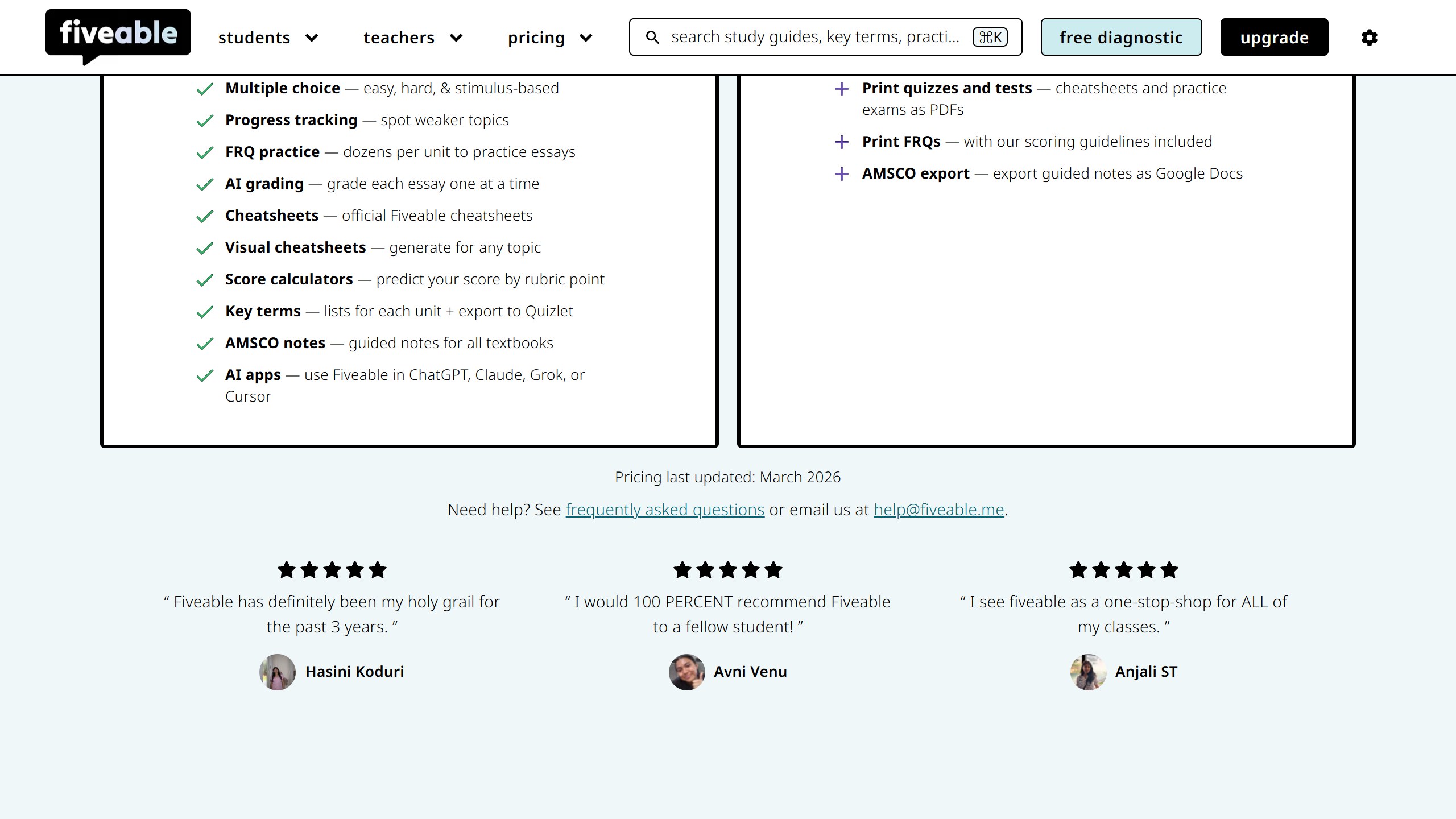
The feature that separates it from a pile of flashcards is FRQ scoring. You write a free-response answer, and Fiveable scores it rubric row by rubric row in the format AP scoring guidelines use, with a reason for each point. That is the part of AP that students cannot practise alone, because a practice essay with no score attached teaches you very little. Fiveable’s pricing page reports 3.4 million multiple-choice questions answered and 208,000 free-response questions graded.
About that 96% figure. Fiveable’s homepage says 96% of AP scores reported in its 2026 survey were qualifying, against a national rate of 71.7%. Read it carefully, because Fiveable does. Its own page states that these are “voluntary, self-reported survey results, not a randomized study or a causal estimate”, and publishes the methodology. Students who volunteer their scores to a study app are not a random sample of AP candidates, and students who studied hard enough to use the app all year are not the same people as students who did not. Treat it as evidence that engaged students do well, which is true and unsurprising, not as evidence that the app raises scores.
One genuinely unusual thing: Fiveable runs a connector that lets you use its AP content inside ChatGPT, Claude, Grok, Cursor or VS Code, with no per-call charge. No other product in this guide does that. If you already study with an AI assistant open, this puts real AP content behind it instead of whatever the model remembers.
Weakness: it is a study platform, not a teacher. It will show you the gap and drill it. It will not sit with you and explain why you keep making the same mistake.
2. Crimsora. Best for Learning Out Loud
Crimsora is a voice-first AI tutor. You open a live session, a synthetic tutor talks you through a concept while sketching it on a shared whiteboard, and you can interrupt and ask questions the way you would with a person. It launched in 2025 and its homepage says it now covers 29 courses across AP, Digital SAT, ACT and school subjects, with lesson plans mapped to the units in each AP course description.
Pricing: $29 a month as a founding price, locked in while you stay subscribed, against a stated regular price of $49 a month. The free tier gives you the first unit of every course plus 15 minutes of live tutoring, and the homepage runs a demo lesson with no account and no card.
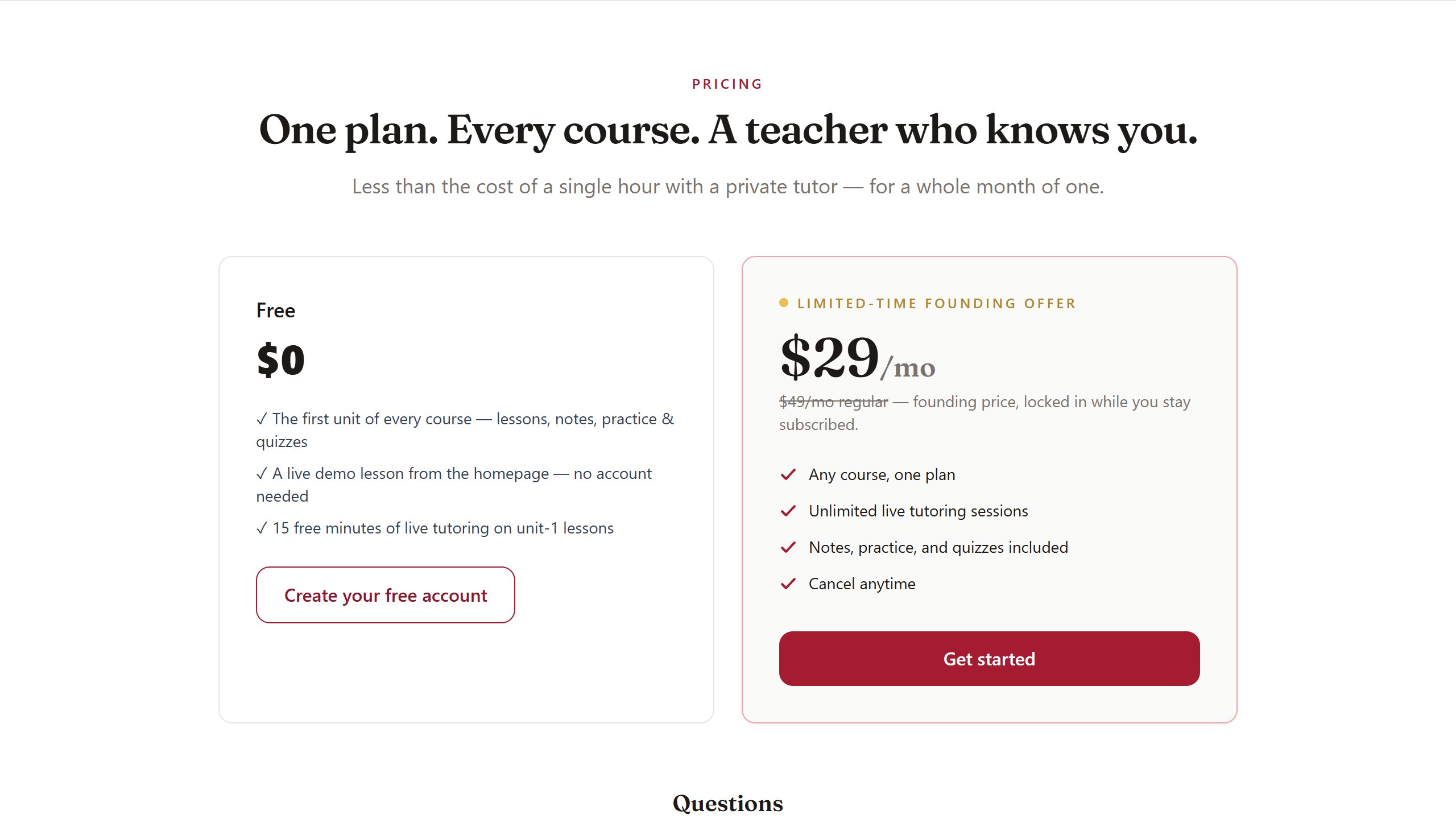
Read the word “unlimited” properly. Crimsora advertises unlimited live tutoring, and its own pricing FAQ explains what that means: a fair-use allowance of 30 hours of live voice sessions a month, roughly an hour a day, with notes, practice, quizzes and mocks never metered. That is a generous cap and an honest disclosure, but it is a cap, and a student cramming three AP subjects in the two weeks before May could hit it. We prefer a published cap to a vague promise, but you should know it exists.
Two more things worth being clear about. The named teachers on the site, with their stated years of experience and their catchphrases, are AI personas with synthetic voices, not human staff. And the voice technology is licensed: Crimsora’s own footer credits Evelyn Learning. The site also states plainly that it is not affiliated with or endorsed by College Board or ACT.
Weakness: voice tutoring is the most expensive thing here per month, and it only pays off if you actually talk back. A student who will not speak to the app is paying $29 for notes and quizzes that Knowt gives away.
3. Khanmigo. Cheapest Credible AI Tutor
Khanmigo is Khan Academy’s AI tutor, and at $4 a month or $44 a year it is the cheapest paid option on this page by an order of magnitude. It is built to refuse to hand over answers, guiding you to the solution instead, and it sits on top of Khan Academy’s free content library, which covers a lot of AP material.
The restrictions are the story. Khanmigo’s own FAQ states that to subscribe you must be 18 or older, live in the United States, and have a US billing address. An AP student who is 16 cannot buy it. A parent subscribes and enables access for up to 10 children. Teachers explicitly cannot grant students access; classroom access only exists through a school or district partnership. And a child already enrolled in an active Khan Academy classroom may not be able to have Khanmigo switched on at all.
So the cheapest tool here is also the one with the most conditions attached, and if you are outside the US it is not available to you as a family at any price. Khan Academy’s underlying content library stays free worldwide, which is worth remembering.
Weakness: it is a general tutor that happens to cover AP topics, not an AP product. There is no AP rubric scoring and no AP-shaped practice exam.
4. Knowt. Best Free Tier
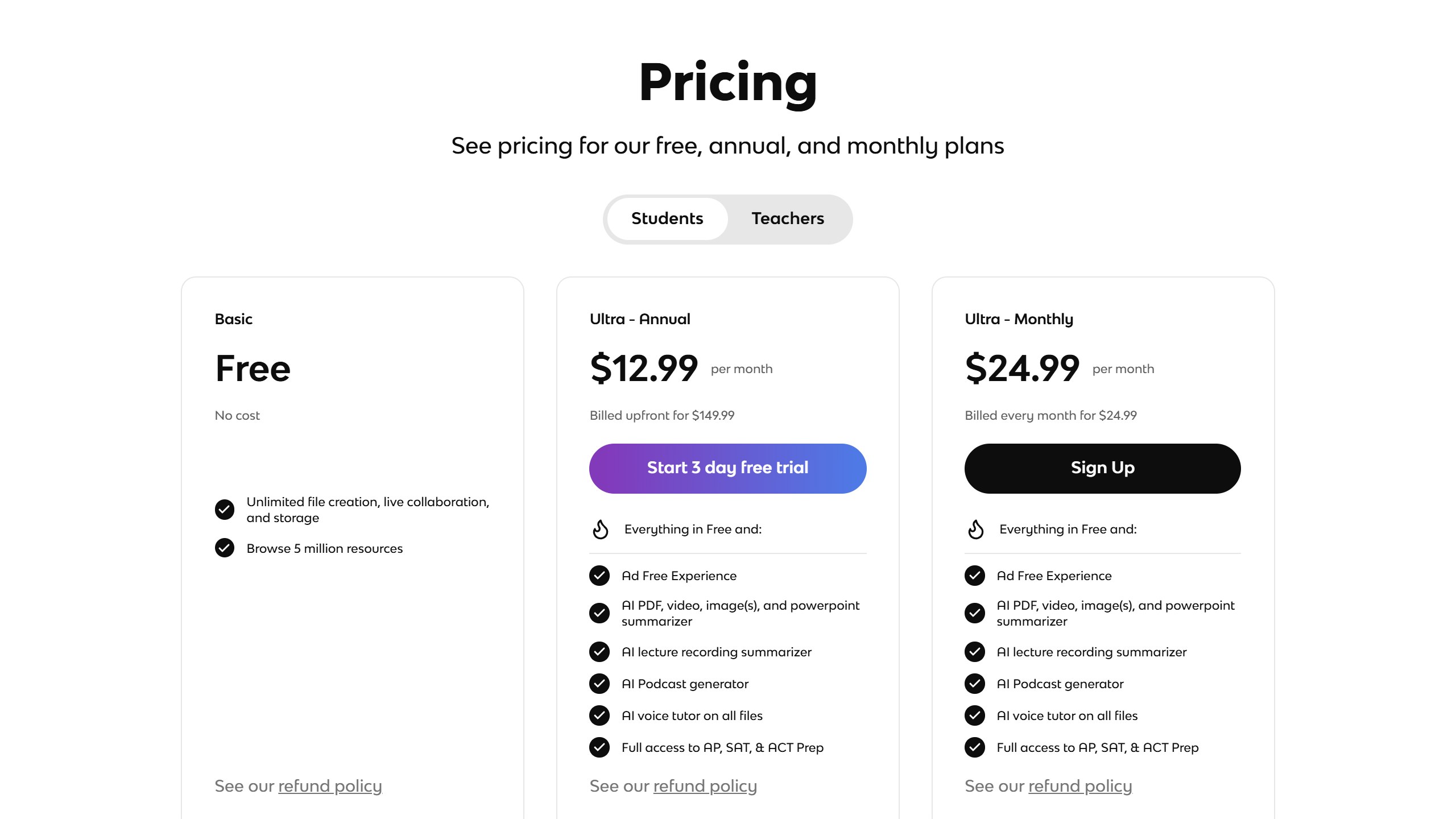
Knowt started as a free flashcard and notes tool and grew into a study platform with 6.5 million claimed users. The free tier is unusually generous: unlimited file creation, live collaboration, storage, and access to a library of 5 million student-made resources, which for popular AP subjects means somebody has already made the deck you were about to make.
Pricing: Ultra costs $149.99 billed annually, which the plans page quotes as $12.99 a month, or $24.99 month to month. There is a 3-day free trial on the annual plan. Ultra adds AI summarising of PDFs, videos, images and slide decks, a lecture recording summariser, an AI voice tutor on your own files, and full access to its AP, SAT and ACT prep.
The honest way to use Knowt is to live on the free tier and only upgrade if you find yourself wanting the AI features on your own class materials. Cancelling is self-service through Settings and Your Plan, which sounds trivial until you compare it with tools that make you email support.
Weakness: student-made content is student-made. A deck with 400 upvotes can still contain a wrong definition, and Knowt cannot tell you which.
5. Albert. Best for One Subject at a Time
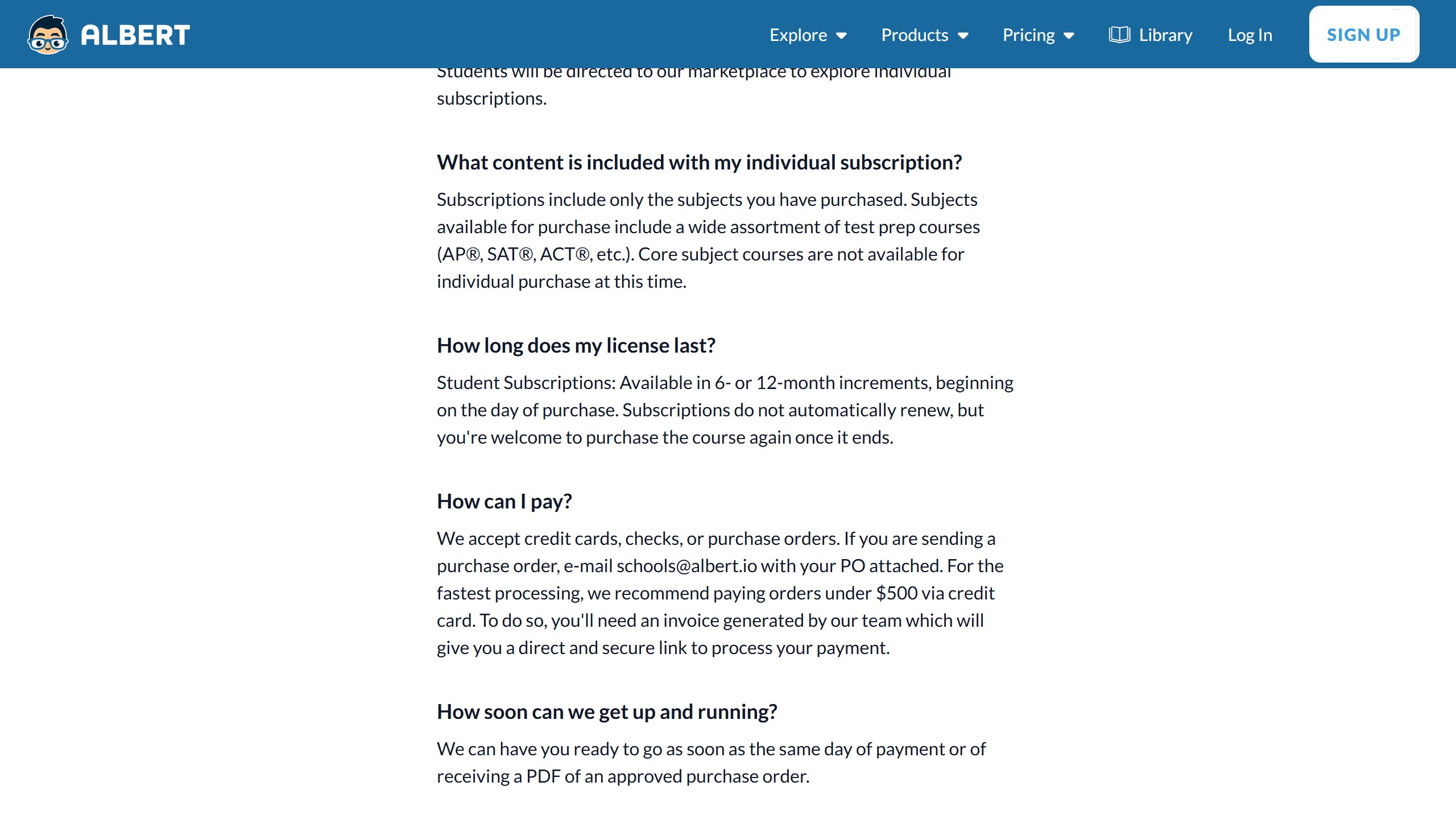
Albert sells AP practice question banks by subject rather than as one subscription. Its student pricing page lists $79 for a single subject, falling to $49 a subject in bundles, so two subjects are $98 and four are $196. Subscriptions come in 6-month or 12-month increments starting the day you buy.
The detail we want to flag, because it is rare: Albert’s student subscriptions do not automatically renew. When the term ends, it ends, and you buy again if you want to. Nearly everything else in this guide auto-renews by default. If you are a parent who has been quietly billed for a study app your child stopped opening in March, that single line is worth the price difference.
Weakness: per-subject pricing gets expensive fast. A student taking four APs pays $196 at Albert against $79 for all 38 subjects at Fiveable, and Albert is a question bank rather than a full course.
6. UWorld. Best Question Difficulty
UWorld built its reputation on medical and accounting exam question banks, where its questions are known for being harder than the real thing, and brought the same approach to AP. If you are the student who scores well on practice and then freezes on the real exam, harder practice with thorough answer explanations is the right medicine.
It does not publish a price. The AP product pages carry no figure, and pricing sits behind the application. We will not invent one. What UWorld does publish is the refund terms, and they are worth knowing before you buy: refunds are subject to a cancellation fee of $75 for a single section purchase or $250 for a package. That is an unusual amount of friction on a student product, and it is the kind of thing a comparison page that never reads the terms will not tell you.
Weakness: unpublished pricing plus a cancellation fee is a bad combination for a family on a budget. Find the price before you find the checkout.
7. Quizlet. Best for Memorisation
Quizlet is not an AP product, and we are including it for one reason: a large part of several AP subjects is vocabulary and formulas, and Quizlet is still the best tool for grinding those in. Fiveable even exports its key term lists straight into Quizlet, which tells you how the two fit together.
Pricing as served on 24 September 2026: Quizlet Plus Unlimited at $44.99 a year, quoted as $3.75 a month, and Quizlet Plus at $35.99 a year, quoted as $2.99 a month. The 7-day free trial is available on annual plans only, and Quizlet states that monthly plans are not trial-eligible. The cheaper paid tier still has caps: 3 practice tests a month, 3 textbook or Q and A solutions a month, and 20 rounds of Learn a month.
Weakness: it has no idea what the AP exam looks like. It will help you memorise 200 AP Biology terms and do nothing to prepare you for a stimulus-based multiple-choice set.
8. AP Classroom. The Free Official One
AP Classroom is College Board’s own platform, and if you are enrolled in an AP course your teacher can already assign you official practice questions from it, drawn from real released material. It costs nothing extra. It is not an AI tool, which is why it sits eighth on a page about AI tools, and it is still the highest-quality question source any AP student has access to.
Start here before you spend anything. Work through what your teacher has assigned, see where you actually lose points, and then buy the tool that fixes that specific problem. The most common mistake we see in this category is a student buying a $588 subscription in October to solve a problem they have not diagnosed yet.
Weakness: access runs through your school and your teacher. A homeschooled student or one whose teacher does not assign from it is stuck, and it will not explain anything to you the way a tutor will.
9. The Princeton Review. The Human Benchmark
Included so the prices above mean something. Princeton Review sells AP 5 Tutoring as 24 hours of instruction at $250 an hour, with a money-back guarantee, and AP Standard Tutoring at 18 or 10 hours at $125 or $150 an hour with no guarantee. The package includes between 281 and 710 practice questions, 3 to 8 full-length practice tests, the AP prep book and 365 days of online access, across 12 AP subjects.
The guarantee is real and conditional. Its published table refunds nothing if you score a 5, 25% of tuition less materials and shipping if you score a 4, and tuition less materials and shipping if you score a 3 or below, provided you complete the programme and meet the other requirements.
Weakness: the price. Twenty-four hours at $250 is roughly 75 years of Fiveable. A human tutor is better than any of these tools at diagnosing why a specific student is stuck, and most families cannot spend $6,000 per subject to find out.
Comparison Table
| Tool | Price | Free option | AP-specific | Auto-renews |
|---|---|---|---|---|
| Fiveable | $79/yr or $29/mo | Limited | Yes, all 38 subjects | Yes |
| Crimsora | $29/mo founding, $49 regular | First unit, 15 min voice | Yes, 29 courses | Yes |
| Khanmigo | $4/mo or $44/yr | Khan Academy content is free | No, general tutor | Yes |
| Knowt | $149.99/yr or $24.99/mo | Yes, generous | In the paid tier | Yes |
| Albert | $79 per subject, $49 in bundles | No | Yes, by subject | No |
| UWorld | Not published | No | Yes | Check at checkout |
| Quizlet | $44.99/yr or $35.99/yr | Yes | No | Yes |
| AP Classroom | Free via your school | Yes | Yes, official | Not applicable |
| Princeton Review | $250/hr, 24 hours | No | Yes, 12 subjects | Not applicable |
Prices read from each company’s own pages on 24 September 2026 and served in US dollars. Check the current figure before you buy, because study-tool pricing moves with the school year.
What College Board Actually Allows
This is the part most AI study guides skip, and it matters more than any feature comparison, because getting it wrong cancels your score.
There is no blanket AP-wide AI ban. College Board publishes AI guidance for the 2026-27 academic year covering five course families: AP African American Studies, AP Art and Design, AP Capstone which is Seminar and Research, AP Computer Science Principles, and AP World Languages and Cultures. Every other AP course has no published AI policy on that page.
The common thread across the courses that do have one: AI is allowed as an optional aid for exploring topics, initial source searches, checking your understanding of a difficult text and checking grammar and tone. College Board’s help centre is sharper still, saying students may use AI for “checking their writing but not rewriting” and that students may not use AI tools to write or create their assignments.
Two specifics worth knowing. In AP Art and Design, generative AI is allowed during research and ideation but prohibited in final submitted artwork, including generative fill inside otherwise permitted editing software, and any AI use must be disclosed in the Digital Portfolio. In AP Capstone, students must complete interim checkpoints with their teacher, and College Board states that failure to complete them “will result in a score of 0 on the associated task”.
Then there is the rule that catches students who never broke an AI policy at all. College Board’s exam security policies say it will automatically cancel the score of any student who discloses multiple-choice content from any exam, or free-response content that has not yet been released on its website. Pasting an AP free-response question into ChatGPT or an AI homework app on the walk home from the exam is disclosing unreleased exam content. The AI tool is not the problem. Posting the question is.
We have written this up in full, per course, in our guide to what College Board allows on AP work.
How to Choose Without Wasting Money
Diagnose before you buy. Work through the AP Classroom questions your teacher has already assigned and find out whether you are losing points on content you do not know, on questions you misread, or on free-response answers that know the material but do not earn the rubric points. Those are three different problems with three different tools.
If you cannot write to a rubric, you need scored free-response practice. That is Fiveable at $79 a year.
If you do not understand the concept at all, no amount of practice questions will help and you need something that teaches. That is Crimsora at $29 a month, or Khanmigo at $4 if you are in the US and have a parent who can subscribe.
If you know it but cannot recall it fast enough, that is memorisation, and Knowt’s free tier or Quizlet at $44.99 a year will do it.
If you are taking one hard AP and are fine in the others, Albert’s $79 single subject with no auto-renewal is the tidiest purchase on this page.
Buy monthly first. Almost every tool here is cheaper annually, and almost every student who buys annually in October has stopped opening the app by February. Pay the monthly premium for two months, find out whether you use it, then commit.
The Verdict
Fiveable is the best default for most AP students, because $79 a year covers every subject you are taking and the rubric-level free-response scoring addresses the thing students genuinely cannot practise alone. Crimsora is the better buy if your problem is comprehension rather than practice, and its 30-hour published cap is more honest than most uses of the word unlimited. Khanmigo is remarkable value at $4 a month for the families who can actually buy it. And AP Classroom is free, official and already waiting for you, which makes it the first thing to exhaust and the last thing anyone mentions.
None of these tools will save a student who has not opened the textbook since August. All of them are cheaper than $250 an hour.
Sources
- Fiveable pricing, AP score survey results and methodology and AI app access, read 24 September 2026.
- Crimsora pricing and FAQ and comparison pages, read 24 September 2026.
- Khanmigo for learners, including its pricing and eligibility FAQ, read 24 September 2026.
- Knowt plans and Albert student pricing, read 24 September 2026.
- UWorld AP product and refund terms, and Quizlet upgrade pricing, read 24 September 2026.
- The Princeton Review AP 5 Tutoring package table and money-back guarantee, read 24 September 2026.
- College Board: Guidance for Artificial Intelligence Tools and Other Services, What is the acceptable use of AI and Exam Security Policies, read 24 September 2026.

Written by
FazFaz is the founder of AIToolsBakery. Some tools here are tested hands on. Others are assessed from vendor documentation and pricing verified on the live page, and every review says which one it is. Sponsors can buy a position in a guide. They cannot buy the score, the criticism, or silence about a better option.
How we test and how we make money →