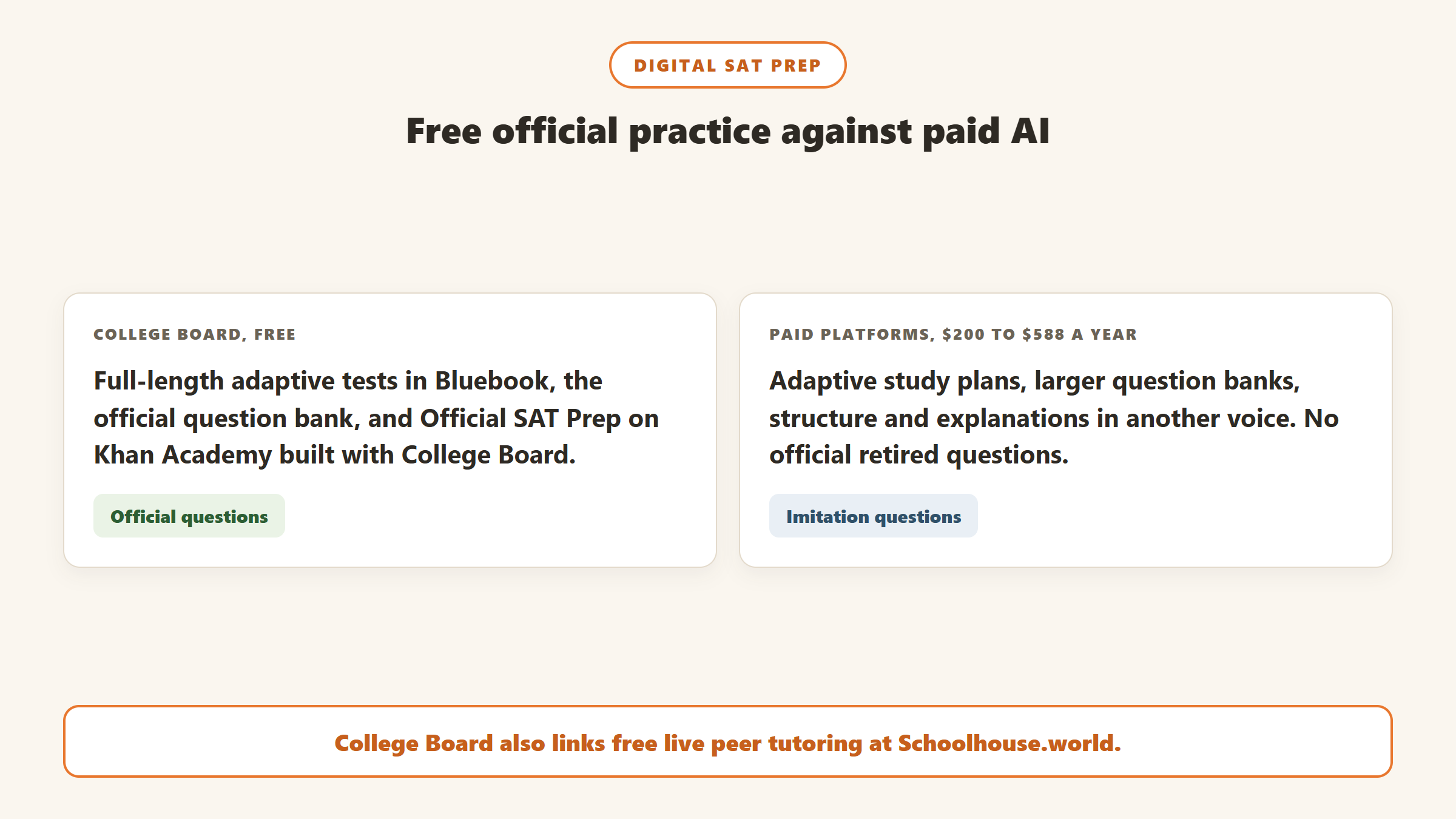
Most SAT prep guides bury the single most useful fact about SAT prep, because it does not pay a commission. College Board makes the test, and College Board gives away full-length adaptive practice tests in Bluebook, an official question bank, and a complete prep course built with Khan Academy. It also links students to free live tutoring. All of that costs nothing, and every paid tool on this page is competing against it.
That does not make the paid tools pointless. It changes the question. Instead of asking which SAT app is best, ask what a paid app adds to free official practice, and whether that addition is worth $200 or $588 a year to you specifically. This guide answers that with published prices and published terms.
How we put this guide together. We have not used these apps ourselves. Everything below comes from each company’s own pricing, product and terms pages plus College Board’s own site, all read on 24 September 2026. Where a company does not publish a price, we say so instead of guessing. Nothing here is a test result, and nobody paid to be on this page.
The 9 Best SAT Prep Tools in 2026
| Best for | Tool |
|---|---|
| Everyone, before spending anything | Bluebook and Official SAT Prep on Khan Academy |
| Adaptive AI drilling with a guarantee | Acely |
| The cheapest paid AI option | LearnQ |
| Students who learn by talking | Crimsora |
| Free notes and flashcards | Knowt |
| Students already using it for AP | Fiveable |
| Harder than the real thing | UWorld |
| Free live tutoring from a human | Schoolhouse.world |
| A tutor accountable for the score | The Princeton Review |
1. Bluebook and Khan Academy. Start Here, Free
Bluebook is the app you will actually sit the SAT in, and College Board publishes full-length adaptive practice tests inside it plus a student question bank, both free. Because the digital SAT is adaptive, practising in the real application matters more than it used to: a paper practice test cannot reproduce how the second module changes based on how you did in the first.
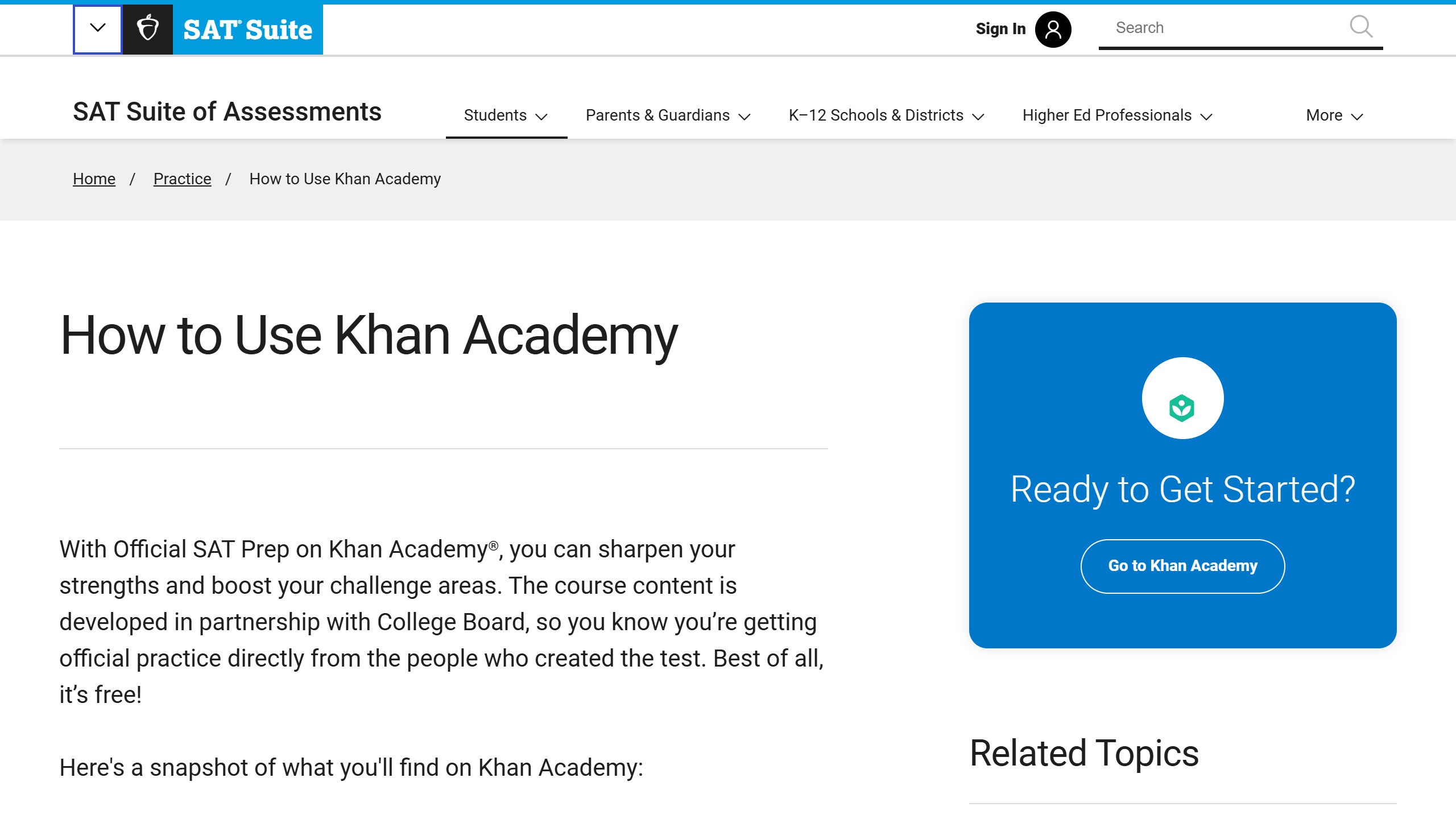
Official SAT Prep on Khan Academy is the companion course. College Board’s own site describes it as “developed in partnership with College Board” and adds, in its own words, “Best of all, it’s free!” After you take a Bluebook practice test you can jump into a walk-through course that explains every question on that test, with each explanation linking to a lesson on the skill behind it. Practice is levelled as Foundations, Medium and Advanced, most video walk-throughs run about five minutes, and course challenges tell you where to start.
Between them, these two cover what most students need: real adaptive tests, an official question bank, per-question explanations tied to your own mistakes, and a study plan. If you have not exhausted them, you are not yet in a position to know what a paid tool would add.
Weakness: nothing here will chase you. There is no nagging, no accountability and nobody noticing that you have not opened it in three weeks. For a lot of students that, and not content, is the actual problem.
2. Acely. Adaptive Drilling With a Real Guarantee
Acely is an AI-driven SAT and ACT platform that builds a study plan from a diagnostic and adapts as you work. Its pricing page lists $49 a month billed annually, which is $588 a year, $99 a month billed quarterly at $297, or $149 month to month. There is a free version with no card that includes a short skills assessment and one SAT and one ACT practice test, plus a 3-day trial of the paid features that does require a card.
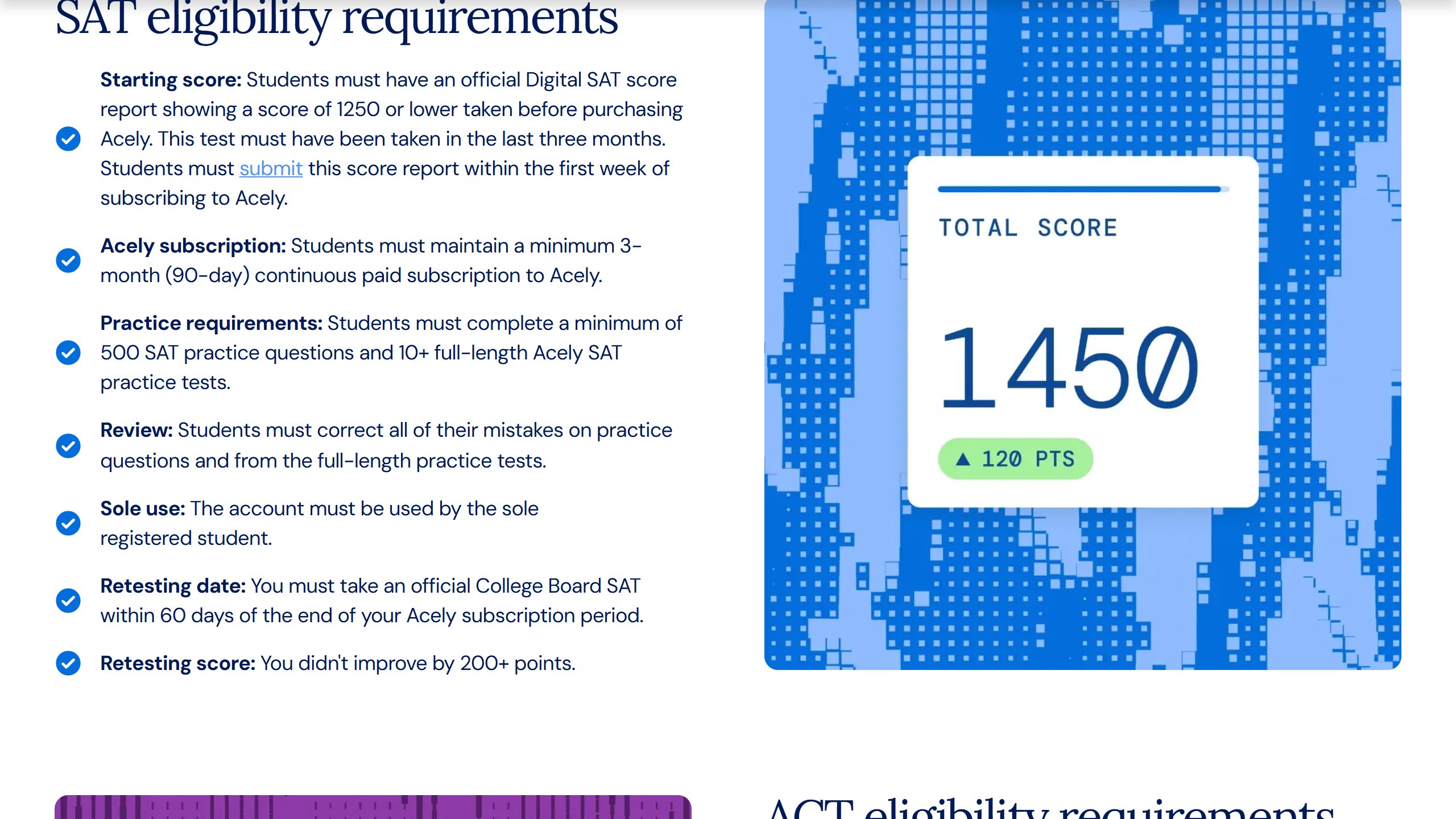
The guarantee, in full. Acely advertises a 100% refund if your score does not rise by 200 SAT points or 5 ACT points. That is a real offer, and it is heavily conditioned. Its published terms require all of the following: an official digital SAT score of 1250 or lower taken in the three months before you buy and submitted within your first week; a continuous paid subscription of at least 90 days; 500 or more practice questions and 10 or more full-length Acely practice tests; correcting every mistake on both the questions and the full-length tests; sole use of the account; and an official retest within 60 days of your subscription ending.
We are not calling that a trick. It is a reasonable way to stop people claiming refunds without studying. But a student who does 500 questions, 10 full tests and corrects every error has done the work that raises scores, whichever app they did it in. Read the guarantee as a study contract, not as insurance.
Weakness: $588 a year is the most expensive software on this page, for a test you sit once or twice.
3. LearnQ. Cheapest Paid AI Option
LearnQ covers the same ground at a much lower price. Its pricing page lists $17 a month billed annually, which is $200 a year, $33 a month billed quarterly at $100, or $50 month to month. A promotional discount banner was live on the day we read it, which is normal for this category and a reason to check the current figure rather than trust any listicle, including this one.
At $200 against Acely’s $588 for broadly comparable adaptive practice, LearnQ is the better starting point for most families. Neither is necessary if free official practice is still untouched.
Weakness: no score guarantee, and a smaller question bank reputation than the incumbents. You are buying convenience and adaptivity, not exclusive content.
4. Crimsora. A Voice Tutor for SAT and ACT
Crimsora is a voice-first AI tutor that covers the digital SAT and ACT alongside AP and school subjects, 29 courses in total. You open a live session and a synthetic tutor explains a concept aloud while working it through on a shared whiteboard. Its pricing is $29 a month as a founding rate against a stated regular price of $49, with a free first unit of every course and 15 free minutes of live tutoring. There is a demo lesson on the homepage with no account and no card.
Its “unlimited” tutoring is capped, and Crimsora publishes the cap: a fair-use allowance of 30 hours of live voice sessions a month, with notes, practice, quizzes and mocks unmetered. We cover Crimsora and eight other options in our AP exam prep guide. For SAT prep specifically, 30 hours a month is far more than any student will use.
The tutors with names, voices and stated years of experience are AI personas, not people, and Crimsora’s footer credits Evelyn Learning for the voice technology and states it is not affiliated with or endorsed by College Board or ACT.
Weakness: it is a teaching tool, not a test-strategy tool. The specific skill of pacing an adaptive module is better trained in Bluebook.
5. Knowt. The Free Tier Worth Having
Knowt gives away unlimited notes and flashcards, live collaboration and a library of 5 million student-made resources, which for the SAT means plenty of ready-made vocabulary and formula decks. Its Ultra plan is $149.99 billed annually, quoted as $12.99 a month, or $24.99 month to month, with a 3-day trial on the annual plan, and it adds AI summarising of your own materials, an AI voice tutor on your files and full SAT, ACT and AP prep.
Weakness: shared student content is unverified. A popular deck can still be wrong, and for a standardised test that is a real risk.
6. Fiveable. Sensible if You Already Pay for It
Fiveable is primarily an AP platform, and its digital SAT section covers eight units from SAT Math Algebra through SAT Reading and Writing Standard English Conventions, with study guides, practice questions and key terms. The Student Workspace is $79 a year or $29 a month and includes everything, AP and SAT alike.
The logic is simple. If you are a junior taking three APs and sitting the SAT in the same year, one $79 subscription covering both is better value than a separate SAT tool. If you only need SAT prep, it is not what Fiveable is built for.
Weakness: the SAT side is a smaller part of a product designed around AP, and there is no adaptive full-length SAT simulation to match Bluebook.
7. UWorld. Harder Questions, Unpublished Price
UWorld is known for question banks harder than the exam, with long explanations, and its digital SAT bank follows that pattern. It is the right fit for a student already scoring well who needs to close the last stretch.
No price is published on the SAT product page. We will not invent one. What UWorld does publish is the refund terms: refunds carry a cancellation fee of $75 on a single section purchase or $250 on a package. Its SAT page also mentions an offer for students who previously spent over $399 on a different prep programme, which tells you the price range it expects to compete in.
Weakness: harder than the real test is a feature for a 1400 student and a demoralising waste of money for a 1050 student.
8. Schoolhouse.world. Free Live Human Tutoring
College Board’s own practice page links students to Schoolhouse.world for free live small-group SAT tutoring led by trained peer tutors. That is a human, in a session, at no cost, endorsed on College Board’s own site, and it goes unmentioned in nearly every SAT app roundup.
If what you lack is accountability and somebody to ask, this solves the exact problem that a $588 subscription does not.
Weakness: small-group sessions run on a schedule, not on demand, and peer tutors vary. It is not a substitute for a professional tutor on a hard timeline.
9. The Princeton Review. The Price of a Human
Included to give the other numbers scale. SAT 1500+ Tutoring is 18 hours of tutoring at $420 an hour, listed at $7,560 on the day we read it, with a $500 promotion running. The package includes 365 days of online access, 9 full-length practice tests, live online sessions, detailed score analysis, thousands of drills, digital eBooks and access to an ACT self-paced course.
The money-back guarantee promises a 1500 or an improvement of 180 points depending on your starting score, based on your superscore after two tests, subject to published terms.
Weakness: $7,560 is more than a year of every other tool on this page combined, many times over. It buys a professional who will diagnose your specific problem, which software genuinely cannot do as well. Very few families should start here.
Comparison Table
| Tool | Price | Free option | Adaptive full tests | Score guarantee |
|---|---|---|---|---|
| Bluebook and Khan Academy | Free | Entirely free | Yes, official | No |
| Acely | $588/yr, $297/qtr, $149/mo | Yes, limited, no card | Yes | Yes, heavily conditioned |
| LearnQ | $200/yr, $100/qtr, $50/mo | Check current terms | Yes | No |
| Crimsora | $29/mo founding, $49 regular | First unit, 15 min voice | Mock exams included | No |
| Knowt | $149.99/yr or $24.99/mo | Yes, generous | In the paid tier | No |
| Fiveable | $79/yr or $29/mo | Limited | No | No |
| UWorld | Not published | No | Yes | No |
| Schoolhouse.world | Free | Entirely free | Not applicable | No |
| Princeton Review 1500+ | $420/hr, 18 hours | No | 9 practice tests | Yes, published terms |
Prices read from each company’s own pages on 24 September 2026, served in US dollars. A promotion was running on the Princeton Review page at the time. Check current prices before buying.
Why Adaptive Testing Changed What Prep Means
The digital SAT is section-adaptive, and that single fact quietly invalidates a lot of older prep advice. You sit two modules per section. Your performance on the first module determines the difficulty of the second, and the difficulty of the questions you see feeds into your score. A student who breezes through module one and then meets a harder module two has not been punished. They have been routed to the version of the test that can measure them.
Three consequences follow, and they should shape what you buy.
Pacing matters more than it used to. Rushing module one to bank time produces careless errors that route you into an easier module two, which caps where your score can land. Practice that does not reproduce the two-module structure cannot teach you this, which is why any amount of paper practice is a poor substitute for a Bluebook test.
A raw number of questions right no longer maps cleanly to a score. Tools that show you a percentage correct are telling you less than they used to. What you want from a platform is a skill-level breakdown, which is what the official question bank and the better paid platforms both give you.
Question banks age differently now. A bank of static questions is still useful for drilling a skill, but a set of full-length simulations that does not adapt is imitating a test that no longer exists. When a paid tool advertises full-length practice tests, it is worth checking whether they adapt or simply present a fixed sequence.
This is also the strongest argument for starting with the free official tools. Bluebook is not an imitation of the adaptive test. It is the test application.
What Paid SAT Software Actually Adds
Four things, and it is worth being honest about which of them you need.
Adaptivity beyond the official tools. Bluebook adapts within a test. Paid platforms adapt across your whole study plan, pushing you toward the question types you keep missing. This is genuinely useful and it is what you are mostly paying for.
Volume. The official question bank is large but finite. A student doing serious daily practice for six months can run through it, and paid banks add thousands more.
Structure and accountability. A plan that tells you what to do today is worth more to most teenagers than better questions. This is also the cheapest thing to replicate for free with a calendar and a parent.
Explanations in a voice you like. Khan Academy’s explanations are good. If a student bounces off them, a voice tutor that re-explains a different way can unlock things nothing else will.
What paid software does not add is official content. Nobody except College Board has real retired SAT questions, and the free tools are where they live.
How to Spend Nothing First
Take a full Bluebook practice test under real timing. Not a paper test, not an app’s imitation. You need the adaptive experience and a real score.
Review every wrong answer through the Khan Academy walk-through for that test, and write down the skill behind each mistake rather than the question.
Drill those skills in the official question bank and in Khan Academy’s levelled practice, starting one level below where you think you are.
Book free tutoring at Schoolhouse.world if you need a person to ask.
Then, and only then, buy something, knowing exactly what you need it to fix. If the answer is volume and adaptivity, LearnQ at $200 is the sensible first purchase. If the answer is comprehension, Crimsora at $29 a month. If your score is already strong and you need harder questions, UWorld, once you have found its price.
The Verdict
Bluebook and Official SAT Prep on Khan Academy are the best SAT prep available at any price, and they cost nothing. That is an unusual sentence to write in a guide to paid apps, and it is the most useful thing on this page.
Among the paid tools, LearnQ at $200 a year is the best value for adaptive drilling, Acely is the same idea at nearly three times the price with a guarantee that requires you to study hard enough not to need it, and Crimsora at $29 a month is the one to pick if your problem is understanding rather than repetition. Fiveable makes sense as a single subscription for a junior juggling APs and the SAT in the same year.
And if the real obstacle is that nobody is holding the student to a schedule, no subscription fixes that. Schoolhouse.world is free and a human is on the other end.
Sources
- College Board: SAT practice and preparation and How to Use Khan Academy, read 24 September 2026.
- Official SAT Prep on Khan Academy and Bluebook, read 24 September 2026.
- Acely pricing and score improvement guarantee terms, read 24 September 2026.
- LearnQ pricing, Crimsora pricing and Knowt plans, read 24 September 2026.
- Fiveable pricing and its digital SAT section, read 24 September 2026.
- UWorld SAT product and refund terms, read 24 September 2026.
- The Princeton Review SAT 1500+ Tutoring package and pricing, read 24 September 2026.

Written by
FazFaz is the founder of AIToolsBakery. Some tools here are tested hands on. Others are assessed from vendor documentation and pricing verified on the live page, and every review says which one it is. Sponsors can buy a position in a guide. They cannot buy the score, the criticism, or silence about a better option.
How we test and how we make money →